Copyright © 2003 TWI Ltd Faisal Yusof
TE
Welding Inspection
Consumables
Course Reference WIS 5
Copyright © 2003 TWI Ltd Faisal Yusof
TE Welding ConsumablesWelding Consumables
 Inserts Shielded arc filler wires, lengths or
rolls
 Covered electrodes
 Shielding gases
 Separately supplied flux
 Fusible
Welding consumables may be:
Copyright © 2003 TWI Ltd Faisal Yusof
TE Welding ConsumablesWelding Consumables
Copyright © 2003 TWI Ltd Faisal Yusof
TE
 Size
 Classification / Supplier
 Condition
 Handling and storage
 Treatments e.g. baking / drying
Each consumable is critical in respect to:
Welding ConsumablesWelding Consumables
Copyright © 2003 TWI Ltd Faisal Yusof
TE Welding ConsumablesWelding Consumables
Handling and storage is critical for consumable
control
Copyright © 2003 TWI Ltd Faisal Yusof
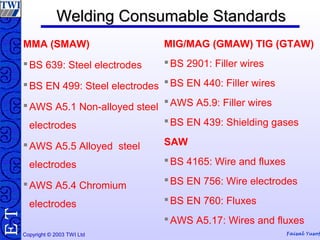
TE Welding Consumable StandardsWelding Consumable Standards
MMA (SMAW)
BS 639: Steel electrodes
BS EN 499: Steel electrodes
AWS A5.1 Non-alloyed steel
electrodes
AWS A5.5 Alloyed steel
electrodes
AWS A5.4 Chromium
electrodes
MIG/MAG (GMAW) TIG (GTAW)
BS 2901: Filler wires
BS EN 440: Filler wires
AWS A5.9: Filler wires
BS EN 439: Shielding gases
SAW
BS 4165: Wire and fluxes
BS EN 756: Wire electrodes
BS EN 760: Fluxes
AWS A5.17: Wires and fluxes
Copyright © 2003 TWI Ltd Faisal Yusof
TE Welding Consumable MMAWelding Consumable MMA
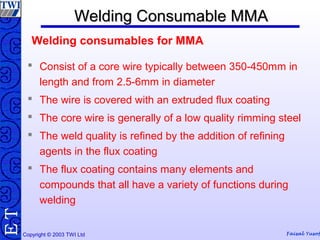
 Consist of a core wire typically between 350-450mm in
length and from 2.5-6mm in diameter
 The wire is covered with an extruded flux coating
 The core wire is generally of a low quality rimming steel
 The weld quality is refined by the addition of refining
agents in the flux coating
 The flux coating contains many elements and
compounds that all have a variety of functions during
welding
Welding consumables for MMA
Copyright © 2003 TWI Ltd Faisal Yusof
TE MMA Welding ConsumablesMMA Welding Consumables
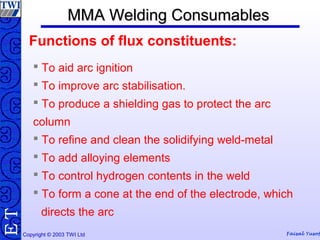
 To aid arc ignition
 To improve arc stabilisation.
 To produce a shielding gas to protect the arc
column
 To refine and clean the solidifying weld-metal
 To add alloying elements
 To control hydrogen contents in the weld
 To form a cone at the end of the electrode, which
directs the arc
Functions of flux constituents:
Copyright © 2003 TWI Ltd Faisal Yusof
TE MMA Welding ConsumablesMMA Welding Consumables
 Rutile
 Cellulose
 Basic
 Acidic
Common flux types
Copyright © 2003 TWI Ltd Faisal Yusof
TE BS 639 Covered ElectrodesBS 639 Covered Electrodes
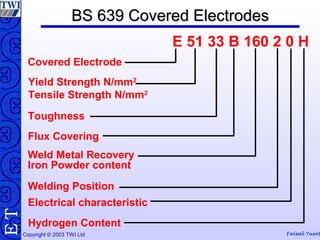
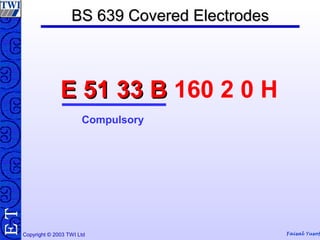
E 51 33 B 160 2 0 H
Covered Electrode
Yield Strength N/mm2
Tensile Strength N/mm2
Toughness
Flux Covering
Weld Metal Recovery
Iron Powder content
Welding Position
Hydrogen Content
Electrical characteristic
Copyright © 2003 TWI Ltd Faisal Yusof
TE BS 639 Covered ElectrodesBS 639 Covered Electrodes
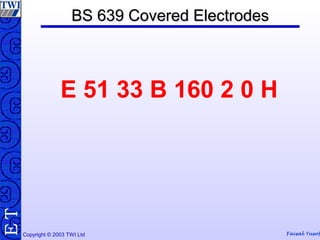
E 51 33 B 160 2 0 H
Copyright © 2003 TWI Ltd Faisal Yusof
TE BS 639 Covered ElectrodesBS 639 Covered Electrodes
E 51 33 BE 51 33 B 160 2 0 H
Compulsory
Copyright © 2003 TWI Ltd Faisal Yusof
TE BS 639 Covered ElectrodesBS 639 Covered Electrodes
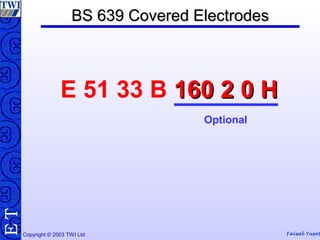
E 51 33 B 160 2 0 H160 2 0 H
Optional
Copyright © 2003 TWI Ltd Faisal Yusof
TE BS 639 Covered ElectrodesBS 639 Covered Electrodes
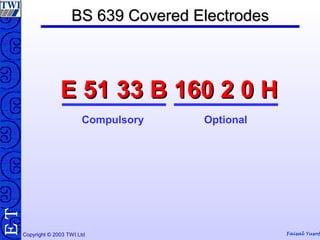
E 51 33 BE 51 33 B 160 2 0 H160 2 0 H
OptionalCompulsory
Copyright © 2003 TWI Ltd Faisal Yusof
TE
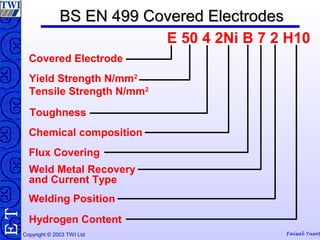
E 50 4 2Ni B 7 2 H10
BS EN 499 Covered ElectrodesBS EN 499 Covered Electrodes
Covered Electrode
Yield Strength N/mm2
Tensile Strength N/mm2
Toughness
Chemical composition
Flux Covering
Weld Metal Recovery
and Current Type
Welding Position
Hydrogen Content
Copyright © 2003 TWI Ltd Faisal Yusof
TE BS EN 499 Covered ElectrodesBS EN 499 Covered Electrodes
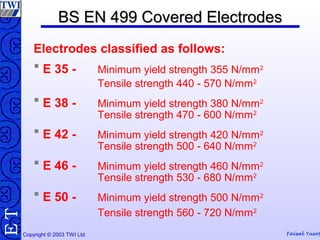
Electrodes classified as follows:
 E 35 - Minimum yield strength 355 N/mm2
Tensile strength 440 - 570 N/mm2
 E 38 - Minimum yield strength 380 N/mm2
Tensile strength 470 - 600 N/mm2
 E 42 - Minimum yield strength 420 N/mm2
Tensile strength 500 - 640 N/mm2
 E 46 - Minimum yield strength 460 N/mm2
Tensile strength 530 - 680 N/mm2
 E 50 - Minimum yield strength 500 N/mm2
Tensile strength 560 - 720 N/mm2
Copyright © 2003 TWI Ltd Faisal Yusof
TE
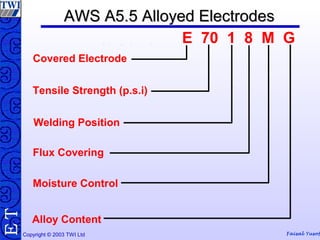
E 70 1 8 M G
AWS A5.5 Alloyed ElectrodesAWS A5.5 Alloyed Electrodes
Covered Electrode
Tensile Strength (p.s.i)
Welding Position
Flux Covering
Alloy Content
Moisture Control
Copyright © 2003 TWI Ltd Faisal Yusof
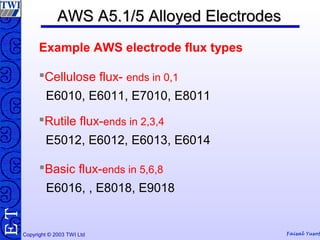
TE AWS A5.1/5 Alloyed ElectrodesAWS A5.1/5 Alloyed Electrodes
Example AWS electrode flux types
Cellulose flux- ends in 0,1
E6010, E6011, E7010, E8011
Rutile flux-ends in 2,3,4
E5012, E6012, E6013, E6014
Basic flux-ends in 5,6,8
E6016, , E8018, E9018
Copyright © 2003 TWI Ltd Faisal Yusof
TE
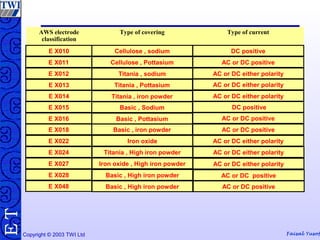
AWS electrode
classification
Type of covering Type of current
E X010
E X011
E X012
E X013
E X014
E X015
E X016
E X018
E X022
E X024
E X027
E X028
E X048
Cellulose , sodium
Cellulose , Pottasium
Titania , sodium
Titania , Pottasium
Titania , iron powder
Basic , Sodium
Basic , Pottasium
Basic , iron powder
Iron oxide
Titania , High iron powder
Iron oxide , High iron powder
Basic , High iron powder
DC positive
AC or DC positive
AC or DC either polarity
DC positive
AC or DC positive
AC or DC positive
AC or DC either polarity
AC or DC positive
AC or DC positive
Copyright © 2003 TWI Ltd Faisal Yusof
TE
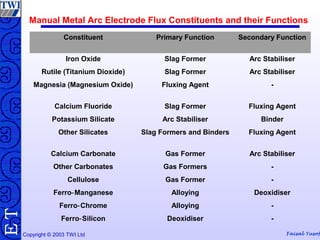
Constituent Primary Function Secondary Function
Iron Oxide Slag Former Arc Stabiliser
Rutile (Titanium Dioxide) Slag Former Arc Stabiliser
Magnesia (Magnesium Oxide) Fluxing Agent -
Calcium Fluoride Slag Former Fluxing Agent
Potassium Silicate Arc Stabiliser Binder
Other Silicates Slag Formers and Binders Fluxing Agent
Calcium Carbonate Gas Former Arc Stabiliser
Other Carbonates Gas Formers -
Cellulose Gas Former -
Ferro Manganese‑ Alloying Deoxidiser
Ferro Chrome‑ Alloying -
Ferro Silicon‑ Deoxidiser -
Manual Metal Arc Electrode Flux Constituents and their Functions
Copyright © 2003 TWI Ltd Faisal Yusof
TE MMA Welding ConsumablesMMA Welding Consumables
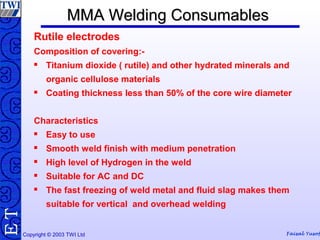
Rutile electrodes
Composition of covering:-
 Titanium dioxide ( rutile) and other hydrated minerals and
organic cellulose materials
 Coating thickness less than 50% of the core wire diameter
Characteristics
 Easy to use
 Smooth weld finish with medium penetration
 High level of Hydrogen in the weld
 Suitable for AC and DC
 The fast freezing of weld metal and fluid slag makes them
suitable for vertical and overhead welding
Copyright © 2003 TWI Ltd Faisal Yusof
TE MMA Welding ConsumablesMMA Welding Consumables
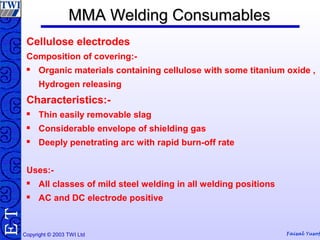
Cellulose electrodes
Composition of covering:-
 Organic materials containing cellulose with some titanium oxide ,
Hydrogen releasing
Characteristics:-
 Thin easily removable slag
 Considerable envelope of shielding gas
 Deeply penetrating arc with rapid burn-off rate
Uses:-
 All classes of mild steel welding in all welding positions
 AC and DC electrode positive
Copyright © 2003 TWI Ltd Faisal Yusof
TE MMA Welding ConsumablesMMA Welding Consumables
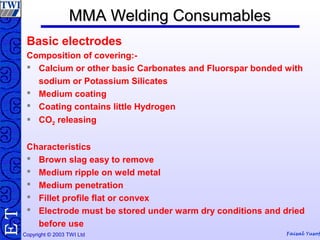
Basic electrodes
Composition of covering:-
 Calcium or other basic Carbonates and Fluorspar bonded with
sodium or Potassium Silicates
 Medium coating
 Coating contains little Hydrogen
 CO2 releasing
Characteristics
 Brown slag easy to remove
 Medium ripple on weld metal
 Medium penetration
 Fillet profile flat or convex
 Electrode must be stored under warm dry conditions and dried
before use
Copyright © 2003 TWI Ltd Faisal Yusof
TE Basic ElectrodesBasic Electrodes
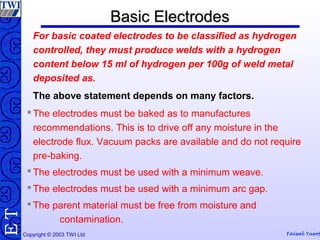
For basic coated electrodes to be classified as hydrogen
controlled, they must produce welds with a hydrogen
content below 15 ml of hydrogen per 100g of weld metal
deposited as.
The above statement depends on many factors.
 The electrodes must be baked as to manufactures
recommendations. This is to drive off any moisture in the
electrode flux. Vacuum packs are available and do not require
pre-baking.
 The electrodes must be used with a minimum weave.
 The electrodes must be used with a minimum arc gap.
 The parent material must be free from moisture and
contamination.
Copyright © 2003 TWI Ltd Faisal Yusof
TE
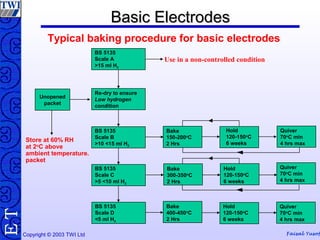
Unopened
packet
Basic ElectrodesBasic Electrodes
Bake
300-350o
C
2 Hrs
BS 5135
Scale A
>15 ml H2
Re-dry to ensure
Low hydrogen
condition
BS 5135
Scale B
>10 <15 ml H2
BS 5135
Scale C
>5 <10 ml H2
BS 5135
Scale D
<5 ml H2
Store at 60% RH
at 2o
C above
ambient temperature.
packet
Bake
150-200o
C
2 Hrs
Bake
400-450o
C
2 Hrs
Hold
120-150o
C
6 weeks
Hold
120-150o
C
6 weeks
Hold
120-150o
C
6 weeks
Quiver
70o
C min
4 hrs max
Quiver
70o
C min
4 hrs max
Quiver
70o
C min
4 hrs max
Use in a non-controlled condition
Typical baking procedure for basic electrodes
Copyright © 2003 TWI Ltd Faisal Yusof
TE TIG Welding ConsumablesTIG Welding Consumables
 Consist of a wire and gas, though tungsten electrodes being
classed as non-consumable may be considered consumables
(dia 1.6-10mm)
 The wire needs to be of a very high quality as normally no extra
cleaning elements are added
 The wire is copper coated to resist corrosion
 The wire normally comes in 1m lengths with the applicable code
stamped onto the wire for traceability
 The shielding gases used are mainly Argon and Helium, usually
of the highest quality (99.9% pure).
 Ceramic shields, the size and shape depends on application
Welding consumables for TIG
Copyright © 2003 TWI Ltd Faisal Yusof
TE MIG/MAG Welding ConsumablesMIG/MAG Welding Consumables
 Consist of a wire and gas, the same quality as for TIG
wires
 The wires are copper coated, main purpose corrosion
resistance and electrical pick-up
 Wires are available in sizes from 0.6-1.6 mm in diameter
 Most wires are supplied on a 15kg spool, with finer wires
supplied on a 1kg spool
 Gases can be pure CO2, CO2+Argon mixes and
Argon+2%O2 mixes (stainless steels).
Welding consumables for MIG/MAG
Copyright © 2003 TWI Ltd Faisal Yusof
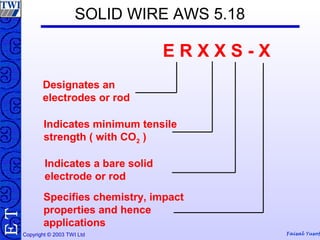
TE SOLID WIRE AWS 5.18
E R X X S - X
Designates an
electrodes or rod
Indicates minimum tensile
strength ( with CO2 )
Indicates a bare solid
electrode or rod
Specifies chemistry, impact
properties and hence
applications
Copyright © 2003 TWI Ltd Faisal Yusof
TE MIG/MAG Welding ConsumablesMIG/MAG Welding Consumables
Shielding gas used for MIG/MAG
Copyright © 2003 TWI Ltd Faisal Yusof
TE
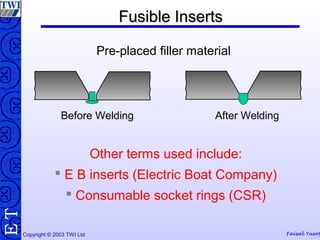
Before Welding
Fusible InsertsFusible Inserts
Pre-placed filler material
Other terms used include:
 E B inserts (Electric Boat Company)
 Consumable socket rings (CSR)
After Welding
Copyright © 2003 TWI Ltd Faisal Yusof
TE
Any Questions?Any Questions?
Copyright © 2003 TWI Ltd Faisal Yusof
TE
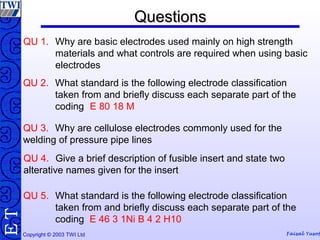
QU 1. Why are basic electrodes used mainly on high strength
materials and what controls are required when using basic
electrodes
QuestionsQuestions
QU 2. What standard is the following electrode classification
taken from and briefly discuss each separate part of the
coding E 80 18 M
QU 3. Why are cellulose electrodes commonly used for the
welding of pressure pipe lines
QU 4. Give a brief description of fusible insert and state two
alterative names given for the insert
QU 5. What standard is the following electrode classification
taken from and briefly discuss each separate part of the
coding E 46 3 1Ni B 4 2 H10

Wis5 welding consumables 18

  • 1.
    Copyright © 2003TWI Ltd Faisal Yusof TE Welding Inspection Consumables Course Reference WIS 5
  • 2.
    Copyright © 2003TWI Ltd Faisal Yusof TE Welding ConsumablesWelding Consumables  Inserts Shielded arc filler wires, lengths or rolls  Covered electrodes  Shielding gases  Separately supplied flux  Fusible Welding consumables may be:
  • 3.
    Copyright © 2003TWI Ltd Faisal Yusof TE Welding ConsumablesWelding Consumables
  • 4.
    Copyright © 2003TWI Ltd Faisal Yusof TE  Size  Classification / Supplier  Condition  Handling and storage  Treatments e.g. baking / drying Each consumable is critical in respect to: Welding ConsumablesWelding Consumables
  • 5.
    Copyright © 2003TWI Ltd Faisal Yusof TE Welding ConsumablesWelding Consumables Handling and storage is critical for consumable control
  • 6.
    Copyright © 2003TWI Ltd Faisal Yusof TE Welding Consumable StandardsWelding Consumable Standards MMA (SMAW) BS 639: Steel electrodes BS EN 499: Steel electrodes AWS A5.1 Non-alloyed steel electrodes AWS A5.5 Alloyed steel electrodes AWS A5.4 Chromium electrodes MIG/MAG (GMAW) TIG (GTAW) BS 2901: Filler wires BS EN 440: Filler wires AWS A5.9: Filler wires BS EN 439: Shielding gases SAW BS 4165: Wire and fluxes BS EN 756: Wire electrodes BS EN 760: Fluxes AWS A5.17: Wires and fluxes
  • 7.
    Copyright © 2003TWI Ltd Faisal Yusof TE Welding Consumable MMAWelding Consumable MMA  Consist of a core wire typically between 350-450mm in length and from 2.5-6mm in diameter  The wire is covered with an extruded flux coating  The core wire is generally of a low quality rimming steel  The weld quality is refined by the addition of refining agents in the flux coating  The flux coating contains many elements and compounds that all have a variety of functions during welding Welding consumables for MMA
  • 8.
    Copyright © 2003TWI Ltd Faisal Yusof TE MMA Welding ConsumablesMMA Welding Consumables  To aid arc ignition  To improve arc stabilisation.  To produce a shielding gas to protect the arc column  To refine and clean the solidifying weld-metal  To add alloying elements  To control hydrogen contents in the weld  To form a cone at the end of the electrode, which directs the arc Functions of flux constituents:
  • 9.
    Copyright © 2003TWI Ltd Faisal Yusof TE MMA Welding ConsumablesMMA Welding Consumables  Rutile  Cellulose  Basic  Acidic Common flux types
  • 10.
    Copyright © 2003TWI Ltd Faisal Yusof TE BS 639 Covered ElectrodesBS 639 Covered Electrodes E 51 33 B 160 2 0 H Covered Electrode Yield Strength N/mm2 Tensile Strength N/mm2 Toughness Flux Covering Weld Metal Recovery Iron Powder content Welding Position Hydrogen Content Electrical characteristic
  • 11.
    Copyright © 2003TWI Ltd Faisal Yusof TE BS 639 Covered ElectrodesBS 639 Covered Electrodes E 51 33 B 160 2 0 H
  • 12.
    Copyright © 2003TWI Ltd Faisal Yusof TE BS 639 Covered ElectrodesBS 639 Covered Electrodes E 51 33 BE 51 33 B 160 2 0 H Compulsory
  • 13.
    Copyright © 2003TWI Ltd Faisal Yusof TE BS 639 Covered ElectrodesBS 639 Covered Electrodes E 51 33 B 160 2 0 H160 2 0 H Optional
  • 14.
    Copyright © 2003TWI Ltd Faisal Yusof TE BS 639 Covered ElectrodesBS 639 Covered Electrodes E 51 33 BE 51 33 B 160 2 0 H160 2 0 H OptionalCompulsory
  • 15.
    Copyright © 2003TWI Ltd Faisal Yusof TE E 50 4 2Ni B 7 2 H10 BS EN 499 Covered ElectrodesBS EN 499 Covered Electrodes Covered Electrode Yield Strength N/mm2 Tensile Strength N/mm2 Toughness Chemical composition Flux Covering Weld Metal Recovery and Current Type Welding Position Hydrogen Content
  • 16.
    Copyright © 2003TWI Ltd Faisal Yusof TE BS EN 499 Covered ElectrodesBS EN 499 Covered Electrodes Electrodes classified as follows:  E 35 - Minimum yield strength 355 N/mm2 Tensile strength 440 - 570 N/mm2  E 38 - Minimum yield strength 380 N/mm2 Tensile strength 470 - 600 N/mm2  E 42 - Minimum yield strength 420 N/mm2 Tensile strength 500 - 640 N/mm2  E 46 - Minimum yield strength 460 N/mm2 Tensile strength 530 - 680 N/mm2  E 50 - Minimum yield strength 500 N/mm2 Tensile strength 560 - 720 N/mm2
  • 17.
    Copyright © 2003TWI Ltd Faisal Yusof TE E 70 1 8 M G AWS A5.5 Alloyed ElectrodesAWS A5.5 Alloyed Electrodes Covered Electrode Tensile Strength (p.s.i) Welding Position Flux Covering Alloy Content Moisture Control
  • 18.
    Copyright © 2003TWI Ltd Faisal Yusof TE AWS A5.1/5 Alloyed ElectrodesAWS A5.1/5 Alloyed Electrodes Example AWS electrode flux types Cellulose flux- ends in 0,1 E6010, E6011, E7010, E8011 Rutile flux-ends in 2,3,4 E5012, E6012, E6013, E6014 Basic flux-ends in 5,6,8 E6016, , E8018, E9018
  • 19.
    Copyright © 2003TWI Ltd Faisal Yusof TE AWS electrode classification Type of covering Type of current E X010 E X011 E X012 E X013 E X014 E X015 E X016 E X018 E X022 E X024 E X027 E X028 E X048 Cellulose , sodium Cellulose , Pottasium Titania , sodium Titania , Pottasium Titania , iron powder Basic , Sodium Basic , Pottasium Basic , iron powder Iron oxide Titania , High iron powder Iron oxide , High iron powder Basic , High iron powder Basic , High iron powder DC positive AC or DC positive AC or DC either polarity AC or DC either polarity AC or DC either polarity DC positive AC or DC positive AC or DC positive AC or DC either polarity AC or DC either polarity AC or DC either polarity AC or DC positive AC or DC positive
  • 20.
    Copyright © 2003TWI Ltd Faisal Yusof TE Constituent Primary Function Secondary Function Iron Oxide Slag Former Arc Stabiliser Rutile (Titanium Dioxide) Slag Former Arc Stabiliser Magnesia (Magnesium Oxide) Fluxing Agent - Calcium Fluoride Slag Former Fluxing Agent Potassium Silicate Arc Stabiliser Binder Other Silicates Slag Formers and Binders Fluxing Agent Calcium Carbonate Gas Former Arc Stabiliser Other Carbonates Gas Formers - Cellulose Gas Former - Ferro Manganese‑ Alloying Deoxidiser Ferro Chrome‑ Alloying - Ferro Silicon‑ Deoxidiser - Manual Metal Arc Electrode Flux Constituents and their Functions
  • 21.
    Copyright © 2003TWI Ltd Faisal Yusof TE MMA Welding ConsumablesMMA Welding Consumables Rutile electrodes Composition of covering:-  Titanium dioxide ( rutile) and other hydrated minerals and organic cellulose materials  Coating thickness less than 50% of the core wire diameter Characteristics  Easy to use  Smooth weld finish with medium penetration  High level of Hydrogen in the weld  Suitable for AC and DC  The fast freezing of weld metal and fluid slag makes them suitable for vertical and overhead welding
  • 22.
    Copyright © 2003TWI Ltd Faisal Yusof TE MMA Welding ConsumablesMMA Welding Consumables Cellulose electrodes Composition of covering:-  Organic materials containing cellulose with some titanium oxide , Hydrogen releasing Characteristics:-  Thin easily removable slag  Considerable envelope of shielding gas  Deeply penetrating arc with rapid burn-off rate Uses:-  All classes of mild steel welding in all welding positions  AC and DC electrode positive
  • 23.
    Copyright © 2003TWI Ltd Faisal Yusof TE MMA Welding ConsumablesMMA Welding Consumables Basic electrodes Composition of covering:-  Calcium or other basic Carbonates and Fluorspar bonded with sodium or Potassium Silicates  Medium coating  Coating contains little Hydrogen  CO2 releasing Characteristics  Brown slag easy to remove  Medium ripple on weld metal  Medium penetration  Fillet profile flat or convex  Electrode must be stored under warm dry conditions and dried before use
  • 24.
    Copyright © 2003TWI Ltd Faisal Yusof TE Basic ElectrodesBasic Electrodes For basic coated electrodes to be classified as hydrogen controlled, they must produce welds with a hydrogen content below 15 ml of hydrogen per 100g of weld metal deposited as. The above statement depends on many factors.  The electrodes must be baked as to manufactures recommendations. This is to drive off any moisture in the electrode flux. Vacuum packs are available and do not require pre-baking.  The electrodes must be used with a minimum weave.  The electrodes must be used with a minimum arc gap.  The parent material must be free from moisture and contamination.
  • 25.
    Copyright © 2003TWI Ltd Faisal Yusof TE Unopened packet Basic ElectrodesBasic Electrodes Bake 300-350o C 2 Hrs BS 5135 Scale A >15 ml H2 Re-dry to ensure Low hydrogen condition BS 5135 Scale B >10 <15 ml H2 BS 5135 Scale C >5 <10 ml H2 BS 5135 Scale D <5 ml H2 Store at 60% RH at 2o C above ambient temperature. packet Bake 150-200o C 2 Hrs Bake 400-450o C 2 Hrs Hold 120-150o C 6 weeks Hold 120-150o C 6 weeks Hold 120-150o C 6 weeks Quiver 70o C min 4 hrs max Quiver 70o C min 4 hrs max Quiver 70o C min 4 hrs max Use in a non-controlled condition Typical baking procedure for basic electrodes
  • 26.
    Copyright © 2003TWI Ltd Faisal Yusof TE TIG Welding ConsumablesTIG Welding Consumables  Consist of a wire and gas, though tungsten electrodes being classed as non-consumable may be considered consumables (dia 1.6-10mm)  The wire needs to be of a very high quality as normally no extra cleaning elements are added  The wire is copper coated to resist corrosion  The wire normally comes in 1m lengths with the applicable code stamped onto the wire for traceability  The shielding gases used are mainly Argon and Helium, usually of the highest quality (99.9% pure).  Ceramic shields, the size and shape depends on application Welding consumables for TIG
  • 27.
    Copyright © 2003TWI Ltd Faisal Yusof TE MIG/MAG Welding ConsumablesMIG/MAG Welding Consumables  Consist of a wire and gas, the same quality as for TIG wires  The wires are copper coated, main purpose corrosion resistance and electrical pick-up  Wires are available in sizes from 0.6-1.6 mm in diameter  Most wires are supplied on a 15kg spool, with finer wires supplied on a 1kg spool  Gases can be pure CO2, CO2+Argon mixes and Argon+2%O2 mixes (stainless steels). Welding consumables for MIG/MAG
  • 28.
    Copyright © 2003TWI Ltd Faisal Yusof TE SOLID WIRE AWS 5.18 E R X X S - X Designates an electrodes or rod Indicates minimum tensile strength ( with CO2 ) Indicates a bare solid electrode or rod Specifies chemistry, impact properties and hence applications
  • 29.
    Copyright © 2003TWI Ltd Faisal Yusof TE MIG/MAG Welding ConsumablesMIG/MAG Welding Consumables Shielding gas used for MIG/MAG
  • 30.
    Copyright © 2003TWI Ltd Faisal Yusof TE Before Welding Fusible InsertsFusible Inserts Pre-placed filler material Other terms used include:  E B inserts (Electric Boat Company)  Consumable socket rings (CSR) After Welding
  • 31.
    Copyright © 2003TWI Ltd Faisal Yusof TE Any Questions?Any Questions?
  • 32.
    Copyright © 2003TWI Ltd Faisal Yusof TE QU 1. Why are basic electrodes used mainly on high strength materials and what controls are required when using basic electrodes QuestionsQuestions QU 2. What standard is the following electrode classification taken from and briefly discuss each separate part of the coding E 80 18 M QU 3. Why are cellulose electrodes commonly used for the welding of pressure pipe lines QU 4. Give a brief description of fusible insert and state two alterative names given for the insert QU 5. What standard is the following electrode classification taken from and briefly discuss each separate part of the coding E 46 3 1Ni B 4 2 H10