Learning Competencies
Subject Matter
Content:
•1.Essentials of welding
•2. International welding codes and standards
•3. Acceptable weld profiles
•4. Weld defects, causes and remedies
•5. Welding Procedure Specifications (WPS)
•6. Welding techniques and procedures
•7. Safe welding practices
4
5.
Learning Competencies
Subject Matter
Contentstandard:
The leaner demonstrates an understanding of the
concepts and underlying principle in Shielded
Metal Arc Welding (SMAW)
Performance standard:
The learner independently performs Shielded
Metal Arc Welding (SMAW) processes based on
market standards.
5
6.
Learning Competencies
Subject Matter
Learningcompetency:
L.O. 1 WELD CARBON STEEL PLATES IN FLAT POSITION (1G)
• 1.4 Conducts visual inspection on the finished
weldment in accordance with welding standards for
TOPIC: 1.4.4 Uniformity of beads
DOMAIN/COMPONENT
PERFORM GROOVE WELDING ON CARBON STEEL
PLATE (GW)
CODE
CODE: TLE_IAAW9-12GW-Ia-j-1
6
7.
Objectives
• At theend of the lesson the students
are able to:
Familiarize the finish weldment visually
acceptable in accordance with welding
standards for uniformity of bead.
Perform and weld carbon steel plate in
groove weld in accordance with welding
standards for uniformity of bead.
Value the accuracy of their
output(Smoothness and Uniformity of
bead ripples must be in accordance with
welding standard and finish at the exact
given time).
7
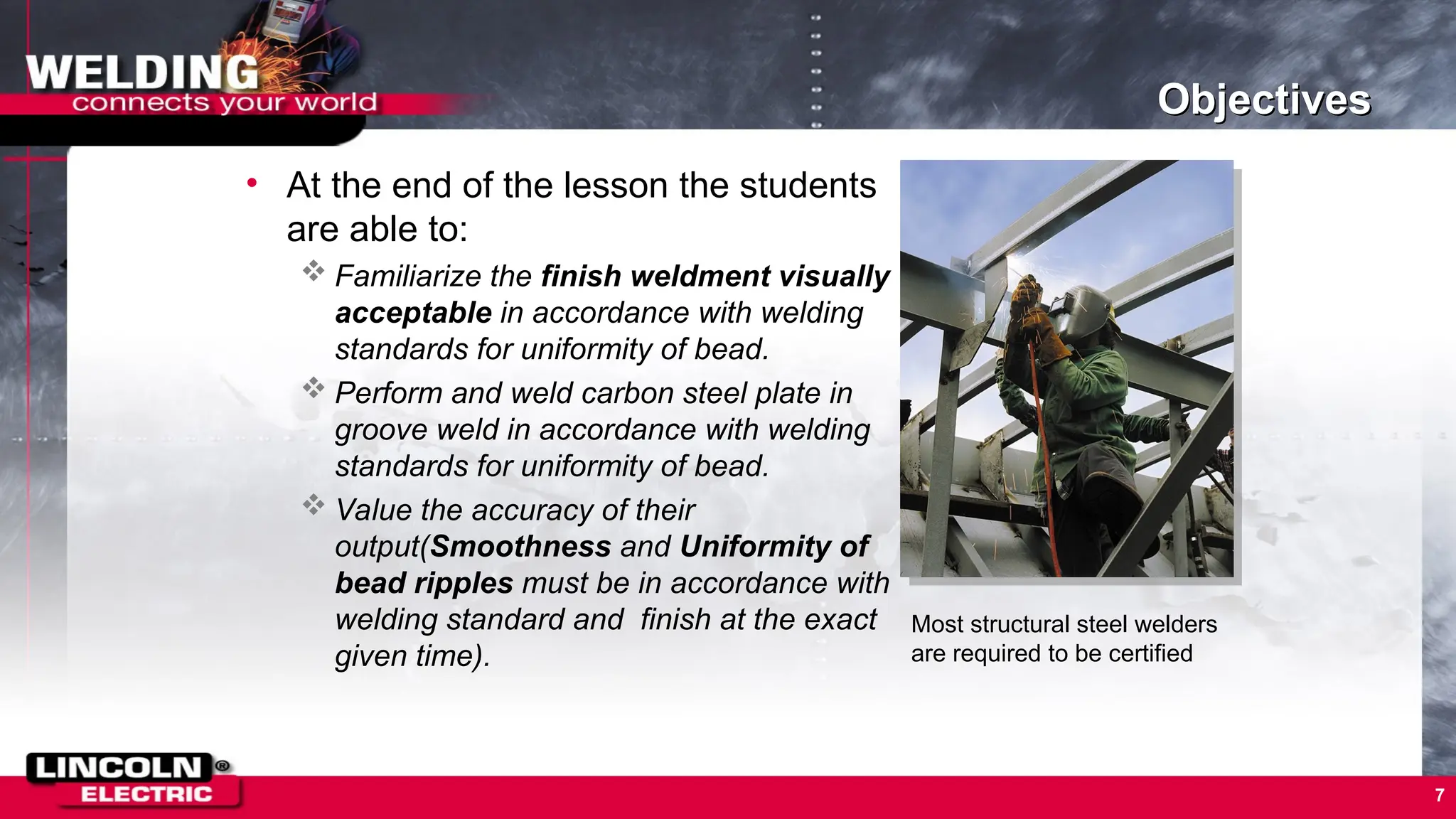
Most structural steel welders
are required to be certified
8.
8
Overview
• During thisoverview, we will
discuss the following topics:
• Arc
• Bead
• Weldbead
• Weldment
• Stringer bead
• Wave bead
• Standard length of bead by
stroke
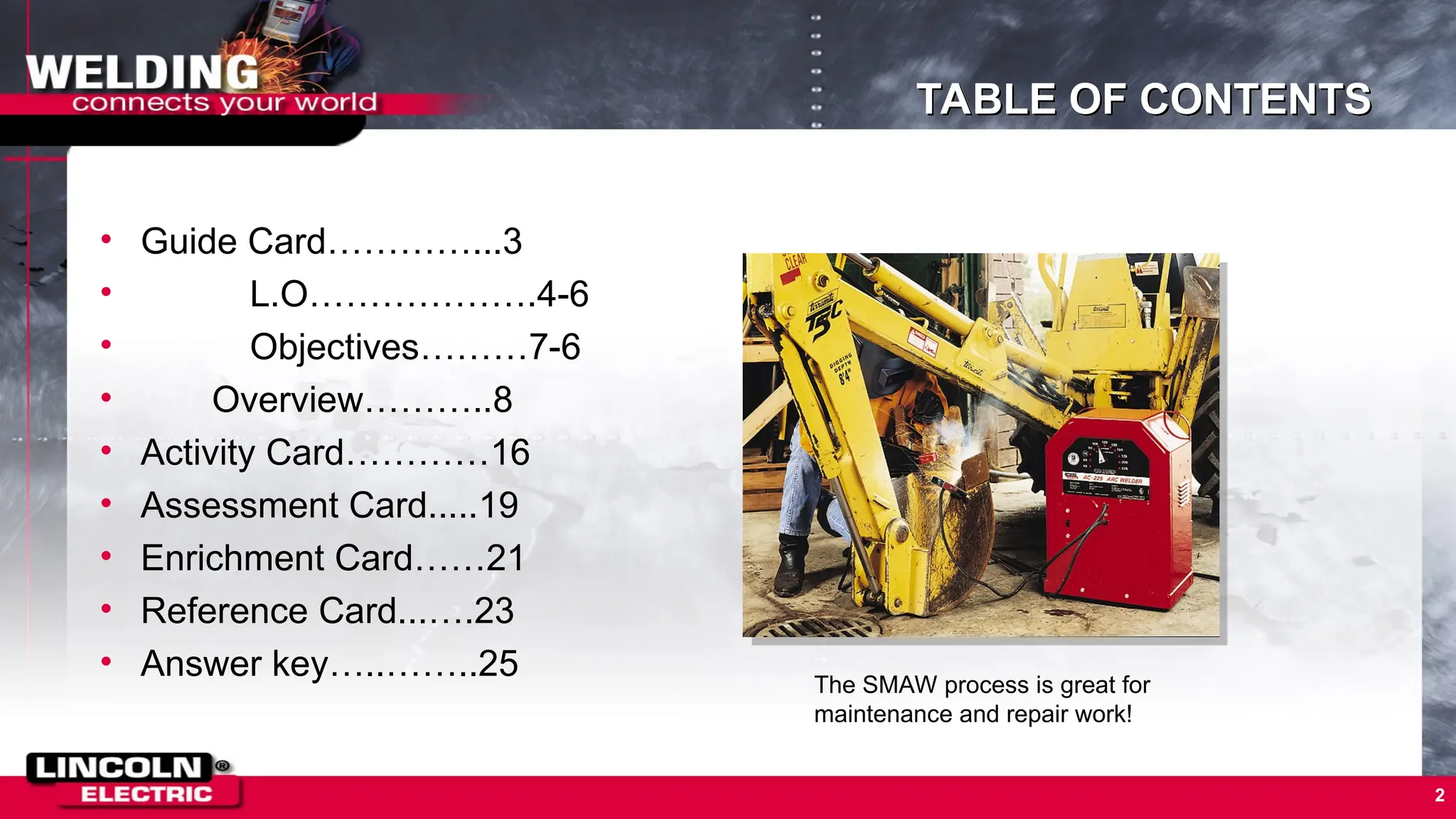
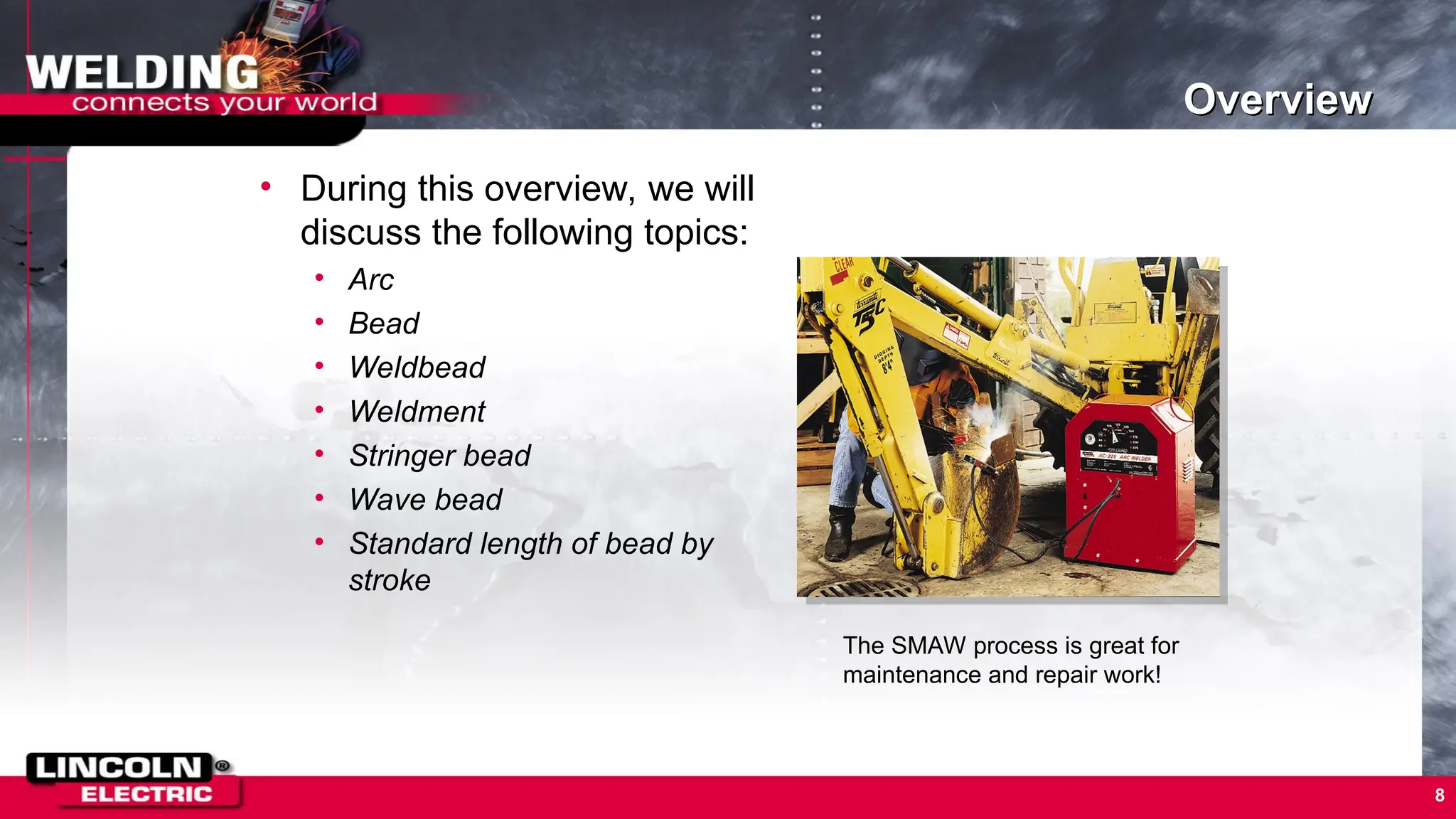
The SMAW process is great for
maintenance and repair work!
9.
9
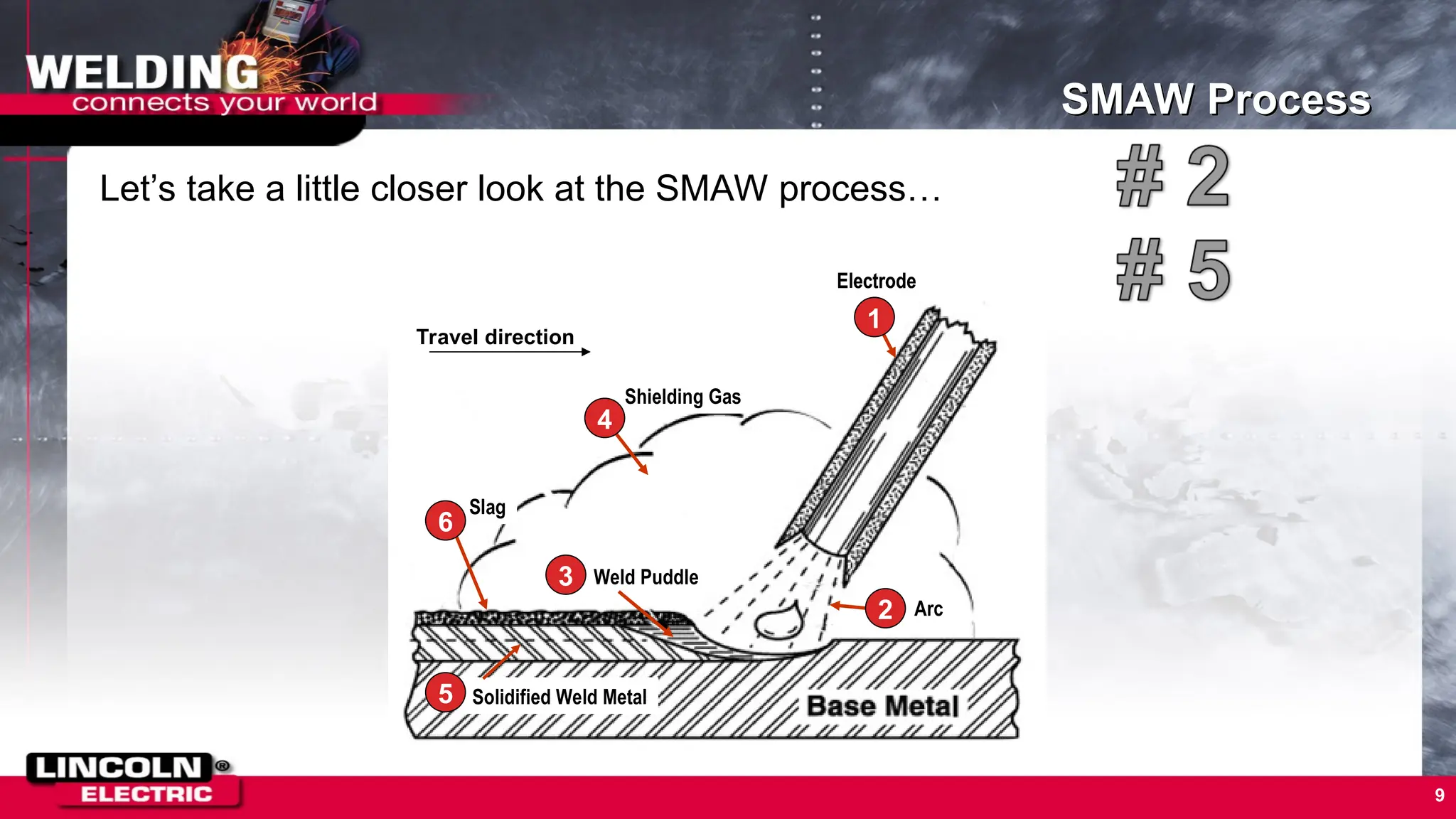
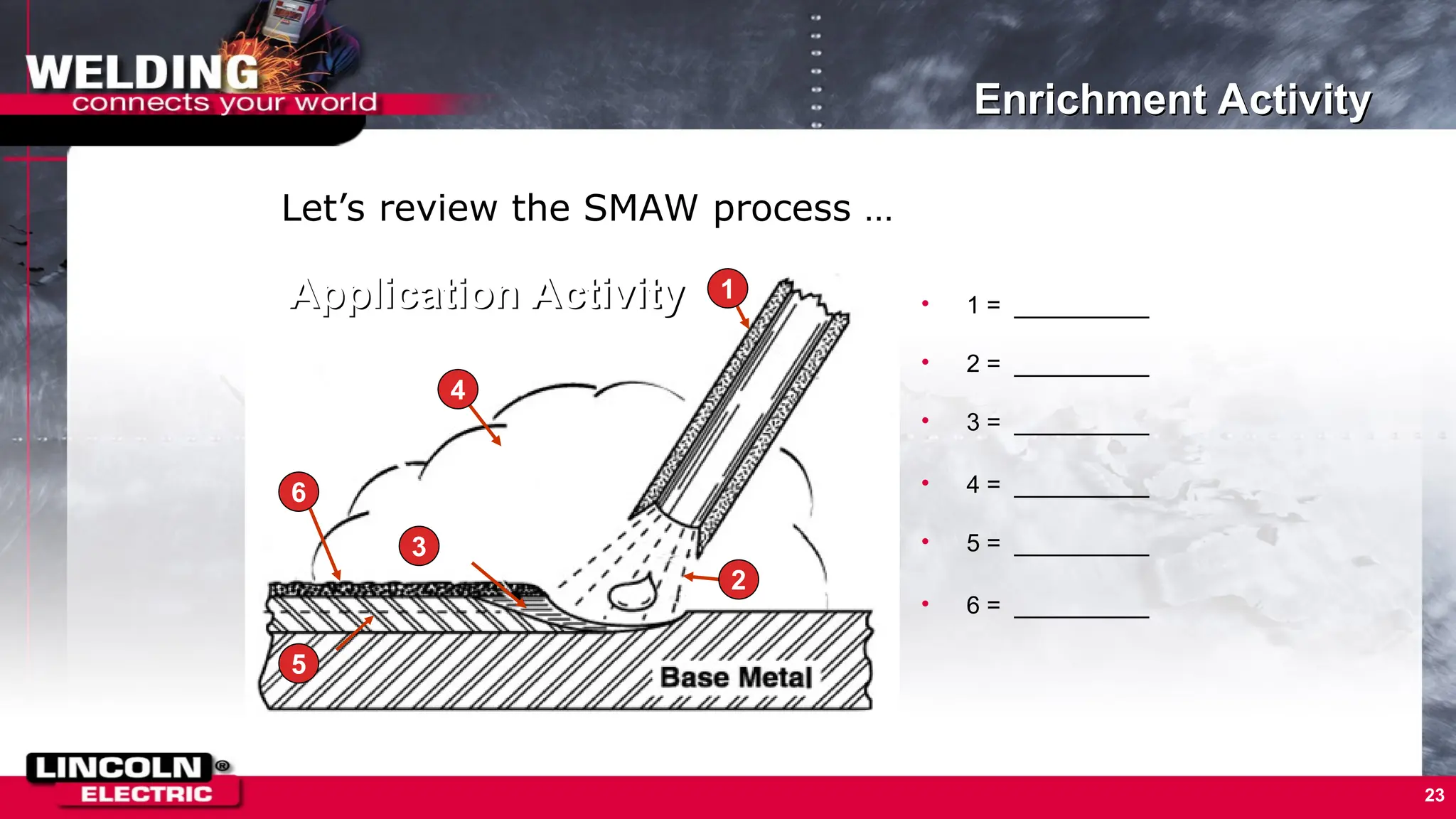
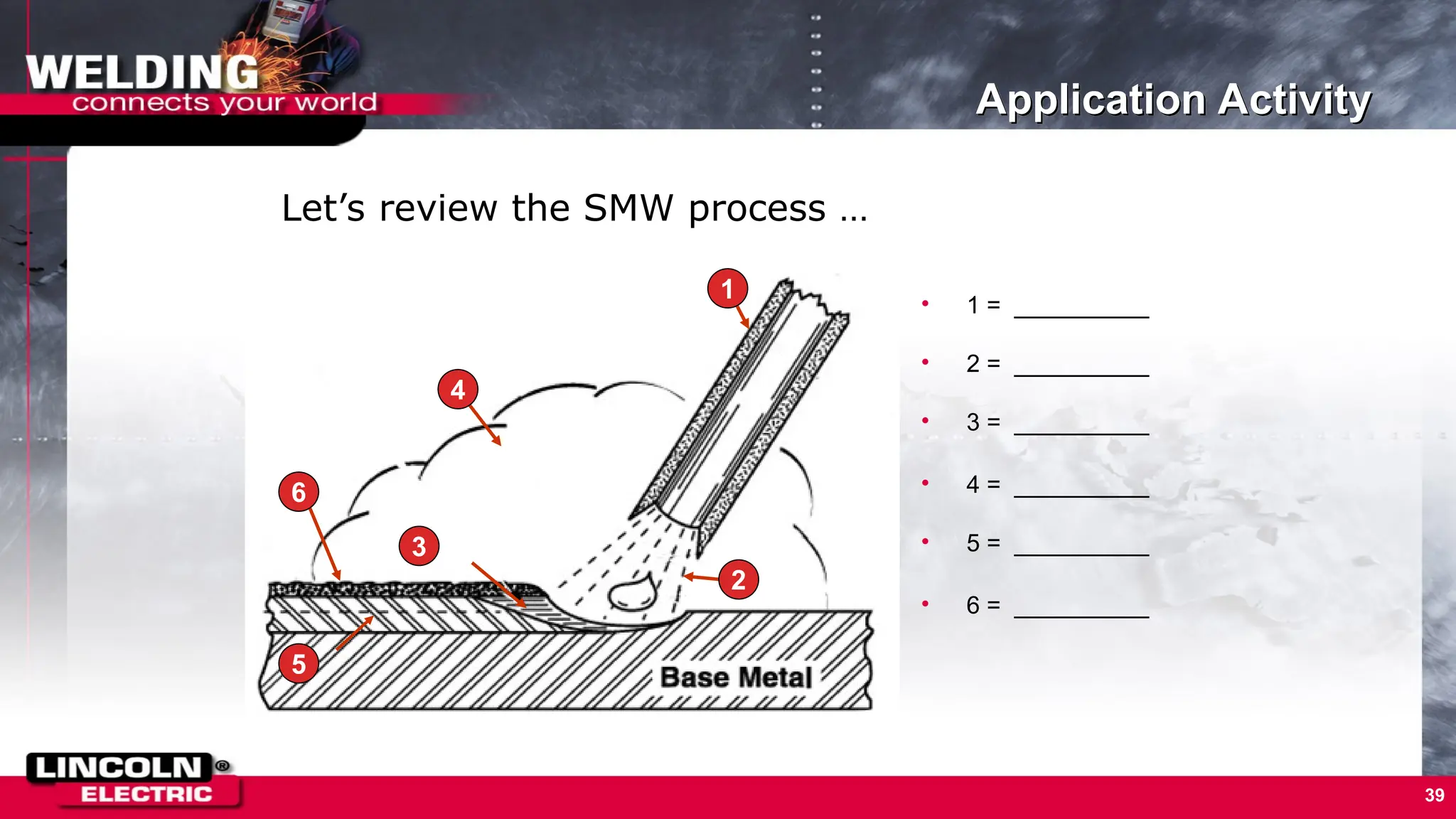
SMAW Process
1
Travel direction
Electrode
Arc
2
WeldPuddle 3
Shielding Gas
4
Solidified Weld Metal
5
Slag
6
Let’s take a little closer look at the SMAW process…
1
Travel direction
Electrode
Arc
2
Weld Puddle
3
Shielding Gas
4
Solidified Weld Metal
5
Slag
6
10.
10
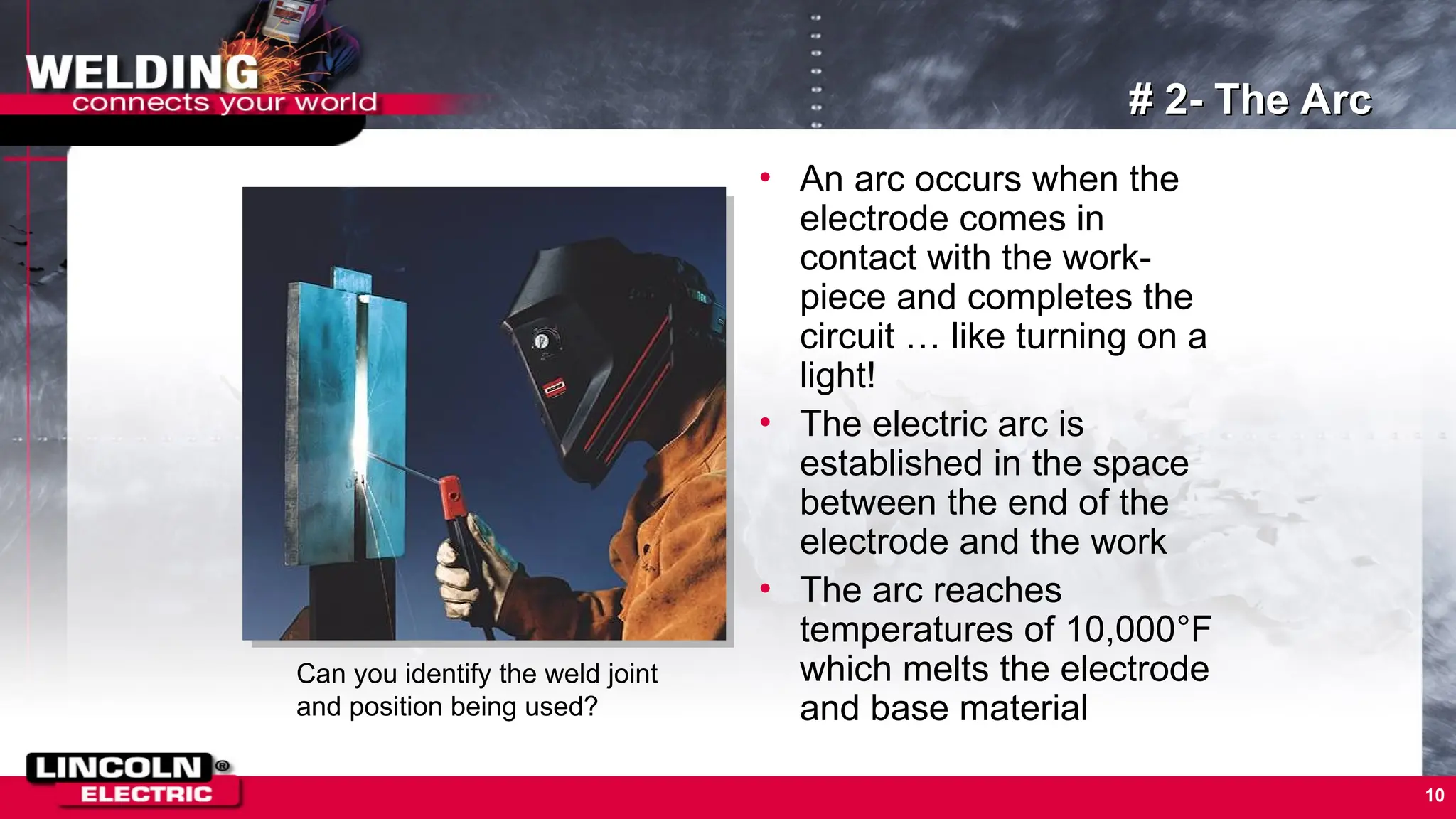
# 2- TheArc
• An arc occurs when the
electrode comes in
contact with the work-
piece and completes the
circuit … like turning on a
light!
• The electric arc is
established in the space
between the end of the
electrode and the work
• The arc reaches
temperatures of 10,000°F
which melts the electrode
and base material
Can you identify the weld joint
and position being used?
11.
11
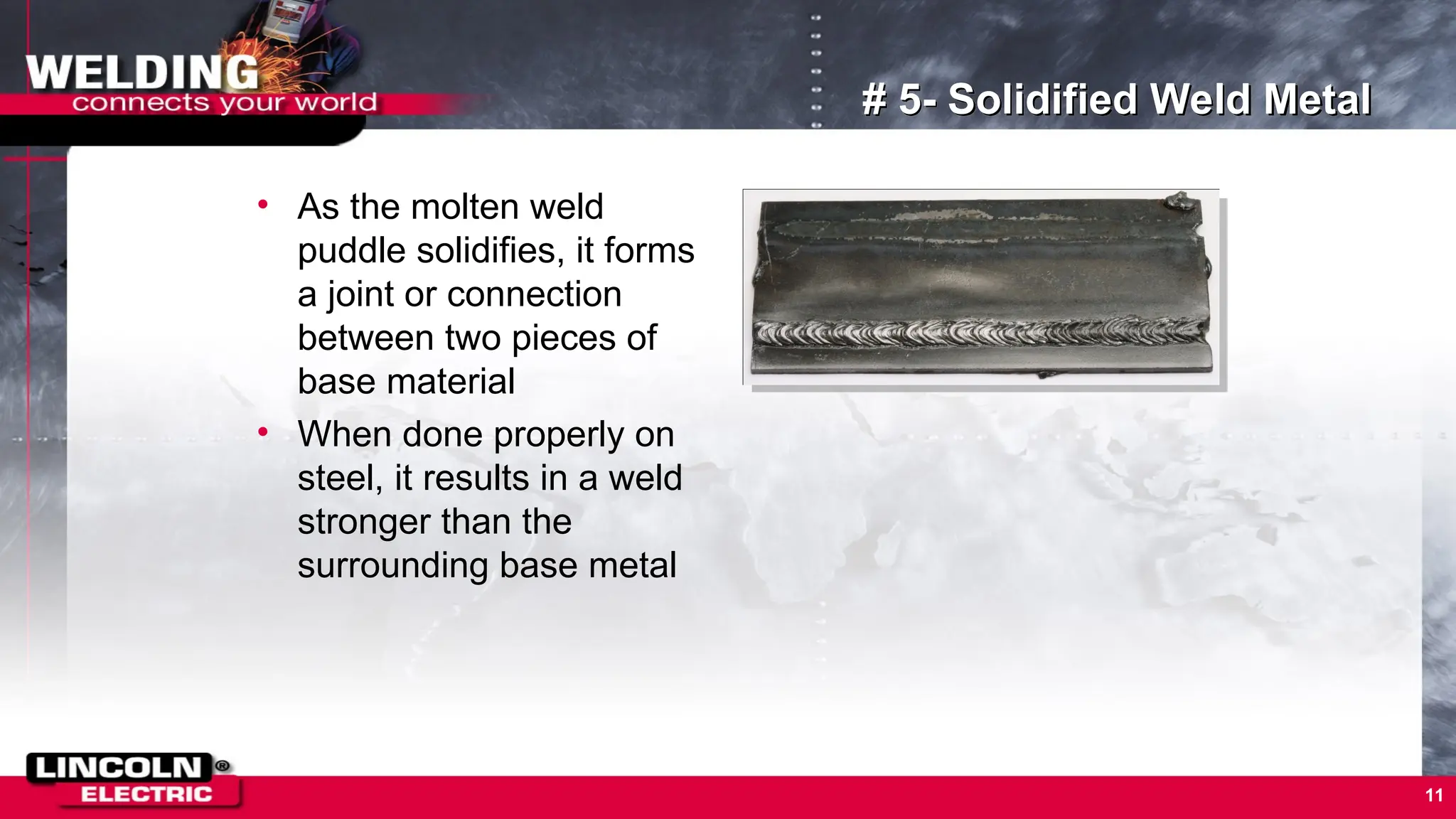
# 5- SolidifiedWeld Metal
• As the molten weld
puddle solidifies, it forms
a joint or connection
between two pieces of
base material
• When done properly on
steel, it results in a weld
stronger than the
surrounding base metal
12.
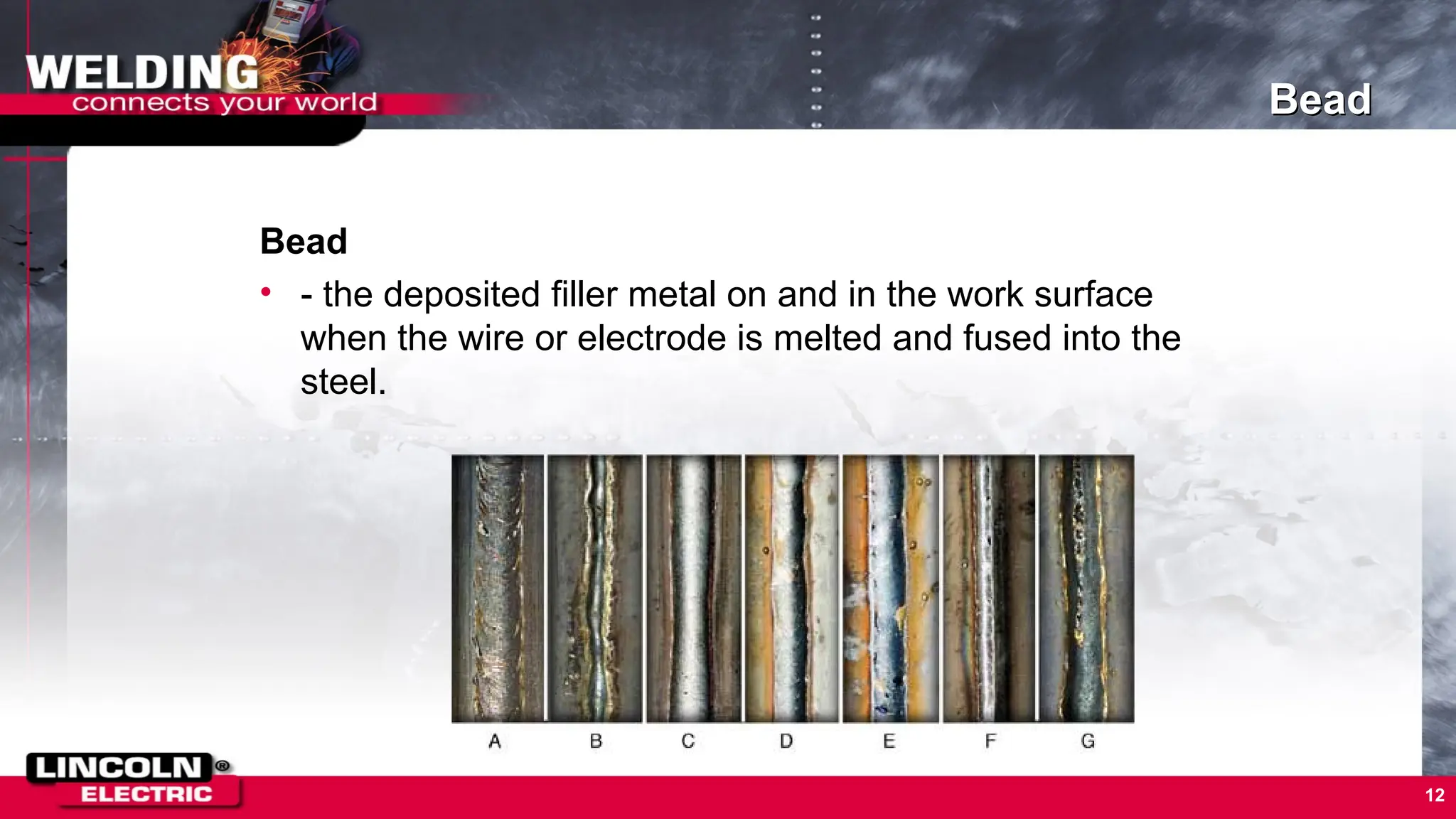
Bead
Bead
• - thedeposited filler metal on and in the work surface
when the wire or electrode is melted and fused into the
steel.
12
13.
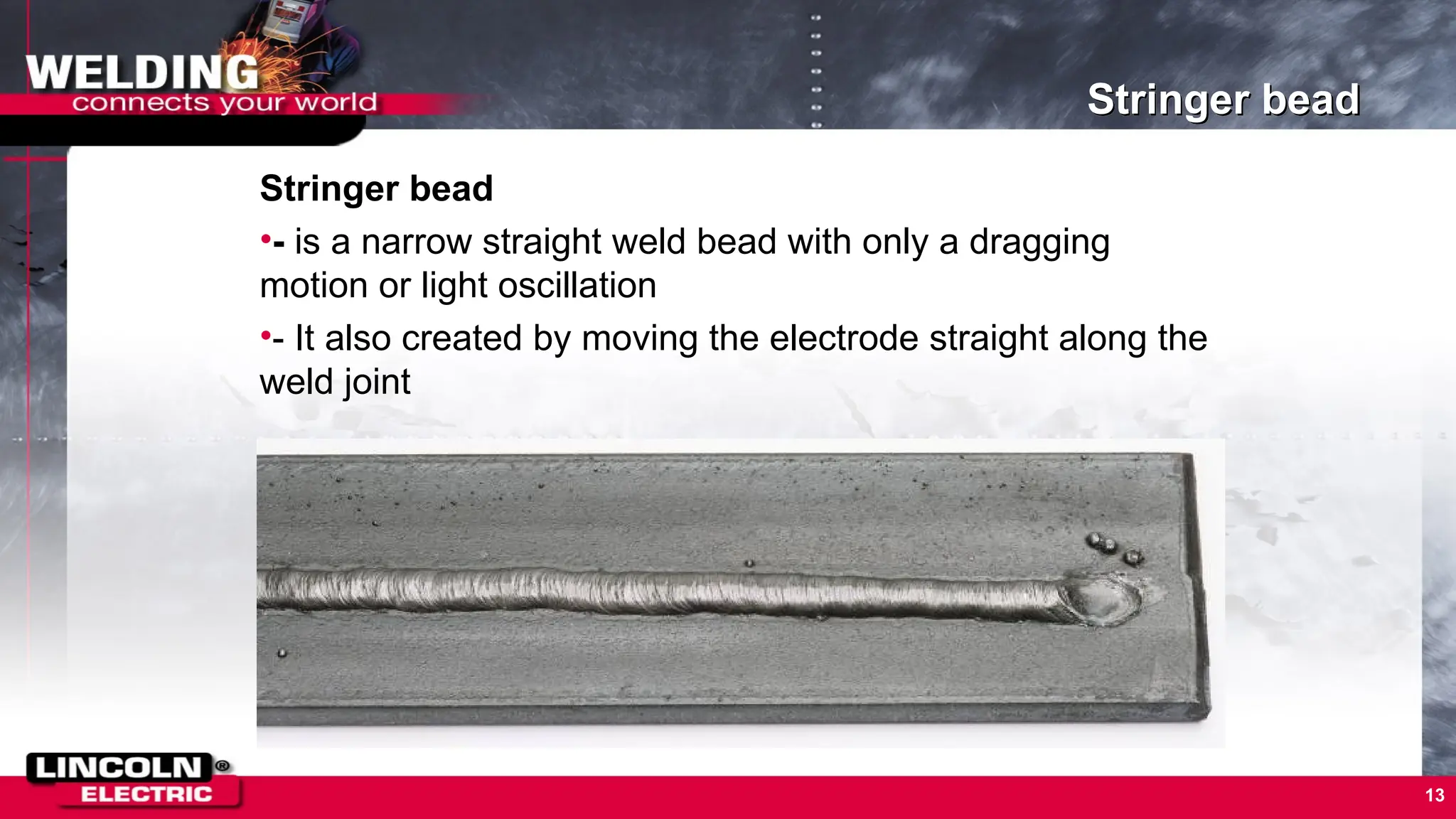
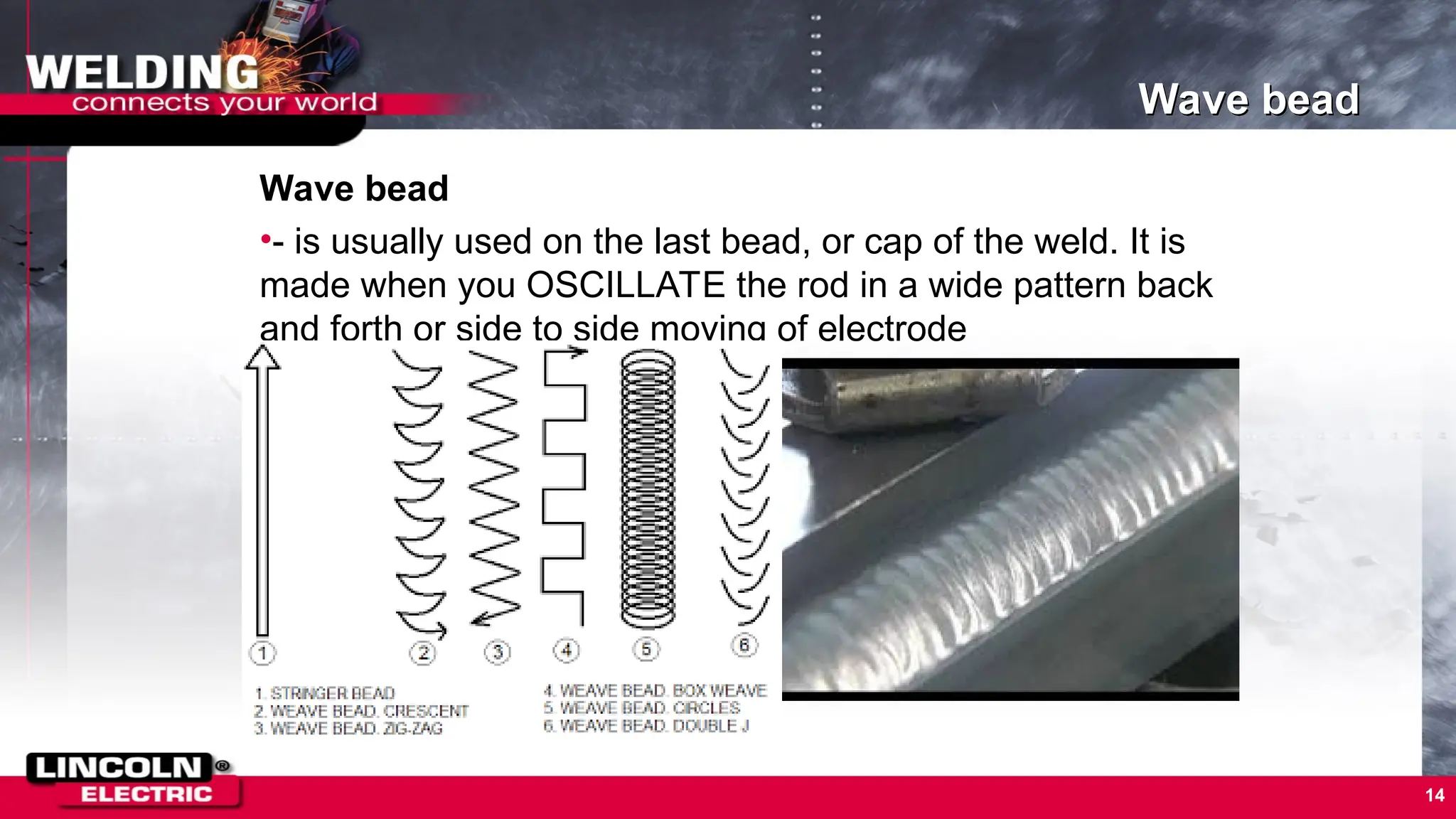
Stringer bead
Stringer bead
•-is a narrow straight weld bead with only a dragging
motion or light oscillation
•- It also created by moving the electrode straight along the
weld joint
13
14.
Wave bead
Wave bead
•-is usually used on the last bead, or cap of the weld. It is
made when you OSCILLATE the rod in a wide pattern back
and forth or side to side moving of electrode
14
15.
•STANDARD LENGTH OFWELD BEAD
•Standard length of electrode 14” inches
•Standard core diameter of electrode
– 5/32” inches in diameter
– 1/16” inches in diameter
– 1/8” inches in diameter
15
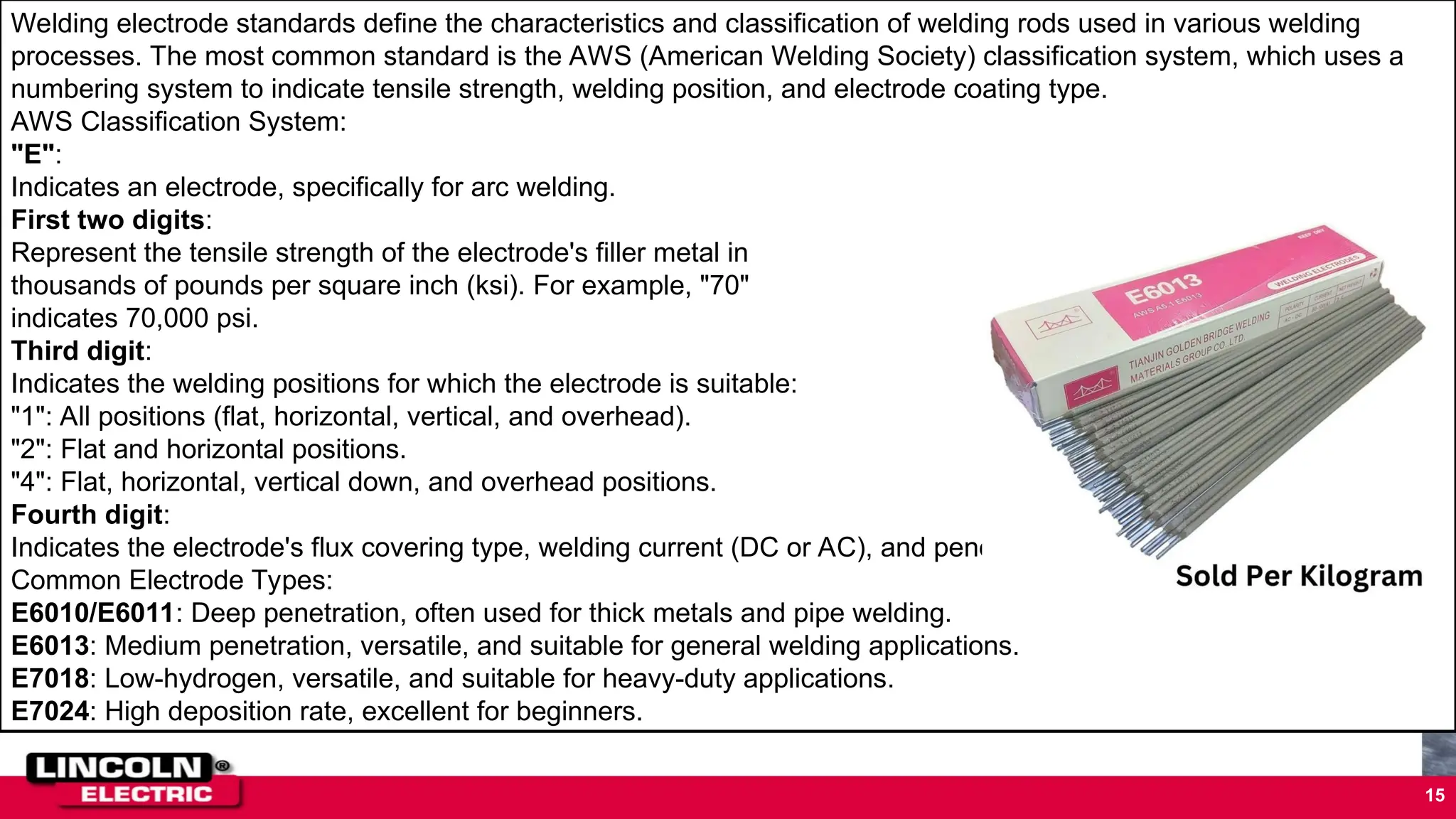
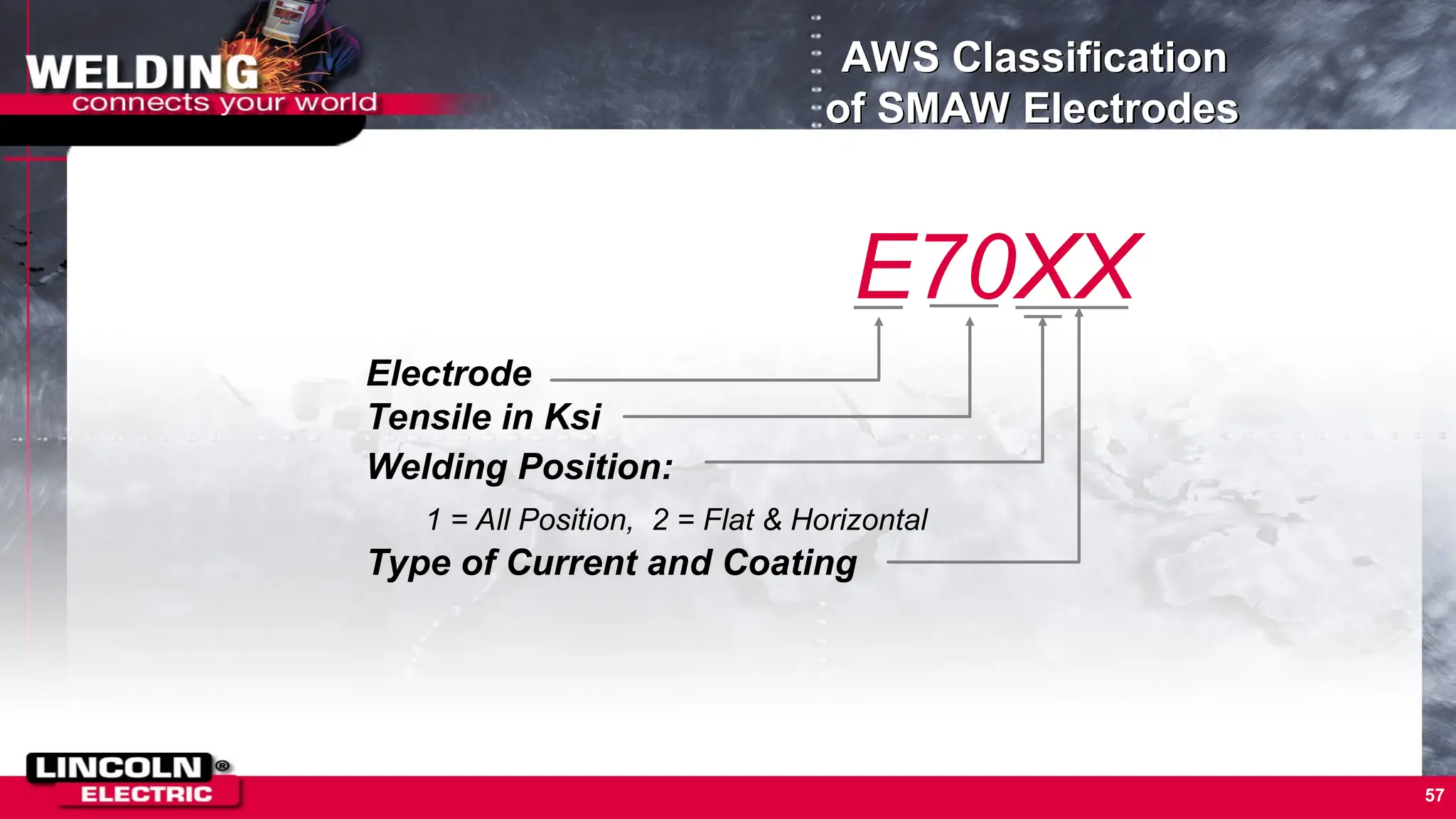
Welding electrode standards define the characteristics and classification of welding rods used in various welding
processes. The most common standard is the AWS (American Welding Society) classification system, which uses a
numbering system to indicate tensile strength, welding position, and electrode coating type.
AWS Classification System:
"E":
Indicates an electrode, specifically for arc welding.
First two digits:
Represent the tensile strength of the electrode's filler metal in
thousands of pounds per square inch (ksi). For example, "70"
indicates 70,000 psi.
Third digit:
Indicates the welding positions for which the electrode is suitable:
"1": All positions (flat, horizontal, vertical, and overhead).
"2": Flat and horizontal positions.
"4": Flat, horizontal, vertical down, and overhead positions.
Fourth digit:
Indicates the electrode's flux covering type, welding current (DC or AC), and penetration level.
Common Electrode Types:
E6010/E6011: Deep penetration, often used for thick metals and pipe welding.
E6013: Medium penetration, versatile, and suitable for general welding applications.
E7018: Low-hydrogen, versatile, and suitable for heavy-duty applications.
E7024: High deposition rate, excellent for beginners.
17
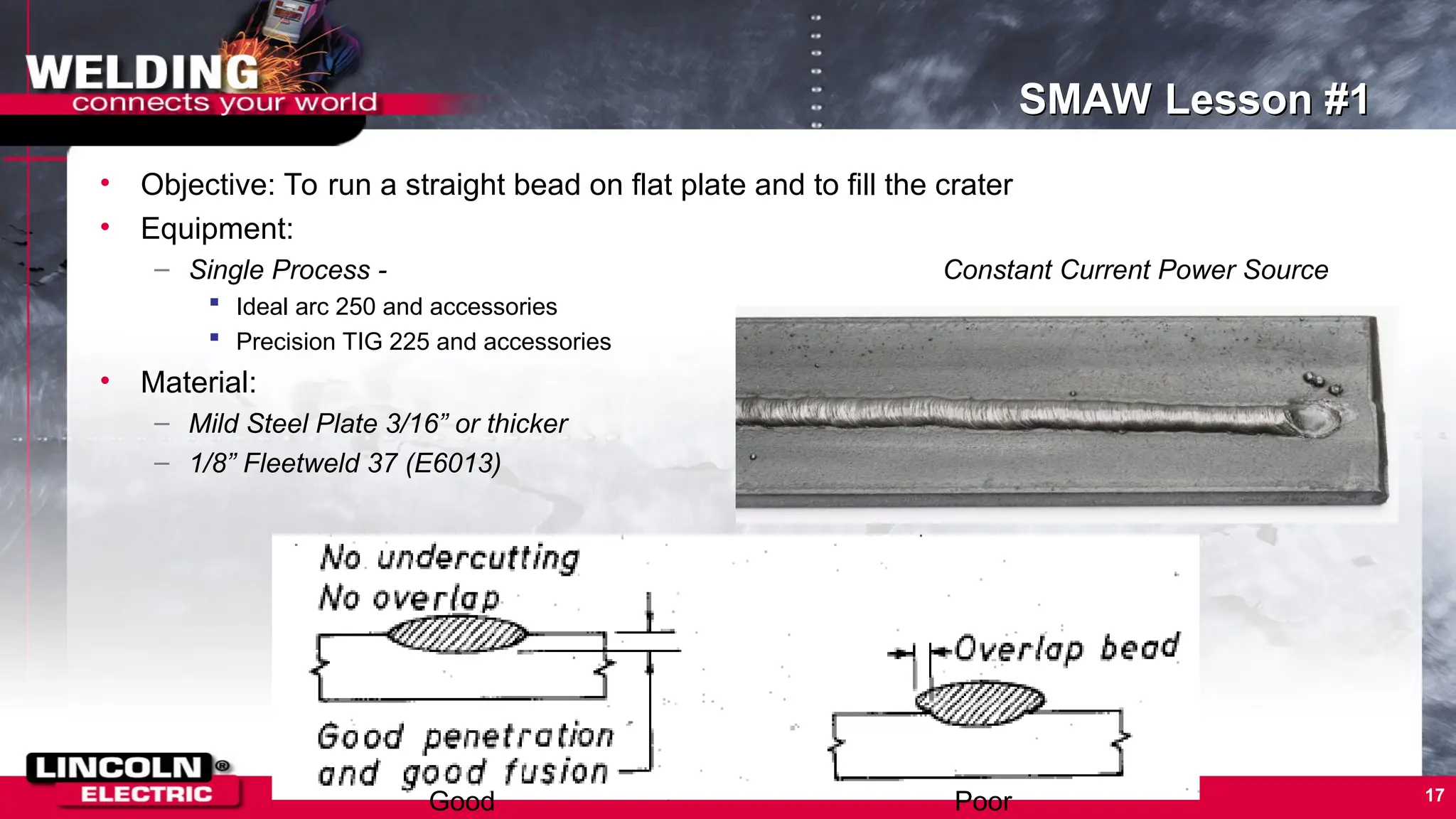
SMAW Lesson #1
•Objective: To run a straight bead on flat plate and to fill the crater
• Equipment:
– Single Process - Constant Current Power Source
Ideal arc 250 and accessories
Precision TIG 225 and accessories
• Material:
– Mild Steel Plate 3/16” or thicker
– 1/8” Fleetweld 37 (E6013)
Good Poor
18.
18
SMAW Lesson #2
•Objective: To run a bead with the whip technique
• Equipment:
– Single Process - Constant Current Power Source
Idealarc 250 and accessories
Precision SMAW 225 and accessories
• Material:
– Mild Steel Plate 3/16” or thicker
– 1/8” Fleetweld 5P+ (E6010) for DC or Fleetweld 180 (E6011) for AC
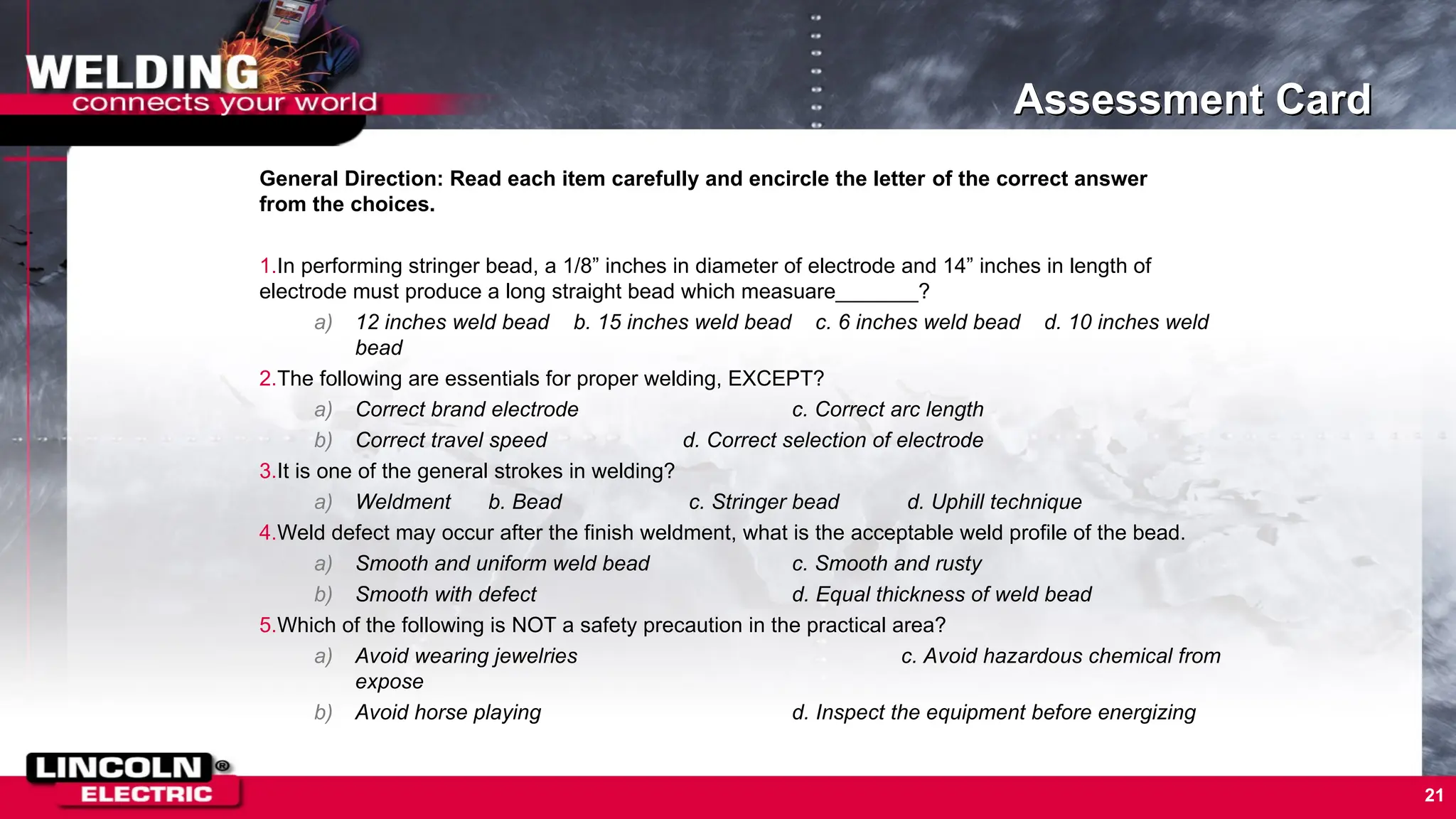
Assessment Card
General Direction:Read each item carefully and encircle the letter of the correct answer
from the choices.
1.In performing stringer bead, a 1/8” inches in diameter of electrode and 14” inches in length of
electrode must produce a long straight bead which measuare_______?
a) 12 inches weld bead b. 15 inches weld bead c. 6 inches weld bead d. 10 inches weld
bead
2.The following are essentials for proper welding, EXCEPT?
a) Correct brand electrode c. Correct arc length
b) Correct travel speed d. Correct selection of electrode
3.It is one of the general strokes in welding?
a) Weldment b. Bead c. Stringer bead d. Uphill technique
4.Weld defect may occur after the finish weldment, what is the acceptable weld profile of the bead.
a) Smooth and uniform weld bead c. Smooth and rusty
b) Smooth with defect d. Equal thickness of weld bead
5.Which of the following is NOT a safety precaution in the practical area?
a) Avoid wearing jewelries c. Avoid hazardous chemical from
expose
b) Avoid horse playing d. Inspect the equipment before energizing
21
• Curriculum Guide(CG),
• WELDING FUNDAMENTALS
(BOOK)
• Lincoln electric
25
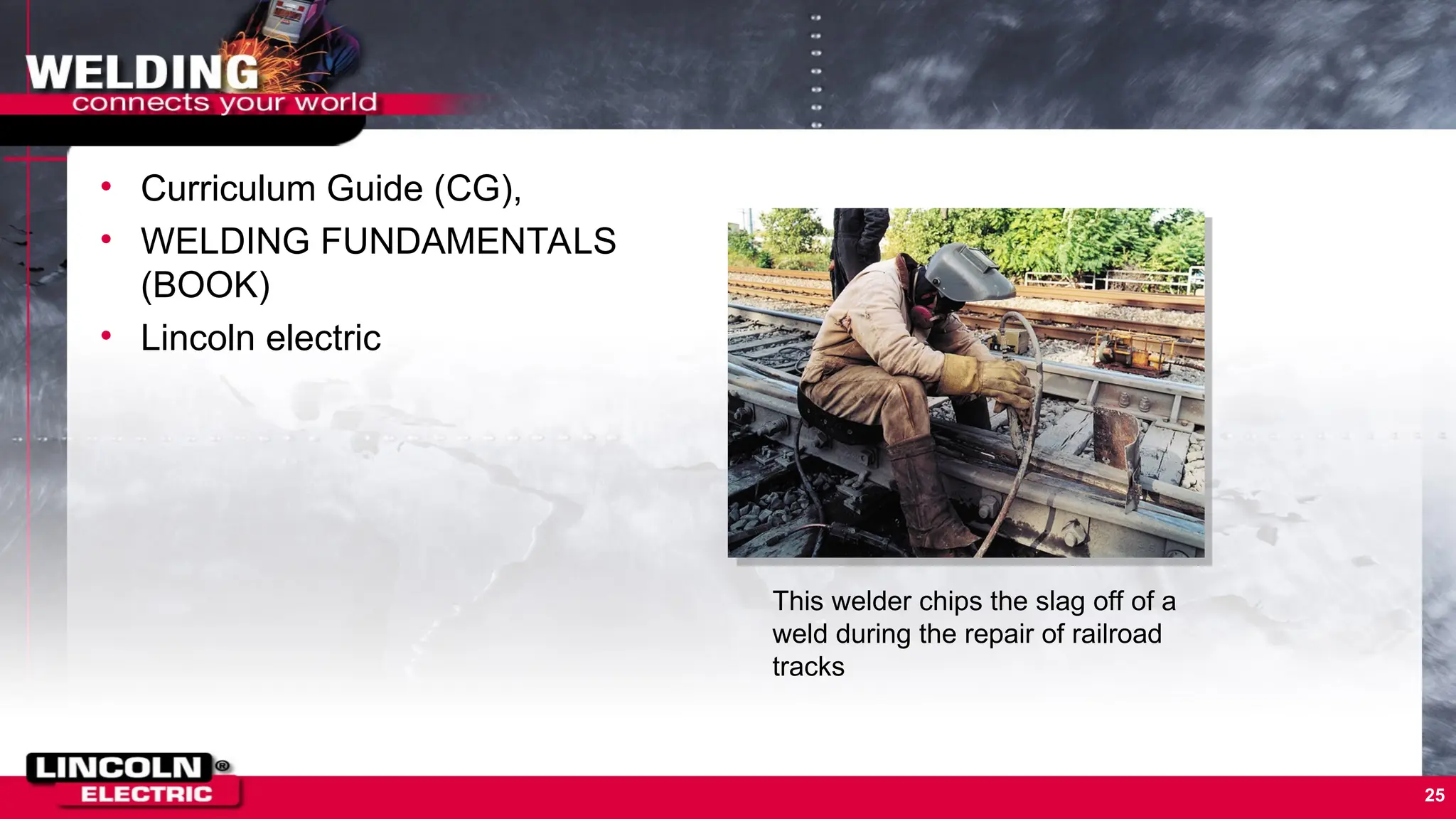
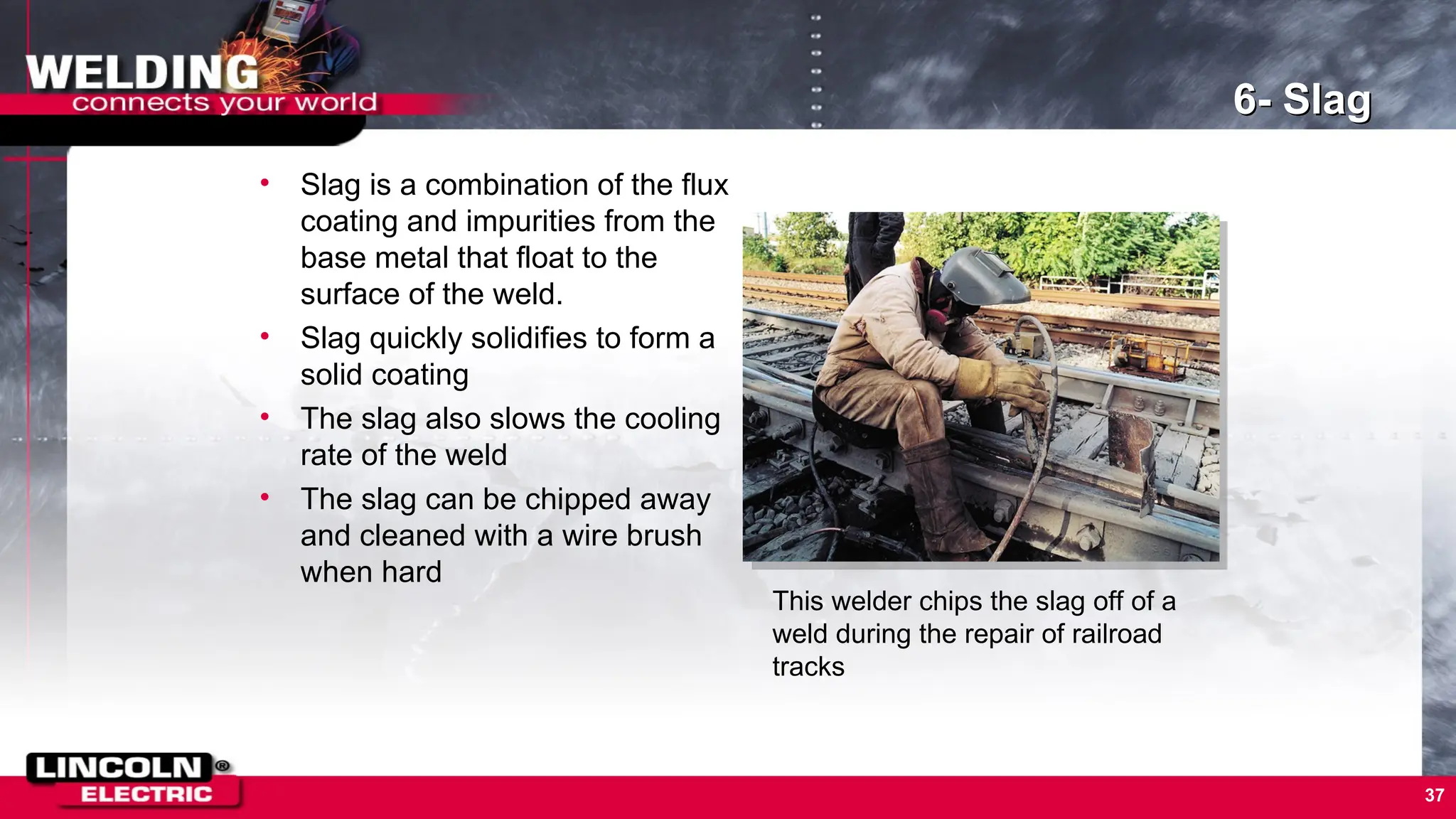
This welder chips the slag off of a
weld during the repair of railroad
tracks
29
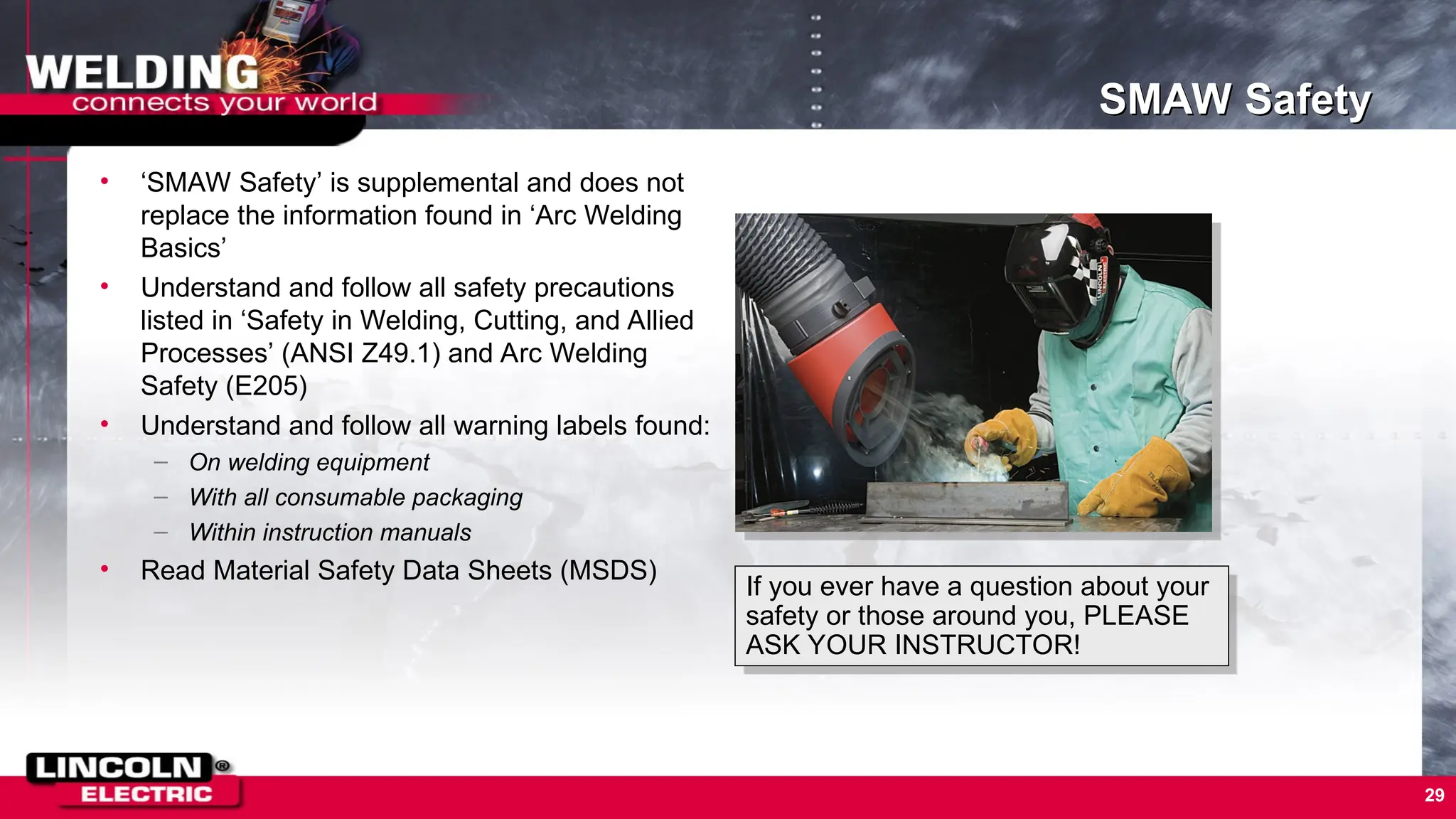
SMAW Safety
• ‘SMAWSafety’ is supplemental and does not
replace the information found in ‘Arc Welding
Basics’
• Understand and follow all safety precautions
listed in ‘Safety in Welding, Cutting, and Allied
Processes’ (ANSI Z49.1) and Arc Welding
Safety (E205)
• Understand and follow all warning labels found:
– On welding equipment
– With all consumable packaging
– Within instruction manuals
• Read Material Safety Data Sheets (MSDS)
If you ever have a question about your
safety or those around you, PLEASE
ASK YOUR INSTRUCTOR!
30.
30
SMAW Safety
• Fumesand Gases can be dangerous
– Keep your head out of the fumes
– Use enough ventilation, exhaust at the arc, or both, to keep fumes and gases
from your breathing zone and the general area
– The SMAW process can withstand wind and exhaust near the arc from ventilation
equipment
• Electric Shock can kill – to receive a shock your body must touch the electrode and
work or ground at the same time
– Do not touch the electrode or metal parts of the electrode holder with skin or wet
clothing
– Keep dry insulation between your body and the metal being welded or ground
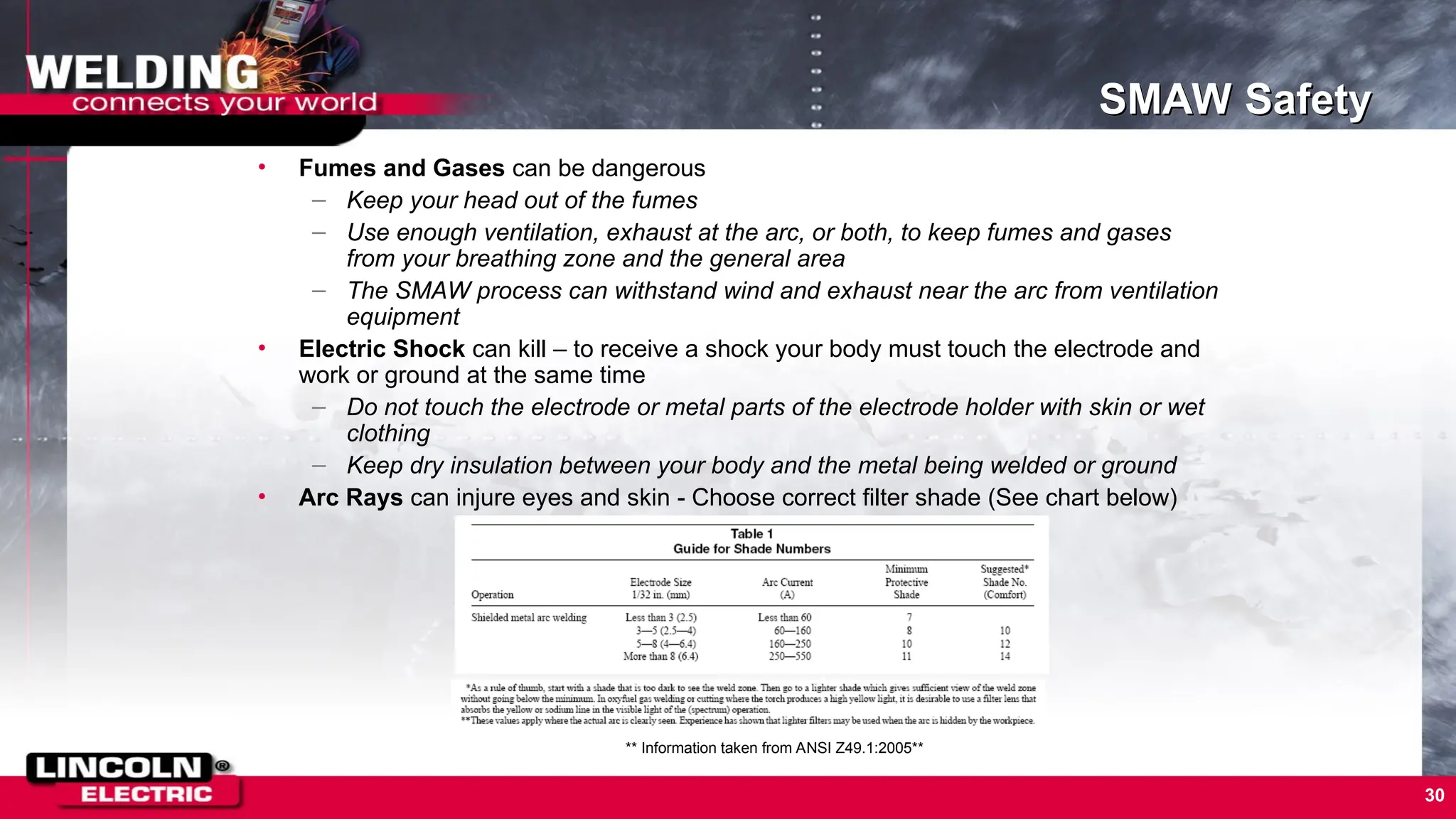
• Arc Rays can injure eyes and skin - Choose correct filter shade (See chart below)
** Information taken from ANSI Z49.1:2005**
32
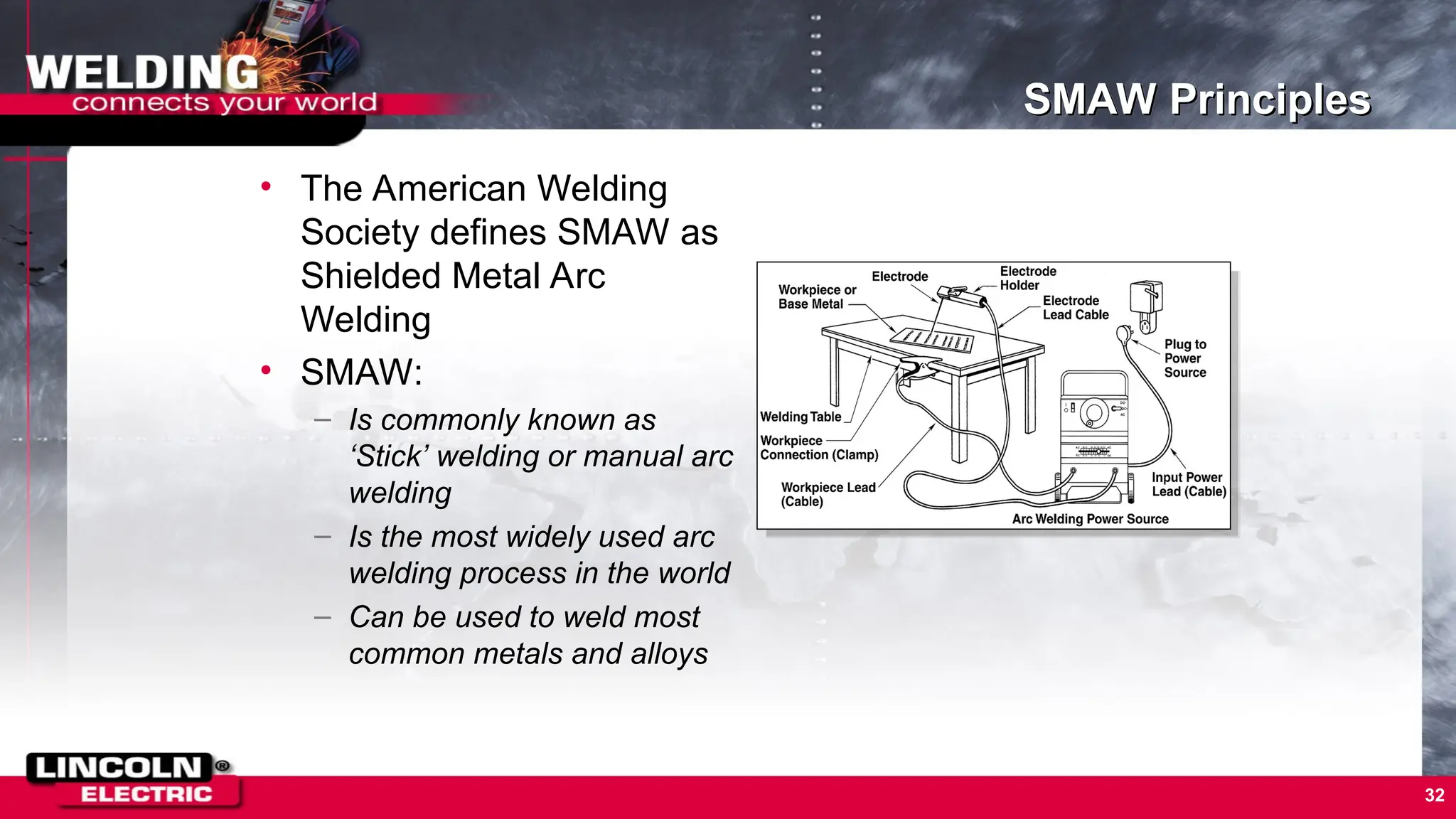
SMAW Principles
• TheAmerican Welding
Society defines SMAW as
Shielded Metal Arc
Welding
• SMAW:
– Is commonly known as
‘Stick’ welding or manual arc
welding
– Is the most widely used arc
welding process in the world
– Can be used to weld most
common metals and alloys
33.
33
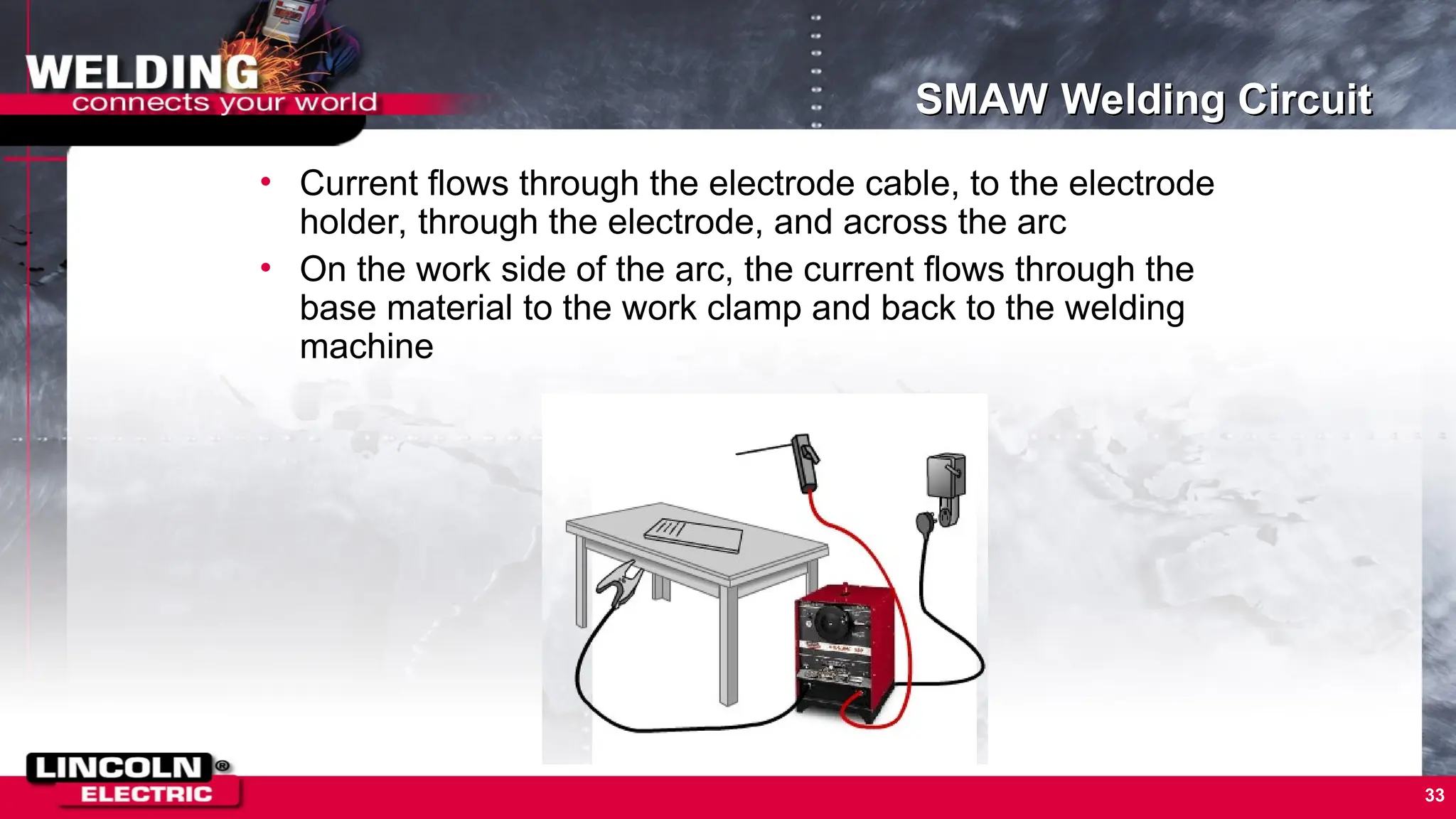
SMAW Welding Circuit
•Current flows through the electrode cable, to the electrode
holder, through the electrode, and across the arc
• On the work side of the arc, the current flows through the
base material to the work clamp and back to the welding
machine
34.
34
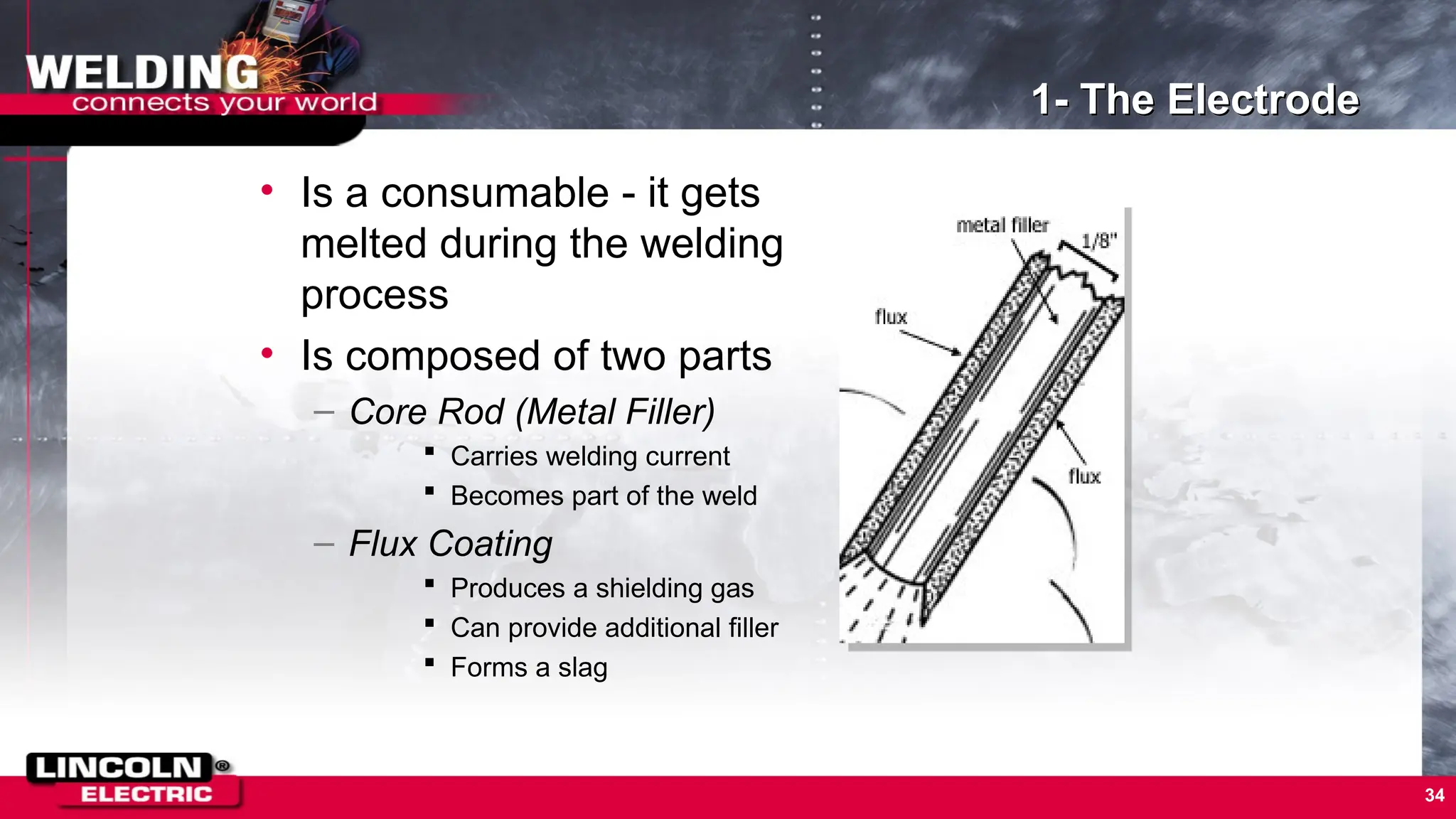
1- The Electrode
•Is a consumable - it gets
melted during the welding
process
• Is composed of two parts
– Core Rod (Metal Filler)
Carries welding current
Becomes part of the weld
– Flux Coating
Produces a shielding gas
Can provide additional filler
Forms a slag
35.
35
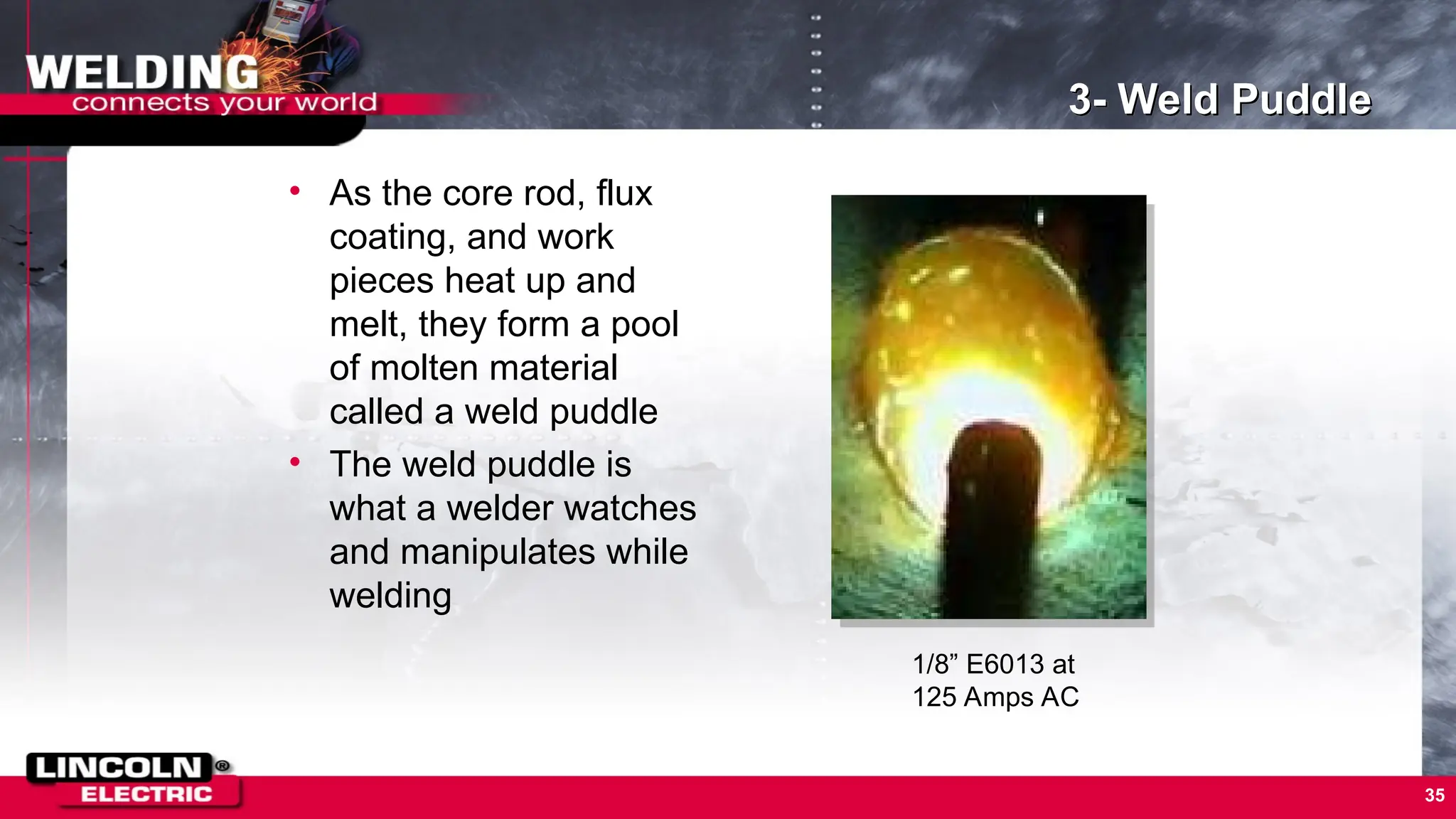
3- Weld Puddle
•As the core rod, flux
coating, and work
pieces heat up and
melt, they form a pool
of molten material
called a weld puddle
• The weld puddle is
what a welder watches
and manipulates while
welding
1/8” E6013 at
125 Amps AC
36.
36
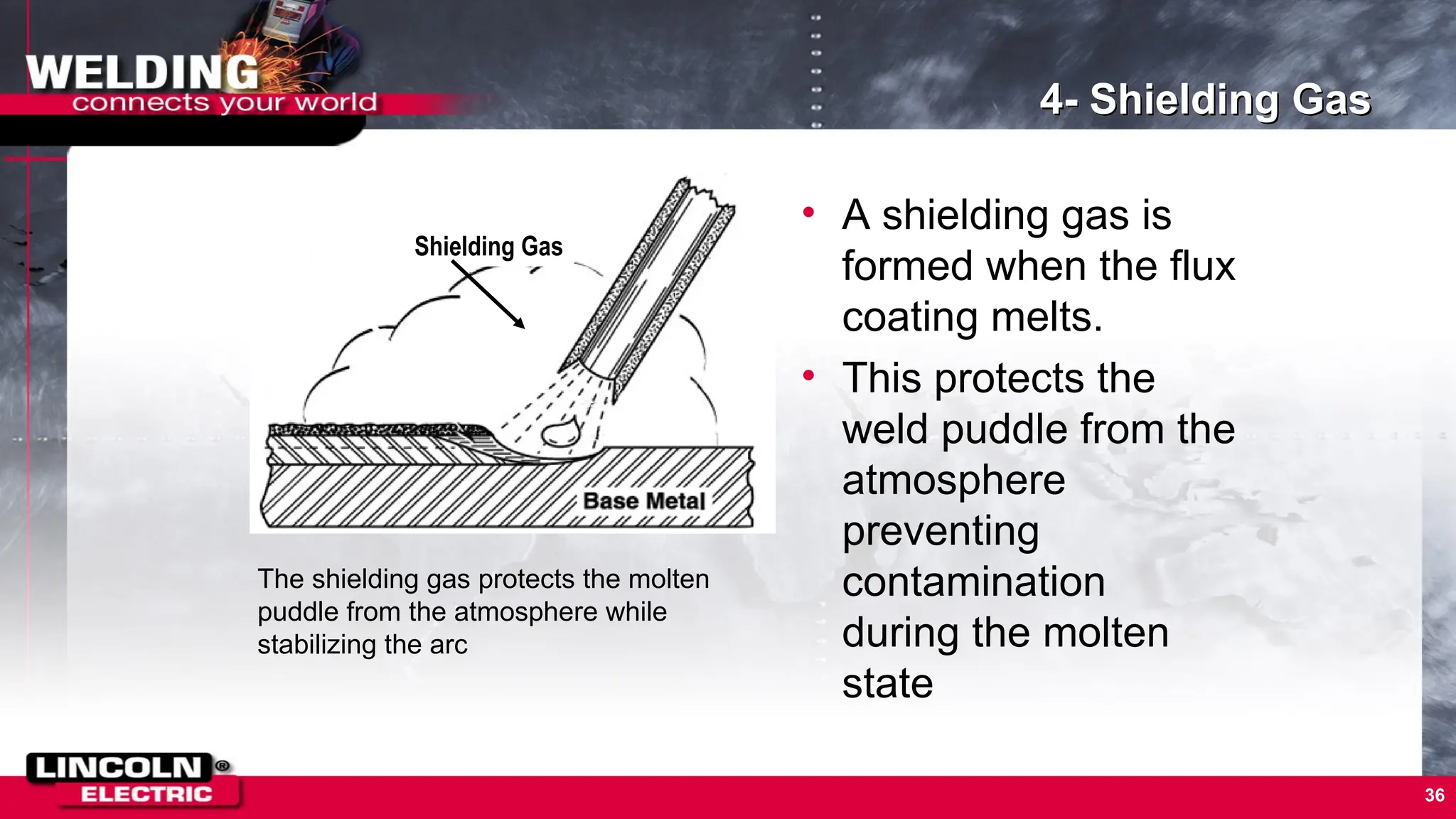
4- Shielding Gas
•A shielding gas is
formed when the flux
coating melts.
• This protects the
weld puddle from the
atmosphere
preventing
contamination
during the molten
state
The shielding gas protects the molten
puddle from the atmosphere while
stabilizing the arc
2
3
Shielding Gas
4
37.
37
6- Slag
• Slagis a combination of the flux
coating and impurities from the
base metal that float to the
surface of the weld.
• Slag quickly solidifies to form a
solid coating
• The slag also slows the cooling
rate of the weld
• The slag can be chipped away
and cleaned with a wire brush
when hard
This welder chips the slag off of a
weld during the repair of railroad
tracks
41
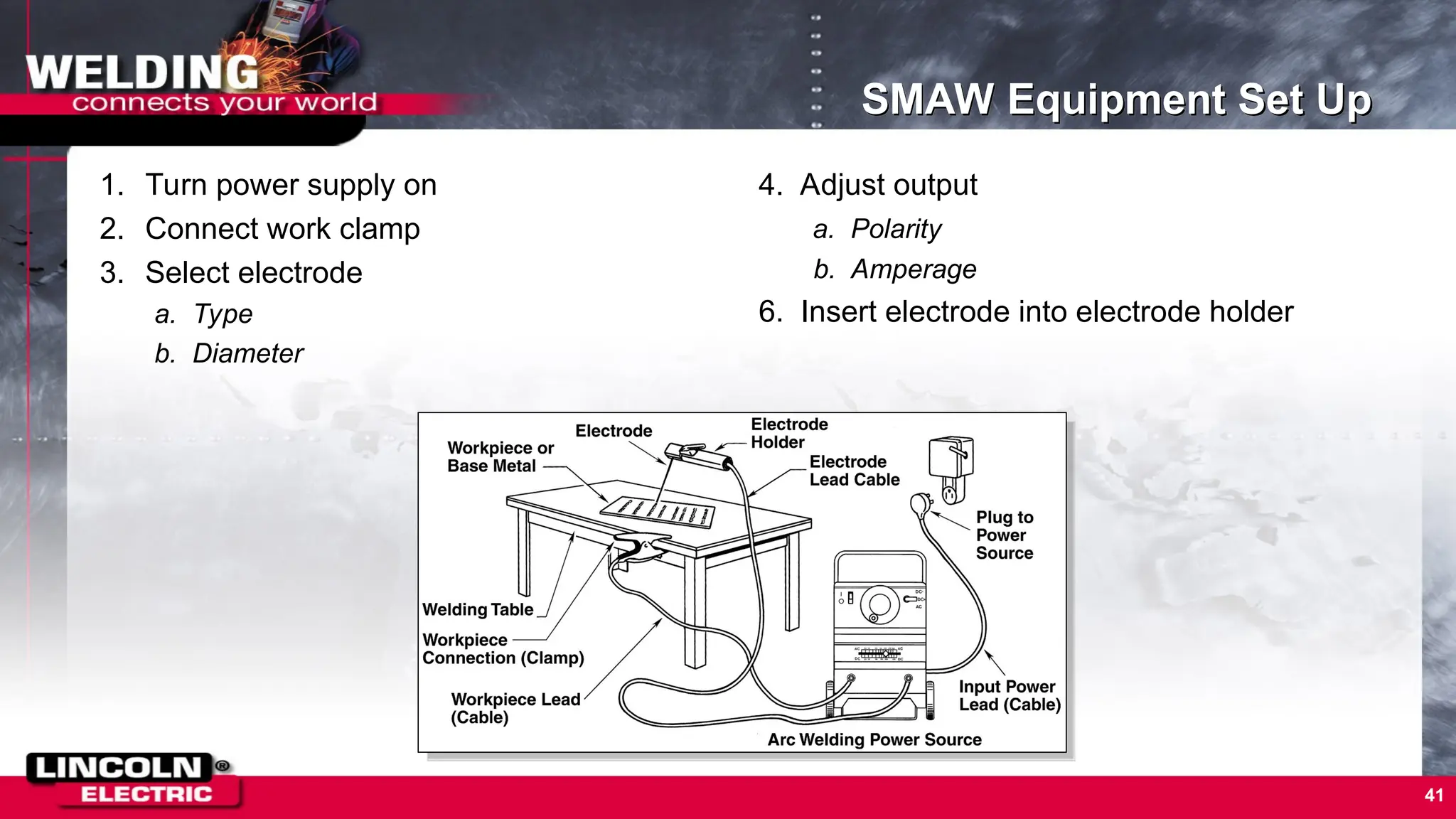
SMAW Equipment SetUp
1. Turn power supply on
2. Connect work clamp
3. Select electrode
a. Type
b. Diameter
4. Adjust output
a. Polarity
b. Amperage
6. Insert electrode into electrode holder
42.
42
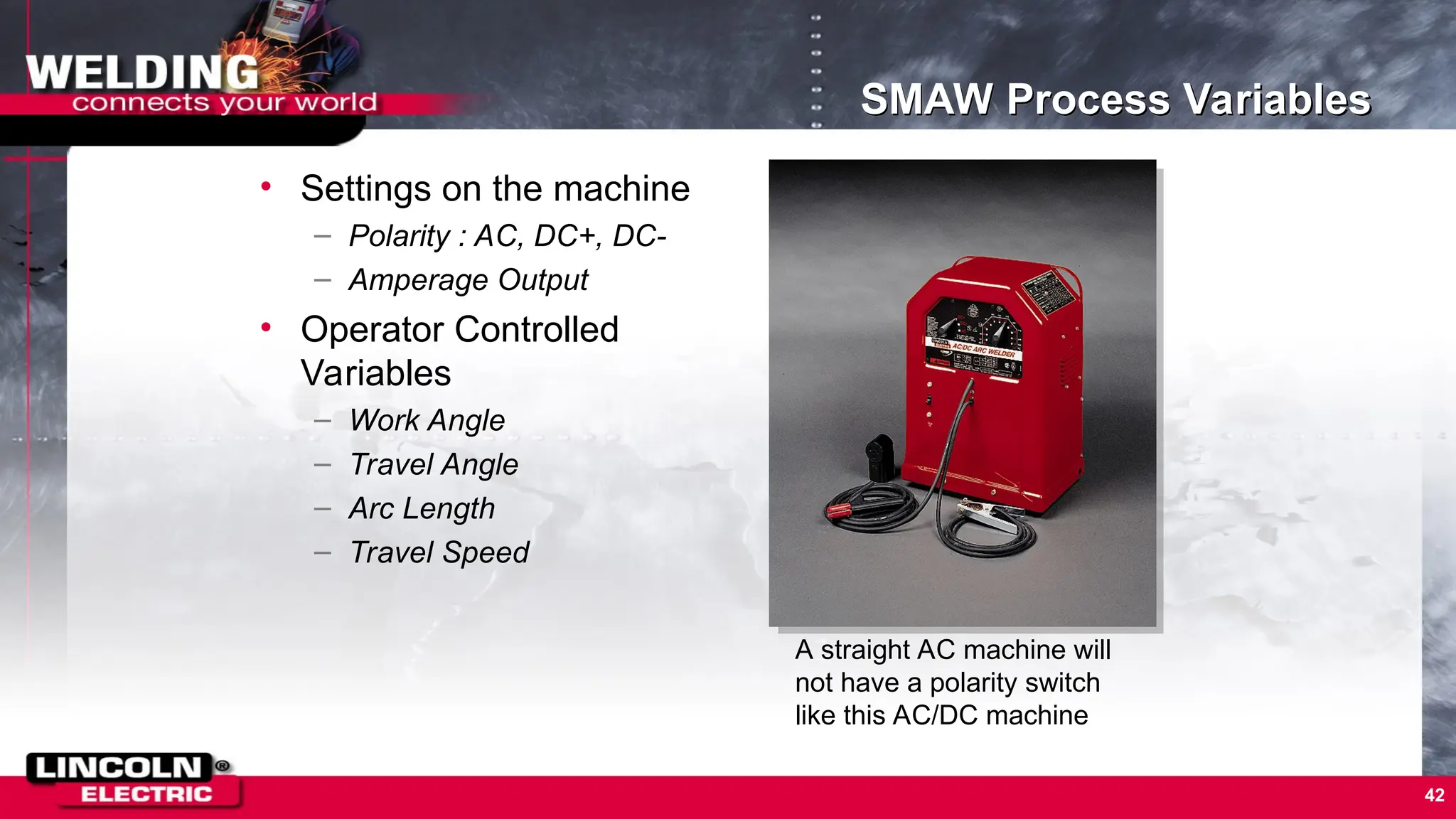
SMAW Process Variables
•Settings on the machine
– Polarity : AC, DC+, DC-
– Amperage Output
• Operator Controlled
Variables
– Work Angle
– Travel Angle
– Arc Length
– Travel Speed
A straight AC machine will
not have a polarity switch
like this AC/DC machine
44
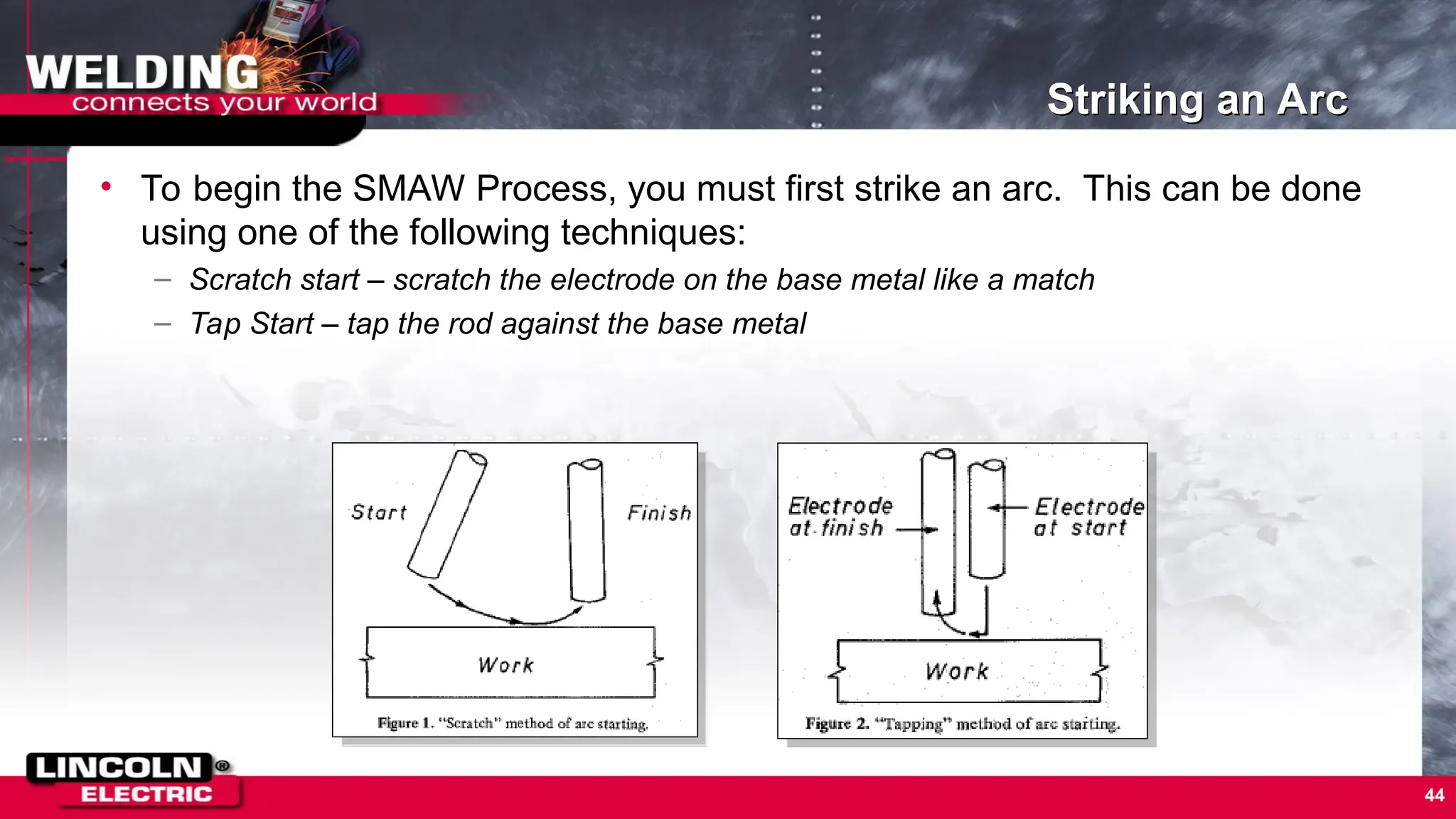
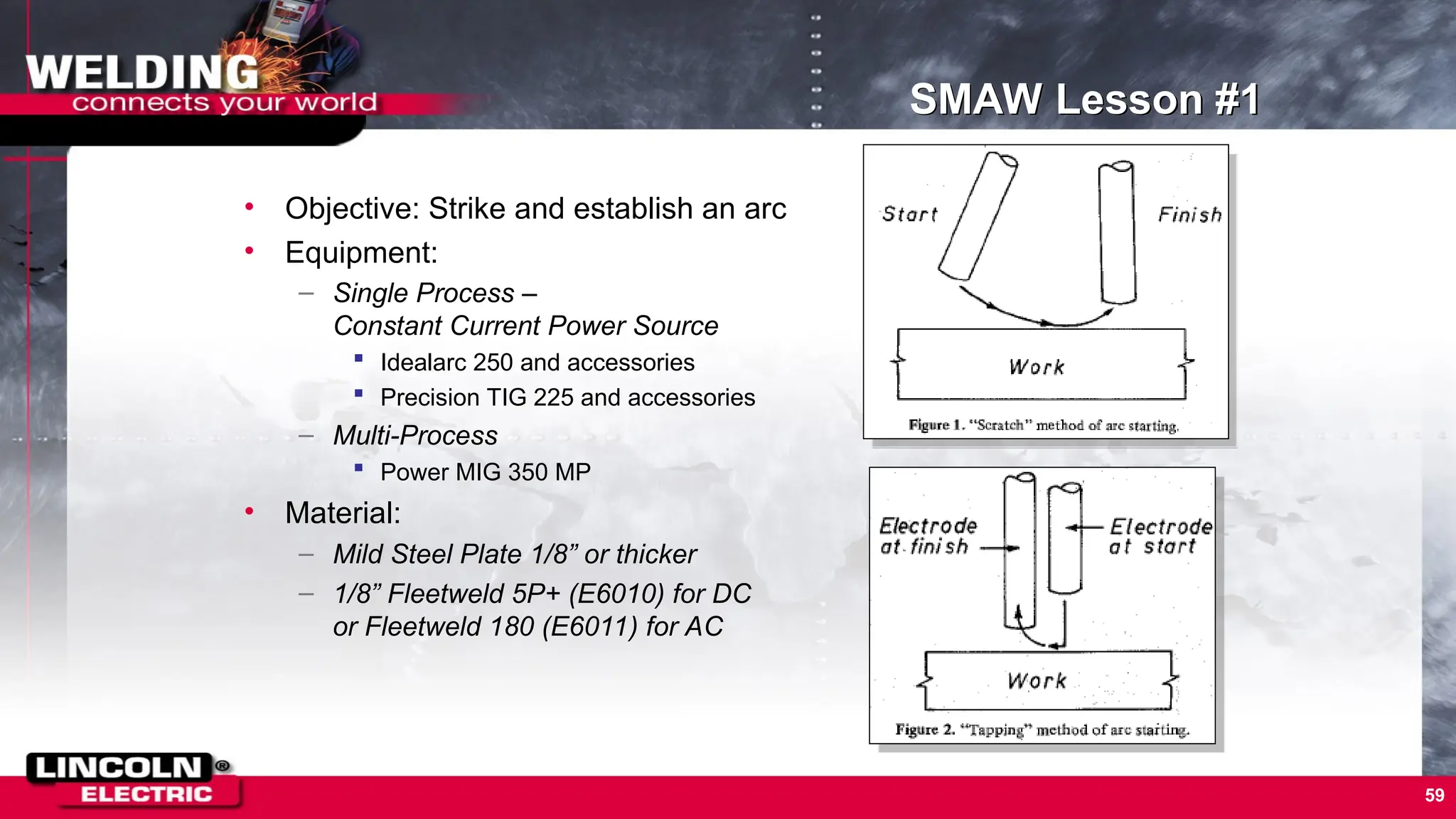
Striking an Arc
•To begin the SMAW Process, you must first strike an arc. This can be done
using one of the following techniques:
– Scratch start – scratch the electrode on the base metal like a match
– Tap Start – tap the rod against the base metal
45.
45
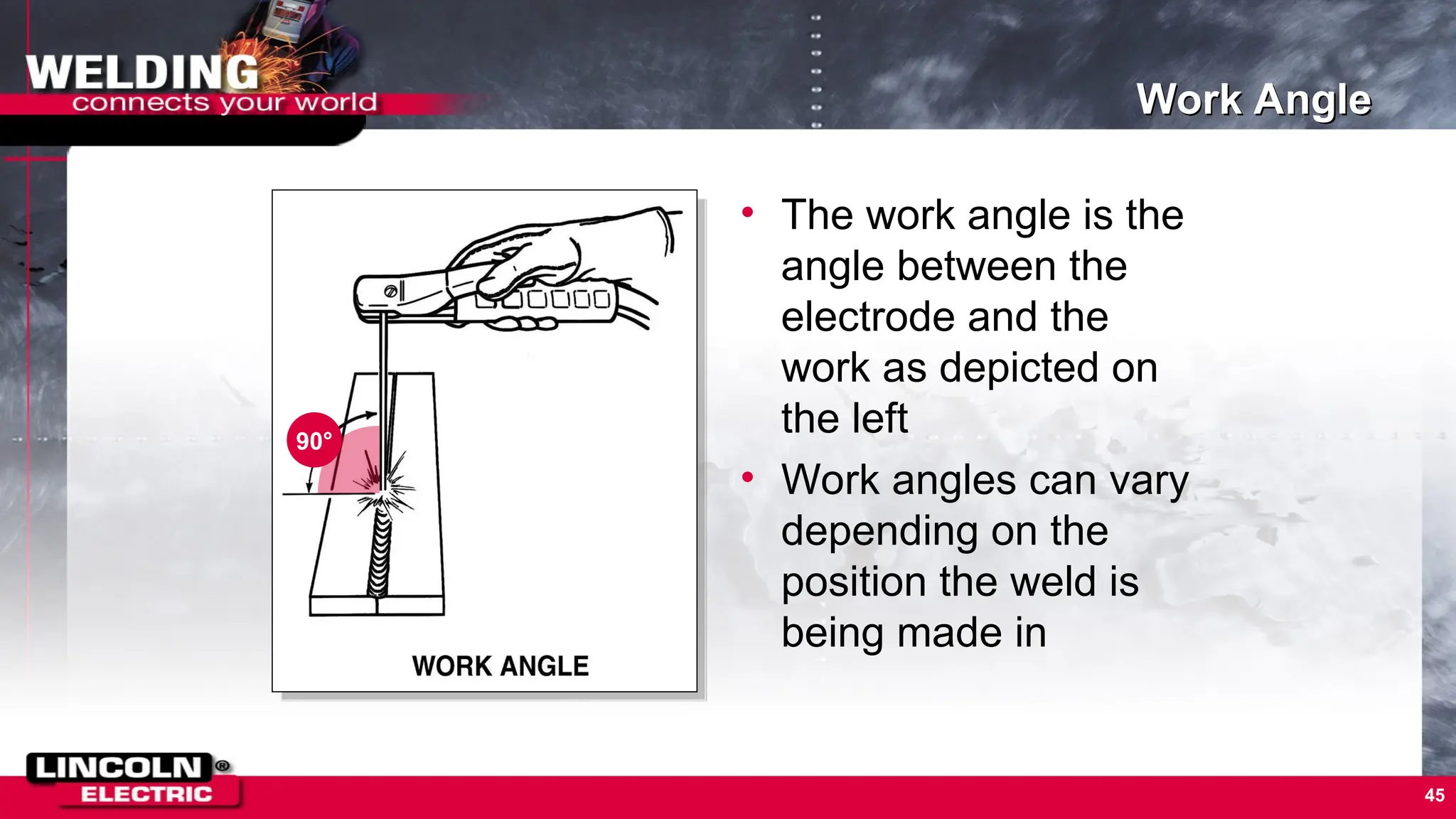
Work Angle
• Thework angle is the
angle between the
electrode and the
work as depicted on
the left
• Work angles can vary
depending on the
position the weld is
being made in
90°
46.
46
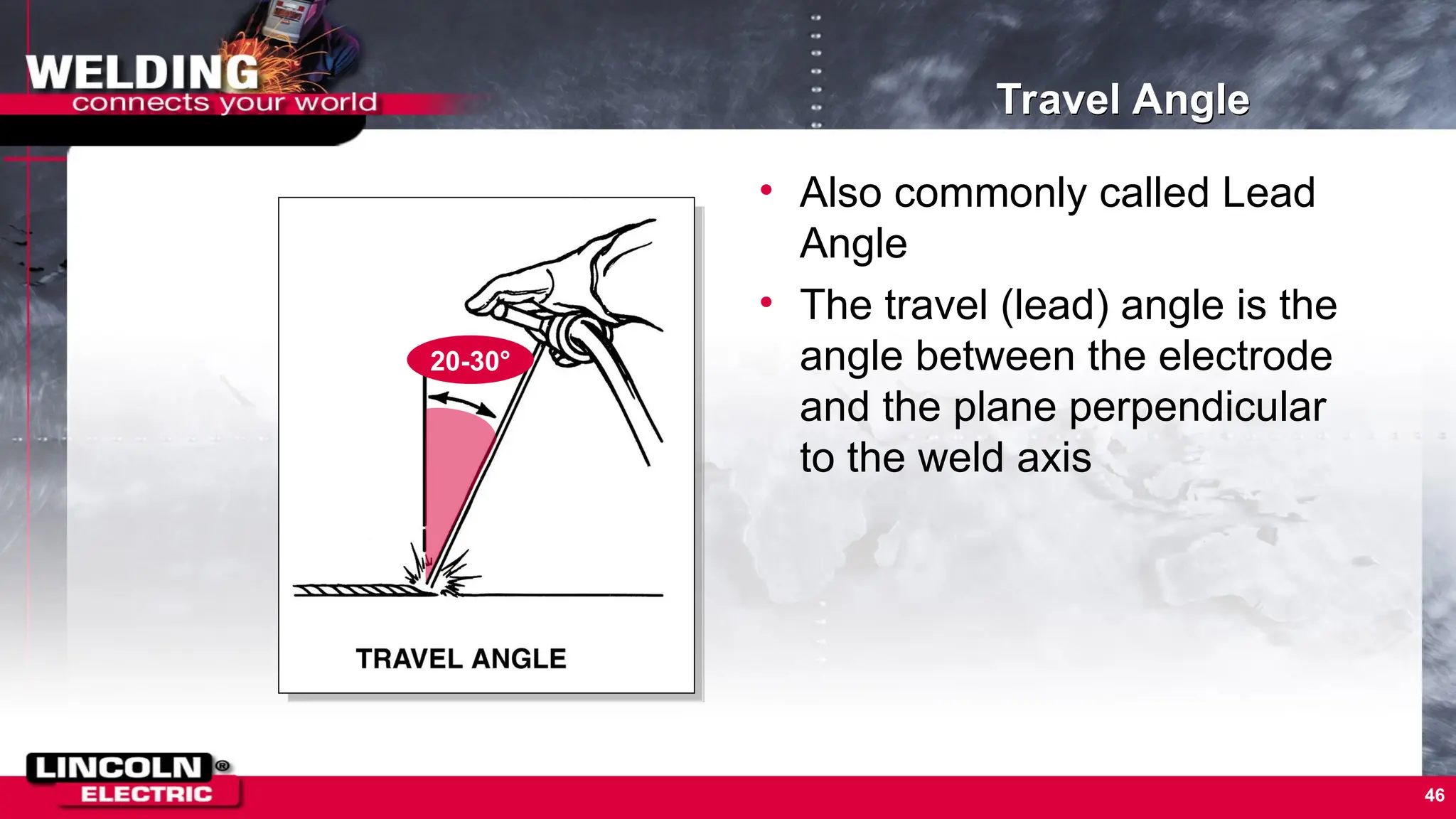
Travel Angle
• Alsocommonly called Lead
Angle
• The travel (lead) angle is the
angle between the electrode
and the plane perpendicular
to the weld axis
20-30°
47.
47
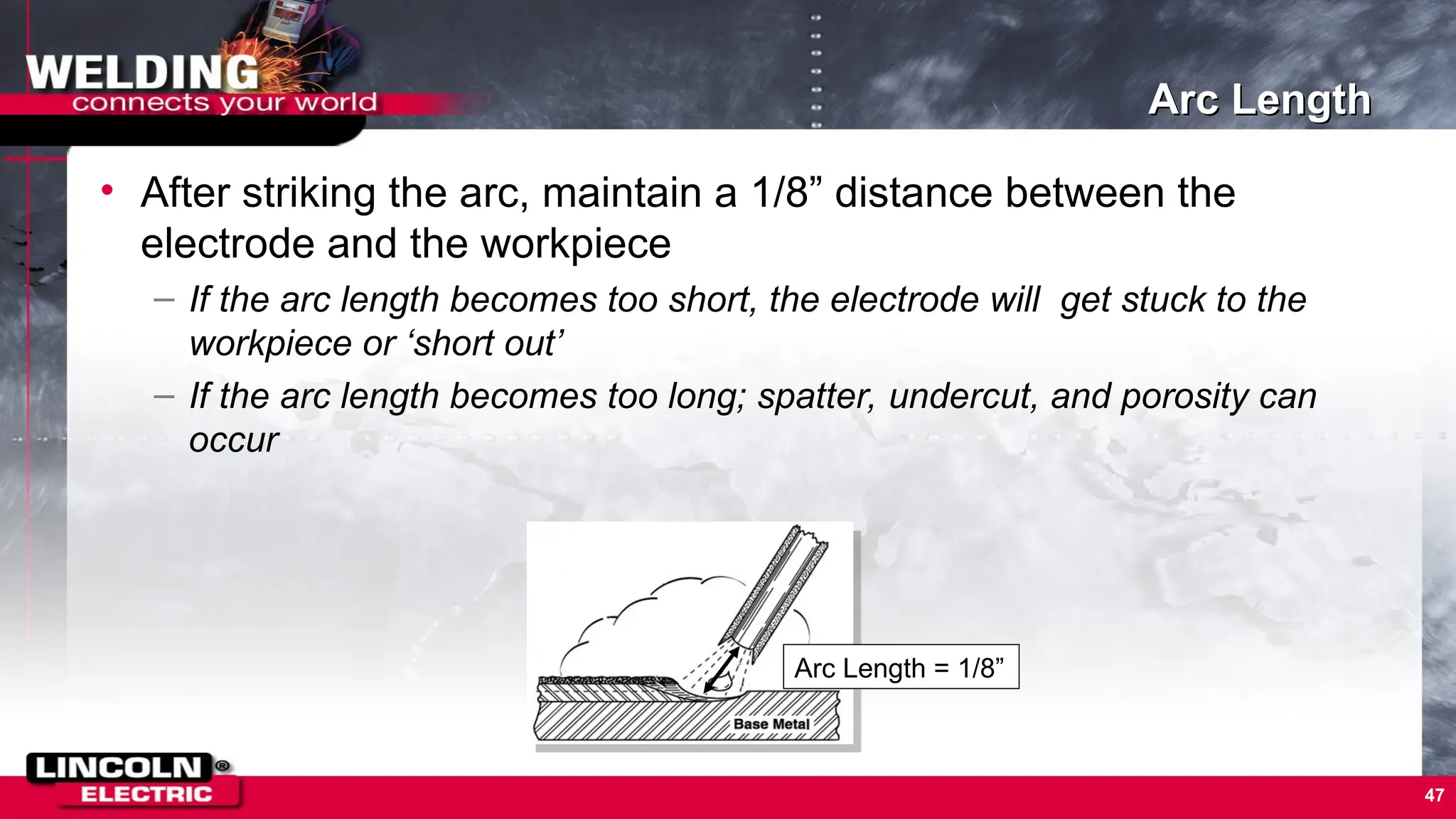
Arc Length
• Afterstriking the arc, maintain a 1/8” distance between the
electrode and the workpiece
– If the arc length becomes too short, the electrode will get stuck to the
workpiece or ‘short out’
– If the arc length becomes too long; spatter, undercut, and porosity can
occur
Arc Length = 1/8”
48.
48
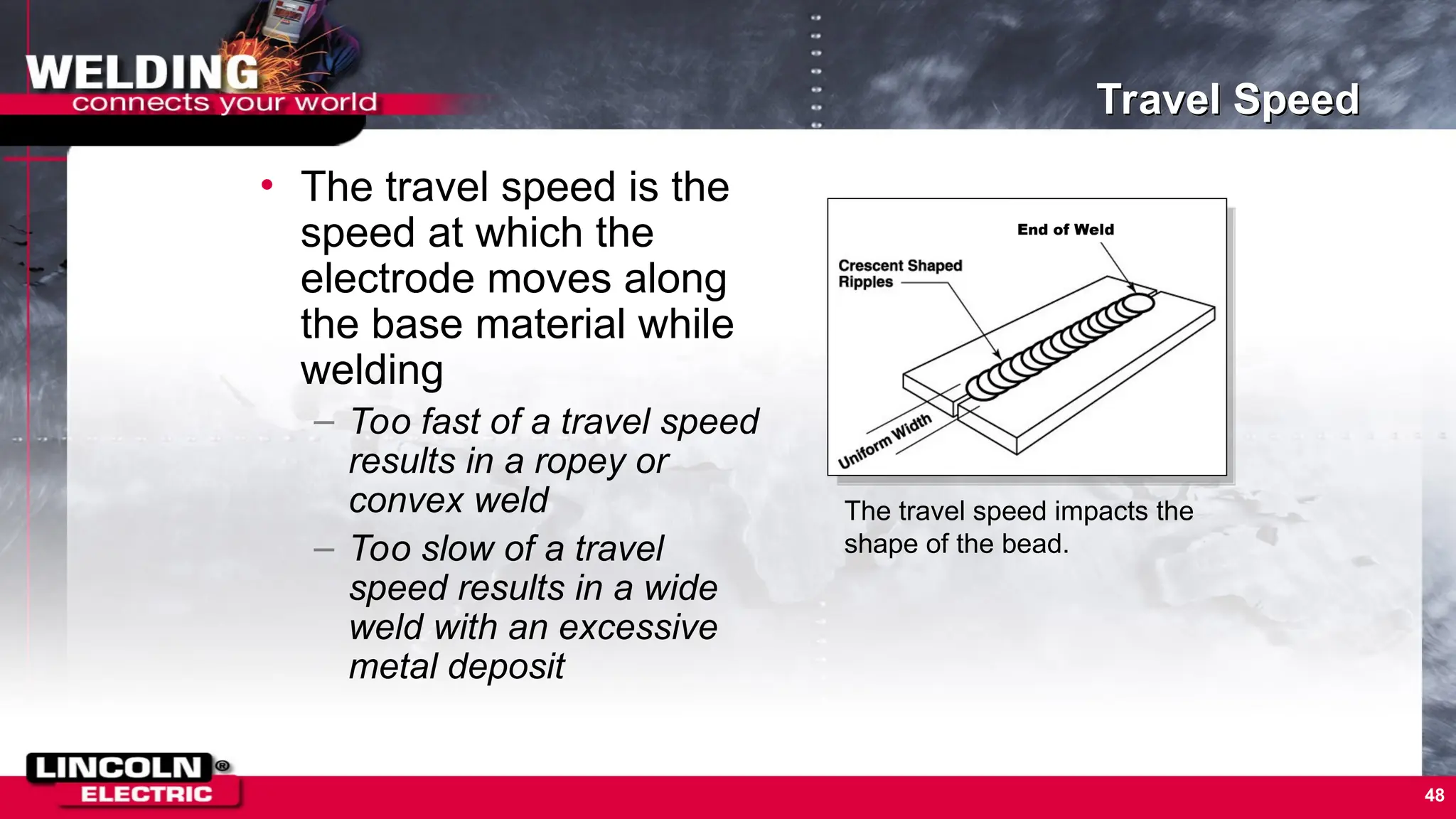
Travel Speed
• Thetravel speed is the
speed at which the
electrode moves along
the base material while
welding
– Too fast of a travel speed
results in a ropey or
convex weld
– Too slow of a travel
speed results in a wide
weld with an excessive
metal deposit
The travel speed impacts the
shape of the bead.
End of Weld
49.
49
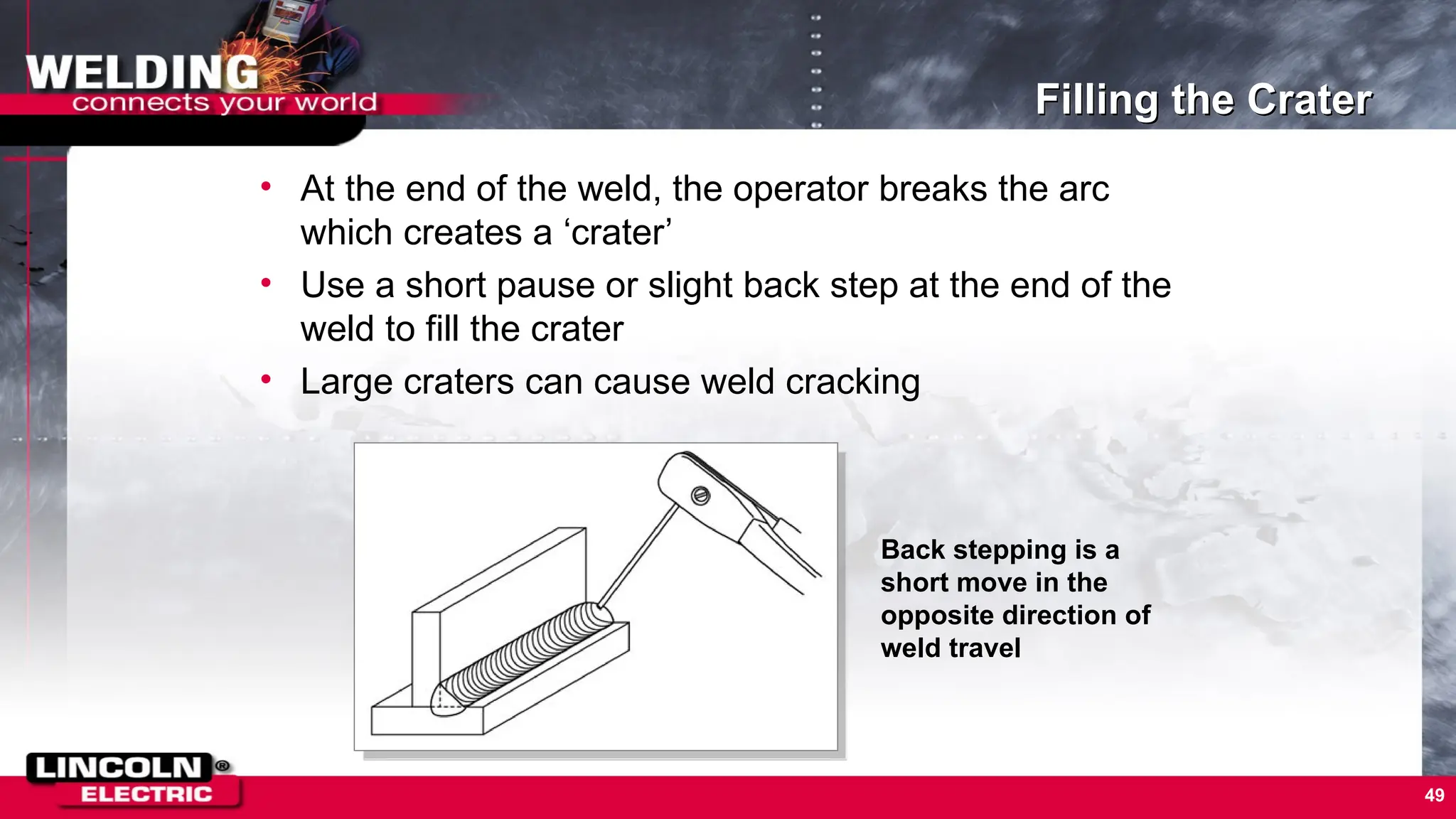
Filling the Crater
•At the end of the weld, the operator breaks the arc
which creates a ‘crater’
• Use a short pause or slight back step at the end of the
weld to fill the crater
• Large craters can cause weld cracking
Back stepping is a
short move in the
opposite direction of
weld travel
50.
50
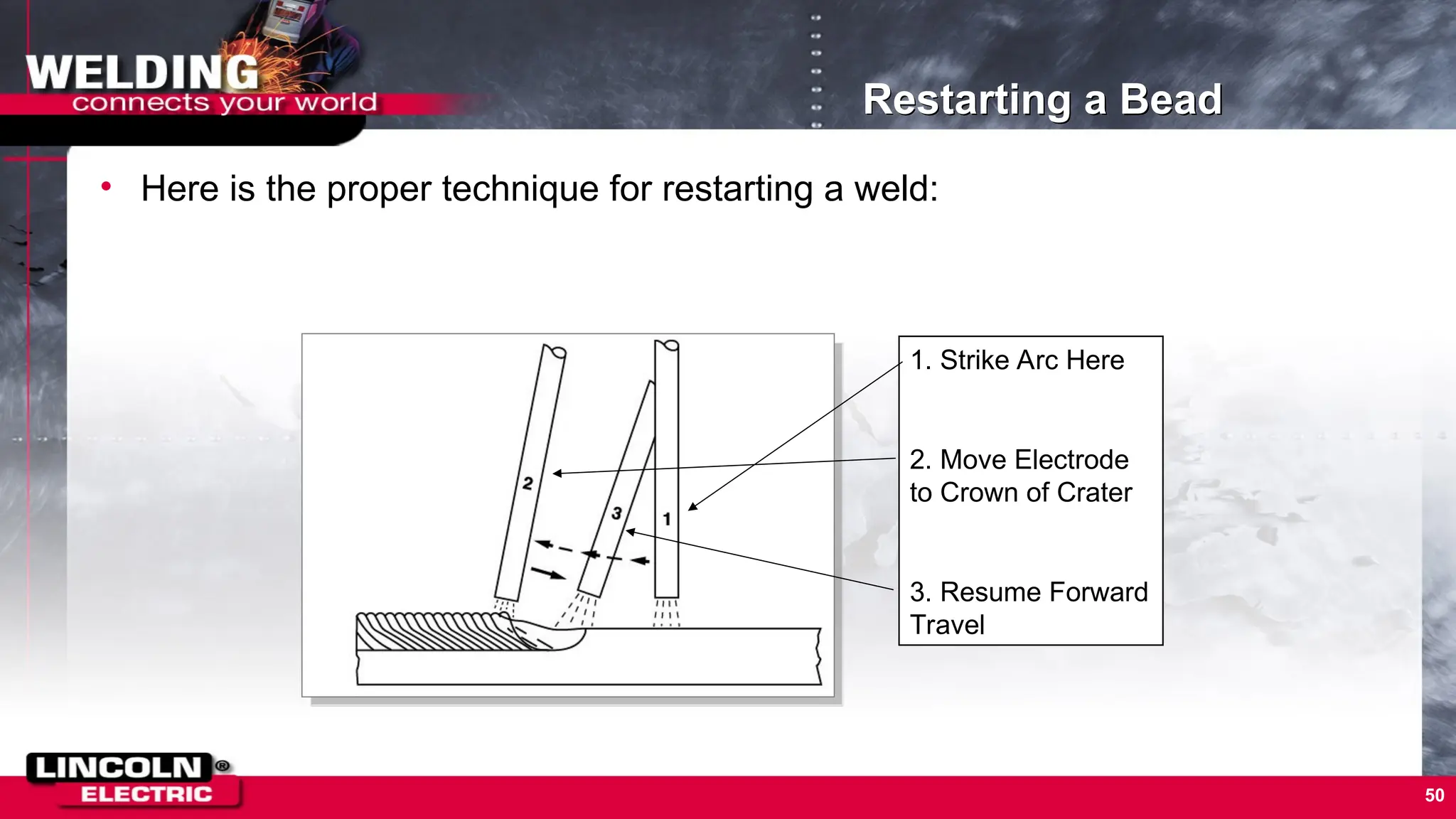
Restarting a Bead
•Here is the proper technique for restarting a weld:
1. Strike Arc Here
2. Move Electrode
to Crown of Crater
3. Resume Forward
Travel
54
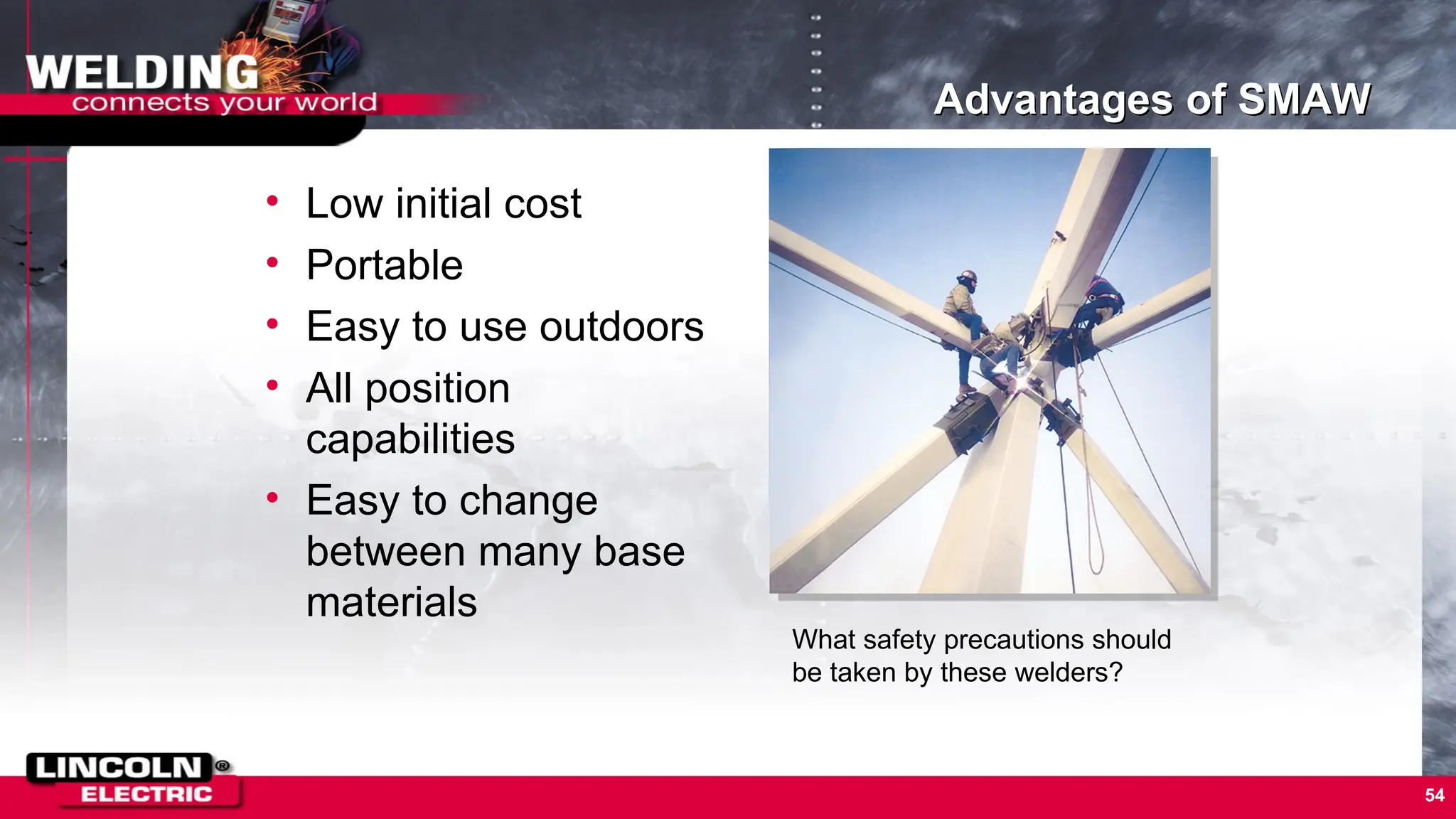
Advantages of SMAW
•Low initial cost
• Portable
• Easy to use outdoors
• All position
capabilities
• Easy to change
between many base
materials
What safety precautions should
be taken by these welders?
55.
55
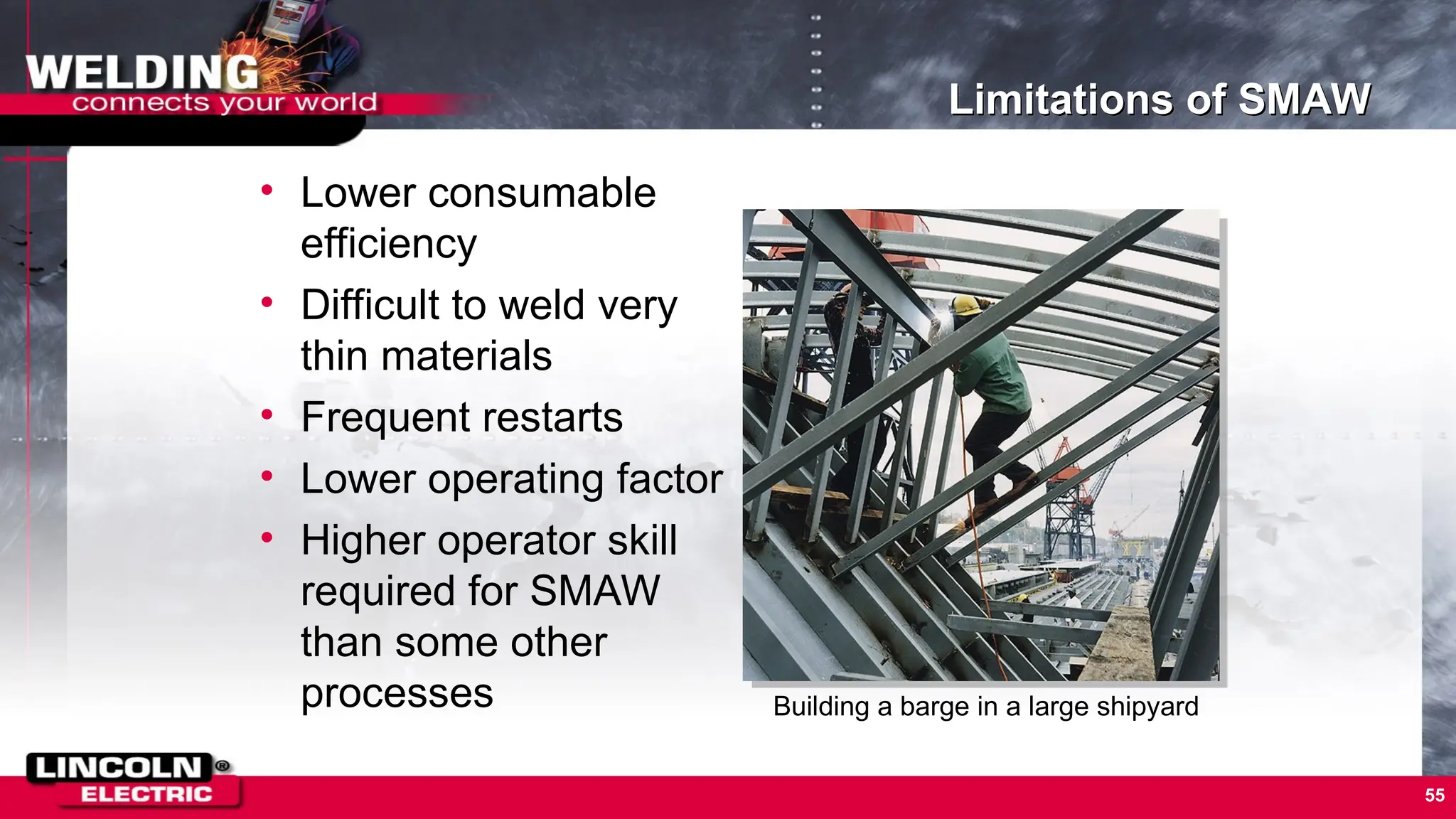
Limitations of SMAW
•Lower consumable
efficiency
• Difficult to weld very
thin materials
• Frequent restarts
• Lower operating factor
• Higher operator skill
required for SMAW
than some other
processes Building a barge in a large shipyard
59
SMAW Lesson #1
•Objective: Strike and establish an arc
• Equipment:
– Single Process –
Constant Current Power Source
Idealarc 250 and accessories
Precision TIG 225 and accessories
– Multi-Process
Power MIG 350 MP
• Material:
– Mild Steel Plate 1/8” or thicker
– 1/8” Fleetweld 5P+ (E6010) for DC
or Fleetweld 180 (E6011) for AC
60.
60
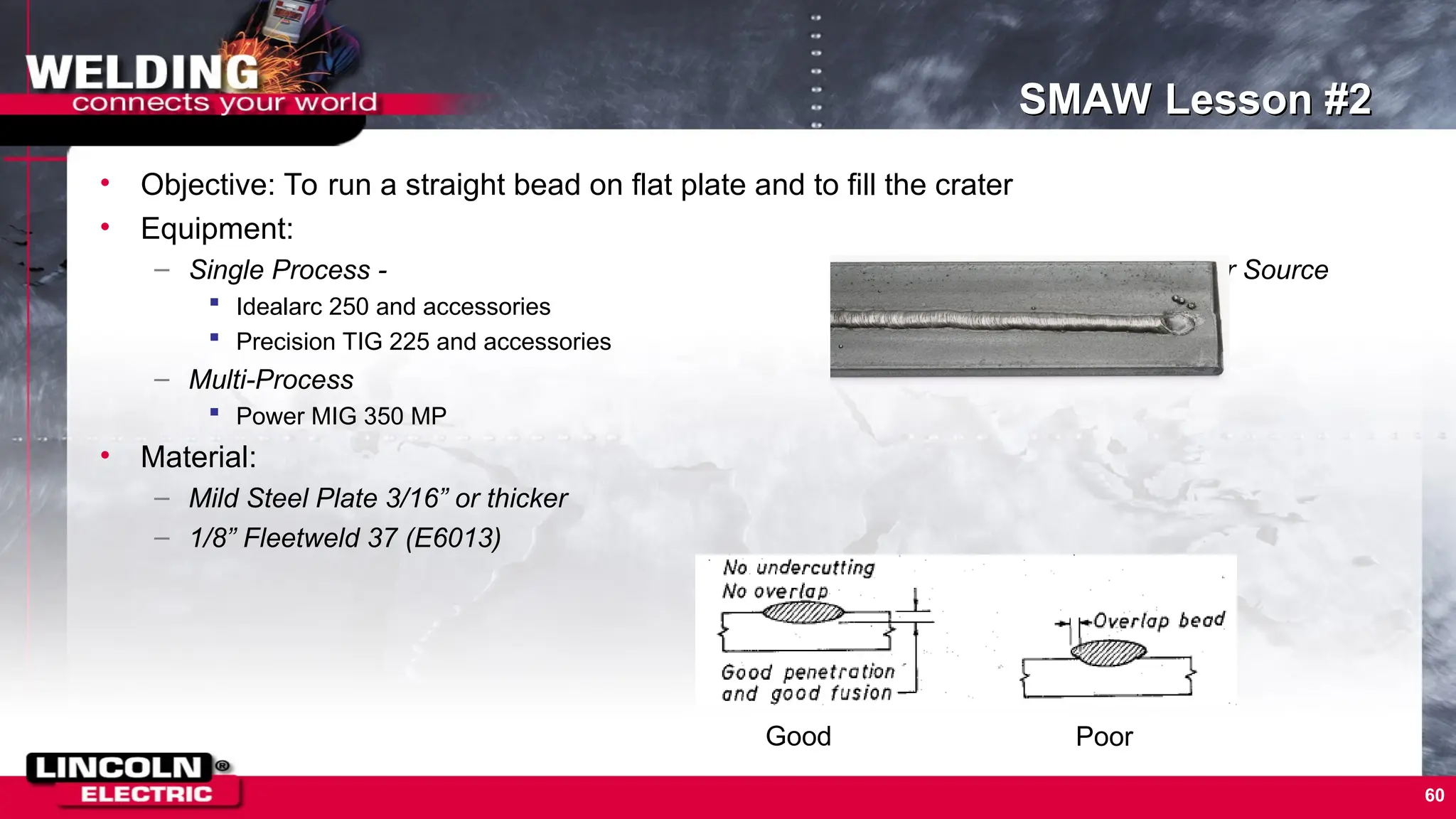
SMAW Lesson #2
•Objective: To run a straight bead on flat plate and to fill the crater
• Equipment:
– Single Process - Constant Current Power Source
Idealarc 250 and accessories
Precision TIG 225 and accessories
– Multi-Process
Power MIG 350 MP
• Material:
– Mild Steel Plate 3/16” or thicker
– 1/8” Fleetweld 37 (E6013)
Good Poor
61.
61
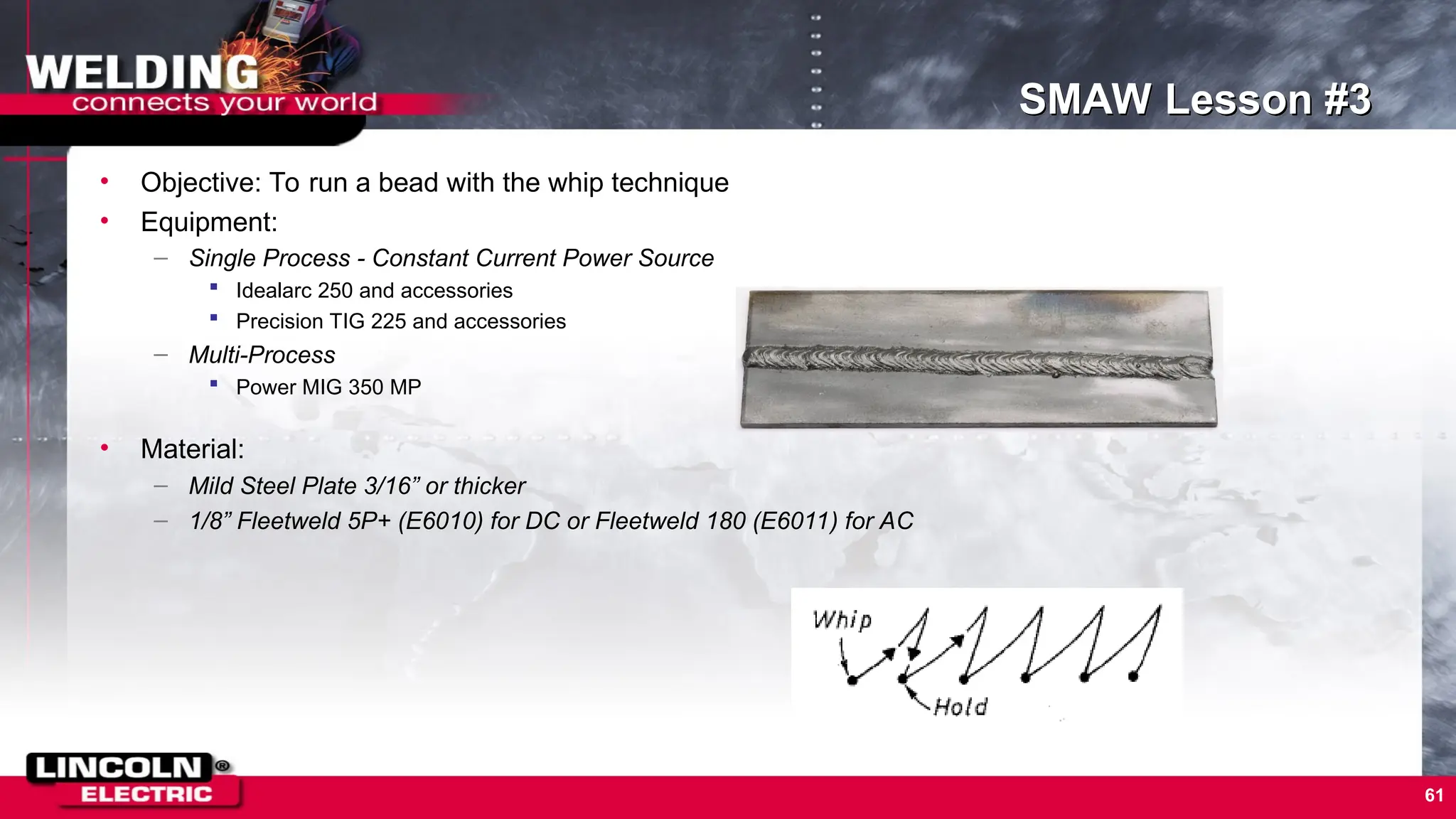
SMAW Lesson #3
•Objective: To run a bead with the whip technique
• Equipment:
– Single Process - Constant Current Power Source
Idealarc 250 and accessories
Precision TIG 225 and accessories
– Multi-Process
Power MIG 350 MP
• Material:
– Mild Steel Plate 3/16” or thicker
– 1/8” Fleetweld 5P+ (E6010) for DC or Fleetweld 180 (E6011) for AC
62.
62
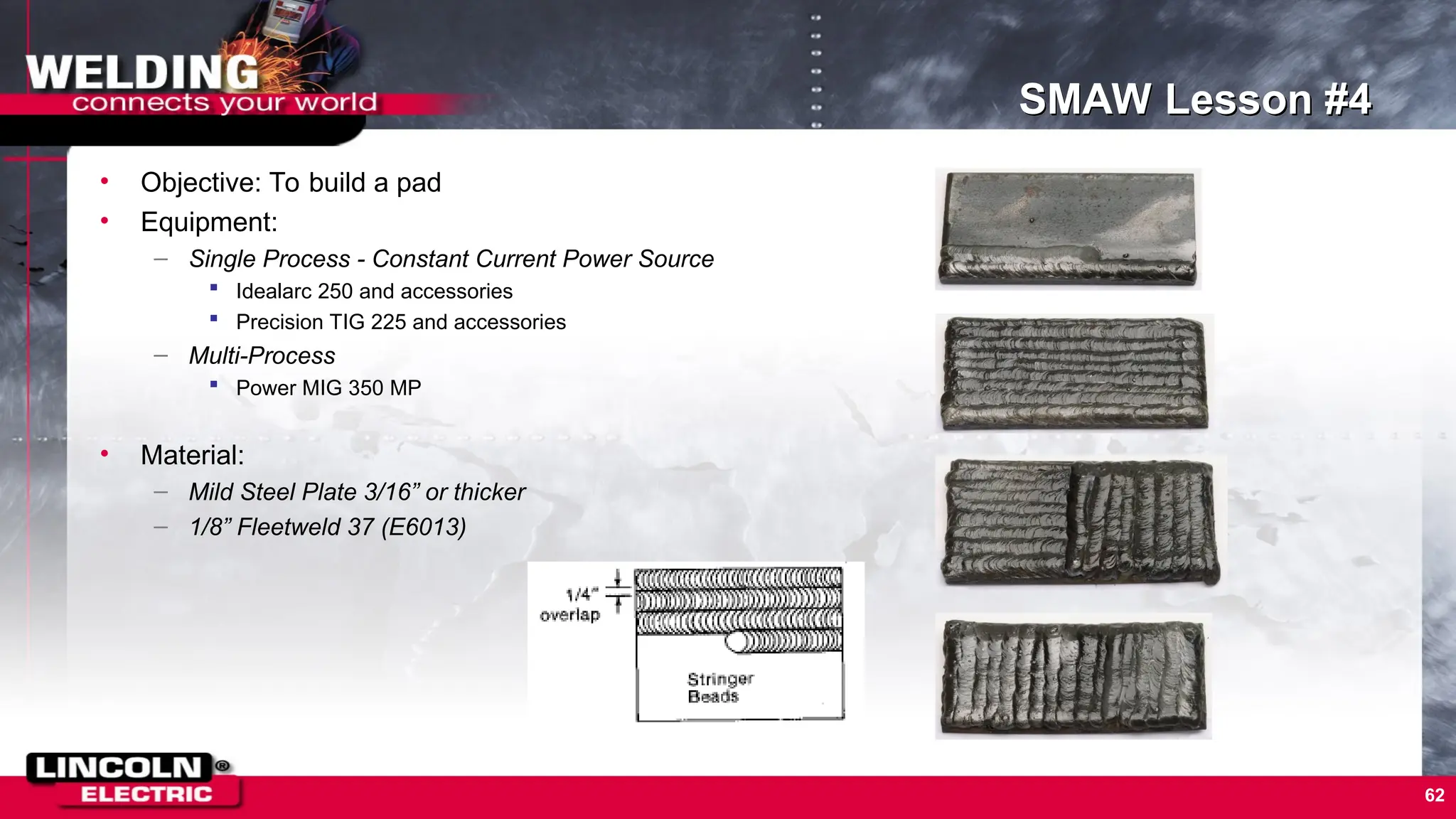
SMAW Lesson #4
•Objective: To build a pad
• Equipment:
– Single Process - Constant Current Power Source
Idealarc 250 and accessories
Precision TIG 225 and accessories
– Multi-Process
Power MIG 350 MP
• Material:
– Mild Steel Plate 3/16” or thicker
– 1/8” Fleetweld 37 (E6013)
63.
63
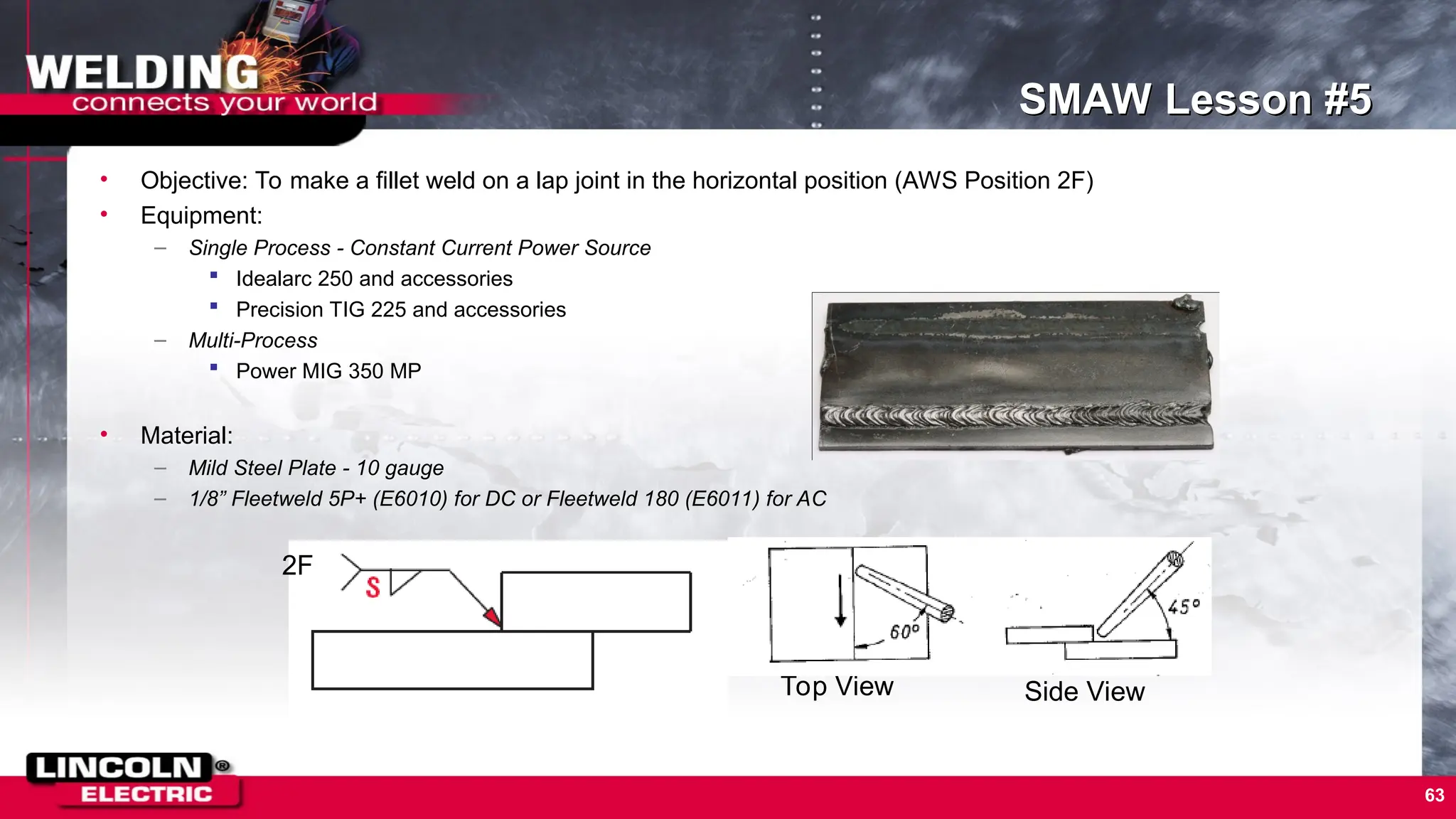
SMAW Lesson #5
•Objective: To make a fillet weld on a lap joint in the horizontal position (AWS Position 2F)
• Equipment:
– Single Process - Constant Current Power Source
Idealarc 250 and accessories
Precision TIG 225 and accessories
– Multi-Process
Power MIG 350 MP
• Material:
– Mild Steel Plate - 10 gauge
– 1/8” Fleetweld 5P+ (E6010) for DC or Fleetweld 180 (E6011) for AC
2F
Top View Side View
64.
64
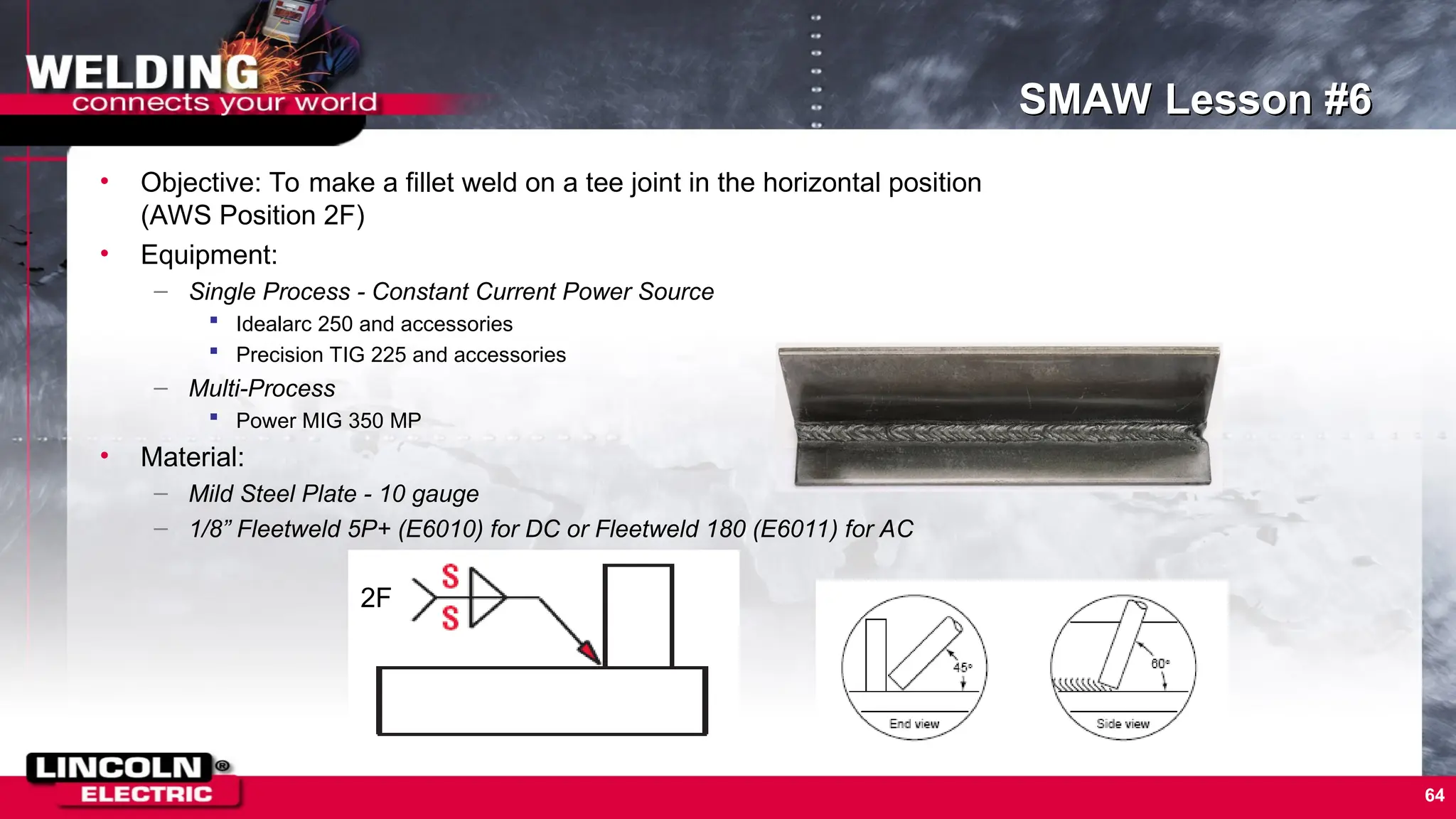
SMAW Lesson #6
•Objective: To make a fillet weld on a tee joint in the horizontal position
(AWS Position 2F)
• Equipment:
– Single Process - Constant Current Power Source
Idealarc 250 and accessories
Precision TIG 225 and accessories
– Multi-Process
Power MIG 350 MP
• Material:
– Mild Steel Plate - 10 gauge
– 1/8” Fleetweld 5P+ (E6010) for DC or Fleetweld 180 (E6011) for AC
2F
65.
65
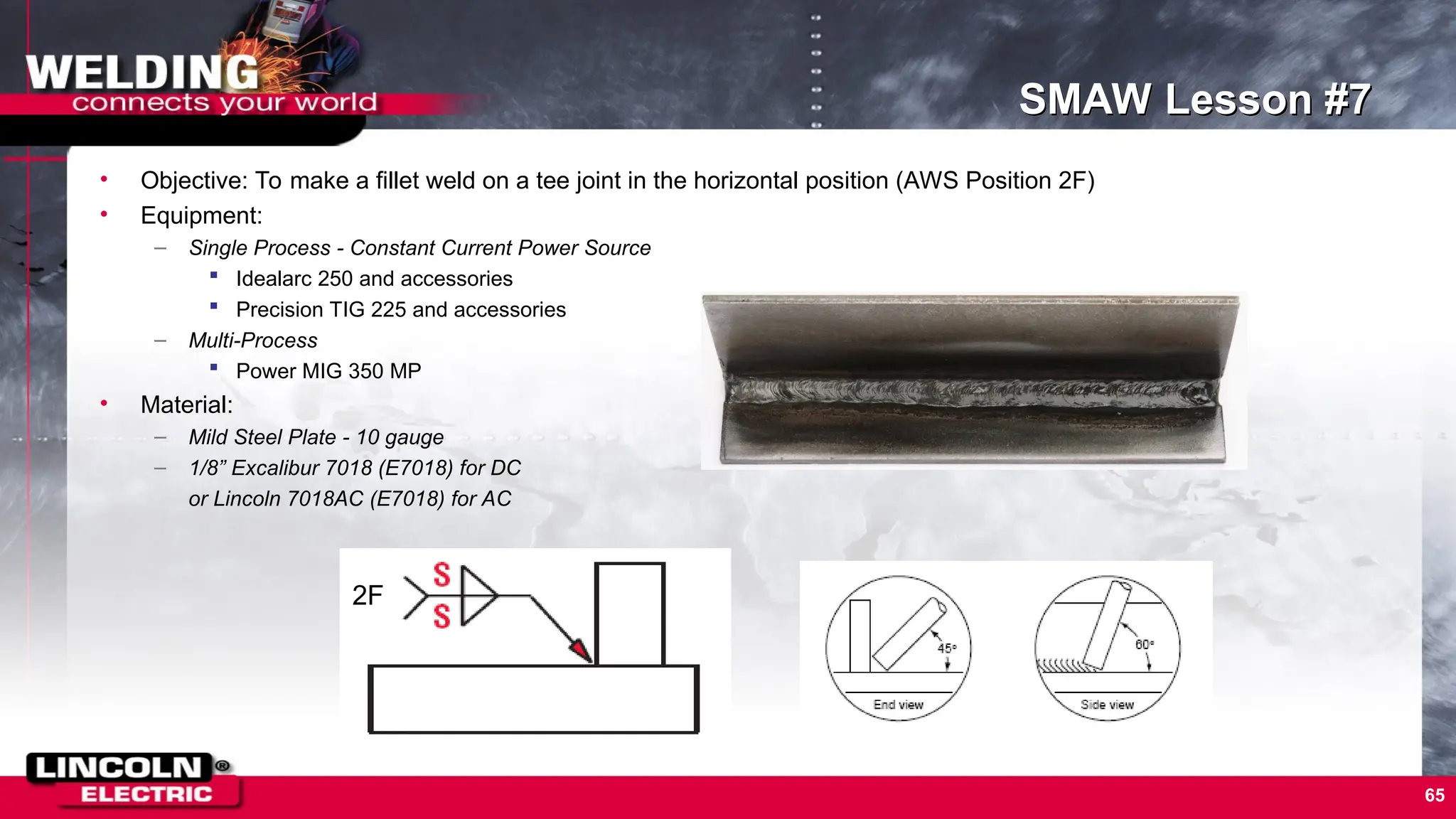
SMAW Lesson #7
•Objective: To make a fillet weld on a tee joint in the horizontal position (AWS Position 2F)
• Equipment:
– Single Process - Constant Current Power Source
Idealarc 250 and accessories
Precision TIG 225 and accessories
– Multi-Process
Power MIG 350 MP
• Material:
– Mild Steel Plate - 10 gauge
– 1/8” Excalibur 7018 (E7018) for DC
or Lincoln 7018AC (E7018) for AC
2F
66.
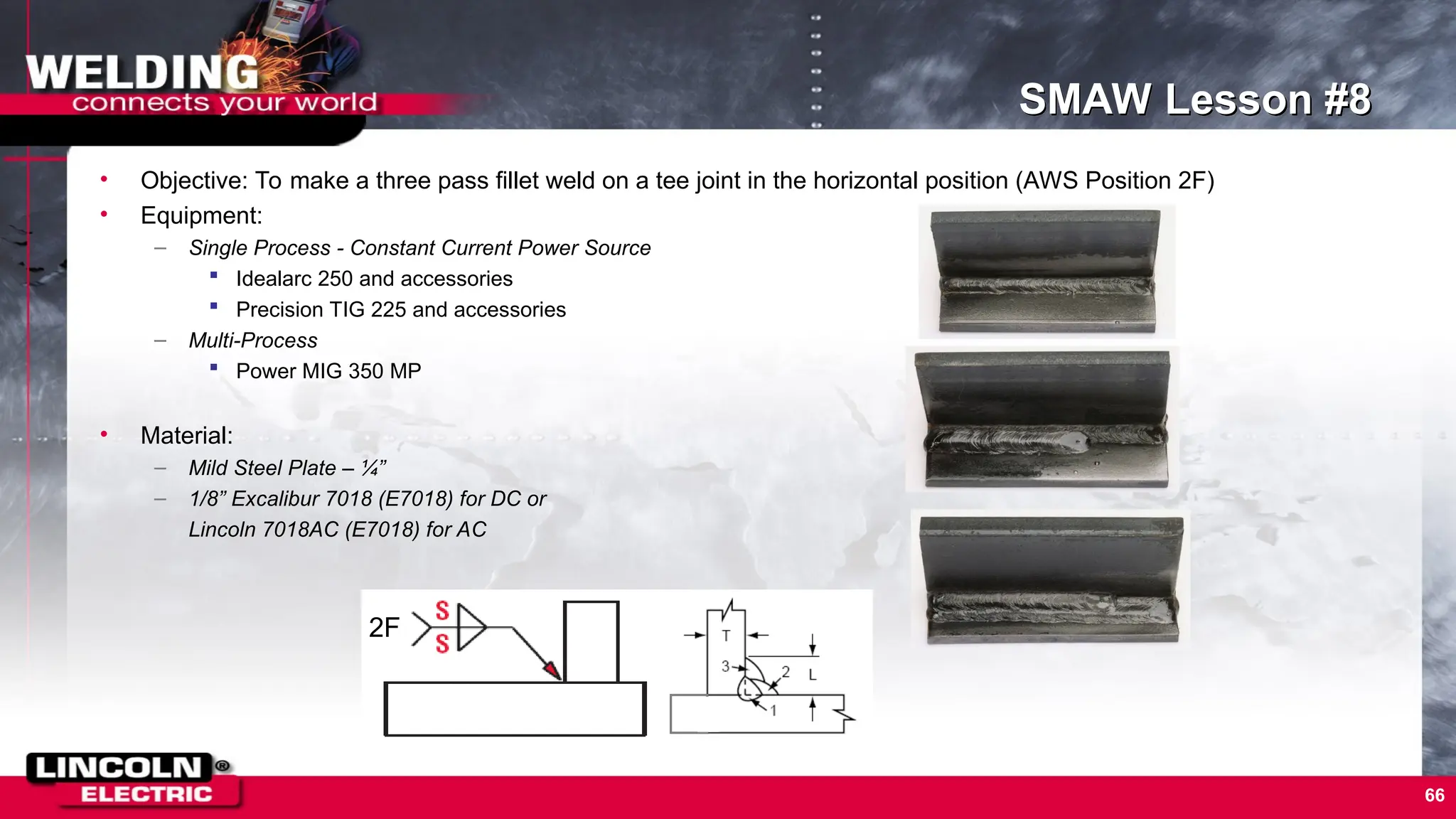
66
SMAW Lesson #8
•Objective: To make a three pass fillet weld on a tee joint in the horizontal position (AWS Position 2F)
• Equipment:
– Single Process - Constant Current Power Source
Idealarc 250 and accessories
Precision TIG 225 and accessories
– Multi-Process
Power MIG 350 MP
• Material:
– Mild Steel Plate – ¼”
– 1/8” Excalibur 7018 (E7018) for DC or
Lincoln 7018AC (E7018) for AC
2F
67.
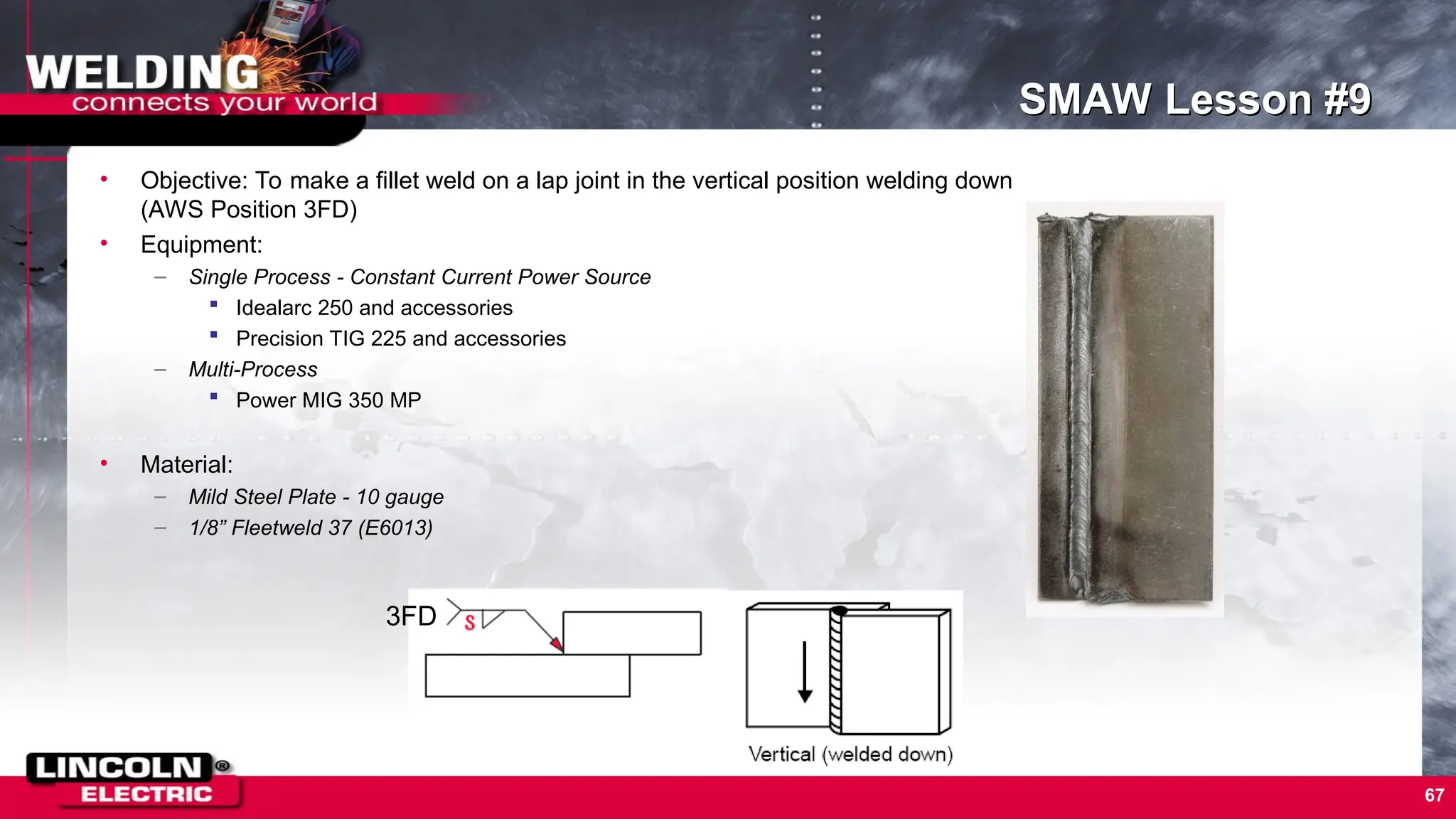
67
SMAW Lesson #9
•Objective: To make a fillet weld on a lap joint in the vertical position welding down
(AWS Position 3FD)
• Equipment:
– Single Process - Constant Current Power Source
Idealarc 250 and accessories
Precision TIG 225 and accessories
– Multi-Process
Power MIG 350 MP
• Material:
– Mild Steel Plate - 10 gauge
– 1/8” Fleetweld 37 (E6013)
3FD
68.
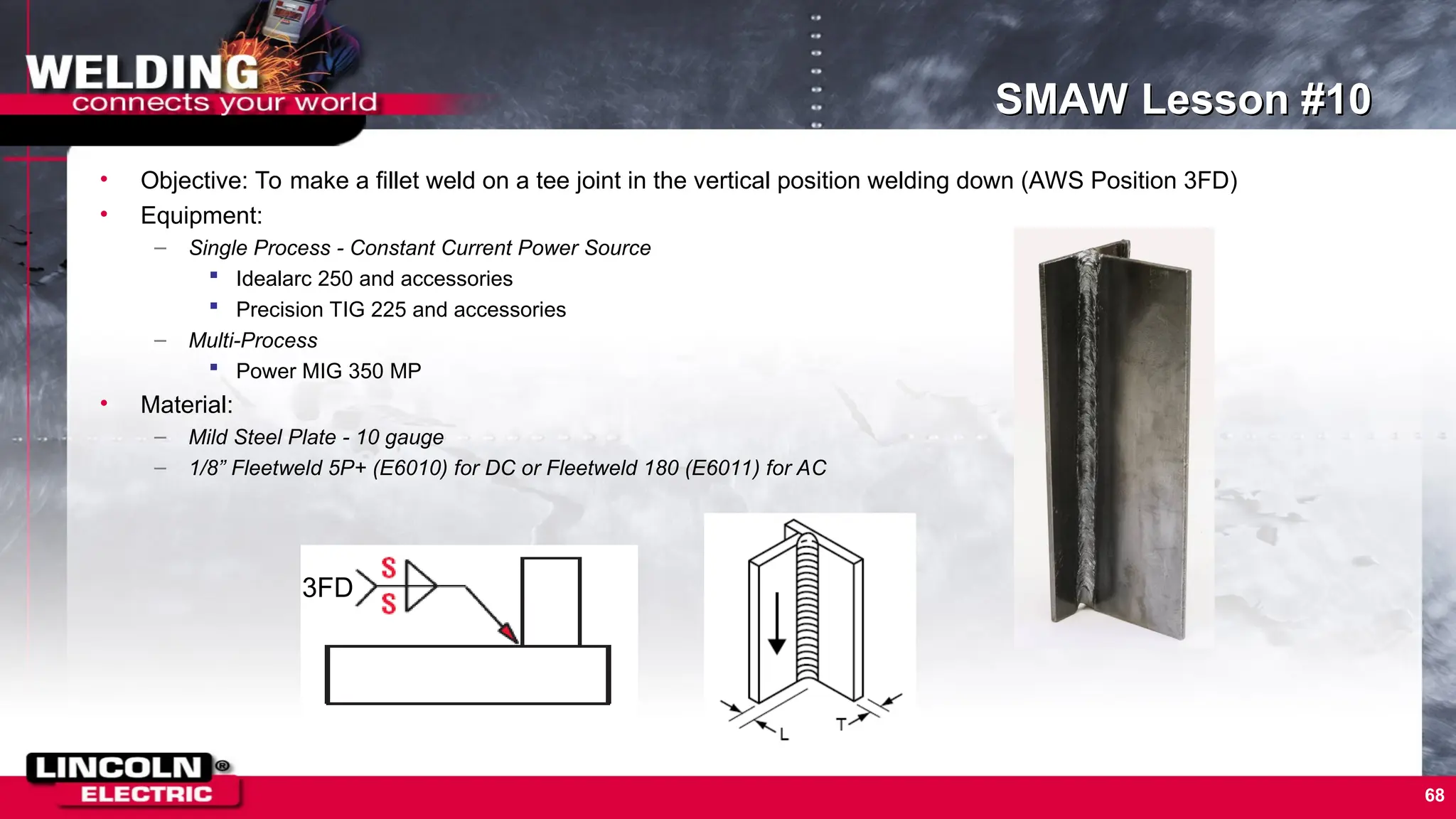
68
SMAW Lesson #10
•Objective: To make a fillet weld on a tee joint in the vertical position welding down (AWS Position 3FD)
• Equipment:
– Single Process - Constant Current Power Source
Idealarc 250 and accessories
Precision TIG 225 and accessories
– Multi-Process
Power MIG 350 MP
• Material:
– Mild Steel Plate - 10 gauge
– 1/8” Fleetweld 5P+ (E6010) for DC or Fleetweld 180 (E6011) for AC
3FD
69.
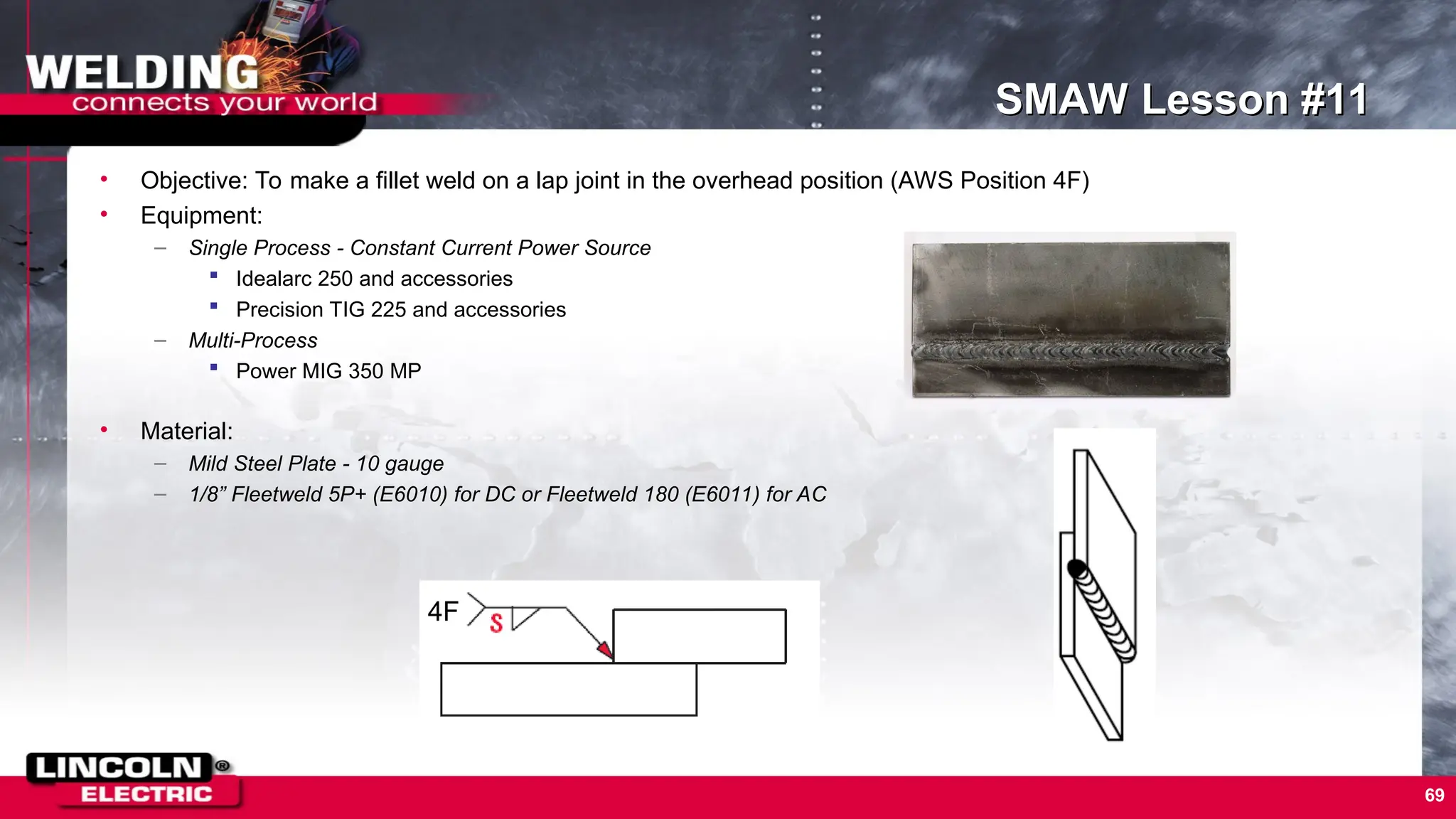
69
SMAW Lesson #11
•Objective: To make a fillet weld on a lap joint in the overhead position (AWS Position 4F)
• Equipment:
– Single Process - Constant Current Power Source
Idealarc 250 and accessories
Precision TIG 225 and accessories
– Multi-Process
Power MIG 350 MP
• Material:
– Mild Steel Plate - 10 gauge
– 1/8” Fleetweld 5P+ (E6010) for DC or Fleetweld 180 (E6011) for AC
4F
70.
70
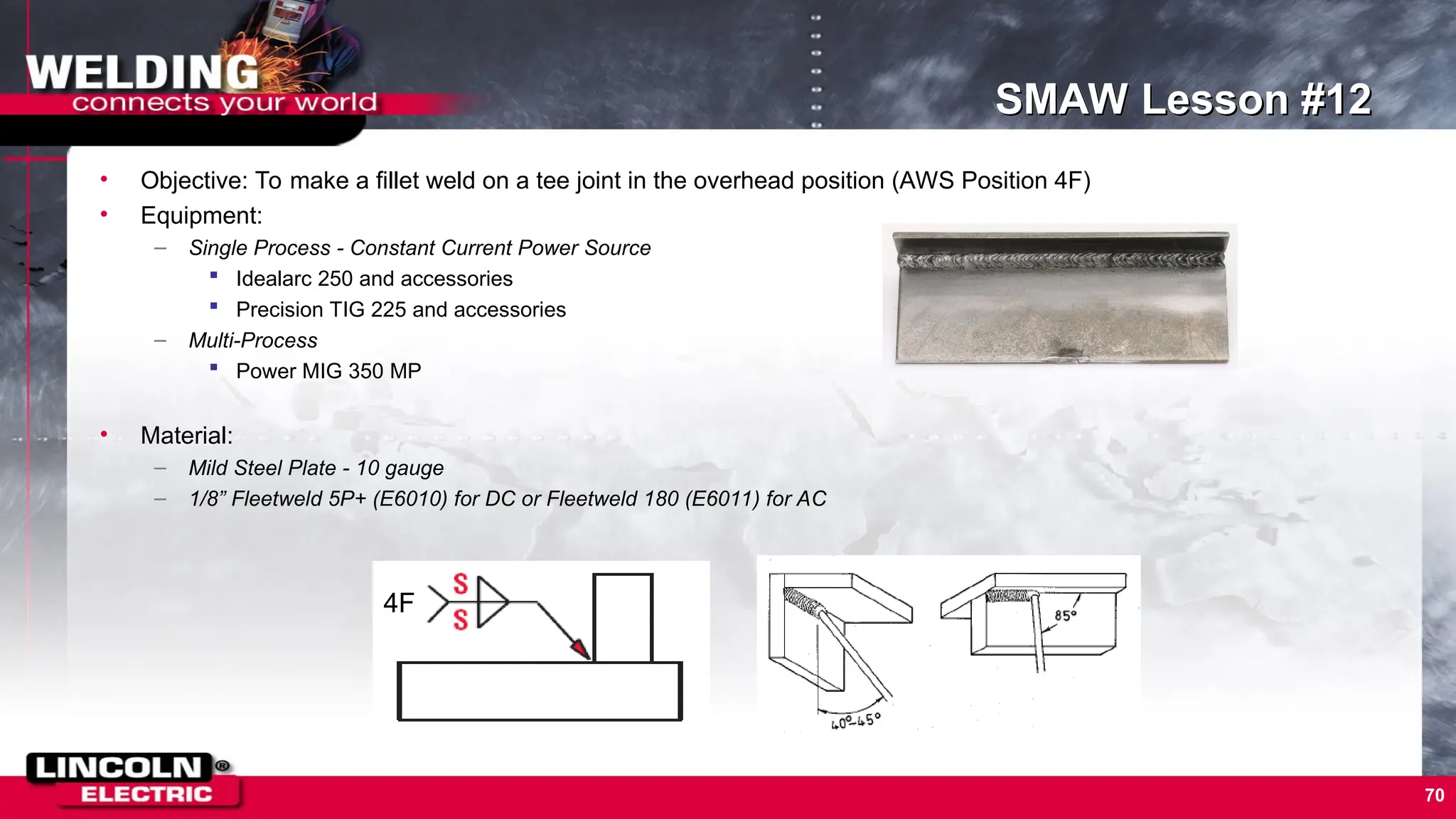
SMAW Lesson #12
•Objective: To make a fillet weld on a tee joint in the overhead position (AWS Position 4F)
• Equipment:
– Single Process - Constant Current Power Source
Idealarc 250 and accessories
Precision TIG 225 and accessories
– Multi-Process
Power MIG 350 MP
• Material:
– Mild Steel Plate - 10 gauge
– 1/8” Fleetweld 5P+ (E6010) for DC or Fleetweld 180 (E6011) for AC
4F
71.
71
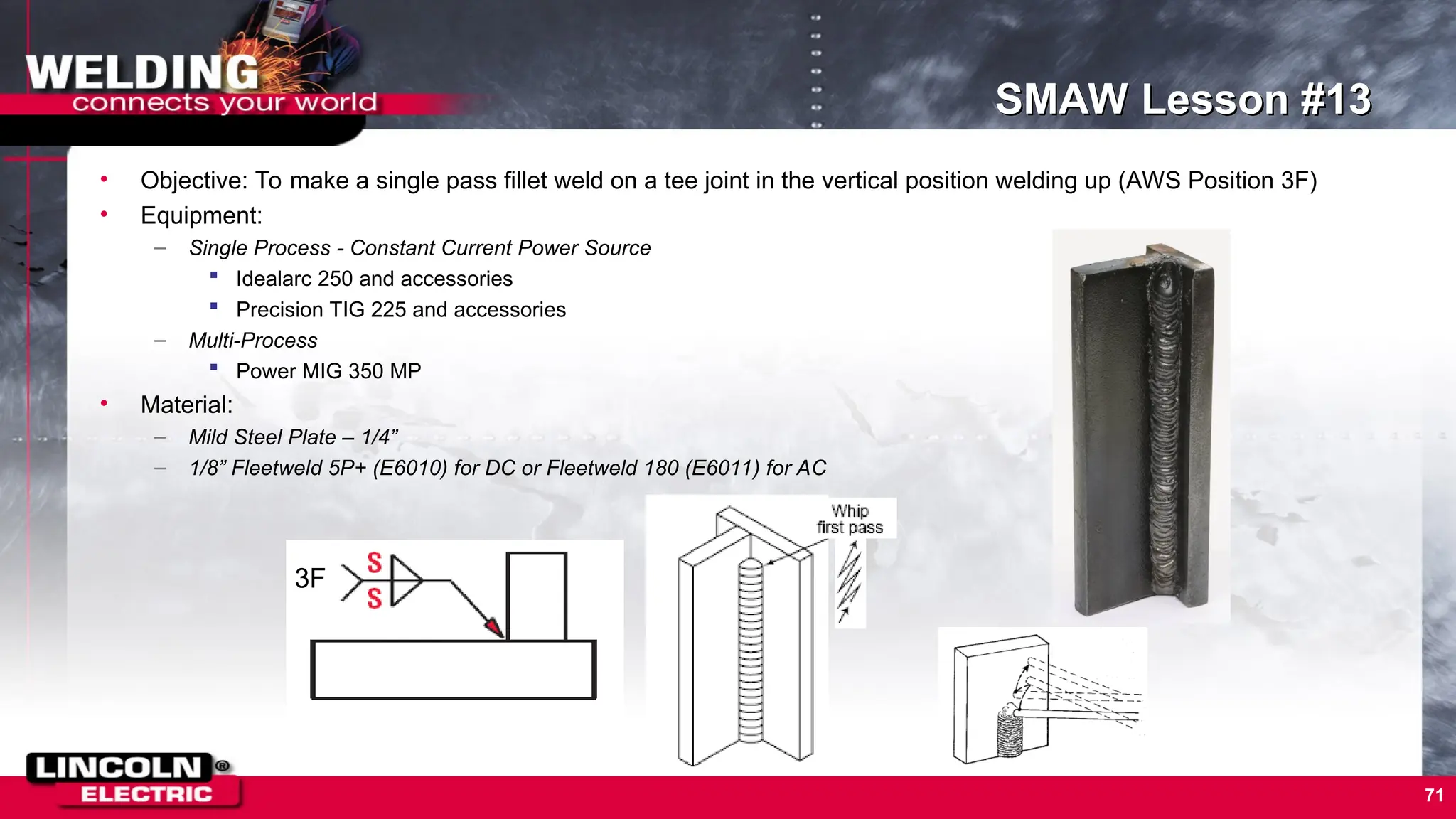
SMAW Lesson #13
•Objective: To make a single pass fillet weld on a tee joint in the vertical position welding up (AWS Position 3F)
• Equipment:
– Single Process - Constant Current Power Source
Idealarc 250 and accessories
Precision TIG 225 and accessories
– Multi-Process
Power MIG 350 MP
• Material:
– Mild Steel Plate – 1/4”
– 1/8” Fleetweld 5P+ (E6010) for DC or Fleetweld 180 (E6011) for AC
3F
72.
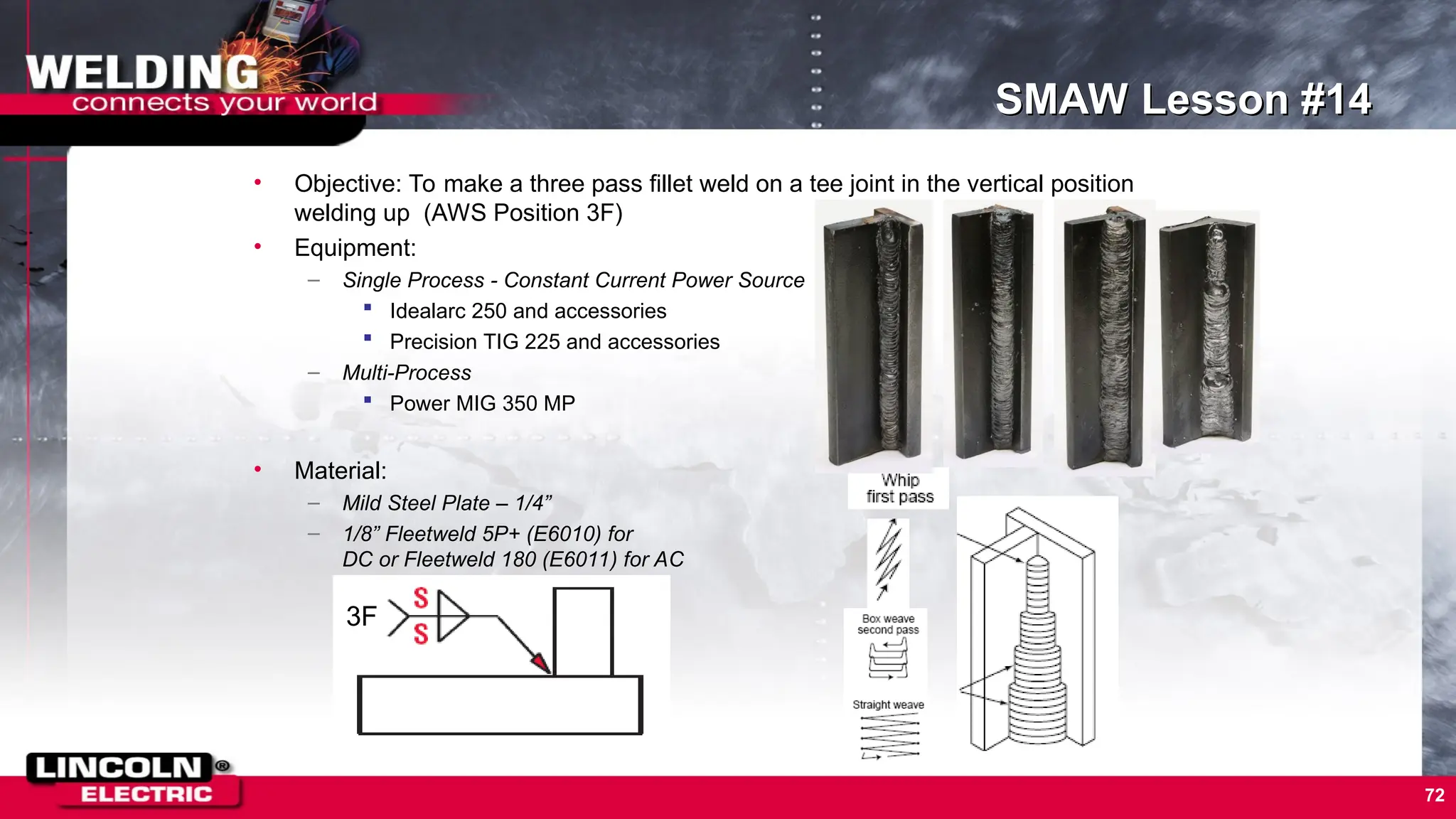
72
SMAW Lesson #14
3F
•Objective: To make a three pass fillet weld on a tee joint in the vertical position
welding up (AWS Position 3F)
• Equipment:
– Single Process - Constant Current Power Source
Idealarc 250 and accessories
Precision TIG 225 and accessories
– Multi-Process
Power MIG 350 MP
• Material:
– Mild Steel Plate – 1/4”
– 1/8” Fleetweld 5P+ (E6010) for
DC or Fleetweld 180 (E6011) for AC
73.
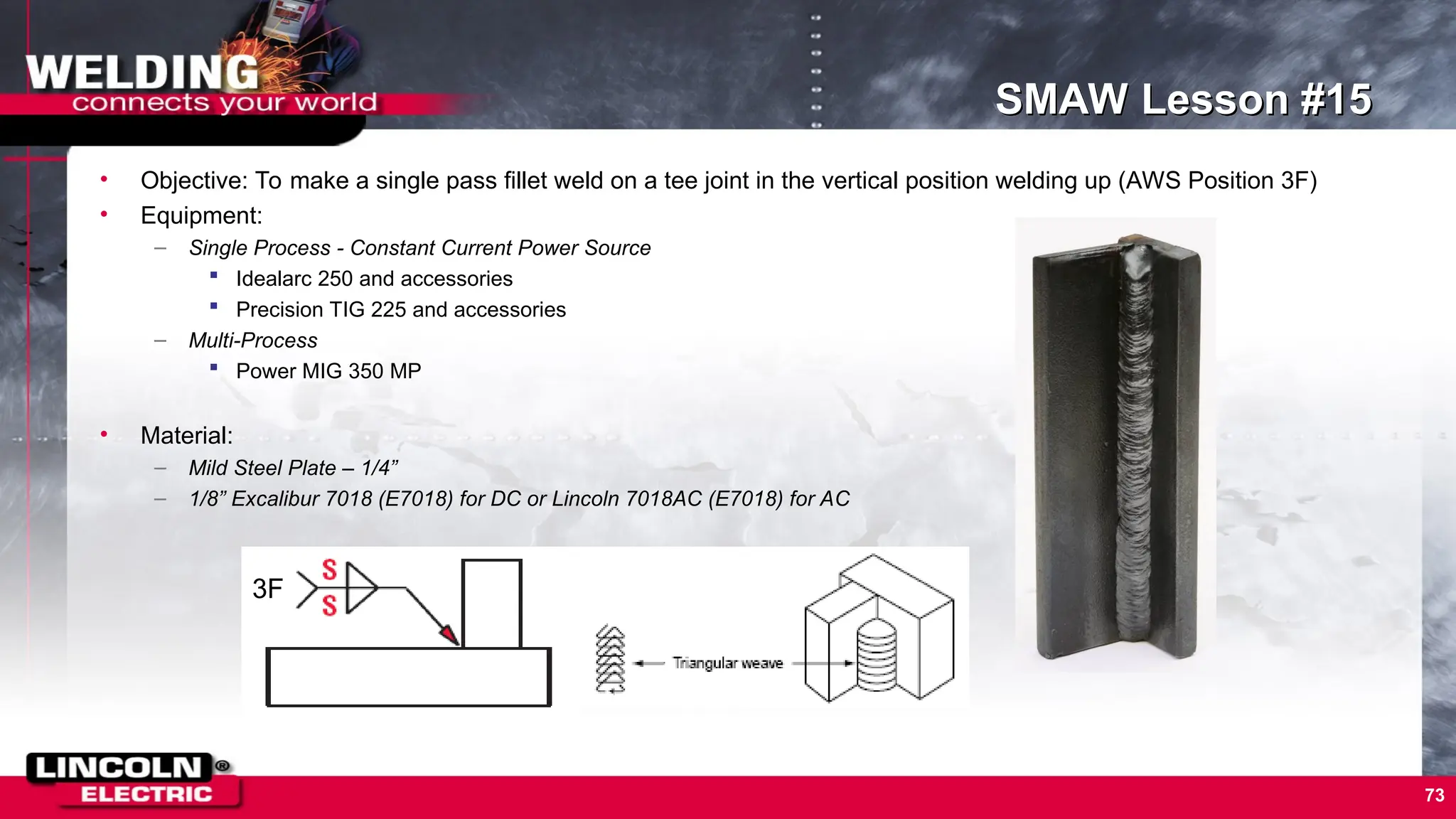
73
SMAW Lesson #15
•Objective: To make a single pass fillet weld on a tee joint in the vertical position welding up (AWS Position 3F)
• Equipment:
– Single Process - Constant Current Power Source
Idealarc 250 and accessories
Precision TIG 225 and accessories
– Multi-Process
Power MIG 350 MP
• Material:
– Mild Steel Plate – 1/4”
– 1/8” Excalibur 7018 (E7018) for DC or Lincoln 7018AC (E7018) for AC
3F
74.
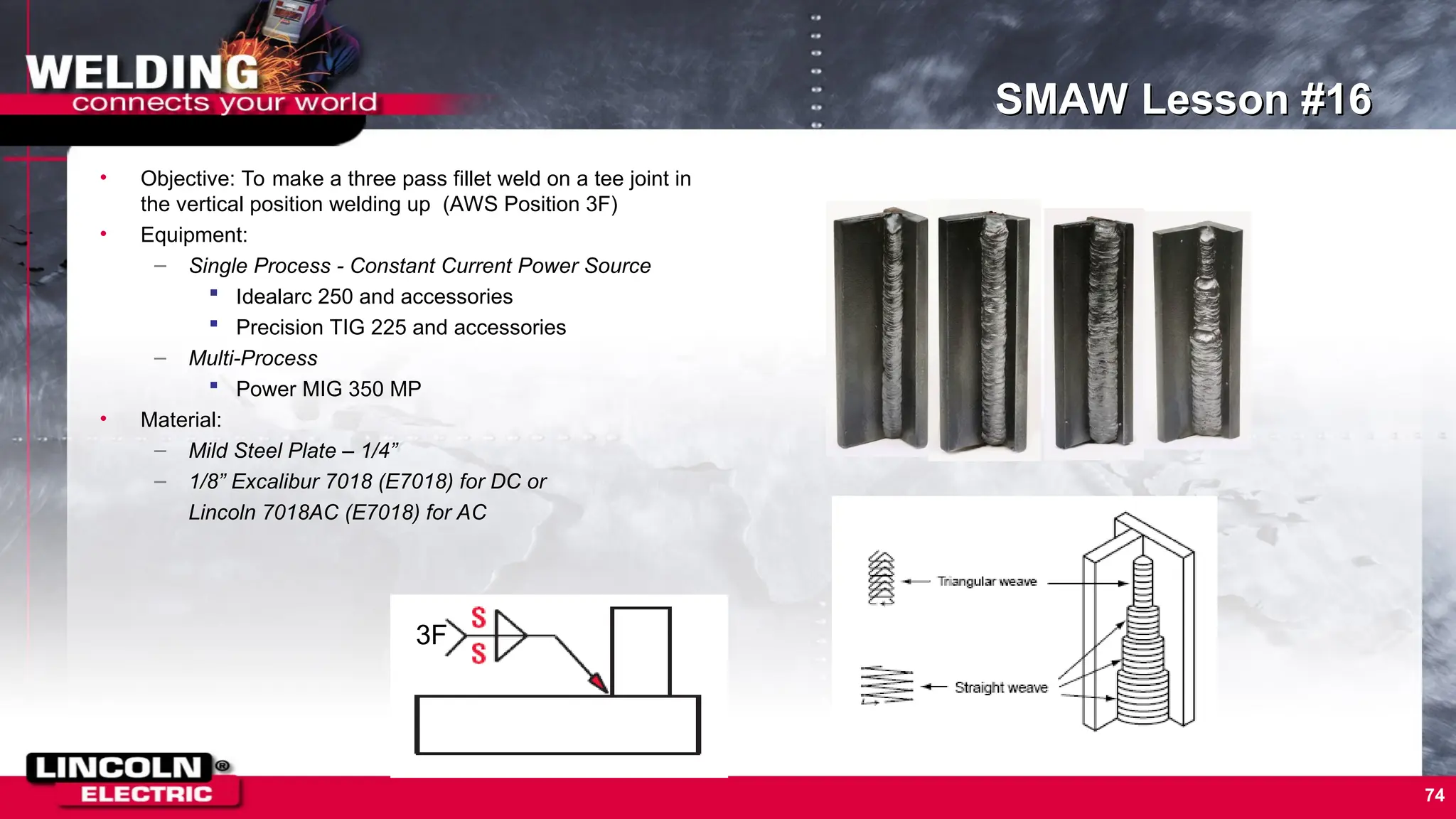
74
SMAW Lesson #16
•Objective: To make a three pass fillet weld on a tee joint in
the vertical position welding up (AWS Position 3F)
• Equipment:
– Single Process - Constant Current Power Source
Idealarc 250 and accessories
Precision TIG 225 and accessories
– Multi-Process
Power MIG 350 MP
• Material:
– Mild Steel Plate – 1/4”
– 1/8” Excalibur 7018 (E7018) for DC or
Lincoln 7018AC (E7018) for AC
3F
76
AWS Connection
• TheSMAW Welding Unit of study incorporates the following
information taken from the AWS EG 2.0 requirements:
– Set up for SMAW operations on carbon steel
– Operate SMAW equipment on carbon steel
– Make SMAW fillet welds on carbon steel
78
National Academic StandardsCrosswalk
• The unit, just completed, has covered parts of academic content
listed in the National Academic Standards as follows:
– NM-PROB.CONN.PK-12.3: Recognizes and applies mathematics in contexts outside of
mathematics.
– NLA-STANDARD 1: Uses the general skills and strategies of the writing process.
– NLA-STANDARD 7: Uses reading skills and strategies to understand and interpret a
variety of informational texts.
– NS-PHYSICAL SCIENCE: (Experiences) interactions of energy and matter.
Editor's Notes
#1 SECTION OVERVIEW:
Section Overviews are provided on the introductory slides at the front of each topical area to explain the intended use for the slides included in the section.
Slide numbers are included on the Section Overview slides for easy reference when preparing for delivery of the slide content.
TEACHER NOTES:
Teacher Notes are included on the Section Overview slides as a reference tool when making class preparations.
Suggested Activities are included as ideas for teachers to use to help students gain practical experience with the welding content. However, these are designed to be supplemented by each teacher based on local program needs.
Slides have been developed to incorporate content information regarding performance standards from the American Welding Society (AWS) and the National Academic Standards for English, Science, and Math.
INDIVIDUAL WELDING LESSON NOTES ARE AVAILABLE IN LESSON PLAN FACILITATOR’S GUIDE
#8 SECTION OVERVIEW:
This slide is meant to start generating conversation and thoughts about content to be covered in this lesson.
TEACHER NOTES:
Bulleted information on topical areas is provided to lead class discussion on areas which are to be covered in the training.
#28 SECTION OVERVIEW:
The next few slides are meant to point out safety requirements when doing SMAW welding.
TEACHER NOTES:
Slides 4-6: Bulleted information on topical areas is provided to lead class discussion on important areas of safety to be practiced in the SMAW welding environment.
To download your own copy of ‘Safety in Welding, Cutting and Allied Processes’ (ANSI Z49.1) go to: www.aws.org/technical/facts/Z49.1-2005-all.pdf
To download your own copy of Lincoln Electric’s Arc Welding Safety (E205) document go to: http://content.lincolnelectric.com/pdfs/products/literature/e205.pdf
To order copies of Lincoln Electric’s Arc Welding Safety (E205) document and poster (E201) go to: www.lincolnelectric.com (Quick Link: Literature Request)
MSDS can be obtained from Lincoln Consumable packaging, online at www.lincolnelectric.com (Quick Link: MSDS) or by calling 1-216-481-8100
For a free DVD on Welding Safely, submit order form in the back of the Lesson Plan Facilitator’s Guide (shipping and handling charges apply).
See Facilitator’s Guide for more information on welding hazards such as Fumes and Gases and Electrical Shock.
#31 SECTION OVERVIEW:
These slides are meant to lead into the discussion of the SMAW process
TEACHER NOTES:
Slides 7-16:
For more information on the American Welding Society, see ‘Arc Welding Basics’ and www.aws.org
Discussion could be given on stick electrodes commonly being between 9-18” long, and come in diameters ranging from 1/16” to 1/4”. An activity could be to show 3 electrodes all the same diameter: E6010 or E6011, E7018, and E7024. Ask students to compare flux coatings (color, thickness, feel)
The size of the electrode is determined by the diameter of its metal core. PLEASE NOTE: The overall diameter of the electrode changes due to flux coating even though metal diameter remains the same.
An arc digs into the base metal much like water from a nozzle on a garden hose digs into the earth. (The flow of the water is like welding current and water pressure is similar to voltage)
#38 SECTION OVERVIEW:
These slides provide an overview of the SMAW process.
TEACHER NOTES: (Explanation of Activity)
Slides 17-18: After discussing the parts included on this slide, students will take a quiz as an application activity.
For the activity, have participants work individually and mark 1-6 on a piece of paper.
Explain that this activity is meant to check whether each student understands SMAW before beginning to apply the process in the lab.
Project slide on the screen and have each student fill in the blanks on a piece of paper to be turned in. Collect papers and discuss.
Answers to the Application Activity are:
1. Electrode
2. Arc
3. Weld Puddle
4. Shielding Gas
5. Solidified Weld Metal
6. Slag
#40 SECTION OVERVIEW:
These slides explain how to set up the equipment for SMAW and the process variables used.
TEACHER NOTES:
Slides 19-21: These slides explain SMAW equipment set up and operator controlled variables
The exposed metal end of the electrode should fit securely within the jaws of the electrode holder
Discuss how the correct amperage setting for any given electrode is important to ensure proper shape of bead, proper penetration, and minimal spatter.
Explain when the amperage is set too high the bead may be flat, have excessive spatter, have some porosity and the electrode will overheat. If the amperage setting is too low, difficulty is experienced in striking the arc and maintaining the correct arc length. The weld bead becomes convex with excessive overlap and poor penetration.
Discuss polarity – All stick electrodes run on DC. Not all will weld on AC. All electrodes have a preferred polarity and most are designated by the AWS.
#43 SECTION OVERVIEW:
These slides discuss striking an arc and making a weld
TEACHER NOTES:
Slides 22-29: When using these slides, teachers may prefer to discuss the importance of the following topics:
Striking an arc
Work angle
Travel angle
Arc length
Travel speed
Filling a crater
Restarting the bead
#51 SECTION OVERVIEW:
The next slide discusses several troubleshooting topics.
TEACHER NOTES:
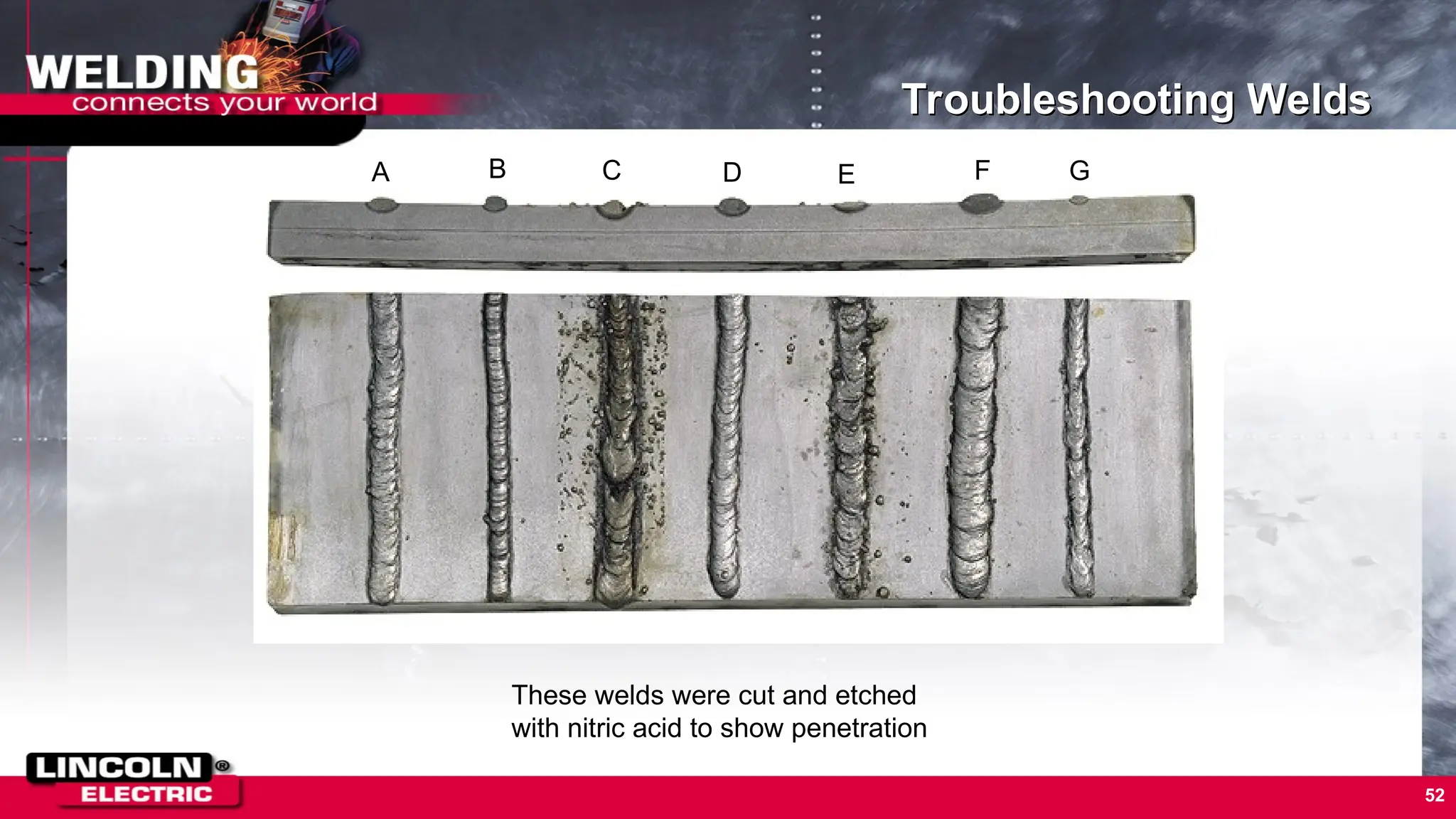
Slide 30-31: Weld troubleshooting. The beads on the pad depict changes in welding variables and their results. Discuss the following:
A – Good Weld: Proper Current, Travel Speed and Arc Length
B – Current too low: Ropey, convex bead appearance
C – Current too High: Excess spatter and possible burn-through of base materials
D – Arc Length too short: Poor wet-in at toes, electrode can ‘short’ to base material
E – Arc Length too Long: Excess spatter, undercut and porosity
F – Travel Speed too slow: Wide weld with excess metal deposit
G – Travel Speed too high: Ropey and convex bead
#53 SECTION OVERVIEW:
This section is meant to lead into a discussion regarding the advantages and limitations of using the SMAW process.
TEACHER NOTES:
Slides 32-34: The advantages and limitations of SMAW
Advantages:
Low start up costs – SMAW equipment is less expensive than GMAW equipment
Portable – electrode leads are easy to move from job to job
Easy to use outdoors - The process does not require a shielding gas so it is resistant to winds
All position capabilities
SMAW can be used on variety of materials – just change the electrode and you’re ready for the next project
Limitations:
Electrodes are 60-65% efficient - 1.5 to 2” of the electrode (stub) is thrown away. The slag and spatter also contribute to SMAW consumable losses.
Difficult to weld very thin material –
Frequent restarts – Most electrodes are 9-18” in length. As the electrodes are consumed they continually need to be replaced
Operating factor of 5-25% - Operators using the SMAW process spend only 5-25% of their time welding. Time is spent chipping slag, cleaning spatter, changing electrodes, repositioning the part, etc.
It takes practice to become a good welder using the SMAW process. The GMAW process is generally easier to learn.
#56 SECTION OVERVIEW:
This section is meant to lead into a discussion regarding the AWS Classification of SMAW Electrodes
TEACHER NOTES:
Slides 35-36:
For more information on the AWS classification of SMAW electrodes see Lincoln Electric’s free ‘Stick Electrode Product Catalog’ - http://content.lincolnelectric.com/pdfs/products/literature/c210.pdf
#58 SECTION OVERVIEW:
These slides are used for practicing lesson content in the lab setting.
TEACHER NOTES:
Slides 37-53: When using these slides, teachers might want to reference information included in the Facilitator’s Guide.
Recommended equipment – Only one of the single process or multi-process machines is required to complete the lesson.
#75 SECTION OVERVIEW:
The next few slides discuss the connection of this unit with AWS and the certification process.
TEACHER NOTES:
Slide 54-55: Content included in this unit of study is designed to be used by interested students as a building block in the learning process if interested in pursuing a certification program
#77 SECTION OVERVIEW:
The next slide discusses how the content covered in the welding unit is applicable to English, Math, and Science classes.
TEACHER NOTES:
Slides 56-57: These slides contain information regarding how this welding unit of study relates to the National Academic Standards.

















![GRADE 8 - ENTREPRENEURSHIP PRESENTATION [Autosaved].pptx](https://cdn.slidesharecdn.com/ss_thumbnails/grade8-entrepautosaved-250622051542-e85e7c3e-thumbnail.jpg?width=640&height=640&fit=bounds)


