• My name is mohsin iqbal qazi, working as lab engineer at
IED UET Peshawar, Jalozai Campus.
• The topic which I have selected for my demo is electric
arc welding
• Welding is permanent joining process that joins two or
more than two surfaces at their
Joining process in which two (or more) parts are
coalesced at their contacting surfaces by
application of heat and/or pressure
 Many welding processes are accomplished by
heat alone, with no pressure applied
• Provides a permanent joint Welded components
become a single entity.
• Usually the most economical way to join parts
in terms of material usage and fabrication costs.
• Not restricted to a factory environment, Welding
can be accomplished "in the field“.
• Welding can be performed on both similar and
dissimilar metals.
Welding processes can be divided
into two major categories:
 Fusion welding
 Solid state welding
Fusion
Joining processes that melt the base
metals
 In many fusion welding operations, a filler
metal is added to the molten pool to
facilitate the process and provide bulk and
added strength to the welded joint.
 Arc welding (AW) – melting of the metals is
accomplished by electric arc
 Resistance welding (RW) melting is ‑
accomplished by heat from resistance to an
electrical current between faying surfaces held
together under pressure
 Oxyfuel gas welding (OFW) melting is ‑
accomplished by an oxyfuel gas such as
acetylene
Joining processes in which coalescence
results from application of pressure alone or
a combination of heat and pressure.
 If heat is used, temperature is below
melting point of metals being welded.
 No filler metal is added in solid state
welding.
Plasma arc welding, laser beam welding,
electron beam welding, resistance welding,
spot welding
 Diffusion welding (DFW) –coalescence is by
solid state fusion between two surfaces held
together under pressure at elevated
temperature
 Friction welding (FRW) coalescence by heat ‑
of friction between two surfaces
 Ultrasonic welding (USW) coalescence by ‑
ultrasonic oscillating motion in a direction
parallel to contacting surfaces of two parts held
together under pressure
Now I will explain shielded metal arc welding process
that lies under the category of fusion welding.
Arc Welding
• Also known as “stick welding”, manual metal arc welding
• It is a fusion welding processes which uses
an electric arc to produce the heat required
for melting the metal.
• The welder creates an electric arc that melts the base
metals and filler metal (consumable) together so that they
all fuse into one solid piece of metal
ELECTRIC ARC
WELDING
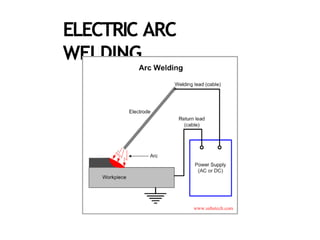
Inthisprocessheatrequiredtomeltthebasemetal
andelectrodeisobtainedfromtheelectricarc
producesbetweenworkpieceandelectrode.
This electric arc is generated as current
passes through the highly resistant air gap
andactasflameofintenseheat.
Pressure is not applied.
ELECTRIC ARC
WELDING
Arc
Welding
• It is a manual arc welding process that uses a
consumable electrode coated in flux agents and
slag formers to lay the weld.
• An electric current, in the form of either
alternating current or direct current from a
welding power supply, is used to form an electric
arc between the electrode and the metals to be
joined.
• As the weld is laid, the flux coating of the electrode
disintegrates, giving off vapors that serve as a
shielding gas and providing a layer of slag, both of
which protect the weld area from atmospheric
contamination.
Tiny drops of metal enter the arc stream and are deposited on
the parent metal
Ultraviolet radiation emitted in arc welding is
injurious to human vision
Welder must wear a special helmet with a
dark viewing window
Filters out dangerous radiation but welder
is blind except when arc is struck
Sparks, spatters of molten metal, smoke,
and fumes add to the risks
SMAW, MMAW,Stick
Heat, Electric Arc, 5500 C.
Electrode (covering, holder, compatible)
Flux (composition, function)
Slag (Function, removal)
Power AC DC
Removal of electrode
Application
Advantages
Defects
Plasma arc welding, laser beam welding,
electron beam welding, resistance welding,
spot welding
Arc
Welding
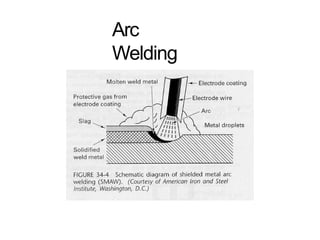
• Arc welding is a process that melts and joins metals by
heating them with an arc established between a stick
like covered electrode and the metals.
• The core wire conducts the electric current to the arc
and provides filler metal for the joint.
• The electrode holder is essentially a metal clamp with
an electrically insulated outside shell for the welder to
hold safely.
• The heat of the arc melts the core wire and the
flux covering at the electrode tip into metal
droplets.
• Molten metal in the weld pool solidifies into the weld
metal while the lighter molten flux floats on the top
surface and solidifies as a slag layer.
Coated
Electrodes
• The electrode is coated in a metal
mixture called flux, which gives off gases
as it decomposes to prevent
1.Weld contamination
2.Introduces deoxidizers to purify the weld
3.Causes weld-protecting slag to form
4.Improves the arc stability, and
5.Provides alloying elements to improve the weld
quality.
Arc
Welding
Principle of
Arc
• Asuitable gap is kept between the work
and electrode
• Ahigh current is passed through the
circuit.
• The electric energy is converted into heat
energy, producing a temperature of 3000°C
to 4000°C.
• This heat melts the edges to be welded
and molten pool is formed.
• On solidification the welding joint is
obtained
Arc
Welding
• Process:
– Intense heat at the arc melts the tip of the electrode
– Tiny drops of metal enter the arc stream and are
deposited on the parent metal
– As molten metal is deposited, a slag forms over the
bead which serves as an insulation against air
contaminants during cooling
– After a weld ‘pass’ is allowed the cool, the oxide layer
is removed by a chipping hammer and then cleaned
with a wirebrush before the next pass.
Arc
Welding
• Because of the versatility of the process and
the simplicity of its equipment and operation,
shielded metal arc welding is one of the
world's most popular welding processes.
Basics of Arc
Welding
• The arc is struck between the
electrode and the metal.
• It then heats the metal to the
melting point.
• The electrode is then removed,
breaking the arc between the
electrode and the metal. This allows
the molten metal to “freeze” or
solidify.
Basic Steps of Arc
Welding
• Prepare the base materials: remove paint
and rust
• Choose the right welding process
• Choose the right filler material
• Assess and comply with safety requirements
• Use proper welding techniques and be sure to
protect the molten puddle from contaminants
in the air
• Inspect the weld
Electric Power for
Welding
• Current used may be
– 1. AC
– 2. DC
For most purposes, DCis
preferred.
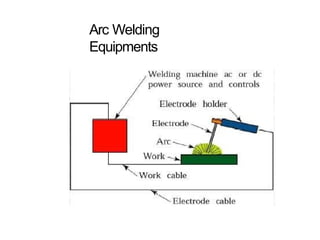
Arc Welding
Equipments
Arc
Welding
• The choice of electrode for SMAW depends
on a number of factors, including
1. The weld material
2. Welding position and
3. The desired weld properties.
Welding Electrodes
• The composition of the electrode core is generally
similar and sometimes identical to that of the base
material.
• But even though a number of feasible options exist, a
slight difference in alloy composition can strongly impact
the properties of the resulting weld.
Functions of electrode (flux)
covering
• Provides the gaseous shield to protect
the molten metal from air.
– Cellulose-type electrode (C6H10O5)x ,
providing gas mixture of H2, CO, H2O and
CO2.
– Limestone-type electrode (CaCO3) – low in
hydrogen and it is used for welding metals that
are susceptible to hydrogen cracking such as
high- strength steels.
Functions of electrode (flux)
covering
• Deoxidation - Provide deoxidizers and fluxing agent
to deoxidize and cleanse the weld metal. The solid
slag also protects the weld metal from oxidation.
• Arc stabilization - Provide arc stabilizers which
are compounds such as potassium oxalate and
lithium carbonate. They readily decompose into
ions in an arc, which increase electrical
conductivity.
• Metal addition - Provide alloying elements (for
composition control) and metal powder
(increase deposition rate) to the weld pool.
Arc Welding Power
Supplies
• The current for arc welder can be supplied
by line current or by an
alternator/generator.
– The amount of heat is determined by the
current flow (amps)
– The ease of starting and harshness of the arc
is determined by the electrical potential
(volts).
Amperage
Output
• Current setting formula is 4 * Dia of Rod
• 185 to 225 amps is a common size.
• For an individual weld, the optimum
output amperage is determined by
– thickness of the metal
– type of joint and
– type of electrode
DC Arc
Welding
• D.C. machines are made up to the capacity
range of 600 amperes.
• 45 to 95 volts
• D.C. can be given in two ways:
(a)Straight polarity
(b)Reverse polarity
The polarity will affect the weld size and
application
Direct
Current
• Direct current: The type of current where the flow of
electrons (polarity) is in one direction.
• Controlling the polarity allows the welder to influence the
location of the heat.
• When the electrode is positive (+) DCEP it will be slightly
hotter than the base metal. (reverse)
• When the base metal is positive (+), DCEN the base metal will
be slightly hotter than the electrode. (straight)
• DCis required for GMAW
• It is frequently used for SMAW
Amper
e
• Electricity passing through a resistance causes
heat.
• An air gap is a high resistance
• The greater the amperage flowing through the
resistance (air gap)  the greater the heat.
• The electrode also has resistance.
• Excessive amperage for the diameter of the
electrode (current density) over heats the
electrode.
• Insufficient amperage for the diameter of
electrode makes the electrode hard to start.
Arc Welding
Defects
The most common quality problems associated with SMAW include
• 1. Weld spatter
Weld spatter, while not affecting the integrity of the weld,
damages its appearance and increases cleaning costs. It can be
caused by excessively high current.
• 2. Porosity
Porosity, often not visible without the use of advanced
nondestructive testing methods, is a serious concern because it
can potentially weaken the weld.
Arc Welding
Defects
• 3. Poor fusion
Another defect affecting the strength of the weld is poor
fusion, though it is often easily visible. It is caused by low
current, contaminated joint surfaces, or the use of an
improper electrode.
• 4. Shallow penetration
Shallow penetration, another detriment to weld strength, can be
addressed by decreasing welding speed, increasing the
current or using a smaller electrode.
• 5. Cracking.
Any of these weld-strength-related defects can make the weld
prone to cracking, but other factors are involved as well. High
carbon, alloy or sulfur content in the base material can lead to
cracking, especially if low-hydrogen electrodes and
preheating are not employed. Furthermore, the workpieces
should not be excessively restrained, as this introduces residual
stresses into the weld and can cause cracking as the weld cools
and contracts.
Advantages of arc
welding
1. Simple welding equipment
2. Portable
3. Inexpensive power source
4. Relatively inexpensive equipment
5. Welders use standard domestic current.
6. Process is fast and reliable
7. Short learning curve
8. Equipment can be used for multiple functions
9. Electric arc is about 5,000 oC
10. Used for maintenance, repair, and field construction
Disadvantage
s
• Not clean enough for reactive metals such as
aluminium and titanium.
• The deposition rate is limited because the
electrode covering tends to overheat and fall
off.
• The electrode length is ~ 35 mm and requires
electrode changing lower the overall
production rate.
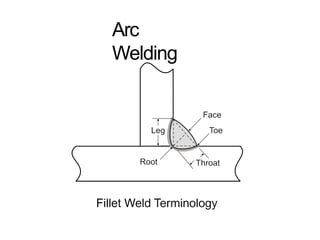
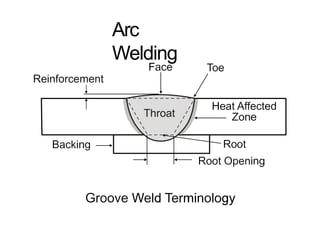
Arc
Welding
Arc
Welding
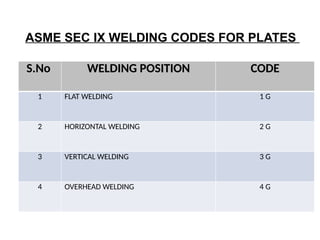
ASME SEC IX WELDING CODES FOR PLATES
S.No WELDING POSITION CODE
1 FLAT WELDING 1 G
2 HORIZONTAL WELDING 2 G
3 VERTICAL WELDING 3 G
4 OVERHEAD WELDING 4 G
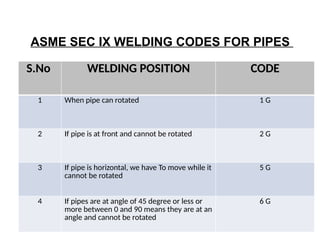
ASME SEC IX WELDING CODES FOR PIPES
S.No WELDING POSITION CODE
1 When pipe can rotated 1 G
2 If pipe is at front and cannot be rotated 2 G
3 If pipe is horizontal, we have To move while it
cannot be rotated
5 G
4 If pipes are at angle of 45 degree or less or
more between 0 and 90 means they are at an
angle and cannot be rotated
6 G
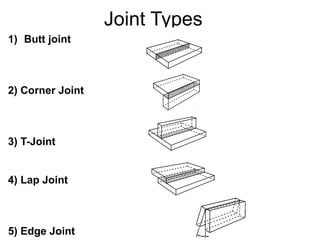
Joint Types
1) Butt joint
2) Corner Joint
3) T-Joint
4) Lap Joint
5) Edge Joint
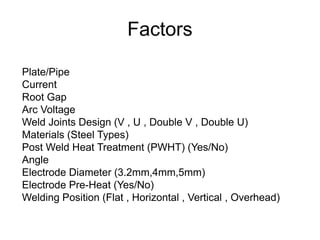
Factors
Plate/Pipe
Current
Root Gap
Arc Voltage
Weld Joints Design (V , U , Double V , Double U)
Materials (Steel Types)
Post Weld Heat Treatment (PWHT) (Yes/No)
Angle
Electrode Diameter (3.2mm,4mm,5mm)
Electrode Pre-Heat (Yes/No)
Welding Position (Flat , Horizontal , Vertical , Overhead)
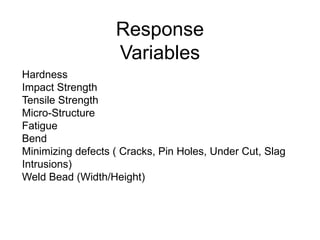
Response
Variables
Hardness
Impact Strength
Tensile Strength
Micro-Structure
Fatigue
Bend
Minimizing defects ( Cracks, Pin Holes, Under Cut, Slag
Intrusions)
Weld Bead (Width/Height)

Electric Arc Welding Shielded Metal Arc Welding

  • 1.
    • My nameis mohsin iqbal qazi, working as lab engineer at IED UET Peshawar, Jalozai Campus. • The topic which I have selected for my demo is electric arc welding • Welding is permanent joining process that joins two or more than two surfaces at their
  • 2.
    Joining process inwhich two (or more) parts are coalesced at their contacting surfaces by application of heat and/or pressure  Many welding processes are accomplished by heat alone, with no pressure applied
  • 3.
    • Provides apermanent joint Welded components become a single entity. • Usually the most economical way to join parts in terms of material usage and fabrication costs. • Not restricted to a factory environment, Welding can be accomplished "in the field“. • Welding can be performed on both similar and dissimilar metals.
  • 4.
    Welding processes canbe divided into two major categories:  Fusion welding  Solid state welding
  • 5.
    Fusion Joining processes thatmelt the base metals  In many fusion welding operations, a filler metal is added to the molten pool to facilitate the process and provide bulk and added strength to the welded joint.
  • 6.
     Arc welding(AW) – melting of the metals is accomplished by electric arc  Resistance welding (RW) melting is ‑ accomplished by heat from resistance to an electrical current between faying surfaces held together under pressure  Oxyfuel gas welding (OFW) melting is ‑ accomplished by an oxyfuel gas such as acetylene
  • 7.
    Joining processes inwhich coalescence results from application of pressure alone or a combination of heat and pressure.  If heat is used, temperature is below melting point of metals being welded.  No filler metal is added in solid state welding. Plasma arc welding, laser beam welding, electron beam welding, resistance welding, spot welding
  • 8.
     Diffusion welding(DFW) –coalescence is by solid state fusion between two surfaces held together under pressure at elevated temperature  Friction welding (FRW) coalescence by heat ‑ of friction between two surfaces  Ultrasonic welding (USW) coalescence by ‑ ultrasonic oscillating motion in a direction parallel to contacting surfaces of two parts held together under pressure
  • 9.
    Now I willexplain shielded metal arc welding process that lies under the category of fusion welding.
  • 10.
    Arc Welding • Alsoknown as “stick welding”, manual metal arc welding • It is a fusion welding processes which uses an electric arc to produce the heat required for melting the metal. • The welder creates an electric arc that melts the base metals and filler metal (consumable) together so that they all fuse into one solid piece of metal
  • 11.
    ELECTRIC ARC WELDING Inthisprocessheatrequiredtomeltthebasemetal andelectrodeisobtainedfromtheelectricarc producesbetweenworkpieceandelectrode. This electricarc is generated as current passes through the highly resistant air gap andactasflameofintenseheat. Pressure is not applied.
  • 12.
  • 13.
    Arc Welding • It isa manual arc welding process that uses a consumable electrode coated in flux agents and slag formers to lay the weld. • An electric current, in the form of either alternating current or direct current from a welding power supply, is used to form an electric arc between the electrode and the metals to be joined. • As the weld is laid, the flux coating of the electrode disintegrates, giving off vapors that serve as a shielding gas and providing a layer of slag, both of which protect the weld area from atmospheric contamination.
  • 14.
    Tiny drops ofmetal enter the arc stream and are deposited on the parent metal
  • 15.
    Ultraviolet radiation emittedin arc welding is injurious to human vision Welder must wear a special helmet with a dark viewing window Filters out dangerous radiation but welder is blind except when arc is struck Sparks, spatters of molten metal, smoke, and fumes add to the risks
  • 16.
    SMAW, MMAW,Stick Heat, ElectricArc, 5500 C. Electrode (covering, holder, compatible) Flux (composition, function) Slag (Function, removal) Power AC DC Removal of electrode Application Advantages Defects Plasma arc welding, laser beam welding, electron beam welding, resistance welding, spot welding
  • 17.
    Arc Welding • Arc weldingis a process that melts and joins metals by heating them with an arc established between a stick like covered electrode and the metals. • The core wire conducts the electric current to the arc and provides filler metal for the joint. • The electrode holder is essentially a metal clamp with an electrically insulated outside shell for the welder to hold safely. • The heat of the arc melts the core wire and the flux covering at the electrode tip into metal droplets. • Molten metal in the weld pool solidifies into the weld metal while the lighter molten flux floats on the top surface and solidifies as a slag layer.
  • 18.
    Coated Electrodes • The electrodeis coated in a metal mixture called flux, which gives off gases as it decomposes to prevent 1.Weld contamination 2.Introduces deoxidizers to purify the weld 3.Causes weld-protecting slag to form 4.Improves the arc stability, and 5.Provides alloying elements to improve the weld quality.
  • 19.
  • 20.
    Principle of Arc • Asuitablegap is kept between the work and electrode • Ahigh current is passed through the circuit. • The electric energy is converted into heat energy, producing a temperature of 3000°C to 4000°C. • This heat melts the edges to be welded and molten pool is formed. • On solidification the welding joint is obtained
  • 21.
    Arc Welding • Process: – Intenseheat at the arc melts the tip of the electrode – Tiny drops of metal enter the arc stream and are deposited on the parent metal – As molten metal is deposited, a slag forms over the bead which serves as an insulation against air contaminants during cooling – After a weld ‘pass’ is allowed the cool, the oxide layer is removed by a chipping hammer and then cleaned with a wirebrush before the next pass.
  • 22.
    Arc Welding • Because ofthe versatility of the process and the simplicity of its equipment and operation, shielded metal arc welding is one of the world's most popular welding processes.
  • 23.
    Basics of Arc Welding •The arc is struck between the electrode and the metal. • It then heats the metal to the melting point. • The electrode is then removed, breaking the arc between the electrode and the metal. This allows the molten metal to “freeze” or solidify.
  • 24.
    Basic Steps ofArc Welding • Prepare the base materials: remove paint and rust • Choose the right welding process • Choose the right filler material • Assess and comply with safety requirements • Use proper welding techniques and be sure to protect the molten puddle from contaminants in the air • Inspect the weld
  • 25.
    Electric Power for Welding •Current used may be – 1. AC – 2. DC For most purposes, DCis preferred.
  • 26.
  • 27.
    Arc Welding • The choiceof electrode for SMAW depends on a number of factors, including 1. The weld material 2. Welding position and 3. The desired weld properties.
  • 28.
    Welding Electrodes • Thecomposition of the electrode core is generally similar and sometimes identical to that of the base material. • But even though a number of feasible options exist, a slight difference in alloy composition can strongly impact the properties of the resulting weld.
  • 29.
    Functions of electrode(flux) covering • Provides the gaseous shield to protect the molten metal from air. – Cellulose-type electrode (C6H10O5)x , providing gas mixture of H2, CO, H2O and CO2. – Limestone-type electrode (CaCO3) – low in hydrogen and it is used for welding metals that are susceptible to hydrogen cracking such as high- strength steels.
  • 30.
    Functions of electrode(flux) covering • Deoxidation - Provide deoxidizers and fluxing agent to deoxidize and cleanse the weld metal. The solid slag also protects the weld metal from oxidation. • Arc stabilization - Provide arc stabilizers which are compounds such as potassium oxalate and lithium carbonate. They readily decompose into ions in an arc, which increase electrical conductivity. • Metal addition - Provide alloying elements (for composition control) and metal powder (increase deposition rate) to the weld pool.
  • 31.
    Arc Welding Power Supplies •The current for arc welder can be supplied by line current or by an alternator/generator. – The amount of heat is determined by the current flow (amps) – The ease of starting and harshness of the arc is determined by the electrical potential (volts).
  • 32.
    Amperage Output • Current settingformula is 4 * Dia of Rod • 185 to 225 amps is a common size. • For an individual weld, the optimum output amperage is determined by – thickness of the metal – type of joint and – type of electrode
  • 33.
    DC Arc Welding • D.C.machines are made up to the capacity range of 600 amperes. • 45 to 95 volts • D.C. can be given in two ways: (a)Straight polarity (b)Reverse polarity The polarity will affect the weld size and application
  • 34.
    Direct Current • Direct current:The type of current where the flow of electrons (polarity) is in one direction. • Controlling the polarity allows the welder to influence the location of the heat. • When the electrode is positive (+) DCEP it will be slightly hotter than the base metal. (reverse) • When the base metal is positive (+), DCEN the base metal will be slightly hotter than the electrode. (straight) • DCis required for GMAW • It is frequently used for SMAW
  • 35.
    Amper e • Electricity passingthrough a resistance causes heat. • An air gap is a high resistance • The greater the amperage flowing through the resistance (air gap)  the greater the heat. • The electrode also has resistance. • Excessive amperage for the diameter of the electrode (current density) over heats the electrode. • Insufficient amperage for the diameter of electrode makes the electrode hard to start.
  • 36.
    Arc Welding Defects The mostcommon quality problems associated with SMAW include • 1. Weld spatter Weld spatter, while not affecting the integrity of the weld, damages its appearance and increases cleaning costs. It can be caused by excessively high current. • 2. Porosity Porosity, often not visible without the use of advanced nondestructive testing methods, is a serious concern because it can potentially weaken the weld.
  • 37.
    Arc Welding Defects • 3.Poor fusion Another defect affecting the strength of the weld is poor fusion, though it is often easily visible. It is caused by low current, contaminated joint surfaces, or the use of an improper electrode. • 4. Shallow penetration Shallow penetration, another detriment to weld strength, can be addressed by decreasing welding speed, increasing the current or using a smaller electrode. • 5. Cracking. Any of these weld-strength-related defects can make the weld prone to cracking, but other factors are involved as well. High carbon, alloy or sulfur content in the base material can lead to cracking, especially if low-hydrogen electrodes and preheating are not employed. Furthermore, the workpieces should not be excessively restrained, as this introduces residual stresses into the weld and can cause cracking as the weld cools and contracts.
  • 38.
    Advantages of arc welding 1.Simple welding equipment 2. Portable 3. Inexpensive power source 4. Relatively inexpensive equipment 5. Welders use standard domestic current. 6. Process is fast and reliable 7. Short learning curve 8. Equipment can be used for multiple functions 9. Electric arc is about 5,000 oC 10. Used for maintenance, repair, and field construction
  • 39.
    Disadvantage s • Not cleanenough for reactive metals such as aluminium and titanium. • The deposition rate is limited because the electrode covering tends to overheat and fall off. • The electrode length is ~ 35 mm and requires electrode changing lower the overall production rate.
  • 40.
  • 41.
  • 42.
    ASME SEC IXWELDING CODES FOR PLATES S.No WELDING POSITION CODE 1 FLAT WELDING 1 G 2 HORIZONTAL WELDING 2 G 3 VERTICAL WELDING 3 G 4 OVERHEAD WELDING 4 G
  • 43.
    ASME SEC IXWELDING CODES FOR PIPES S.No WELDING POSITION CODE 1 When pipe can rotated 1 G 2 If pipe is at front and cannot be rotated 2 G 3 If pipe is horizontal, we have To move while it cannot be rotated 5 G 4 If pipes are at angle of 45 degree or less or more between 0 and 90 means they are at an angle and cannot be rotated 6 G
  • 44.
    Joint Types 1) Buttjoint 2) Corner Joint 3) T-Joint 4) Lap Joint 5) Edge Joint
  • 45.
    Factors Plate/Pipe Current Root Gap Arc Voltage WeldJoints Design (V , U , Double V , Double U) Materials (Steel Types) Post Weld Heat Treatment (PWHT) (Yes/No) Angle Electrode Diameter (3.2mm,4mm,5mm) Electrode Pre-Heat (Yes/No) Welding Position (Flat , Horizontal , Vertical , Overhead)
  • 46.
    Response Variables Hardness Impact Strength Tensile Strength Micro-Structure Fatigue Bend Minimizingdefects ( Cracks, Pin Holes, Under Cut, Slag Intrusions) Weld Bead (Width/Height)