2 © 2012 Delmar, Cengage Learning
Chapter 3
Shielded Metal Arc Welding,
Setup, and Operation
2 © 2012 Delmar, Cengage Learning
Objectives
• Describe the process of shielded metal arc
welding (SMAW)
• List and define the three units used to measure a
welding current
• Tell how adding chemicals to the coverings of the
electrodes affects the arc
• Discuss the three different types of current used
for welding
2 © 2012 Delmar, Cengage Learning
Objectives (cont'd.)
• Explain the types of welding power supplies and
which type the shielded metal arc welding process
requires
• Define open circuit voltage and operating voltage
• Explain arc blow, what causes it, and how to
control it
• Tell what the purpose of a welding transformer is
and what kind of change occurs to the voltage and
amperage with a step-down transformer
2 © 2012 Delmar, Cengage Learning
Objectives (cont'd.)
• Compare generators and alternators
• Tell the purpose of a rectifier
• Read a welding machine duty cycle chart and
explain its significance
• Demonstrate how to determine the proper welding
cable size
• Demonstrate how to service and repair electrode
holders
2 © 2012 Delmar, Cengage Learning
Objectives (cont'd.)
• Discuss the problems that can occur as a result of
poor work lead clamping
• Describe the factors that should be considered
when placing an arc welding machine in a welding
area
2 © 2012 Delmar, Cengage Learning
Introduction
• Shielded metal arc welding (SMAW)
– A flux-covered metal electrode carries current
• SMAW is a widely used welding process
– Low cost
– Flexible
– Portable
– Versatile
2 © 2012 Delmar, Cengage Learning
Welding Current and Electrical
Measurement
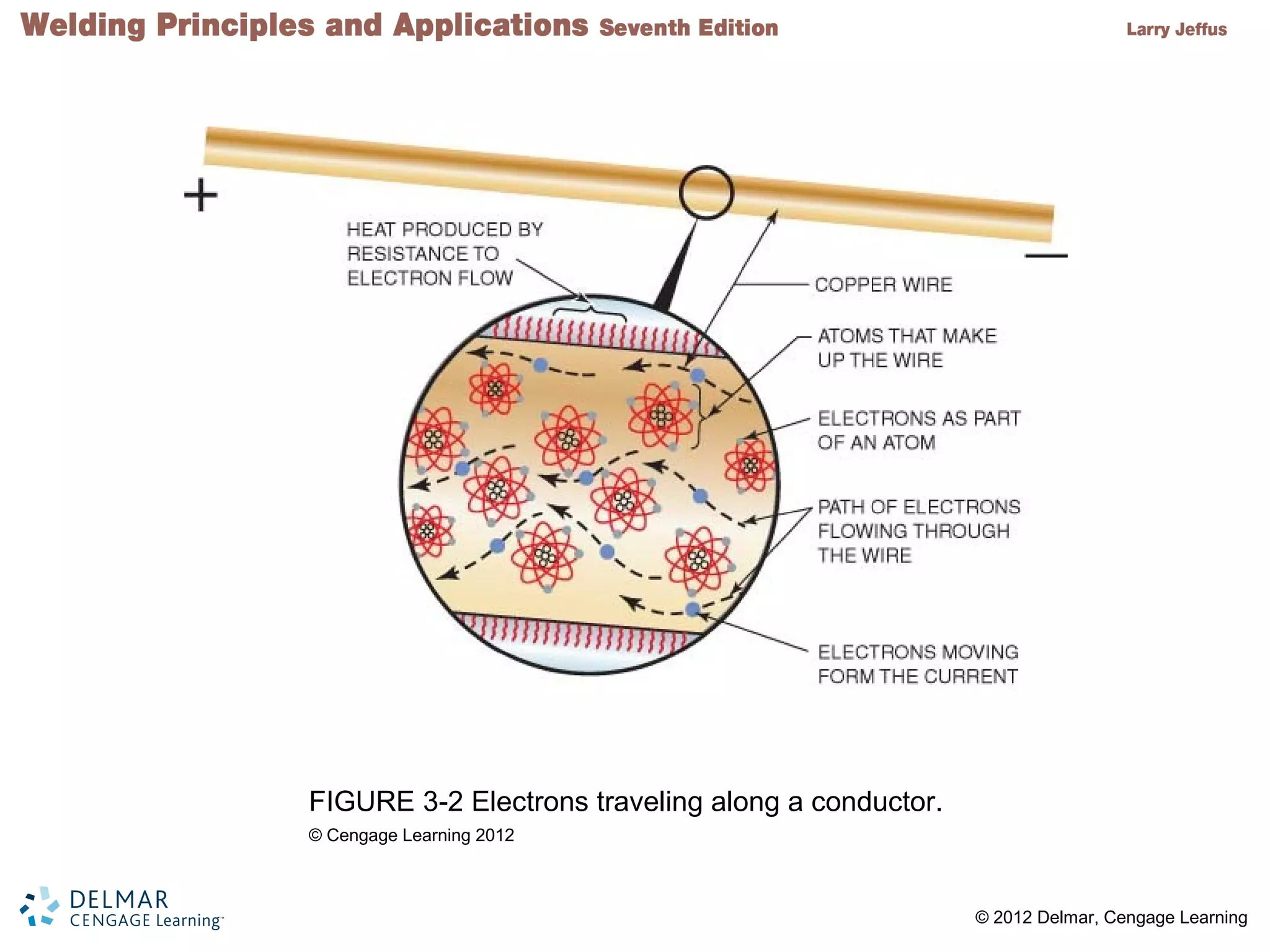
• Electric current
– Source of heat
– Flow of electrons
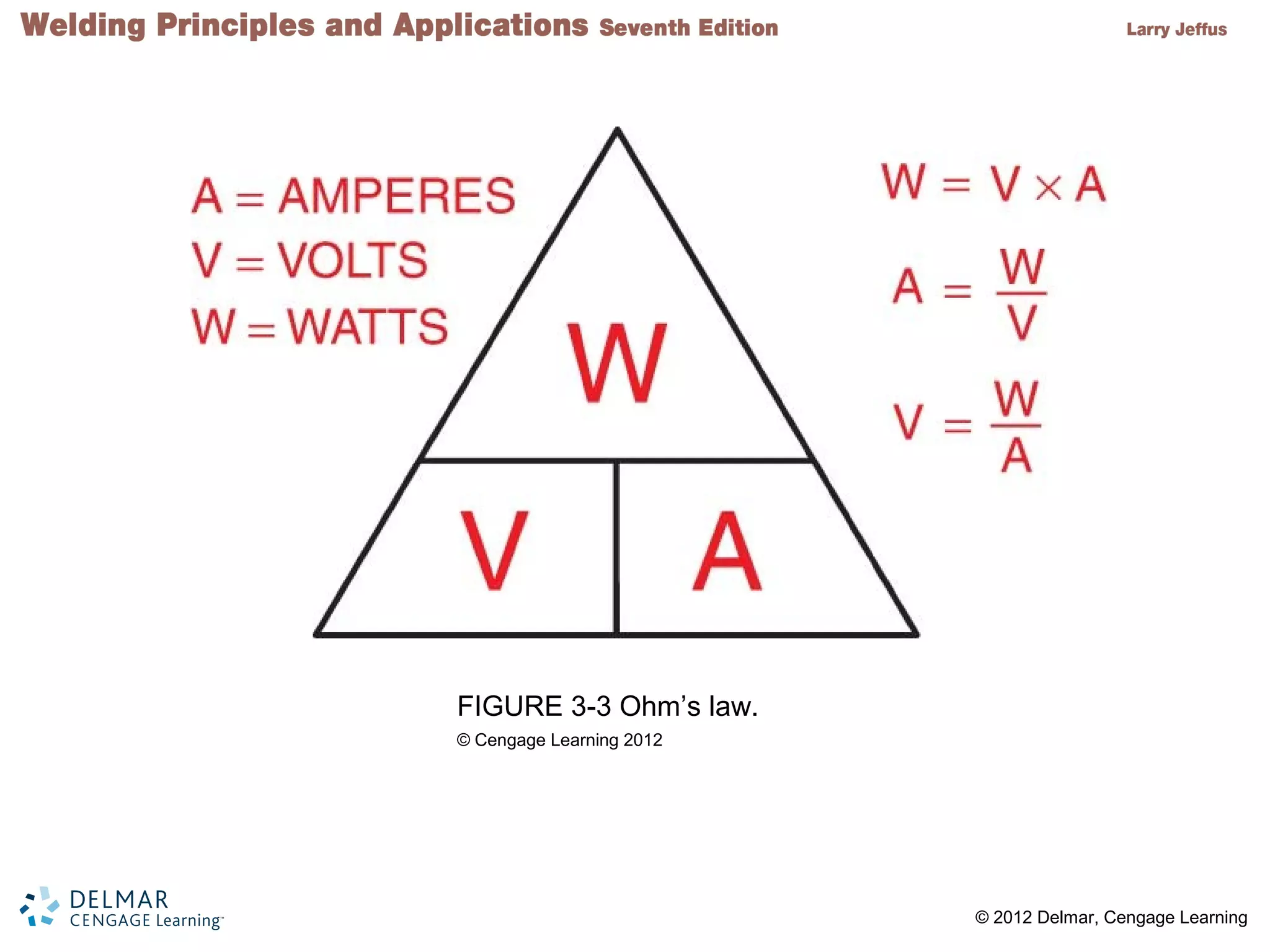
• Units used to describe electrical current
– Voltage: measurement of electrical pressure
– Amperage: total number of electrons flowing
– Wattage: measurement of electrical energy or
power in the arc
2 © 2012 Delmar, Cengage Learning
FIGURE 3-2 Electrons traveling along a conductor.
© Cengage Learning 2012
2 © 2012 Delmar, Cengage Learning
FIGURE 3-3 Ohm’s law.
© Cengage Learning 2012
2 © 2012 Delmar, Cengage Learning
SMA Welding Arc Temperature and Heat
• Temperature
– Degree or level of energy in a material
– Measured in degrees with a thermometer
• Heat
– Quantity of energy in a material
– Cannot easily be measured
– Determined by knowing temperature and object
mass
• Temperature of a welding arc
– Dependent on voltage, arc length, and atmosphere
2 © 2012 Delmar, Cengage Learning
Types of Welding Currents
• Three types of current used for arc welding
– Alternating Current (AC)
– Direct-current electrode negative (DCEN)
– Direct-current electrode positive (DCEP)
• Some electrodes can used with only one type of
current
– Others can be used with two or more
• Each current has a different effect on the weld
2 © 2012 Delmar, Cengage Learning
Types of Welding Power
• Welding power can be supplied as:
– Constant voltage (CV)
• Arc voltage remains constant
– Rising arc voltage (RAV)
• Arc voltage increases as amperage increases
– Constant Current (CC)
• Total welding current remains the same
• Shielded metal arc welding
– Requires a constant current arc voltage
characteristic
2 © 2012 Delmar, Cengage Learning
Open Circuit Voltage
• Voltage at the electrode before striking an arc
– Usually between 50 V and 80 V
• Higher open circuit voltage
– Easier to strike an arc
– Maximum safe open circuit voltage for welders is 80
volts
• High voltage increases chance of electrical shock
2 © 2012 Delmar, Cengage Learning
Operating Voltage
• Voltage at the arc during welding
– Also called welding or closed circuit voltage
• Will vary with:
– Arc length
– Type of electrode
– Type of current
– Polarity
2 © 2012 Delmar, Cengage Learning
Arc Blow
• Electrons flow
– Create lines of magnetic force that circle around the
path of flow called magnetic flux lines
• These lines space themselves evenly along a
current-carrying wire
• Arc blow
– Movement of the arc
– Makes arc drift like a string would drift in the wind
– More of a problem when magnetic fields are the
most uneven
2 © 2012 Delmar, Cengage Learning
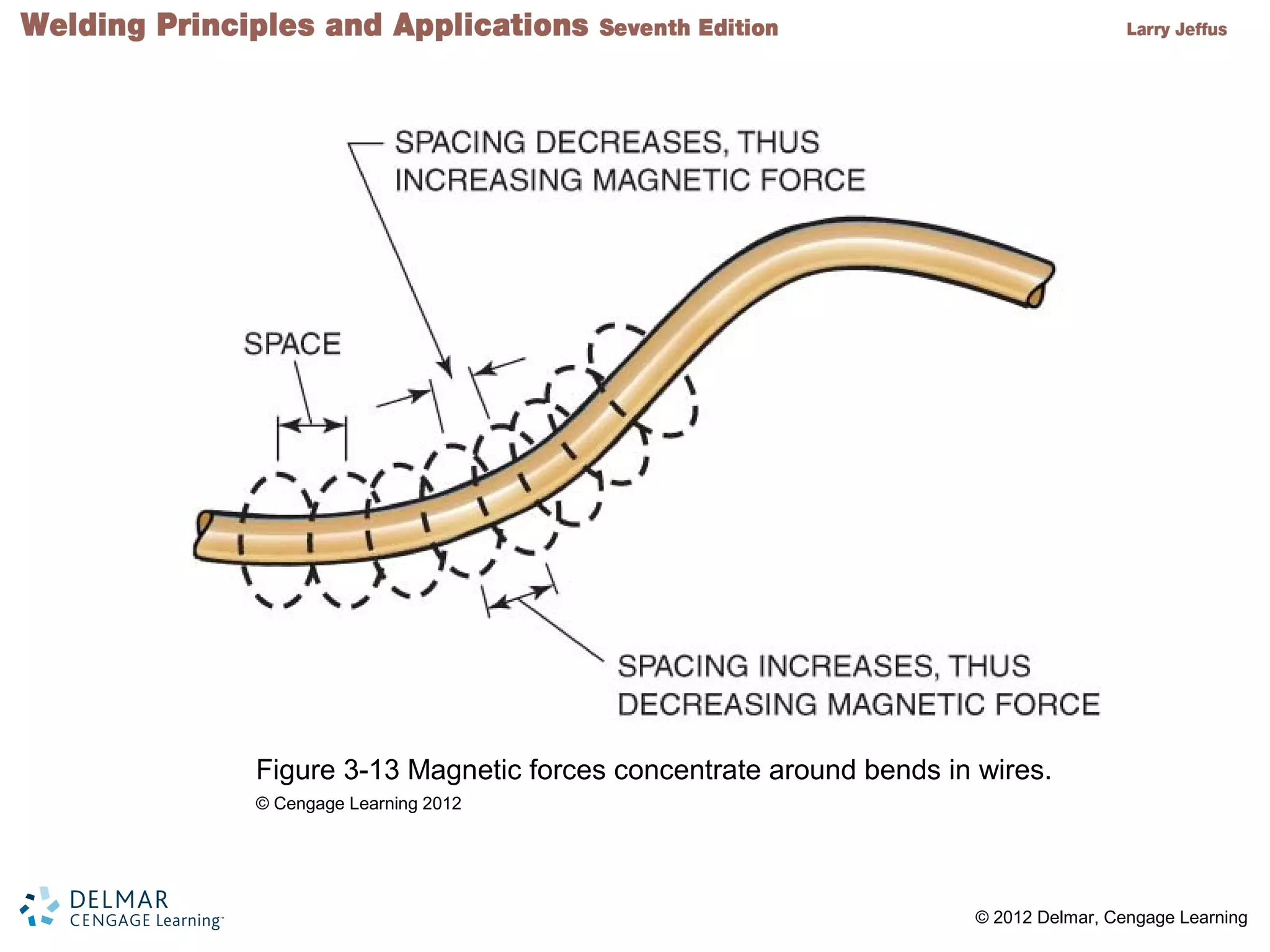
Figure 3-13 Magnetic forces concentrate around bends in wires.
© Cengage Learning 2012
2 © 2012 Delmar, Cengage Learning
Types of Power Sources
• Electrical devices used
– Electric motors or internal combustion engines
– Step-down transformers
• Welding transformers
– Use high-voltage AC to produce low-voltage
welding power
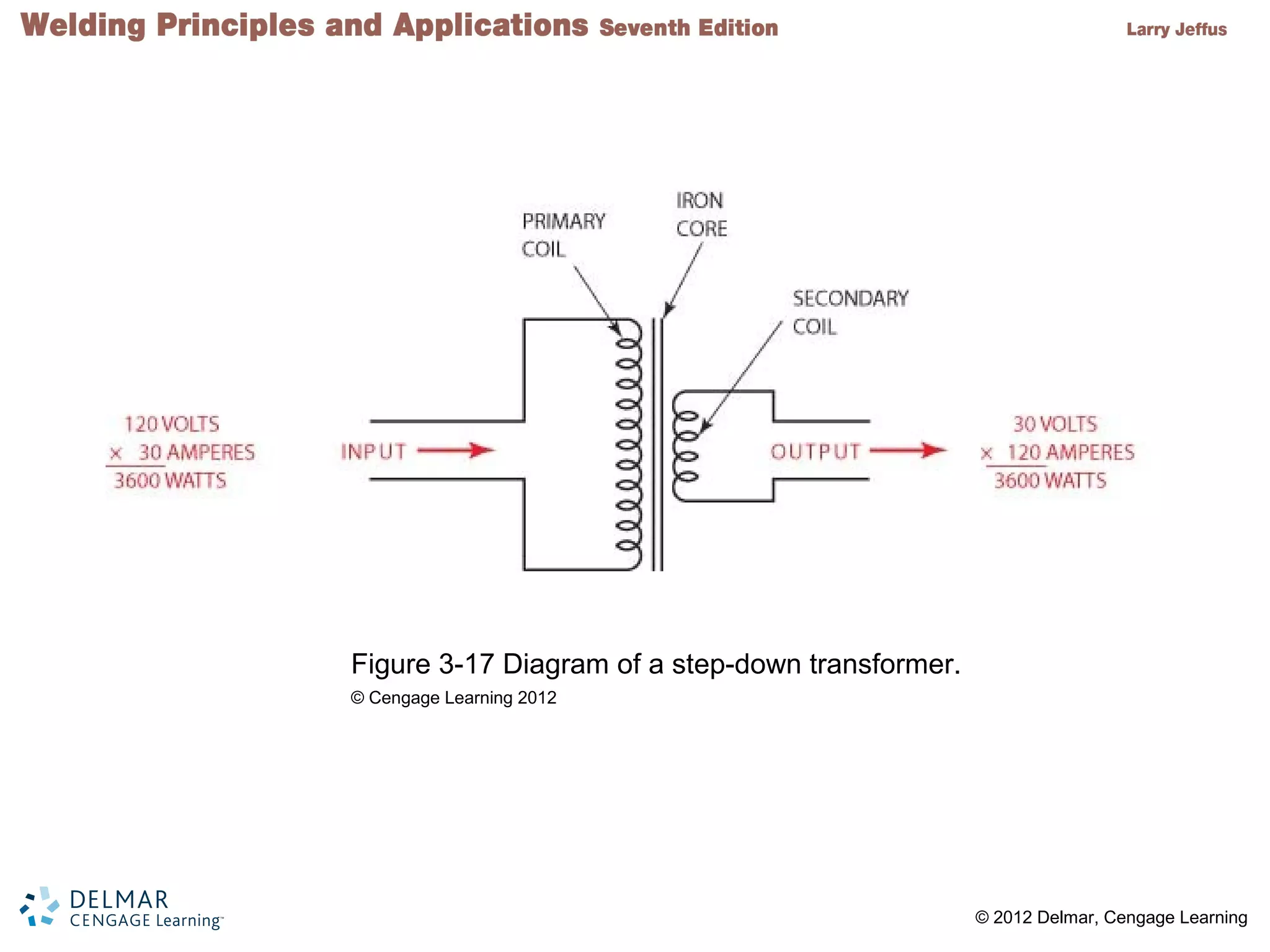
• Step-down transformers
– Takes high voltage, low amperage current and
turns it into low voltage, high amperage current
2 © 2012 Delmar, Cengage Learning
Figure 3-17 Diagram of a step-down transformer.
© Cengage Learning 2012
2 © 2012 Delmar, Cengage Learning
Types of Power Sources (cont'd.)
• Multiple-coil machine
– Allows the selection of different current setting
• Movable coil or core
– Has high and low current
– Handwheel moves internal parts
– Closer coils: greater current
• Inverter welding machines
– Smaller, but with same amperage range
– Power changed to thousands of cycles per second
2 © 2012 Delmar, Cengage Learning
Generator and Alternator Type Welders
• Both produce welding electricity
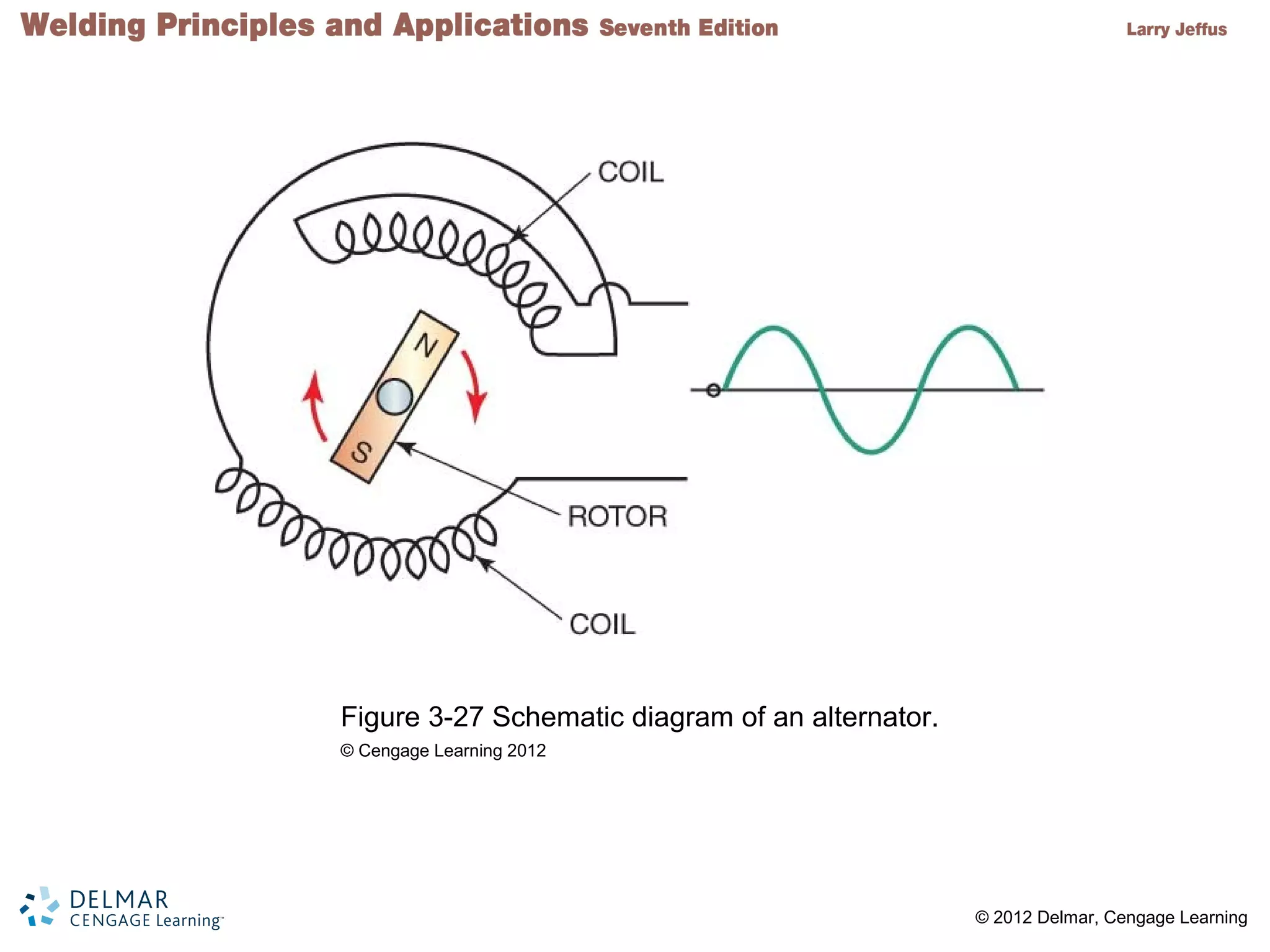
– Alternator: magnetic lines of force rotate inside a
coil or wire
• Produces AC only
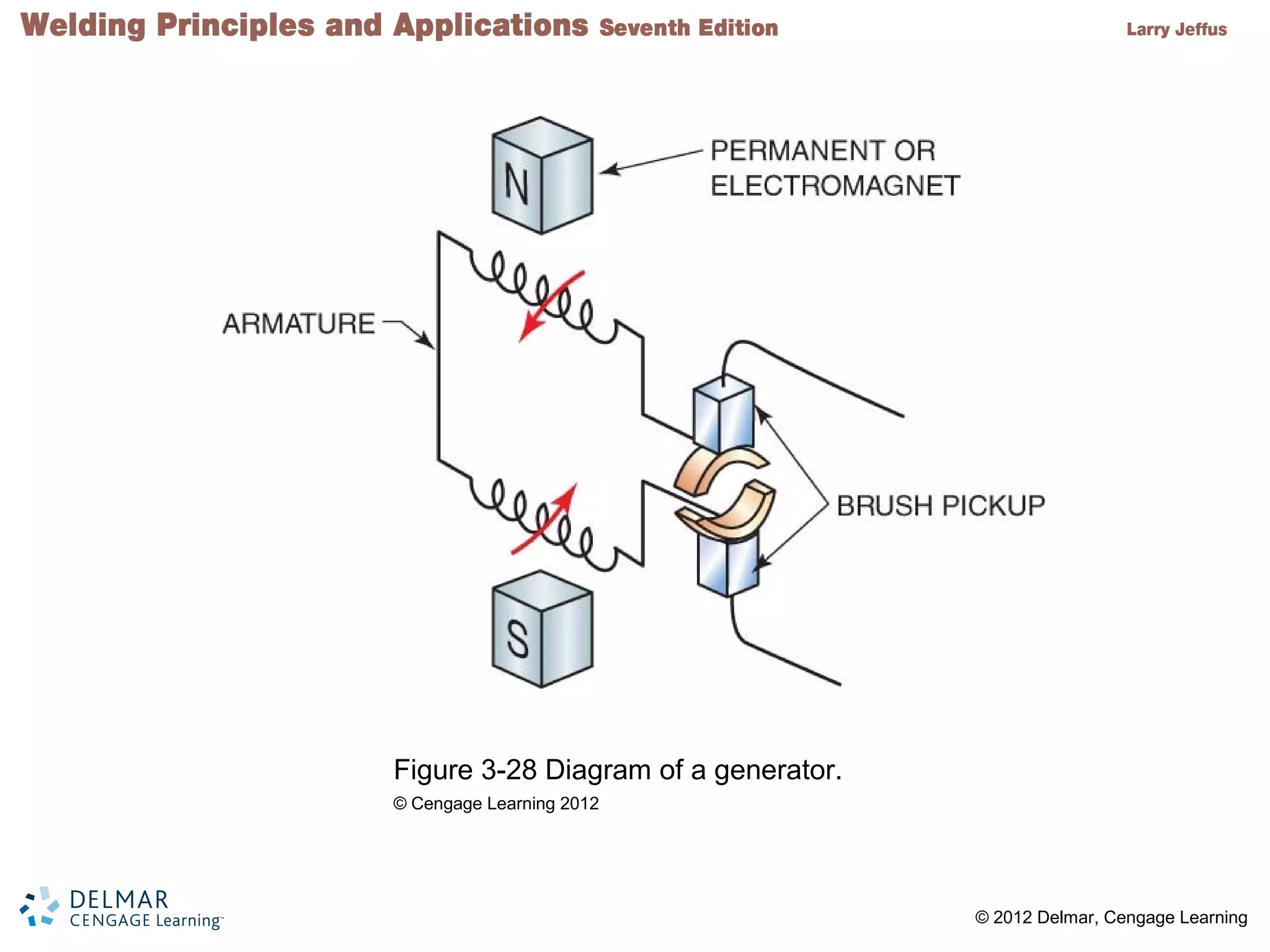
– Generators: welding current is produced on the
armature and is picked up with brushes
• Produces DC
– Portable engine-driven welders
• Require more maintenance
2 © 2012 Delmar, Cengage Learning
Figure 3-27 Schematic diagram of an alternator.
© Cengage Learning 2012
2 © 2012 Delmar, Cengage Learning
Figure 3-28 Diagram of a generator.
© Cengage Learning 2012
2 © 2012 Delmar, Cengage Learning
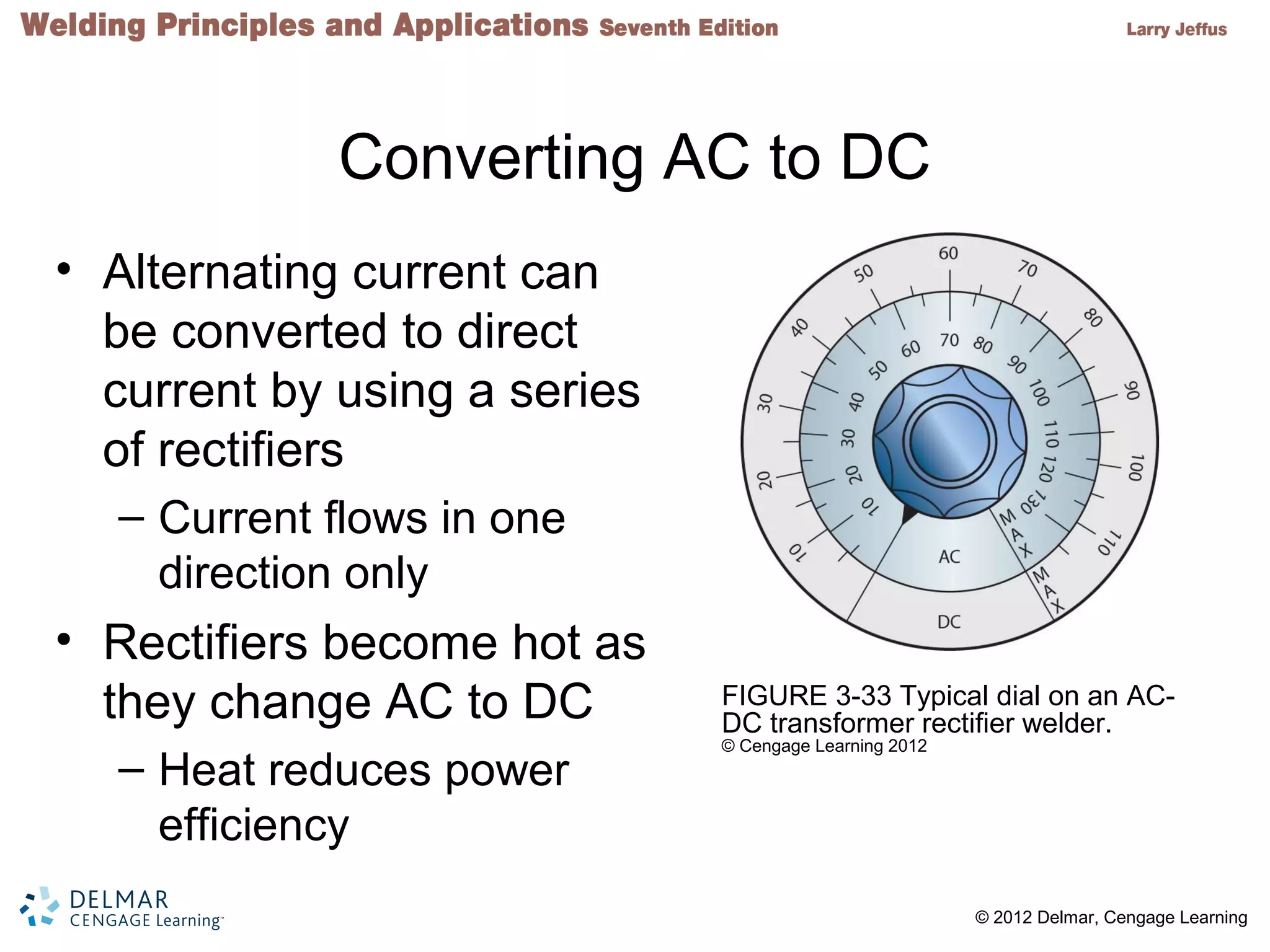
Converting AC to DC
• Alternating current can
be converted to direct
current by using a series
of rectifiers
– Current flows in one
direction only
• Rectifiers become hot as
they change AC to DC
– Heat reduces power
efficiency
FIGURE 3-33 Typical dial on an AC-
DC transformer rectifier welder.
© Cengage Learning 2012
2 © 2012 Delmar, Cengage Learning
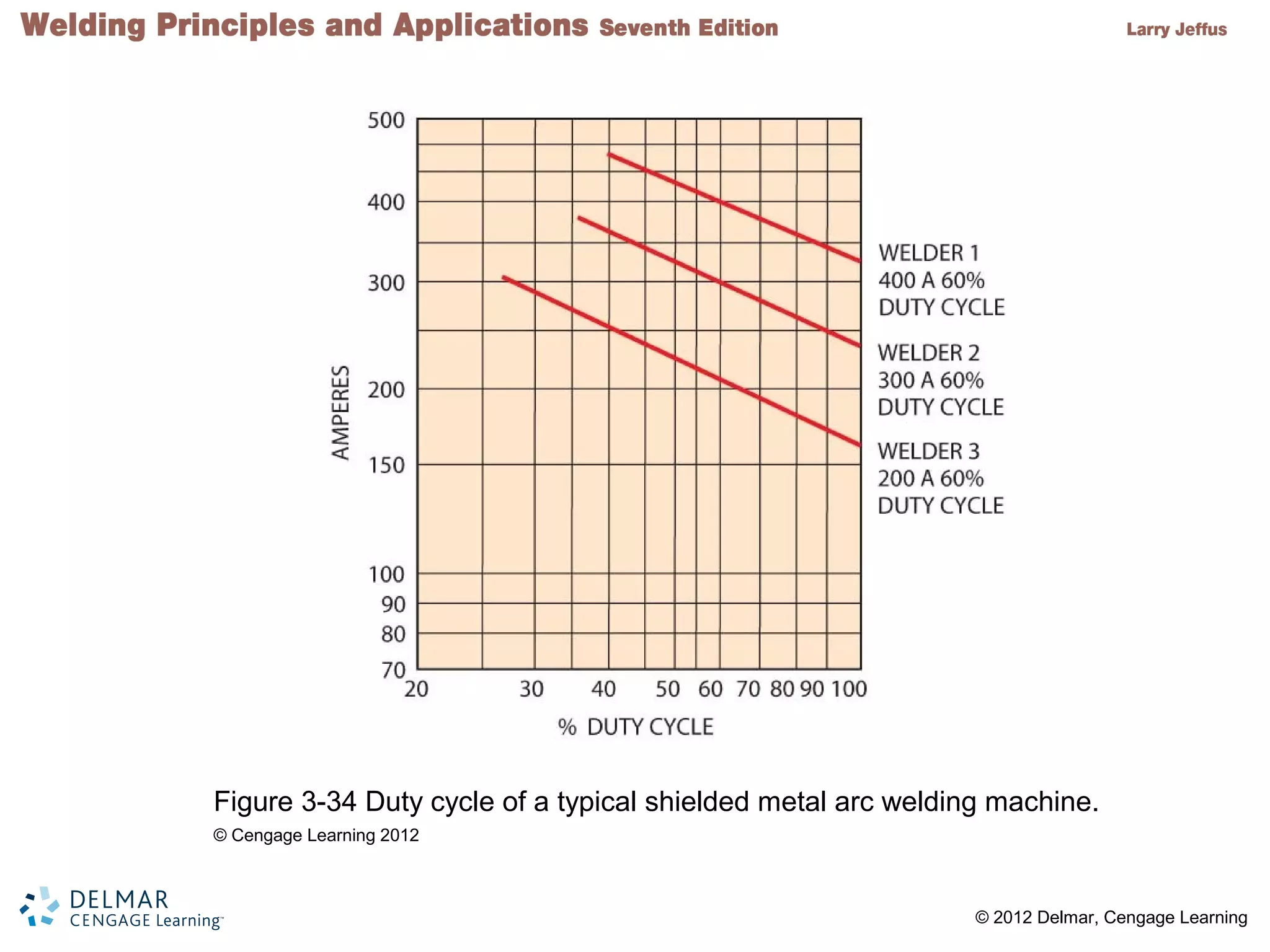
Duty Cycle
• Welding machines
– Produce internal heat as they produce the welding
current
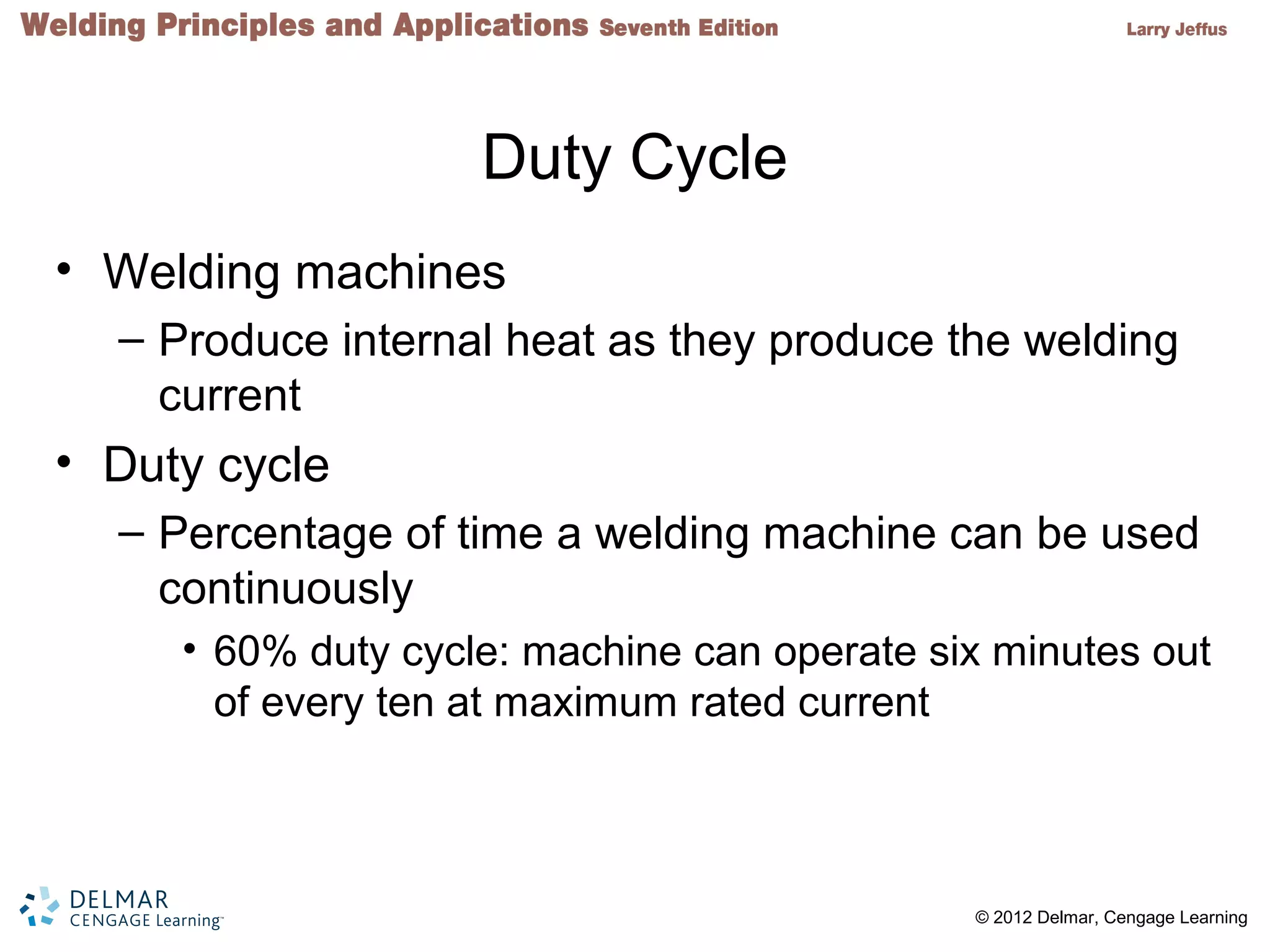
• Duty cycle
– Percentage of time a welding machine can be used
continuously
• 60% duty cycle: machine can operate six minutes out
of every ten at maximum rated current
2 © 2012 Delmar, Cengage Learning
Figure 3-34 Duty cycle of a typical shielded metal arc welding machine.
© Cengage Learning 2012
2 © 2012 Delmar, Cengage Learning
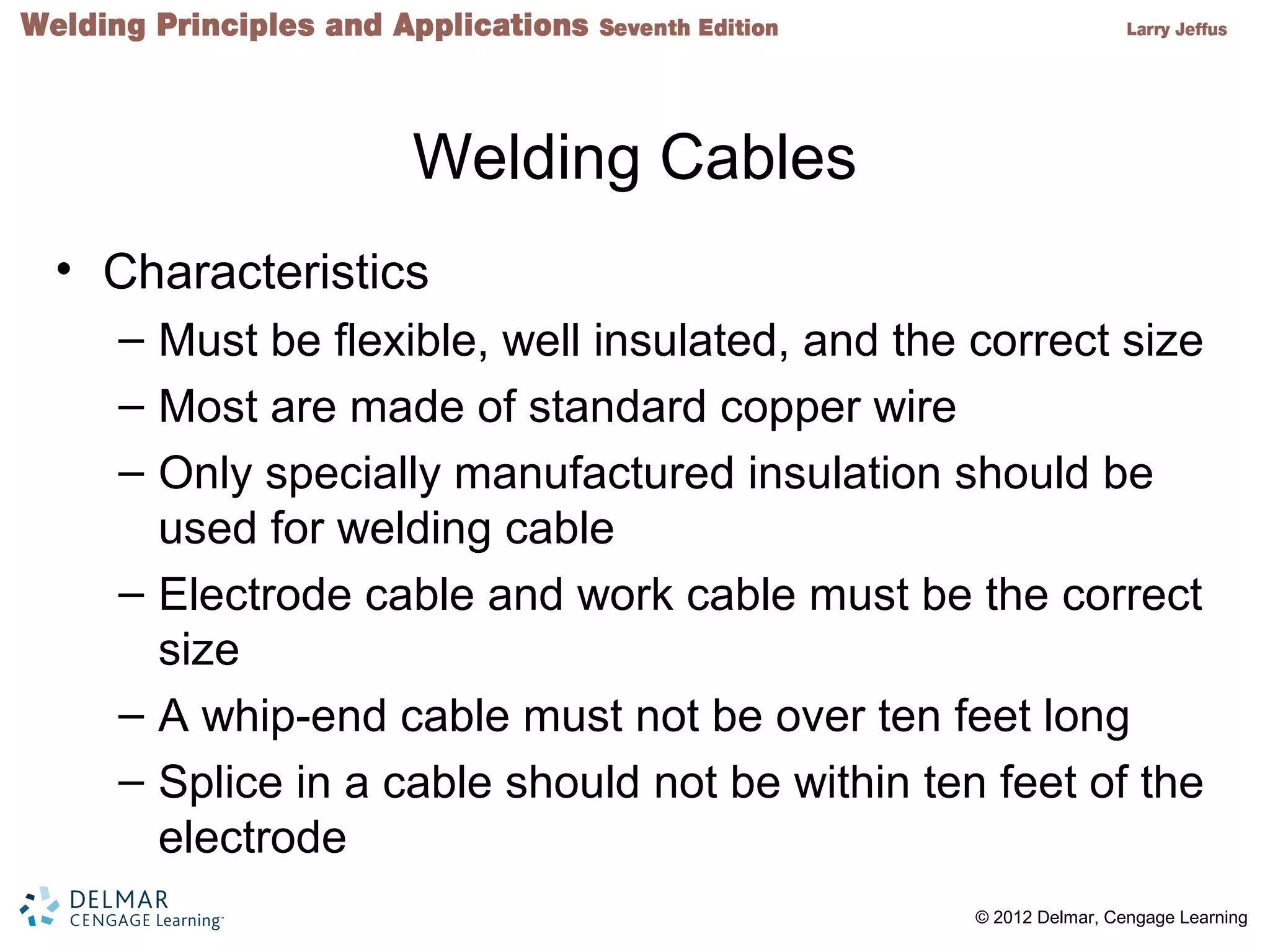
Welding Cables
• Characteristics
– Must be flexible, well insulated, and the correct size
– Most are made of standard copper wire
– Only specially manufactured insulation should be
used for welding cable
– Electrode cable and work cable must be the correct
size
– A whip-end cable must not be over ten feet long
– Splice in a cable should not be within ten feet of the
electrode
2 © 2012 Delmar, Cengage Learning
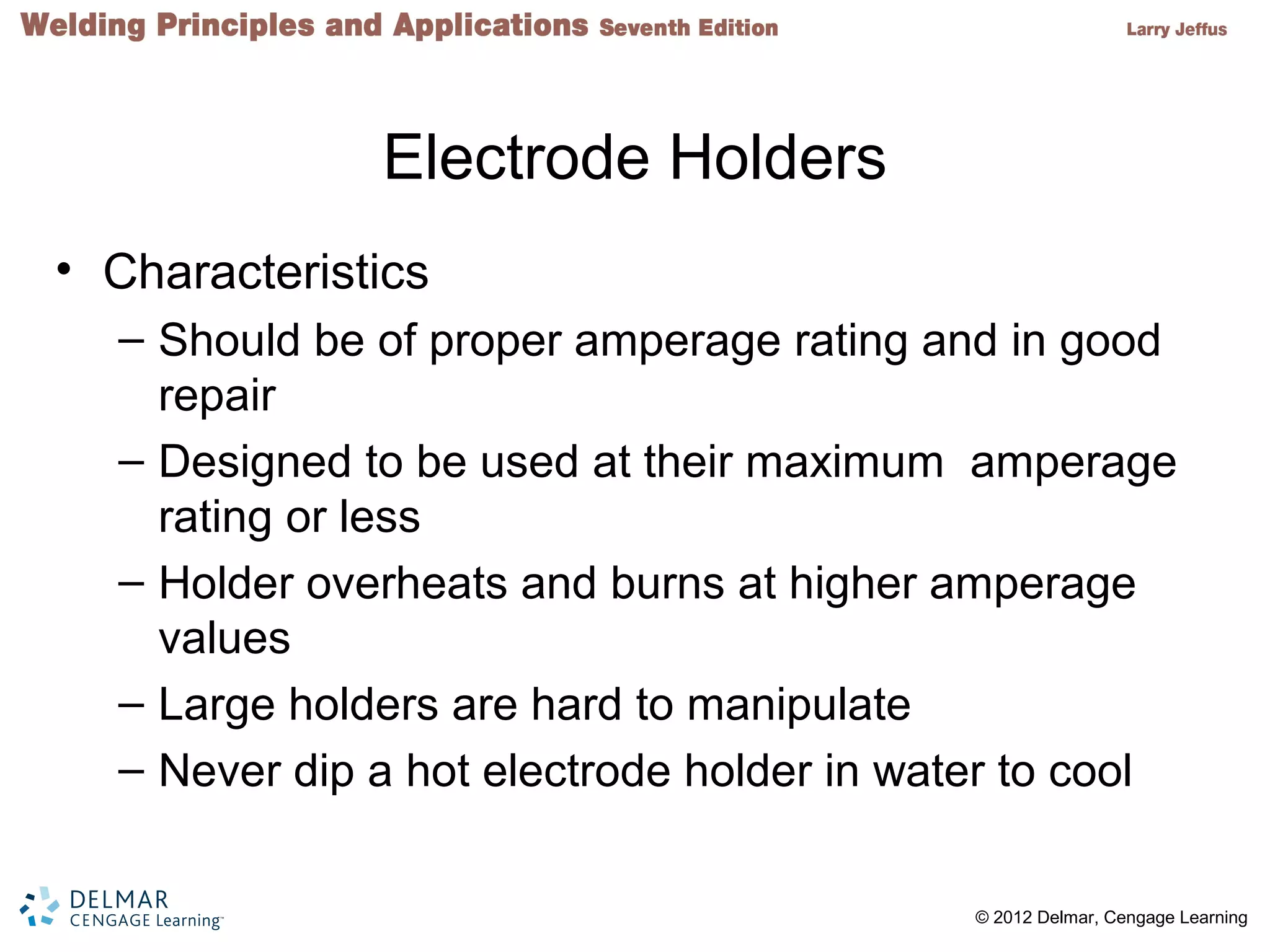
Electrode Holders
• Characteristics
– Should be of proper amperage rating and in good
repair
– Designed to be used at their maximum amperage
rating or less
– Holder overheats and burns at higher amperage
values
– Large holders are hard to manipulate
– Never dip a hot electrode holder in water to cool
2 © 2012 Delmar, Cengage Learning
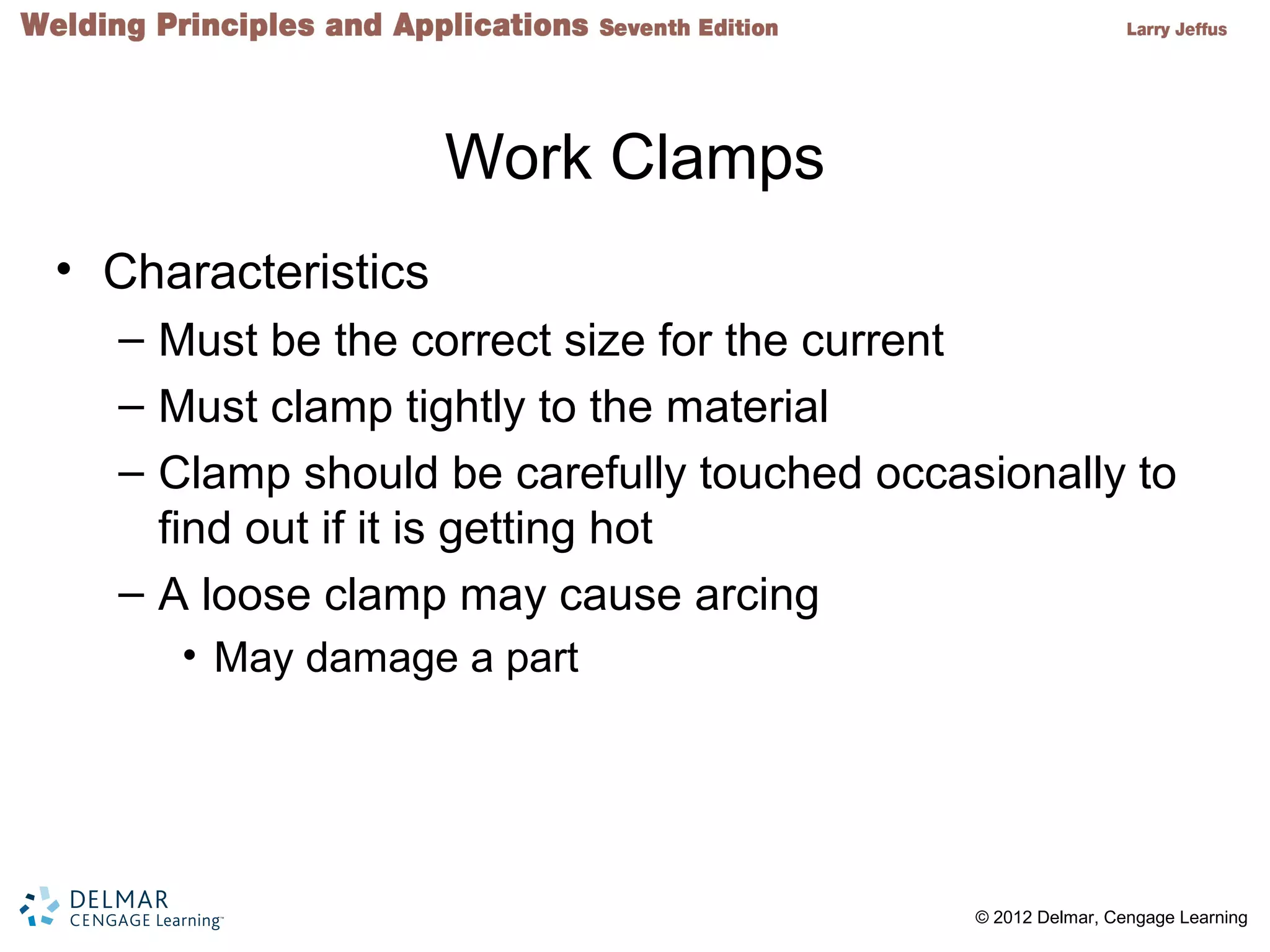
Work Clamps
• Characteristics
– Must be the correct size for the current
– Must clamp tightly to the material
– Clamp should be carefully touched occasionally to
find out if it is getting hot
– A loose clamp may cause arcing
• May damage a part
2 © 2012 Delmar, Cengage Learning
Equipment Setup
• Arc welding machines
– Should be located near the welding site
• Far enough to avoid spark showers
– Machines can be stacked to save space
– Ensure each machine has sufficient air circulation
– Keep away from cleaning tanks and corrosive
fumes
– Water leaks must be fixed and puddles cleaned up
before a machine is used
2 © 2012 Delmar, Cengage Learning
Equipment Setup (cont'd.)
– Power shutoff must be easy to reach in an
emergency
– Machine case or frame must be grounded
– Cables should not be placed on the floor
– Work station must be free of combustible materials
– Cable should never be wrapped around the body or
tied to scaffolding or ladders
2 © 2012 Delmar, Cengage Learning
Summary
• Understanding electricity and magnetism
– Aids in understanding welding currents
• Failure to control arc blow
– Can result in weld failures
• Check equipment manufacturer's safety guidelines
– Proper operation and maintenance
• Keeping work area clean and orderly
– Helps prevent accidents

Ch 3 shielded metal arc welding setup and operation

  • 1.
    2 © 2012Delmar, Cengage Learning Chapter 3 Shielded Metal Arc Welding, Setup, and Operation
  • 2.
    2 © 2012Delmar, Cengage Learning Objectives • Describe the process of shielded metal arc welding (SMAW) • List and define the three units used to measure a welding current • Tell how adding chemicals to the coverings of the electrodes affects the arc • Discuss the three different types of current used for welding
  • 3.
    2 © 2012Delmar, Cengage Learning Objectives (cont'd.) • Explain the types of welding power supplies and which type the shielded metal arc welding process requires • Define open circuit voltage and operating voltage • Explain arc blow, what causes it, and how to control it • Tell what the purpose of a welding transformer is and what kind of change occurs to the voltage and amperage with a step-down transformer
  • 4.
    2 © 2012Delmar, Cengage Learning Objectives (cont'd.) • Compare generators and alternators • Tell the purpose of a rectifier • Read a welding machine duty cycle chart and explain its significance • Demonstrate how to determine the proper welding cable size • Demonstrate how to service and repair electrode holders
  • 5.
    2 © 2012Delmar, Cengage Learning Objectives (cont'd.) • Discuss the problems that can occur as a result of poor work lead clamping • Describe the factors that should be considered when placing an arc welding machine in a welding area
  • 6.
    2 © 2012Delmar, Cengage Learning Introduction • Shielded metal arc welding (SMAW) – A flux-covered metal electrode carries current • SMAW is a widely used welding process – Low cost – Flexible – Portable – Versatile
  • 7.
    2 © 2012Delmar, Cengage Learning Welding Current and Electrical Measurement • Electric current – Source of heat – Flow of electrons • Units used to describe electrical current – Voltage: measurement of electrical pressure – Amperage: total number of electrons flowing – Wattage: measurement of electrical energy or power in the arc
  • 8.
    2 © 2012Delmar, Cengage Learning FIGURE 3-2 Electrons traveling along a conductor. © Cengage Learning 2012
  • 9.
    2 © 2012Delmar, Cengage Learning FIGURE 3-3 Ohm’s law. © Cengage Learning 2012
  • 10.
    2 © 2012Delmar, Cengage Learning SMA Welding Arc Temperature and Heat • Temperature – Degree or level of energy in a material – Measured in degrees with a thermometer • Heat – Quantity of energy in a material – Cannot easily be measured – Determined by knowing temperature and object mass • Temperature of a welding arc – Dependent on voltage, arc length, and atmosphere
  • 11.
    2 © 2012Delmar, Cengage Learning Types of Welding Currents • Three types of current used for arc welding – Alternating Current (AC) – Direct-current electrode negative (DCEN) – Direct-current electrode positive (DCEP) • Some electrodes can used with only one type of current – Others can be used with two or more • Each current has a different effect on the weld
  • 12.
    2 © 2012Delmar, Cengage Learning Types of Welding Power • Welding power can be supplied as: – Constant voltage (CV) • Arc voltage remains constant – Rising arc voltage (RAV) • Arc voltage increases as amperage increases – Constant Current (CC) • Total welding current remains the same • Shielded metal arc welding – Requires a constant current arc voltage characteristic
  • 13.
    2 © 2012Delmar, Cengage Learning Open Circuit Voltage • Voltage at the electrode before striking an arc – Usually between 50 V and 80 V • Higher open circuit voltage – Easier to strike an arc – Maximum safe open circuit voltage for welders is 80 volts • High voltage increases chance of electrical shock
  • 14.
    2 © 2012Delmar, Cengage Learning Operating Voltage • Voltage at the arc during welding – Also called welding or closed circuit voltage • Will vary with: – Arc length – Type of electrode – Type of current – Polarity
  • 15.
    2 © 2012Delmar, Cengage Learning Arc Blow • Electrons flow – Create lines of magnetic force that circle around the path of flow called magnetic flux lines • These lines space themselves evenly along a current-carrying wire • Arc blow – Movement of the arc – Makes arc drift like a string would drift in the wind – More of a problem when magnetic fields are the most uneven
  • 16.
    2 © 2012Delmar, Cengage Learning Figure 3-13 Magnetic forces concentrate around bends in wires. © Cengage Learning 2012
  • 17.
    2 © 2012Delmar, Cengage Learning Types of Power Sources • Electrical devices used – Electric motors or internal combustion engines – Step-down transformers • Welding transformers – Use high-voltage AC to produce low-voltage welding power • Step-down transformers – Takes high voltage, low amperage current and turns it into low voltage, high amperage current
  • 18.
    2 © 2012Delmar, Cengage Learning Figure 3-17 Diagram of a step-down transformer. © Cengage Learning 2012
  • 19.
    2 © 2012Delmar, Cengage Learning Types of Power Sources (cont'd.) • Multiple-coil machine – Allows the selection of different current setting • Movable coil or core – Has high and low current – Handwheel moves internal parts – Closer coils: greater current • Inverter welding machines – Smaller, but with same amperage range – Power changed to thousands of cycles per second
  • 20.
    2 © 2012Delmar, Cengage Learning Generator and Alternator Type Welders • Both produce welding electricity – Alternator: magnetic lines of force rotate inside a coil or wire • Produces AC only – Generators: welding current is produced on the armature and is picked up with brushes • Produces DC – Portable engine-driven welders • Require more maintenance
  • 21.
    2 © 2012Delmar, Cengage Learning Figure 3-27 Schematic diagram of an alternator. © Cengage Learning 2012
  • 22.
    2 © 2012Delmar, Cengage Learning Figure 3-28 Diagram of a generator. © Cengage Learning 2012
  • 23.
    2 © 2012Delmar, Cengage Learning Converting AC to DC • Alternating current can be converted to direct current by using a series of rectifiers – Current flows in one direction only • Rectifiers become hot as they change AC to DC – Heat reduces power efficiency FIGURE 3-33 Typical dial on an AC- DC transformer rectifier welder. © Cengage Learning 2012
  • 24.
    2 © 2012Delmar, Cengage Learning Duty Cycle • Welding machines – Produce internal heat as they produce the welding current • Duty cycle – Percentage of time a welding machine can be used continuously • 60% duty cycle: machine can operate six minutes out of every ten at maximum rated current
  • 25.
    2 © 2012Delmar, Cengage Learning Figure 3-34 Duty cycle of a typical shielded metal arc welding machine. © Cengage Learning 2012
  • 26.
    2 © 2012Delmar, Cengage Learning Welding Cables • Characteristics – Must be flexible, well insulated, and the correct size – Most are made of standard copper wire – Only specially manufactured insulation should be used for welding cable – Electrode cable and work cable must be the correct size – A whip-end cable must not be over ten feet long – Splice in a cable should not be within ten feet of the electrode
  • 27.
    2 © 2012Delmar, Cengage Learning Electrode Holders • Characteristics – Should be of proper amperage rating and in good repair – Designed to be used at their maximum amperage rating or less – Holder overheats and burns at higher amperage values – Large holders are hard to manipulate – Never dip a hot electrode holder in water to cool
  • 28.
    2 © 2012Delmar, Cengage Learning Work Clamps • Characteristics – Must be the correct size for the current – Must clamp tightly to the material – Clamp should be carefully touched occasionally to find out if it is getting hot – A loose clamp may cause arcing • May damage a part
  • 29.
    2 © 2012Delmar, Cengage Learning Equipment Setup • Arc welding machines – Should be located near the welding site • Far enough to avoid spark showers – Machines can be stacked to save space – Ensure each machine has sufficient air circulation – Keep away from cleaning tanks and corrosive fumes – Water leaks must be fixed and puddles cleaned up before a machine is used
  • 30.
    2 © 2012Delmar, Cengage Learning Equipment Setup (cont'd.) – Power shutoff must be easy to reach in an emergency – Machine case or frame must be grounded – Cables should not be placed on the floor – Work station must be free of combustible materials – Cable should never be wrapped around the body or tied to scaffolding or ladders
  • 31.
    2 © 2012Delmar, Cengage Learning Summary • Understanding electricity and magnetism – Aids in understanding welding currents • Failure to control arc blow – Can result in weld failures • Check equipment manufacturer's safety guidelines – Proper operation and maintenance • Keeping work area clean and orderly – Helps prevent accidents