Fundamentals of
Strategic HRM
By :- Sonu Choudhary
Importance of HRM
HRM has a dual nature:
.
Strategic HRM provides a clear connection between the
organization’s goals and the activities of employees.
supports the
organization’s strategy
represents and advocates
for the employees
The HRM Functions
HRM has four basic functions:
In other words, hiring people, preparing them, stimulating
them, and keeping them.
staffing
training and
development
motivation
maintenance
The HRM Functions
Staffing has fostered the most change in HR departments
during the past 30 years.
staffing
 strategic human resource planning: match prospects’ skills to
the company’s strategy needs
 recruiting: use accurate job descriptions to obtain an
appropriate pool of applicants
 selection: thin out pool of applicants to find the best choice
The HRM Functions
The goal is to have competent, adapted employees.
training and
development
 orientation: teach the rules, regulations, goals, and culture
 employee training: acquiring better skills for the job
 employee development: prepare for future position(s) in the company
 organizational development: help adapt to the company’s changing
strategic directions
 career development: helping employees realize career goals
The HRM Functions
motivation
 theories and job design: environment; well-constructed jobs
 performance appraisals: standards; feedback
 rewards and compensation: linked
 employee benefits: pay-for-performance plan
The HRM Functions
Job loyalty has declined over the past decade.
maintenance
 safety and health: has a big effect on their commitment
 communications and employee relations: keep employees
well-informed; provide a means of venting frustrations
External Influences on HRM
management
thought
labor
unions
laws and
regulationsHRM
dynamic
environment
External influences affect HRM functions.
External Influences on HRM
dynamic
environment
“The only constant in life is change.”
globalization decentralized work sites
technology
teams
workforce diversity
employee involvement
ethicschanging skill requirements
continuous improvement
External Influences on HRM
laws and
regulations
 legislation has an enormous effect on HRM
 laws protect employee rights to union representation, fair
wages, family medical leave, and freedom from discrimination
based on conditions unrelated to job performance
The U.S. Equal Employment Opportunity Commission
www.eeoc.gov enforces federal laws on civil rights at work.
External Influences on HRM
labor unions
assist workers in dealing with company management
negotiate wages, hours, and other terms of employment
promote and foster a grievance procedures
When a union is present, employers can not fire workers for
unjustified reasons.
External Influences on HRM
management
thought
Frederick Taylor developed principles to enhance worker productivity
Hugo Munsterberg devised improvements to worker testing, training,
evaluations, and efficiency
Mary Parker Follett advocated people-oriented organizations
Elton Mayo’s Hawthorne Studies: dynamics of informal work groups
have a bigger effect on worker performance than do wage incentives
The Hawthorne Studies gave rise to the human relations movement:
benefits, healthy work conditions, concern for employee well-being.
Structure of the HR Department
promotes staffing activities, recruits new
employees, but does not make hiring decision
helps workers adapt to change in the company’s
external and internal environments
pays employees and administers their benefits
package
ensures open communication within the company by
fostering top management commitment, upward and
accurate communication, feedback, and effective
information sources
compensation/
benefits
employee
relations
training and
development
employment
Careers in HR
HR positions include:
 assistants who support other HR professionals
 generalists who provide service in all four HR functions
 specialists who work in one of the four HR functions
 executives who report to top management and coordinate HR
functions to organizational strategy
Interpersonal communication skills and ambition are two
factors that HR professionals say advance their careers.
Careers in HR
Organizations that spend money for quality HR
programs perform better than those that don’t.
(HCI study)
Quality programs:
reward productive work
offer a flexible, work-friendly environment
properly recruit and retain quality employees
provide effective communications
Make sure HR services match the overall
organizational strategy.
HR Trends and Opportunities
 Outsourcing
more than half of all companies outsource all or
some parts of their HR functions
 Professional Employer Organizations (PEO)
 help small- to medium-size companies attract
stronger candidates and handle new laws in HR
 Shared Services allow Organizations
 with several divisions or locations to consolidate
some HR functions into one central location while
retaining certain functions in divisional locations
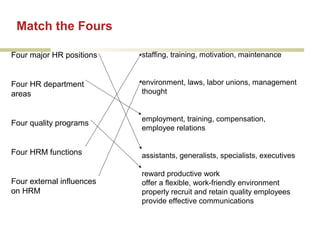
Match the Fours
Four major HR positions
Four HR department
areas
Four quality programs
Four HRM functions
Four external influences
on HRM
staffing, training, motivation, maintenance
environment, laws, labor unions, management
thought
employment, training, compensation,
employee relations
assistants, generalists, specialists, executives
reward productive work
offer a flexible, work-friendly environment
properly recruit and retain quality employees
provide effective communications
Thank You

HRM Function By Sonu Choudhary

  • 1.
  • 2.
    Importance of HRM HRMhas a dual nature: . Strategic HRM provides a clear connection between the organization’s goals and the activities of employees. supports the organization’s strategy represents and advocates for the employees
  • 3.
    The HRM Functions HRMhas four basic functions: In other words, hiring people, preparing them, stimulating them, and keeping them. staffing training and development motivation maintenance
  • 4.
    The HRM Functions Staffinghas fostered the most change in HR departments during the past 30 years. staffing  strategic human resource planning: match prospects’ skills to the company’s strategy needs  recruiting: use accurate job descriptions to obtain an appropriate pool of applicants  selection: thin out pool of applicants to find the best choice
  • 5.
    The HRM Functions Thegoal is to have competent, adapted employees. training and development  orientation: teach the rules, regulations, goals, and culture  employee training: acquiring better skills for the job  employee development: prepare for future position(s) in the company  organizational development: help adapt to the company’s changing strategic directions  career development: helping employees realize career goals
  • 6.
    The HRM Functions motivation theories and job design: environment; well-constructed jobs  performance appraisals: standards; feedback  rewards and compensation: linked  employee benefits: pay-for-performance plan
  • 7.
    The HRM Functions Jobloyalty has declined over the past decade. maintenance  safety and health: has a big effect on their commitment  communications and employee relations: keep employees well-informed; provide a means of venting frustrations
  • 8.
    External Influences onHRM management thought labor unions laws and regulationsHRM dynamic environment External influences affect HRM functions.
  • 9.
    External Influences onHRM dynamic environment “The only constant in life is change.” globalization decentralized work sites technology teams workforce diversity employee involvement ethicschanging skill requirements continuous improvement
  • 10.
    External Influences onHRM laws and regulations  legislation has an enormous effect on HRM  laws protect employee rights to union representation, fair wages, family medical leave, and freedom from discrimination based on conditions unrelated to job performance The U.S. Equal Employment Opportunity Commission www.eeoc.gov enforces federal laws on civil rights at work.
  • 11.
    External Influences onHRM labor unions assist workers in dealing with company management negotiate wages, hours, and other terms of employment promote and foster a grievance procedures When a union is present, employers can not fire workers for unjustified reasons.
  • 12.
    External Influences onHRM management thought Frederick Taylor developed principles to enhance worker productivity Hugo Munsterberg devised improvements to worker testing, training, evaluations, and efficiency Mary Parker Follett advocated people-oriented organizations Elton Mayo’s Hawthorne Studies: dynamics of informal work groups have a bigger effect on worker performance than do wage incentives The Hawthorne Studies gave rise to the human relations movement: benefits, healthy work conditions, concern for employee well-being.
  • 13.
    Structure of theHR Department promotes staffing activities, recruits new employees, but does not make hiring decision helps workers adapt to change in the company’s external and internal environments pays employees and administers their benefits package ensures open communication within the company by fostering top management commitment, upward and accurate communication, feedback, and effective information sources compensation/ benefits employee relations training and development employment
  • 14.
    Careers in HR HRpositions include:  assistants who support other HR professionals  generalists who provide service in all four HR functions  specialists who work in one of the four HR functions  executives who report to top management and coordinate HR functions to organizational strategy Interpersonal communication skills and ambition are two factors that HR professionals say advance their careers.
  • 15.
    Careers in HR Organizationsthat spend money for quality HR programs perform better than those that don’t. (HCI study) Quality programs: reward productive work offer a flexible, work-friendly environment properly recruit and retain quality employees provide effective communications Make sure HR services match the overall organizational strategy.
  • 16.
    HR Trends andOpportunities  Outsourcing more than half of all companies outsource all or some parts of their HR functions  Professional Employer Organizations (PEO)  help small- to medium-size companies attract stronger candidates and handle new laws in HR  Shared Services allow Organizations  with several divisions or locations to consolidate some HR functions into one central location while retaining certain functions in divisional locations
  • 17.
    Match the Fours Fourmajor HR positions Four HR department areas Four quality programs Four HRM functions Four external influences on HRM staffing, training, motivation, maintenance environment, laws, labor unions, management thought employment, training, compensation, employee relations assistants, generalists, specialists, executives reward productive work offer a flexible, work-friendly environment properly recruit and retain quality employees provide effective communications
  • 19.