Clinical Teaching
Prepared by
Ms. Jenisha Adhikari
BSN
Content
• Definition
• Purpose
• Principle
• Criteria for clinical teaching
• Difference between class and clinical teaching
• Model of clinical teaching
• Factor influencing clinical teaching
• Clinical teaching methods
• Clinical learning cycle
• Role of clinical instructor
• Responsibility of clinical instructor
Clinical teaching
Definition
Clinical teaching is an individualized
or group teaching to the nursing
student in the clinical area by the
nurse educators, staff and
clinical nurse manager.
In preparation of professional practice, the
clinical setting is the place where the students
come in contact with patient or consumer for
the purpose of testing theories and learning
skill
• Teaching in clinical setting is a challenge that
is different from those encountered in the class
room
• Like any other skill based profession, nursing
also requires the development of relationship
between theory and practice
Defintion
“ Clinical teaching is vehicle that provides
students with opportunity to translate basic
theoretical knowledge into learning of variety
of intellectual and psychomotor skills needed
to provide patient – centered quality nursing
care.”
- Schweer
Purpose of clinical teaching
1. To provide individualized care in a
systematic, holistic approach
2. To develop high technical competent skills
3. To practice various procedure
4. To collect and analyze the data
Contd…
5. To develop communication skills and maintain
interpersonal relationship
6. To maintain high standard of nursing practice
to become independent enough to practice
nursing
7. To develop, cognitive, affective and
psychomotor skills
Contd ….
8. To learn various diagnostic procedures
9. To learn various skill in giving health
education technique to the client
10. To develop proficiency and efficiency in
carrying out various procedure
Principles of clinical teaching
• Clinical education should reflect the nature of
professional practice
• Clinical teaching is supported by
climate of mutual trust and respect
• Clinical teaching and learning should
focus on essential knowledge, skill and
attitude
GUIDELINES FOR SELECTION OF
CLINICAL TEACHING METHODS
• Must be appropriate to objectives and desired
behavioral changes.
• Must be in accordance with principles of
learning.
• Must be in accordance with the capacity of the
student.
Contd.
• Must be in accordance with availability of
resources.
• Must be in accordance with the teacher’s
ability to use it effectively and creatively.
Difference between class room and clinical
teaching
CLASS ROOM TEACHING
•Large group
•No focus on patient
•Knowledge
•Theoretical framework
•Teacher/students ratio is
large
•Passive students
•Less interactive
CLINICAL TEACHING
•Small group
•Focus on patient
•Application of knowledge
•Clinical reasoning
•Teacher / students ratio
is small
•Active students
•More interactive
Models of clinical teaching
• Traditional model
• Preceptor model
• Associated / Partnership model
FACTORS INFLUENCING
CLINICAL TEACHING
• Group interaction skills
•Clinical supervision skill
•Clinical competence and professionalism
•Knowledge and analytical ability.
•Organization and clarity of presentation
•Enthusiasm and stimulation of interest
Clinical teaching method
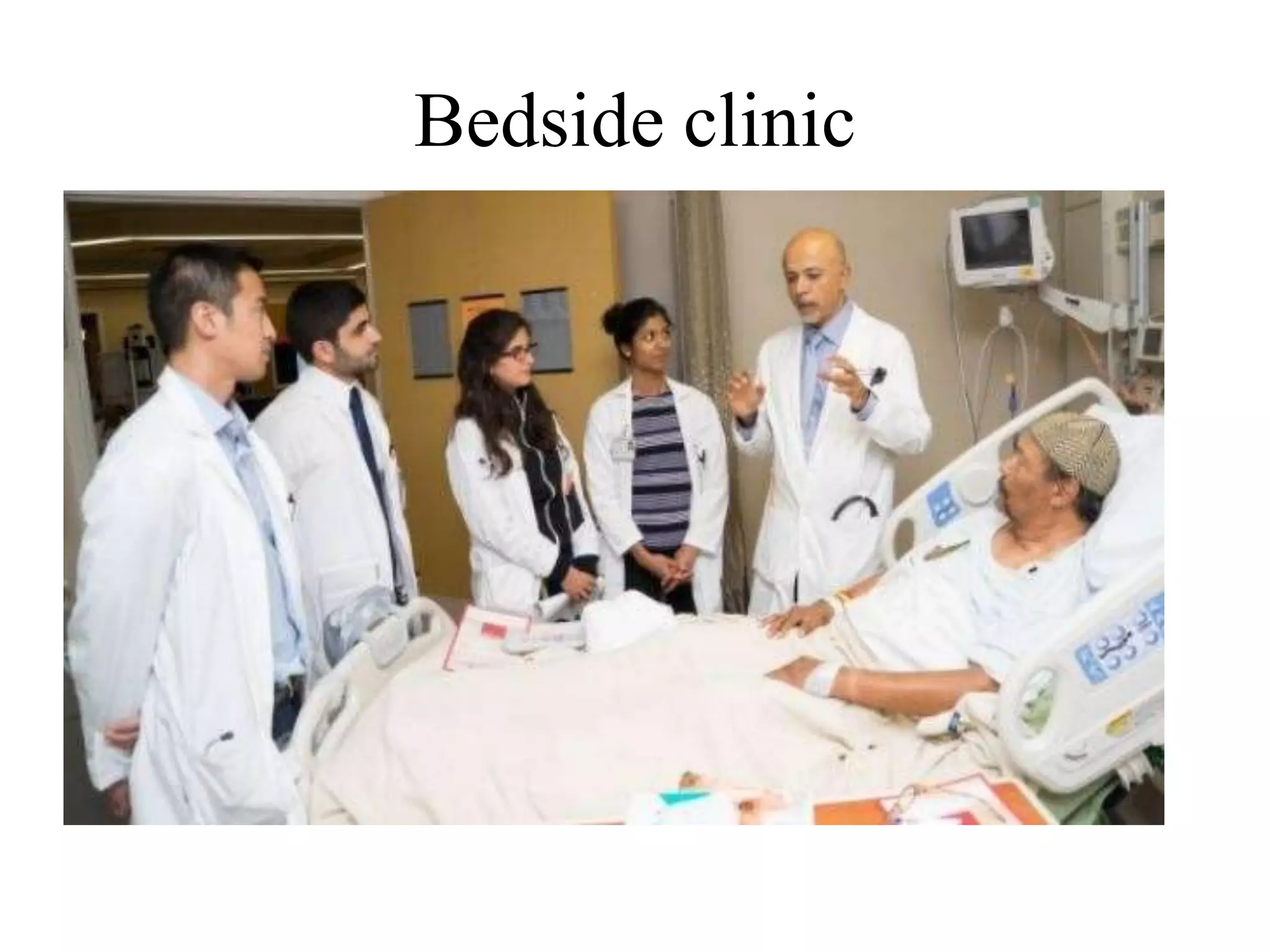
– Bedside clinic
– Nursing rounds
– Nursing shift reports
– Nursing care conferences
– Demonstration
– Nursing care studies
Contd
– Process recording
– Laboratory method
– Nursing assignment
– Field trip
Bedside clinic
Definition
It is a method of clinical teaching which is
carried out by either the group visits the
patient or the patient is brought to the
conference room in order to study problems
associated with a particular disease or
disorder
Contd..
• Always ensure the presence of the patient.
• Patients with typical diseases are selected.
Uses of bedside clinic
• To show the sign and symptoms related to a
particular condition
• To demonstrate a significant nursing situation
• To show how nursing problem have been
solved
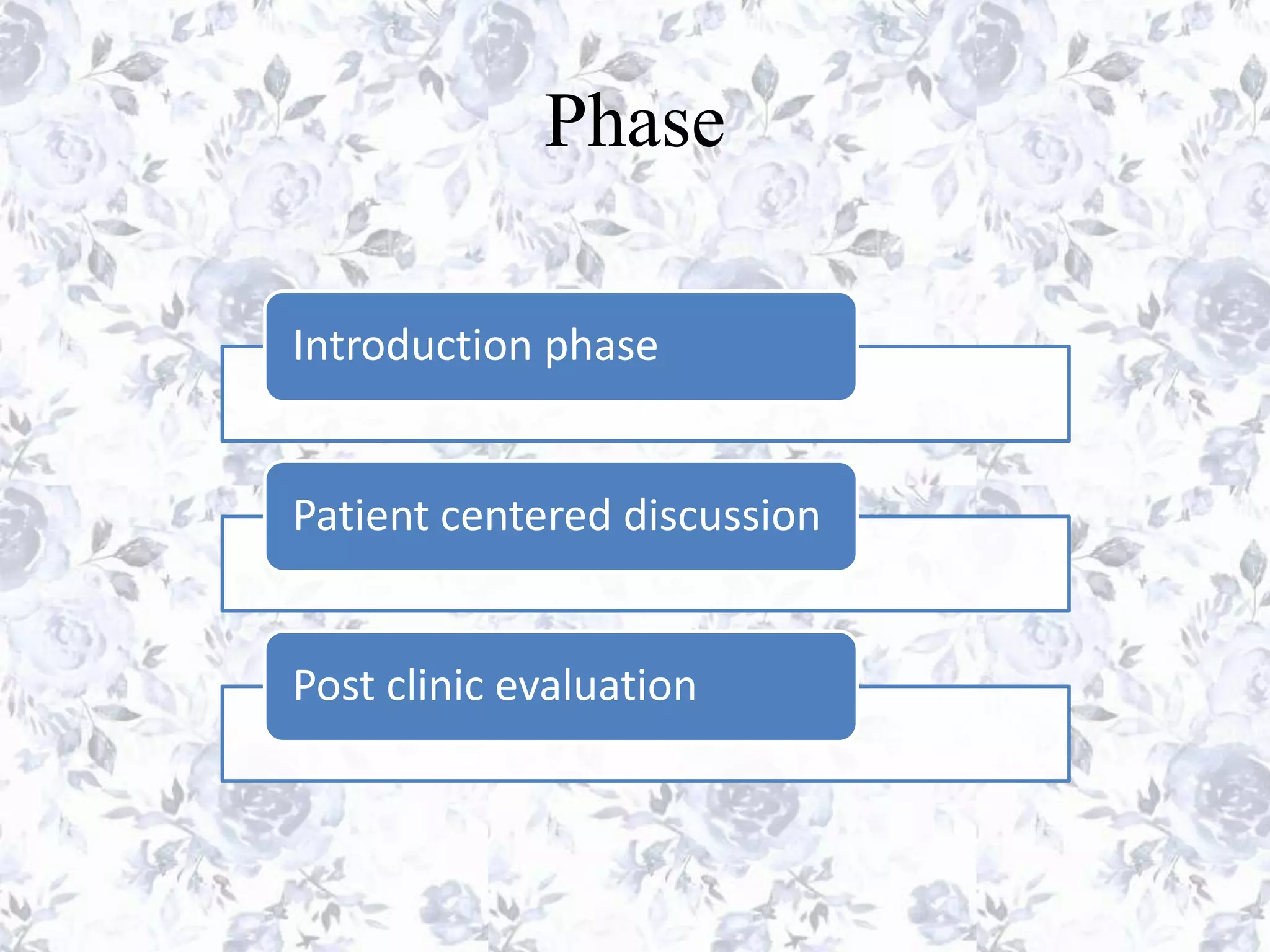
Phase
Introduction phase
Patient centered discussion
Post clinic evaluation
Advantages
• It puts the student in an active actual situation
• Develop skills in collecting information from
authentic source
• Develop tactfulness diplomacy needed to get
information from the patient
• Develop skills in problem solving, decision
making an organizing
• Permits comparison between reality and theory
Disadvantages
• Sometimes put patient in a difficult situation
Nursing round
Definition
A tour of patient’s bedside area made by a small
group of staff and students, not more than 7 or
8 for the purpose of clinical learning and
instructional purpose
Types
Instructional
Round
Information giving
round
Uses of nursing rounds
• To demonstrate clinical manifestation that
needs nursing intervention
• To study patient’s response to disease
conditions
• To demonstrate the effect of therapeutic
treatment
Contd..
• To illustrate skillful nursing care
• To have better understanding of patient’ s
needs in order to provide better care to patient
Advantages
• Puts the students in actual live situation where
patient responds and acts as a stimulus variable
• Students have options to select specific case or
problem that interest them and plan proper
nursing care
Contd ..
• It provides opportunity to reinforce the
theoretical knowledge through its application
in a real patient
• Increases learning ability
Disadvantages
• Only applicable for small group of students
• Require careful planning
Nursing shift report
Definition
• Nursing care reports are written or oral
summary of the nursing actions taken in
relation to patient’s care
Guideline for writing reports
• It should be clear and concise but include all
necessary information
• The report should be well organized for easy
understanding
• For report to be complete and meaningful, it
should include the date and time, the people
concerned the situation and the signature of
report writer
Advantages
• It aids in studying health condition
• It shows the progress in reaching goals
• Provides quality and continuity of work from
one shift to another
Disadvantage
• Wrong or invalid data in the report may lead
to faulty interpretation of patient’s condition
Nursing care conference
Definition
“Nursing Care Conference is defined as the
process in which group discussion is made
using problem solving techniques to determine
the ways of providing care for the patients
to whom students are assigned as
part of their clinical experience”
Types
• Group conference • Individual conference
Group conference
• Is a small group teaching method
• Allows student to participate actively ,
explaining their own experience
• Develop problem solving skills, team building
skills and ability to express themselves
Individual conference
• Focuses on the overall development of
individual student
• It mainly deals with the student nursing care
ability , level of performance achievements
and assignments related to the clinical
experience
Advantages
•Sharpens the critical thinking
•Helps the students to know about their progress
and hence boosts their self confidence.
• Develop problem solving skills
Disadvantages
• Time consuming
• Conflict of opinion
Demonstration
Definition
• Demonstration teaches by “Exhibition &
explanation ”
• It trains the students in the art of careful
observation
Types
• Planned
• Involves preliminary
preparation,
introduction, procedure
and follow up
• Unplanned
• Uncommon treatment
occur in the ward that
can be demonstrated if
not emergency
Advantages
• Activates senses
• Opportunity for observation and learning
• Creates interest by use of illustration
• Correlate theory and practice
Disadvantages
• Expensive
• Time consuming
Nursing care study
Definition
Method which focuses on information and facts
about patient, the disease condition , social and
personal history and the application of this
knowledge in rendering nursing care
• Student selects one patient for intensive study
• Students are given opportunity to take care of
the patients, study their treatment modalities
until they are discharged
Advantages
• Students learn problem-solving approach.
• Report acts as reference material for students
• Evaluate patient’s progress
Process recording
Definition
It is a written account or verbatim recording of
all that transpired during and immediately
following the nurse-patient interaction
Advantages
• Improve the quality of nurse – patient
interaction
• Gain competency in interpreting and
synthesizing raw data under supervision
• Increase observational skills
Process recording in
earlier period
Process recording in
modern period
Laboratory method
Definition
• Laboratory is a part of clinical teaching that offers
students with the opportunities to apply their
theoretical knowledge or previous learning into
practice in a controlled situation under guidance and
supervision where there is no client.
Advantages
• Increase students participation
• Prepare students for actual situation
• Clarify doubts and queries regarding to
demostration
Disadvantages
• Budget
• Time consuming
• Lack of apparatus
Nursing assignment
Definition
• It is the part of learning experiences where the
students are assigned with patient or other
activities concerning to patient in clinical
laboratory.
Methods of assignments in patient care
• Functional method
• Team method
• Case method
• Functional method
Nurses are assigned specific functions
such as administering medications, monitoring
vital signs etc
• Team method
In this method a group of patients are
looked after by nursing team, comprised of
nursing staff and student nurse
• Case method
In this type is a single nurse is assigned the
responsibility for the care of each patient from
time the patient is admitted to the hospital till
the patient is discharge.
Advantages
• Time efficient
Field trip
Definition
• It’s a well organized trip from a usual place
for teaching purpose
Purpose of field trip
• The field trip must be planned to meet specific
educational objectives
• Have list of all candidates, contact numbers of
people to be contacted in case of emergency &
special needs.
• Submit report on field visit and analyze.
Advantages
• Field trip gives natural stimulation and
motivates the learner to be more interactive
and creative.
•The monotony and boredom of classroom
teaching is eliminated through field trips
Disadvantage
• If the field trip is not planned well with
specific learning objectives it will result in
wastage of teaching learning resources.
• Field trips are expensive.
• Safety and security of the students is a real
concern.
Clinical learning cycle
Preparatory
theory
Laboratory
Briefing
Clinical
practice
Debriefing
Follow up
evaluation
Role of clinical instructor
• Supporter
• Facilitator
• Challenger
• Manager
• Coordinator
• Observer
• Evaluator
• Expert
Responsibility of clinical instructor
• Set objective, standard for practice
• Develop evaluation tools
• Should take permission of the institute
• Prepare master rotation plan
• Set up the clinical area in an instead manner
• Keep ready equipment in working condition
to provide nursing care
Contd…
• Direct and supervise the students
• Demonstrate nursing procedure on patient and
ask the students to re- demonstrate procedures
to develop skill and confidence
• Analyze the difficulties and guiding the
students accordingly
• Encourage, motivate and inspire students
Contd.
• Maintain strict discipline
• Maintain student’s record eg. Duty schedule,
individual assignments, evaluation tools,
clinical teachings and performance of students
• Conduct individual with the students to solve
any problem arose and to meet their
professional and personal needs
• Supervise assignment like ward teaching class,
case study, health talks.
• Has to participate in faculty conference
• Focus attention of students upon the medical
and nursing problems of client to whom they
are assigned
• Assist students in preparing teaching plans. x
Reference
• Singh Indira, Essentials of education A text book
for nurses and other health professional, 5th
edition, Hisi offset printer Pvt. Ltd, page no – 230-
254
• http://www.crlt.umich.edu/publinks/occ1
• https://www.slideshare.net/jimcyjose/clinical-
teaching-in-nursing?qid=407ed42a-7172-435d-
b937-133c8252dea7&v=&b=&from_search=1
• https://www.slideshare.net/gangahealth/effectiv
e-clinical-teaching-methods-gihs?qid=9da453d6-
d2c2-4293-ba15-
77842e218941&v=&b=&from_search=1
Thank you

Clinical teaching

  • 1.
  • 2.
    Content • Definition • Purpose •Principle • Criteria for clinical teaching • Difference between class and clinical teaching • Model of clinical teaching
  • 3.
    • Factor influencingclinical teaching • Clinical teaching methods • Clinical learning cycle • Role of clinical instructor • Responsibility of clinical instructor
  • 5.
  • 6.
    Definition Clinical teaching isan individualized or group teaching to the nursing student in the clinical area by the nurse educators, staff and clinical nurse manager.
  • 7.
    In preparation ofprofessional practice, the clinical setting is the place where the students come in contact with patient or consumer for the purpose of testing theories and learning skill
  • 8.
    • Teaching inclinical setting is a challenge that is different from those encountered in the class room • Like any other skill based profession, nursing also requires the development of relationship between theory and practice
  • 9.
    Defintion “ Clinical teachingis vehicle that provides students with opportunity to translate basic theoretical knowledge into learning of variety of intellectual and psychomotor skills needed to provide patient – centered quality nursing care.” - Schweer
  • 10.
    Purpose of clinicalteaching 1. To provide individualized care in a systematic, holistic approach 2. To develop high technical competent skills 3. To practice various procedure 4. To collect and analyze the data
  • 11.
    Contd… 5. To developcommunication skills and maintain interpersonal relationship 6. To maintain high standard of nursing practice to become independent enough to practice nursing 7. To develop, cognitive, affective and psychomotor skills
  • 12.
    Contd …. 8. Tolearn various diagnostic procedures 9. To learn various skill in giving health education technique to the client 10. To develop proficiency and efficiency in carrying out various procedure
  • 13.
    Principles of clinicalteaching • Clinical education should reflect the nature of professional practice • Clinical teaching is supported by climate of mutual trust and respect • Clinical teaching and learning should focus on essential knowledge, skill and attitude
  • 14.
    GUIDELINES FOR SELECTIONOF CLINICAL TEACHING METHODS • Must be appropriate to objectives and desired behavioral changes. • Must be in accordance with principles of learning. • Must be in accordance with the capacity of the student.
  • 15.
    Contd. • Must bein accordance with availability of resources. • Must be in accordance with the teacher’s ability to use it effectively and creatively.
  • 16.
    Difference between classroom and clinical teaching CLASS ROOM TEACHING •Large group •No focus on patient •Knowledge •Theoretical framework •Teacher/students ratio is large •Passive students •Less interactive CLINICAL TEACHING •Small group •Focus on patient •Application of knowledge •Clinical reasoning •Teacher / students ratio is small •Active students •More interactive
  • 17.
    Models of clinicalteaching • Traditional model • Preceptor model • Associated / Partnership model
  • 18.
    FACTORS INFLUENCING CLINICAL TEACHING •Group interaction skills •Clinical supervision skill •Clinical competence and professionalism •Knowledge and analytical ability. •Organization and clarity of presentation •Enthusiasm and stimulation of interest
  • 19.
    Clinical teaching method –Bedside clinic – Nursing rounds – Nursing shift reports – Nursing care conferences – Demonstration – Nursing care studies
  • 20.
    Contd – Process recording –Laboratory method – Nursing assignment – Field trip
  • 21.
  • 22.
    Definition It is amethod of clinical teaching which is carried out by either the group visits the patient or the patient is brought to the conference room in order to study problems associated with a particular disease or disorder
  • 23.
    Contd.. • Always ensurethe presence of the patient. • Patients with typical diseases are selected.
  • 24.
    Uses of bedsideclinic • To show the sign and symptoms related to a particular condition • To demonstrate a significant nursing situation • To show how nursing problem have been solved
  • 25.
    Phase Introduction phase Patient centereddiscussion Post clinic evaluation
  • 26.
    Advantages • It putsthe student in an active actual situation • Develop skills in collecting information from authentic source • Develop tactfulness diplomacy needed to get information from the patient • Develop skills in problem solving, decision making an organizing • Permits comparison between reality and theory
  • 27.
    Disadvantages • Sometimes putpatient in a difficult situation
  • 28.
  • 29.
    Definition A tour ofpatient’s bedside area made by a small group of staff and students, not more than 7 or 8 for the purpose of clinical learning and instructional purpose
  • 30.
  • 31.
    Uses of nursingrounds • To demonstrate clinical manifestation that needs nursing intervention • To study patient’s response to disease conditions • To demonstrate the effect of therapeutic treatment
  • 32.
    Contd.. • To illustrateskillful nursing care • To have better understanding of patient’ s needs in order to provide better care to patient
  • 33.
    Advantages • Puts thestudents in actual live situation where patient responds and acts as a stimulus variable • Students have options to select specific case or problem that interest them and plan proper nursing care
  • 34.
    Contd .. • Itprovides opportunity to reinforce the theoretical knowledge through its application in a real patient • Increases learning ability
  • 35.
    Disadvantages • Only applicablefor small group of students • Require careful planning
  • 36.
  • 37.
    Definition • Nursing carereports are written or oral summary of the nursing actions taken in relation to patient’s care
  • 38.
    Guideline for writingreports • It should be clear and concise but include all necessary information • The report should be well organized for easy understanding • For report to be complete and meaningful, it should include the date and time, the people concerned the situation and the signature of report writer
  • 39.
    Advantages • It aidsin studying health condition • It shows the progress in reaching goals • Provides quality and continuity of work from one shift to another
  • 40.
    Disadvantage • Wrong orinvalid data in the report may lead to faulty interpretation of patient’s condition
  • 41.
  • 42.
    Definition “Nursing Care Conferenceis defined as the process in which group discussion is made using problem solving techniques to determine the ways of providing care for the patients to whom students are assigned as part of their clinical experience”
  • 43.
    Types • Group conference• Individual conference
  • 44.
    Group conference • Isa small group teaching method • Allows student to participate actively , explaining their own experience • Develop problem solving skills, team building skills and ability to express themselves
  • 45.
    Individual conference • Focuseson the overall development of individual student • It mainly deals with the student nursing care ability , level of performance achievements and assignments related to the clinical experience
  • 46.
    Advantages •Sharpens the criticalthinking •Helps the students to know about their progress and hence boosts their self confidence. • Develop problem solving skills
  • 47.
  • 48.
  • 49.
    Definition • Demonstration teachesby “Exhibition & explanation ” • It trains the students in the art of careful observation
  • 50.
    Types • Planned • Involvespreliminary preparation, introduction, procedure and follow up • Unplanned • Uncommon treatment occur in the ward that can be demonstrated if not emergency
  • 51.
    Advantages • Activates senses •Opportunity for observation and learning • Creates interest by use of illustration • Correlate theory and practice
  • 52.
  • 53.
  • 54.
    Definition Method which focuseson information and facts about patient, the disease condition , social and personal history and the application of this knowledge in rendering nursing care
  • 55.
    • Student selectsone patient for intensive study • Students are given opportunity to take care of the patients, study their treatment modalities until they are discharged
  • 56.
    Advantages • Students learnproblem-solving approach. • Report acts as reference material for students • Evaluate patient’s progress
  • 57.
  • 58.
    Definition It is awritten account or verbatim recording of all that transpired during and immediately following the nurse-patient interaction
  • 59.
    Advantages • Improve thequality of nurse – patient interaction • Gain competency in interpreting and synthesizing raw data under supervision • Increase observational skills
  • 60.
    Process recording in earlierperiod Process recording in modern period
  • 61.
  • 62.
    Definition • Laboratory isa part of clinical teaching that offers students with the opportunities to apply their theoretical knowledge or previous learning into practice in a controlled situation under guidance and supervision where there is no client.
  • 63.
    Advantages • Increase studentsparticipation • Prepare students for actual situation • Clarify doubts and queries regarding to demostration
  • 64.
    Disadvantages • Budget • Timeconsuming • Lack of apparatus
  • 65.
  • 66.
    Definition • It isthe part of learning experiences where the students are assigned with patient or other activities concerning to patient in clinical laboratory.
  • 67.
    Methods of assignmentsin patient care • Functional method • Team method • Case method
  • 68.
    • Functional method Nursesare assigned specific functions such as administering medications, monitoring vital signs etc
  • 69.
    • Team method Inthis method a group of patients are looked after by nursing team, comprised of nursing staff and student nurse
  • 70.
    • Case method Inthis type is a single nurse is assigned the responsibility for the care of each patient from time the patient is admitted to the hospital till the patient is discharge.
  • 71.
  • 72.
  • 73.
    Definition • It’s awell organized trip from a usual place for teaching purpose
  • 74.
    Purpose of fieldtrip • The field trip must be planned to meet specific educational objectives • Have list of all candidates, contact numbers of people to be contacted in case of emergency & special needs. • Submit report on field visit and analyze.
  • 75.
    Advantages • Field tripgives natural stimulation and motivates the learner to be more interactive and creative. •The monotony and boredom of classroom teaching is eliminated through field trips
  • 76.
    Disadvantage • If thefield trip is not planned well with specific learning objectives it will result in wastage of teaching learning resources. • Field trips are expensive. • Safety and security of the students is a real concern.
  • 77.
  • 78.
    Role of clinicalinstructor • Supporter • Facilitator • Challenger • Manager • Coordinator
  • 79.
  • 80.
    Responsibility of clinicalinstructor • Set objective, standard for practice • Develop evaluation tools • Should take permission of the institute • Prepare master rotation plan • Set up the clinical area in an instead manner • Keep ready equipment in working condition to provide nursing care
  • 81.
    Contd… • Direct andsupervise the students • Demonstrate nursing procedure on patient and ask the students to re- demonstrate procedures to develop skill and confidence • Analyze the difficulties and guiding the students accordingly • Encourage, motivate and inspire students
  • 82.
    Contd. • Maintain strictdiscipline • Maintain student’s record eg. Duty schedule, individual assignments, evaluation tools, clinical teachings and performance of students • Conduct individual with the students to solve any problem arose and to meet their professional and personal needs
  • 83.
    • Supervise assignmentlike ward teaching class, case study, health talks. • Has to participate in faculty conference • Focus attention of students upon the medical and nursing problems of client to whom they are assigned • Assist students in preparing teaching plans. x
  • 84.
    Reference • Singh Indira,Essentials of education A text book for nurses and other health professional, 5th edition, Hisi offset printer Pvt. Ltd, page no – 230- 254 • http://www.crlt.umich.edu/publinks/occ1 • https://www.slideshare.net/jimcyjose/clinical- teaching-in-nursing?qid=407ed42a-7172-435d- b937-133c8252dea7&v=&b=&from_search=1 • https://www.slideshare.net/gangahealth/effectiv e-clinical-teaching-methods-gihs?qid=9da453d6- d2c2-4293-ba15- 77842e218941&v=&b=&from_search=1
  • 85.