Educational
Research
Do you view the nature of knowledge
Hard, real, capable of
being transmitted in
tangible form
Softer, subjective,
based on personal
experience and insight
Empiricist, knowledge is objectively,
immediately observable, positivist
Rationalist, knowledge is perceived as
created by the individual, interpretivist
OR
Quantitative
procedures
Qualitative
procedures
Research – Paradigms
1. Research Methodology
This refers to the theory of getting knowledge, to the consideration of
the best approaches and procedures (methods)by which data, that will
provide the evidence basis for the construction of knowledge about
whatever it is that is being researched, is obtained.
2. Research approaches
This is the overall structure (approach) used for the research and
will help to define the procedures used
3. Research procedures
These are the actual methods (practical activity) used to undertake
the research
Terminology used in Educational Research
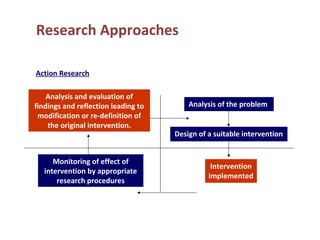
Action Research
Design of a suitable intervention
Intervention
implemented
Monitoring of effect of
intervention by appropriate
research procedures
Analysis and evaluation of
findings and reflection leading to
modification or re-definition of
the original intervention.
Analysis of the problem
Research Approaches
Data Collection Methods
Questionnaires Interviews
Observations Case Studies
Steps for Designing and Conduct
a Survey
Set the goals - What do you want to capture?
Decide on the target population and sample size - Who will you ask?
Determine the questions - What will you ask?
Trial the survey - Test the questions
Conduct the survey - Ask the questions
Analyse the data collected - Produce results
Advantages
Broad scope
Answers the questions of what, how many, how much, how, and why
Ability to observe a phenomena in a natural setting
Ability to control variables
Respondents may be more honest in their responses because of the anonymous
nature
Low marginal costs (reusable)
Easy to administer, score, and code
High external validity
Accurate results due to the large sample size
Method to test theoretical propositions objectively
Confirms and quantifies the findings of qualitative research
Disadvantages
Provides little depth and understanding of the context and history of a
phenomena
Research performed via surveys can be too confined because of
structured nature of questionnaires
Can only provide a snapshot of behaviour at one place and time
Structure of questionnaires may cause people to poorly represent their
opinion and respondents may not answer some questions
Results may differ if using the same questionnaire in a different
context or culture
Cannot prove causal relationships
Effort to set-up and score
Typically low response rates
Distribution
Personal distribution, mail, email, web-
based (eg surveymonkey)
Consider - speed, response rate, and cost
Consider context for distribution
Sample size ( record number issued and
percentage returned)
Interviews
More time efficient
Allow the researcher to establish a rapport
with the respondent
Allow the acquisition of more in-depth
information
Allow for variation according to response
Allow the interviewer to obtain visual cues
May be personal or telephone interviews
Questions, Questions, Questions
Will questions be open or closed
Will scales be provided ( eg always,
sometimes, seldom, never)
How many questions should there be?
In an interview is everyone asked the same
question?
Observational Research Methods
2 Forms of Observational Research
Structured
Unstructured
Descriptive Research
Observational Research Methods
Structured Observations
Rigid and controlled
Predetermined methods
Unstructured Observations
 Used to determine unselective,
detailed, continuous description
of behaviour.
 Detects unintended effects
 More time consuming because
of time and labor required to
collect and analyse sets of
extensive observations
Case Studies
Use a collection of methods to discuss a
specific case.
For example:
Provide a descriptive measure of student
progress based on actual performance
Give picture of learning and development
over time
Informed consent
Who needs to be informed?
Will permission need to be sought?
What do your respondents need to know
about the research?
How will confidentiality be maintained?
Classroom Activities
1. Does more frequent use of textbooks increase student achievement?
2. How are texts used by teachers and students in the classroom?
3. Are male or female students more likely to benefit from texts being
used during instruction?
4. How do students and teachers view the instructional value and
context of texts?
5. Are textbooks more effective than other instructional resources in
promoting on-task behaviour of students in school?
Which of the two research paradigms we have discussed do you think best links
with each of the following research questions? If you feel neither really ideally
links then just note this.
Discuss in pairs/groups why you have come to the decision you have?
Research paradigms in action
The aim of this exercise is to enable you to get a feel for the process of interviewing
and being interviewed. Work in a group of 3. One person (A) will carry out the
interview, (B) is the respondent and (C) will act as an observer.
Have person (A) provide a topic for interview (of general significance) and allow them
5 minutes to jot down 3 or 4 questions they want to ask. Meanwhile person (B) can be
considering their views of the topic given and person (C) on what they are going to
concentrate their observation on.
Allow (A) to interview (B) with (C) observing for 5-10 minutes.
Undertake a small group discussion for 5-10 minutes and jot down any questions you
have about interviewing.
If time repeat the process so each person experiences a different role
Exploring the role of an interviewer and
interviewee

Research methods

  • 1.
  • 2.
    Do you viewthe nature of knowledge Hard, real, capable of being transmitted in tangible form Softer, subjective, based on personal experience and insight Empiricist, knowledge is objectively, immediately observable, positivist Rationalist, knowledge is perceived as created by the individual, interpretivist OR Quantitative procedures Qualitative procedures Research – Paradigms
  • 3.
    1. Research Methodology Thisrefers to the theory of getting knowledge, to the consideration of the best approaches and procedures (methods)by which data, that will provide the evidence basis for the construction of knowledge about whatever it is that is being researched, is obtained. 2. Research approaches This is the overall structure (approach) used for the research and will help to define the procedures used 3. Research procedures These are the actual methods (practical activity) used to undertake the research Terminology used in Educational Research
  • 4.
    Action Research Design ofa suitable intervention Intervention implemented Monitoring of effect of intervention by appropriate research procedures Analysis and evaluation of findings and reflection leading to modification or re-definition of the original intervention. Analysis of the problem Research Approaches
  • 5.
    Data Collection Methods QuestionnairesInterviews Observations Case Studies
  • 6.
    Steps for Designingand Conduct a Survey Set the goals - What do you want to capture? Decide on the target population and sample size - Who will you ask? Determine the questions - What will you ask? Trial the survey - Test the questions Conduct the survey - Ask the questions Analyse the data collected - Produce results
  • 7.
    Advantages Broad scope Answers thequestions of what, how many, how much, how, and why Ability to observe a phenomena in a natural setting Ability to control variables Respondents may be more honest in their responses because of the anonymous nature Low marginal costs (reusable) Easy to administer, score, and code High external validity Accurate results due to the large sample size Method to test theoretical propositions objectively Confirms and quantifies the findings of qualitative research
  • 8.
    Disadvantages Provides little depthand understanding of the context and history of a phenomena Research performed via surveys can be too confined because of structured nature of questionnaires Can only provide a snapshot of behaviour at one place and time Structure of questionnaires may cause people to poorly represent their opinion and respondents may not answer some questions Results may differ if using the same questionnaire in a different context or culture Cannot prove causal relationships Effort to set-up and score Typically low response rates
  • 9.
    Distribution Personal distribution, mail,email, web- based (eg surveymonkey) Consider - speed, response rate, and cost Consider context for distribution Sample size ( record number issued and percentage returned)
  • 10.
    Interviews More time efficient Allowthe researcher to establish a rapport with the respondent Allow the acquisition of more in-depth information Allow for variation according to response Allow the interviewer to obtain visual cues May be personal or telephone interviews
  • 11.
    Questions, Questions, Questions Willquestions be open or closed Will scales be provided ( eg always, sometimes, seldom, never) How many questions should there be? In an interview is everyone asked the same question?
  • 12.
    Observational Research Methods 2Forms of Observational Research Structured Unstructured
  • 13.
    Descriptive Research Observational ResearchMethods Structured Observations Rigid and controlled Predetermined methods Unstructured Observations  Used to determine unselective, detailed, continuous description of behaviour.  Detects unintended effects  More time consuming because of time and labor required to collect and analyse sets of extensive observations
  • 14.
    Case Studies Use acollection of methods to discuss a specific case. For example: Provide a descriptive measure of student progress based on actual performance Give picture of learning and development over time
  • 15.
    Informed consent Who needsto be informed? Will permission need to be sought? What do your respondents need to know about the research? How will confidentiality be maintained?
  • 16.
  • 17.
    1. Does morefrequent use of textbooks increase student achievement? 2. How are texts used by teachers and students in the classroom? 3. Are male or female students more likely to benefit from texts being used during instruction? 4. How do students and teachers view the instructional value and context of texts? 5. Are textbooks more effective than other instructional resources in promoting on-task behaviour of students in school? Which of the two research paradigms we have discussed do you think best links with each of the following research questions? If you feel neither really ideally links then just note this. Discuss in pairs/groups why you have come to the decision you have? Research paradigms in action
  • 18.
    The aim ofthis exercise is to enable you to get a feel for the process of interviewing and being interviewed. Work in a group of 3. One person (A) will carry out the interview, (B) is the respondent and (C) will act as an observer. Have person (A) provide a topic for interview (of general significance) and allow them 5 minutes to jot down 3 or 4 questions they want to ask. Meanwhile person (B) can be considering their views of the topic given and person (C) on what they are going to concentrate their observation on. Allow (A) to interview (B) with (C) observing for 5-10 minutes. Undertake a small group discussion for 5-10 minutes and jot down any questions you have about interviewing. If time repeat the process so each person experiences a different role Exploring the role of an interviewer and interviewee

Editor's Notes

  • #2 Just going over what the session hopes to achieve
  • #3 Just go through this to link research paradigms
  • #4 Generalisable vs relatable Talk of teaching example – going comprehensive
  • #6 These may be used singly or in various combinations depending on the research question to be addressed
  • #10 Mail and fax considered very similar and the web-based/email approach was found dissimilar to both. Certain methods lend themselves better considering time constraints.
  • #18 Here you have 1 and 3 more quantitative, others more qualitative – but no clear delineation