Ethical Considerations
Questions to consider:
1. Can it ever be justified to observe people without them knowing
for the purposes of research?
2. Should participants always be told the ‘whole truth’?
3. Are there some matters that are so private or sensitive, they
should not be the focus for research?
4. What type and level of costs to participants are acceptable?
5. What if anything can participants reasonably expect in return for
their participation?
General principles:
Informed consent
What does informed mean – who is to give consent…
• The purpose of the research, length of time and procedures
• Right to not take part in the research
• Right to withdraw from the research once participation has
begun
• Any research benefits
• Whom to contact for questions about the research
• Research is conducted in accordance with the approved
research protocol
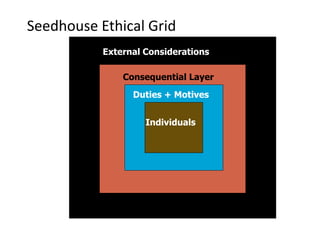
External Considerations
Consequential Layer
Duties + Motives
Individuals
Seedhouse Ethical Grid
External Considerations
• Codes of practice
• Risks
• The law
• Use of resources
• Effectiveness and efficiency
of action
• The degree of certainty of
the evidence on which
action is taken
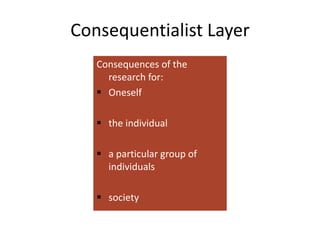
Consequentialist Layer
Consequences of the
research for:
 Oneself
 the individual
 a particular group of
individuals
 society
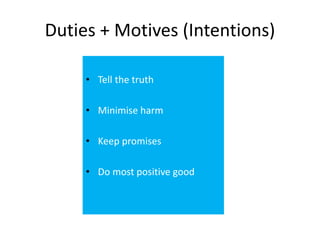
Duties + Motives (Intentions)
• Tell the truth
• Minimise harm
• Keep promises
• Do most positive good
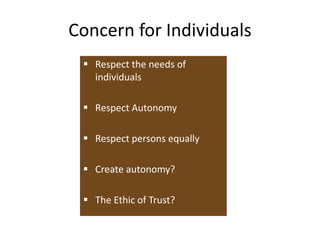
Concern for Individuals
 Respect the needs of
individuals
 Respect Autonomy
 Respect persons equally
 Create autonomy?
 The Ethic of Trust?
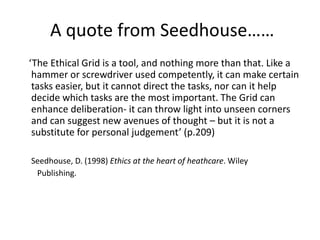
A quote from Seedhouse……
‘The Ethical Grid is a tool, and nothing more than that. Like a
hammer or screwdriver used competently, it can make certain
tasks easier, but it cannot direct the tasks, nor can it help
decide which tasks are the most important. The Grid can
enhance deliberation- it can throw light into unseen corners
and can suggest new avenues of thought – but it is not a
substitute for personal judgement’ (p.209)
Seedhouse, D. (1998) Ethics at the heart of heathcare. Wiley
Publishing.
Advantages
• Provides structure and coherence in a field in which it is
lacking
• Based on Moral theory
• Can be used over time at different points in the research
• Seems to embrace many of the ideas described elsewhere
Reference
• Stutchbury, K. and Fox, A. (2009) 'Ethics in
educational research: introducing a
methodological tool for effective ethical
analysis', Cambridge Journal of Education,
Vol. 39, No. 4, pp. 489 – 504.

Ethics

  • 1.
  • 2.
    Questions to consider: 1.Can it ever be justified to observe people without them knowing for the purposes of research? 2. Should participants always be told the ‘whole truth’? 3. Are there some matters that are so private or sensitive, they should not be the focus for research? 4. What type and level of costs to participants are acceptable? 5. What if anything can participants reasonably expect in return for their participation?
  • 3.
    General principles: Informed consent Whatdoes informed mean – who is to give consent… • The purpose of the research, length of time and procedures • Right to not take part in the research • Right to withdraw from the research once participation has begun • Any research benefits • Whom to contact for questions about the research • Research is conducted in accordance with the approved research protocol
  • 4.
    External Considerations Consequential Layer Duties+ Motives Individuals Seedhouse Ethical Grid
  • 5.
    External Considerations • Codesof practice • Risks • The law • Use of resources • Effectiveness and efficiency of action • The degree of certainty of the evidence on which action is taken
  • 6.
    Consequentialist Layer Consequences ofthe research for:  Oneself  the individual  a particular group of individuals  society
  • 7.
    Duties + Motives(Intentions) • Tell the truth • Minimise harm • Keep promises • Do most positive good
  • 8.
    Concern for Individuals Respect the needs of individuals  Respect Autonomy  Respect persons equally  Create autonomy?  The Ethic of Trust?
  • 9.
    A quote fromSeedhouse…… ‘The Ethical Grid is a tool, and nothing more than that. Like a hammer or screwdriver used competently, it can make certain tasks easier, but it cannot direct the tasks, nor can it help decide which tasks are the most important. The Grid can enhance deliberation- it can throw light into unseen corners and can suggest new avenues of thought – but it is not a substitute for personal judgement’ (p.209) Seedhouse, D. (1998) Ethics at the heart of heathcare. Wiley Publishing.
  • 10.
    Advantages • Provides structureand coherence in a field in which it is lacking • Based on Moral theory • Can be used over time at different points in the research • Seems to embrace many of the ideas described elsewhere
  • 11.
    Reference • Stutchbury, K.and Fox, A. (2009) 'Ethics in educational research: introducing a methodological tool for effective ethical analysis', Cambridge Journal of Education, Vol. 39, No. 4, pp. 489 – 504.