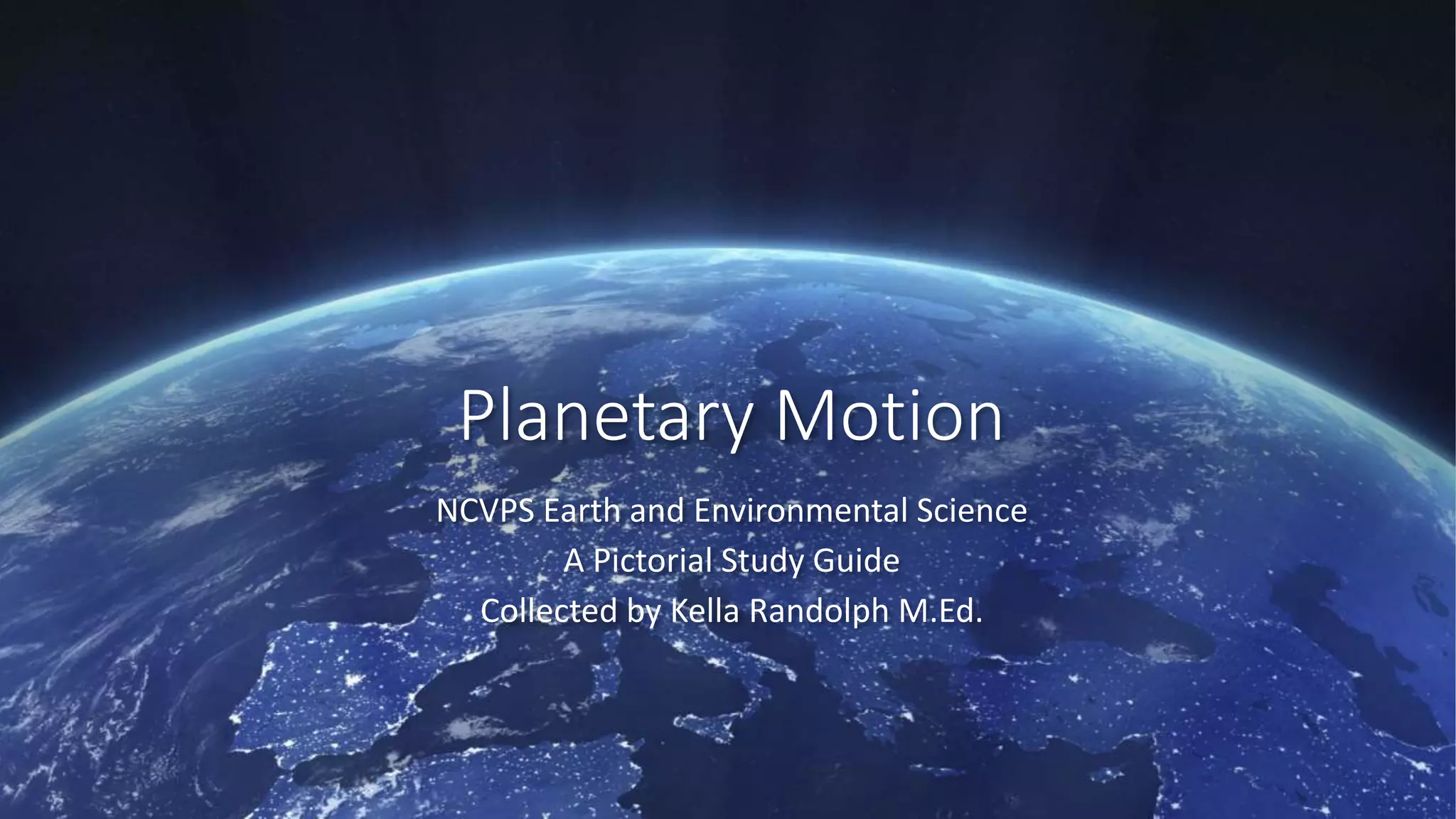
Planetary Motion
NCVPS Earth and Environmental Science
A Pictorial Study Guide
Collected by Kella Randolph M.Ed.
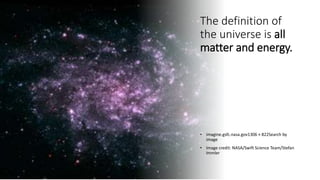
The definition of
the universe is all
matter and energy.
• imagine.gsfc.nasa.gov1306 × 822Search by
image
• Image credit: NASA/Swift Science Team/Stefan
Immler
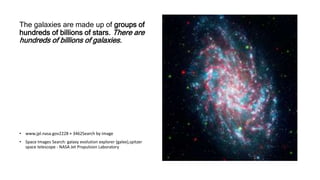
The galaxies are made up of groups of
hundreds of billions of stars. There are
hundreds of billions of galaxies.
• www.jpl.nasa.gov2228 × 3462Search by image
• Space Images Search: galaxy evolution explorer (galex),spitzer
space telescope - NASA Jet Propulsion Laboratory
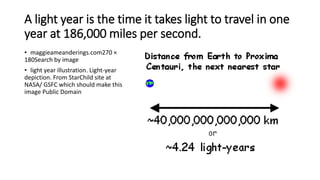
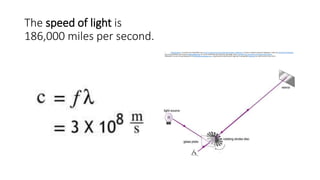
A light year is the time it takes light to travel in one
year at 186,000 miles per second.
• maggieameanderings.com270 ×
180Search by image
• light year illustration. Light-year
depiction. From StarChild site at
NASA/ GSFC which should make this
image Public Domain
The speed of light is
186,000 miles per second.
• (Droit d'auteur : les textes sont disponibles sous licence Creative Commons paternité partage à l’identique ; d’autres conditions peuvent s’appliquer. Voyez les conditions d’utilisation
pour plus de détails, ainsi que les crédits graphiques. En cas de réutilisationdes textes de cette page, voyez comment citer les auteurs et mentionnerla licence.
Wikipedia® est une marque déposée de la WikimediaFoundation, Inc., organisation de bienfaisance régie par le paragraphe 501(c)(3) du code fiscal des États-Unis.)
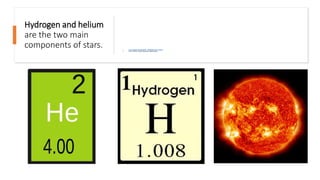
Hydrogen and helium
are the two main
components of stars. • www.infoescola.com4096 × 4096Search by image
• Foto: NASA / Solar Dynamics Observatory
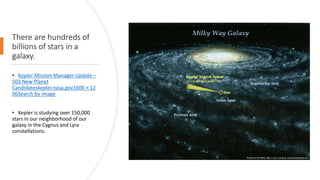
There are hundreds of
billions of stars in a
galaxy.
• Kepler Mission Manager Update –
503 New Planet
Candidateskepler.nasa.gov1600 × 12
06Search by image
• Kepler is studying over 150,000
stars in our neighborhood of our
galaxy in the Cygnus and Lyra
constellations.
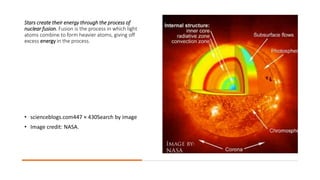
Stars create their energy through the process of
nuclear fusion. Fusion is the process in which light
atoms combine to form heavier atoms, giving off
excess energy in the process.
• scienceblogs.com447 × 430Search by image
• Image credit: NASA.
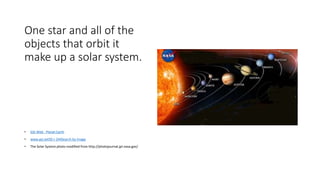
One star and all of the
objects that orbit it
make up a solar system.
• GSI Web - Planet Earth
• www.gsi.ie450 × 244Search by image
• The Solar System photo modified from http://photojournal.jpl.nasa.gov/
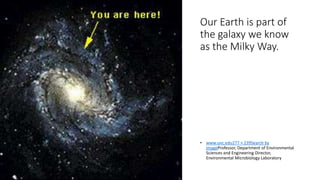
Our Earth is part of
the galaxy we know
as the Milky Way.
• www.unc.edu277 × 239Search by
imageProfessor, Department of Environmental
Sciences and Engineering Director,
Environmental Microbiology Laboratory
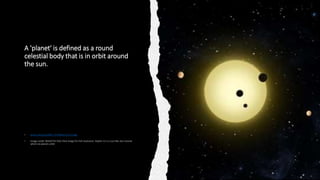
A 'planet' is defined as a round
celestial body that is in orbit around
the sun.
www.nasa.gov3300 × 2476Search by image
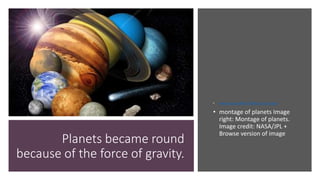
Planets became round
because of the force of gravity.
• www.nasa.gov800 × 640Search by image
• montage of planets Image
right: Montage of planets.
Image credit: NASA/JPL +
Browse version of image
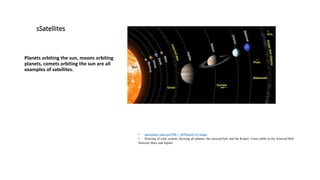
sSatellites
• spaceplace.nasa.gov900 × 469Search by image
• Drawing of solar system, showing all planets, the asteroid belt, and the Kuiper. Ceres orbits in the Asteroid Belt
between Mars and Jupiter.
Planets orbiting the sun, moons orbiting
planets, comets orbiting the sun are all
examples of satellites.
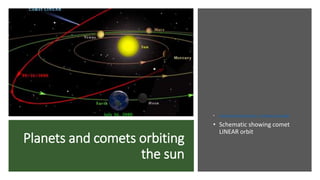
Planets and comets orbiting
the sun
• chandra.harvard.edu510 × 317Search by image
• Schematic showing comet
LINEAR orbit
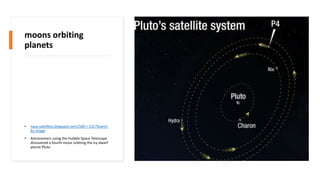
moons orbiting
planets
• nasa-satellites.blogspot.com1500 × 1317Search
by image
• Astronomers using the Hubble Space Telescope
discovered a fourth moon orbiting the icy dwarf
planet Pluto
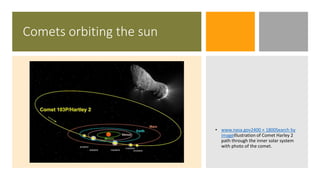
Comets orbiting the sun
• www.nasa.gov2400 × 1800Search by
imageIllustration of Comet Harley 2
path through the inner solar system
with photo of the comet.
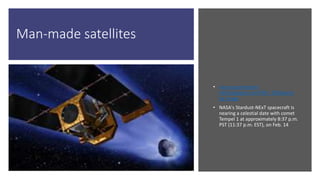
Man-made satellites
• nasa-spacestation-
info.blogspot.com708 × 256Search
by image
• NASA's Stardust-NExT spacecraft is
nearing a celestial date with comet
Tempel 1 at approximately 8:37 p.m.
PST (11:37 p.m. EST), on Feb. 14
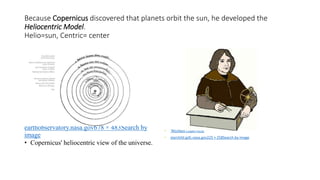
Because Copernicus discovered that planets orbit the sun, he developed the
Heliocentric Model.
Helio=sun, Centric= center
earthobservatory.nasa.gov678 × 483Search by
image
• Copernicus' heliocentric view of the universe.
• Nicolaus Copernicus
• starchild.gsfc.nasa.gov225 × 258Search by image
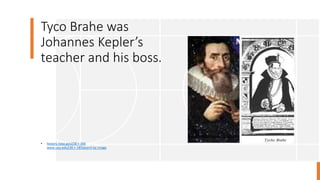
Tyco Brahe was
Johannes Kepler’s
teacher and his boss.
• history.nasa.gov238 × 344
www.usu.edu230 × 185Search by image
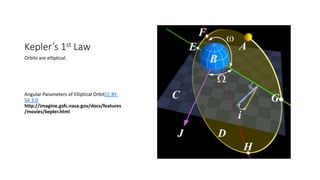
Kepler’s 1st Law
Orbits are elliptical.
Angular Parameters of Elliptical OrbitCC BY-
SA 3.0
http://imagine.gsfc.nasa.gov/docs/features
/movies/kepler.html
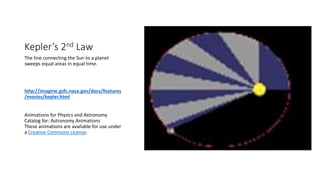
Kepler’s 2nd Law
The line connecting the Sun to a planet
sweeps equal areas in equal time.
http://imagine.gsfc.nasa.gov/docs/features
/movies/kepler.html
Animations for Physics and Astronomy
Catalog for: Astronomy Animations
These animations are available for use under
a Creative Commons License.
Kepler’s 3rd Law
• Kepler's third law, the law of periods,
relates the time required for a planet to
make one complete trip around the Sun
to its mean distance from the Sun. "For
any planet, the square of its period of
revolution is directly proportional to the
cube of its mean distance from the Sun."
Applied to Earth satellites, Kepler's third
law explains that the farther a satellite is
from the Earth, the longer it will take to
complete an orbit, the greater the
distance it will travel to complete an
orbit, and the slower its average speed
will be
• http://imagine.gsfc.nasa.gov/docs/feat
ures/movies/kepler.html
The main point of Kepler’s
third law is to measure
distances between planets
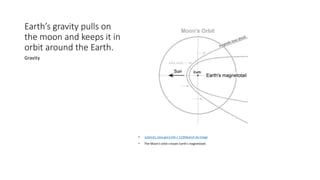
Earth’s gravity pulls on
the moon and keeps it in
orbit around the Earth.
• science1.nasa.gov1144 × 1236Search by image
• The Moon's orbit crosses Earth's magnetotail.
Gravity
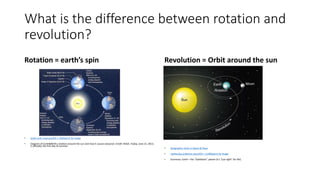
What is the difference between rotation and
revolution?
Rotation = earth’s spin
• www.ncdc.noaa.gov431 × 356Search by image
• Diagram of Earth's rotation around the sun and how it causes seasonal. Credit: NASA. Today, June 21, 2013,
is officially the first day of summer
Revolution = Orbit around the sun
• Geography: Earth in Space & Place
• clasfaculty.ucdenver.edu1601 × 1198Search by image
• Summary: Earth = the “Goldilocks” planet (it's “just right” for life).
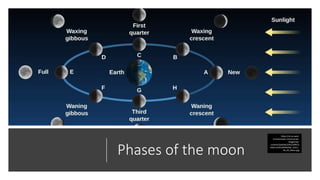
Phases of the moon
https://s3-us-west-
2.amazonaws.com/courses-
images/wp-
content/uploads/sites/1095/2
016/11/03154929/OSC_Astro_
04_05_Moon.jpg
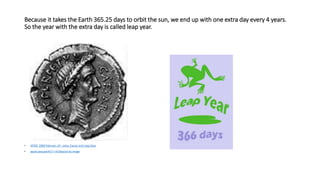
Because it takes the Earth 365.25 days to orbit the sun, we end up with one extra day every 4 years.
So the year with the extra day is called leap year.
• APOD: 2000 February 29 - Julius Caesar and Leap Days
• apod.nasa.gov417 × 415Search by image
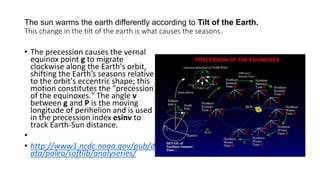
The sun warms the earth differently according to Tilt of the Earth.
This change in the tilt of the earth is what causes the seasons.
• The precession causes the vernal
equinox point g to migrate
clockwise along the Earth's orbit,
shifting the Earth’s seasons relative
to the orbit's eccentric shape; this
motion constitutes the "precession
of the equinoxes." The angle v
between g and P is the moving
longitude of perihelion and is used
in the precession index esinv to
track Earth-Sun distance.
•
• http://www1.ncdc.noaa.gov/pub/d
ata/paleo/softlib/analyseries/
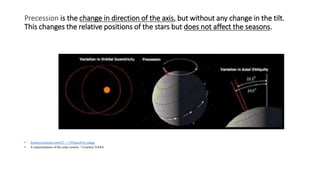
Precession is the change in direction of the axis, but without any change in the tilt.
This changes the relative positions of the stars but does not affect the seasons.
• frontierscientists.com525 × 176Search by image
• A representation of the solar system. / Courtesy NASA
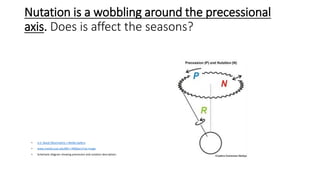
Nutation is a wobbling around the precessional
axis. Does is affect the seasons?
• U.S. Naval Observatory » Media Gallery
• www.meted.ucar.edu300 × 400Search by image
• Schematic diagram showing precession and nutation description:
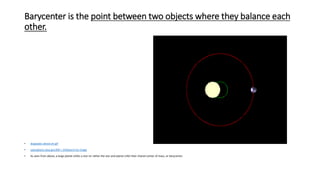
Barycenter is the point between two objects where they balance each
other.
• doppspec-above.en.gif
• spaceplace.nasa.gov300 × 243Search by image
• As seen from above, a large planet orbits a star–or rather the star and planet orbit their shared center of mass, or barycenter.
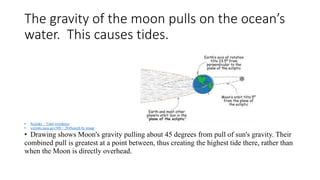
The gravity of the moon pulls on the ocean’s
water. This causes tides.
• Scijinks :: Tidal weirdness
• scijinks.nasa.gov500 × 284Search by image
• Drawing shows Moon's gravity pulling about 45 degrees from pull of sun's gravity. Their
combined pull is greatest at a point between, thus creating the highest tide there, rather than
when the Moon is directly overhead.
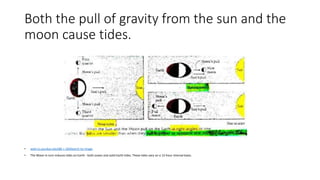
Both the pull of gravity from the sun and the
moon cause tides.
• web.ics.purdue.edu586 × 264Search by image
• The Moon in turn induces tides on Earth - both ocean and solid Earth tides. These tides vary on a 12-hour interval basis.
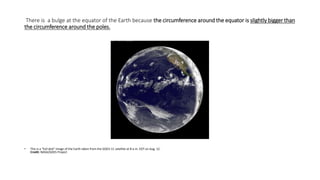
There is a bulge at the equator of the Earth because the circumference around the equator is slightly bigger than
the circumference around the poles.
• This is a "full-disk" image of the Earth taken from the GOES-11 satellite at 8 a.m. EDT on Aug. 12.
Credit: NASA/GOES Project
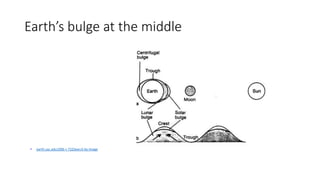
Earth’s bulge at the middle
• earth.usc.edu1006 × 732Search by image
Pictorial Study Guide
• Orbital Motions
• By Kella Randolph
• NCVPS
• Earth and Environmental Science

Planetary motion study guide

  • 1.
    Planetary Motion NCVPS Earthand Environmental Science A Pictorial Study Guide Collected by Kella Randolph M.Ed.
  • 2.
    The definition of theuniverse is all matter and energy. • imagine.gsfc.nasa.gov1306 × 822Search by image • Image credit: NASA/Swift Science Team/Stefan Immler
  • 3.
    The galaxies aremade up of groups of hundreds of billions of stars. There are hundreds of billions of galaxies. • www.jpl.nasa.gov2228 × 3462Search by image • Space Images Search: galaxy evolution explorer (galex),spitzer space telescope - NASA Jet Propulsion Laboratory
  • 4.
    A light yearis the time it takes light to travel in one year at 186,000 miles per second. • maggieameanderings.com270 × 180Search by image • light year illustration. Light-year depiction. From StarChild site at NASA/ GSFC which should make this image Public Domain
  • 5.
    The speed oflight is 186,000 miles per second. • (Droit d'auteur : les textes sont disponibles sous licence Creative Commons paternité partage à l’identique ; d’autres conditions peuvent s’appliquer. Voyez les conditions d’utilisation pour plus de détails, ainsi que les crédits graphiques. En cas de réutilisationdes textes de cette page, voyez comment citer les auteurs et mentionnerla licence. Wikipedia® est une marque déposée de la WikimediaFoundation, Inc., organisation de bienfaisance régie par le paragraphe 501(c)(3) du code fiscal des États-Unis.)
  • 6.
    Hydrogen and helium arethe two main components of stars. • www.infoescola.com4096 × 4096Search by image • Foto: NASA / Solar Dynamics Observatory
  • 7.
    There are hundredsof billions of stars in a galaxy. • Kepler Mission Manager Update – 503 New Planet Candidateskepler.nasa.gov1600 × 12 06Search by image • Kepler is studying over 150,000 stars in our neighborhood of our galaxy in the Cygnus and Lyra constellations.
  • 8.
    Stars create theirenergy through the process of nuclear fusion. Fusion is the process in which light atoms combine to form heavier atoms, giving off excess energy in the process. • scienceblogs.com447 × 430Search by image • Image credit: NASA.
  • 9.
    One star andall of the objects that orbit it make up a solar system. • GSI Web - Planet Earth • www.gsi.ie450 × 244Search by image • The Solar System photo modified from http://photojournal.jpl.nasa.gov/
  • 10.
    Our Earth ispart of the galaxy we know as the Milky Way. • www.unc.edu277 × 239Search by imageProfessor, Department of Environmental Sciences and Engineering Director, Environmental Microbiology Laboratory
  • 11.
    A 'planet' isdefined as a round celestial body that is in orbit around the sun. www.nasa.gov3300 × 2476Search by image
  • 12.
    Planets became round becauseof the force of gravity. • www.nasa.gov800 × 640Search by image • montage of planets Image right: Montage of planets. Image credit: NASA/JPL + Browse version of image
  • 13.
    sSatellites • spaceplace.nasa.gov900 ×469Search by image • Drawing of solar system, showing all planets, the asteroid belt, and the Kuiper. Ceres orbits in the Asteroid Belt between Mars and Jupiter. Planets orbiting the sun, moons orbiting planets, comets orbiting the sun are all examples of satellites.
  • 14.
    Planets and cometsorbiting the sun • chandra.harvard.edu510 × 317Search by image • Schematic showing comet LINEAR orbit
  • 15.
    moons orbiting planets • nasa-satellites.blogspot.com1500× 1317Search by image • Astronomers using the Hubble Space Telescope discovered a fourth moon orbiting the icy dwarf planet Pluto
  • 16.
    Comets orbiting thesun • www.nasa.gov2400 × 1800Search by imageIllustration of Comet Harley 2 path through the inner solar system with photo of the comet.
  • 17.
    Man-made satellites • nasa-spacestation- info.blogspot.com708× 256Search by image • NASA's Stardust-NExT spacecraft is nearing a celestial date with comet Tempel 1 at approximately 8:37 p.m. PST (11:37 p.m. EST), on Feb. 14
  • 18.
    Because Copernicus discoveredthat planets orbit the sun, he developed the Heliocentric Model. Helio=sun, Centric= center earthobservatory.nasa.gov678 × 483Search by image • Copernicus' heliocentric view of the universe. • Nicolaus Copernicus • starchild.gsfc.nasa.gov225 × 258Search by image
  • 19.
    Tyco Brahe was JohannesKepler’s teacher and his boss. • history.nasa.gov238 × 344 www.usu.edu230 × 185Search by image
  • 20.
    Kepler’s 1st Law Orbitsare elliptical. Angular Parameters of Elliptical OrbitCC BY- SA 3.0 http://imagine.gsfc.nasa.gov/docs/features /movies/kepler.html
  • 21.
    Kepler’s 2nd Law Theline connecting the Sun to a planet sweeps equal areas in equal time. http://imagine.gsfc.nasa.gov/docs/features /movies/kepler.html Animations for Physics and Astronomy Catalog for: Astronomy Animations These animations are available for use under a Creative Commons License.
  • 22.
    Kepler’s 3rd Law •Kepler's third law, the law of periods, relates the time required for a planet to make one complete trip around the Sun to its mean distance from the Sun. "For any planet, the square of its period of revolution is directly proportional to the cube of its mean distance from the Sun." Applied to Earth satellites, Kepler's third law explains that the farther a satellite is from the Earth, the longer it will take to complete an orbit, the greater the distance it will travel to complete an orbit, and the slower its average speed will be • http://imagine.gsfc.nasa.gov/docs/feat ures/movies/kepler.html The main point of Kepler’s third law is to measure distances between planets
  • 23.
    Earth’s gravity pullson the moon and keeps it in orbit around the Earth. • science1.nasa.gov1144 × 1236Search by image • The Moon's orbit crosses Earth's magnetotail. Gravity
  • 24.
    What is thedifference between rotation and revolution? Rotation = earth’s spin • www.ncdc.noaa.gov431 × 356Search by image • Diagram of Earth's rotation around the sun and how it causes seasonal. Credit: NASA. Today, June 21, 2013, is officially the first day of summer Revolution = Orbit around the sun • Geography: Earth in Space & Place • clasfaculty.ucdenver.edu1601 × 1198Search by image • Summary: Earth = the “Goldilocks” planet (it's “just right” for life).
  • 25.
    Phases of themoon https://s3-us-west- 2.amazonaws.com/courses- images/wp- content/uploads/sites/1095/2 016/11/03154929/OSC_Astro_ 04_05_Moon.jpg
  • 26.
    Because it takesthe Earth 365.25 days to orbit the sun, we end up with one extra day every 4 years. So the year with the extra day is called leap year. • APOD: 2000 February 29 - Julius Caesar and Leap Days • apod.nasa.gov417 × 415Search by image
  • 27.
    The sun warmsthe earth differently according to Tilt of the Earth. This change in the tilt of the earth is what causes the seasons. • The precession causes the vernal equinox point g to migrate clockwise along the Earth's orbit, shifting the Earth’s seasons relative to the orbit's eccentric shape; this motion constitutes the "precession of the equinoxes." The angle v between g and P is the moving longitude of perihelion and is used in the precession index esinv to track Earth-Sun distance. • • http://www1.ncdc.noaa.gov/pub/d ata/paleo/softlib/analyseries/
  • 28.
    Precession is thechange in direction of the axis, but without any change in the tilt. This changes the relative positions of the stars but does not affect the seasons. • frontierscientists.com525 × 176Search by image • A representation of the solar system. / Courtesy NASA
  • 29.
    Nutation is awobbling around the precessional axis. Does is affect the seasons? • U.S. Naval Observatory » Media Gallery • www.meted.ucar.edu300 × 400Search by image • Schematic diagram showing precession and nutation description:
  • 30.
    Barycenter is thepoint between two objects where they balance each other. • doppspec-above.en.gif • spaceplace.nasa.gov300 × 243Search by image • As seen from above, a large planet orbits a star–or rather the star and planet orbit their shared center of mass, or barycenter.
  • 31.
    The gravity ofthe moon pulls on the ocean’s water. This causes tides. • Scijinks :: Tidal weirdness • scijinks.nasa.gov500 × 284Search by image • Drawing shows Moon's gravity pulling about 45 degrees from pull of sun's gravity. Their combined pull is greatest at a point between, thus creating the highest tide there, rather than when the Moon is directly overhead.
  • 32.
    Both the pullof gravity from the sun and the moon cause tides. • web.ics.purdue.edu586 × 264Search by image • The Moon in turn induces tides on Earth - both ocean and solid Earth tides. These tides vary on a 12-hour interval basis.
  • 33.
    There is abulge at the equator of the Earth because the circumference around the equator is slightly bigger than the circumference around the poles. • This is a "full-disk" image of the Earth taken from the GOES-11 satellite at 8 a.m. EDT on Aug. 12. Credit: NASA/GOES Project
  • 34.
    Earth’s bulge atthe middle • earth.usc.edu1006 × 732Search by image
  • 35.
    Pictorial Study Guide •Orbital Motions • By Kella Randolph • NCVPS • Earth and Environmental Science