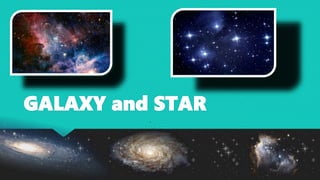
GALAXY and STAR
GALAXY
What is Galaxy ?
 A galaxy is a gravitationally bound system of stars,
interstellar gas, dust, and dark matter.
Types of Galaxy
 There are three main types of galaxies:
 Elliptical
 Spiral and
 Irregular
Elliptical Galaxy
 Elliptical galaxies are shaped like a
spheriod, or elongated sphere. In the sky,
where we can only see two of their three
dimensions, these galaxies look like
elliptical, or oval, shaped disks
 Elliptical galaxies have no particular axis
of rotation
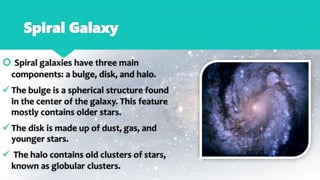
Spiral Galaxy
 Spiral galaxies have three main
components: a bulge, disk, and halo.
 The bulge is a spherical structure found
in the center of the galaxy. This feature
mostly contains older stars.
 The disk is made up of dust, gas, and
younger stars.
 The halo contains old clusters of stars,
known as globular clusters.
Irregular Galaxy
Irregular galaxies have no regular or
symmetrical structure.
Having a lot of gas and dust means
that these galaxies have a lot of star
formation going on within them. This
can make them very bright.
The Large Magellanic Clouds are
examples of irregular galaxies.
Milky Way Galaxy
 The Milky Way is a barred spiral galaxy.
 Milky Way is the galaxy that contains our Solar
System
 The Milky Way is estimated to contain 100–400
billion stars. There are probably at least 100
billion planets in the Milky Way .
 The Milky Way consists of a bar-shaped core
region surrounded by a disk of gas, dust and
stars.
Whirlpool Galaxy
The Whirlpool Galaxy, also known
as Messier 51a, M51a, and NGC 5194.
 It was the first galaxy to be classified
as a spiral galaxy.
Its mass is estimated to be 160 billion
solar masses.
 Overall the galaxy is about 35% the
size of the Milky Way.
STAR
What is Star ?
 A star is a luminous ball of gas, mostly hydrogen and helium, held together by
its own gravity.
 The nearest star to Earth is the Sun.
Different Types 0f Stars ?
Protostar
T Tauri Star
Main Sequence Star
Red Giant Star
White Dwarf Star
Red Dwarf Star
Neutron Star
Supergiant Star
Protostar
A protostar is a very young star.
 Protostar is a collection of gas that has
collapsed down from a giant molecular
cloud.
T Tauri Star
A very young, lightweight star, less than
10 million years old.
T Tauri stars don’t have enough pressure
and temperature at their cores to
generate nuclear fusion.
Main Sequence Star
The majority of all stars in our galaxy,
and even the Universe, are main
sequence stars.
Our Sun is a main sequence star.
 Main sequence stars can vary in size,
mass and brightness.
Red Giant Star
 A red giant is a luminous giant star of low or
intermediate mass in a late phase of stellar
evolution.
They have radii tens to hundreds of times
larger than that of the Sun.
White Dwarf Star
 When a star has completely run out of
hydrogen fuel it becomes a white dwarf
star.
 A white dwarf shines because it was a hot
star once, but there’s no fusion reactions
happening any more.
Red Dwarf Star
 A red dwarf is a small and relatively cool
star.
Red dwarfs are very-low-mass stars. As a
result, they have relatively low pressures, a
low fusion rate, and hence, a low
temperature.
Red dwarf stars are able to keep the
hydrogen fuel mixing into their core.
Neutron Star
Neutron stars are the smallest and densest stars
known to exist.
Neutron stars are created when giant stars die
in supernovas and their cores collapse.
At present, there are about 2000 known
neutron stars in the Milky Way and the
Magellanic clouds.
Supergiant Star
 The largest stars in the Universe are
supergiant stars.
 They can be thousands of times bigger
than our Sun and have a mass up to 100
times greater.
Direct image of the star “ UY Scuti ” , a red
supergiant which is one of the largest known
stars.
THE END

Galaxy and star

  • 1.
  • 2.
  • 3.
    What is Galaxy?  A galaxy is a gravitationally bound system of stars, interstellar gas, dust, and dark matter.
  • 4.
    Types of Galaxy There are three main types of galaxies:  Elliptical  Spiral and  Irregular
  • 5.
    Elliptical Galaxy  Ellipticalgalaxies are shaped like a spheriod, or elongated sphere. In the sky, where we can only see two of their three dimensions, these galaxies look like elliptical, or oval, shaped disks  Elliptical galaxies have no particular axis of rotation
  • 6.
    Spiral Galaxy  Spiralgalaxies have three main components: a bulge, disk, and halo.  The bulge is a spherical structure found in the center of the galaxy. This feature mostly contains older stars.  The disk is made up of dust, gas, and younger stars.  The halo contains old clusters of stars, known as globular clusters.
  • 7.
    Irregular Galaxy Irregular galaxieshave no regular or symmetrical structure. Having a lot of gas and dust means that these galaxies have a lot of star formation going on within them. This can make them very bright. The Large Magellanic Clouds are examples of irregular galaxies.
  • 8.
    Milky Way Galaxy The Milky Way is a barred spiral galaxy.  Milky Way is the galaxy that contains our Solar System  The Milky Way is estimated to contain 100–400 billion stars. There are probably at least 100 billion planets in the Milky Way .  The Milky Way consists of a bar-shaped core region surrounded by a disk of gas, dust and stars.
  • 9.
    Whirlpool Galaxy The WhirlpoolGalaxy, also known as Messier 51a, M51a, and NGC 5194.  It was the first galaxy to be classified as a spiral galaxy. Its mass is estimated to be 160 billion solar masses.  Overall the galaxy is about 35% the size of the Milky Way.
  • 10.
  • 11.
    What is Star?  A star is a luminous ball of gas, mostly hydrogen and helium, held together by its own gravity.  The nearest star to Earth is the Sun.
  • 12.
    Different Types 0fStars ? Protostar T Tauri Star Main Sequence Star Red Giant Star White Dwarf Star Red Dwarf Star Neutron Star Supergiant Star
  • 13.
    Protostar A protostar isa very young star.  Protostar is a collection of gas that has collapsed down from a giant molecular cloud.
  • 14.
    T Tauri Star Avery young, lightweight star, less than 10 million years old. T Tauri stars don’t have enough pressure and temperature at their cores to generate nuclear fusion.
  • 15.
    Main Sequence Star Themajority of all stars in our galaxy, and even the Universe, are main sequence stars. Our Sun is a main sequence star.  Main sequence stars can vary in size, mass and brightness.
  • 16.
    Red Giant Star A red giant is a luminous giant star of low or intermediate mass in a late phase of stellar evolution. They have radii tens to hundreds of times larger than that of the Sun.
  • 17.
    White Dwarf Star When a star has completely run out of hydrogen fuel it becomes a white dwarf star.  A white dwarf shines because it was a hot star once, but there’s no fusion reactions happening any more.
  • 18.
    Red Dwarf Star A red dwarf is a small and relatively cool star. Red dwarfs are very-low-mass stars. As a result, they have relatively low pressures, a low fusion rate, and hence, a low temperature. Red dwarf stars are able to keep the hydrogen fuel mixing into their core.
  • 19.
    Neutron Star Neutron starsare the smallest and densest stars known to exist. Neutron stars are created when giant stars die in supernovas and their cores collapse. At present, there are about 2000 known neutron stars in the Milky Way and the Magellanic clouds.
  • 20.
    Supergiant Star  Thelargest stars in the Universe are supergiant stars.  They can be thousands of times bigger than our Sun and have a mass up to 100 times greater. Direct image of the star “ UY Scuti ” , a red supergiant which is one of the largest known stars.
  • 21.