Earth’s Motions
EEn.1.1 Explain the Earth’s role as a body in space.
● EEn.1.1.1 Explain the Earth’s motion through space, including precession,
nutation, the barycenter, and its path about the galaxy.
● EEn.1.1.2 Explain how the Earth’s rotation and revolution about the Sun affect
its shape and is related to seasons and tides.
● EEn.1.1.3 Explain how the sun produces energy which is transferred to the
Earth by radiation.
● EEn.1.1.4 Explain how incoming solar energy makes life possible on Earth.
Earth’s Motions
Earth’s Motions
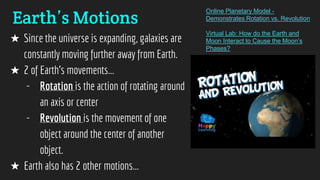
★ Since the universe is expanding, galaxies are
constantly moving further away from Earth.
★ 2 of Earth’s movements...
- Rotation is the action of rotating around
an axis or center
- Revolution is the movement of one
object around the center of another
object.
★ Earth also has 2 other motions...
Online Planetary Model -
Demonstrates Rotation vs. Revolution
Virtual Lab: How do the Earth and
Moon Interact to Cause the Moon’s
Phases?
Precession
★ Earth is tilted approximately 23.5 degrees
★ Precession: Change in the direction of the axis without a change in the tilt.
○ Impacts the position of stars near the poles
○ 26,000 year cycle Video
Nutation
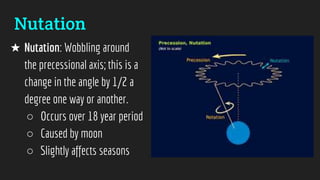
★ Nutation: Wobbling around
the precessional axis; this is a
change in the angle by 1/2 a
degree one way or another.
○ Occurs over 18 year period
○ Caused by moon
○ Slightly affects seasons
Barycenter
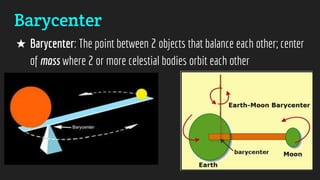
★ Barycenter: The point between 2 objects that balance each other; center
of mass where 2 or more celestial bodies orbit each other
Barycenter
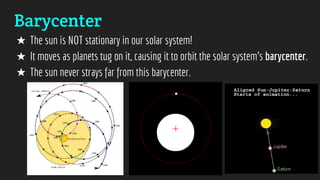
★ The sun is NOT stationary in our solar system!
★ It moves as planets tug on it, causing it to orbit the solar system’s barycenter.
★ The sun never strays far from this barycenter.
Kepler’s 3 Laws of Planetary Motion
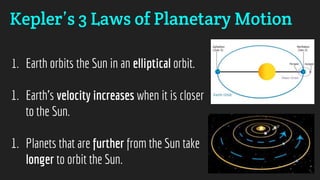
1. Earth orbits the Sun in an elliptical orbit.
1. Earth’s velocity increases when it is closer
to the Sun.
1. Planets that are further from the Sun take
longer to orbit the Sun.
Gravity
★ A natural force in which all
things with energy are
brought toward one another
including stars, planets,
galaxies, and particles.
Solar Nebula Hypothesis
★ This is a theory for the formation of our solar system. (Our galaxy is called the
Milky Way).
★ Estimated as occurring about 4.5 billion years ago!
1. A cloud of gas and dust, called a nebula, began to condense due to gravity.
2. Some regions condensed more than others, eventually creating planets,
the Sun, and moons.
3. The Sun’s gravity caused the gases and dust to begin revolving around it.
http://study.com/academy/lesson/solar-nebular-hypothesis-definition-lesson-quiz.html
Early Ideas?
★ Geocentric Model - Scientists thought that our system revolved
around the Earth
★ However, Nicolaus Copernicus proved that the Earth actually rotates
around the Sun, and the Sun is the center of our system → called
the Heliocentric Model
So, WHY DO WE HAVE
SEASONS?
Earth’s Tilt and Seasons
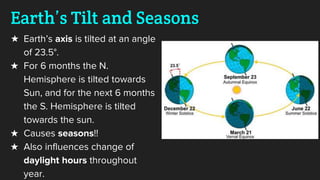
★ Earth’s axis is tilted at an angle
of 23.5°.
★ For 6 months the N.
Hemisphere is tilted towards
Sun, and for the next 6 months
the S. Hemisphere is tilted
towards the sun.
★ Causes seasons!!
★ Also influences change of
daylight hours throughout
year.
Solstices and Equinoxes
★ Summer Solstice - June
22nd, Maximum # of
daylight for the Northern
Hemisphere
★ Winter Solstice -
December 22nd, Fewest #
of daylight for the
Northern Hemisphere
★ Autumnal Equinox -
September 22nd, Equal
amount of sunlight for
both Hemispheres
★ Vernal Equinox - March
22nd, Equal amount of
sunlight for both
Hemispheres
Solstices and Equinoxes
Extra Resources: https://www.fi.edu/blog/solstice-equinox
Earth’s Moon
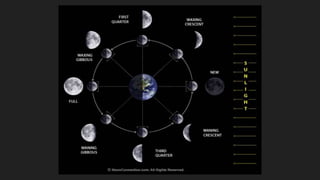
★ The Moon does NOT radiate its own light. Instead, it reflects light from the _____!
★ Appears to “change shape” throughout the month.
★ There are 8 “shapes” which we call Lunar
phases.
Earth's Motions
Earth's Motions

Earth's Motions

  • 1.
    Earth’s Motions EEn.1.1 Explainthe Earth’s role as a body in space. ● EEn.1.1.1 Explain the Earth’s motion through space, including precession, nutation, the barycenter, and its path about the galaxy. ● EEn.1.1.2 Explain how the Earth’s rotation and revolution about the Sun affect its shape and is related to seasons and tides. ● EEn.1.1.3 Explain how the sun produces energy which is transferred to the Earth by radiation. ● EEn.1.1.4 Explain how incoming solar energy makes life possible on Earth.
  • 2.
  • 3.
    Earth’s Motions ★ Sincethe universe is expanding, galaxies are constantly moving further away from Earth. ★ 2 of Earth’s movements... - Rotation is the action of rotating around an axis or center - Revolution is the movement of one object around the center of another object. ★ Earth also has 2 other motions... Online Planetary Model - Demonstrates Rotation vs. Revolution Virtual Lab: How do the Earth and Moon Interact to Cause the Moon’s Phases?
  • 4.
    Precession ★ Earth istilted approximately 23.5 degrees ★ Precession: Change in the direction of the axis without a change in the tilt. ○ Impacts the position of stars near the poles ○ 26,000 year cycle Video
  • 5.
    Nutation ★ Nutation: Wobblingaround the precessional axis; this is a change in the angle by 1/2 a degree one way or another. ○ Occurs over 18 year period ○ Caused by moon ○ Slightly affects seasons
  • 6.
    Barycenter ★ Barycenter: Thepoint between 2 objects that balance each other; center of mass where 2 or more celestial bodies orbit each other
  • 7.
    Barycenter ★ The sunis NOT stationary in our solar system! ★ It moves as planets tug on it, causing it to orbit the solar system’s barycenter. ★ The sun never strays far from this barycenter.
  • 8.
    Kepler’s 3 Lawsof Planetary Motion 1. Earth orbits the Sun in an elliptical orbit. 1. Earth’s velocity increases when it is closer to the Sun. 1. Planets that are further from the Sun take longer to orbit the Sun.
  • 9.
    Gravity ★ A naturalforce in which all things with energy are brought toward one another including stars, planets, galaxies, and particles.
  • 10.
    Solar Nebula Hypothesis ★This is a theory for the formation of our solar system. (Our galaxy is called the Milky Way). ★ Estimated as occurring about 4.5 billion years ago! 1. A cloud of gas and dust, called a nebula, began to condense due to gravity. 2. Some regions condensed more than others, eventually creating planets, the Sun, and moons. 3. The Sun’s gravity caused the gases and dust to begin revolving around it. http://study.com/academy/lesson/solar-nebular-hypothesis-definition-lesson-quiz.html
  • 11.
    Early Ideas? ★ GeocentricModel - Scientists thought that our system revolved around the Earth ★ However, Nicolaus Copernicus proved that the Earth actually rotates around the Sun, and the Sun is the center of our system → called the Heliocentric Model
  • 12.
    So, WHY DOWE HAVE SEASONS?
  • 13.
    Earth’s Tilt andSeasons ★ Earth’s axis is tilted at an angle of 23.5°. ★ For 6 months the N. Hemisphere is tilted towards Sun, and for the next 6 months the S. Hemisphere is tilted towards the sun. ★ Causes seasons!! ★ Also influences change of daylight hours throughout year.
  • 14.
    Solstices and Equinoxes ★Summer Solstice - June 22nd, Maximum # of daylight for the Northern Hemisphere ★ Winter Solstice - December 22nd, Fewest # of daylight for the Northern Hemisphere ★ Autumnal Equinox - September 22nd, Equal amount of sunlight for both Hemispheres ★ Vernal Equinox - March 22nd, Equal amount of sunlight for both Hemispheres
  • 15.
    Solstices and Equinoxes ExtraResources: https://www.fi.edu/blog/solstice-equinox
  • 16.
    Earth’s Moon ★ TheMoon does NOT radiate its own light. Instead, it reflects light from the _____! ★ Appears to “change shape” throughout the month. ★ There are 8 “shapes” which we call Lunar phases.