Venus
•
Venus is the second planet from the Sun, orbiting it every 224.7 Earth days. It has
the longest rotation period (245 days) of any planet in the Solar System and
rotates in the opposite direction to most other planets. It has no natural satellite.
It is the second-brightest natural object in the night sky after the Moon,
reaching an apparent magnitude of −4.6, bright enough to cast shadows.
Because Venus is an inferior planet from Earth, it never appears to venture far
from the Sun.
It is named after the Roman goddess of love and
beauty.
Venus is a terrestrial planet and is sometimes called Earth's "sister planet"
because of their similar size, mass, proximity to the Sun, and bulk
composition. It is radically different from Earth in other respects. It has the
densest atmosphere of the four terrestrial planets, consisting of more than
96% carbon dioxide. The atmospheric pressure at the planet's surface is 92
times that of Earth. Venus is by far the hottest planet in the Solar System
even though Mercury is closer to the Sun. Venus is shrouded by an opaque
layer of highly reflective clouds of sulfuric acid.
The planet Venus in natural colors.
As one of the brightest objects in the sky, Venus has been a major fixture in human culture
for as long as records have existed. It has been made sacred to gods of many cultures,
and has been a prime inspiration for writers and poets as the "morning star" and
"evening star". It was the first planet beyond Earth visited by a spacecraft (Mariner 2)
in 1962. Venus's thick clouds render observation of its surface impossible in visible
light, and the first detailed maps did not emerge until the arrival of the Magellan
orbiter in 1991.
Physical characteristics
Geography
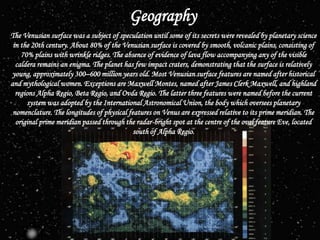
The Venusian surface was a subject of speculation until some of its secrets were revealed by planetary science
in the 20th century. About 80% of the Venusian surface is covered by smooth, volcanic plains, consisting of
70% plains with wrinkle ridges. The absence of evidence of lava flow accompanying any of the visible
caldera remains an enigma. The planet has few impact craters, demonstrating that the surface is relatively
young, approximately 300–600 million years old. Most Venusian surface features are named after historical
and mythological women. Exceptions are Maxwell Montes, named after James Clerk Maxwell, and highland
regions Alpha Regio, Beta Regio, and Ovda Regio. The latter three features were named before the current
system was adopted by the International Astronomical Union, the body which oversees planetary
nomenclature. The longitudes of physical features on Venus are expressed relative to its prime meridian. The
original prime meridian passed through the radar-bright spot at the centre of the oval feature Eve, located
south of Alpha Regio.
Internal structure
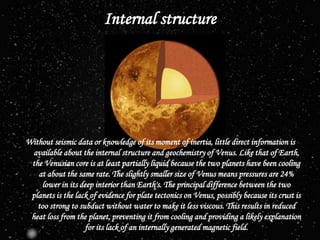
Without seismic data or knowledge of its moment of inertia, little direct information is
available about the internal structure and geochemistry of Venus. Like that of Earth,
the Venusian core is at least partially liquid because the two planets have been cooling
at about the same rate. The slightly smaller size of Venus means pressures are 24%
lower in its deep interior than Earth's. The principal difference between the two
planets is the lack of evidence for plate tectonics on Venus, possibly because its crust is
too strong to subduct without water to make it less viscous. This results in reduced
heat loss from the planet, preventing it from cooling and providing a likely explanation
for its lack of an internally generated magnetic field.
Atmosphere and climate
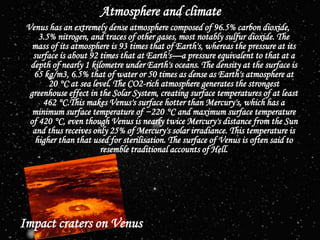
Impact craters on Venus
Venus has an extremely dense atmosphere composed of 96.5% carbon dioxide,
3.5% nitrogen, and traces of other gases, most notably sulfur dioxide. The
mass of its atmosphere is 93 times that of Earth's, whereas the pressure at its
surface is about 92 times that at Earth's—a pressure equivalent to that at a
depth of nearly 1 kilometre under Earth's oceans. The density at the surface is
65 kg/m3, 6.5% that of water or 50 times as dense as Earth's atmosphere at
20 °C at sea level. The CO2-rich atmosphere generates the strongest
greenhouse effect in the Solar System, creating surface temperatures of at least
462 °C.This makes Venus's surface hotter than Mercury's, which has a
minimum surface temperature of −220 °C and maximum surface temperature
of 420 °C, even though Venus is nearly twice Mercury's distance from the Sun
and thus receives only 25% of Mercury's solar irradiance. This temperature is
higher than that used for sterilisation. The surface of Venus is often said to
resemble traditional accounts of Hell.
Observation
To the naked eye, Venus appears as a white point of light brighter than any other planet
or star (apart from the Sun). The planet is bright enough to be seen in a midday clear
sky, and it can be easy to see when the Sun is low on the horizon. As an inferior
planet, it always lies within about 47° of the Sun. Venus "overtakes" Earth every
584 days as it orbits the Sun. As it does so, it changes from the "Evening Star",
visible after sunset, to the "Morning Star", visible before sunrise. Venus is hard to
miss when it is at its brightest. As the brightest point-like object in the sky, Venus is
a commonly misreported "unidentified flying object". U.S. President Jimmy Carter
reported having seen a UFO in 1969, which later analysis suggested was probably
Venus.
As it moves around its orbit, Venus displays phases like those of the Moon in a
telescopic view. The planet presents a small "full" image when it is on the opposite
side of the Sun. It shows a larger "quarter phase" when it is at its maximum
elongations from the Sun, and is at its brightest in the night sky, and presents a
much larger "thin crescent" in telescopic views as it comes around to the near side
between Earth and the Sun. Venus is at its largest and presents its "new phase"
when it is between Earth and the Sun. Its atmosphere can be seen in a telescope by
the halo of light refracted around it.
Venus is always brighter than the brightest stars
In culture
Dresden Codex, created by the Maya, includes information about the observations of Venus
Throughout history and cultures,
the planet has been of remarkable
importance as an especial object of
observation, reflection and
projection. Popular beliefs and
observations resulted in different
and in parts similar patterns in
mythology as well as
phenomenological descriptions,
attributions and depictions, e.g. in
astrology. Such developments in
manifestations of human thought
reflect the planet's image as a result
of early observations of Venus and
their impact on culture and science.
Venus is a primary feature of the night sky, and so has
been present in fiction for as long as fiction has
existed. Classical poets such as Homer, Sappho,
Ovid and Virgil spoke of the star and its light.
Romantic poets such as William Blake, Robert
Frost, Alfred Lord Tennyson and William
Wordsworth wrote odes to it. With the invention
of the telescope, the idea that Venus was a physical
world and possible destination began to take form.
The impenetrable Venusian cloud cover gave science
fiction writers free rein to speculate on conditions
at its surface; all the more so when early
observations showed that not only was it similar in
size to Earth, it possessed a substantial
atmosphere. Closer to the Sun than Earth, the
planet was frequently depicted as warmer, but still
habitable by humans. The genre reached its peak
between the 1930s and 1950s, at a time when
science had revealed some aspects of Venus, but not
yet the harsh reality of its surface conditions.
Findings from the first missions to Venus showed
the reality to be quite different, and brought this
particular genre to an end. As scientific knowledge
of Venus advanced, so science fiction authors tried
to keep pace, particularly by conjecturing human
attempts to terraform Venus.
Sukra this term Venus in Sanskrit
Colonisation and terraforming
The colonisation of Venus has been a subject of many works of science fiction since before
the dawn of spaceflight, and is still discussed from both a fictional and a scientific
standpoint. However, with the discovery of Venus's extremely hostile surface
environment, attention has largely shifted towards the colonisation of the Moon and
Mars instead, with proposals for Venus focused on colonies floating in the upper-
middle atmosphere and on terraforming. Over 20 successful space missions have visited
Venus since 1962. The last active probe was ESA's Venus Express, which was in
polar orbit around the planet from 2006 to 2014. A Japanese probe, Akatsuki, failed
in its first attempt to orbit Venus, but successfully reinserted itself into orbit on 7
December 2015. Other low-cost missions have been proposed to further explore the
planet's atmosphere, as the area 50 km above the surface where gas pressure is at the
same level as Earth has not yet been thoroughly explored.
Thanks for watching
our presentation
Group 5
Wiktoria Waniak
Stavros Tsambalas
Alicja Toborek
Petros Panteli
Marina Chatzikiriakou

Venus

  • 1.
  • 2.
    • Venus is thesecond planet from the Sun, orbiting it every 224.7 Earth days. It has the longest rotation period (245 days) of any planet in the Solar System and rotates in the opposite direction to most other planets. It has no natural satellite. It is the second-brightest natural object in the night sky after the Moon, reaching an apparent magnitude of −4.6, bright enough to cast shadows. Because Venus is an inferior planet from Earth, it never appears to venture far from the Sun.
  • 3.
    It is namedafter the Roman goddess of love and beauty.
  • 4.
    Venus is aterrestrial planet and is sometimes called Earth's "sister planet" because of their similar size, mass, proximity to the Sun, and bulk composition. It is radically different from Earth in other respects. It has the densest atmosphere of the four terrestrial planets, consisting of more than 96% carbon dioxide. The atmospheric pressure at the planet's surface is 92 times that of Earth. Venus is by far the hottest planet in the Solar System even though Mercury is closer to the Sun. Venus is shrouded by an opaque layer of highly reflective clouds of sulfuric acid.
  • 5.
    The planet Venusin natural colors. As one of the brightest objects in the sky, Venus has been a major fixture in human culture for as long as records have existed. It has been made sacred to gods of many cultures, and has been a prime inspiration for writers and poets as the "morning star" and "evening star". It was the first planet beyond Earth visited by a spacecraft (Mariner 2) in 1962. Venus's thick clouds render observation of its surface impossible in visible light, and the first detailed maps did not emerge until the arrival of the Magellan orbiter in 1991.
  • 6.
  • 7.
    Geography The Venusian surfacewas a subject of speculation until some of its secrets were revealed by planetary science in the 20th century. About 80% of the Venusian surface is covered by smooth, volcanic plains, consisting of 70% plains with wrinkle ridges. The absence of evidence of lava flow accompanying any of the visible caldera remains an enigma. The planet has few impact craters, demonstrating that the surface is relatively young, approximately 300–600 million years old. Most Venusian surface features are named after historical and mythological women. Exceptions are Maxwell Montes, named after James Clerk Maxwell, and highland regions Alpha Regio, Beta Regio, and Ovda Regio. The latter three features were named before the current system was adopted by the International Astronomical Union, the body which oversees planetary nomenclature. The longitudes of physical features on Venus are expressed relative to its prime meridian. The original prime meridian passed through the radar-bright spot at the centre of the oval feature Eve, located south of Alpha Regio.
  • 8.
    Internal structure Without seismicdata or knowledge of its moment of inertia, little direct information is available about the internal structure and geochemistry of Venus. Like that of Earth, the Venusian core is at least partially liquid because the two planets have been cooling at about the same rate. The slightly smaller size of Venus means pressures are 24% lower in its deep interior than Earth's. The principal difference between the two planets is the lack of evidence for plate tectonics on Venus, possibly because its crust is too strong to subduct without water to make it less viscous. This results in reduced heat loss from the planet, preventing it from cooling and providing a likely explanation for its lack of an internally generated magnetic field.
  • 9.
    Atmosphere and climate Impactcraters on Venus Venus has an extremely dense atmosphere composed of 96.5% carbon dioxide, 3.5% nitrogen, and traces of other gases, most notably sulfur dioxide. The mass of its atmosphere is 93 times that of Earth's, whereas the pressure at its surface is about 92 times that at Earth's—a pressure equivalent to that at a depth of nearly 1 kilometre under Earth's oceans. The density at the surface is 65 kg/m3, 6.5% that of water or 50 times as dense as Earth's atmosphere at 20 °C at sea level. The CO2-rich atmosphere generates the strongest greenhouse effect in the Solar System, creating surface temperatures of at least 462 °C.This makes Venus's surface hotter than Mercury's, which has a minimum surface temperature of −220 °C and maximum surface temperature of 420 °C, even though Venus is nearly twice Mercury's distance from the Sun and thus receives only 25% of Mercury's solar irradiance. This temperature is higher than that used for sterilisation. The surface of Venus is often said to resemble traditional accounts of Hell.
  • 10.
    Observation To the nakedeye, Venus appears as a white point of light brighter than any other planet or star (apart from the Sun). The planet is bright enough to be seen in a midday clear sky, and it can be easy to see when the Sun is low on the horizon. As an inferior planet, it always lies within about 47° of the Sun. Venus "overtakes" Earth every 584 days as it orbits the Sun. As it does so, it changes from the "Evening Star", visible after sunset, to the "Morning Star", visible before sunrise. Venus is hard to miss when it is at its brightest. As the brightest point-like object in the sky, Venus is a commonly misreported "unidentified flying object". U.S. President Jimmy Carter reported having seen a UFO in 1969, which later analysis suggested was probably Venus.
  • 11.
    As it movesaround its orbit, Venus displays phases like those of the Moon in a telescopic view. The planet presents a small "full" image when it is on the opposite side of the Sun. It shows a larger "quarter phase" when it is at its maximum elongations from the Sun, and is at its brightest in the night sky, and presents a much larger "thin crescent" in telescopic views as it comes around to the near side between Earth and the Sun. Venus is at its largest and presents its "new phase" when it is between Earth and the Sun. Its atmosphere can be seen in a telescope by the halo of light refracted around it. Venus is always brighter than the brightest stars
  • 12.
    In culture Dresden Codex,created by the Maya, includes information about the observations of Venus Throughout history and cultures, the planet has been of remarkable importance as an especial object of observation, reflection and projection. Popular beliefs and observations resulted in different and in parts similar patterns in mythology as well as phenomenological descriptions, attributions and depictions, e.g. in astrology. Such developments in manifestations of human thought reflect the planet's image as a result of early observations of Venus and their impact on culture and science.
  • 13.
    Venus is aprimary feature of the night sky, and so has been present in fiction for as long as fiction has existed. Classical poets such as Homer, Sappho, Ovid and Virgil spoke of the star and its light. Romantic poets such as William Blake, Robert Frost, Alfred Lord Tennyson and William Wordsworth wrote odes to it. With the invention of the telescope, the idea that Venus was a physical world and possible destination began to take form. The impenetrable Venusian cloud cover gave science fiction writers free rein to speculate on conditions at its surface; all the more so when early observations showed that not only was it similar in size to Earth, it possessed a substantial atmosphere. Closer to the Sun than Earth, the planet was frequently depicted as warmer, but still habitable by humans. The genre reached its peak between the 1930s and 1950s, at a time when science had revealed some aspects of Venus, but not yet the harsh reality of its surface conditions. Findings from the first missions to Venus showed the reality to be quite different, and brought this particular genre to an end. As scientific knowledge of Venus advanced, so science fiction authors tried to keep pace, particularly by conjecturing human attempts to terraform Venus. Sukra this term Venus in Sanskrit
  • 14.
    Colonisation and terraforming Thecolonisation of Venus has been a subject of many works of science fiction since before the dawn of spaceflight, and is still discussed from both a fictional and a scientific standpoint. However, with the discovery of Venus's extremely hostile surface environment, attention has largely shifted towards the colonisation of the Moon and Mars instead, with proposals for Venus focused on colonies floating in the upper- middle atmosphere and on terraforming. Over 20 successful space missions have visited Venus since 1962. The last active probe was ESA's Venus Express, which was in polar orbit around the planet from 2006 to 2014. A Japanese probe, Akatsuki, failed in its first attempt to orbit Venus, but successfully reinserted itself into orbit on 7 December 2015. Other low-cost missions have been proposed to further explore the planet's atmosphere, as the area 50 km above the surface where gas pressure is at the same level as Earth has not yet been thoroughly explored.
  • 15.
    Thanks for watching ourpresentation Group 5 Wiktoria Waniak Stavros Tsambalas Alicja Toborek Petros Panteli Marina Chatzikiriakou