Fossil Fuels
By Kella Randolph M.Ed.
https://upload.wikimedia.org/wikipedia/commons/thumb/d/dd/Furnace_onboard_Edith_May_sailing_Barge.JPG/120
px-Furnace_onboard_Edith_May_sailing_Barge.JPG
Three examples of fossil
fuels
How fossil fuels cause harm
• Burning coal makes ozone, smog,
acid rain, climate change, mercury
pollution
• Oil spills damage all living things
• Natural gas is poisonous and is
colorless, odorless and tasteless. We
must add a bad smell to it in order to
prevent being killed by a gas leak.
Three examples of fossil fuels could be
a. coal
b. oil
c. natural gas
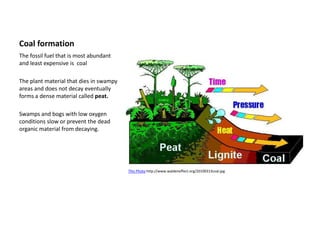
Coal formation
The fossil fuel that is most abundant
and least expensive is coal
The plant material that dies in swampy
areas and does not decay eventually
forms a dense material called peat.
Swamps and bogs with low oxygen
conditions slow or prevent the dead
organic material from decaying.
This Photo http://www.waldeneffect.org/20100313coal.jpg
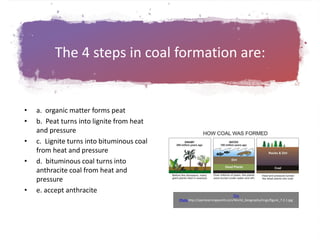
The 4 steps in coal formation are:
• a. organic matter forms peat
• b. Peat turns into lignite from heat
and pressure
• c. Lignite turns into bituminous coal
from heat and pressure
• d. bituminous coal turns into
anthracite coal from heat and
pressure
• e. accept anthracite
This
Photohttp://openlearningworld.com/World_Geography/imgs/figure_7.3.1.jpg
Slow change
Conditions that change peat to coal
from one form to another over
millions of years are heat and
pressure.
Older coal that has been under heat
and pressure is called anthracite.
Anthracite coal burns with less
pollution and gives off more heat than
any other type of coal.
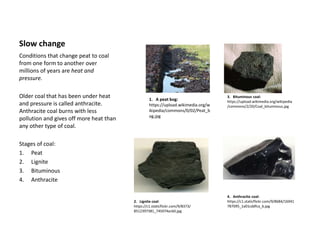
Stages of coal:
1. Peat
2. Lignite
3. Bituminous
4. Anthracite
3. Bituminous coal:
https://upload.wikimedia.org/wikipedia
/commons/2/20/Coal_bituminous.jpg
1. A peat bog:
https://upload.wikimedia.org/w
ikipedia/commons/0/02/Peat_b
og.jpg
2. Lignite coal:
https://c1.staticflickr.com/9/8373/
8512397381_745074acb0.jpg
4. Anthracite coal:
https://c1.staticflickr.com/9/8684/16941
787095_1a01cddfca_b.jpg
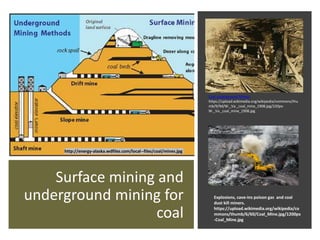
Surface mining and
underground mining for
coal
Coal underground Miners
https://upload.wikimedia.org/wikipedia/commons/thu
mb/9/9d/W._Va._coal_mine_1908.jpg/220px-
W._Va._coal_mine_1908.jpg
http://energy-alaska.wdfiles.com/local--files/coal/mines.jpg
Explosions, cave-ins poison gas and coal
dust kill miners.
https://upload.wikimedia.org/wikipedia/co
mmons/thumb/6/60/Coal_Mine.jpg/1200px
-Coal_Mine.jpg
Getting the coal out of the
ground:
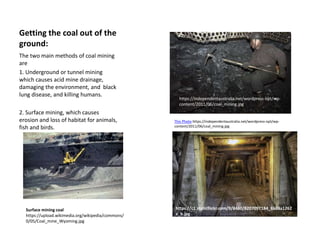
The two main methods of coal mining
are
1. Underground or tunnel mining
which causes acid mine drainage,
damaging the environment, and black
lung disease, and killing humans.
2. Surface mining, which causes
erosion and loss of habitat for animals,
fish and birds.
This Photo https://independentaustralia.net/wordpress-opt/wp-
content/2011/06/coal_mining.jpg
https://c1.staticflickr.com/9/8480/8207097184_8b98a1262
e_b.jpg
https://independentaustralia.net/wordpress-opt/wp-
content/2011/06/coal_mining.jpg
Surface mining coal
https://upload.wikimedia.org/wikipedia/commons/
0/05/Coal_mine_Wyoming.jpg
Natural gas
https://farm5.staticflickr.com/4045/5147614068_ac6f4d434e_z.jpg
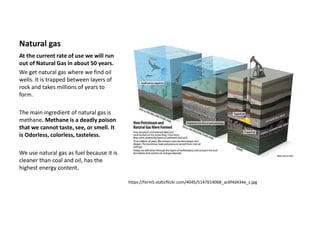
At the current rate of use we will run
out of Natural Gas in about 50 years.
We get natural gas where we find oil
wells. It is trapped between layers of
rock and takes millions of years to
form.
The main ingredient of natural gas is
methane. Methane is a deadly poison
that we cannot taste, see, or smell. It
is Odorless, colorless, tasteless.
We use natural gas as fuel because it is
cleaner than coal and oil, has the
highest energy content.
Tar sands
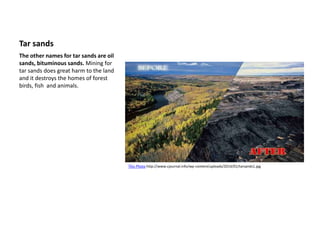
The other names for tar sands are oil
sands, bituminous sands. Mining for
tar sands does great harm to the land
and it destroys the homes of forest
birds, fish and animals.
This Photo http://www.cjournal.info/wp-content/uploads/2014/01/tarsands1.jpg
Oil shale
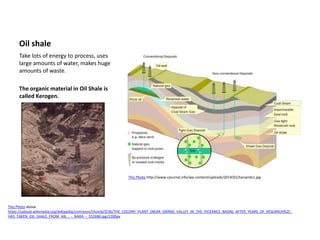
Take lots of energy to process, uses
large amounts of water, makes huge
amounts of waste.
The organic material in Oil Shale is
called Kerogen.
This Photo http://www.cjournal.info/wp-content/uploads/2014/01/tarsands1.jpg
This Photo above
https://upload.wikimedia.org/wikipedia/commons/thumb/3/36/THE_COLONY_PLANT_(NEAR_GRAND_VALLEY_IN_THE_PICEANCE_BASIN)_AFTER_YEARS_OF_RESEARCH%2C_
HAS_TAKEN_OIL_SHALE_FROM_AN..._-_NARA_-_552686.jpg/1200px
Biomass
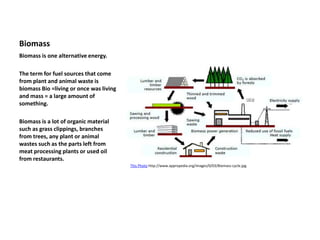
Biomass is one alternative energy.
The term for fuel sources that come
from plant and animal waste is
biomass Bio =living or once was living
and mass = a large amount of
something.
Biomass is a lot of organic material
such as grass clippings, branches
from trees, any plant or animal
wastes such as the parts left from
meat processing plants or used oil
from restaurants.
This Photo http://www.appropedia.org/images/0/03/Biomass-cycle.jpg

Common fossil fuels

  • 1.
    Fossil Fuels By KellaRandolph M.Ed. https://upload.wikimedia.org/wikipedia/commons/thumb/d/dd/Furnace_onboard_Edith_May_sailing_Barge.JPG/120 px-Furnace_onboard_Edith_May_sailing_Barge.JPG
  • 2.
    Three examples offossil fuels How fossil fuels cause harm • Burning coal makes ozone, smog, acid rain, climate change, mercury pollution • Oil spills damage all living things • Natural gas is poisonous and is colorless, odorless and tasteless. We must add a bad smell to it in order to prevent being killed by a gas leak. Three examples of fossil fuels could be a. coal b. oil c. natural gas
  • 3.
    Coal formation The fossilfuel that is most abundant and least expensive is coal The plant material that dies in swampy areas and does not decay eventually forms a dense material called peat. Swamps and bogs with low oxygen conditions slow or prevent the dead organic material from decaying. This Photo http://www.waldeneffect.org/20100313coal.jpg
  • 4.
    The 4 stepsin coal formation are: • a. organic matter forms peat • b. Peat turns into lignite from heat and pressure • c. Lignite turns into bituminous coal from heat and pressure • d. bituminous coal turns into anthracite coal from heat and pressure • e. accept anthracite This Photohttp://openlearningworld.com/World_Geography/imgs/figure_7.3.1.jpg
  • 5.
    Slow change Conditions thatchange peat to coal from one form to another over millions of years are heat and pressure. Older coal that has been under heat and pressure is called anthracite. Anthracite coal burns with less pollution and gives off more heat than any other type of coal. Stages of coal: 1. Peat 2. Lignite 3. Bituminous 4. Anthracite 3. Bituminous coal: https://upload.wikimedia.org/wikipedia /commons/2/20/Coal_bituminous.jpg 1. A peat bog: https://upload.wikimedia.org/w ikipedia/commons/0/02/Peat_b og.jpg 2. Lignite coal: https://c1.staticflickr.com/9/8373/ 8512397381_745074acb0.jpg 4. Anthracite coal: https://c1.staticflickr.com/9/8684/16941 787095_1a01cddfca_b.jpg
  • 6.
    Surface mining and undergroundmining for coal Coal underground Miners https://upload.wikimedia.org/wikipedia/commons/thu mb/9/9d/W._Va._coal_mine_1908.jpg/220px- W._Va._coal_mine_1908.jpg http://energy-alaska.wdfiles.com/local--files/coal/mines.jpg Explosions, cave-ins poison gas and coal dust kill miners. https://upload.wikimedia.org/wikipedia/co mmons/thumb/6/60/Coal_Mine.jpg/1200px -Coal_Mine.jpg
  • 7.
    Getting the coalout of the ground: The two main methods of coal mining are 1. Underground or tunnel mining which causes acid mine drainage, damaging the environment, and black lung disease, and killing humans. 2. Surface mining, which causes erosion and loss of habitat for animals, fish and birds. This Photo https://independentaustralia.net/wordpress-opt/wp- content/2011/06/coal_mining.jpg https://c1.staticflickr.com/9/8480/8207097184_8b98a1262 e_b.jpg https://independentaustralia.net/wordpress-opt/wp- content/2011/06/coal_mining.jpg Surface mining coal https://upload.wikimedia.org/wikipedia/commons/ 0/05/Coal_mine_Wyoming.jpg
  • 8.
    Natural gas https://farm5.staticflickr.com/4045/5147614068_ac6f4d434e_z.jpg At thecurrent rate of use we will run out of Natural Gas in about 50 years. We get natural gas where we find oil wells. It is trapped between layers of rock and takes millions of years to form. The main ingredient of natural gas is methane. Methane is a deadly poison that we cannot taste, see, or smell. It is Odorless, colorless, tasteless. We use natural gas as fuel because it is cleaner than coal and oil, has the highest energy content.
  • 9.
    Tar sands The othernames for tar sands are oil sands, bituminous sands. Mining for tar sands does great harm to the land and it destroys the homes of forest birds, fish and animals. This Photo http://www.cjournal.info/wp-content/uploads/2014/01/tarsands1.jpg
  • 10.
    Oil shale Take lotsof energy to process, uses large amounts of water, makes huge amounts of waste. The organic material in Oil Shale is called Kerogen. This Photo http://www.cjournal.info/wp-content/uploads/2014/01/tarsands1.jpg This Photo above https://upload.wikimedia.org/wikipedia/commons/thumb/3/36/THE_COLONY_PLANT_(NEAR_GRAND_VALLEY_IN_THE_PICEANCE_BASIN)_AFTER_YEARS_OF_RESEARCH%2C_ HAS_TAKEN_OIL_SHALE_FROM_AN..._-_NARA_-_552686.jpg/1200px
  • 11.
    Biomass Biomass is onealternative energy. The term for fuel sources that come from plant and animal waste is biomass Bio =living or once was living and mass = a large amount of something. Biomass is a lot of organic material such as grass clippings, branches from trees, any plant or animal wastes such as the parts left from meat processing plants or used oil from restaurants. This Photo http://www.appropedia.org/images/0/03/Biomass-cycle.jpg