Earth’s Place in Space Chapter 2, section 1
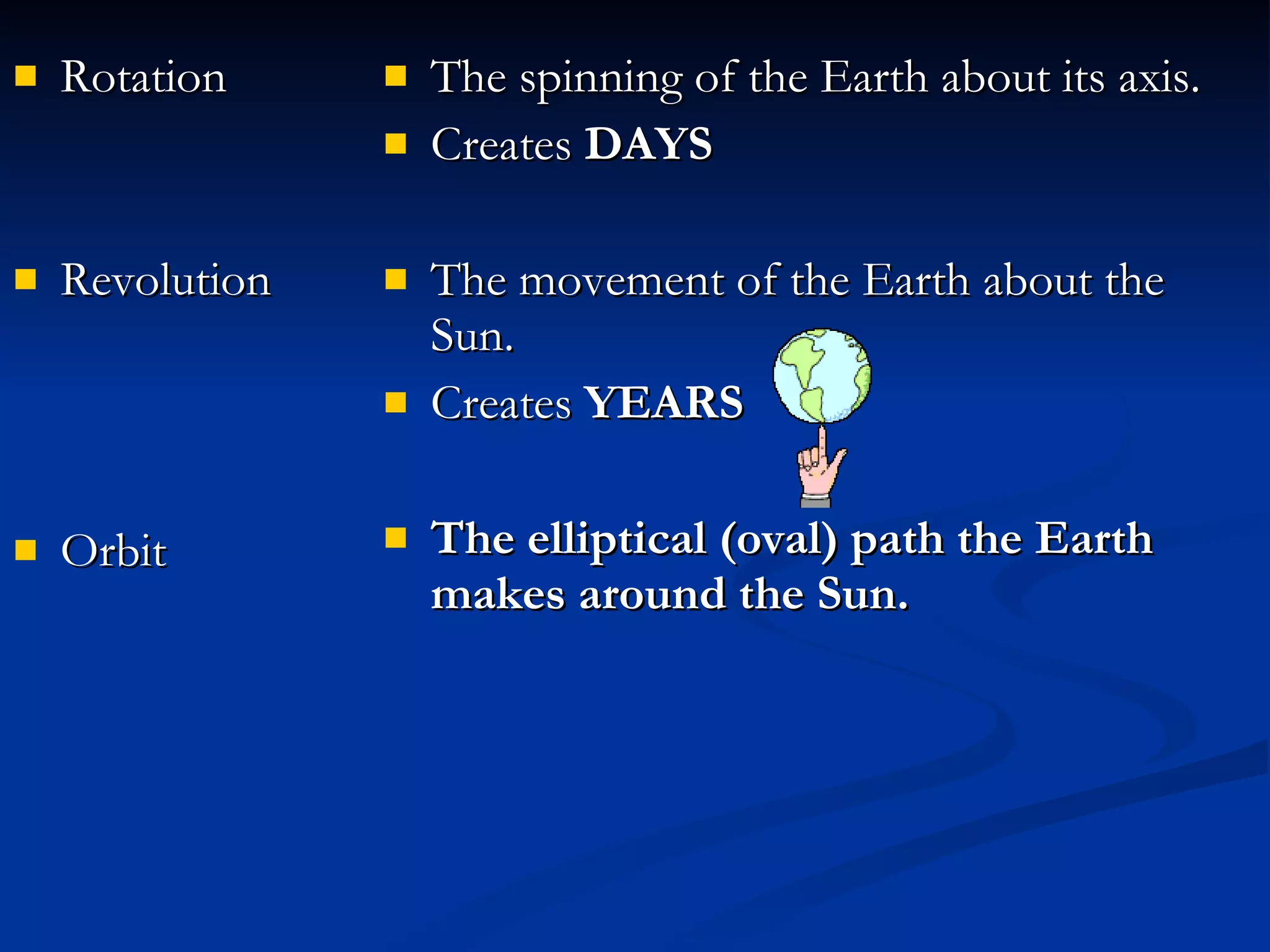
Rotation Revolution Orbit The spinning of the Earth about its axis. Creates  DAYS The movement of the Earth about the Sun. Creates  YEARS The elliptical (oval) path the Earth makes around the Sun.
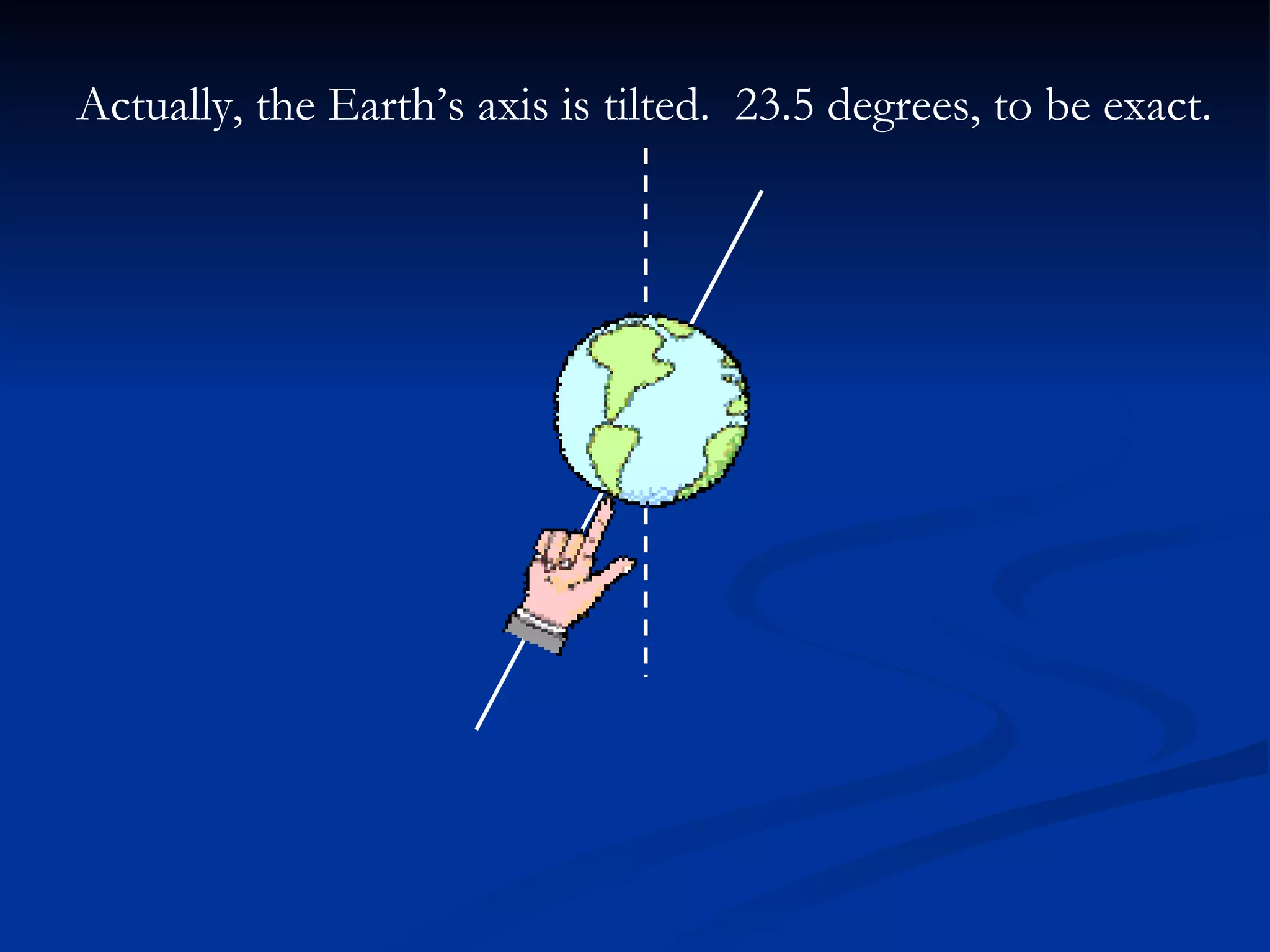
Actually, the Earth’s axis is tilted.  23.5 degrees, to be exact.
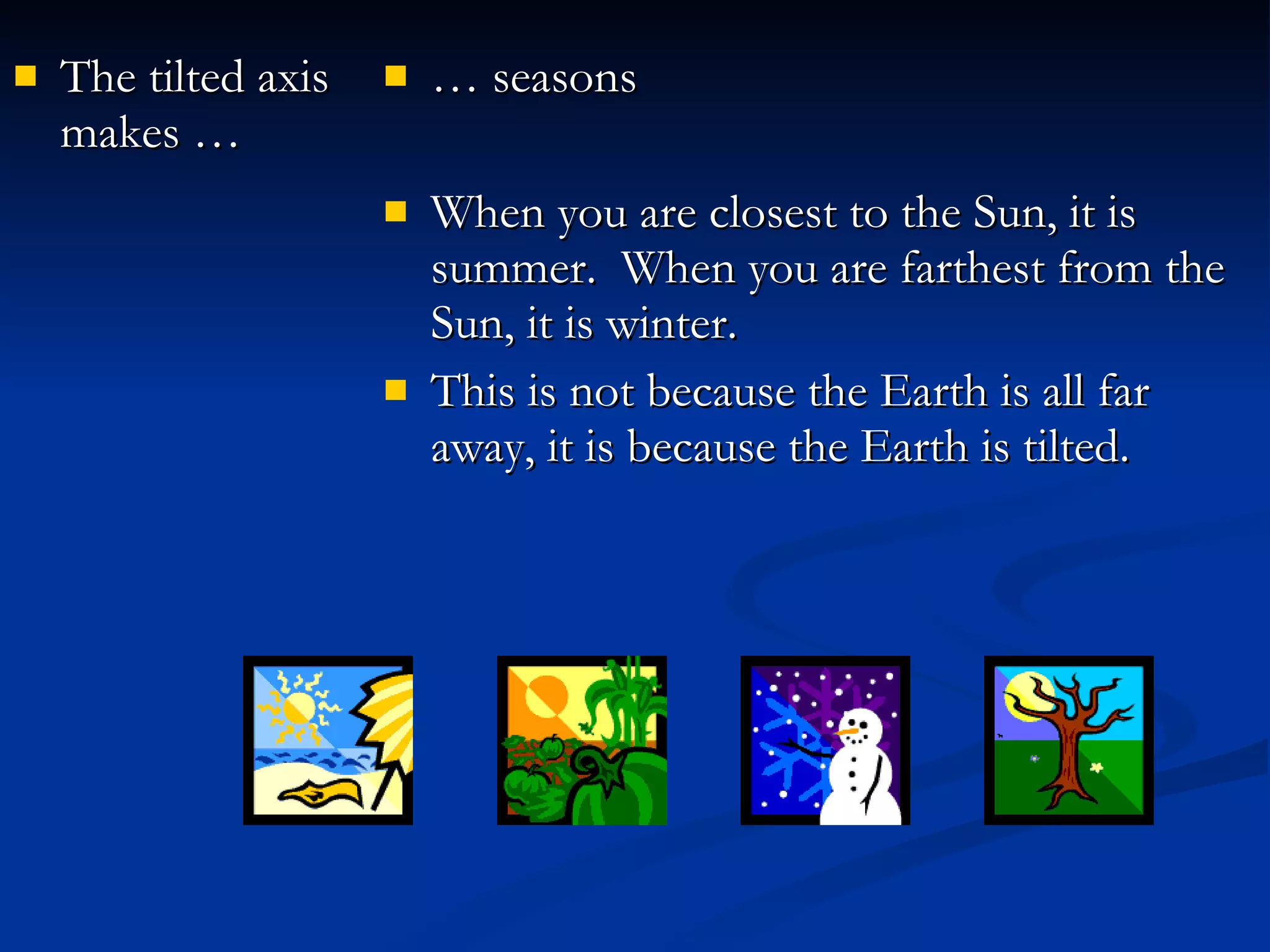
The tilted axis makes … …  seasons When you are closest to the Sun, it is summer.  When you are farthest from the Sun, it is winter. This is not because the Earth is all far away, it is because the Earth is tilted.
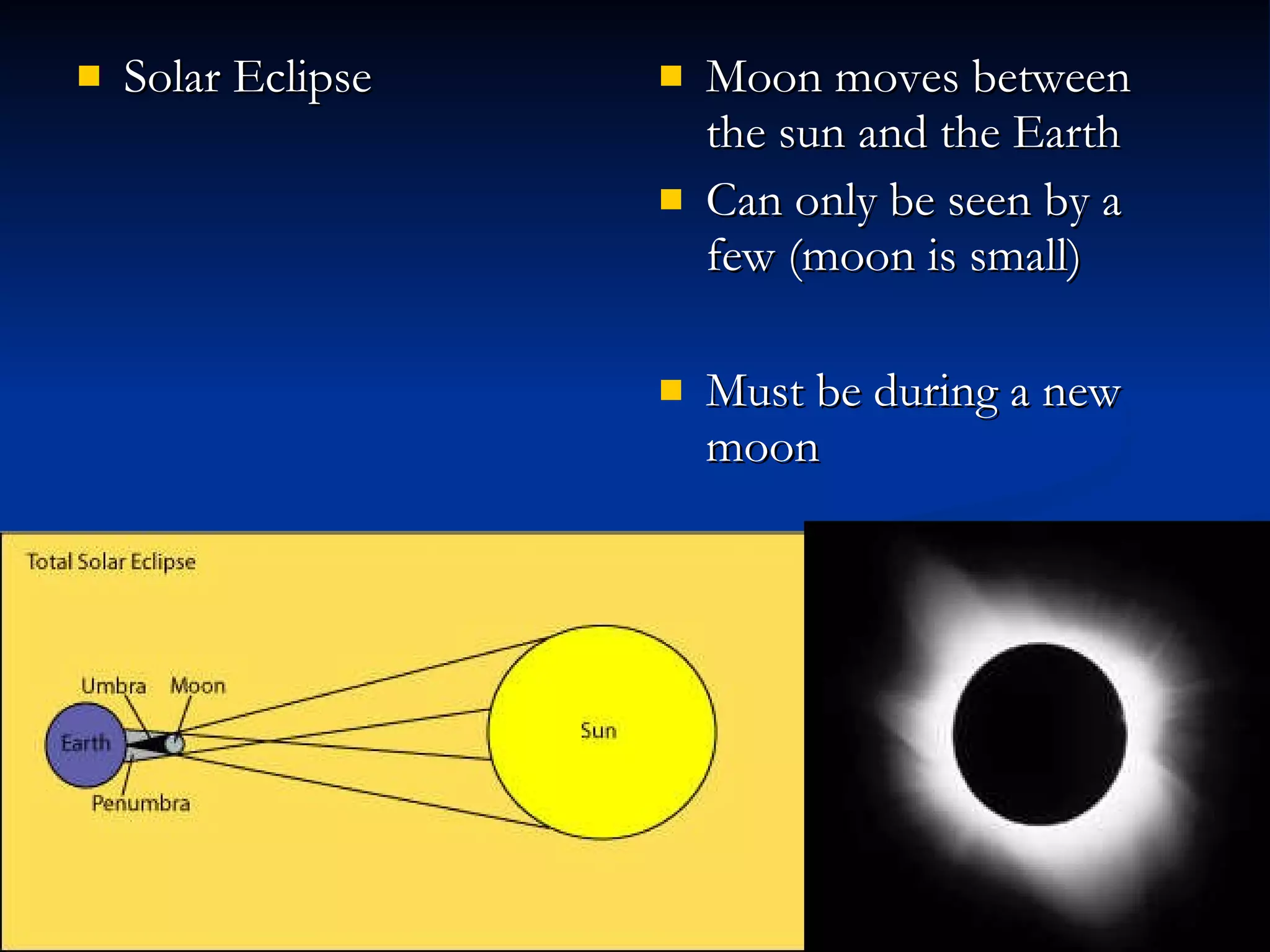
Solar Eclipse Moon moves between the sun and the Earth Can only be seen by a few (moon is small) Must be during a new moon
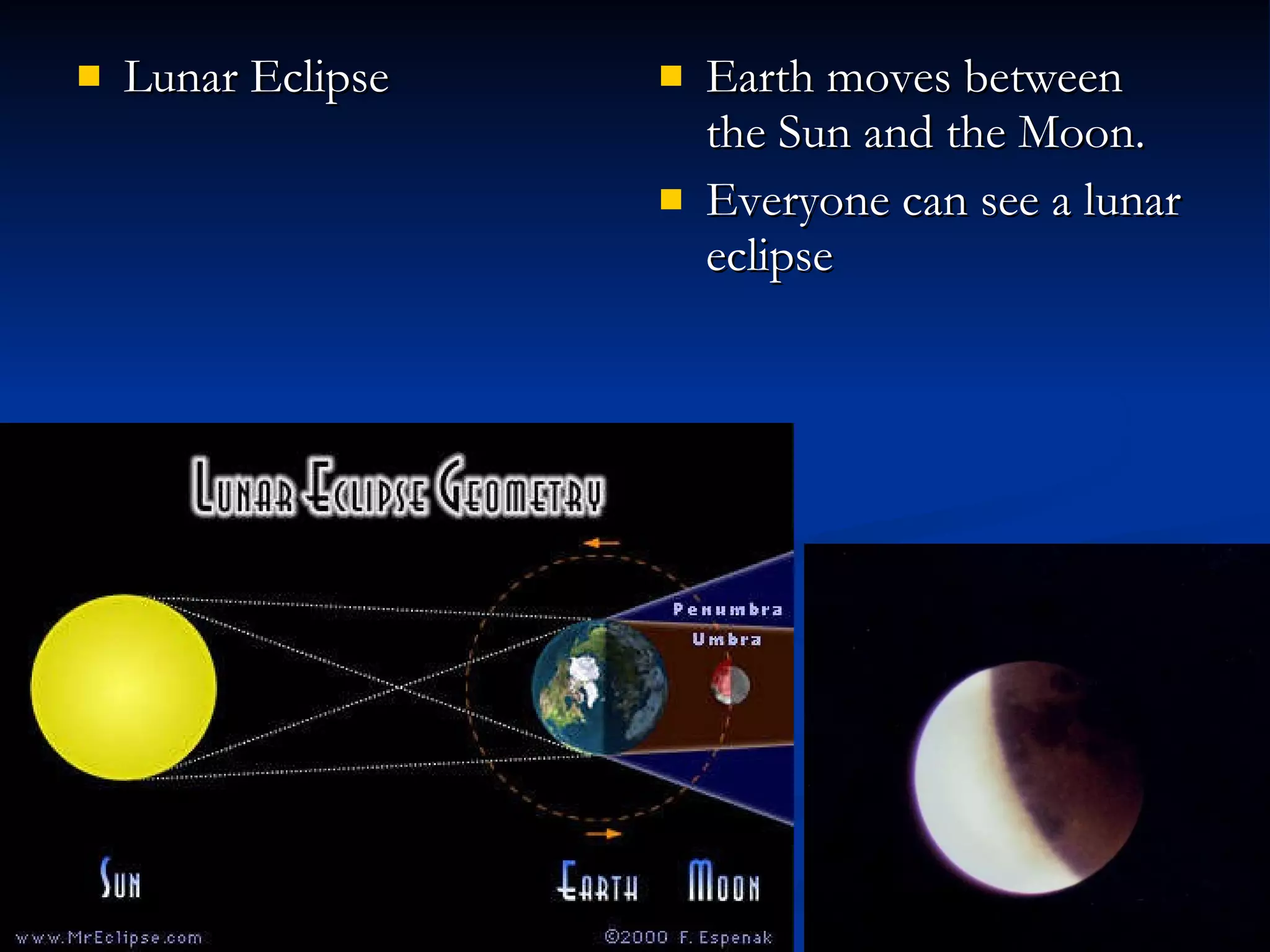
Lunar Eclipse Earth moves between the Sun and the Moon. Everyone can see a lunar eclipse
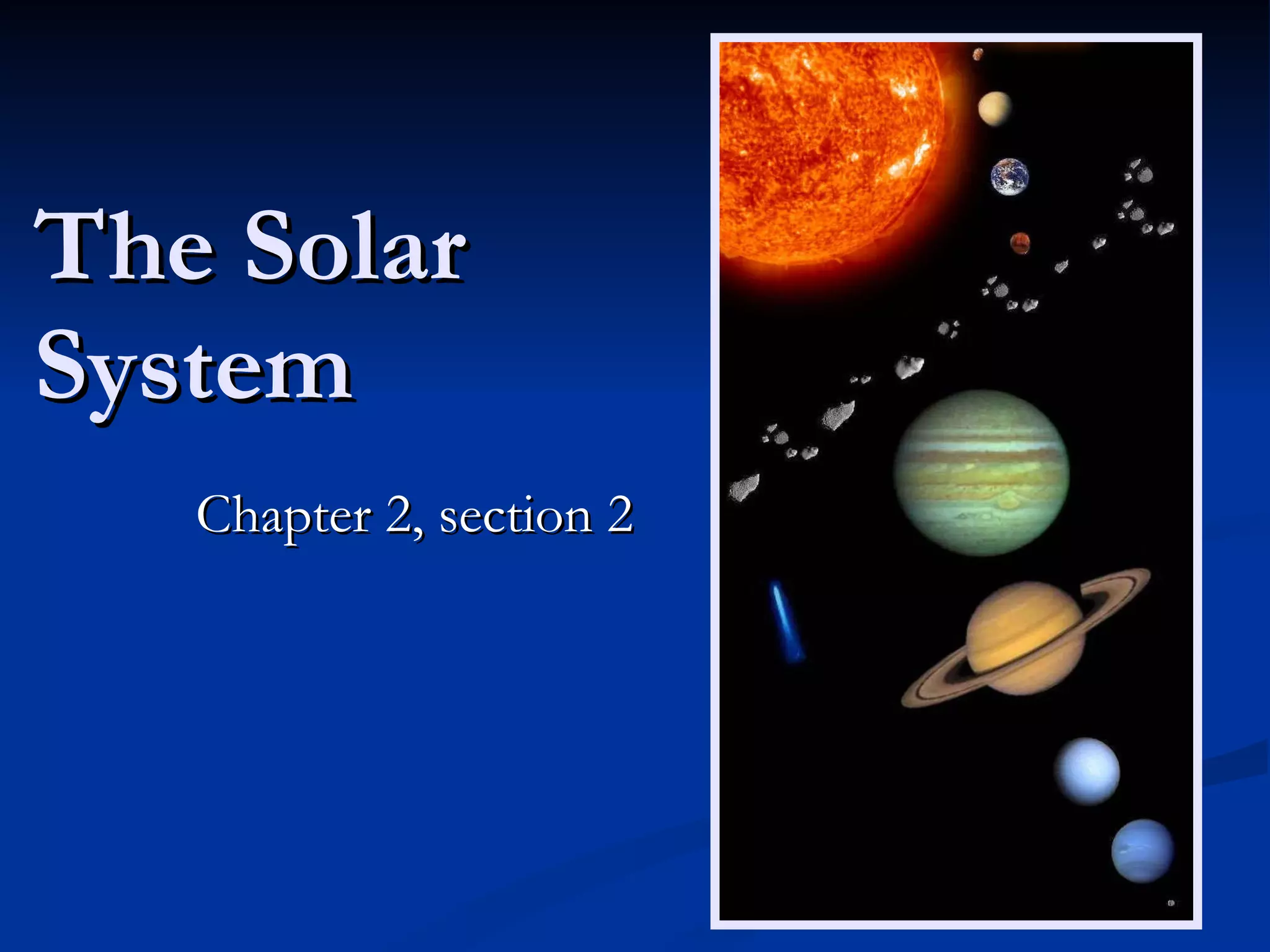
The Solar System Chapter 2, section 2
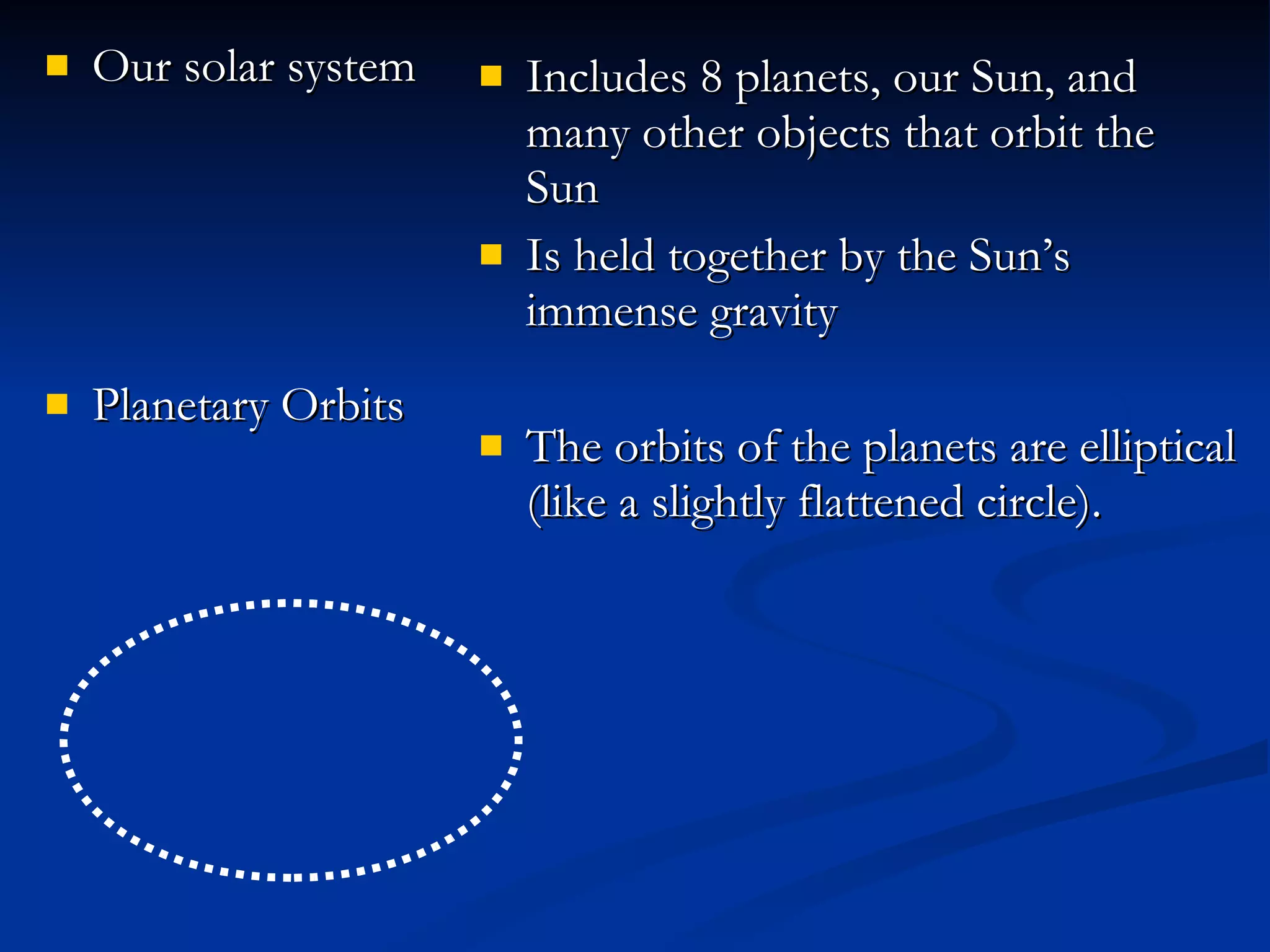
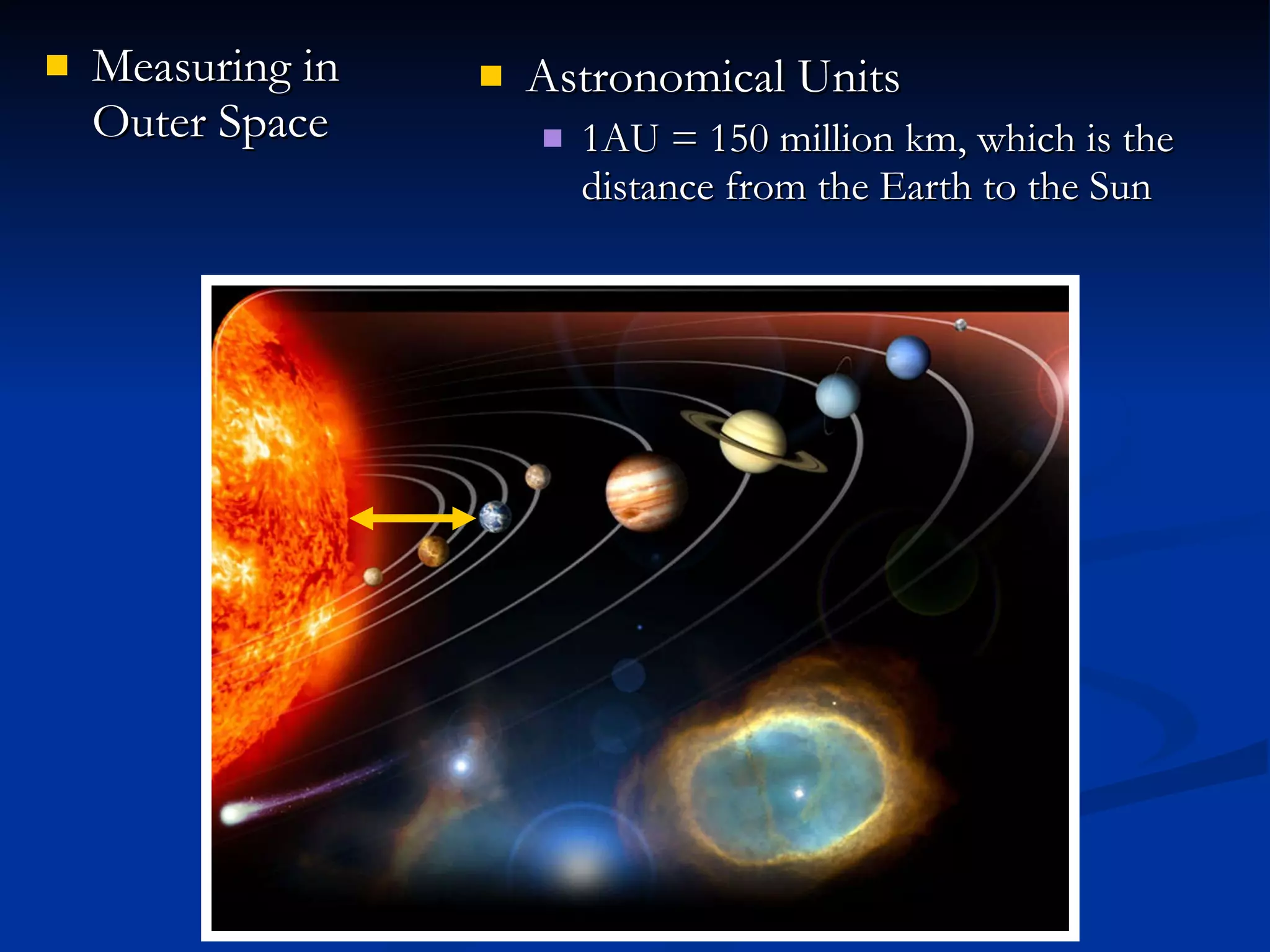
Our solar system Planetary Orbits Includes 8 planets, our Sun, and many other objects that orbit the Sun Is held together by the Sun’s immense gravity The orbits of the planets are elliptical (like a slightly flattened circle).
Measuring in Outer Space Astronomical Units 1AU = 150 million km, which is the distance from the Earth to the Sun
 
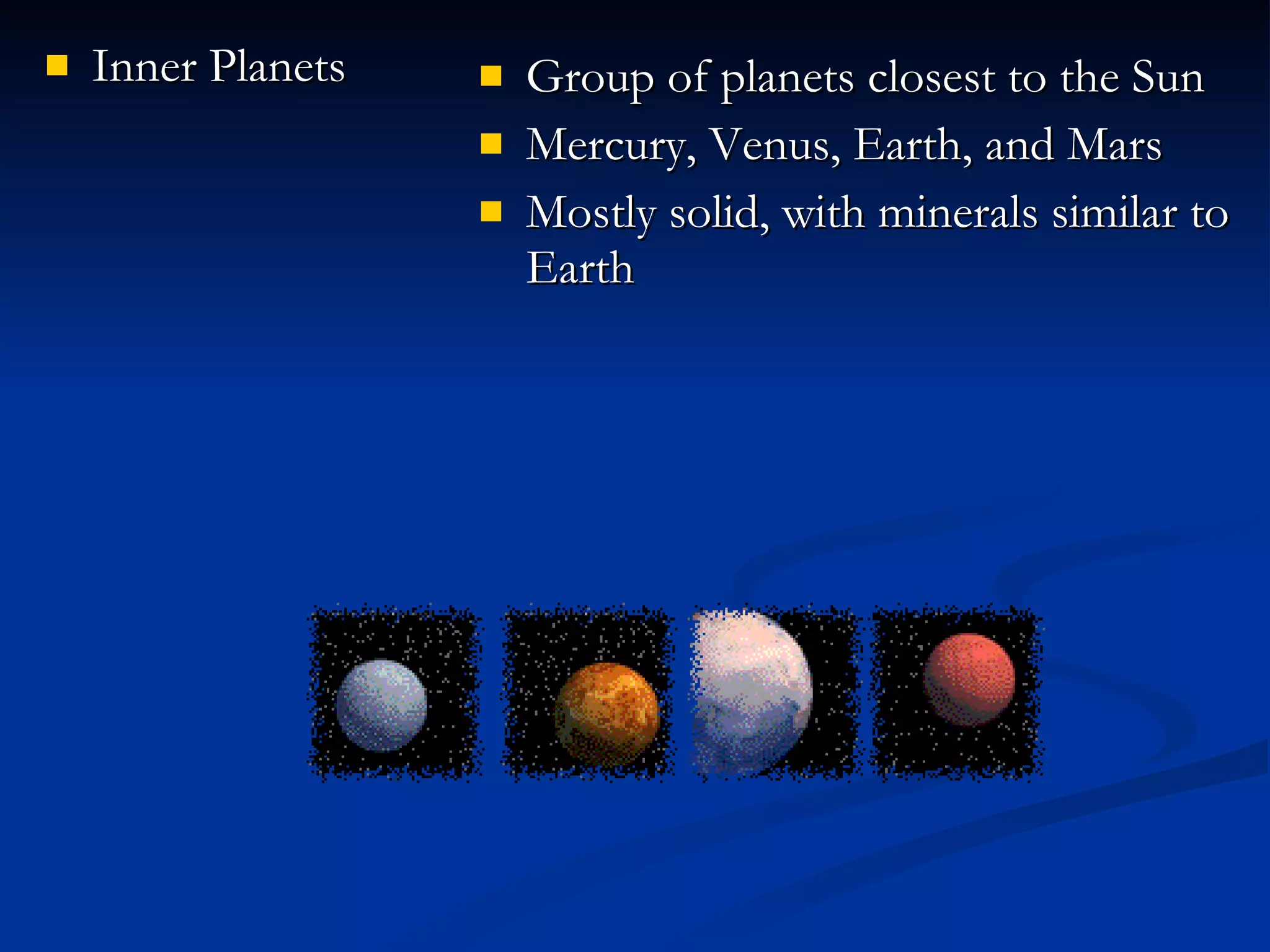
Inner Planets Group of planets closest to the Sun Mercury, Venus, Earth, and Mars Mostly solid, with minerals similar to Earth
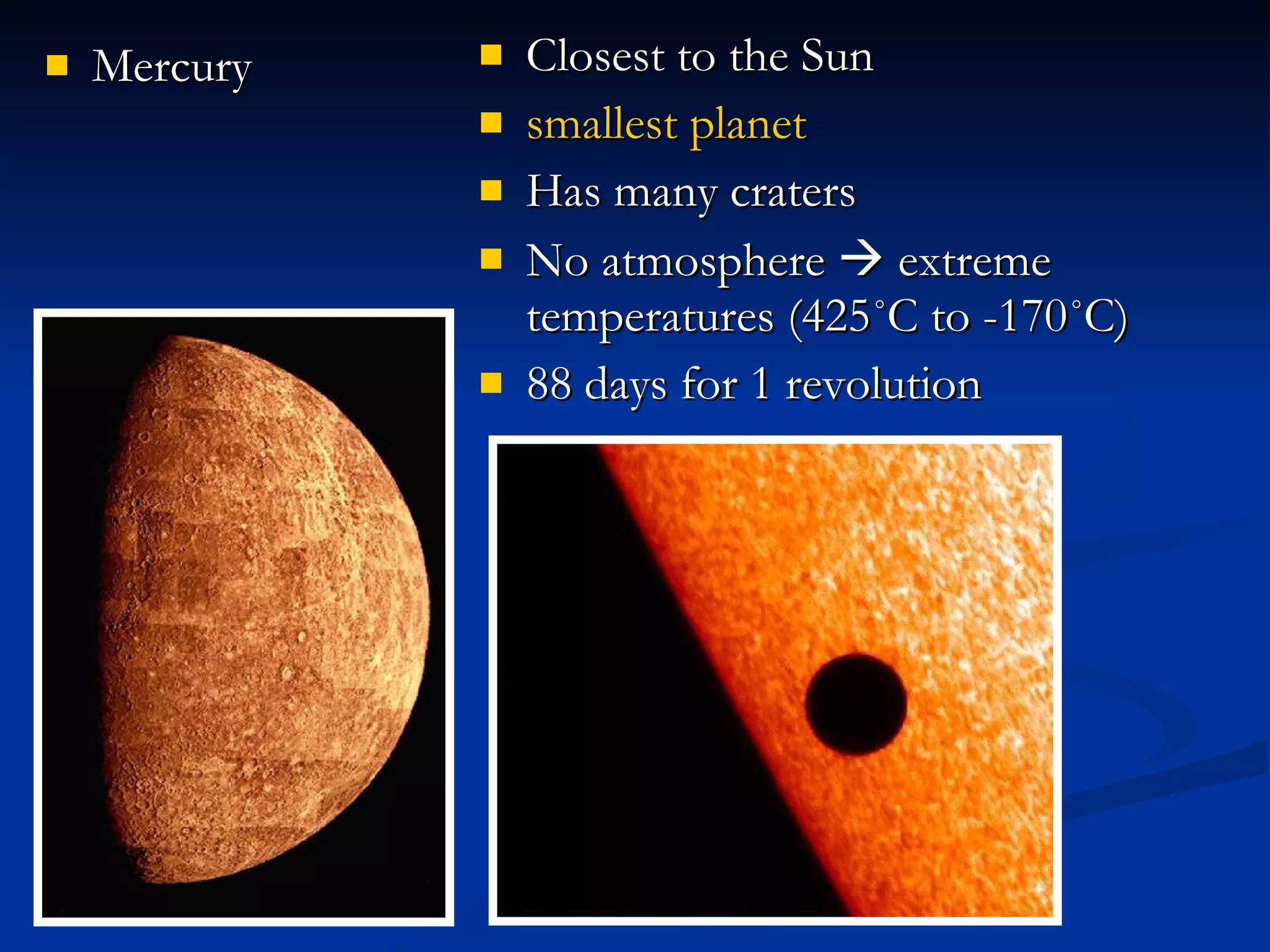
Mercury Closest to the Sun smallest planet Has many craters No atmosphere    extreme temperatures (425˚C to -170˚C)  88 days for 1 revolution
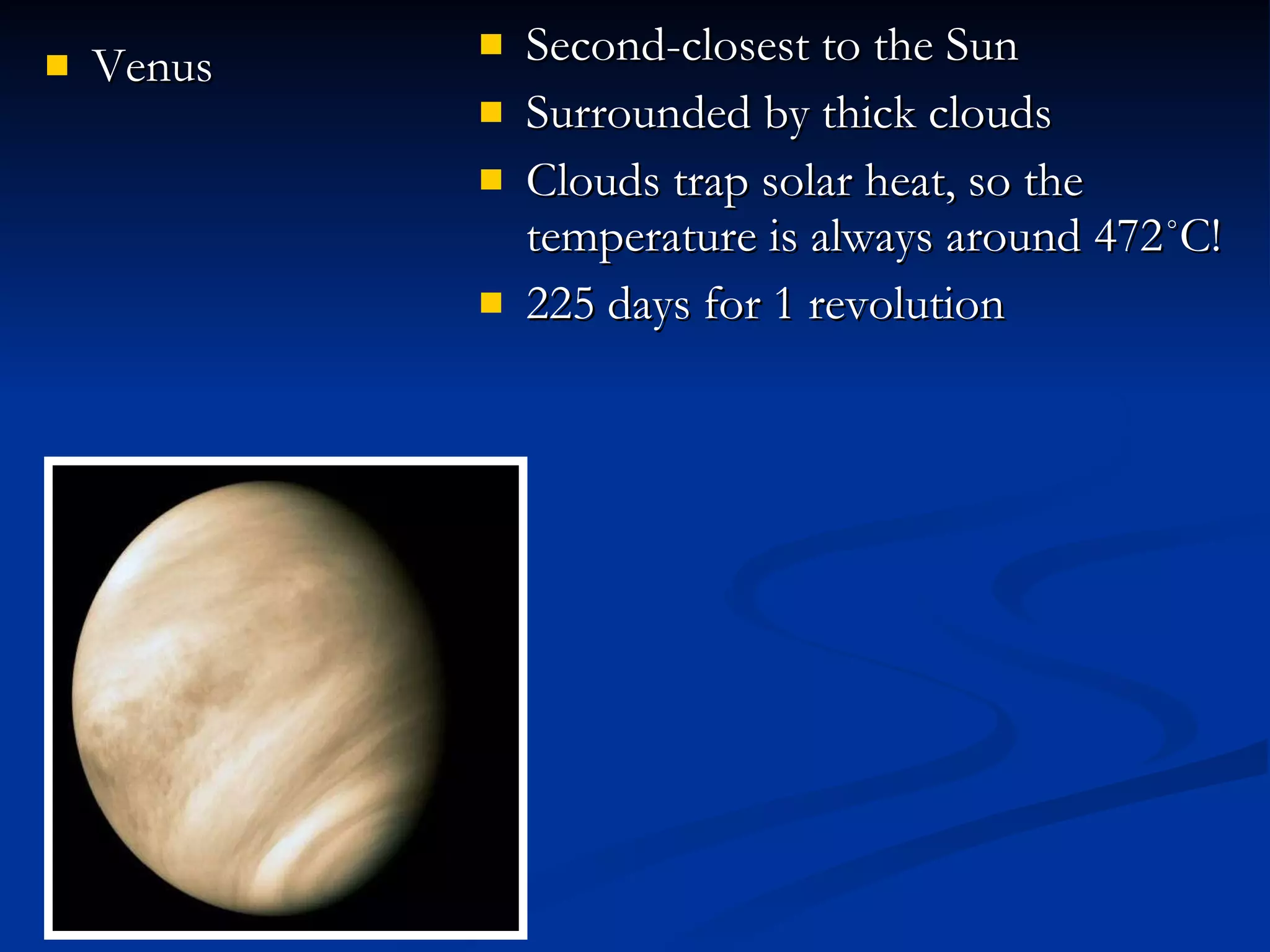
Venus Second-closest to the Sun Surrounded by thick clouds Clouds trap solar heat, so the temperature is always around 472˚C!  225 days for 1 revolution
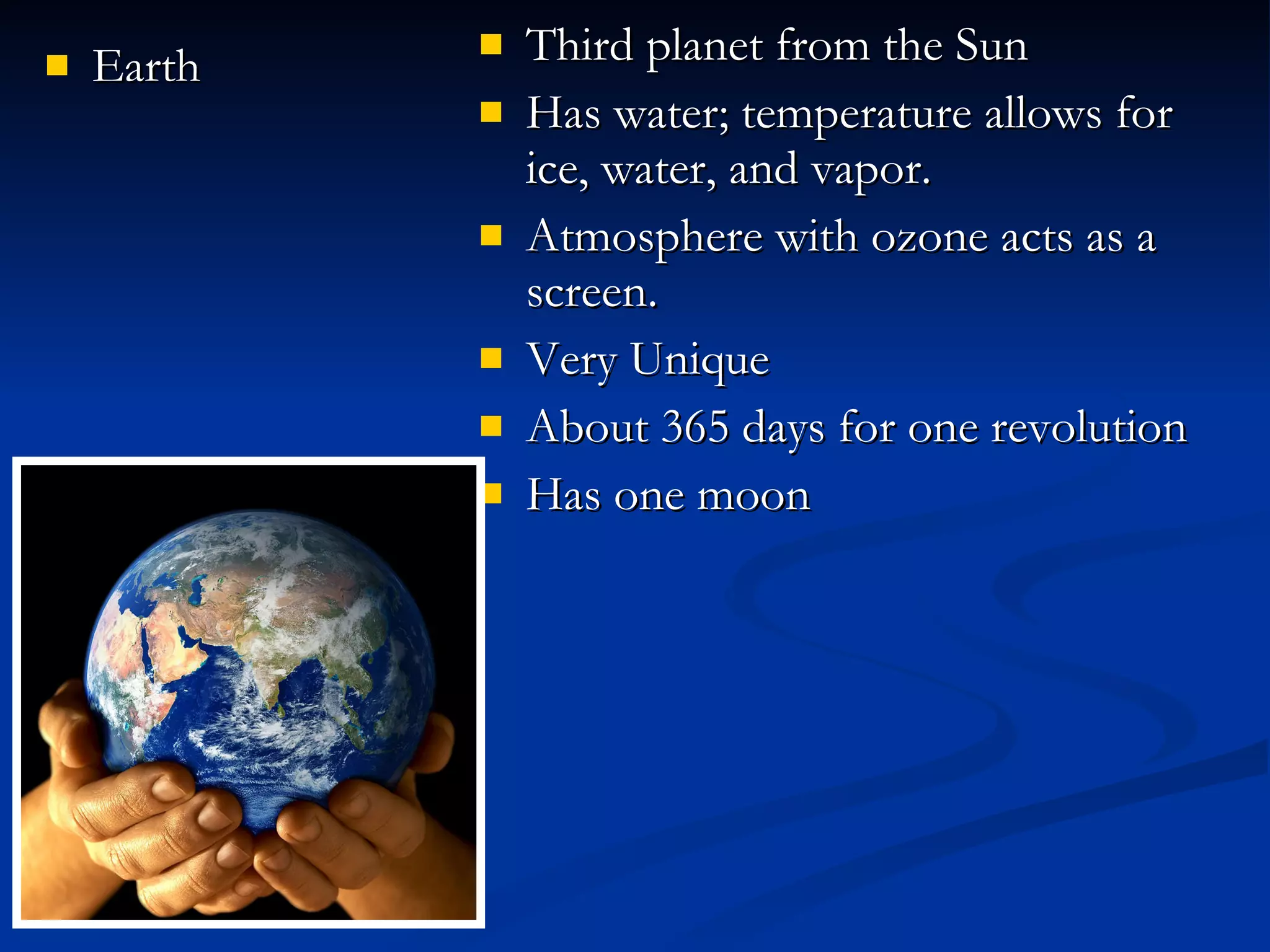
Earth Third planet from the Sun Has water; temperature allows for ice, water, and vapor. Atmosphere with ozone acts as a screen. Very Unique About 365 days for one revolution Has one moon
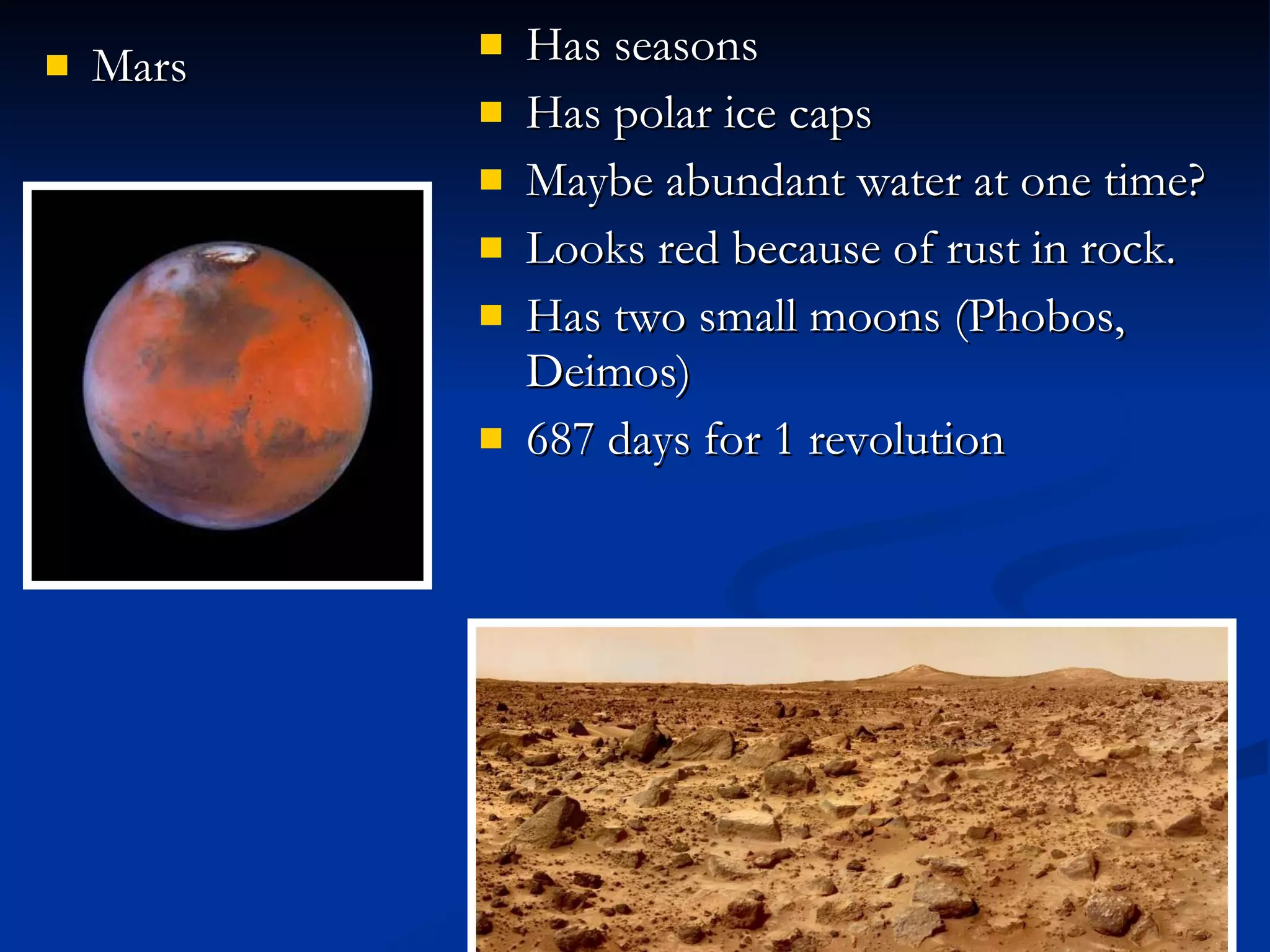
Mars Has seasons Has polar ice caps Maybe abundant water at one time? Looks red because of rust in rock. Has two small moons (Phobos, Deimos) 687 days for 1 revolution
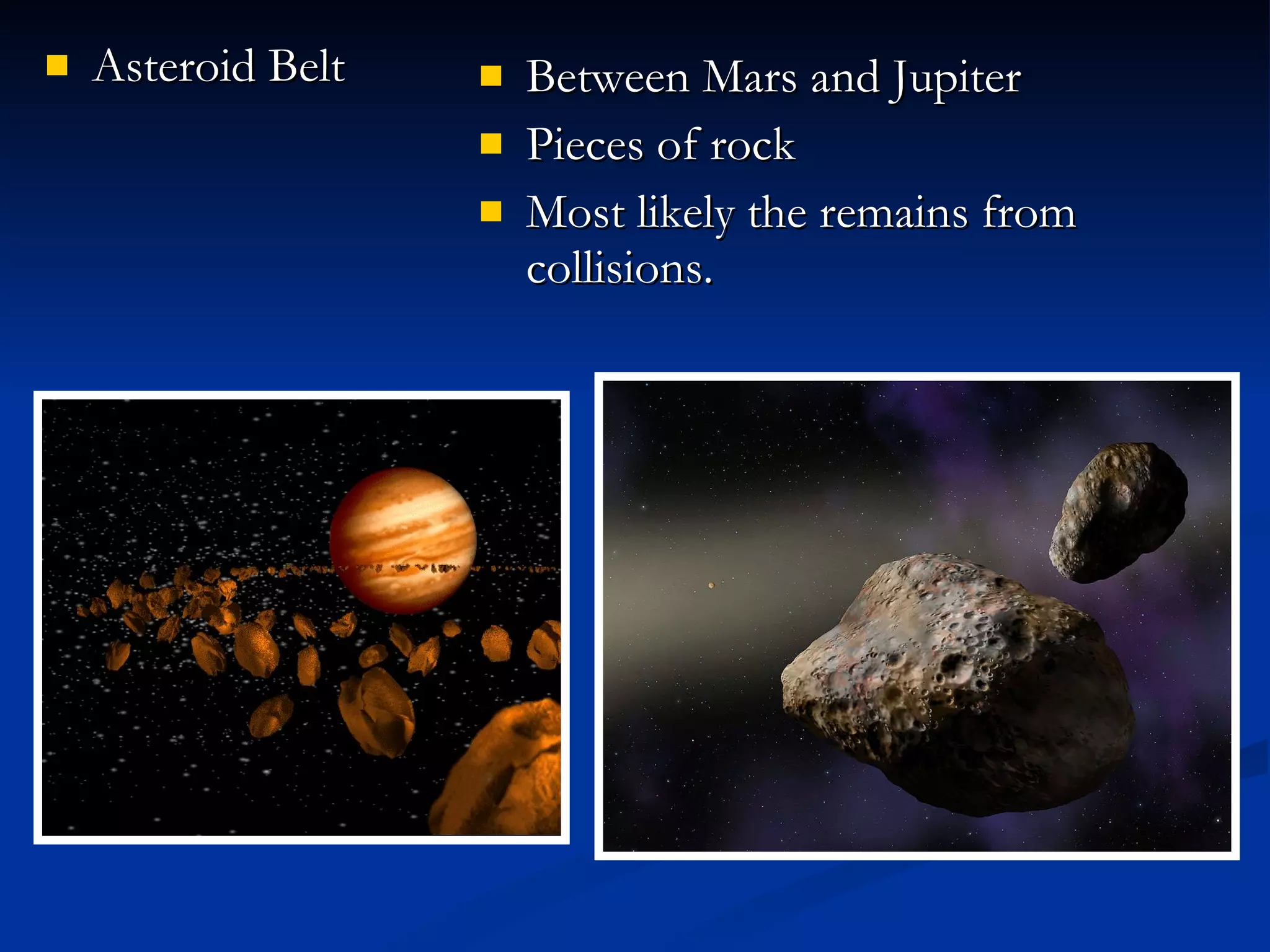
Asteroid Belt Between Mars and Jupiter Pieces of rock Most likely the remains from collisions.
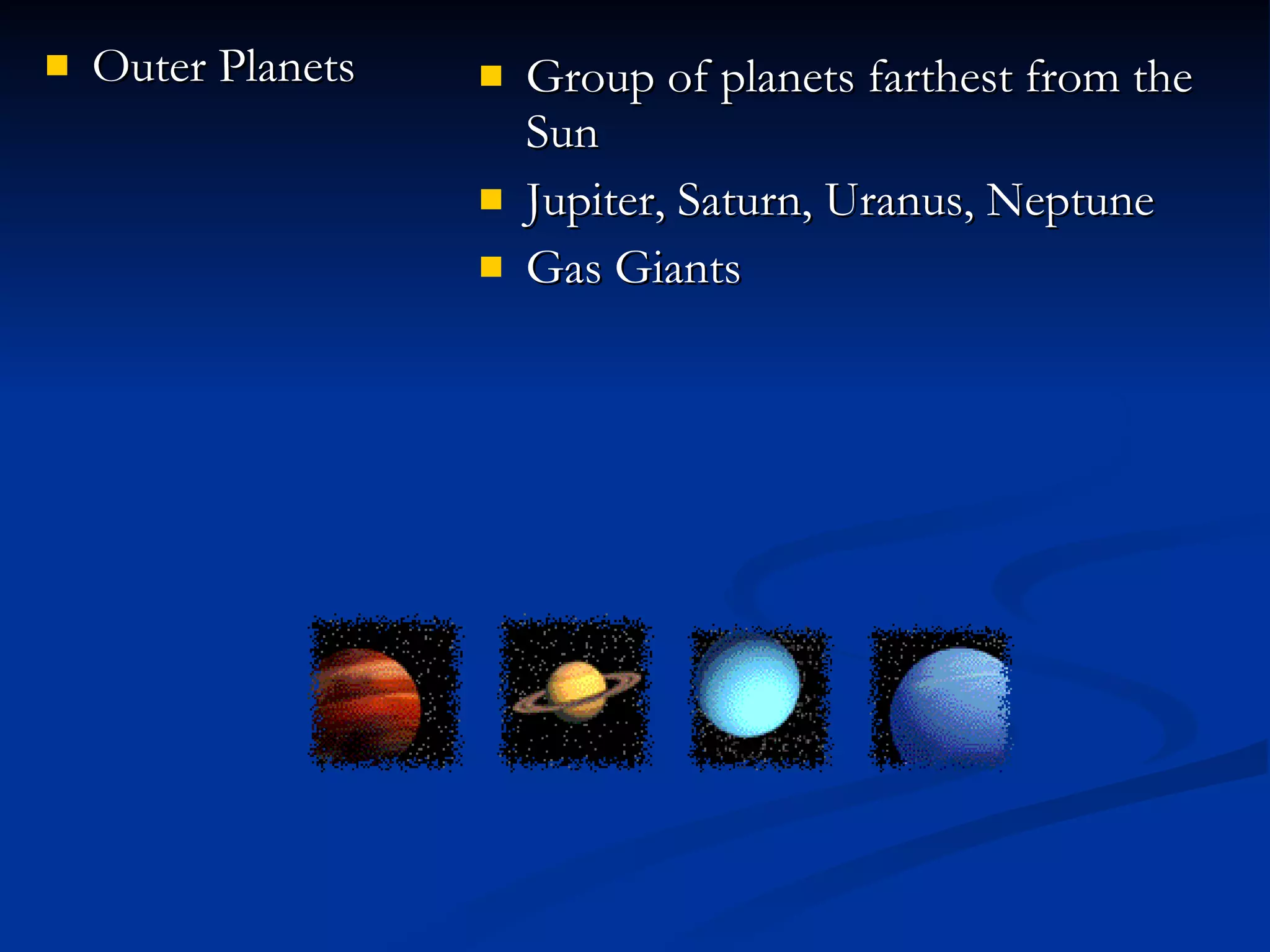
Outer Planets Group of planets farthest from the Sun Jupiter, Saturn, Uranus, Neptune Gas Giants
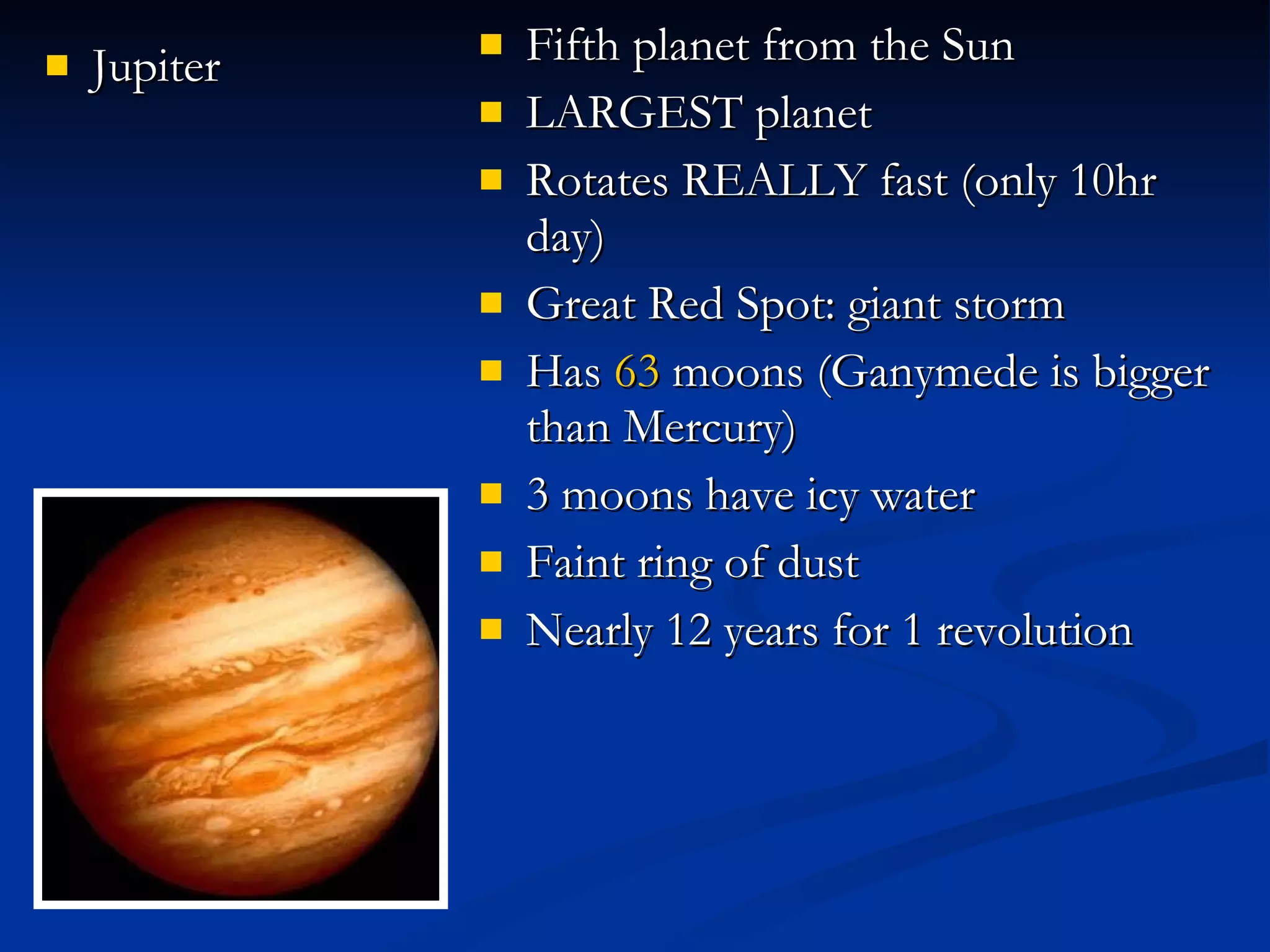
Jupiter Fifth planet from the Sun LARGEST planet Rotates REALLY fast (only 10hr day) Great Red Spot: giant storm Has  63  moons (Ganymede is bigger than Mercury) 3 moons have icy water Faint ring of dust Nearly 12 years for 1 revolution
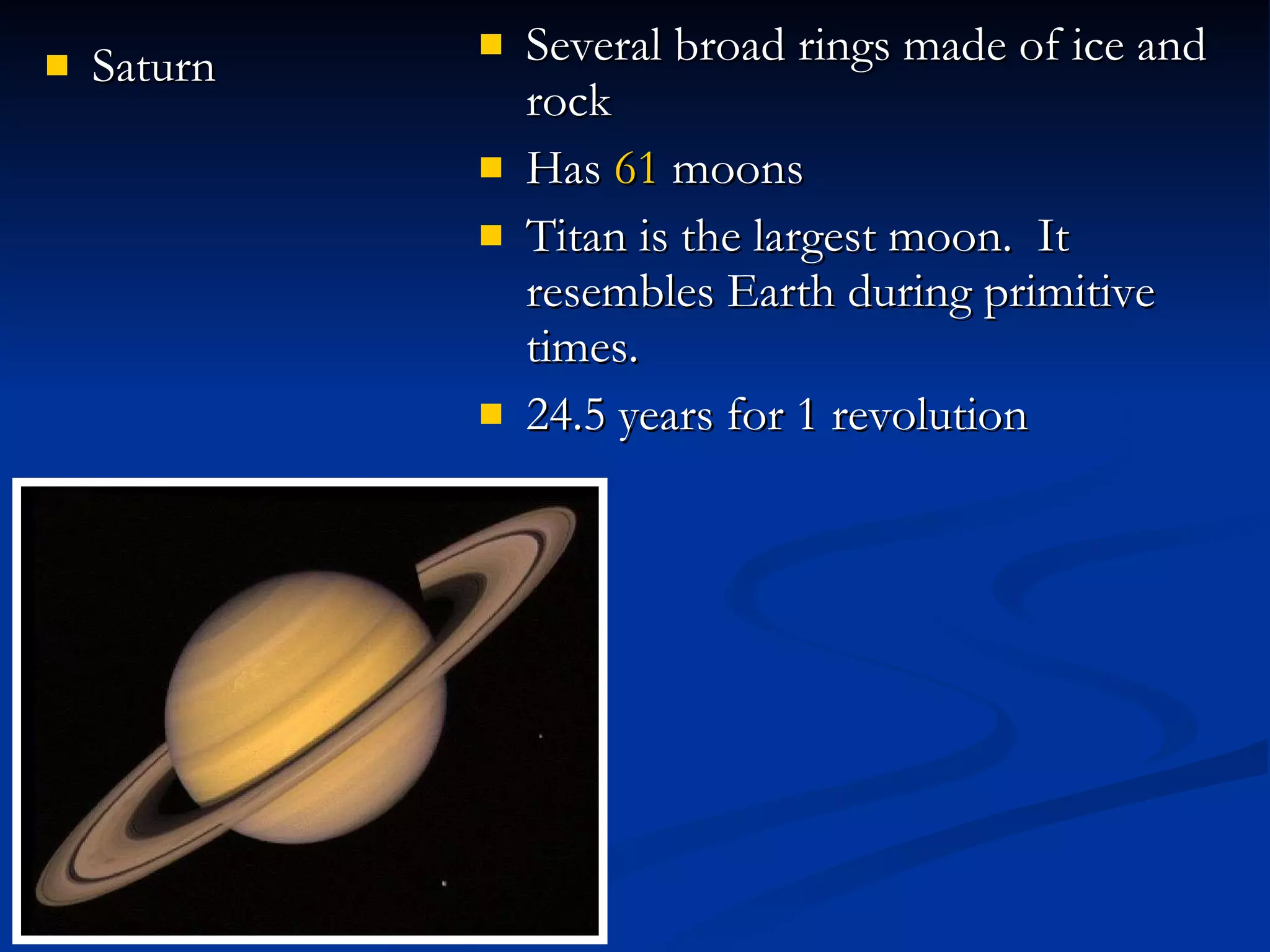
Saturn Several broad rings made of ice and rock Has  61  moons Titan is the largest moon.  It resembles Earth during primitive times. 24.5 years for 1 revolution
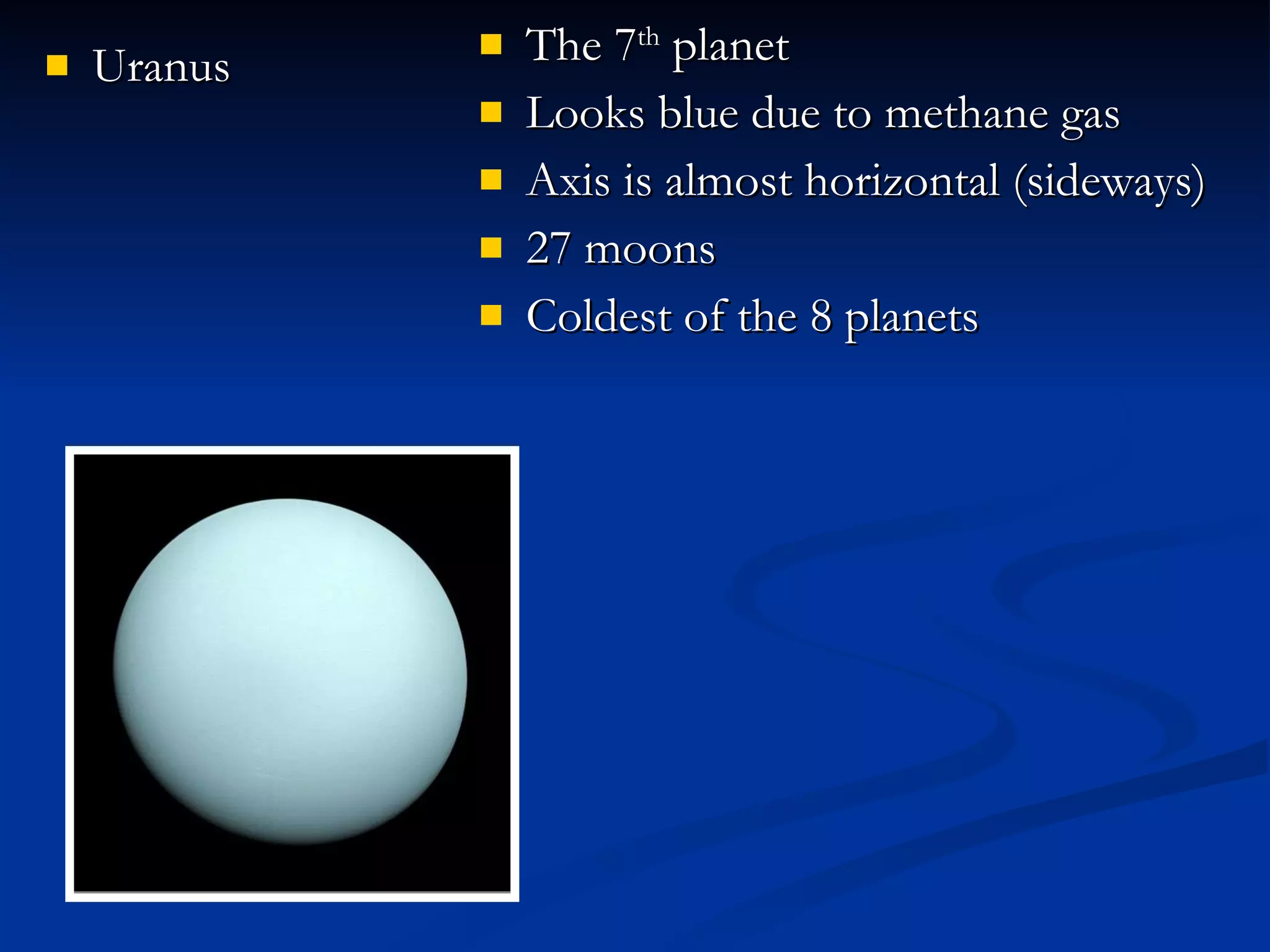
Uranus The 7 th  planet  Looks blue due to methane gas Axis is almost horizontal (sideways) 27 moons Coldest of the 8 planets
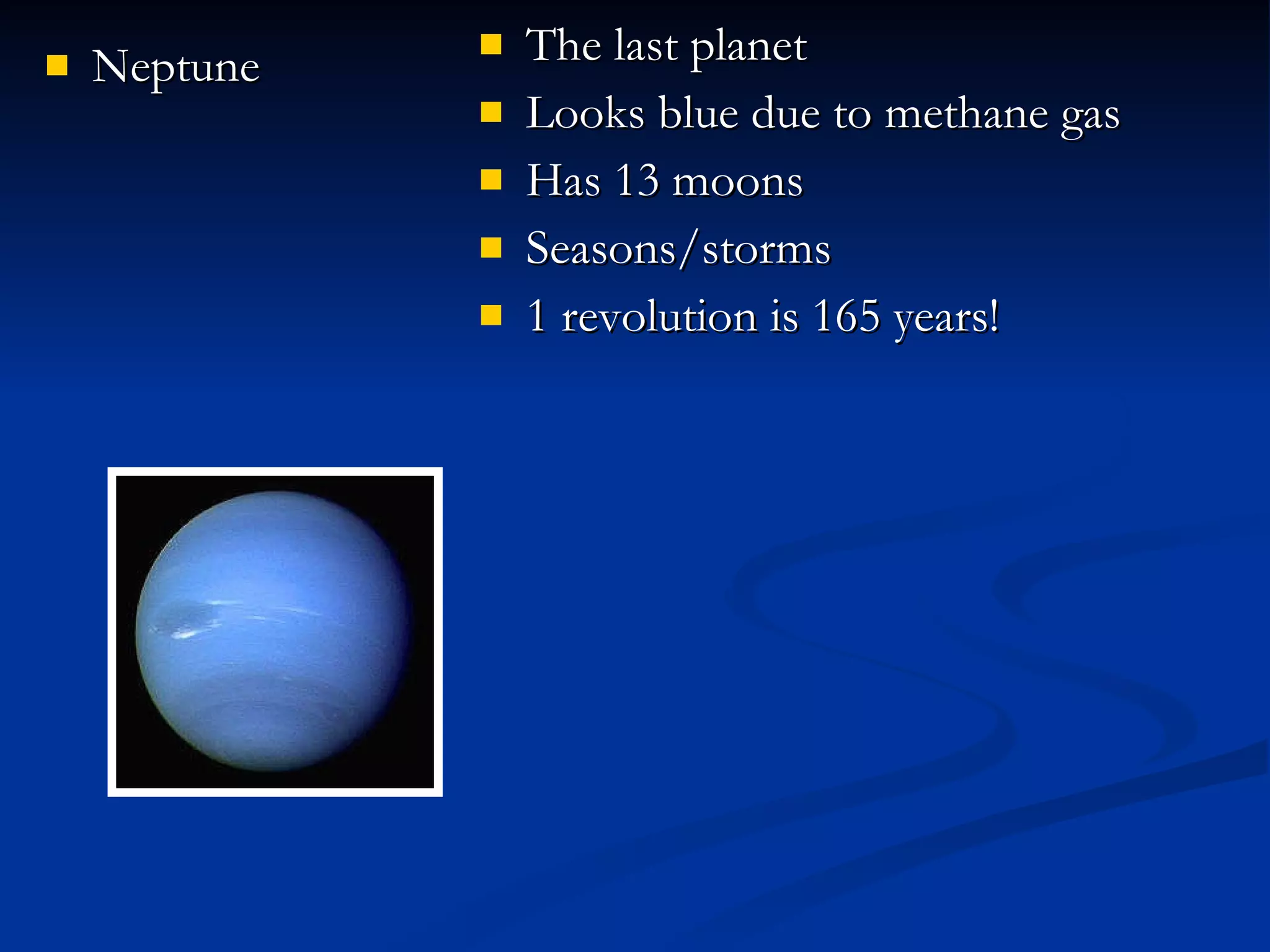
Neptune The last planet  Looks blue due to methane gas Has 13 moons Seasons/storms 1 revolution is 165 years!
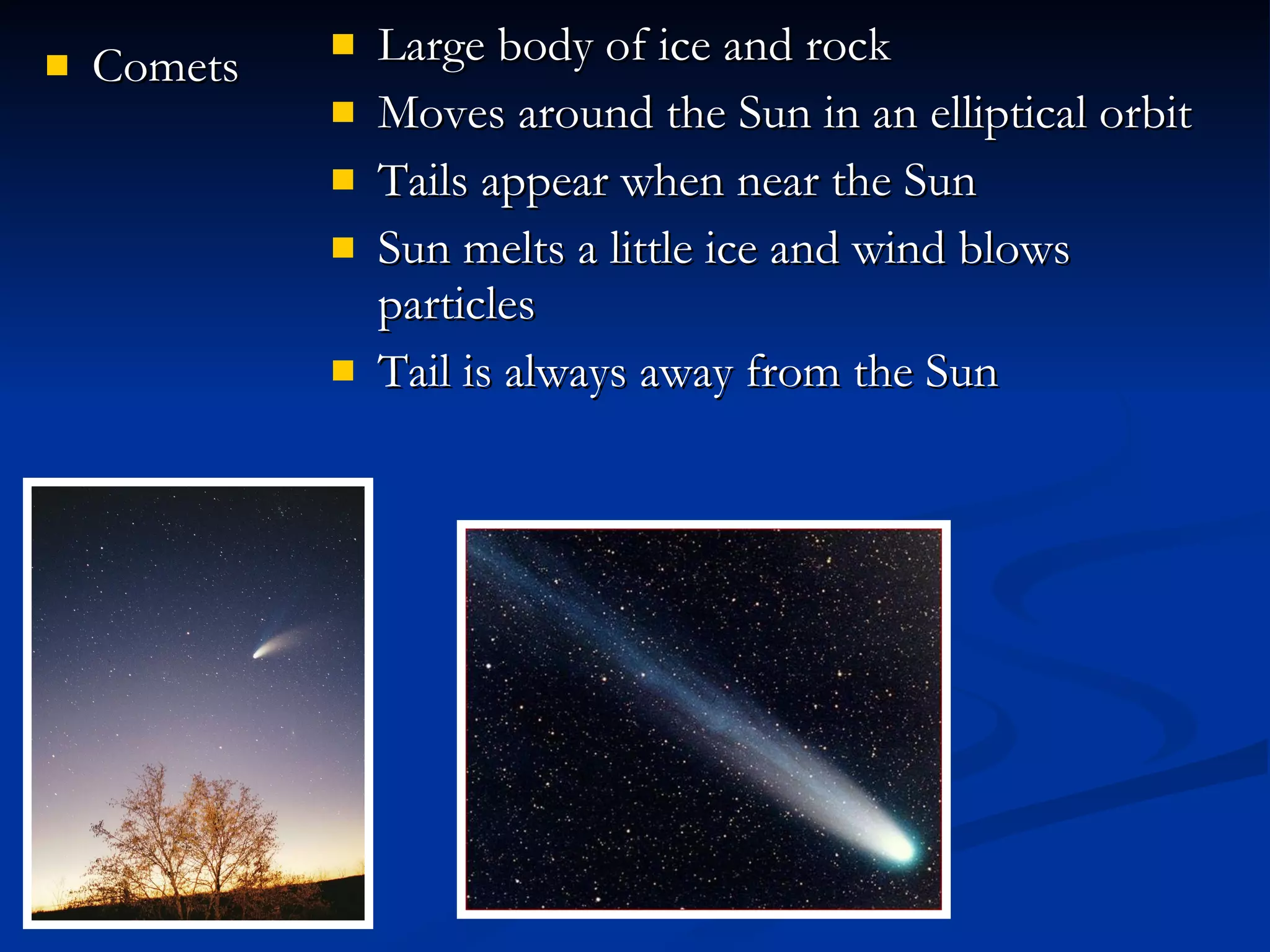
Comets Large body of ice and rock Moves around the Sun in an elliptical orbit Tails appear when near the Sun  Sun melts a little ice and wind blows particles Tail is always away from the Sun
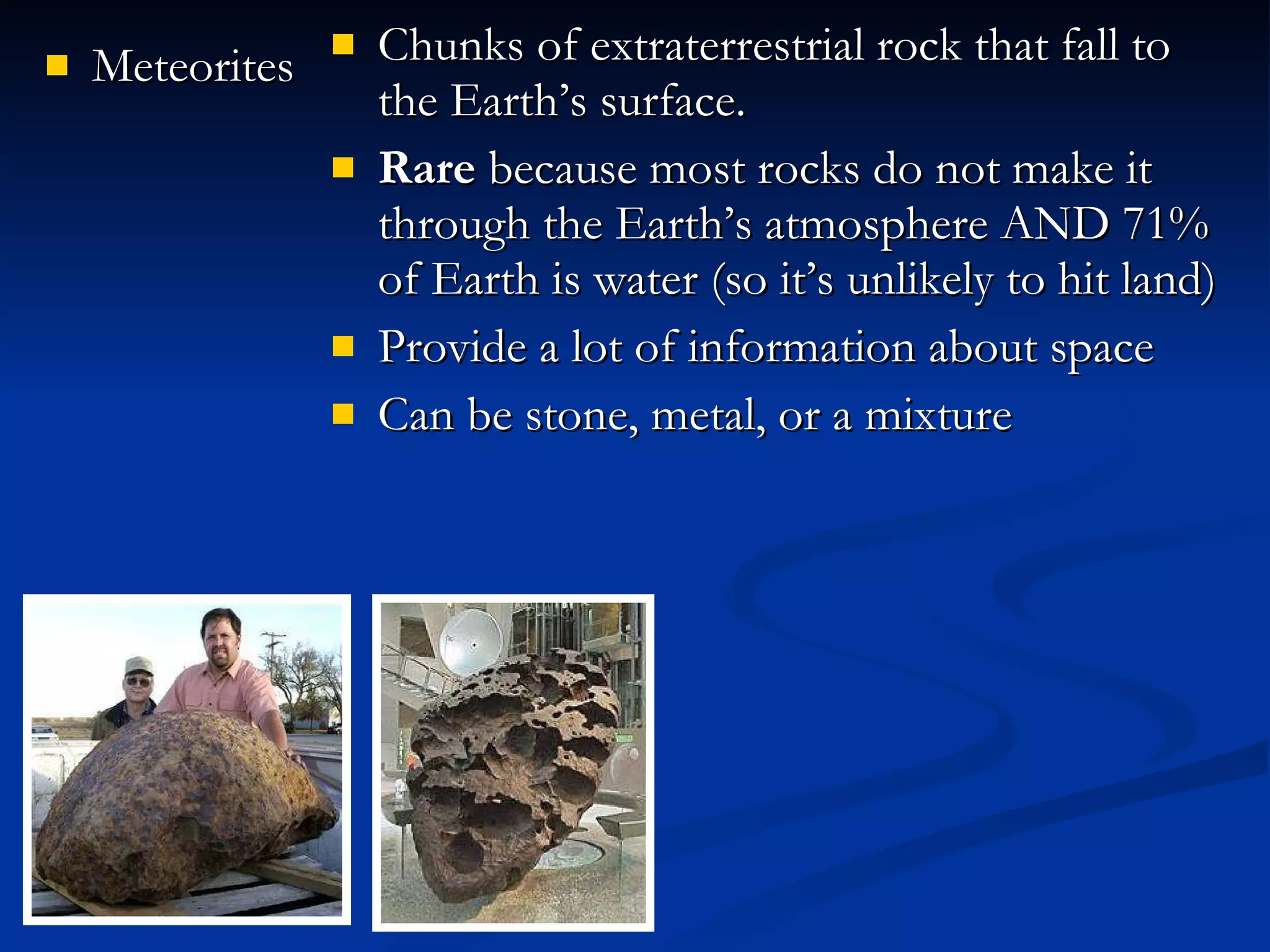
Meteorites Chunks of extraterrestrial rock that fall to the Earth’s surface. Rare  because most rocks do not make it through the Earth’s atmosphere AND 71% of Earth is water (so it’s unlikely to hit land) Provide a lot of information about space Can be stone, metal, or a mixture
Stars & Galaxies Chapter 2, Section 3
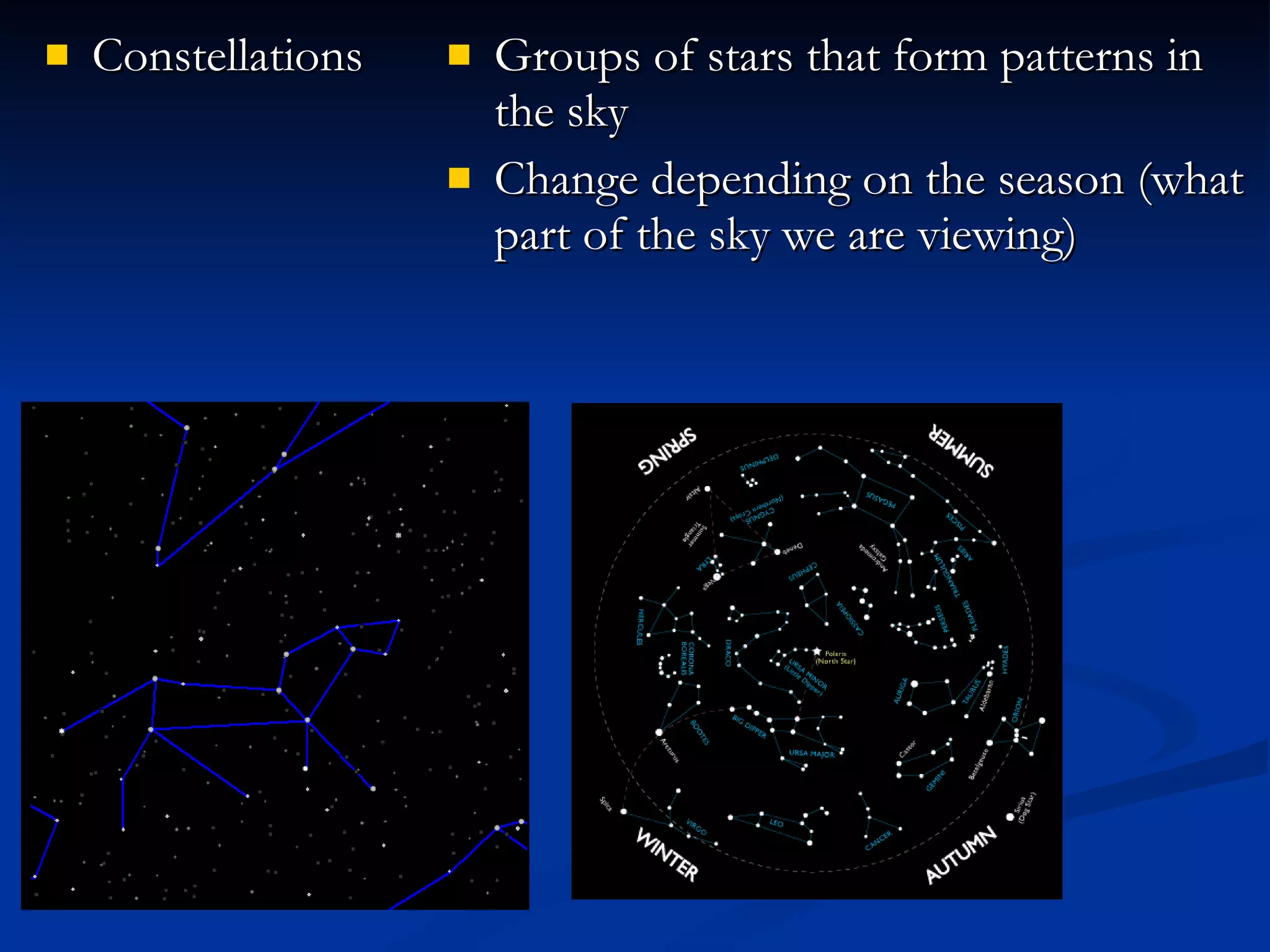
Constellations Groups of stars that form patterns in the sky Change depending on the season (what part of the sky we are viewing)
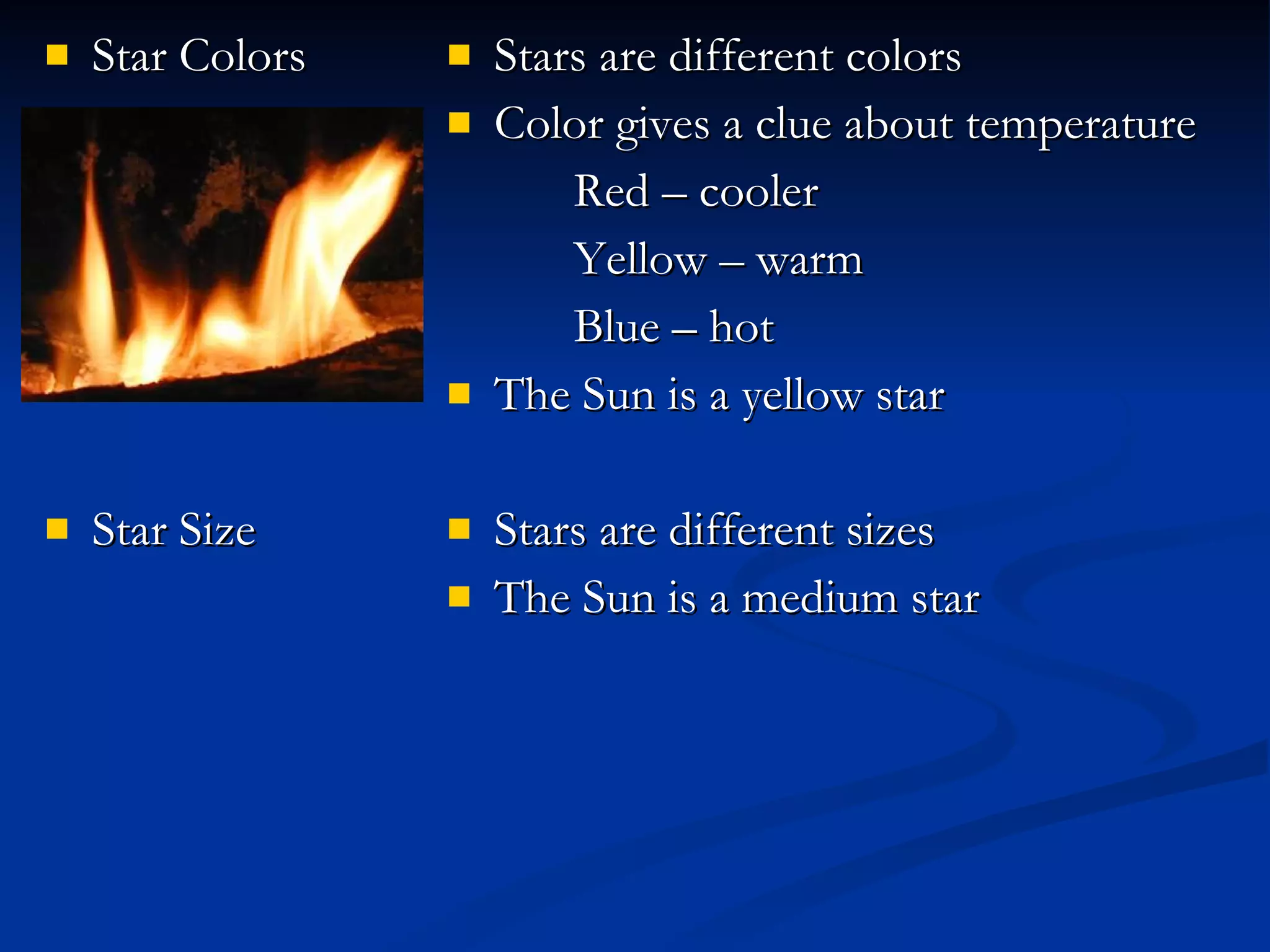
Star Colors Star Size Stars are different colors Color gives a clue about temperature Red – cooler Yellow – warm Blue – hot The Sun is a yellow star Stars are different sizes The Sun is a medium star
Brightness Apparent Magnitude Stars have different brightnesses How bright a star appears from Earth The star’s distance from Earth affects this (flashlight near or far)
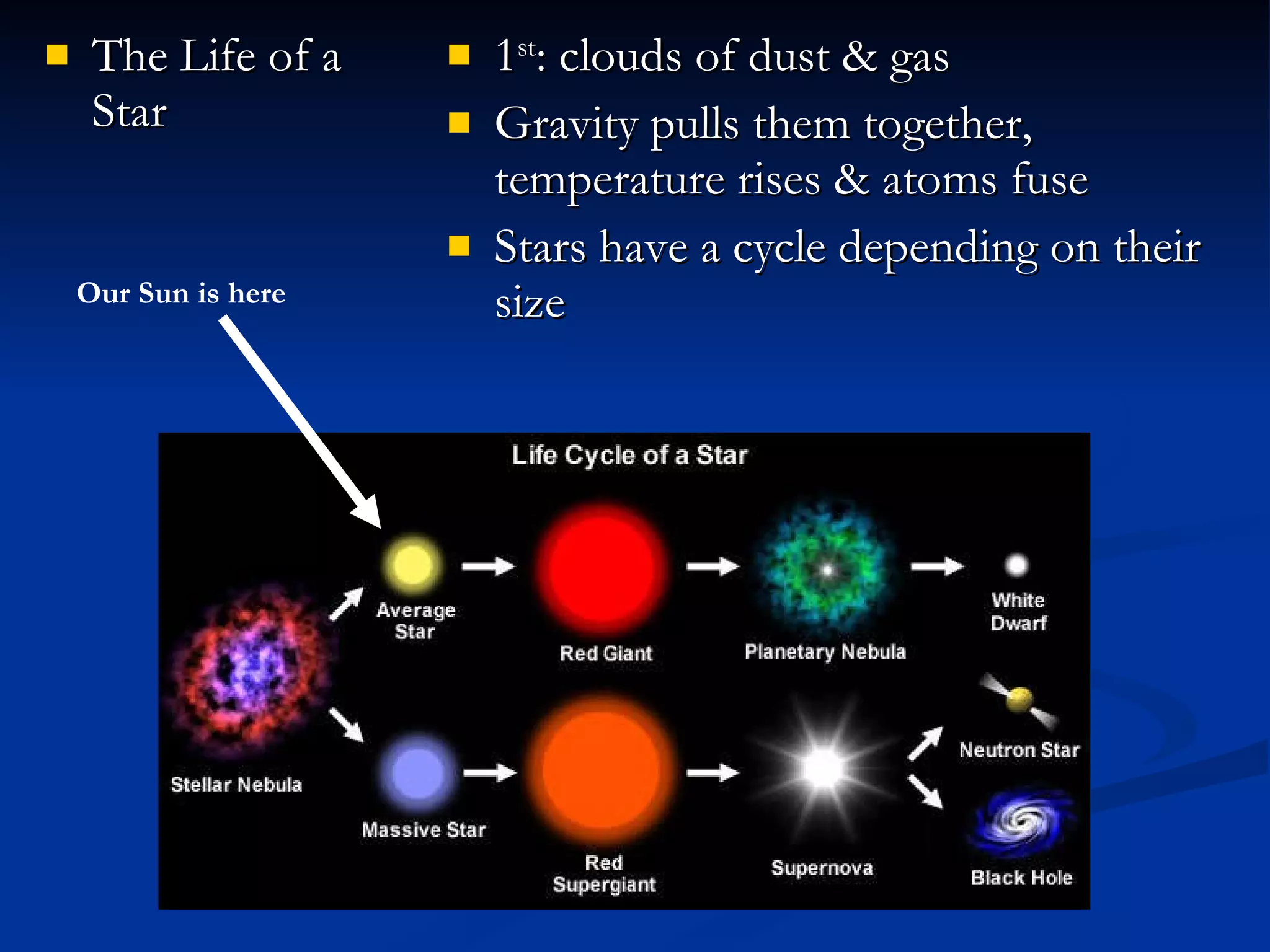
The Life of a Star 1 st : clouds of dust & gas Gravity pulls them together, temperature rises & atoms fuse Stars have a cycle depending on their size Our Sun is here
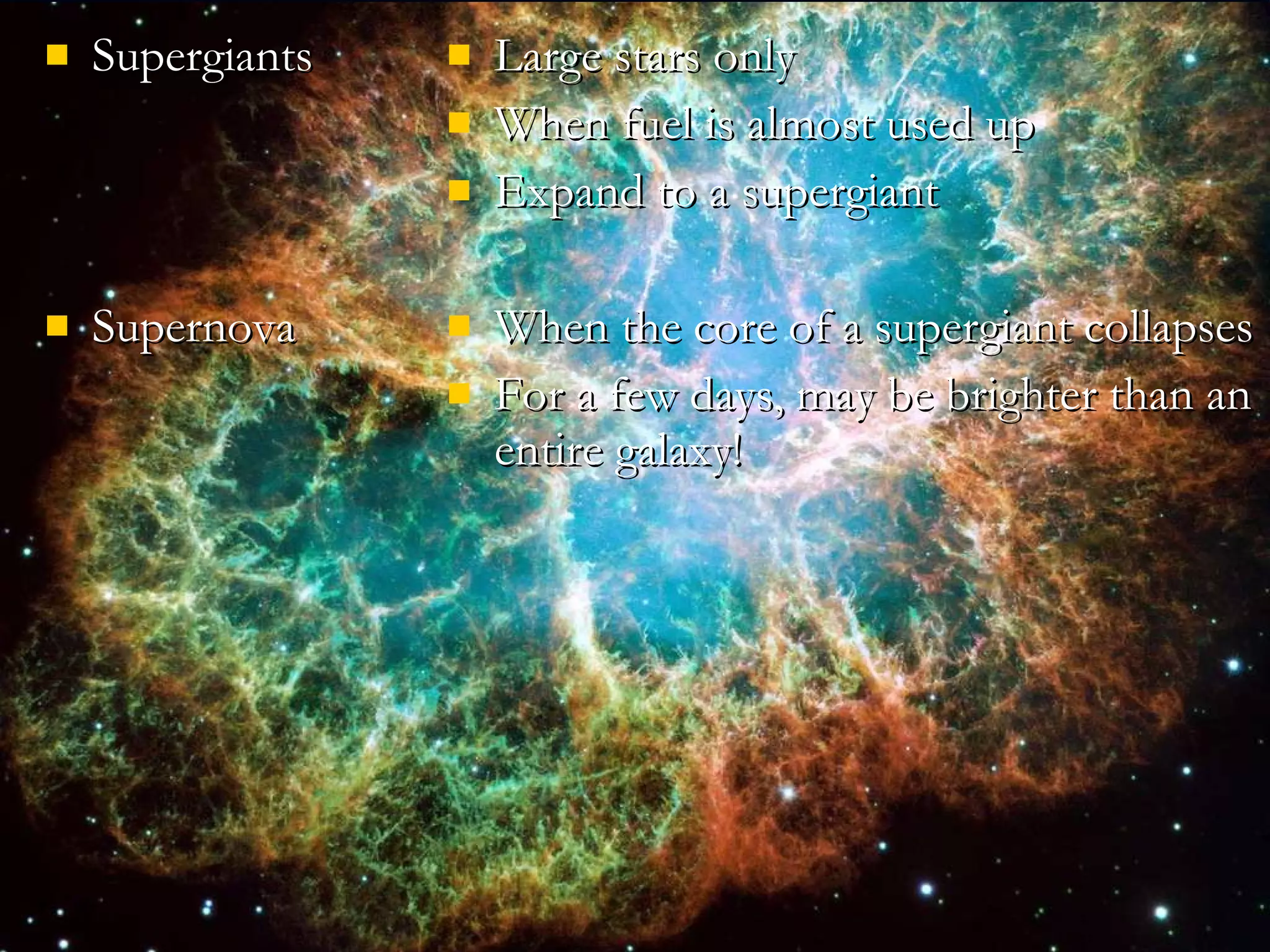
Supergiants Supernova Large stars only When fuel is almost used up Expand to a supergiant When the core of a supergiant collapses For a few days, may be brighter than an entire galaxy!
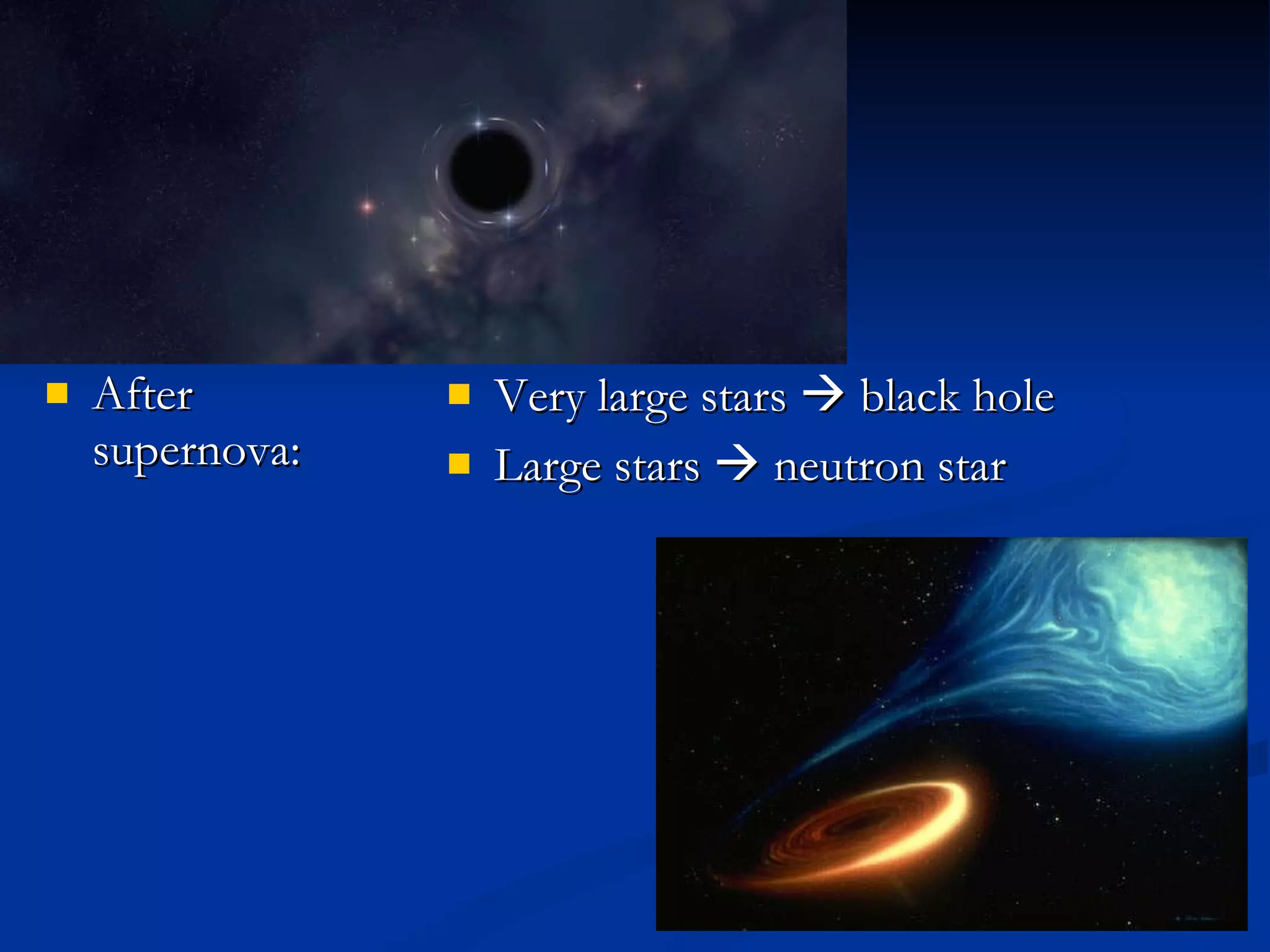
After supernova: Very large stars    black hole Large stars    neutron star
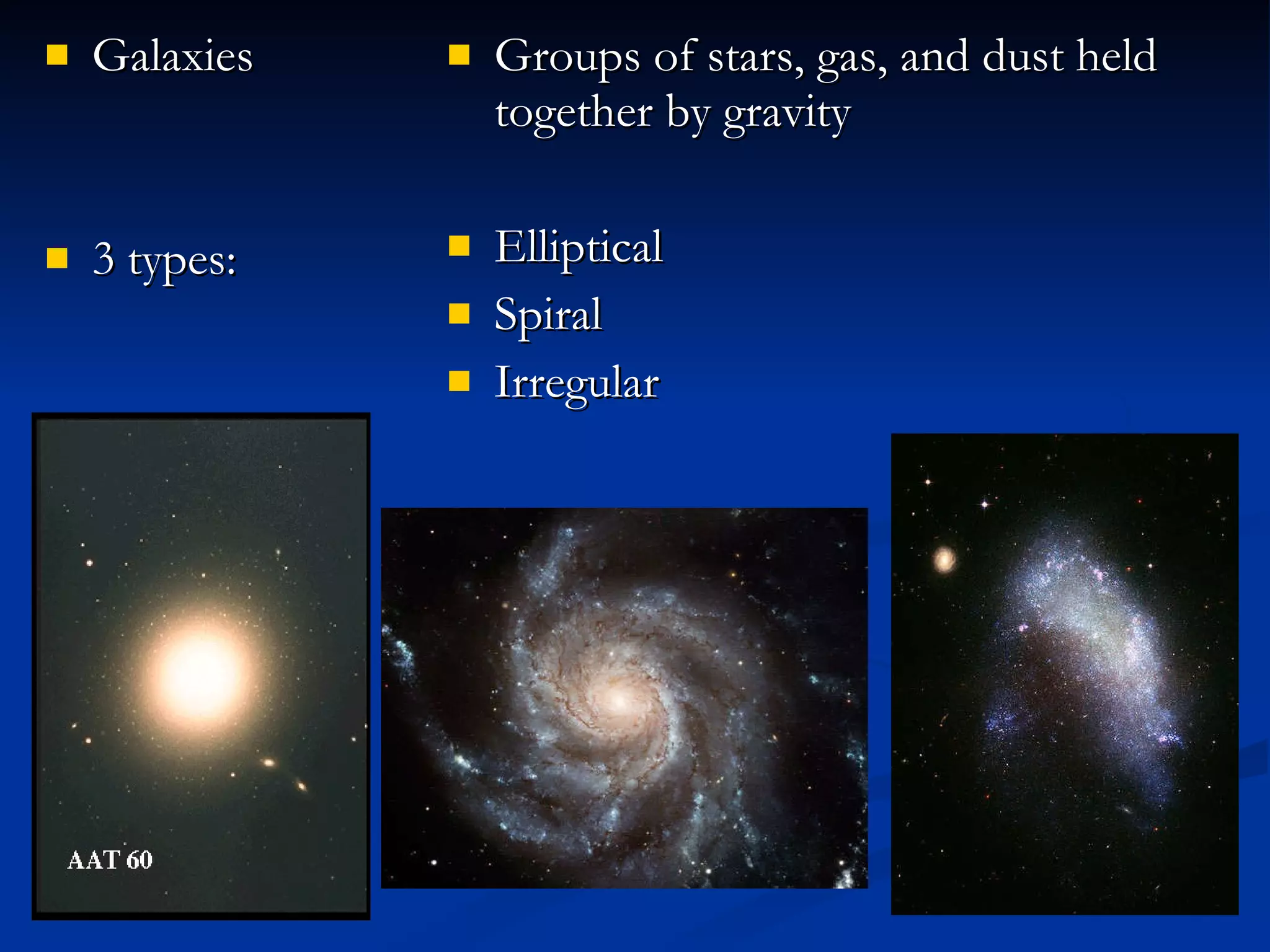
Galaxies 3 types: Groups of stars, gas, and dust held together by gravity Elliptical Spiral Irregular
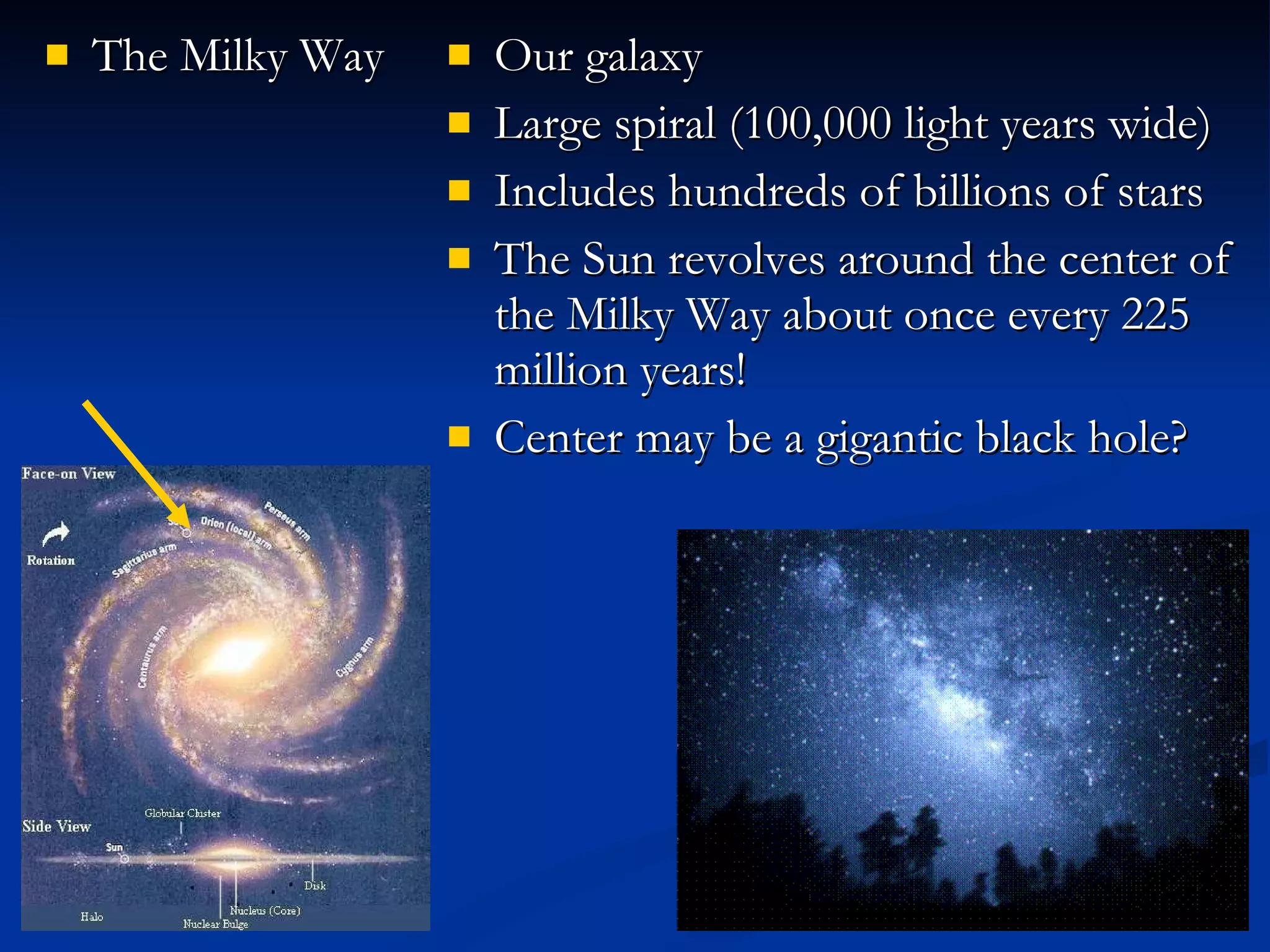
The Milky Way Our galaxy Large spiral (100,000 light years wide) Includes hundreds of billions of stars The Sun revolves around the center of the Milky Way about once every 225 million years! Center may be a gigantic black hole?
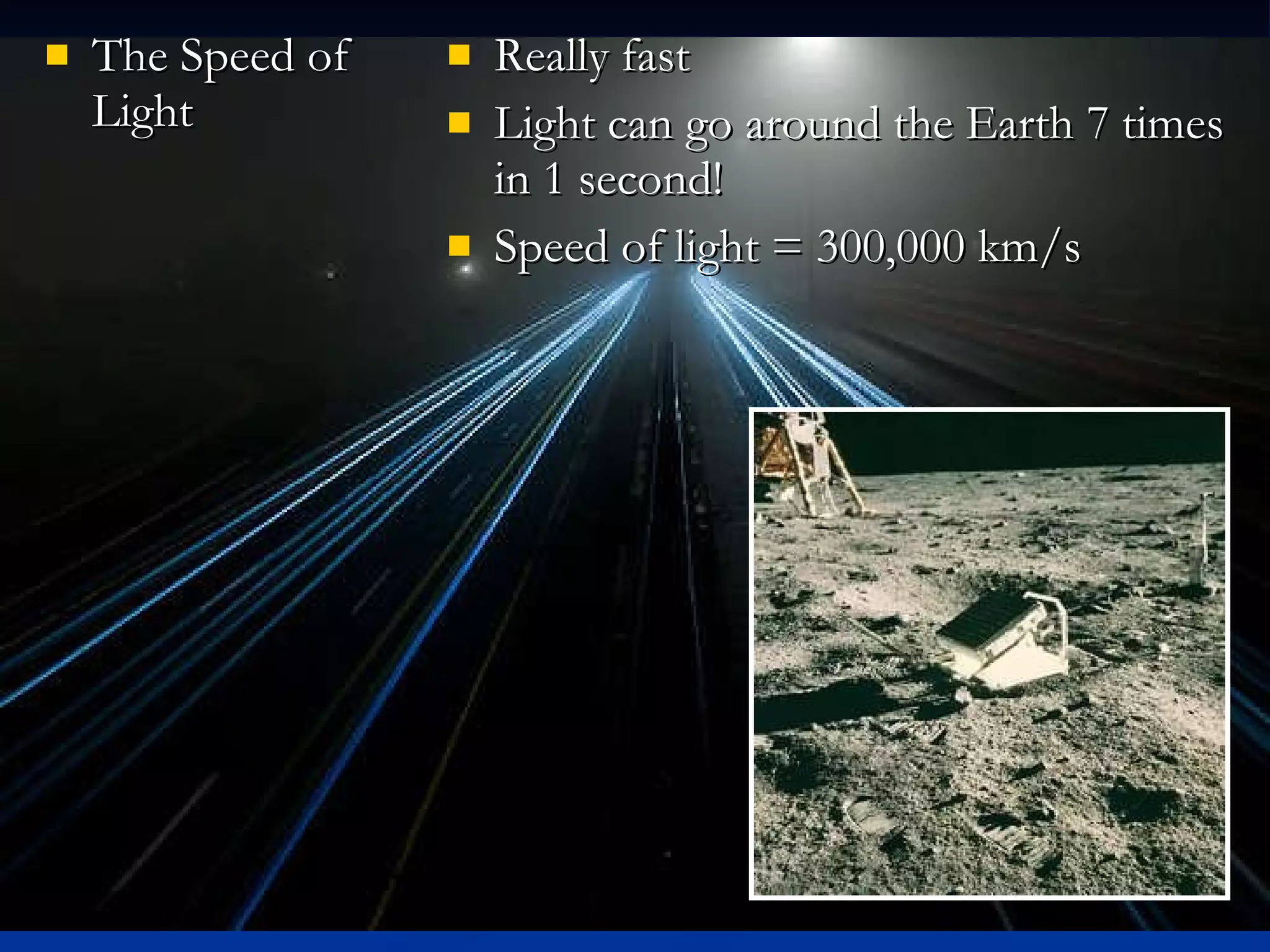
The Speed of Light Really fast Light can go around the Earth 7 times in 1 second! Speed of light = 300,000 km/s
Light Years Astronomical units are too small in the universe, so we use light years It is the distance light travels in one year About 9.5 trillion km! The Milky Way Galaxy is 100,000 ly away! For most galaxies, we are seeing them as they were millions of years ago because they are millions of light years away.
The Universe Each galaxy includes billions of stars.  Our universe may include as many as 100 billion galaxies! In ten days, the Hubble Telescope took pictures in a small area of sky.  It discovered 1500 galaxies! Scientists believe the universe is expanding (getting bigger) because some galaxies are moving away from our Solar System.

Chapter 2 Solar System

  • 1.
    Earth’s Place inSpace Chapter 2, section 1
  • 2.
    Rotation Revolution OrbitThe spinning of the Earth about its axis. Creates DAYS The movement of the Earth about the Sun. Creates YEARS The elliptical (oval) path the Earth makes around the Sun.
  • 3.
    Actually, the Earth’saxis is tilted. 23.5 degrees, to be exact.
  • 4.
    The tilted axismakes … … seasons When you are closest to the Sun, it is summer. When you are farthest from the Sun, it is winter. This is not because the Earth is all far away, it is because the Earth is tilted.
  • 5.
    Solar Eclipse Moonmoves between the sun and the Earth Can only be seen by a few (moon is small) Must be during a new moon
  • 6.
    Lunar Eclipse Earthmoves between the Sun and the Moon. Everyone can see a lunar eclipse
  • 7.
    The Solar SystemChapter 2, section 2
  • 8.
    Our solar systemPlanetary Orbits Includes 8 planets, our Sun, and many other objects that orbit the Sun Is held together by the Sun’s immense gravity The orbits of the planets are elliptical (like a slightly flattened circle).
  • 9.
    Measuring in OuterSpace Astronomical Units 1AU = 150 million km, which is the distance from the Earth to the Sun
  • 10.
  • 11.
    Inner Planets Groupof planets closest to the Sun Mercury, Venus, Earth, and Mars Mostly solid, with minerals similar to Earth
  • 12.
    Mercury Closest tothe Sun smallest planet Has many craters No atmosphere  extreme temperatures (425˚C to -170˚C) 88 days for 1 revolution
  • 13.
    Venus Second-closest tothe Sun Surrounded by thick clouds Clouds trap solar heat, so the temperature is always around 472˚C! 225 days for 1 revolution
  • 14.
    Earth Third planetfrom the Sun Has water; temperature allows for ice, water, and vapor. Atmosphere with ozone acts as a screen. Very Unique About 365 days for one revolution Has one moon
  • 15.
    Mars Has seasonsHas polar ice caps Maybe abundant water at one time? Looks red because of rust in rock. Has two small moons (Phobos, Deimos) 687 days for 1 revolution
  • 16.
    Asteroid Belt BetweenMars and Jupiter Pieces of rock Most likely the remains from collisions.
  • 17.
    Outer Planets Groupof planets farthest from the Sun Jupiter, Saturn, Uranus, Neptune Gas Giants
  • 18.
    Jupiter Fifth planetfrom the Sun LARGEST planet Rotates REALLY fast (only 10hr day) Great Red Spot: giant storm Has 63 moons (Ganymede is bigger than Mercury) 3 moons have icy water Faint ring of dust Nearly 12 years for 1 revolution
  • 19.
    Saturn Several broadrings made of ice and rock Has 61 moons Titan is the largest moon. It resembles Earth during primitive times. 24.5 years for 1 revolution
  • 20.
    Uranus The 7th planet Looks blue due to methane gas Axis is almost horizontal (sideways) 27 moons Coldest of the 8 planets
  • 21.
    Neptune The lastplanet Looks blue due to methane gas Has 13 moons Seasons/storms 1 revolution is 165 years!
  • 22.
    Comets Large bodyof ice and rock Moves around the Sun in an elliptical orbit Tails appear when near the Sun Sun melts a little ice and wind blows particles Tail is always away from the Sun
  • 23.
    Meteorites Chunks ofextraterrestrial rock that fall to the Earth’s surface. Rare because most rocks do not make it through the Earth’s atmosphere AND 71% of Earth is water (so it’s unlikely to hit land) Provide a lot of information about space Can be stone, metal, or a mixture
  • 24.
    Stars & GalaxiesChapter 2, Section 3
  • 25.
    Constellations Groups ofstars that form patterns in the sky Change depending on the season (what part of the sky we are viewing)
  • 26.
    Star Colors StarSize Stars are different colors Color gives a clue about temperature Red – cooler Yellow – warm Blue – hot The Sun is a yellow star Stars are different sizes The Sun is a medium star
  • 27.
    Brightness Apparent MagnitudeStars have different brightnesses How bright a star appears from Earth The star’s distance from Earth affects this (flashlight near or far)
  • 28.
    The Life ofa Star 1 st : clouds of dust & gas Gravity pulls them together, temperature rises & atoms fuse Stars have a cycle depending on their size Our Sun is here
  • 29.
    Supergiants Supernova Largestars only When fuel is almost used up Expand to a supergiant When the core of a supergiant collapses For a few days, may be brighter than an entire galaxy!
  • 30.
    After supernova: Verylarge stars  black hole Large stars  neutron star
  • 31.
    Galaxies 3 types:Groups of stars, gas, and dust held together by gravity Elliptical Spiral Irregular
  • 32.
    The Milky WayOur galaxy Large spiral (100,000 light years wide) Includes hundreds of billions of stars The Sun revolves around the center of the Milky Way about once every 225 million years! Center may be a gigantic black hole?
  • 33.
    The Speed ofLight Really fast Light can go around the Earth 7 times in 1 second! Speed of light = 300,000 km/s
  • 34.
    Light Years Astronomicalunits are too small in the universe, so we use light years It is the distance light travels in one year About 9.5 trillion km! The Milky Way Galaxy is 100,000 ly away! For most galaxies, we are seeing them as they were millions of years ago because they are millions of light years away.
  • 35.
    The Universe Eachgalaxy includes billions of stars. Our universe may include as many as 100 billion galaxies! In ten days, the Hubble Telescope took pictures in a small area of sky. It discovered 1500 galaxies! Scientists believe the universe is expanding (getting bigger) because some galaxies are moving away from our Solar System.