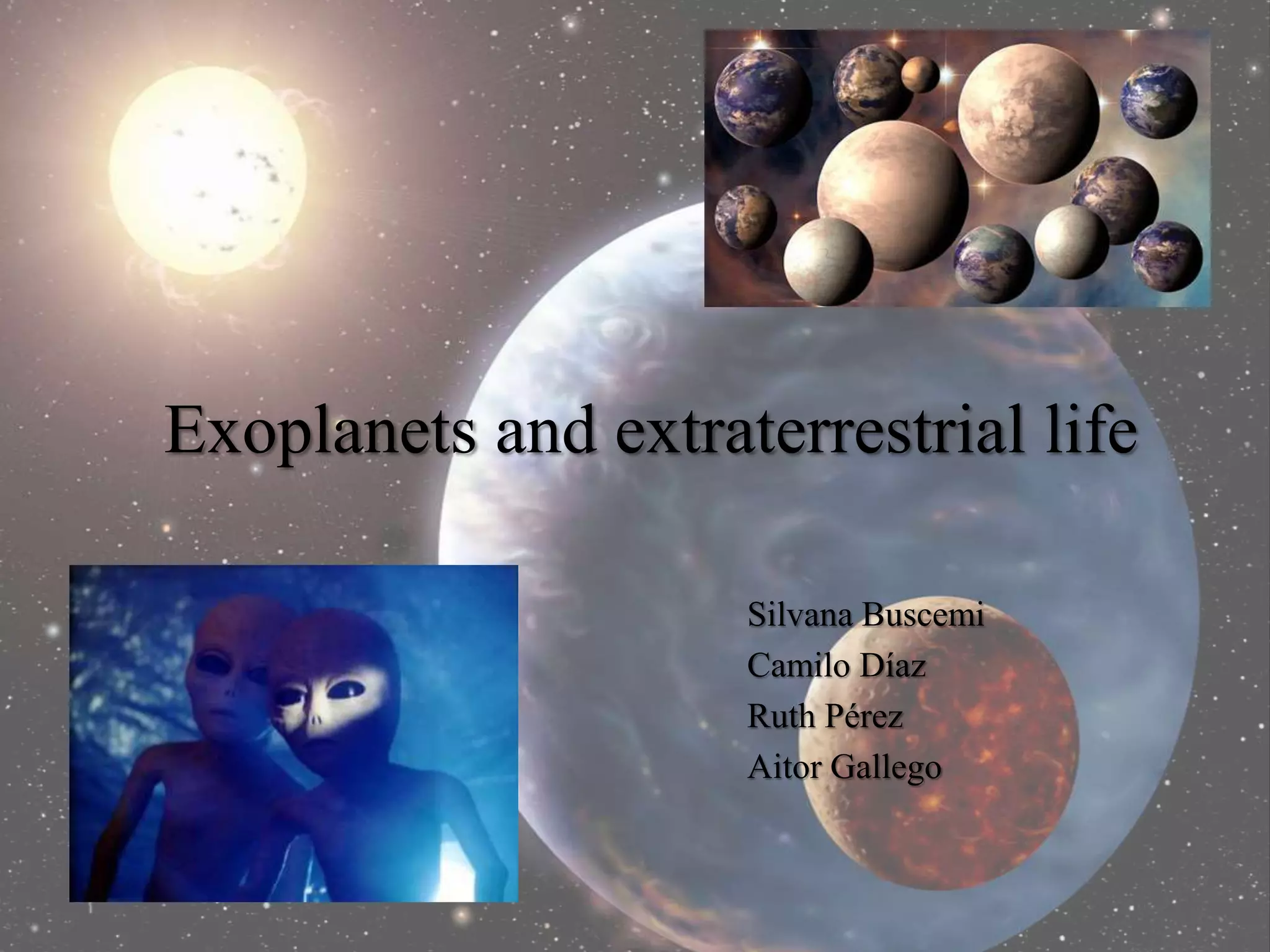
Exoplanets and extraterrestrial life 
Silvana Buscemi 
Camilo Díaz 
Ruth Pérez 
Aitor Gallego
EXOPLANETS 
• Exoplanet: planet that doesn’t orbit the sun, 
instead orbits a different star. 
• 1800 exoplanets have been discovered. 
• Nearest exoplanet to the Earth: Alpha Centauri 
Bb.
DETECTION METHODS 
Direct methods: 
1. Direct imaging: 
• It is extremely difficult, and in most cases impossible. 
• Being small and dim planets are easily lost in the brilliant glare 
of the giant stars they orbit. 
• It works best for planets that orbit at a great distance from 
their stars. 
Indirect methods: 
1. Transit method. 
• When a planet crosses in front of its star as viewed by an 
observer, the event is called a transit. 
• It can determine the radius of a planet. 
• Transits by terrestrial planets produce a small change in a 
star's brightness .
DETECTION METHODS 
2. Astrometry: 
• It involves precise measurements of the positions and 
movements of stars and other celestial bodies. 
• It provides information on the kinematics and physical 
origin of our Solar System and our galaxy, the Milky Way. 
3. Radial velocity: 
• It is based on the detection of variations in the velocity of 
the central star 
• When the star moves towards us, its spectrum is blue 
shifted, while it is red shifted when it moves away from 
us.
Habitable exoplanets 
• The circumstellar habitable zone 
• 12 confirmed habitable planets 
• Habitable exoplanets are ranked trough their size: terran, 
subterran and superterran. 
• They are also classified according to their temperature: 
hypopsychroplanet if they are below -50c, psychroplanet 0c/- 
50c, mesoplanet which is the ideal from 0 to 50c and 
thermoplanets which are very hot.
Gliese 667 Cc 
Gliese 667 cc is the most similar planet to earth that is 
scientifically proved to be a possible planet with live as 
we know it. 
• This planet has about 4 and a half times the mass of 
the earth. 
• It orbits around the star Gliese 667 C which is a 
member of the Gliese 667 triple star system. 
• The star Gliese 667 C hosts at least 7 planets and 3 of 
those, all rocky planets , are within the habitable zone. 
• It is a bit warmer than the earth but complex life could 
exist at that temperature.
HISTORY OF DETECTION 
• Early speculations. 
• Confirmed discoveries. 
• Unconfirmed Kepler 
Candidates.(candidate planets) 
• Total planets.
EARLY ESPECULATIONS 
• Guiordano Bruno. (16th century) 
• Isaac newton. (18th century) 
• Otto struve. (20th century)
CONFIRMED DISCOVERIES 
• First published by Bruce Campbell, G.H.A 
Walker and Stephenson Yang in 1988. (Gamma 
Cephei)
CONFIRMED DISCOVERIES 
• First definitive detection of an exoplanet orbiting 
51 Pegasi star by Michel Mayor and Didier 
Queloz. (1995)
UNCONFIRMED KEPLER 
CANDIDATES 
• Alpha Centuri Bb planet in 17 October 2012.
What is the SETI? When and how did 
this idea began? 
• It is the science used to search 
the skies for signals from alien 
civilizations. 
• The idea of SETI began in 1959. 
• Giuseppe Cocconi and Philip 
Morrison published a paper 
discussing the possibility of the 
existence of alien civilizations. 
• Method of detection: Radio 
waves. Why? because they are 
capable of traveling the vast 
distances between stars 
• First search: Project Ozma in 
1960.
PROJECT OZMA 
• It started in 1960, by a young 
astronomer named Frank 
Drake. 
• It was the humanity's first 
attempt to detect interstellar 
radio transmissions. 
• Stars chosen for the project: 
• - Tau Ceti in the Constellation 
Cetus (the Whale) 
• -Epsilon Eridani in the 
Constellation Eridanus (the 
River).
PROJECT PHOENIX 
• It was the most ambitious 
search for extraterrestrial 
intelligence ever undertaken. 
• From February 1995 to 
March 2004. 
• Project Phoenix observed 
about 800 stars. 
• Where did the project take 
place? 
-Australia 
-West Virginia 
-Puerto Rico. 
• No ET signals were detected.
FERMI PARADOX 
• It is the apparent contradiction between high estimates 
of the probability of the existence of extraterrestrial 
civilization and humanity's lack contact with. 
Arguments: 
• The Sun is a typical star, and relatively young. 
• some of these stars will have Earth-like planets, some of 
these planets may develop intelligent life. 
• Some of these civilizations may develop interstellar 
travel. 
• The galaxy can be completely colonized in a few tens of 
millions of years. 
• Hence Fermi's question, "Where is everybody?"
QUIZ for the audience. 
Rules: 
• First of all the class is divided into the groups 
assigned for the PPTs. 
• In each group there will be a speaker and 
questions will be asked randomly between 
the speakers of each group so be prepared!! 
• Mr. Cuesta can of course ask questions to 
any of you even if you are not speakers if you 
are not paying attention.
QUIZ. 
• 1 What is the SETI? 
• 2 Can you explain how it works any of the 
detection methods we explained? 
• 3 What is the circumstellar habitable zone? 
• 4 So according with our explanations is Gliese 667 
Cc a terran, subterran or superterran planet?
QUIZ 
• 5 Did project Ozma or project Phoenix proved 
something about extraterrestrial life? 
• 6 When was the first exoplanet discovered? 
• 7 How many stars did project phoenix observed? 
• 8 Do you think it could be anybody out there 
after this PPT?

Exoplanets and extraterrestial life

  • 1.
    Exoplanets and extraterrestriallife Silvana Buscemi Camilo Díaz Ruth Pérez Aitor Gallego
  • 2.
    EXOPLANETS • Exoplanet:planet that doesn’t orbit the sun, instead orbits a different star. • 1800 exoplanets have been discovered. • Nearest exoplanet to the Earth: Alpha Centauri Bb.
  • 3.
    DETECTION METHODS Directmethods: 1. Direct imaging: • It is extremely difficult, and in most cases impossible. • Being small and dim planets are easily lost in the brilliant glare of the giant stars they orbit. • It works best for planets that orbit at a great distance from their stars. Indirect methods: 1. Transit method. • When a planet crosses in front of its star as viewed by an observer, the event is called a transit. • It can determine the radius of a planet. • Transits by terrestrial planets produce a small change in a star's brightness .
  • 5.
    DETECTION METHODS 2.Astrometry: • It involves precise measurements of the positions and movements of stars and other celestial bodies. • It provides information on the kinematics and physical origin of our Solar System and our galaxy, the Milky Way. 3. Radial velocity: • It is based on the detection of variations in the velocity of the central star • When the star moves towards us, its spectrum is blue shifted, while it is red shifted when it moves away from us.
  • 6.
    Habitable exoplanets •The circumstellar habitable zone • 12 confirmed habitable planets • Habitable exoplanets are ranked trough their size: terran, subterran and superterran. • They are also classified according to their temperature: hypopsychroplanet if they are below -50c, psychroplanet 0c/- 50c, mesoplanet which is the ideal from 0 to 50c and thermoplanets which are very hot.
  • 7.
    Gliese 667 Cc Gliese 667 cc is the most similar planet to earth that is scientifically proved to be a possible planet with live as we know it. • This planet has about 4 and a half times the mass of the earth. • It orbits around the star Gliese 667 C which is a member of the Gliese 667 triple star system. • The star Gliese 667 C hosts at least 7 planets and 3 of those, all rocky planets , are within the habitable zone. • It is a bit warmer than the earth but complex life could exist at that temperature.
  • 9.
    HISTORY OF DETECTION • Early speculations. • Confirmed discoveries. • Unconfirmed Kepler Candidates.(candidate planets) • Total planets.
  • 10.
    EARLY ESPECULATIONS •Guiordano Bruno. (16th century) • Isaac newton. (18th century) • Otto struve. (20th century)
  • 11.
    CONFIRMED DISCOVERIES •First published by Bruce Campbell, G.H.A Walker and Stephenson Yang in 1988. (Gamma Cephei)
  • 12.
    CONFIRMED DISCOVERIES •First definitive detection of an exoplanet orbiting 51 Pegasi star by Michel Mayor and Didier Queloz. (1995)
  • 13.
    UNCONFIRMED KEPLER CANDIDATES • Alpha Centuri Bb planet in 17 October 2012.
  • 14.
    What is theSETI? When and how did this idea began? • It is the science used to search the skies for signals from alien civilizations. • The idea of SETI began in 1959. • Giuseppe Cocconi and Philip Morrison published a paper discussing the possibility of the existence of alien civilizations. • Method of detection: Radio waves. Why? because they are capable of traveling the vast distances between stars • First search: Project Ozma in 1960.
  • 15.
    PROJECT OZMA •It started in 1960, by a young astronomer named Frank Drake. • It was the humanity's first attempt to detect interstellar radio transmissions. • Stars chosen for the project: • - Tau Ceti in the Constellation Cetus (the Whale) • -Epsilon Eridani in the Constellation Eridanus (the River).
  • 16.
    PROJECT PHOENIX •It was the most ambitious search for extraterrestrial intelligence ever undertaken. • From February 1995 to March 2004. • Project Phoenix observed about 800 stars. • Where did the project take place? -Australia -West Virginia -Puerto Rico. • No ET signals were detected.
  • 17.
    FERMI PARADOX •It is the apparent contradiction between high estimates of the probability of the existence of extraterrestrial civilization and humanity's lack contact with. Arguments: • The Sun is a typical star, and relatively young. • some of these stars will have Earth-like planets, some of these planets may develop intelligent life. • Some of these civilizations may develop interstellar travel. • The galaxy can be completely colonized in a few tens of millions of years. • Hence Fermi's question, "Where is everybody?"
  • 18.
    QUIZ for theaudience. Rules: • First of all the class is divided into the groups assigned for the PPTs. • In each group there will be a speaker and questions will be asked randomly between the speakers of each group so be prepared!! • Mr. Cuesta can of course ask questions to any of you even if you are not speakers if you are not paying attention.
  • 19.
    QUIZ. • 1What is the SETI? • 2 Can you explain how it works any of the detection methods we explained? • 3 What is the circumstellar habitable zone? • 4 So according with our explanations is Gliese 667 Cc a terran, subterran or superterran planet?
  • 20.
    QUIZ • 5Did project Ozma or project Phoenix proved something about extraterrestrial life? • 6 When was the first exoplanet discovered? • 7 How many stars did project phoenix observed? • 8 Do you think it could be anybody out there after this PPT?