HPLC DETECTORS
BY:-VARUN GIRME
 PAD:-DIODE ARRAY DETECTOR
OR DAD OR HPLC PAD
DETECTOR.
 ELSD:-EVAPORATIVE LIGHT
SCATTERING DETECTOR.
PAD:-DIODE ARRAY
DETECTOR OR DAD OR
HPLC PAD DETECTOR.
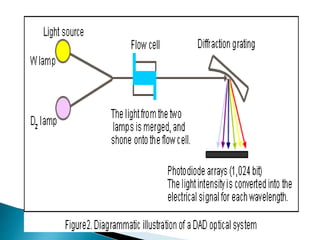
 Diode array detector also referred to as a DAD detector
or more specifically HPLC PAD detector.
 PAD are used for obtaining spectral profiles from
molecular mixtures or chromatographically separated
samples.
 Whether used to analyze molecules in a flow cell, static
solution or solids they provide ultra-fast low noise
spectral analysis.
 Resolution determined by the number of diodes
deployed over a specific wavelength range.
 An HPLC photo diode array detector is coupled to elute
of separation devices by molecular weight,
hydrophobicity or ionic charge.
 Certain HPLC PAD detectors handle the entire spectrum
from the uv at 190nm to the near 1R at 1micron.
 Other are specifically targeted to the uv visual or near
1R which up to 2048 elements provided for ultimate
flexibility in resolution and multiplexing.
 These mechanics provide high sampling speed of up to
190Hz and provide thermoelectric temp. control of
sensor to limit noise.
ELSD:-EVAPORATIVE LIGHT
SCATTERING DETECTOR.
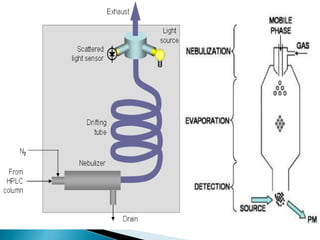
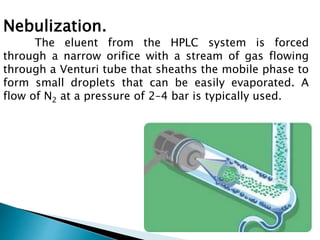
Nebulization.
The eluent from the HPLC system is forced
through a narrow orifice with a stream of gas flowing
through a Venturi tube that sheaths the mobile phase to
form small droplets that can be easily evaporated. A
flow of N2 at a pressure of 2–4 bar is typically used.
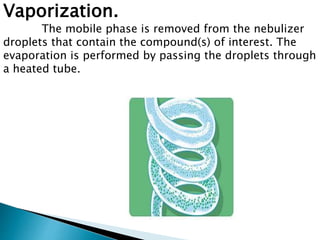
Vaporization.
The mobile phase is removed from the nebulizer
droplets that contain the compound(s) of interest. The
evaporation is performed by passing the droplets through
a heated tube.
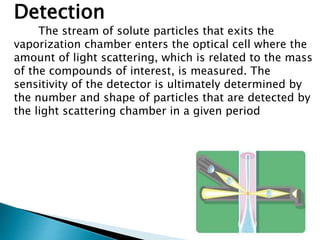
Detection
The stream of solute particles that exits the
vaporization chamber enters the optical cell where the
amount of light scattering, which is related to the mass
of the compounds of interest, is measured. The
sensitivity of the detector is ultimately determined by
the number and shape of particles that are detected by
the light scattering chamber in a given period
 APPLICATION:-
 Extremely small footprint to maximize availability
bench space.
 Wide gradient compatibility, no limitation on choice of
solvent.
 High sensitivity extremely low limits of detection.
 Wide application range to cover very low to high
molecular weight compounds.
 Low dispersion minimum peak broadening for
maximum resolution.
 Rapid equilibrium fast set-up and high productivity.
 Advanced easy to use instrument controls with built-
in-safety.
 THANK YOU

HPLC Detectors

  • 1.
  • 2.
     PAD:-DIODE ARRAYDETECTOR OR DAD OR HPLC PAD DETECTOR.  ELSD:-EVAPORATIVE LIGHT SCATTERING DETECTOR.
  • 3.
    PAD:-DIODE ARRAY DETECTOR ORDAD OR HPLC PAD DETECTOR.
  • 5.
     Diode arraydetector also referred to as a DAD detector or more specifically HPLC PAD detector.  PAD are used for obtaining spectral profiles from molecular mixtures or chromatographically separated samples.  Whether used to analyze molecules in a flow cell, static solution or solids they provide ultra-fast low noise spectral analysis.  Resolution determined by the number of diodes deployed over a specific wavelength range.  An HPLC photo diode array detector is coupled to elute of separation devices by molecular weight, hydrophobicity or ionic charge.
  • 6.
     Certain HPLCPAD detectors handle the entire spectrum from the uv at 190nm to the near 1R at 1micron.  Other are specifically targeted to the uv visual or near 1R which up to 2048 elements provided for ultimate flexibility in resolution and multiplexing.  These mechanics provide high sampling speed of up to 190Hz and provide thermoelectric temp. control of sensor to limit noise.
  • 7.
  • 9.
    Nebulization. The eluent fromthe HPLC system is forced through a narrow orifice with a stream of gas flowing through a Venturi tube that sheaths the mobile phase to form small droplets that can be easily evaporated. A flow of N2 at a pressure of 2–4 bar is typically used.
  • 10.
    Vaporization. The mobile phaseis removed from the nebulizer droplets that contain the compound(s) of interest. The evaporation is performed by passing the droplets through a heated tube.
  • 11.
    Detection The stream ofsolute particles that exits the vaporization chamber enters the optical cell where the amount of light scattering, which is related to the mass of the compounds of interest, is measured. The sensitivity of the detector is ultimately determined by the number and shape of particles that are detected by the light scattering chamber in a given period
  • 12.
     APPLICATION:-  Extremelysmall footprint to maximize availability bench space.  Wide gradient compatibility, no limitation on choice of solvent.  High sensitivity extremely low limits of detection.  Wide application range to cover very low to high molecular weight compounds.  Low dispersion minimum peak broadening for maximum resolution.  Rapid equilibrium fast set-up and high productivity.  Advanced easy to use instrument controls with built- in-safety.
  • 13.