MTT ASSAY
INTRODUCTION
2
MTT
• 3-(4,5-diMethyThiazol- 2-yl)-2,5- diphenyl
Tetrazolium bromide
3
Dimethyl thiazolyl Diphenyl tetrazole
• MTT, a yellow tetrazole is reduced
to purpleformazan in living cells.
• A solubilization solution
• dimethyl sulfoxide
• an acidified ethanol solution
• Isopropanol
• detergent sodium dodecyl sulfate in
diluted hydrochloric acid) is added to dissolve the
insoluble purple formazan product into a colored
solution.
4
PRINCIPLE
5
PRINCIPLE
• The MTT assay is a colorimetric assay for
assessing cell metabolic activity.
• NAD(P)H-dependent cellular oxido reductase
enzymes may, under defined conditions,
reflect the number of viable cells present.
• These enzymes are capable of reducing the
tetrazolium dye MTT 3-(4,5-dimethylthiazol-2-
yl)-2,5-diphenyltetrazolium bromide to its
insoluble formazan, which has a purple color.
6
MTT ASSAY:Principle:
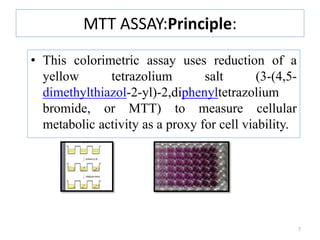
• This colorimetric assay uses reduction of a
yellow tetrazolium salt (3-(4,5-
dimethylthiazol-2-yl)-2,diphenyltetrazolium
bromide, or MTT) to measure cellular
metabolic activity as a proxy for cell viability.
7
MTT assays are usually done in the dark since
the MTT reagent is sensitive to light.
8
Principle
• Viable cells contain NAD(P)H-dependent
oxidoreductase enzymes which reduce the
MTT reagent to formazan, an insoluble
crystalline product with a deep purple color.
• Formazan crystals are then dissolved using a
solubilizing solution ( organic solvent s-eg.
Isopropanol/DMSO) and absorbance is
measured at 500-600 nanometers using a plate-
reader.
9
• The darker the solution, the greater the
number of viable, metabolically active
cells
• The absorbance of this colored solution
can be quantified by measuring at a
certain wavelength (usually between 500
and 600 nm) by a spectrophotometer.
• The degree of light absorption depends
on the solvent.
10
Other than MTT XTT
• XTT (2,3-bis-(2-methoxy-4-nitro-5-
sulfophenyl)-2H-tetrazolium-5-
carboxanilide) has been proposed to
replace MTT, yielding higher
sensitivity and a higher dynamic
range. The formed formazan dye is
water-soluble, avoiding a final
solubilization step
11
MTS
• MTS (3-(4,5-dimethylthiazol-2-yl)-5-(3-
carboxymethoxyphenyl)-2-(4-sulfophenyl)-2H-
tetrazolium), in the presence of phenazine
methosulfate (PMS), produces a formazan
product that has an absorbance maximum at
490 nm in phosphate-buffered saline. The
MTS assay is often described as a 'one-step'
MTT assay.
12
WST
• WST-1 and in particular WST-8 (2-(2-methoxy-4-
nitrophenyl)-3-(4-nitrophenyl)-5-(2,4-
disulfophenyl)-2H-tetrazolium), are advantageous
over MTT in that they are reduced outside cells,
combined with PMS electron mediator, and yield
a water-soluble formazan. Finally, WST assays (1)
can be read directly (unlike MTT that needs a
solubilization step), (2) give a more effective
signal than MTT, and (3) decrease toxicity to cells
(unlike cell-permeable MTT, and its insoluble
formazan that accumulate inside cells)
13
Tetrazolium dye assays can also be
used to measure
• Cytotoxicity (loss of viable cells)
• Cytostatic activity (shift from
proliferation to quiescence [ it is a state
of quietness or inactivity) of potential
medicinal agents
• Cytostatic activity of toxic materials.
• Number of viable cells present
14
CELL VIABILITY ASSAY
Features of viable cell
They are based on various cell functions such as
– enzyme activity,
– cell membrane permeability,.
- cell adherence,
– ATP production,
– co-enzyme production,
– nucleotide uptake activity
16
Used to measure a
markers that indicate the number of
– dead cells (cytotoxicity assay),
– the number of live cells(viability
assay),
• the total number of cells or
• the mechanism of cell death (e.g.,
apoptosis).
17
Application of viability assay
• To detect cytotoxic or growth inhibitory
lymphokines
• To detect mammalian cell survival and
proliferations
• To diagnose disease
• To diagnose male infertility
• To screen drugs
18
PROCEDURE
19
20
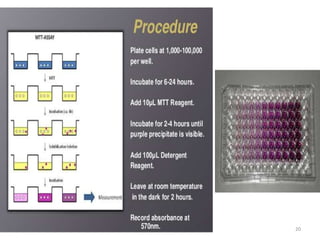
MTT ASSAY PROTOCOL:
Trypsinization or scrapping the cells
Resuspend or splitting cells at 96 well plate
Check the cell confluency (if 90%-100% of the cell
then it is ready for using)
100~ 200 µl of desired drugs or compound in
each well (usually 1 compound /drugs should
have triplicates)
 Incubate the cells (12~24 hours)
Dissolve 1mg MTT in 1ml PBS solution then the
molar concentration will be 2.41m M
21
In each well add 20 µl MTT reagent and rest 160
µl culture media and incubate it for 3~4 hours
 check the cells to see the purple precipitation
and the purple color is clearly visible then discard
the media carefully as it does not drain the cells.
after discarding media add 100 µl DMSO/
isopropanol
cover it with aluminum foil and mildly shake it for
10 ~15 minutes
 Read plate in fluorescent Reader – measure OD
in 570nm (background wavelength is 630nm).
22
MASS = CONCENTRATION X VOLUME X MOLECULAR WEIGHT
Interpreting results
• The absorbance reading of the blank must be
subtracted from all samples.
• Absorbance readings from test samples must
then be divided by those of the control and
multiplied by 100 to give percentage cell viability
or proliferation (see formula below).
• Absorbance values greater than the control
indicate cell proliferation, while lower values
suggest cell death or inhibition of proliferation.
23
% Viable cells = abs (sam)- abs (blank)
abs (control) – abs (blank)
TROUBLE SHOOTING:REAGENTS:
• MTT is light-sensitive, and should be kept in the dark as much as
possible. It is always a good idea to cover MTT bottles with foil.
• Make sure you do not contaminate your MTT stock. If it is green
or blue (it should be yellow), you can assume it has either been
contaminated by cells or bacteria, or exposed to light. If properly
looked after and stored at 4°C, your MTT stock can last up to 18
months.
• Always handle MTT using the appropriate personal protection
equipment, as it is can cause skin and eye irritation.
• To dissolve formazan crystals, you can use DMSO, acidified
isopropanol, or SDS. Test to find out which works best for your
experiment.
24
Absorbance values
• Your absorbance readings should fall between 0.75 and 1.25. If your
readings are too low, try increasing the number of cells plated or the
incubation time, and make sure your cell culture conditions are
appropriate.
• On the other hand, plating too many cells per well will yield very high
absorbance readings, as will contamination by yeast or bacteria.
• To determine the optimal cell number per well, prepare and plate serial
dilutions of cells in medium from 106 to 10³ cells/mL. This will help
you decide which number of cells yields appropriate absorbance values.
• Always include a positive control (untreated cells) and a blank (well
containing medium only), and plate these and samples in triplicate.
• Always wash cells with PBS (step 2) before adding MTT in order to
remove dead cells and cellular debris, which could give inaccurate
results.
25
ADVANTAGES:
• No transfer of the cells, the entire assay is
performed in a single microplate
• MTT is metabolised by all cells , the assay can be
used with all cell types.
• In expensive.
DISADVANTAGES:
• Cannot take multiple time points in a single assay.
• Cells with low metabolic activity (eg:
lymphocytes) must be used in high numbers.
26
APPLICATIONS:
• Cell proliferation assays
• Cytotoxicity analysis
• Apoptosis screening
• Anticancer drug
• Predictive drug testing for tumors
• Genotoxicity
27
REFERNCE:
• MTT assay protocol by Masuma akter
• https://blog.quartzy.com/2017/05/01/cell-
viability-assays-mtt-protocol
28

Cell viability assay

  • 1.
  • 2.
  • 3.
    MTT • 3-(4,5-diMethyThiazol- 2-yl)-2,5-diphenyl Tetrazolium bromide 3 Dimethyl thiazolyl Diphenyl tetrazole
  • 4.
    • MTT, ayellow tetrazole is reduced to purpleformazan in living cells. • A solubilization solution • dimethyl sulfoxide • an acidified ethanol solution • Isopropanol • detergent sodium dodecyl sulfate in diluted hydrochloric acid) is added to dissolve the insoluble purple formazan product into a colored solution. 4
  • 5.
  • 6.
    PRINCIPLE • The MTTassay is a colorimetric assay for assessing cell metabolic activity. • NAD(P)H-dependent cellular oxido reductase enzymes may, under defined conditions, reflect the number of viable cells present. • These enzymes are capable of reducing the tetrazolium dye MTT 3-(4,5-dimethylthiazol-2- yl)-2,5-diphenyltetrazolium bromide to its insoluble formazan, which has a purple color. 6
  • 7.
    MTT ASSAY:Principle: • Thiscolorimetric assay uses reduction of a yellow tetrazolium salt (3-(4,5- dimethylthiazol-2-yl)-2,diphenyltetrazolium bromide, or MTT) to measure cellular metabolic activity as a proxy for cell viability. 7
  • 8.
    MTT assays areusually done in the dark since the MTT reagent is sensitive to light. 8
  • 9.
    Principle • Viable cellscontain NAD(P)H-dependent oxidoreductase enzymes which reduce the MTT reagent to formazan, an insoluble crystalline product with a deep purple color. • Formazan crystals are then dissolved using a solubilizing solution ( organic solvent s-eg. Isopropanol/DMSO) and absorbance is measured at 500-600 nanometers using a plate- reader. 9
  • 10.
    • The darkerthe solution, the greater the number of viable, metabolically active cells • The absorbance of this colored solution can be quantified by measuring at a certain wavelength (usually between 500 and 600 nm) by a spectrophotometer. • The degree of light absorption depends on the solvent. 10
  • 11.
    Other than MTTXTT • XTT (2,3-bis-(2-methoxy-4-nitro-5- sulfophenyl)-2H-tetrazolium-5- carboxanilide) has been proposed to replace MTT, yielding higher sensitivity and a higher dynamic range. The formed formazan dye is water-soluble, avoiding a final solubilization step 11
  • 12.
    MTS • MTS (3-(4,5-dimethylthiazol-2-yl)-5-(3- carboxymethoxyphenyl)-2-(4-sulfophenyl)-2H- tetrazolium),in the presence of phenazine methosulfate (PMS), produces a formazan product that has an absorbance maximum at 490 nm in phosphate-buffered saline. The MTS assay is often described as a 'one-step' MTT assay. 12
  • 13.
    WST • WST-1 andin particular WST-8 (2-(2-methoxy-4- nitrophenyl)-3-(4-nitrophenyl)-5-(2,4- disulfophenyl)-2H-tetrazolium), are advantageous over MTT in that they are reduced outside cells, combined with PMS electron mediator, and yield a water-soluble formazan. Finally, WST assays (1) can be read directly (unlike MTT that needs a solubilization step), (2) give a more effective signal than MTT, and (3) decrease toxicity to cells (unlike cell-permeable MTT, and its insoluble formazan that accumulate inside cells) 13
  • 14.
    Tetrazolium dye assayscan also be used to measure • Cytotoxicity (loss of viable cells) • Cytostatic activity (shift from proliferation to quiescence [ it is a state of quietness or inactivity) of potential medicinal agents • Cytostatic activity of toxic materials. • Number of viable cells present 14
  • 15.
  • 16.
    Features of viablecell They are based on various cell functions such as – enzyme activity, – cell membrane permeability,. - cell adherence, – ATP production, – co-enzyme production, – nucleotide uptake activity 16
  • 17.
    Used to measurea markers that indicate the number of – dead cells (cytotoxicity assay), – the number of live cells(viability assay), • the total number of cells or • the mechanism of cell death (e.g., apoptosis). 17
  • 18.
    Application of viabilityassay • To detect cytotoxic or growth inhibitory lymphokines • To detect mammalian cell survival and proliferations • To diagnose disease • To diagnose male infertility • To screen drugs 18
  • 19.
  • 20.
  • 21.
    MTT ASSAY PROTOCOL: Trypsinizationor scrapping the cells Resuspend or splitting cells at 96 well plate Check the cell confluency (if 90%-100% of the cell then it is ready for using) 100~ 200 µl of desired drugs or compound in each well (usually 1 compound /drugs should have triplicates)  Incubate the cells (12~24 hours) Dissolve 1mg MTT in 1ml PBS solution then the molar concentration will be 2.41m M 21
  • 22.
    In each welladd 20 µl MTT reagent and rest 160 µl culture media and incubate it for 3~4 hours  check the cells to see the purple precipitation and the purple color is clearly visible then discard the media carefully as it does not drain the cells. after discarding media add 100 µl DMSO/ isopropanol cover it with aluminum foil and mildly shake it for 10 ~15 minutes  Read plate in fluorescent Reader – measure OD in 570nm (background wavelength is 630nm). 22
  • 23.
    MASS = CONCENTRATIONX VOLUME X MOLECULAR WEIGHT Interpreting results • The absorbance reading of the blank must be subtracted from all samples. • Absorbance readings from test samples must then be divided by those of the control and multiplied by 100 to give percentage cell viability or proliferation (see formula below). • Absorbance values greater than the control indicate cell proliferation, while lower values suggest cell death or inhibition of proliferation. 23
  • 24.
    % Viable cells= abs (sam)- abs (blank) abs (control) – abs (blank) TROUBLE SHOOTING:REAGENTS: • MTT is light-sensitive, and should be kept in the dark as much as possible. It is always a good idea to cover MTT bottles with foil. • Make sure you do not contaminate your MTT stock. If it is green or blue (it should be yellow), you can assume it has either been contaminated by cells or bacteria, or exposed to light. If properly looked after and stored at 4°C, your MTT stock can last up to 18 months. • Always handle MTT using the appropriate personal protection equipment, as it is can cause skin and eye irritation. • To dissolve formazan crystals, you can use DMSO, acidified isopropanol, or SDS. Test to find out which works best for your experiment. 24
  • 25.
    Absorbance values • Yourabsorbance readings should fall between 0.75 and 1.25. If your readings are too low, try increasing the number of cells plated or the incubation time, and make sure your cell culture conditions are appropriate. • On the other hand, plating too many cells per well will yield very high absorbance readings, as will contamination by yeast or bacteria. • To determine the optimal cell number per well, prepare and plate serial dilutions of cells in medium from 106 to 10³ cells/mL. This will help you decide which number of cells yields appropriate absorbance values. • Always include a positive control (untreated cells) and a blank (well containing medium only), and plate these and samples in triplicate. • Always wash cells with PBS (step 2) before adding MTT in order to remove dead cells and cellular debris, which could give inaccurate results. 25
  • 26.
    ADVANTAGES: • No transferof the cells, the entire assay is performed in a single microplate • MTT is metabolised by all cells , the assay can be used with all cell types. • In expensive. DISADVANTAGES: • Cannot take multiple time points in a single assay. • Cells with low metabolic activity (eg: lymphocytes) must be used in high numbers. 26
  • 27.
    APPLICATIONS: • Cell proliferationassays • Cytotoxicity analysis • Apoptosis screening • Anticancer drug • Predictive drug testing for tumors • Genotoxicity 27
  • 28.
    REFERNCE: • MTT assayprotocol by Masuma akter • https://blog.quartzy.com/2017/05/01/cell- viability-assays-mtt-protocol 28