
High Performance Printed
     Circuit Boards

     By Joseph Y. Lee
 Samsung Electro-Mechanics
Chapter – 6

    Design of
High Performance
  Circuit Boards
PCB Design Flow
   Connectors, backplanes, and other interconnects –
    potential of unwanted noise, delays, and reliability
    problems.
   Slowest logic family can adequately meet worst-case
    performance and timing goals
   Minimize layers should be considered
   Equivalent Integrated Circuit Count (EIC) technique
         (??? – correlation factors for total layer count)
   Computer Aided Design (CAD)
   Rule violations should be avoided
   PCB process documented
   Fabricate prototype
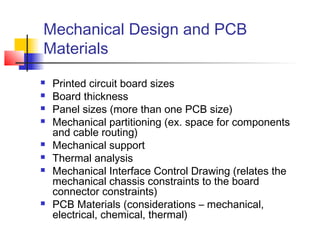
Mechanical Design and PCB
Materials
   Printed circuit board sizes
   Board thickness
   Panel sizes (more than one PCB size)
   Mechanical partitioning (ex. space for components
    and cable routing)
   Mechanical support
   Thermal analysis
   Mechanical Interface Control Drawing (relates the
    mechanical chassis constraints to the board
    connector constraints)
   PCB Materials (considerations – mechanical,
    electrical, chemical, thermal)
Electrical Considerations
   Impedance – capacitance, resistance, and
    inductance
   Cross talk; a phenomenon where a signal on
    one line/trace is capacitively coupled to an
    adjacent line/trace. It can be a form or noise.
   Heat; another form of noise – 1.5*kT
   Switching (on-off-on-off) noise; increases while
    impedance decreases. Higher impedance MAY
    solve problem.
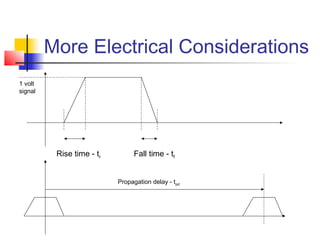
More Electrical Considerations
1 volt
signal


          Rise time - tr        Fall time - tf


                           Propagation delay - tpd
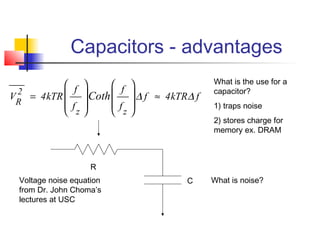
Capacitors - advantages
          f      f                       What is the use for a
 2                                           capacitor?
V = 4kTR   Coth         ∆ f ≈ 4kTR ∆ f
 R        f      f                       1) traps noise
          z      z     
                                             2) stores charge for
                                             memory ex. DRAM


                    R
 Voltage noise equation                C     What is noise?
 from Dr. John Choma’s
 lectures at USC
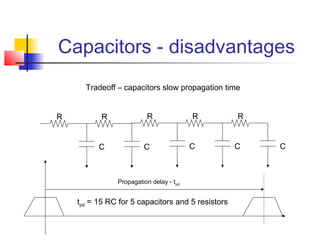
Capacitors - disadvantages
      Tradeoff – capacitors slow propagation time


R          R             R               R         R


          C             C                C         C   C


               Propagation delay - tpd


    tpd = 15 RC for 5 capacitors and 5 resistors
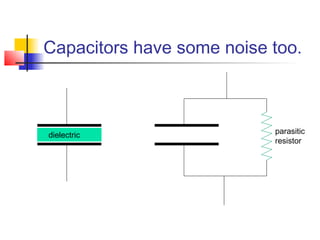
Capacitors have some noise too.


dielectric                 parasitic
                           resistor
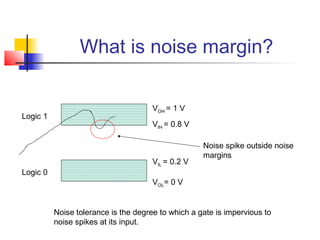
What is noise margin?

                                      VOH = 1 V
Logic 1
                                      VIH = 0.8 V

                                                    Noise spike outside noise
                                                    margins
                                      VIL = 0.2 V
Logic 0
                                      VOL= 0 V


          Noise tolerance is the degree to which a gate is impervious to
          noise spikes at its input.
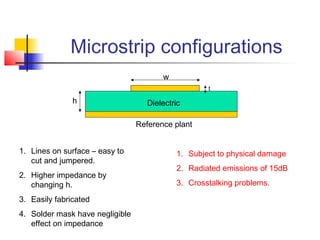
Microstrip configurations
                                        w
                                                    t

               h                    Dielectric

                                 Reference plant


1. Lines on surface – easy to               1. Subject to physical damage
   cut and jumpered.
                                            2. Radiated emissions of 15dB
2. Higher impedance by
   changing h.                              3. Crosstalking problems.

3. Easily fabricated
4. Solder mask have negligible
   effect on impedance
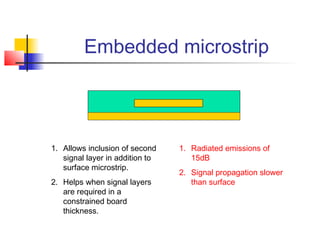
Embedded microstrip


1. Allows inclusion of second    1. Radiated emissions of
   signal layer in addition to      15dB
   surface microstrip.
                                 2. Signal propagation slower
2. Helps when signal layers         than surface
   are required in a
   constrained board
   thickness.
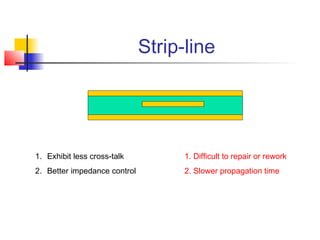
Strip-line


1. Exhibit less cross-talk          1. Difficult to repair or rework
2. Better impedance control         2. Slower propagation time
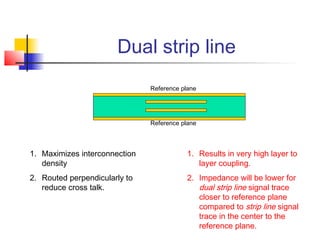
Dual strip line
                               Reference plane


                               Reference plane


1. Maximizes interconnection               1. Results in very high layer to
   density                                    layer coupling.
2. Routed perpendicularly to               2. Impedance will be lower for
   reduce cross talk.                         dual strip line signal trace
                                              closer to reference plane
                                              compared to strip line signal
                                              trace in the center to the
                                              reference plane.
Cross-talk

   Mutual capacitive and inductive b/t signal
    lines produces cross-talk.
   Moving ground plane closer to signal lines
    reduces cross-talk.
   Forward cross-talk (IL - IC) – normally opposite
    of signal source
   Backward cross-talk (IC + IL) – same as signal
    course, twice the line delay (worst case)
Cross-talk control
   Full or partial termination reduce cross-talk amplitudes.
   Signals must be routed orthogonally.
   Void parallel of high speed logic parallel to low level
    analog circuits.
   Keep all buses physically separate from clocks and
    strobes.
   Distance separation between critical traces must be
    three times the width of the traces measured from
    centerline to centerline.
   Thin traces reduce cross-talk.
   Separate traces at 2 mils/inch of trace length.
   Keep lines short!
Clock and strobe distribution
   Use point to point clock configurations.
   Centrally locate the clock drivers.
   Avoid branching.
   Make clocks, strobes, and control signals first
    priority.
   Do not use the same buffer to drive on and off
    the card simultaneously.
   Do not assign clocks of different frequencies
    to the same clock driver package.
Series termination

   Series termination does not increase
    power dissipation.
   Low state reflections are more
    critical compared to high state
    reflections.
   Must be lumped very close to the
    end of the lines
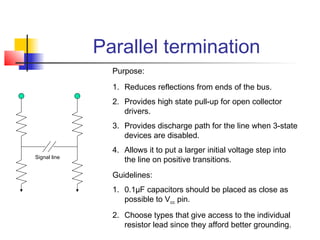
Parallel termination
                Purpose:

                1. Reduces reflections from ends of the bus.
                2. Provides high state pull-up for open collector
                   drivers.
                3. Provides discharge path for the line when 3-state
                   devices are disabled.
                4. Allows it to put a larger initial voltage step into
Signal line
                   the line on positive transitions.
                Guidelines:
                1. 0.1µF capacitors should be placed as close as
                   possible to Vcc pin.
                2. Choose types that give access to the individual
                   resistor lead since they afford better grounding.
Parallel termination
   Signals travel relatively undistorted.
   Loading delay is about half that of
    series termination.
   Helps to offset the driver versus line
    voltage divider delay
   Higher power consumption.
   Higher cross-talk levels.
   Decreases the low level noise margins.
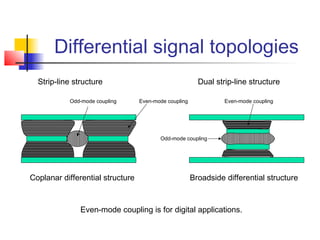
Differential signal topologies
  Strip-line structure                                   Dual strip-line structure

           Odd-mode coupling      Even-mode coupling             Even-mode coupling


                                         Odd-mode coupling


Coplanar differential structure                        Broadside differential structure


               Even-mode coupling is for digital applications.
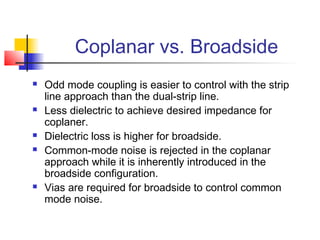
Coplanar vs. Broadside
   Odd mode coupling is easier to control with the strip
    line approach than the dual-strip line.
   Less dielectric to achieve desired impedance for
    coplaner.
   Dielectric loss is higher for broadside.
   Common-mode noise is rejected in the coplanar
    approach while it is inherently introduced in the
    broadside configuration.
   Vias are required for broadside to control common
    mode noise.
Net layout guidelines
   Make critical signals first priority.
   Keep signal lines short.
   Use slowest logic family meeting timing requirements.
   Terminate transmission lines.
   Keep loading along distributed nets equal and well balanced.
   Avoid branching.
   Avoid driving on and off card simultaneously.
   Keep stubs off of transmission lines <2 inch.
   Proper grounding practices mandatory.
   When logic devices have risetimes of 1 ns or less, use 45° instead of
    right anges in circuit paths.
   Avoid long test point circuit traces.
   Testability should also be considered.
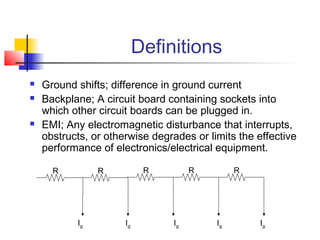
Definitions
   Ground shifts; difference in ground current
   Backplane; A circuit board containing sockets into
    which other circuit boards can be plugged in.
   EMI; Any electromagnetic disturbance that interrupts,
    obstructs, or otherwise degrades or limits the effective
    performance of electronics/electrical equipment.

      R         R           R         R        R


           Ig         Ig         Ig       Ig       Ig
Reducing ground shifts
   Do not use thermal relief “butterflies.”
   Use the appropriate connectors. Used as
    many ground pins per connector.
   Logic cards that represent the heaviest current
    drain should be located nearest the end where
    the ground enters the backplane.
   Cards with the most single-ended logic
    interconnects between them should be
    assigned to slots as close together as
    possible.
   Consider differential driving.
Multilayer power distribution
   Keep plane spacing as close as possible.
   Multiple 1-oz planes arranged in couplets are
    recommended for distributing backplane power.
   Shorter pins will have less resistance.
   Stagger power/ground inputs on the backplane so as
    to distribute power more evenly into the plane.
   Keep power supply as close as possible to the
    backplane to minimize voltage drops in connecting
    planes.
   2% maximum voltage drop from supplies to any circuit
    device is recommended.
   Use additional planes to distribute auxiliary power in
    the backplane.
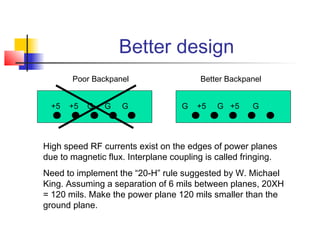
Better design
       Poor Backpanel                    Better Backpanel


  +5   +5   G   G   G               G   +5   G +5     G


High speed RF currents exist on the edges of power planes
due to magnetic flux. Interplane coupling is called fringing.
Need to implement the “20-H” rule suggested by W. Michael
King. Assuming a separation of 6 mils between planes, 20XH
= 120 mils. Make the power plane 120 mils smaller than the
ground plane.
Types of capacitors
   NPO – “temperature compensating”
    materials. Capacitance change +/- 0.3% from
    -55 to +125°C.
   X7R – “temperature stable” Capacitance
    change +/- 15% from -55 to +125°C.
   Z5U – “general purpose” provide highest
    capacitance – very unstable under
    environmental changes – small size, low ESL,
    low ESR, and excellent frequency response.
EMI layout guidelines
   Use multilayer boards with dedicated power and
    ground planes.
   Strip-lines reduced radiated emissions up to 15 dB.
   Auxiliary power or ground traces are required – keep
    them as wide as possible to lower inductance and DC
    resistance.
   Adequate decoupling reduces current inductive traces
    and thus lowers emissions.
   Keep highest speed logic closer to the card connector.
   Keep signal traces as short as possible.
   If a noisy card is anticipated, use a strip-line approach.
감사합니다

High Performance Printed Circuit Boards - Lecture #3

  • 1.
    High Performance Printed Circuit Boards By Joseph Y. Lee Samsung Electro-Mechanics
  • 2.
    Chapter – 6 Design of High Performance Circuit Boards
  • 3.
    PCB Design Flow  Connectors, backplanes, and other interconnects – potential of unwanted noise, delays, and reliability problems.  Slowest logic family can adequately meet worst-case performance and timing goals  Minimize layers should be considered  Equivalent Integrated Circuit Count (EIC) technique (??? – correlation factors for total layer count)  Computer Aided Design (CAD)  Rule violations should be avoided  PCB process documented  Fabricate prototype
  • 4.
    Mechanical Design andPCB Materials  Printed circuit board sizes  Board thickness  Panel sizes (more than one PCB size)  Mechanical partitioning (ex. space for components and cable routing)  Mechanical support  Thermal analysis  Mechanical Interface Control Drawing (relates the mechanical chassis constraints to the board connector constraints)  PCB Materials (considerations – mechanical, electrical, chemical, thermal)
  • 5.
    Electrical Considerations  Impedance – capacitance, resistance, and inductance  Cross talk; a phenomenon where a signal on one line/trace is capacitively coupled to an adjacent line/trace. It can be a form or noise.  Heat; another form of noise – 1.5*kT  Switching (on-off-on-off) noise; increases while impedance decreases. Higher impedance MAY solve problem.
  • 6.
    More Electrical Considerations 1volt signal Rise time - tr Fall time - tf Propagation delay - tpd
  • 7.
    Capacitors - advantages  f   f  What is the use for a 2 capacitor? V = 4kTR   Coth   ∆ f ≈ 4kTR ∆ f R  f   f  1) traps noise  z  z  2) stores charge for memory ex. DRAM R Voltage noise equation C What is noise? from Dr. John Choma’s lectures at USC
  • 8.
    Capacitors - disadvantages Tradeoff – capacitors slow propagation time R R R R R C C C C C Propagation delay - tpd tpd = 15 RC for 5 capacitors and 5 resistors
  • 9.
    Capacitors have somenoise too. dielectric parasitic resistor
  • 10.
    What is noisemargin? VOH = 1 V Logic 1 VIH = 0.8 V Noise spike outside noise margins VIL = 0.2 V Logic 0 VOL= 0 V Noise tolerance is the degree to which a gate is impervious to noise spikes at its input.
  • 11.
    Microstrip configurations w t h Dielectric Reference plant 1. Lines on surface – easy to 1. Subject to physical damage cut and jumpered. 2. Radiated emissions of 15dB 2. Higher impedance by changing h. 3. Crosstalking problems. 3. Easily fabricated 4. Solder mask have negligible effect on impedance
  • 12.
    Embedded microstrip 1. Allowsinclusion of second 1. Radiated emissions of signal layer in addition to 15dB surface microstrip. 2. Signal propagation slower 2. Helps when signal layers than surface are required in a constrained board thickness.
  • 13.
    Strip-line 1. Exhibit lesscross-talk 1. Difficult to repair or rework 2. Better impedance control 2. Slower propagation time
  • 14.
    Dual strip line Reference plane Reference plane 1. Maximizes interconnection 1. Results in very high layer to density layer coupling. 2. Routed perpendicularly to 2. Impedance will be lower for reduce cross talk. dual strip line signal trace closer to reference plane compared to strip line signal trace in the center to the reference plane.
  • 15.
    Cross-talk  Mutual capacitive and inductive b/t signal lines produces cross-talk.  Moving ground plane closer to signal lines reduces cross-talk.  Forward cross-talk (IL - IC) – normally opposite of signal source  Backward cross-talk (IC + IL) – same as signal course, twice the line delay (worst case)
  • 16.
    Cross-talk control  Full or partial termination reduce cross-talk amplitudes.  Signals must be routed orthogonally.  Void parallel of high speed logic parallel to low level analog circuits.  Keep all buses physically separate from clocks and strobes.  Distance separation between critical traces must be three times the width of the traces measured from centerline to centerline.  Thin traces reduce cross-talk.  Separate traces at 2 mils/inch of trace length.  Keep lines short!
  • 17.
    Clock and strobedistribution  Use point to point clock configurations.  Centrally locate the clock drivers.  Avoid branching.  Make clocks, strobes, and control signals first priority.  Do not use the same buffer to drive on and off the card simultaneously.  Do not assign clocks of different frequencies to the same clock driver package.
  • 18.
    Series termination  Series termination does not increase power dissipation.  Low state reflections are more critical compared to high state reflections.  Must be lumped very close to the end of the lines
  • 19.
    Parallel termination Purpose: 1. Reduces reflections from ends of the bus. 2. Provides high state pull-up for open collector drivers. 3. Provides discharge path for the line when 3-state devices are disabled. 4. Allows it to put a larger initial voltage step into Signal line the line on positive transitions. Guidelines: 1. 0.1µF capacitors should be placed as close as possible to Vcc pin. 2. Choose types that give access to the individual resistor lead since they afford better grounding.
  • 20.
    Parallel termination  Signals travel relatively undistorted.  Loading delay is about half that of series termination.  Helps to offset the driver versus line voltage divider delay  Higher power consumption.  Higher cross-talk levels.  Decreases the low level noise margins.
  • 21.
    Differential signal topologies Strip-line structure Dual strip-line structure Odd-mode coupling Even-mode coupling Even-mode coupling Odd-mode coupling Coplanar differential structure Broadside differential structure Even-mode coupling is for digital applications.
  • 22.
    Coplanar vs. Broadside  Odd mode coupling is easier to control with the strip line approach than the dual-strip line.  Less dielectric to achieve desired impedance for coplaner.  Dielectric loss is higher for broadside.  Common-mode noise is rejected in the coplanar approach while it is inherently introduced in the broadside configuration.  Vias are required for broadside to control common mode noise.
  • 23.
    Net layout guidelines  Make critical signals first priority.  Keep signal lines short.  Use slowest logic family meeting timing requirements.  Terminate transmission lines.  Keep loading along distributed nets equal and well balanced.  Avoid branching.  Avoid driving on and off card simultaneously.  Keep stubs off of transmission lines <2 inch.  Proper grounding practices mandatory.  When logic devices have risetimes of 1 ns or less, use 45° instead of right anges in circuit paths.  Avoid long test point circuit traces.  Testability should also be considered.
  • 24.
    Definitions  Ground shifts; difference in ground current  Backplane; A circuit board containing sockets into which other circuit boards can be plugged in.  EMI; Any electromagnetic disturbance that interrupts, obstructs, or otherwise degrades or limits the effective performance of electronics/electrical equipment. R R R R R Ig Ig Ig Ig Ig
  • 25.
    Reducing ground shifts  Do not use thermal relief “butterflies.”  Use the appropriate connectors. Used as many ground pins per connector.  Logic cards that represent the heaviest current drain should be located nearest the end where the ground enters the backplane.  Cards with the most single-ended logic interconnects between them should be assigned to slots as close together as possible.  Consider differential driving.
  • 26.
    Multilayer power distribution  Keep plane spacing as close as possible.  Multiple 1-oz planes arranged in couplets are recommended for distributing backplane power.  Shorter pins will have less resistance.  Stagger power/ground inputs on the backplane so as to distribute power more evenly into the plane.  Keep power supply as close as possible to the backplane to minimize voltage drops in connecting planes.  2% maximum voltage drop from supplies to any circuit device is recommended.  Use additional planes to distribute auxiliary power in the backplane.
  • 27.
    Better design Poor Backpanel Better Backpanel +5 +5 G G G G +5 G +5 G High speed RF currents exist on the edges of power planes due to magnetic flux. Interplane coupling is called fringing. Need to implement the “20-H” rule suggested by W. Michael King. Assuming a separation of 6 mils between planes, 20XH = 120 mils. Make the power plane 120 mils smaller than the ground plane.
  • 28.
    Types of capacitors  NPO – “temperature compensating” materials. Capacitance change +/- 0.3% from -55 to +125°C.  X7R – “temperature stable” Capacitance change +/- 15% from -55 to +125°C.  Z5U – “general purpose” provide highest capacitance – very unstable under environmental changes – small size, low ESL, low ESR, and excellent frequency response.
  • 29.
    EMI layout guidelines  Use multilayer boards with dedicated power and ground planes.  Strip-lines reduced radiated emissions up to 15 dB.  Auxiliary power or ground traces are required – keep them as wide as possible to lower inductance and DC resistance.  Adequate decoupling reduces current inductive traces and thus lowers emissions.  Keep highest speed logic closer to the card connector.  Keep signal traces as short as possible.  If a noisy card is anticipated, use a strip-line approach.
  • 30.