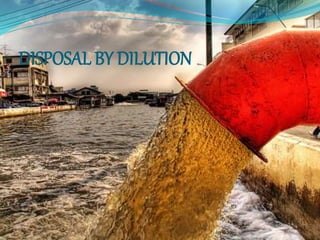
DISPOSAL BY DILUTION
introduction
The study of the sources of disposal is
important, because the amount of treatment
required to be given to sewage depends very
much upon the source of disposal.
Disposal By Dilution
This process where the treated sewage or the
effluent from the sewage treatment plant is
discharged into a river stream.
The discharged sewage, in due course of time is
purified by what is known as self purification
process of natural waters
Disposal of sewage effluents
 Dilution i.e. disposal in water ; and
 Effluent Irrigation or Broad Irrigation or Sewage Farming
i.e. disposal on land
{Disposal by dilution is common of these two}
Conditions favoring Disposal By Dilution
 When sewage comparatively fresh(4 - 5 hrs. old), and
free from floating and settle able solids.
 When the diluting water (i.e. the source of disposal )
has a high dissolved oxygen (D.O) content.
 Where diluting waters are not used for the purpose of
navigation on the down stream from the point of
sewage disposal
 When the out fall sewer of the city or the treatment
plant is situated near some natural waters having large
volumes
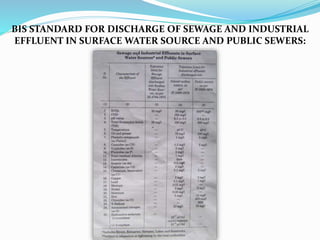
The bureau of Indian Standards
(BIS),previously known as Indian Standard
Institution (ISI), has there for laid don it’s
guiding standards for sewage effluents ,vide IS
4764 -1973,and for industrial effluents vide IS
:2490-1974 as shown in the table
Bureau of Indian Standards
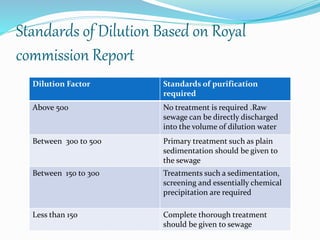
Standards of Dilution Based on Royal
commission Report
Dilution Factor Standards of purification
required
Above 500 No treatment is required .Raw
sewage can be directly discharged
into the volume of dilution water
Between 300 to 500 Primary treatment such as plain
sedimentation should be given to
the sewage
Between 150 to 300 Treatments such a sedimentation,
screening and essentially chemical
precipitation are required
Less than 150 Complete thorough treatment
should be given to sewage
Dilution in Rivers and self
Purification of Natural Streams
The automatic purification of polluted
water by dilution. sedimentation,
oxidation-reduction in sunlight, etc in
due course is called Self Purification
Phenomenon
BIS STANDARD FOR DISCHARGE OF SEWAGE AND INDUSTRIAL
EFFLUENT IN SURFACE WATER SOURCE AND PUBLIC SEWERS:
GENARAL STANDARDS FOR DISCHARGE OF ENVIRONMENT POLLUTANT
FROM EFFLUENT INTO SURFACE WATER SOURCE, PUBLIC SEWERS, AND
MARINE COASTS UNDER ENVIRONMENT(PROTECTION) RULE, 1986
Natural Forces of Purification
 Physical Forces
 Dilution and dispersion
 Sedimentation
 Sunlight
 Chemical Forces
 Oxidation(bio)
 Reduction
Dilution and dispersion
 When the putrescible organic matter is discharged into a
large volume of water contained in the river stream, it
gets rapidly dispersed and diluted . this results in
diminishing conc. of organic matter
When sewage of concentration Cs flows at a rate Qs
in to a river stream with conc. Cr flowing at rate Qr
Cs Qs + Cr Qr = C ( Qs+Qr)
Sedimentation
 The settle able solids, if present in sewage
effluents ,will settle down into the bed of
river, near the outfall of sewage.
Sunlight
 The sunlight has a bleaching and stabilizing
effect of bacteria .It also helps Certain
micro – organisms to derive energy, and it’s
called photo synthesis
OXIDATION
THE OXIDATION IS A ORGANIC MATTER PRESENT
SEWAGE EFFLUENT, WILL START AS SOON AS THE
SEWAGE OUTFALL INTO THE RIVER WATER
CONTAINING DISSOLVED OXYGEN
REDUCTION
REDUCTION OCCURS DUE TO HYDROLYSISOF
ORGANIC MATTER SETTLED AT THE BOTTOM EITHER
CHMICALLY OR BIOLOGICALLY.
ANAEROBIC BACTERIA WILL HELP IN SPLITTING THE
COMPLEX ORGANIC CONSTIUTUENT OF SEWAGE
INTO LIQUID AND GASES, AND THUS PAVING THE
WAY FOR THEIR ULTIMATE STABILIZATION BY
OXYDATION.

desposal by dilution

  • 1.
  • 2.
    introduction The study ofthe sources of disposal is important, because the amount of treatment required to be given to sewage depends very much upon the source of disposal.
  • 3.
    Disposal By Dilution Thisprocess where the treated sewage or the effluent from the sewage treatment plant is discharged into a river stream. The discharged sewage, in due course of time is purified by what is known as self purification process of natural waters
  • 4.
    Disposal of sewageeffluents  Dilution i.e. disposal in water ; and  Effluent Irrigation or Broad Irrigation or Sewage Farming i.e. disposal on land {Disposal by dilution is common of these two}
  • 5.
    Conditions favoring DisposalBy Dilution  When sewage comparatively fresh(4 - 5 hrs. old), and free from floating and settle able solids.  When the diluting water (i.e. the source of disposal ) has a high dissolved oxygen (D.O) content.  Where diluting waters are not used for the purpose of navigation on the down stream from the point of sewage disposal  When the out fall sewer of the city or the treatment plant is situated near some natural waters having large volumes
  • 6.
    The bureau ofIndian Standards (BIS),previously known as Indian Standard Institution (ISI), has there for laid don it’s guiding standards for sewage effluents ,vide IS 4764 -1973,and for industrial effluents vide IS :2490-1974 as shown in the table Bureau of Indian Standards
  • 7.
    Standards of DilutionBased on Royal commission Report Dilution Factor Standards of purification required Above 500 No treatment is required .Raw sewage can be directly discharged into the volume of dilution water Between 300 to 500 Primary treatment such as plain sedimentation should be given to the sewage Between 150 to 300 Treatments such a sedimentation, screening and essentially chemical precipitation are required Less than 150 Complete thorough treatment should be given to sewage
  • 8.
    Dilution in Riversand self Purification of Natural Streams The automatic purification of polluted water by dilution. sedimentation, oxidation-reduction in sunlight, etc in due course is called Self Purification Phenomenon
  • 9.
    BIS STANDARD FORDISCHARGE OF SEWAGE AND INDUSTRIAL EFFLUENT IN SURFACE WATER SOURCE AND PUBLIC SEWERS:
  • 10.
    GENARAL STANDARDS FORDISCHARGE OF ENVIRONMENT POLLUTANT FROM EFFLUENT INTO SURFACE WATER SOURCE, PUBLIC SEWERS, AND MARINE COASTS UNDER ENVIRONMENT(PROTECTION) RULE, 1986
  • 11.
    Natural Forces ofPurification  Physical Forces  Dilution and dispersion  Sedimentation  Sunlight  Chemical Forces  Oxidation(bio)  Reduction
  • 12.
    Dilution and dispersion When the putrescible organic matter is discharged into a large volume of water contained in the river stream, it gets rapidly dispersed and diluted . this results in diminishing conc. of organic matter When sewage of concentration Cs flows at a rate Qs in to a river stream with conc. Cr flowing at rate Qr Cs Qs + Cr Qr = C ( Qs+Qr)
  • 13.
    Sedimentation  The settleable solids, if present in sewage effluents ,will settle down into the bed of river, near the outfall of sewage.
  • 14.
    Sunlight  The sunlighthas a bleaching and stabilizing effect of bacteria .It also helps Certain micro – organisms to derive energy, and it’s called photo synthesis
  • 15.
    OXIDATION THE OXIDATION ISA ORGANIC MATTER PRESENT SEWAGE EFFLUENT, WILL START AS SOON AS THE SEWAGE OUTFALL INTO THE RIVER WATER CONTAINING DISSOLVED OXYGEN
  • 16.
    REDUCTION REDUCTION OCCURS DUETO HYDROLYSISOF ORGANIC MATTER SETTLED AT THE BOTTOM EITHER CHMICALLY OR BIOLOGICALLY. ANAEROBIC BACTERIA WILL HELP IN SPLITTING THE COMPLEX ORGANIC CONSTIUTUENT OF SEWAGE INTO LIQUID AND GASES, AND THUS PAVING THE WAY FOR THEIR ULTIMATE STABILIZATION BY OXYDATION.