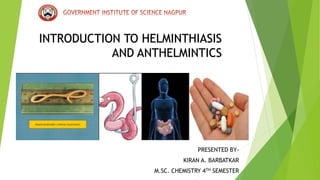
INTRODUCTION TO HELMINTHIASIS
AND ANTHELMINTICS
PRESENTED BY-
KIRAN A. BARBATKAR
M.SC. CHEMISTRY 4TH SEMESTER
OUTLINE
 WHAT IS HELMINTHIASIS….?
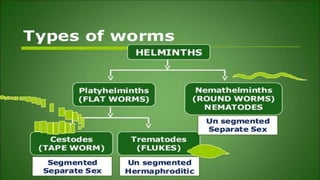
 TYPES OF WORMS
 CESTODE AND TREMATODE HELMINTHS
 WHAT DOES WHO SAYS ….!
 ANTHELMINTICS DRUGS AND THEIR SYNTHESIS
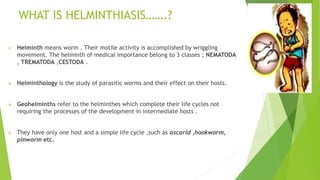
WHAT IS HELMINTHIASIS…….?
 Helminth means worm . Their motile activity is accomplished by wriggling
movement. The helminth of medical importance belong to 3 classes ; NEMATODA
, TREMATODA ,CESTODA .
 Helminthology is the study of parasitic worms and their effect on their hosts.
 Geohelminths refer to the helminthes which complete their life cycles not
requiring the processes of the development in intermediate hosts .
 They have only one host and a simple life cycle ,such as ascarid ,hookworm,
pinworm etc.
 Biohelminths refers to those that have to undergo the development in
intermediate hosts to complete their life cycles , such as filaria ,liver fluke , pork
tapeworm and so on .
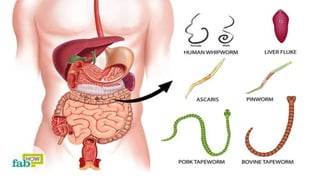
 In the human body gastrointestinal tract is the abode of many helminthes , but
some also live in tissues , or their larvae migrate into the tissues .
 They harm the host by depriving him of food , causing blood loss ,injury to organs ,
intestinal or lymphatic obstruction and by secreting toxins .
 Helminthiasis is rarely fatal , but is major cause of ill health .
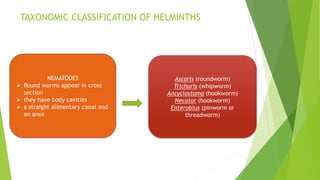
TAXONOMIC CLASSIFICATION OF HELMINTHS
NEMATODES
 Round worms appear in cross
section
 they have body cavities
 a straight alimentary canal and
an anus
Ascaris (roundworm)
Trichuris (whipworm)
Ancyclostoma (hookworm)
Necator (hookworm)
Enterobius (pinworm or
threadworm)
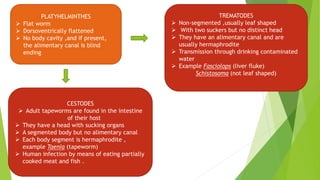
PLATYHELMINTHES
 Flat worm
 Dorsoventrically flattened
 No body cavity ,and if present,
the alimentary canal is blind
ending
CESTODES
 Adult tapeworms are found in the intestine
of their host
 They have a head with sucking organs
 A segmented body but no alimentary canal
 Each body segment is hermaphrodite ,
example Taenia (tapeworm)
 Human infection by means of eating partially
cooked meat and fish .
TREMATODES
 Non-segmented ,usually leaf shaped
 With two suckers but no distinct head
 They have an alimentary canal and are
usually hermaphrodite
 Transmission through drinking contaminated
water
 Example Fasciolops (liver fluke)
Schistosoma (not leaf shaped)
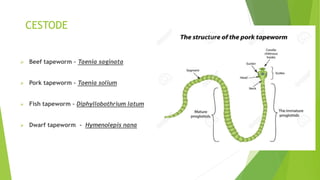
CESTODE
 Beef tapeworm – Taenia saginata
 Pork tapeworm – Taenia solium
 Fish tapeworm – Diphyllobothrium latum
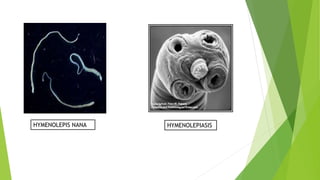
 Dwarf tapeworm - Hymenolepis nana
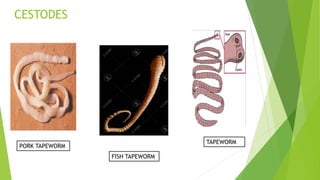
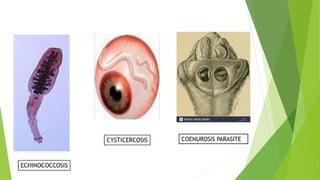
CESTODES
TAPEWORM
PORK TAPEWORM
FISH TAPEWORM
COENUROSIS PARASITE
HYMENOLEPIS NANA HYMENOLEPIASIS
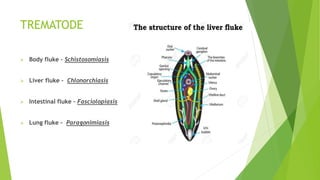
TREMATODE
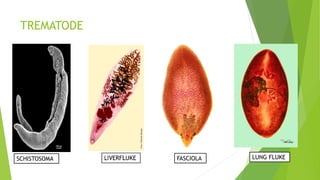
 Body fluke – Schistosomiasis
 Liver fluke - Chlonorchiasis
 Intestinal fluke – Fasciolopiasis
 Lung fluke - Paragonimiasis
TREMATODE
FASCIOLASCHISTOSOMA LUNG FLUKE
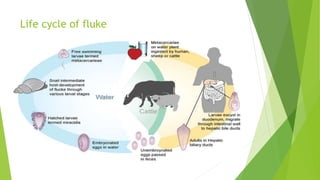
Life cycle of fluke
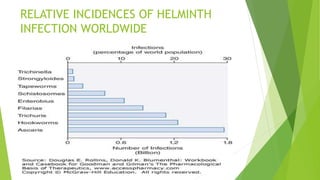
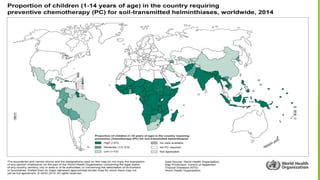
RELATIVE INCIDENCES OF HELMINTH
INFECTION WORLDWIDE
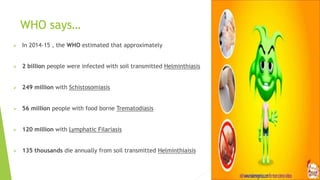
WHO says…
 In 2014-15 , the WHO estimated that approximately
 2 billion people were infected with soil transmitted Helminthiasis
 249 million with Schistosomiasis
 56 million people with food borne Trematodiasis
 120 million with Lymphatic Filariasis
 135 thousands die annually from soil transmitted Helminthiaisis
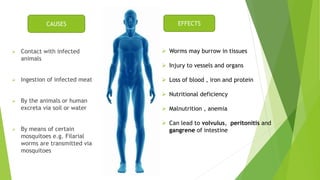
 Contact with infected
animals
 Ingestion of infected meat
 By the animals or human
excreta via soil or water
 By means of certain
mosquitoes e.g. Filarial
worms are transmitted via
mosquitoes
 Worms may burrow in tissues
 Injury to vessels and organs
 Loss of blood , iron and protein
 Nutritional deficiency
 Malnutrition , anemia
 Can lead to volvulus, peritonitis and
gangrene of intestine
CAUSES EFFECTS
 Drugs used to kill or remove the parasitic worms .
 VERMICIDAL : which kill the worms .
 VERMIFUGES : helps in expelling them by making the environment
uncomfortable for living .
 Anthelmintic act by causing :
1. Paralysis of the worm .
2. Damaging the worm leading to partial digestion or rejection by immune mechanisms .
3. Interfere with the metabolism of the worm .
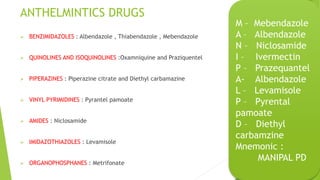
ANTHELMINTICS DRUGS
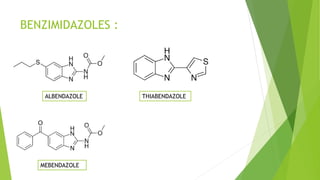
 BENZIMIDAZOLES : Albendazole , Thiabendazole , Mebendazole
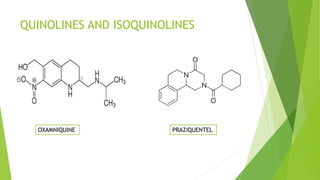
 QUINOLINES AND ISOQUINOLINES :Oxamniquine and Praziquentel
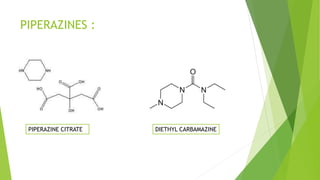
 PIPERAZINES : Piperazine citrate and Diethyl carbamazine
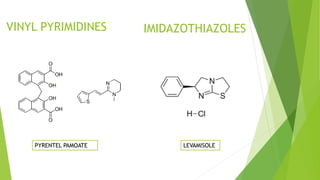
 VINYL PYRIMIDINES : Pyrantel pamoate
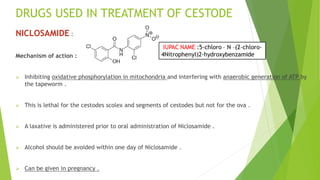
 AMIDES : Niclosamide
 IMIDAZOTHIAZOLES : Levamisole
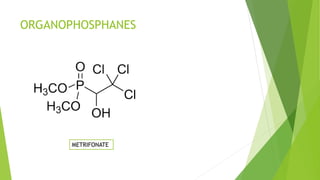
 ORGANOPHOSPHANES : Metrifonate
M – Mebendazole
A – Albendazole
N – Niclosamide
I – Ivermectin
P – Prazequantel
A- Albendazole
L – Levamisole
P – Pyrental
pamoate
D – Diethyl
carbamzine
Mnemonic :
MANIPAL PD
BENZIMIDAZOLES :
ALBENDAZOLE THIABENDAZOLE
MEBENDAZOLE
QUINOLINES AND ISOQUINOLINES
OXAMNIQUINE PRAZIQUENTEL
PIPERAZINES :
PIPERAZINE CITRATE DIETHYL CARBAMAZINE
VINYL PYRIMIDINES
PYRENTEL PAMOATE
IMIDAZOTHIAZOLES
LEVAMISOLE
ORGANOPHOSPHANES
METRIFONATE
DRUGS USED IN TREATMENT OF CESTODE
NICLOSAMIDE :
Mechanism of action :
 Inhibiting oxidative phosphorylation in mitochondria and interfering with anaerobic generation of ATP by
the tapeworm .
 This is lethal for the cestodes scolex and segments of cestodes but not for the ova .
 A laxative is administered prior to oral administration of Niclosamide .
 Alcohol should be avoided within one day of Niclosamide .
 Can be given in pregnancy .
PHARMACOKINETIC
 Poorly absorbed from gut
 excreted in urine
ADVERSE EFFECT :
 Nausea
 Vomiting
 Abdominal pain
 Dizziness
 Skin rash
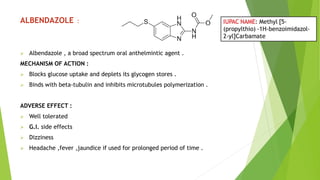
ALBENDAZOLE :
 Albendazole , a broad spectrum oral anthelmintic agent .
MECHANISM OF ACTION :
 Blocks glucose uptake and deplets its glycogen stores .
 Binds with beta-tubulin and inhibits microtubules polymerization .
ADVERSE EFFECT :
 Well tolerated
 G.I. side effects
 Dizziness
 Headache ,fever ,jaundice if used for prolonged period of time .
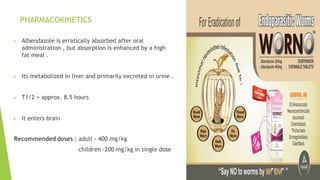
PHARMACOKINETICS
 Albendazole is erratically absorbed after oral
administration , but absorption is enhanced by a high
fat meal .
 Its metabolized in liver and primarily excreted in urine .
 T1/2 = approx. 8.5 hours
 It enters brain
DRUGS USED IN TREATMENT OF TREMATODE
PRAZIQUANTEL :
 Trematode infections are generally treated with Praziquantel .
 It is a drug of choice to treat Schistosmiaisis and cestode infections like Cysticercosis .
MECHANISM OF ACTION :
 Permeability of the cell membrane to calcium ion is increased .
 This leads to contraction and so paralysis of the parasite occurs .
 Worm loses its grip in GIT and expelled out .
IUPAC NAME: (RS)-2-(cyclohexyl
carbonyl)-1,2,3,6,7,11b-
hexahydro-4H-pyrazino [2,1-
a]isoquinolin 4-one
PHARMACOKINETIC
 Rapidly absorbed from intestine , t1/2 – 1.5 hours .
 Excreted in urine .
Recommended doses : 20 mg/kg /dose - 2-3 doses
ADVERSE EFFECTS :
 Dizziness , GI upset , Drowsiness .
 Bitter in taste - nausea and abdominal pain .
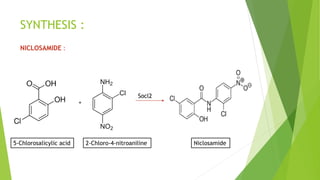
SYNTHESIS :
NICLOSAMIDE :
+
Socl2
5-Chlorosalicylic acid 2-Chloro-4-nitroaniline Niclosamide
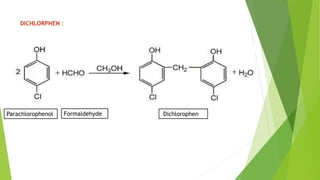
DICHLORPHEN :
Parachlorophenol Formaldehyde Dichlorophen
REFERENCES :
 Synthetic drugs by G.R. Chatwal (page no. 279 -293 )
 Medicinal chemistry by A. Kar (page no. 652-664 )
 Medicinal chemistry by Yogeshwari and D. Shriram (page no. 546 -551 )
 http://www.thesynapticleap.org/files/tsl/images/PZQ%20gif.gif
 www.slideshare.net
 www.google.com
 https://www.parkviewservices.org/wp-content/uploads/2017/04/thank-you.jpg
 https://www.lafarga.es/images/stories/el-cobre/human.jpg
 https://www.fabhow.com/wp-content/uploads/2017/07/intro-parasites-in-
humans.jpg
Introduction to helminthiasis

Introduction to helminthiasis

  • 1.
    INTRODUCTION TO HELMINTHIASIS ANDANTHELMINTICS PRESENTED BY- KIRAN A. BARBATKAR M.SC. CHEMISTRY 4TH SEMESTER
  • 2.
    OUTLINE  WHAT ISHELMINTHIASIS….?  TYPES OF WORMS  CESTODE AND TREMATODE HELMINTHS  WHAT DOES WHO SAYS ….!  ANTHELMINTICS DRUGS AND THEIR SYNTHESIS
  • 3.
    WHAT IS HELMINTHIASIS…….? Helminth means worm . Their motile activity is accomplished by wriggling movement. The helminth of medical importance belong to 3 classes ; NEMATODA , TREMATODA ,CESTODA .  Helminthology is the study of parasitic worms and their effect on their hosts.  Geohelminths refer to the helminthes which complete their life cycles not requiring the processes of the development in intermediate hosts .  They have only one host and a simple life cycle ,such as ascarid ,hookworm, pinworm etc.
  • 4.
     Biohelminths refersto those that have to undergo the development in intermediate hosts to complete their life cycles , such as filaria ,liver fluke , pork tapeworm and so on .  In the human body gastrointestinal tract is the abode of many helminthes , but some also live in tissues , or their larvae migrate into the tissues .  They harm the host by depriving him of food , causing blood loss ,injury to organs , intestinal or lymphatic obstruction and by secreting toxins .  Helminthiasis is rarely fatal , but is major cause of ill health .
  • 6.
    TAXONOMIC CLASSIFICATION OFHELMINTHS NEMATODES  Round worms appear in cross section  they have body cavities  a straight alimentary canal and an anus Ascaris (roundworm) Trichuris (whipworm) Ancyclostoma (hookworm) Necator (hookworm) Enterobius (pinworm or threadworm)
  • 7.
    PLATYHELMINTHES  Flat worm Dorsoventrically flattened  No body cavity ,and if present, the alimentary canal is blind ending CESTODES  Adult tapeworms are found in the intestine of their host  They have a head with sucking organs  A segmented body but no alimentary canal  Each body segment is hermaphrodite , example Taenia (tapeworm)  Human infection by means of eating partially cooked meat and fish . TREMATODES  Non-segmented ,usually leaf shaped  With two suckers but no distinct head  They have an alimentary canal and are usually hermaphrodite  Transmission through drinking contaminated water  Example Fasciolops (liver fluke) Schistosoma (not leaf shaped)
  • 9.
    CESTODE  Beef tapeworm– Taenia saginata  Pork tapeworm – Taenia solium  Fish tapeworm – Diphyllobothrium latum  Dwarf tapeworm - Hymenolepis nana
  • 10.
  • 11.
  • 12.
  • 13.
    TREMATODE  Body fluke– Schistosomiasis  Liver fluke - Chlonorchiasis  Intestinal fluke – Fasciolopiasis  Lung fluke - Paragonimiasis
  • 14.
  • 15.
  • 16.
    RELATIVE INCIDENCES OFHELMINTH INFECTION WORLDWIDE
  • 18.
    WHO says…  In2014-15 , the WHO estimated that approximately  2 billion people were infected with soil transmitted Helminthiasis  249 million with Schistosomiasis  56 million people with food borne Trematodiasis  120 million with Lymphatic Filariasis  135 thousands die annually from soil transmitted Helminthiaisis
  • 19.
     Contact withinfected animals  Ingestion of infected meat  By the animals or human excreta via soil or water  By means of certain mosquitoes e.g. Filarial worms are transmitted via mosquitoes  Worms may burrow in tissues  Injury to vessels and organs  Loss of blood , iron and protein  Nutritional deficiency  Malnutrition , anemia  Can lead to volvulus, peritonitis and gangrene of intestine CAUSES EFFECTS
  • 20.
     Drugs usedto kill or remove the parasitic worms .  VERMICIDAL : which kill the worms .  VERMIFUGES : helps in expelling them by making the environment uncomfortable for living .  Anthelmintic act by causing : 1. Paralysis of the worm . 2. Damaging the worm leading to partial digestion or rejection by immune mechanisms . 3. Interfere with the metabolism of the worm .
  • 21.
    ANTHELMINTICS DRUGS  BENZIMIDAZOLES: Albendazole , Thiabendazole , Mebendazole  QUINOLINES AND ISOQUINOLINES :Oxamniquine and Praziquentel  PIPERAZINES : Piperazine citrate and Diethyl carbamazine  VINYL PYRIMIDINES : Pyrantel pamoate  AMIDES : Niclosamide  IMIDAZOTHIAZOLES : Levamisole  ORGANOPHOSPHANES : Metrifonate M – Mebendazole A – Albendazole N – Niclosamide I – Ivermectin P – Prazequantel A- Albendazole L – Levamisole P – Pyrental pamoate D – Diethyl carbamzine Mnemonic : MANIPAL PD
  • 22.
  • 23.
  • 24.
  • 25.
  • 26.
  • 27.
    DRUGS USED INTREATMENT OF CESTODE NICLOSAMIDE : Mechanism of action :  Inhibiting oxidative phosphorylation in mitochondria and interfering with anaerobic generation of ATP by the tapeworm .  This is lethal for the cestodes scolex and segments of cestodes but not for the ova .  A laxative is administered prior to oral administration of Niclosamide .  Alcohol should be avoided within one day of Niclosamide .  Can be given in pregnancy .
  • 28.
    PHARMACOKINETIC  Poorly absorbedfrom gut  excreted in urine ADVERSE EFFECT :  Nausea  Vomiting  Abdominal pain  Dizziness  Skin rash
  • 29.
    ALBENDAZOLE :  Albendazole, a broad spectrum oral anthelmintic agent . MECHANISM OF ACTION :  Blocks glucose uptake and deplets its glycogen stores .  Binds with beta-tubulin and inhibits microtubules polymerization . ADVERSE EFFECT :  Well tolerated  G.I. side effects  Dizziness  Headache ,fever ,jaundice if used for prolonged period of time .
  • 30.
    PHARMACOKINETICS  Albendazole iserratically absorbed after oral administration , but absorption is enhanced by a high fat meal .  Its metabolized in liver and primarily excreted in urine .  T1/2 = approx. 8.5 hours  It enters brain
  • 31.
    DRUGS USED INTREATMENT OF TREMATODE PRAZIQUANTEL :  Trematode infections are generally treated with Praziquantel .  It is a drug of choice to treat Schistosmiaisis and cestode infections like Cysticercosis . MECHANISM OF ACTION :  Permeability of the cell membrane to calcium ion is increased .  This leads to contraction and so paralysis of the parasite occurs .  Worm loses its grip in GIT and expelled out . IUPAC NAME: (RS)-2-(cyclohexyl carbonyl)-1,2,3,6,7,11b- hexahydro-4H-pyrazino [2,1- a]isoquinolin 4-one
  • 32.
    PHARMACOKINETIC  Rapidly absorbedfrom intestine , t1/2 – 1.5 hours .  Excreted in urine . Recommended doses : 20 mg/kg /dose - 2-3 doses ADVERSE EFFECTS :  Dizziness , GI upset , Drowsiness .  Bitter in taste - nausea and abdominal pain .
  • 33.
    SYNTHESIS : NICLOSAMIDE : + Socl2 5-Chlorosalicylicacid 2-Chloro-4-nitroaniline Niclosamide
  • 34.
  • 35.
    REFERENCES :  Syntheticdrugs by G.R. Chatwal (page no. 279 -293 )  Medicinal chemistry by A. Kar (page no. 652-664 )  Medicinal chemistry by Yogeshwari and D. Shriram (page no. 546 -551 )  http://www.thesynapticleap.org/files/tsl/images/PZQ%20gif.gif  www.slideshare.net  www.google.com  https://www.parkviewservices.org/wp-content/uploads/2017/04/thank-you.jpg  https://www.lafarga.es/images/stories/el-cobre/human.jpg  https://www.fabhow.com/wp-content/uploads/2017/07/intro-parasites-in- humans.jpg