﷽

What is Yellow Fever?
Yellow Fever is a mosquito-born viral disease that
occurs in tropical and subtropical areas. It can
occur in males and females of any age. Yellow fever
belongs to the Flaviviridae family. The Aedes
aegypti is the mosquito that is known to carry the
virus.
History of yellow fever
 Originated in Central Africa.
 170,000 cases and up to 60,000 deaths.
 Spread to east and west Africa, and to America.
 First outbreak in Yucatan peninsula, Mexico in 1648.
 1975 suspected cases and 258 deaths in Angola in
2015.
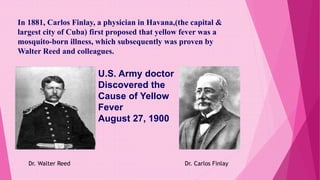
In 1881, Carlos Finlay, a physician in Havana,(the capital &
largest city of Cuba) first proposed that yellow fever was a
mosquito-born illness, which subsequently was proven by
Walter Reed and colleagues.
U.S. Army doctor
Discovered the
Cause of Yellow
Fever
August 27, 1900
Dr. Walter Reed Dr. Carlos Finlay
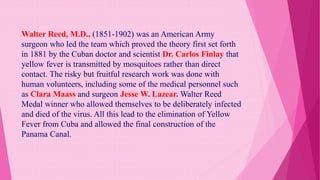
Walter Reed, M.D., (1851-1902) was an American Army
surgeon who led the team which proved the theory first set forth
in 1881 by the Cuban doctor and scientist Dr. Carlos Finlay that
yellow fever is transmitted by mosquitoes rather than direct
contact. The risky but fruitful research work was done with
human volunteers, including some of the medical personnel such
as Clara Maass and surgeon Jesse W. Lazear. Walter Reed
Medal winner who allowed themselves to be deliberately infected
and died of the virus. All this lead to the elimination of Yellow
Fever from Cuba and allowed the final construction of the
Panama Canal.
Clara Maass
On August 14, 1901, Maass allowed herself to be
bitten by infected mosquitoes for the seventh
time. Maass once again became ill with yellow
fever on August 18 and died on August 24. Her
death roused public sentiment and put an end to
yellow fever experiments on humans.
An Electron Micrograph of YFV
There are two different transmission types
of yellow fever.
(1) Urban yellow fever
(2) Sylvatic or (Jungle) Yellow fever
Urban Yellow Fever:
 Disease of humans.
 Spread by mosquitos that have been affected by other people.
 Causes of most yellow fever outbreaks and epidemics.
 1. Yellow fever can spread by coughing, sneezing, breathing,
and handshaking.
 2. Back then, people who died from yellow fever were thrown
out on the streets, this made the city even more contaminated
and more people were likely to get ill.
Sylvatic (or Jungle) Yellow Fever:
 Disease of monkeys.
 Starts when the mosquito bites a monkey and starts to
spread.
 People get infected when they are in the middle of this
natural cycle and are bitten by mosquitos that have
been infected by monkeys.
 It occurs in tropical Central and South America.
Symptoms of Yellow Fever
 After a victim is struck with the fever, symptoms start
to show after three to six days. The time period of this
is called the incubation period. Mild Yellow Fever
symptoms include fever, headache, bloody nose,
nausea, and slow heartbeat. There are about three
stages to these symptoms. These symptoms are not
always a sign of yellow fever.
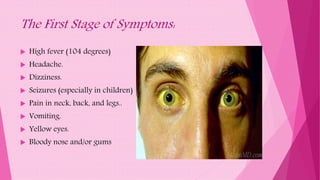
The First Stage of Symptoms:
 High fever (104 degrees)
 Headache.
 Dizziness.
 Seizures (especially in children)
 Pain in neck, back, and legs..
 Vomiting.
 Yellow eyes.
 Bloody nose and/or gums
The Second stage (Recovery possible)
 After three days the fever and symptoms may get better which
begins the second stage.
 New symptoms:
 Bleeding.
 Confusion.
 Anuria (complete stop in the production of urine)
The Third Stage (Toxic period)
 Fever returns.
 Other symptoms:
 Jaundice (yellowing of skin and eyes)
 Continued nose bleeds.
 Heart damage
 Coma
 Vomiting blood.
 Problems in live, kidneys, lungs, or
other organs (possibly could lead to
kidney failure).
 Used since the 1930.
 Scientists at the Rockefeller Foundation in New York developed a
live vaccine (17D).
 The 17D vaccine was first tested in 1936 in New York and in
1937 in Brazil.
Diagnosis
 Blood tests (PCR) can sometimes detect the virus in
the early stages of the disease. In later stages of the
disease, testing to identify antibodies is needed
(ELISA).
Treatment
 Patients should be hospitalized for supportive care and close
observation
 Rest, fluids, and use of pain relievers and medication to reduce
fever may relieve symptoms of aching and fever.
 Yellow fever patients should be protected from further mosquito
exposure for up to 5 days after the onset of fever.
Yellow fever presentation

Yellow fever presentation

  • 1.
  • 3.
  • 5.
    What is YellowFever? Yellow Fever is a mosquito-born viral disease that occurs in tropical and subtropical areas. It can occur in males and females of any age. Yellow fever belongs to the Flaviviridae family. The Aedes aegypti is the mosquito that is known to carry the virus.
  • 6.
    History of yellowfever  Originated in Central Africa.  170,000 cases and up to 60,000 deaths.  Spread to east and west Africa, and to America.  First outbreak in Yucatan peninsula, Mexico in 1648.  1975 suspected cases and 258 deaths in Angola in 2015.
  • 7.
    In 1881, CarlosFinlay, a physician in Havana,(the capital & largest city of Cuba) first proposed that yellow fever was a mosquito-born illness, which subsequently was proven by Walter Reed and colleagues. U.S. Army doctor Discovered the Cause of Yellow Fever August 27, 1900 Dr. Walter Reed Dr. Carlos Finlay
  • 8.
    Walter Reed, M.D.,(1851-1902) was an American Army surgeon who led the team which proved the theory first set forth in 1881 by the Cuban doctor and scientist Dr. Carlos Finlay that yellow fever is transmitted by mosquitoes rather than direct contact. The risky but fruitful research work was done with human volunteers, including some of the medical personnel such as Clara Maass and surgeon Jesse W. Lazear. Walter Reed Medal winner who allowed themselves to be deliberately infected and died of the virus. All this lead to the elimination of Yellow Fever from Cuba and allowed the final construction of the Panama Canal.
  • 9.
  • 10.
    On August 14,1901, Maass allowed herself to be bitten by infected mosquitoes for the seventh time. Maass once again became ill with yellow fever on August 18 and died on August 24. Her death roused public sentiment and put an end to yellow fever experiments on humans.
  • 11.
  • 12.
    There are twodifferent transmission types of yellow fever. (1) Urban yellow fever (2) Sylvatic or (Jungle) Yellow fever
  • 13.
    Urban Yellow Fever: Disease of humans.  Spread by mosquitos that have been affected by other people.  Causes of most yellow fever outbreaks and epidemics.  1. Yellow fever can spread by coughing, sneezing, breathing, and handshaking.  2. Back then, people who died from yellow fever were thrown out on the streets, this made the city even more contaminated and more people were likely to get ill.
  • 14.
    Sylvatic (or Jungle)Yellow Fever:  Disease of monkeys.  Starts when the mosquito bites a monkey and starts to spread.  People get infected when they are in the middle of this natural cycle and are bitten by mosquitos that have been infected by monkeys.  It occurs in tropical Central and South America.
  • 15.
    Symptoms of YellowFever  After a victim is struck with the fever, symptoms start to show after three to six days. The time period of this is called the incubation period. Mild Yellow Fever symptoms include fever, headache, bloody nose, nausea, and slow heartbeat. There are about three stages to these symptoms. These symptoms are not always a sign of yellow fever.
  • 16.
    The First Stageof Symptoms:  High fever (104 degrees)  Headache.  Dizziness.  Seizures (especially in children)  Pain in neck, back, and legs..  Vomiting.  Yellow eyes.  Bloody nose and/or gums
  • 17.
    The Second stage(Recovery possible)  After three days the fever and symptoms may get better which begins the second stage.  New symptoms:  Bleeding.  Confusion.  Anuria (complete stop in the production of urine)
  • 18.
    The Third Stage(Toxic period)  Fever returns.  Other symptoms:  Jaundice (yellowing of skin and eyes)  Continued nose bleeds.  Heart damage  Coma  Vomiting blood.  Problems in live, kidneys, lungs, or other organs (possibly could lead to kidney failure).
  • 19.
     Used sincethe 1930.  Scientists at the Rockefeller Foundation in New York developed a live vaccine (17D).  The 17D vaccine was first tested in 1936 in New York and in 1937 in Brazil.
  • 20.
    Diagnosis  Blood tests(PCR) can sometimes detect the virus in the early stages of the disease. In later stages of the disease, testing to identify antibodies is needed (ELISA).
  • 21.
    Treatment  Patients shouldbe hospitalized for supportive care and close observation  Rest, fluids, and use of pain relievers and medication to reduce fever may relieve symptoms of aching and fever.  Yellow fever patients should be protected from further mosquito exposure for up to 5 days after the onset of fever.