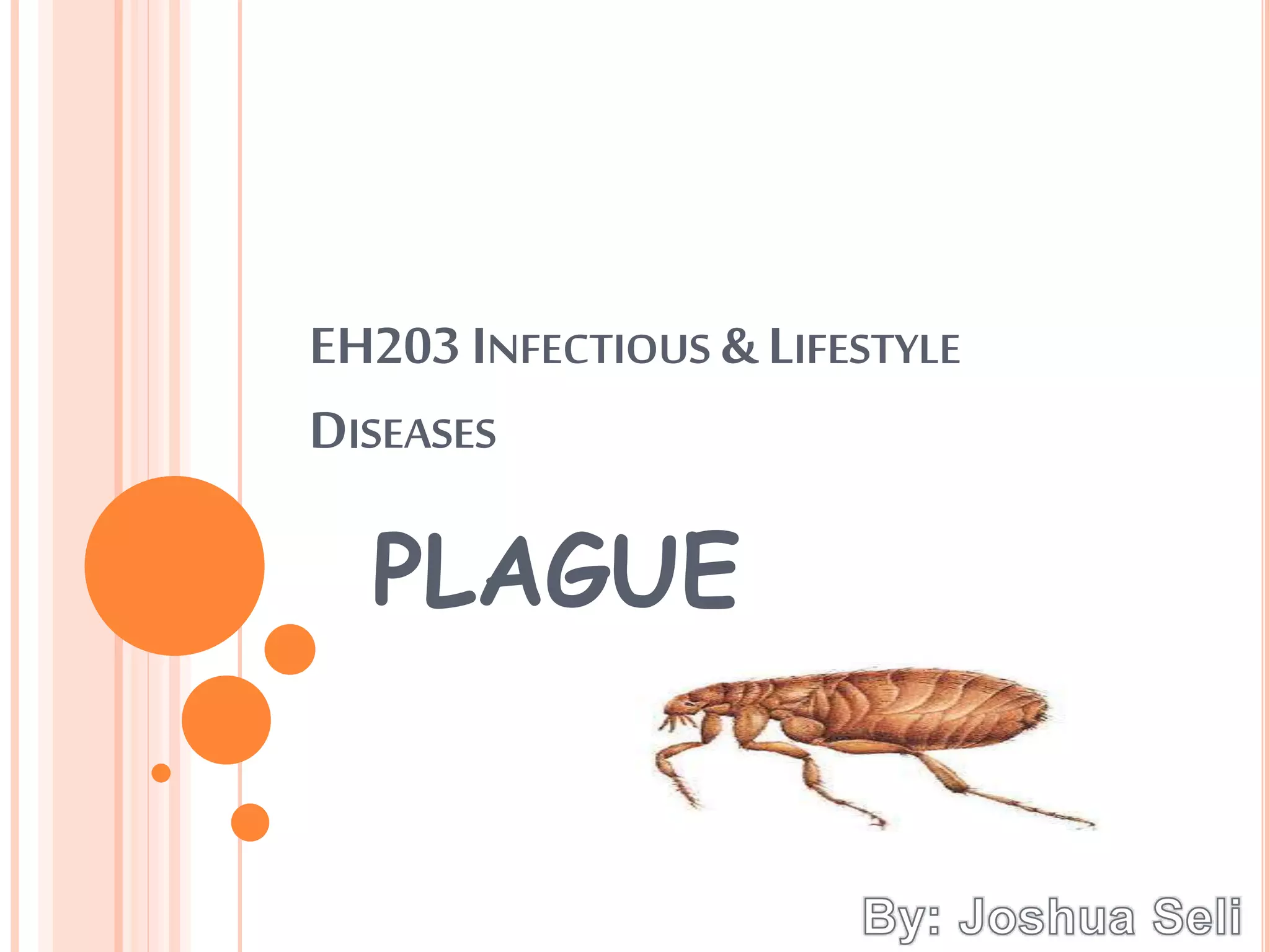

EH203 INFECTIOUS & LIFESTYLE
DISEASES
PLAGUE
CONTENT
 Introduction/summary
 Identify the types of plague
 Signs and Symptoms
 Diagnosis
 Transmission
 Incubation period & Period of communicability
 Occurrence and distribution
 Control and prevention
 Treatment
 Surveillance
WHAT IS PLAGUE?/SUMMURY
 Plague is a deadly epidemic or pestilence
infectious disease and potentially lethal,
causing high mortality and serious historic
events.
 The causative organism is a bacterium
called Yersinia Pestis.
 Generally rats are the carrying agents of
the fleas. These fleas carry the bacteria
with them. Once bitten by the infected flea,
the infection gets transmitted.
 But rat and fleas are not only the major
transmitting agent, the bacteria survives in
many other species and quickly spreads.
And it’s known to cause major pandemics
 Today plague is uncommon, due to better
living conditions and antibiotics.
BRIEF HISTORY
 The plague has been considered as a cause of the
few really major historic pandemics or the epidemic
spread over large and multiple regions worldwide.
 Plague killed millions in the 14th century and was
called the Black Death and in 1900, there was an
outbreak of plague in San Francisco caused by
infected rats brought by a ship.
 In the mid-1800s, it killed 12 million people in
China. Today, thanks to better living conditions,
antibiotics, and improved sanitation, current World
Health Organization statistics show there were only
2,118 cases in 2003 worldwide.
TYPES OF PLAGUE
 Here are the three form of plague
EPIDEOLOGY
 Papua New Guinea doesn’t
experience this but in other
parts of the world they do, in
particularly in the United State
witness’s approximately 18
cases every year. Outside the
United States, there are
average reported 1,666 cases
from 1967-1993. And here are
average few countries that
have shown highest cases of
plague, Tanzania, Zaire, Peru,
Vietnam, Madagascar, Burma,
Uganda, China, etc.
CAUSES
 Rodents such as rats carry
a flea Known as Oriental rat
flea which as the infectious
bacterium Yersinia pestis.
As the flea bites the
humans or animals the
bacteria is transmitted.
SIGNS & SYMPTOMS
 Plague symptoms depend on how
the patient was exposed to the
plague bacteria. Plague can take
different clinical forms, but the
most common are bubonic,
pneumonic and septicemic.
Following are the various signs
and symptoms noted in the
various types of plagues:
 Enlarged lymph nodes.
 Sore throat, Cough (may contain
blood), Shortness of breath.
 Body aches, General feeling of
illness, Blackish skin tissue
 Headache, Fever, Weakness, Stiff
neck ,Confusion, seizures
 Nausea, vomiting, abdominal
pain, Constipation, diarrhea, and
black or tarry stools
DIAGNOSIS
 Plague is a plausible diagnosis for people who
are sick and live in, or have recently traveled to
plague-endemic area.
 Diagnosis is made by taking samples from the
patient, especially blood or part of a swollen
lymph gland, and submitting them for
laboratory testing. Once plague has been
identified as a possible cause of the illness,
appropriate treatment should begin
immediately. Below are some ways to test;
 Blood culture and Sputum culture: These
are advised to look for the presence of the
bacterium Yersinia pestis.
 Serologic tests: These aid to arrive at the
diagnosis. Serum tested for fraction 1 envelope
antigen and antibody. A single positive test in a
patient who neither had plague before nor
received plague vaccine is suggestive of an
infection.
 X-ray Chest: An x-ray of the chest tells about
the lung infection and its severity
TRANSMISSION
 The plague bacteria can
be transmitted to human
in many ways, through;
 A flea bite
 Contact with
contaminated fluid
 Infectious droplets, like
for example if someone is
infected and when
sneezing or coughing the
uninfected person
breathing air
contaminated with the
bacteria is likely to get
pneumonic plague.
PREVENTION & RICKS FACTORS
 Rat control and watching for the
disease in the wild rodent
population are the main measures
used to control the risk of
epidemics.
 A vaccination is available for high-
risk workers, but its effectiveness is
not clearly established.
 There are many ways to prevent
this disease and here below are
some preventative measures to
avoid plague. Avoid;
 Contact with the infected animals
or rodents.
 Living in endemic area i.e. place
where plague is common.
 Exposure to flea bites, Working in
the farm and Travel through rural
areas
TREATMENT
 Plague is a very serious illness,
but is treatable with commonly
available antibiotics. The earlier a
patient seeks medical care and
receives treatment that is
appropriate for plague, the better
their chances are of a full
recovery. Today we have variety
antibiotics which are effective
against the disease. These
include doxycycline, gentamicin
and aminoglycosides
streptomycin. If the disease is
identified soon after infection, the
Plague is almost always treatable
and patients make full recoveries
INCUBATION PERIOD & PERIOD OF
COMMUNICABILITY
 Signs & Symptoms starts 2 – 6
days after exposure to bubonic
plague.
 2 – 4 days after exposure to
pneumonic plague (since severe
and occur very rapidly).
 Not really clear for Septicemic
plague because the disease
normally present in blood stream
where it proceed into lungs. But
generally 2-6 days.
 An unblocked infected flea can
remain alive for several months
that able to transmit infection.
 Blocked infected fleas contained
bacteria that multiply inside,
sticking together and form a plug
that blocks its stomach and
cause it to starve.
 In the process of feeding by
force, it vomits infected blood
back into the bite wound; infect
the area and die, that infection is
not transmitted to new host.
 Pneumonic plague can be
spread rapidly (they are highly
infectious) within a large number
of people although infected
individuals will remain alive for
only a few days.
SURVEILLANCE
 Regular trapping of rodents should be maintained to check
for infection and their flea populations. Notification of any
confirmed or suspect case of plague must be made known
to WHO and any person travelling from an area where
there have been cases of plague must be placed under
surveillance for 6 days.
SUMMARY
 Plague is an infectious disease caused by the Yersinia
pestis bacteria, which is primarily found in rodents the
fleas that feed off of them.
 The bacteria are passed to humans through flea or rodent
bites.
 There are three forms of plague: bubonic, septicemic, and
pneumonic.
 The symptoms and method of transmission vary with each
form of plague.
 Plague can be treated with antibiotics.
REFERRENCES
 Dennis DT, Mead PS, Yersinia species, including
plague. In: Mandell GL, Bennett JE, Dolin R, eds.
Principles and Practice of Infectious Diseases. 7th
ed. Philadelphia, Pa: Elsevier Churchill Livingstone;
2009: chap 229.
 http://health.utah.gov/epi/factsheets/plague.pdf
 Webber, R. (1919 – 1993), Communicable
Epidemiology and Control (2nd ed.). UK: London
School of Hygiene and Tropical Medicine
Eh203 infectious & lifestyle diseases-Plague by JOSHUA SELI

Eh203 infectious & lifestyle diseases-Plague by JOSHUA SELI

  • 1.
    EH203 INFECTIOUS &LIFESTYLE DISEASES PLAGUE
  • 2.
    CONTENT  Introduction/summary  Identifythe types of plague  Signs and Symptoms  Diagnosis  Transmission  Incubation period & Period of communicability  Occurrence and distribution  Control and prevention  Treatment  Surveillance
  • 3.
    WHAT IS PLAGUE?/SUMMURY Plague is a deadly epidemic or pestilence infectious disease and potentially lethal, causing high mortality and serious historic events.  The causative organism is a bacterium called Yersinia Pestis.  Generally rats are the carrying agents of the fleas. These fleas carry the bacteria with them. Once bitten by the infected flea, the infection gets transmitted.  But rat and fleas are not only the major transmitting agent, the bacteria survives in many other species and quickly spreads. And it’s known to cause major pandemics  Today plague is uncommon, due to better living conditions and antibiotics.
  • 4.
    BRIEF HISTORY  Theplague has been considered as a cause of the few really major historic pandemics or the epidemic spread over large and multiple regions worldwide.  Plague killed millions in the 14th century and was called the Black Death and in 1900, there was an outbreak of plague in San Francisco caused by infected rats brought by a ship.  In the mid-1800s, it killed 12 million people in China. Today, thanks to better living conditions, antibiotics, and improved sanitation, current World Health Organization statistics show there were only 2,118 cases in 2003 worldwide.
  • 5.
    TYPES OF PLAGUE Here are the three form of plague
  • 6.
    EPIDEOLOGY  Papua NewGuinea doesn’t experience this but in other parts of the world they do, in particularly in the United State witness’s approximately 18 cases every year. Outside the United States, there are average reported 1,666 cases from 1967-1993. And here are average few countries that have shown highest cases of plague, Tanzania, Zaire, Peru, Vietnam, Madagascar, Burma, Uganda, China, etc.
  • 7.
    CAUSES  Rodents suchas rats carry a flea Known as Oriental rat flea which as the infectious bacterium Yersinia pestis. As the flea bites the humans or animals the bacteria is transmitted.
  • 8.
    SIGNS & SYMPTOMS Plague symptoms depend on how the patient was exposed to the plague bacteria. Plague can take different clinical forms, but the most common are bubonic, pneumonic and septicemic. Following are the various signs and symptoms noted in the various types of plagues:  Enlarged lymph nodes.  Sore throat, Cough (may contain blood), Shortness of breath.  Body aches, General feeling of illness, Blackish skin tissue  Headache, Fever, Weakness, Stiff neck ,Confusion, seizures  Nausea, vomiting, abdominal pain, Constipation, diarrhea, and black or tarry stools
  • 9.
    DIAGNOSIS  Plague isa plausible diagnosis for people who are sick and live in, or have recently traveled to plague-endemic area.  Diagnosis is made by taking samples from the patient, especially blood or part of a swollen lymph gland, and submitting them for laboratory testing. Once plague has been identified as a possible cause of the illness, appropriate treatment should begin immediately. Below are some ways to test;  Blood culture and Sputum culture: These are advised to look for the presence of the bacterium Yersinia pestis.  Serologic tests: These aid to arrive at the diagnosis. Serum tested for fraction 1 envelope antigen and antibody. A single positive test in a patient who neither had plague before nor received plague vaccine is suggestive of an infection.  X-ray Chest: An x-ray of the chest tells about the lung infection and its severity
  • 10.
    TRANSMISSION  The plaguebacteria can be transmitted to human in many ways, through;  A flea bite  Contact with contaminated fluid  Infectious droplets, like for example if someone is infected and when sneezing or coughing the uninfected person breathing air contaminated with the bacteria is likely to get pneumonic plague.
  • 11.
    PREVENTION & RICKSFACTORS  Rat control and watching for the disease in the wild rodent population are the main measures used to control the risk of epidemics.  A vaccination is available for high- risk workers, but its effectiveness is not clearly established.  There are many ways to prevent this disease and here below are some preventative measures to avoid plague. Avoid;  Contact with the infected animals or rodents.  Living in endemic area i.e. place where plague is common.  Exposure to flea bites, Working in the farm and Travel through rural areas
  • 12.
    TREATMENT  Plague isa very serious illness, but is treatable with commonly available antibiotics. The earlier a patient seeks medical care and receives treatment that is appropriate for plague, the better their chances are of a full recovery. Today we have variety antibiotics which are effective against the disease. These include doxycycline, gentamicin and aminoglycosides streptomycin. If the disease is identified soon after infection, the Plague is almost always treatable and patients make full recoveries
  • 13.
    INCUBATION PERIOD &PERIOD OF COMMUNICABILITY  Signs & Symptoms starts 2 – 6 days after exposure to bubonic plague.  2 – 4 days after exposure to pneumonic plague (since severe and occur very rapidly).  Not really clear for Septicemic plague because the disease normally present in blood stream where it proceed into lungs. But generally 2-6 days.  An unblocked infected flea can remain alive for several months that able to transmit infection.  Blocked infected fleas contained bacteria that multiply inside, sticking together and form a plug that blocks its stomach and cause it to starve.  In the process of feeding by force, it vomits infected blood back into the bite wound; infect the area and die, that infection is not transmitted to new host.  Pneumonic plague can be spread rapidly (they are highly infectious) within a large number of people although infected individuals will remain alive for only a few days.
  • 14.
    SURVEILLANCE  Regular trappingof rodents should be maintained to check for infection and their flea populations. Notification of any confirmed or suspect case of plague must be made known to WHO and any person travelling from an area where there have been cases of plague must be placed under surveillance for 6 days. SUMMARY  Plague is an infectious disease caused by the Yersinia pestis bacteria, which is primarily found in rodents the fleas that feed off of them.  The bacteria are passed to humans through flea or rodent bites.  There are three forms of plague: bubonic, septicemic, and pneumonic.  The symptoms and method of transmission vary with each form of plague.  Plague can be treated with antibiotics.
  • 15.
    REFERRENCES  Dennis DT,Mead PS, Yersinia species, including plague. In: Mandell GL, Bennett JE, Dolin R, eds. Principles and Practice of Infectious Diseases. 7th ed. Philadelphia, Pa: Elsevier Churchill Livingstone; 2009: chap 229.  http://health.utah.gov/epi/factsheets/plague.pdf  Webber, R. (1919 – 1993), Communicable Epidemiology and Control (2nd ed.). UK: London School of Hygiene and Tropical Medicine