 Dmitri Popov, PhD, Advanced Medical
Technology and Systems Inc. , Canada.
 intervaccine@gmail.com
 Key Words:
 ROS – Reactive Oxygen Species.
 Neutrophils.
 Macrophages.
 Innate Immunity.
 Adaptive Iimmunity.
 Na Cl O – Sodium Hypochlorite.
 ROS – Reactive Oxygen Species.
 Reactive oxygen species (ROS) are chemically
reactive molecules containing oxygen.
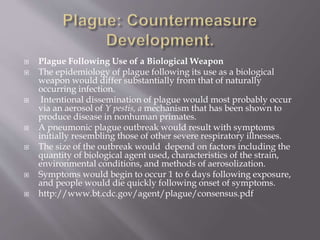
Examples include oxygen ions and peroxides.
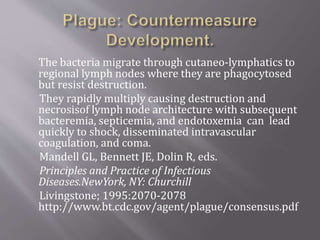
ROS are formed as a natural byproduct of the
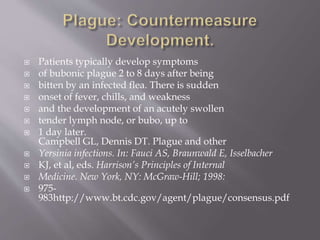
normal metabolism of oxygen and have
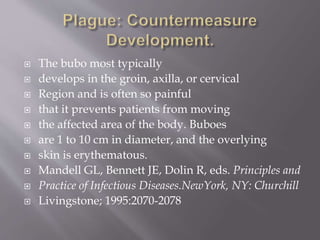
important roles in cell
signaling and homeostasis.
 Treatment of acute, severe, deadly infections
diseases (Plague, Ebola, SARS – Severe Acute
Respiratory Syndrome , MERS – Middle East
Respiratory Syndrome) with I/V solutions
with Reactive Oxygen Species ( Sodium
Hypochlorite).
 Plague is primarily a disease of rodents and
their fleas, which can infect humans. It is
transmitted between rodents by rodent fleas,
and can be transmitted to people when infected
rodent fleas bite them.
 As with many primarily zoo-notic diseases,
plague is a very severe disease in people, with
case fatality rates of 50-60% if left untreated.
[WHO ]
 Objective:
 Biological Weapon remain most dangerous threat in
the world.
 Bioterrorism is terrorism involving the intentional
release or dissemination of biological agents. These
agents are bacteria,viruses, or toxins, and may be in a
naturally occurring or a human-modified form. For the
use of this method in warfare, seebiological warfare.
 The Working Group on Civilian Biodefense has
developed consensus based
recommendations for measures to be taken by medical
and public health professionals following the use of
plague as a biological weapon against a civilian
population.
 A biological weapon is useful
to terrorists mainly as a method of creating
mass panic and disruption to a state or a
country.
http://en.wikipedia.org/wiki/Bioterrorism
 Under current United States law, bio-agents which
have been declared by the U.S. Department of Health
and Human Services or the U.S. Department of
Agriculture to have the "potential to pose a severe
threat to public health and safety" are officially defined
as "select agents". The CDC categorizes these agents (A,
B or C) and administers the Select Agent Program,
which regulates the laboratories which may possess,
use, or transfer select agents within the United States.
As with US attempts to categorize harmful recreational
drugs, designer viruses are not yet categorized and
avian H5N1 has been shown to achieve high mortality
and human-communication in a laboratory setting.
 http://en.wikipedia.org/wiki/Bioterrorism#Category
_A
 Bubonic plague. Plague is a disease caused by
the Yersinia pestis bacterium. Rodents are the normal
host of plague, and the disease is transmitted to
humans by flea bites and occasionally by aerosol in the
form of pneumonic plague. The disease has a history of
use in biological warfare dating back many centuries,
and is considered a threat due to its ease of culture and
ability to remain in circulation among local rodents for
a long period of time. The weaponized threat comes
mainly in the form of pneumonic plague (infection by
inhalation). It was the disease that caused the Black
Death in Medieval Europe.
 http://en.wikipedia.org/wiki/Bioterrorism#Category
_A
 Category A
 These high-priority agents pose a risk to
national security, can be easily transmitted and
disseminated, result in high mortality, have
potential major public health impact, may
cause public panic, or require special action for
public health preparedness.
 http://en.wikipedia.org/wiki/Bioterrorism#C
ategory_A
 An aerosolized plague weapon could cause fever,
cough, chest pain,
 and hemoptysis with signs consistent with severe
pneumonia 1 to 6 days after exposure.
 Rapid evolution of disease would occur in the 2 to 4
days after symptom onset
 and would lead to septic shock with high mortality
without early treatment. Early treatment
 and prophylaxis with streptomycin or gentamicin or
the tetracycline or fluoroquinolone
 classes of antimicrobials would be advised.
 JAMA. 2000;283:2281-2290 www.jama.com
 http://www.bt.cdc.gov/agent/plague/consensus.pdf
 Plague Following Use of a Biological Weapon
 The epidemiology of plague following its use as a biological
weapon would differ substantially from that of naturally
occurring infection.
 Intentional dissemination of plague would most probably occur
via an aerosol of Y pestis, a mechanism that has been shown to
produce disease in nonhuman primates.
 A pneumonic plague outbreak would result with symptoms
initially resembling those of other severe respiratory illnesses.
 The size of the outbreak would depend on factors including the
quantity of biological agent used, characteristics of the strain,
environmental conditions, and methods of aerosolization.
 Symptoms would begin to occur 1 to 6 days following exposure,
and people would die quickly following onset of symptoms.
 http://www.bt.cdc.gov/agent/plague/consensus.pdf
The bacteria migrate through cutaneo-lymphatics to
regional lymph nodes where they are phagocytosed
but resist destruction.
They rapidly multiply causing destruction and
necrosis of lymph node architecture with subsequent
bacteremia, septicemia, and endotoxemia can lead
quickly to shock, disseminated intravascular
coagulation, and coma.
Mandell GL, Bennett JE, Dolin R, eds.
Principles and Practice of Infectious Diseases.
NewYork, NY: Churchill
Livingstone; 1995:2070-2078
http://www.bt.cdc.gov/agent/plague/consensus.pdf
 Patients typically develop symptoms
 of bubonic plague 2 to 8 days after being
 bitten by an infected flea. There is sudden
 onset of fever, chills, and weakness
 and the development of an acutely swollen
 tender lymph node, or bubo, up to
 1 day later.
Campbell GL, Dennis DT. Plague and other
 Yersinia infections. In: Fauci AS, Braunwald E, Isselbacher
 KJ, et al, eds. Harrison’s Principles of Internal
 Medicine. New York, NY: McGraw-Hill; 1998:
 975-
983http://www.bt.cdc.gov/agent/plague/consensus.pdf
 The bubo most typically
 develops in the groin, axilla, or cervical
 Region and is often so painful
 that it prevents patients from moving
 the affected area of the body. Buboes
 are 1 to 10 cm in diameter, and the overlying
 skin is erythematous.
 Mandell GL, Bennett JE, Dolin R, eds. Principles and
 Practice of Infectious Diseases.NewYork, NY: Churchill
 Livingstone; 1995:2070-2078
 Septicemic plague may lead to disseminated
intravascular coagulation, necrosis of
small vessels, and purpuric skin lesions.
Gangrene of regions such as the digits and
nose may also occur
in advanced disease, a process believed
responsible for the name black death in the
second plague pandemic.
 Secondary pneumonic plague develops
in a minority of patients with bubonic or primary
septicemic plague. This process, termed secondary
pneumonic plague, develops via hematogenous
spread of plague bacilli to the lungs. Patients
commonly have symptoms of severe
bronchopneumonia, chest pain, dyspnea, cough,
and hemoptysis.
Mandell GL, Bennett JE, Dolin R, eds. Principles and
Practice of Infectious Diseases.NewYork, NY: Churchill
Livingstone; 1995:2070-2078
 Plague Following Use of a Biological Weapon
 The pathogenesis and clinical manifestations of plague
following a biological attack would be notably different than
naturally occurring plague. Inhaled aerosolized Y pestis
bacilli would cause primary pneumonic plague. The time
from exposure to aerosolized plague bacilli until
development of first symptoms in humans and nonhuman
primates has been found to be 1 to 6 days and most often, 2
to 4 days.
 The first sign of illness would be expected to be fever with
cough and dyspnea, sometimes with the production
of bloody, watery, or less commonly, purulent sputum.
http://www.bt.cdc.gov/agent/plague/consensus.pdf
 Prominent gastrointestinal symptoms, including
nausea, vomiting, abdominal pain, and diarrhea,
might be present. The ensuing clinical findings of
primary pneumonic plague are similar to those of
any severe rapidly progressive pneumonia and are
quite similar to those of secondary pneumonic
plague. Clinical-pathological features may help
distinguish primary from secondary pneumonic
plague.
http://www.bt.cdc.gov/agent/plague/consensus.
pdf
 In contrast to secondary pneumonic plague,
features of primary pneumonic plague
would include absence of buboes (except,
rarely, cervical buboes) and, on
pathologic examination, pulmonary disease
with areas of profound lobular exudation
and bacillary aggregation.
http://www.bt.cdc.gov/agent/plague/consen
sus.pdf
 Laboratory studies may reveal leukocytosis
with toxic granulations, coagulation
abnormalities, aminotransferase elevations,
azotemia, and other evidence of multiorgan
failure. All are nonspecific findings associated with
sepsis and systemic inflammatory response
syndrome. The time from respiratory exposure to
death in humans is reported to have been between
2 to 6 days in epidemics during the pre-antibiotic
era, with a mean of 2 to 4 days in most epidemics.
http://www.bt.cdc.gov/agent/plague/consensus.
pdf
 Diagnosis of Pneumonic Plague Infection Following
Use of a Biological Weapon
 Epidemiology and symptoms
 Sudden appearance of many persons with fever,
cough, shortness of breath, hemoptysis, and chest pain
 Gastrointestinal symptoms common (eg, nausea,
vomiting, abdominal pain, and diarrhea)
 Patients have fulminant course and high mortality
 Clinical signs: Tachypnea, dyspnea, and cyanosis
 Pneumonic consolidation on chest examination
 http://www.bt.cdc.gov/agent/plague/consensus.pdf
 Sepsis, shock, and organ failure
 Infrequent presence of cervical bubo
 (Purpuric skin lesions and necrotic digits only in advanced
disease)
 Laboratory studies Sputum, blood, or lymph node aspirate
 Gram-negative bacilli with bipolar (safety pin) staining on Wright,
Giemsa, or
 Wayson stain
 Rapid diagnostic tests available only at some health departments,
the Centers
 for Disease Control and Prevention, and military laboratories
 Pulmonary infiltrates or consolidation on chest radiograph
 Pathology Lobular exudation, bacillary aggregation, and areas of
necrosis in pulmonary
 Parenchyma
 http://www.bt.cdc.gov/agent/plague/consensus.pdf
 Working Group Recommendations for Treatment of Patients With
Pneumonic
 Plague in the Contained and Mass Casualty Settings and for Post-
exposure Prophylaxis*
 Patient Category Recommended Therapy
 Contained Casualty Setting
 Adults Preferred choices
 Streptomycin, 1 g IM twice daily
 Gentamicin, 5 mg/kg IM or IV once daily or 2 mg/kg loading dose
followed
 by 1.7 mg/kg IM or IV 3 times daily†
 Alternative choices
 Doxycycline, 100 mg IV twice daily or 200 mg IV once daily
 Ciprofloxacin, 400 mg IV twice daily‡
 Chloramphenicol, 25 mg/kg IV 4 times daily
 http://www.bt.cdc.gov/agent/plague/consensus.pdf
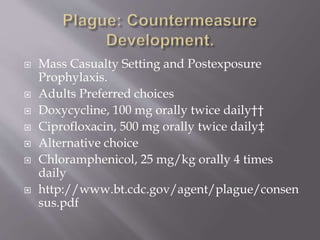
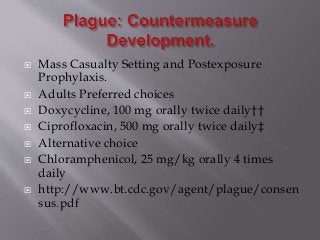
 Mass Casualty Setting and Postexposure
Prophylaxis.
 Adults Preferred choices
 Doxycycline, 100 mg orally twice daily††
 Ciprofloxacin, 500 mg orally twice daily‡
 Alternative choice
 Chloramphenicol, 25 mg/kg orally 4 times
daily
 http://www.bt.cdc.gov/agent/plague/consen
sus.pdf
 Plague – BIOLOGICAL WEAPON.
 Can be resistant to any form of antibiotics.
 Plague treatment with Na Cl O.
 Использование: медицина, для лечения острой и
хронической генерализированной вирусной
инфекции, а именно, гепатита С, герпеса, ВИЧ-
инфекции.
 Method of treatment with Sodium hypochlorite
currently in use in medical practice for treatment
of different forms of Viral Infections - Viral
hepatitis; human immunodeficiency virus (HIV)
is a lentivirus (a subgroup of retrovirus) that
causes the acquired immunodeficiency syndrome
(AIDS); different forms of herpes.
 Can we use this method for Plague treatment?
 Dilute bleach baths have been used for decades
to treat moderate to severe eczema in humans,
but it has not been clear why they work.
According to work published by researchers at
the Stanford University School of Medicine in
November 2013, a very dilute (0.005%) solution
of sodium hypochlorite in water was successful
in treating skin damage with
an inflammatory component caused
by radiation therapy, excess sun exposure or
aging in laboratory mice.
 Sodium hypochlorite solution for intravenous
infusions was produced by electrolysis with device
for electrochemical method of elaboration from
NaCl isotonic (0,89%) solution.
 200–400 ml of 002 %-0,03% sodium hypochlorite
solution usually administered drop-by-drop into
an the median cubital vein (or median basilic
vein) is a superficial vein of the upper limb vein at
the rate of 30-40 drops per minute. A course of
treatment included 20 procedures – 1-3 procedures
every 24 hours (depended on severity of diseases).
 Plague: Treatment with Na Cl O, IV, endo-
lymphatic.
 (Разрешение Фармкомитета МЗ СССР N 418 от
13.04.91).
 Approved by National Pharmaceutical
Department. Ministry of Public Health. Russia.
Advantages & disadvantages.
1. Sodium hypochlorite is a chemical
compound with the formula Na Cl O - well
known disinectant preparation and used for
destruction of viruses and bacteria on external
surfaces.
2. Sodium hypochlorite is a Disinfectant.
3. http://en.wikipedia.org/wiki/Disinfectant
 Advantages & disadvantages.
 Approved by National Pharmaceutical
Department. Ministry of Public Health. Russia.
 Method can be used for medical management
for millions acutely and severe ill people in
short time.
 Method already used in clinical conditions for
treatment patients with viral hepatitis and
intoxication with chemical and biological
toxins.
 Disinfectants are antimicrobial agents that are applied to non-living
objects to destroy microorganisms that are living on the objects.
Disinfection does not necessarily kill all microorganisms, especially
resistant bacterial spores; it is less effective than sterilization, which is an
extreme physical and/or chemical process that kills all types of life.
 Disinfectants are different from other antimicrobial agents such
as antibiotics, which destroy microorganisms within the body,
and antiseptics, which destroy microorganisms on living tissue.
Disinfectants are also different from biocides — the latter are intended to
destroy all forms of life, not just microorganisms. Disinfectants work by
destroying the cell wall of microbes or interfering with the metabolism.
 Bacterial endospores are most resistant to disinfectants, but some viruses
and bacteria also possess some tolerance.
 Disinfectants are frequently used in hospitals, dental surgeries, kitchens,
and bathrooms to kill infectious organisms.
 http://en.wikipedia.org/wiki/Disinfectant#Oxidizing_agents
 Oxidizing agents act by oxidizing the cell
membrane of microorganisms, which results in
a loss of structure and leads to cell lysis and
death. A large number of disinfectants operate
in this way. Chlorine and oxygen are strong
oxidizers.
 http://en.wikipedia.org/wiki/Disinfectant#O
xidizing_agents
 Sodium hypochlorite is very commonly used. Common
household bleach is a sodium hypochlorite solution
and is used in the home to disinfect different surfaces.
In more dilute form, it is used in swimming pools, and
in still more dilute form, it is used in drinking water.
When pools and drinking water are said to be
chlorinated, it is actually sodium hypochlorite or a
related compound—not pure chlorine—that is being
used. Chlorine partly reacts with proteinaceous liquids
such as blood to form non-oxidizing N-chloro
compounds, and thus higher concentrations must be
used if disinfecting surfaces after blood spills.
 In more diluted and ionized form can be used for I/V
administration and treatment for deadly, severe form
of viral or bacterial infection.
 Electrolyzed water or "Anolyte" is an oxidizing,
acidic hypochlorite solution made
by electrolysis of sodium chloride into sodium
hypochlorite and hypochlorous acid. Anolyte
has an oxidation-reduction potential of +600 to
+1200 mV and a typical pH range of 3.5––8.5,
but the most potent solution is produced at a
controlled pH 5.0–6.3 where the predominant
oxychlorine species is hypochlorous acid.
 A method of treating acute generalized Plague
comprising performing medical treatment ,
wherein the treatment consists in IV or endo-
lymphatic administration of an aqueous
solution of sodium hypochlorite.
 Sodium hypochlorite is a chemical
compound with the formula NaClO.
It is composed of
a sodium cation
(Na+) and a hypochlorite anion (ClO−); it may
also be viewed as the
sodium salt of hypochlorous acid.
 A new effective method of countermeasure
against biological weapons, antiviral treatment
of acute and chronic viral hepatitis B and C and
against other viral diseases was used in
medical practice in hospitals.
Research show this method as effective method
against severe viral infections, warfare, and
outbreak infections, Biological warfare,
methicillin-resistant staphylococcus aureus.
 Equipment: Mobile and Industrial.
 Cost effective, Simple, Effective Therapy.
 http://iadt.siemens.ru/assets/files/news/OS
EC.pdf
 http://www.niitop.ru/site.aspx?IID=2139510
&SECTIONID=2074568
 http://carakurt.narod.ru/hipohlorit_Na.htm
 http://www.naclo.ru/opublikovannyie-
stati/type/2/126/
 http://www.naclo.ru/en/
 http://www.dissercat.com/content/gipokhlor
it-natriya-v-lechenii-bolnykh-khronicheskimi-
diffuznymi-zabolevaniyami-pecheni
http://irbis.ismu.baikal.ru/smg/2008-6/18.pdf
 http://www.ikar.udm.ru/sb/sb36-2.htm
 http://www.dissercat.com/content/primenen
ie-gipokhlorita-natriya-i-sandostatina-v-
kompleksnom-lechenii-oslozhnenii-ostrogo-pa
 http://bankpatentov.ru/node/349358
 http://www.findpatent.ru/patent/208/208919
4.html
 Many Thanks to
 Thomas V. Inglesby, MD
 David T. Dennis, MD, MPH
 Donald A. Henderson, MD, MPH
 John G. Bartlett, MD
 Michael S. Ascher, MD
 Edward Eitzen, MD, MPH
 Anne D. Fine, MD
 Arthur M. Friedlander, MD
 Jerome Hauer, MPH
 John F. Koerner, MPH, CIH
 Marcelle Layton, MD
 Joseph McDade, PhD
 Michael T. Osterholm, PhD, MPH
 Tara O’Toole, MD, MPH
 Gerald Parker, PhD, DVM
 Trish M. Perl, MD, MSc
 Philip K. Russell, MD
 Monica Schoch-Spana, PhD
 Kevin Tonat, DrPH, MPH
 for the Working Group
 on Civilian Biodefense
 http://www.bt.cdc.gov/agent/plague/consensus.pdf
 And many others.

Plague : Medical Management and original method of treatment.

  • 2.
     Dmitri Popov,PhD, Advanced Medical Technology and Systems Inc. , Canada.  intervaccine@gmail.com
  • 3.
     Key Words: ROS – Reactive Oxygen Species.  Neutrophils.  Macrophages.  Innate Immunity.  Adaptive Iimmunity.  Na Cl O – Sodium Hypochlorite.
  • 4.
     ROS –Reactive Oxygen Species.  Reactive oxygen species (ROS) are chemically reactive molecules containing oxygen. Examples include oxygen ions and peroxides. ROS are formed as a natural byproduct of the normal metabolism of oxygen and have important roles in cell signaling and homeostasis.
  • 5.
     Treatment ofacute, severe, deadly infections diseases (Plague, Ebola, SARS – Severe Acute Respiratory Syndrome , MERS – Middle East Respiratory Syndrome) with I/V solutions with Reactive Oxygen Species ( Sodium Hypochlorite).
  • 6.
     Plague isprimarily a disease of rodents and their fleas, which can infect humans. It is transmitted between rodents by rodent fleas, and can be transmitted to people when infected rodent fleas bite them.  As with many primarily zoo-notic diseases, plague is a very severe disease in people, with case fatality rates of 50-60% if left untreated. [WHO ]
  • 7.
     Objective:  BiologicalWeapon remain most dangerous threat in the world.  Bioterrorism is terrorism involving the intentional release or dissemination of biological agents. These agents are bacteria,viruses, or toxins, and may be in a naturally occurring or a human-modified form. For the use of this method in warfare, seebiological warfare.  The Working Group on Civilian Biodefense has developed consensus based recommendations for measures to be taken by medical and public health professionals following the use of plague as a biological weapon against a civilian population.
  • 8.
     A biologicalweapon is useful to terrorists mainly as a method of creating mass panic and disruption to a state or a country. http://en.wikipedia.org/wiki/Bioterrorism
  • 9.
     Under currentUnited States law, bio-agents which have been declared by the U.S. Department of Health and Human Services or the U.S. Department of Agriculture to have the "potential to pose a severe threat to public health and safety" are officially defined as "select agents". The CDC categorizes these agents (A, B or C) and administers the Select Agent Program, which regulates the laboratories which may possess, use, or transfer select agents within the United States. As with US attempts to categorize harmful recreational drugs, designer viruses are not yet categorized and avian H5N1 has been shown to achieve high mortality and human-communication in a laboratory setting.  http://en.wikipedia.org/wiki/Bioterrorism#Category _A
  • 10.
     Bubonic plague.Plague is a disease caused by the Yersinia pestis bacterium. Rodents are the normal host of plague, and the disease is transmitted to humans by flea bites and occasionally by aerosol in the form of pneumonic plague. The disease has a history of use in biological warfare dating back many centuries, and is considered a threat due to its ease of culture and ability to remain in circulation among local rodents for a long period of time. The weaponized threat comes mainly in the form of pneumonic plague (infection by inhalation). It was the disease that caused the Black Death in Medieval Europe.  http://en.wikipedia.org/wiki/Bioterrorism#Category _A
  • 11.
     Category A These high-priority agents pose a risk to national security, can be easily transmitted and disseminated, result in high mortality, have potential major public health impact, may cause public panic, or require special action for public health preparedness.  http://en.wikipedia.org/wiki/Bioterrorism#C ategory_A
  • 12.
     An aerosolizedplague weapon could cause fever, cough, chest pain,  and hemoptysis with signs consistent with severe pneumonia 1 to 6 days after exposure.  Rapid evolution of disease would occur in the 2 to 4 days after symptom onset  and would lead to septic shock with high mortality without early treatment. Early treatment  and prophylaxis with streptomycin or gentamicin or the tetracycline or fluoroquinolone  classes of antimicrobials would be advised.  JAMA. 2000;283:2281-2290 www.jama.com  http://www.bt.cdc.gov/agent/plague/consensus.pdf
  • 13.
     Plague FollowingUse of a Biological Weapon  The epidemiology of plague following its use as a biological weapon would differ substantially from that of naturally occurring infection.  Intentional dissemination of plague would most probably occur via an aerosol of Y pestis, a mechanism that has been shown to produce disease in nonhuman primates.  A pneumonic plague outbreak would result with symptoms initially resembling those of other severe respiratory illnesses.  The size of the outbreak would depend on factors including the quantity of biological agent used, characteristics of the strain, environmental conditions, and methods of aerosolization.  Symptoms would begin to occur 1 to 6 days following exposure, and people would die quickly following onset of symptoms.  http://www.bt.cdc.gov/agent/plague/consensus.pdf
  • 14.
    The bacteria migratethrough cutaneo-lymphatics to regional lymph nodes where they are phagocytosed but resist destruction. They rapidly multiply causing destruction and necrosis of lymph node architecture with subsequent bacteremia, septicemia, and endotoxemia can lead quickly to shock, disseminated intravascular coagulation, and coma. Mandell GL, Bennett JE, Dolin R, eds. Principles and Practice of Infectious Diseases. NewYork, NY: Churchill Livingstone; 1995:2070-2078 http://www.bt.cdc.gov/agent/plague/consensus.pdf
  • 15.
     Patients typicallydevelop symptoms  of bubonic plague 2 to 8 days after being  bitten by an infected flea. There is sudden  onset of fever, chills, and weakness  and the development of an acutely swollen  tender lymph node, or bubo, up to  1 day later. Campbell GL, Dennis DT. Plague and other  Yersinia infections. In: Fauci AS, Braunwald E, Isselbacher  KJ, et al, eds. Harrison’s Principles of Internal  Medicine. New York, NY: McGraw-Hill; 1998:  975- 983http://www.bt.cdc.gov/agent/plague/consensus.pdf
  • 16.
     The bubomost typically  develops in the groin, axilla, or cervical  Region and is often so painful  that it prevents patients from moving  the affected area of the body. Buboes  are 1 to 10 cm in diameter, and the overlying  skin is erythematous.  Mandell GL, Bennett JE, Dolin R, eds. Principles and  Practice of Infectious Diseases.NewYork, NY: Churchill  Livingstone; 1995:2070-2078
  • 17.
     Septicemic plaguemay lead to disseminated intravascular coagulation, necrosis of small vessels, and purpuric skin lesions. Gangrene of regions such as the digits and nose may also occur in advanced disease, a process believed responsible for the name black death in the second plague pandemic.
  • 18.
     Secondary pneumonicplague develops in a minority of patients with bubonic or primary septicemic plague. This process, termed secondary pneumonic plague, develops via hematogenous spread of plague bacilli to the lungs. Patients commonly have symptoms of severe bronchopneumonia, chest pain, dyspnea, cough, and hemoptysis. Mandell GL, Bennett JE, Dolin R, eds. Principles and Practice of Infectious Diseases.NewYork, NY: Churchill Livingstone; 1995:2070-2078
  • 19.
     Plague FollowingUse of a Biological Weapon  The pathogenesis and clinical manifestations of plague following a biological attack would be notably different than naturally occurring plague. Inhaled aerosolized Y pestis bacilli would cause primary pneumonic plague. The time from exposure to aerosolized plague bacilli until development of first symptoms in humans and nonhuman primates has been found to be 1 to 6 days and most often, 2 to 4 days.  The first sign of illness would be expected to be fever with cough and dyspnea, sometimes with the production of bloody, watery, or less commonly, purulent sputum. http://www.bt.cdc.gov/agent/plague/consensus.pdf
  • 20.
     Prominent gastrointestinalsymptoms, including nausea, vomiting, abdominal pain, and diarrhea, might be present. The ensuing clinical findings of primary pneumonic plague are similar to those of any severe rapidly progressive pneumonia and are quite similar to those of secondary pneumonic plague. Clinical-pathological features may help distinguish primary from secondary pneumonic plague. http://www.bt.cdc.gov/agent/plague/consensus. pdf
  • 21.
     In contrastto secondary pneumonic plague, features of primary pneumonic plague would include absence of buboes (except, rarely, cervical buboes) and, on pathologic examination, pulmonary disease with areas of profound lobular exudation and bacillary aggregation. http://www.bt.cdc.gov/agent/plague/consen sus.pdf
  • 22.
     Laboratory studiesmay reveal leukocytosis with toxic granulations, coagulation abnormalities, aminotransferase elevations, azotemia, and other evidence of multiorgan failure. All are nonspecific findings associated with sepsis and systemic inflammatory response syndrome. The time from respiratory exposure to death in humans is reported to have been between 2 to 6 days in epidemics during the pre-antibiotic era, with a mean of 2 to 4 days in most epidemics. http://www.bt.cdc.gov/agent/plague/consensus. pdf
  • 23.
     Diagnosis ofPneumonic Plague Infection Following Use of a Biological Weapon  Epidemiology and symptoms  Sudden appearance of many persons with fever, cough, shortness of breath, hemoptysis, and chest pain  Gastrointestinal symptoms common (eg, nausea, vomiting, abdominal pain, and diarrhea)  Patients have fulminant course and high mortality  Clinical signs: Tachypnea, dyspnea, and cyanosis  Pneumonic consolidation on chest examination  http://www.bt.cdc.gov/agent/plague/consensus.pdf
  • 24.
     Sepsis, shock,and organ failure  Infrequent presence of cervical bubo  (Purpuric skin lesions and necrotic digits only in advanced disease)  Laboratory studies Sputum, blood, or lymph node aspirate  Gram-negative bacilli with bipolar (safety pin) staining on Wright, Giemsa, or  Wayson stain  Rapid diagnostic tests available only at some health departments, the Centers  for Disease Control and Prevention, and military laboratories  Pulmonary infiltrates or consolidation on chest radiograph  Pathology Lobular exudation, bacillary aggregation, and areas of necrosis in pulmonary  Parenchyma  http://www.bt.cdc.gov/agent/plague/consensus.pdf
  • 33.
     Working GroupRecommendations for Treatment of Patients With Pneumonic  Plague in the Contained and Mass Casualty Settings and for Post- exposure Prophylaxis*  Patient Category Recommended Therapy  Contained Casualty Setting  Adults Preferred choices  Streptomycin, 1 g IM twice daily  Gentamicin, 5 mg/kg IM or IV once daily or 2 mg/kg loading dose followed  by 1.7 mg/kg IM or IV 3 times daily†  Alternative choices  Doxycycline, 100 mg IV twice daily or 200 mg IV once daily  Ciprofloxacin, 400 mg IV twice daily‡  Chloramphenicol, 25 mg/kg IV 4 times daily  http://www.bt.cdc.gov/agent/plague/consensus.pdf
  • 34.
     Mass CasualtySetting and Postexposure Prophylaxis.  Adults Preferred choices  Doxycycline, 100 mg orally twice daily††  Ciprofloxacin, 500 mg orally twice daily‡  Alternative choice  Chloramphenicol, 25 mg/kg orally 4 times daily  http://www.bt.cdc.gov/agent/plague/consen sus.pdf
  • 35.
     Plague –BIOLOGICAL WEAPON.  Can be resistant to any form of antibiotics.
  • 36.
     Plague treatmentwith Na Cl O.  Использование: медицина, для лечения острой и хронической генерализированной вирусной инфекции, а именно, гепатита С, герпеса, ВИЧ- инфекции.  Method of treatment with Sodium hypochlorite currently in use in medical practice for treatment of different forms of Viral Infections - Viral hepatitis; human immunodeficiency virus (HIV) is a lentivirus (a subgroup of retrovirus) that causes the acquired immunodeficiency syndrome (AIDS); different forms of herpes.  Can we use this method for Plague treatment?
  • 37.
     Dilute bleachbaths have been used for decades to treat moderate to severe eczema in humans, but it has not been clear why they work. According to work published by researchers at the Stanford University School of Medicine in November 2013, a very dilute (0.005%) solution of sodium hypochlorite in water was successful in treating skin damage with an inflammatory component caused by radiation therapy, excess sun exposure or aging in laboratory mice.
  • 38.
     Sodium hypochloritesolution for intravenous infusions was produced by electrolysis with device for electrochemical method of elaboration from NaCl isotonic (0,89%) solution.  200–400 ml of 002 %-0,03% sodium hypochlorite solution usually administered drop-by-drop into an the median cubital vein (or median basilic vein) is a superficial vein of the upper limb vein at the rate of 30-40 drops per minute. A course of treatment included 20 procedures – 1-3 procedures every 24 hours (depended on severity of diseases).
  • 39.
     Plague: Treatmentwith Na Cl O, IV, endo- lymphatic.  (Разрешение Фармкомитета МЗ СССР N 418 от 13.04.91).  Approved by National Pharmaceutical Department. Ministry of Public Health. Russia.
  • 40.
    Advantages & disadvantages. 1.Sodium hypochlorite is a chemical compound with the formula Na Cl O - well known disinectant preparation and used for destruction of viruses and bacteria on external surfaces. 2. Sodium hypochlorite is a Disinfectant. 3. http://en.wikipedia.org/wiki/Disinfectant
  • 41.
     Advantages &disadvantages.  Approved by National Pharmaceutical Department. Ministry of Public Health. Russia.  Method can be used for medical management for millions acutely and severe ill people in short time.  Method already used in clinical conditions for treatment patients with viral hepatitis and intoxication with chemical and biological toxins.
  • 42.
     Disinfectants areantimicrobial agents that are applied to non-living objects to destroy microorganisms that are living on the objects. Disinfection does not necessarily kill all microorganisms, especially resistant bacterial spores; it is less effective than sterilization, which is an extreme physical and/or chemical process that kills all types of life.  Disinfectants are different from other antimicrobial agents such as antibiotics, which destroy microorganisms within the body, and antiseptics, which destroy microorganisms on living tissue. Disinfectants are also different from biocides — the latter are intended to destroy all forms of life, not just microorganisms. Disinfectants work by destroying the cell wall of microbes or interfering with the metabolism.  Bacterial endospores are most resistant to disinfectants, but some viruses and bacteria also possess some tolerance.  Disinfectants are frequently used in hospitals, dental surgeries, kitchens, and bathrooms to kill infectious organisms.  http://en.wikipedia.org/wiki/Disinfectant#Oxidizing_agents
  • 43.
     Oxidizing agentsact by oxidizing the cell membrane of microorganisms, which results in a loss of structure and leads to cell lysis and death. A large number of disinfectants operate in this way. Chlorine and oxygen are strong oxidizers.  http://en.wikipedia.org/wiki/Disinfectant#O xidizing_agents
  • 44.
     Sodium hypochloriteis very commonly used. Common household bleach is a sodium hypochlorite solution and is used in the home to disinfect different surfaces. In more dilute form, it is used in swimming pools, and in still more dilute form, it is used in drinking water. When pools and drinking water are said to be chlorinated, it is actually sodium hypochlorite or a related compound—not pure chlorine—that is being used. Chlorine partly reacts with proteinaceous liquids such as blood to form non-oxidizing N-chloro compounds, and thus higher concentrations must be used if disinfecting surfaces after blood spills.  In more diluted and ionized form can be used for I/V administration and treatment for deadly, severe form of viral or bacterial infection.
  • 45.
     Electrolyzed wateror "Anolyte" is an oxidizing, acidic hypochlorite solution made by electrolysis of sodium chloride into sodium hypochlorite and hypochlorous acid. Anolyte has an oxidation-reduction potential of +600 to +1200 mV and a typical pH range of 3.5––8.5, but the most potent solution is produced at a controlled pH 5.0–6.3 where the predominant oxychlorine species is hypochlorous acid.
  • 46.
     A methodof treating acute generalized Plague comprising performing medical treatment , wherein the treatment consists in IV or endo- lymphatic administration of an aqueous solution of sodium hypochlorite.
  • 47.
     Sodium hypochloriteis a chemical compound with the formula NaClO. It is composed of a sodium cation (Na+) and a hypochlorite anion (ClO−); it may also be viewed as the sodium salt of hypochlorous acid.
  • 48.
     A neweffective method of countermeasure against biological weapons, antiviral treatment of acute and chronic viral hepatitis B and C and against other viral diseases was used in medical practice in hospitals. Research show this method as effective method against severe viral infections, warfare, and outbreak infections, Biological warfare, methicillin-resistant staphylococcus aureus.
  • 49.
     Equipment: Mobileand Industrial.  Cost effective, Simple, Effective Therapy.  http://iadt.siemens.ru/assets/files/news/OS EC.pdf  http://www.niitop.ru/site.aspx?IID=2139510 &SECTIONID=2074568
  • 50.
     http://carakurt.narod.ru/hipohlorit_Na.htm  http://www.naclo.ru/opublikovannyie- stati/type/2/126/ http://www.naclo.ru/en/  http://www.dissercat.com/content/gipokhlor it-natriya-v-lechenii-bolnykh-khronicheskimi- diffuznymi-zabolevaniyami-pecheni http://irbis.ismu.baikal.ru/smg/2008-6/18.pdf
  • 51.
  • 52.
     Many Thanksto  Thomas V. Inglesby, MD  David T. Dennis, MD, MPH  Donald A. Henderson, MD, MPH  John G. Bartlett, MD  Michael S. Ascher, MD  Edward Eitzen, MD, MPH  Anne D. Fine, MD  Arthur M. Friedlander, MD  Jerome Hauer, MPH  John F. Koerner, MPH, CIH  Marcelle Layton, MD  Joseph McDade, PhD  Michael T. Osterholm, PhD, MPH  Tara O’Toole, MD, MPH  Gerald Parker, PhD, DVM  Trish M. Perl, MD, MSc  Philip K. Russell, MD  Monica Schoch-Spana, PhD  Kevin Tonat, DrPH, MPH  for the Working Group  on Civilian Biodefense  http://www.bt.cdc.gov/agent/plague/consensus.pdf  And many others.

Editor's Notes

  • #26 https://www.google.ca/search?q=plague+images&rlz=1C2CHMB_enCA306&biw=1280&bih=739&tbm=isch&imgil=x_mrlBYit_7MsM%253A%253Bs96kzyBHSCh-fM%253Bhttp%25253A%25252F%25252Ftardis.wikia.com%25252Fwiki%25252FBubonic_plague&source=iu&pf=m&fir=x_mrlBYit_7MsM%253A%252Cs96kzyBHSCh-fM%252C_&usg=__Og4SByrBXr5N1ZBtIbTaH9R2kdg%3D&ved=0CDIQyjc&ei=cmGMVJPDI8mPyASYrYG4Cw#facrc=_&imgdii=_&imgrc=ZkTD4d3CPoZH4M%253A%3BKhJvxtx5UVnJ9M%3Bhttp%253A%252F%252Fimages.nationalgeographic.com%252Fwpf%252Fmedia-live%252Fphotos%252F000%252F094%252Fcache%252Fplague-bacteria_9448_600x450.jpg%3Bhttp%253A%252F%252Fscience.nationalgeographic.com%252Fscience%252Fphotos%252Fplague%252F%3B600%3B450
  • #27 https://www.google.ca/search?q=plague+images&rlz=1C2CHMB_enCA306&biw=1280&bih=739&tbm=isch&imgil=x_mrlBYit_7MsM%253A%253Bs96kzyBHSCh-fM%253Bhttp%25253A%25252F%25252Ftardis.wikia.com%25252Fwiki%25252FBubonic_plague&source=iu&pf=m&fir=x_mrlBYit_7MsM%253A%252Cs96kzyBHSCh-fM%252C_&usg=__Og4SByrBXr5N1ZBtIbTaH9R2kdg%3D&ved=0CDIQyjc&ei=cmGMVJPDI8mPyASYrYG4Cw#facrc=_&imgdii=_&imgrc=ZkTD4d3CPoZH4M%253A%3BKhJvxtx5UVnJ9M%3Bhttp%253A%252F%252Fimages.nationalgeographic.com%252Fwpf%252Fmedia-live%252Fphotos%252F000%252F094%252Fcache%252Fplague-bacteria_9448_600x450.jpg%3Bhttp%253A%252F%252Fscience.nationalgeographic.com%252Fscience%252Fphotos%252Fplague%252F%3B600%3B450
  • #28 https://www.google.ca/search?q=plague+images&rlz=1C2CHMB_enCA306&biw=1280&bih=739&tbm=isch&imgil=x_mrlBYit_7MsM%253A%253Bs96kzyBHSCh-fM%253Bhttp%25253A%25252F%25252Ftardis.wikia.com%25252Fwiki%25252FBubonic_plague&source=iu&pf=m&fir=x_mrlBYit_7MsM%253A%252Cs96kzyBHSCh-fM%252C_&usg=__Og4SByrBXr5N1ZBtIbTaH9R2kdg%3D&ved=0CDIQyjc&ei=cmGMVJPDI8mPyASYrYG4Cw#facrc=_&imgdii=_&imgrc=ZkTD4d3CPoZH4M%253A%3BKhJvxtx5UVnJ9M%3Bhttp%253A%252F%252Fimages.nationalgeographic.com%252Fwpf%252Fmedia-live%252Fphotos%252F000%252F094%252Fcache%252Fplague-bacteria_9448_600x450.jpg%3Bhttp%253A%252F%252Fscience.nationalgeographic.com%252Fscience%252Fphotos%252Fplague%252F%3B600%3B450
  • #29 https://www.google.ca/search?q=plague+images&rlz=1C2CHMB_enCA306&biw=1280&bih=739&tbm=isch&imgil=x_mrlBYit_7MsM%253A%253Bs96kzyBHSCh-fM%253Bhttp%25253A%25252F%25252Ftardis.wikia.com%25252Fwiki%25252FBubonic_plague&source=iu&pf=m&fir=x_mrlBYit_7MsM%253A%252Cs96kzyBHSCh-fM%252C_&usg=__Og4SByrBXr5N1ZBtIbTaH9R2kdg%3D&ved=0CDIQyjc&ei=cmGMVJPDI8mPyASYrYG4Cw#facrc=_&imgdii=_&imgrc=ZkTD4d3CPoZH4M%253A%3BKhJvxtx5UVnJ9M%3Bhttp%253A%252F%252Fimages.nationalgeographic.com%252Fwpf%252Fmedia-live%252Fphotos%252F000%252F094%252Fcache%252Fplague-bacteria_9448_600x450.jpg%3Bhttp%253A%252F%252Fscience.nationalgeographic.com%252Fscience%252Fphotos%252Fplague%252F%3B600%3B450
  • #30 https://www.google.ca/search?q=plague+images&rlz=1C2CHMB_enCA306&biw=1280&bih=739&tbm=isch&imgil=x_mrlBYit_7MsM%253A%253Bs96kzyBHSCh-fM%253Bhttp%25253A%25252F%25252Ftardis.wikia.com%25252Fwiki%25252FBubonic_plague&source=iu&pf=m&fir=x_mrlBYit_7MsM%253A%252Cs96kzyBHSCh-fM%252C_&usg=__Og4SByrBXr5N1ZBtIbTaH9R2kdg%3D&ved=0CDIQyjc&ei=cmGMVJPDI8mPyASYrYG4Cw#facrc=_&imgdii=_&imgrc=ZkTD4d3CPoZH4M%253A%3BKhJvxtx5UVnJ9M%3Bhttp%253A%252F%252Fimages.nationalgeographic.com%252Fwpf%252Fmedia-live%252Fphotos%252F000%252F094%252Fcache%252Fplague-bacteria_9448_600x450.jpg%3Bhttp%253A%252F%252Fscience.nationalgeographic.com%252Fscience%252Fphotos%252Fplague%252F%3B600%3B450
  • #31 https://www.google.ca/search?q=plague+images&rlz=1C2CHMB_enCA306&biw=1280&bih=739&tbm=isch&imgil=x_mrlBYit_7MsM%253A%253Bs96kzyBHSCh-fM%253Bhttp%25253A%25252F%25252Ftardis.wikia.com%25252Fwiki%25252FBubonic_plague&source=iu&pf=m&fir=x_mrlBYit_7MsM%253A%252Cs96kzyBHSCh-fM%252C_&usg=__Og4SByrBXr5N1ZBtIbTaH9R2kdg%3D&ved=0CDIQyjc&ei=cmGMVJPDI8mPyASYrYG4Cw#facrc=_&imgdii=_&imgrc=ZkTD4d3CPoZH4M%253A%3BKhJvxtx5UVnJ9M%3Bhttp%253A%252F%252Fimages.nationalgeographic.com%252Fwpf%252Fmedia-live%252Fphotos%252F000%252F094%252Fcache%252Fplague-bacteria_9448_600x450.jpg%3Bhttp%253A%252F%252Fscience.nationalgeographic.com%252Fscience%252Fphotos%252Fplague%252F%3B600%3B450
  • #32 https://www.google.ca/search?q=plague+images&rlz=1C2CHMB_enCA306&biw=1280&bih=739&tbm=isch&imgil=x_mrlBYit_7MsM%253A%253Bs96kzyBHSCh-fM%253Bhttp%25253A%25252F%25252Ftardis.wikia.com%25252Fwiki%25252FBubonic_plague&source=iu&pf=m&fir=x_mrlBYit_7MsM%253A%252Cs96kzyBHSCh-fM%252C_&usg=__Og4SByrBXr5N1ZBtIbTaH9R2kdg%3D&ved=0CDIQyjc&ei=cmGMVJPDI8mPyASYrYG4Cw#facrc=_&imgdii=_&imgrc=ZkTD4d3CPoZH4M%253A%3BKhJvxtx5UVnJ9M%3Bhttp%253A%252F%252Fimages.nationalgeographic.com%252Fwpf%252Fmedia-live%252Fphotos%252F000%252F094%252Fcache%252Fplague-bacteria_9448_600x450.jpg%3Bhttp%253A%252F%252Fscience.nationalgeographic.com%252Fscience%252Fphotos%252Fplague%252F%3B600%3B450
  • #33 https://www.google.ca/search?q=plague+images&rlz=1C2CHMB_enCA306&biw=1280&bih=739&tbm=isch&imgil=x_mrlBYit_7MsM%253A%253Bs96kzyBHSCh-fM%253Bhttp%25253A%25252F%25252Ftardis.wikia.com%25252Fwiki%25252FBubonic_plague&source=iu&pf=m&fir=x_mrlBYit_7MsM%253A%252Cs96kzyBHSCh-fM%252C_&usg=__Og4SByrBXr5N1ZBtIbTaH9R2kdg%3D&ved=0CDIQyjc&ei=cmGMVJPDI8mPyASYrYG4Cw#facrc=_&imgdii=_&imgrc=ZkTD4d3CPoZH4M%253A%3BKhJvxtx5UVnJ9M%3Bhttp%253A%252F%252Fimages.nationalgeographic.com%252Fwpf%252Fmedia-live%252Fphotos%252F000%252F094%252Fcache%252Fplague-bacteria_9448_600x450.jpg%3Bhttp%253A%252F%252Fscience.nationalgeographic.com%252Fscience%252Fphotos%252Fplague%252F%3B600%3B450