Muhammad Ramzan Ul Rehman 1
PLACENTA 
BY MUHAMAD RAMZAN UL REHMAN
PLACENTA 
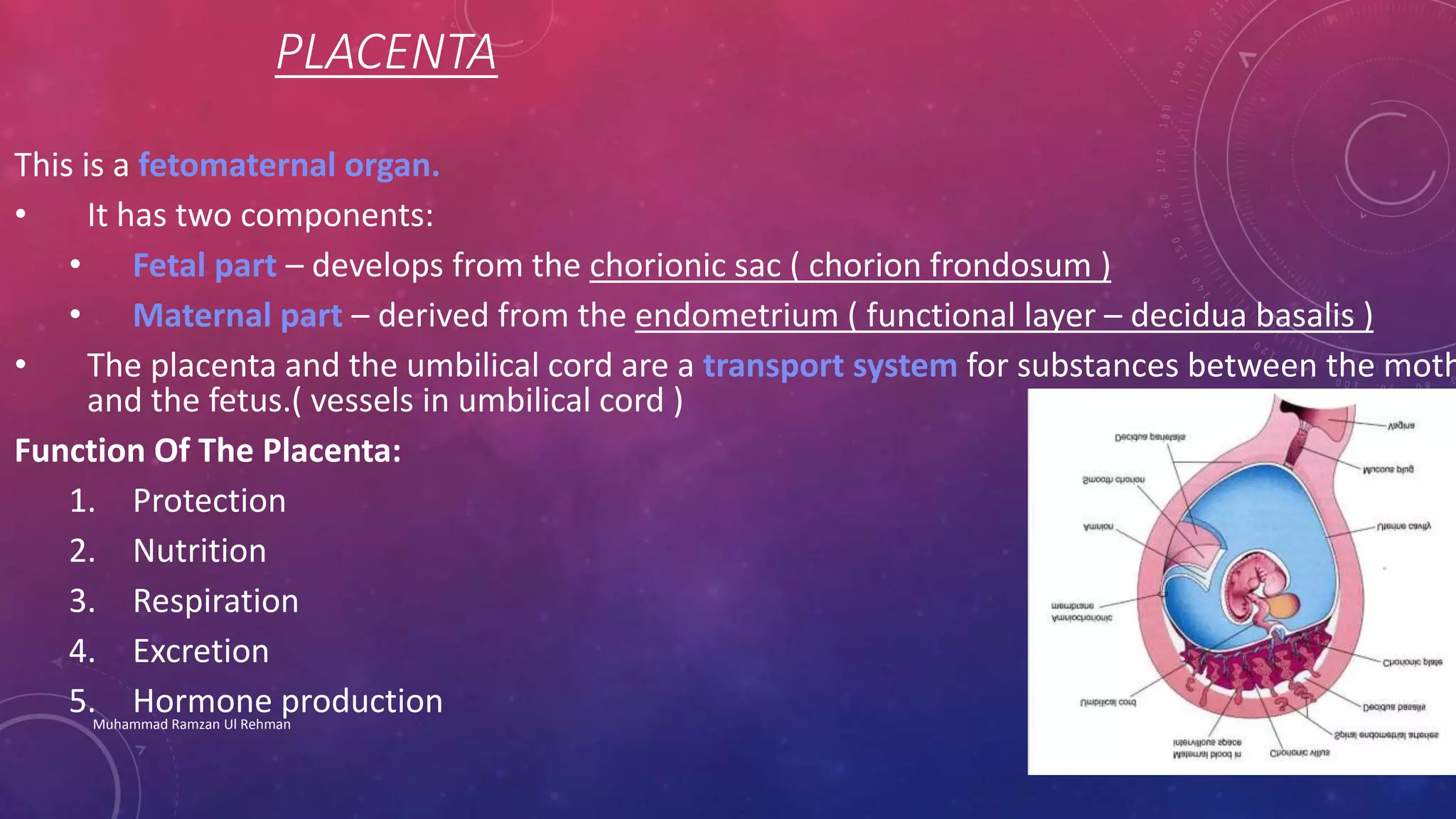
This is a fetomaternal organ. 
• It has two components: 
• Fetal part – develops from the chorionic sac ( chorion frondosum ) 
• Maternal part – derived from the endometrium ( functional layer – decidua basalis ) 
• The placenta and the umbilical cord are a transport system for substances between the mother 
and the fetus.( vessels in umbilical cord ) 
Function Of The Placenta: 
1. Protection 
2. Nutrition 
3. Respiration 
4. Excretion 
5. Hormone production 
Muhammad Ramzan Ul Rehman 3
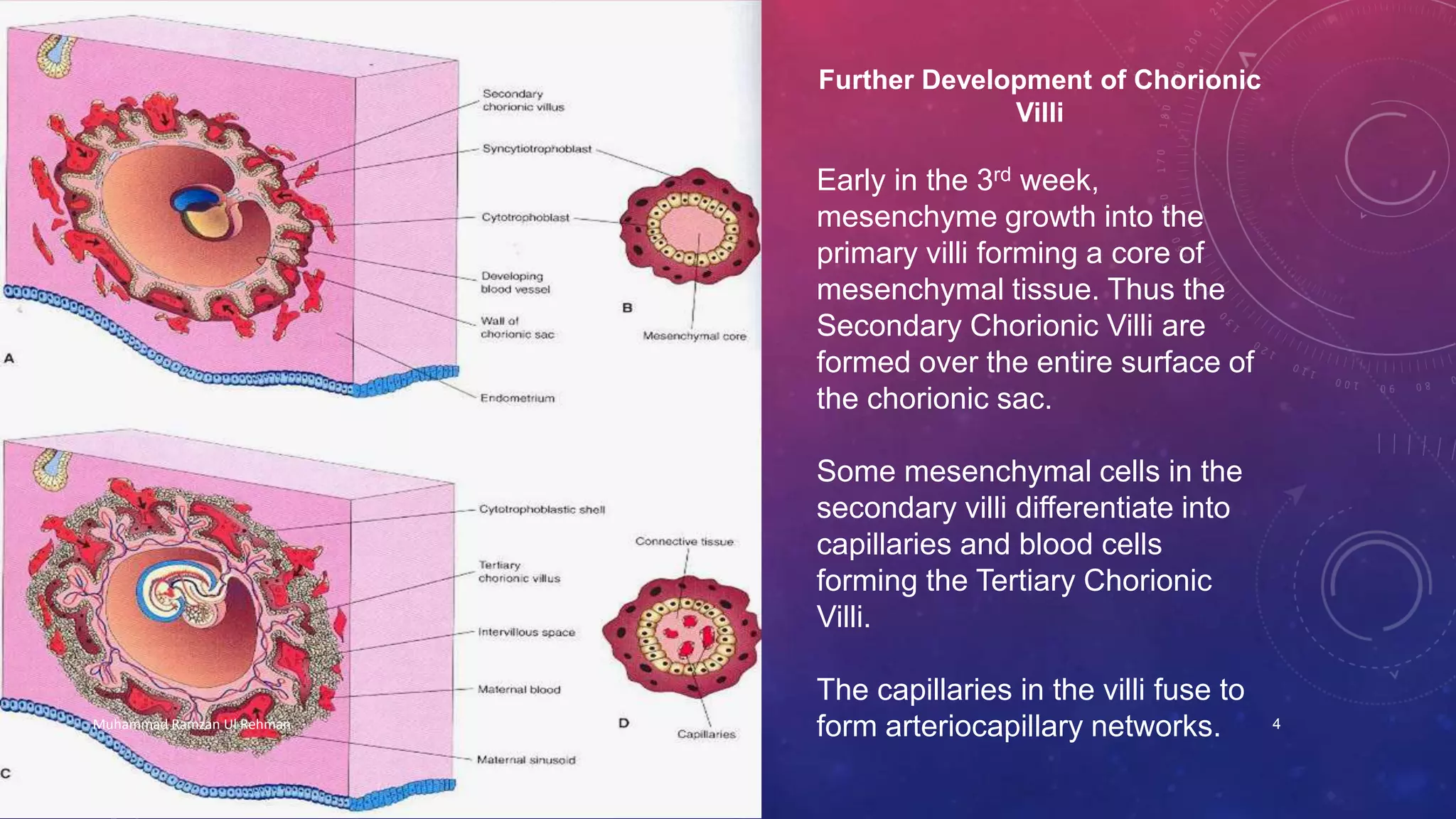
Further Development of Chorionic 
Villi 
Early in the 3rd week, 
mesenchyme growth into the 
primary villi forming a core of 
mesenchymal tissue. Thus the 
Secondary Chorionic Villi are 
formed over the entire surface of 
the chorionic sac. 
Some mesenchymal cells in the 
secondary villi differentiate into 
capillaries and blood cells 
forming the Tertiary Chorionic 
Villi. 
The capillaries in the villi fuse to 
Muhammad Ramzan Ul Rehman form arteriocapillary networks. 4
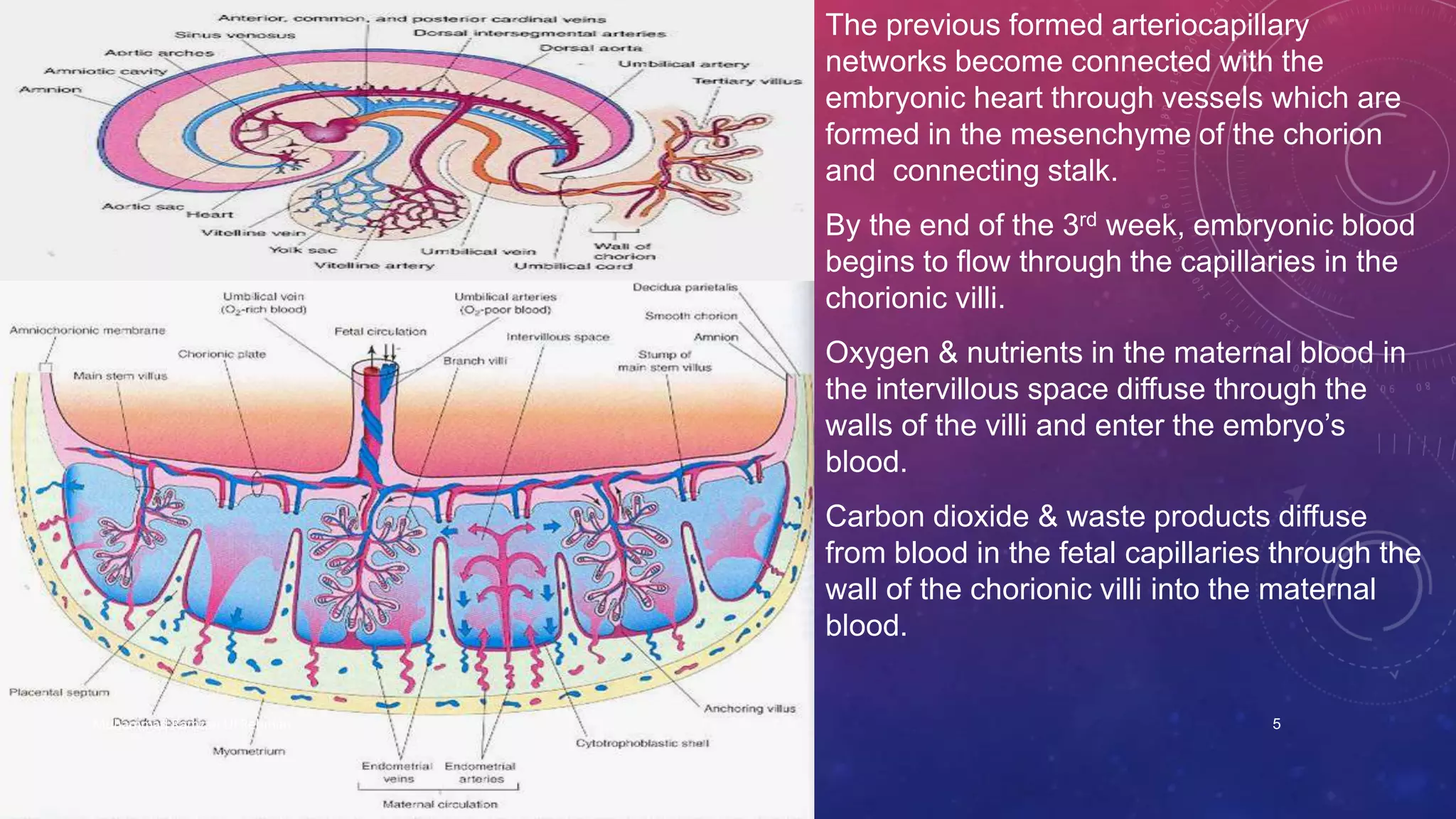
The previous formed arteriocapillary 
networks become connected with the 
embryonic heart through vessels which are 
formed in the mesenchyme of the chorion 
and connecting stalk. 
By the end of the 3rd week, embryonic blood 
begins to flow through the capillaries in the 
chorionic villi. 
Oxygen & nutrients in the maternal blood in 
the intervillous space diffuse through the 
walls of the villi and enter the embryo’s 
blood. 
Carbon dioxide & waste products diffuse 
from blood in the fetal capillaries through the 
wall of the chorionic villi into the maternal 
blood. 
Muhammad Ramzan Ul Rehman 5
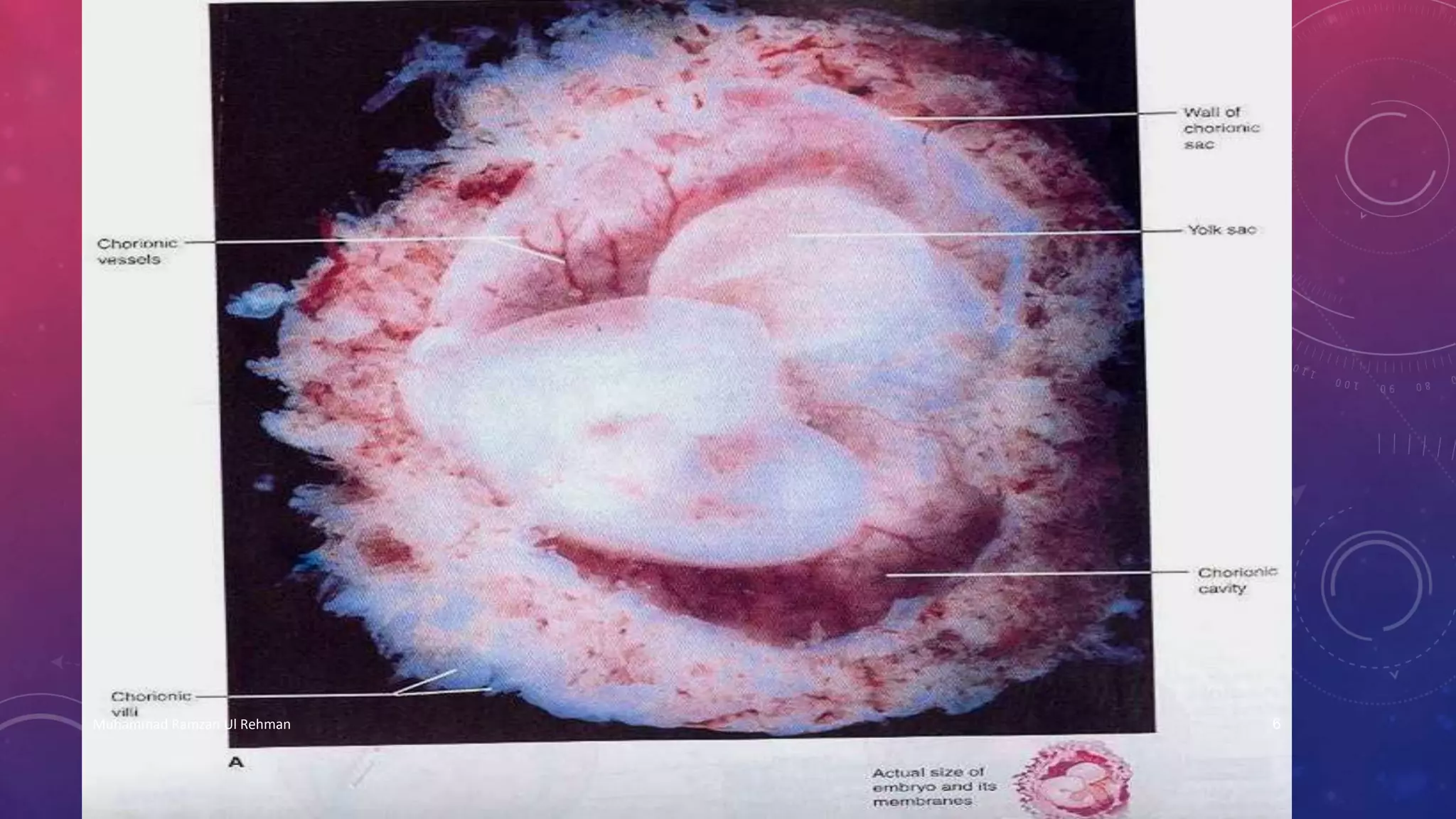
Muhammad Ramzan Ul Rehman 6
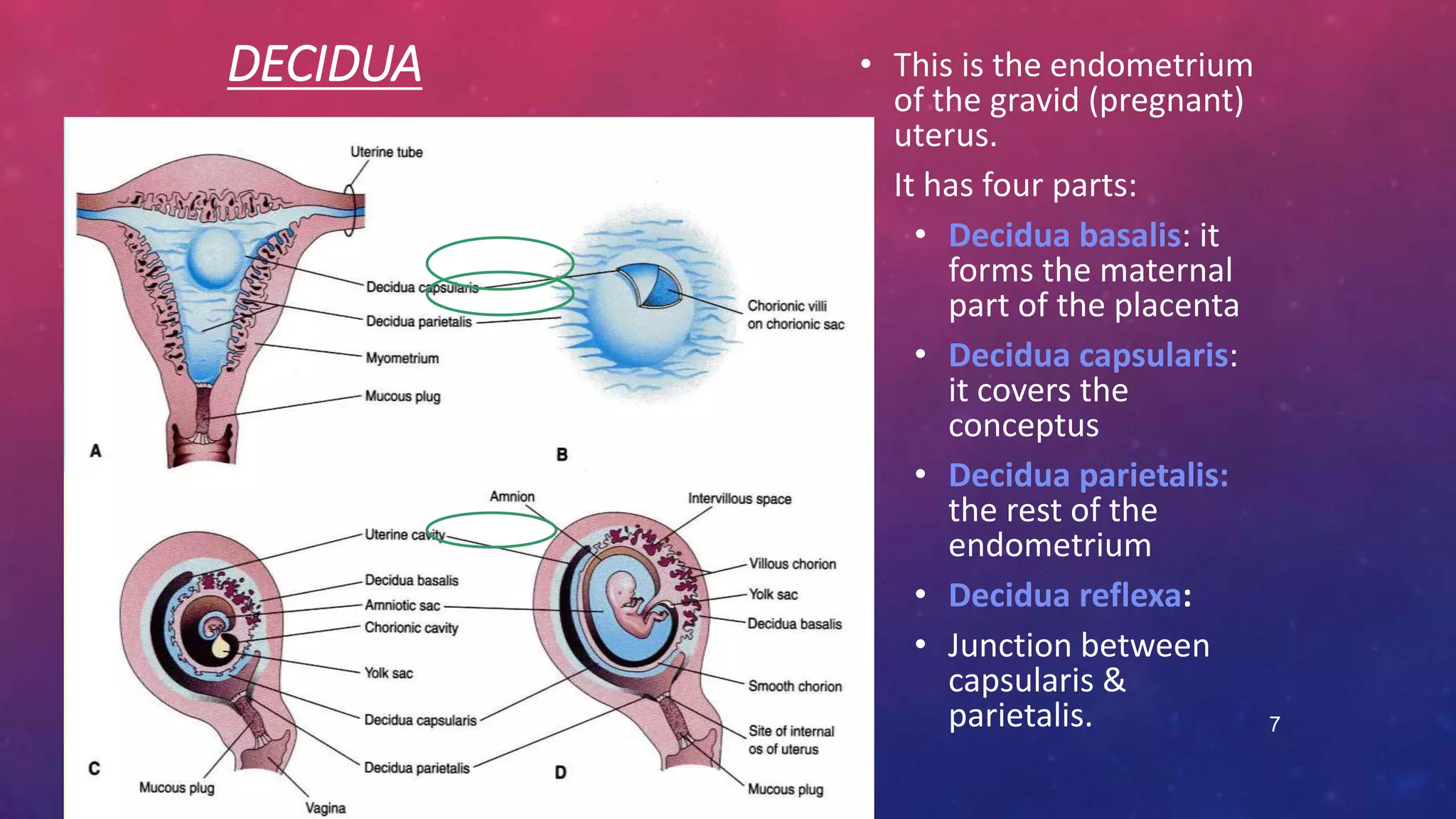
DECIDUA • This is the endometrium 
of the gravid (pregnant) 
uterus. 
• It has four parts: 
• Decidua basalis: it 
forms the maternal 
part of the placenta 
• Decidua capsularis: 
it covers the 
conceptus 
• Decidua parietalis: 
the rest of the 
endometrium 
• Decidua reflexa: 
• Junction between 
capsularis & 
parietalis. Muhammad Ramzan Ul Rehman 7
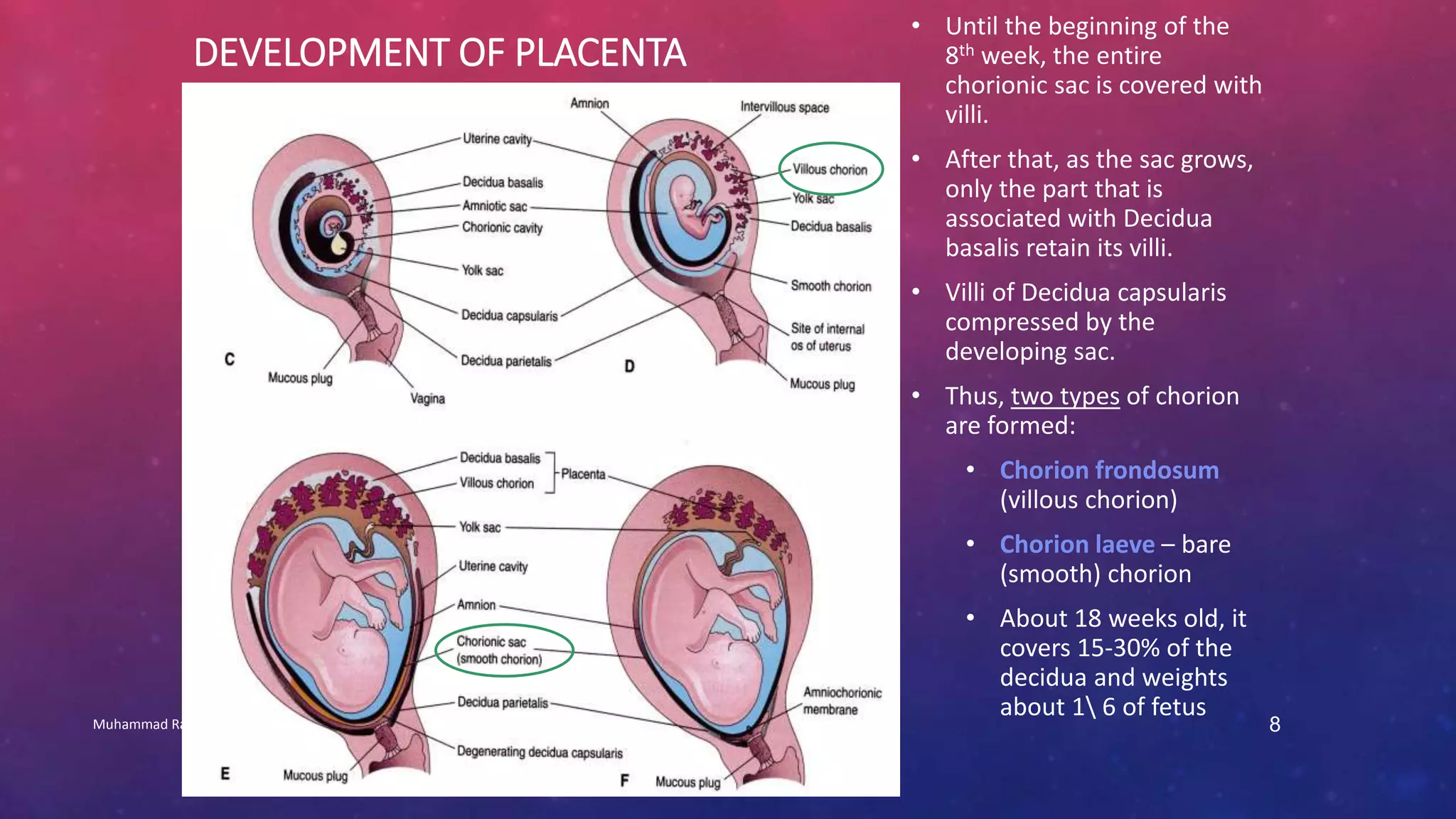
DEVELOPMENT OF PLACENTA 
• Until the beginning of the 
8th week, the entire 
chorionic sac is covered with 
villi. 
• After that, as the sac grows, 
only the part that is 
associated with Decidua 
basalis retain its villi. 
• Villi of Decidua capsularis 
compressed by the 
developing sac. 
• Thus, two types of chorion 
are formed: 
• Chorion frondosum 
(villous chorion) 
• Chorion laeve – bare 
(smooth) chorion 
• About 18 weeks old, it 
covers 15-30% of the 
decidua and weights 
about 1 6 of fetus 
Muhammad Ramzan Ul Rehman 8
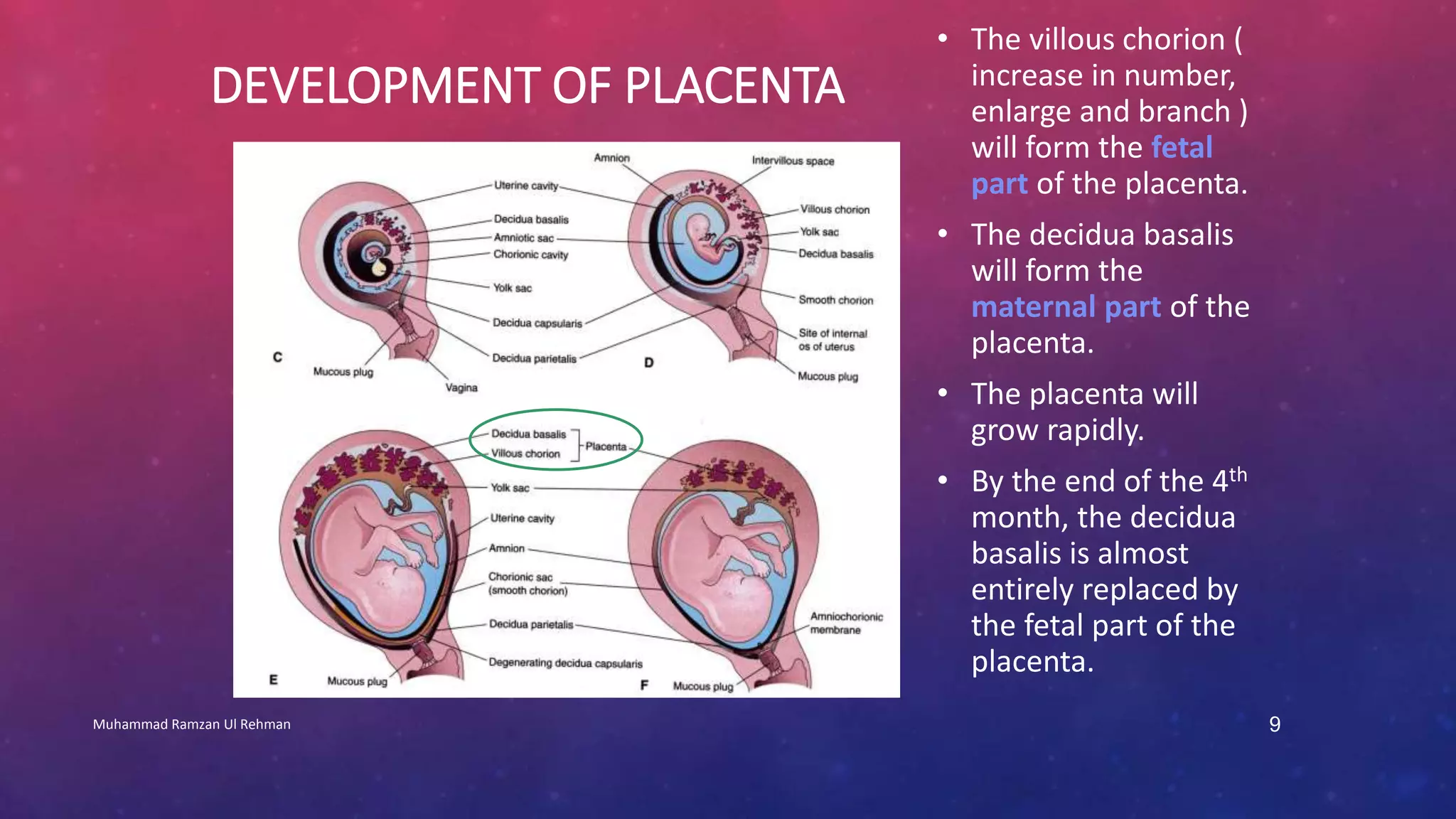
DEVELOPMENT OF PLACENTA 
• The villous chorion ( 
increase in number, 
enlarge and branch ) 
will form the fetal 
part of the placenta. 
• The decidua basalis 
will form the 
maternal part of the 
placenta. 
• The placenta will 
grow rapidly. 
• By the end of the 4th 
month, the decidua 
basalis is almost 
entirely replaced by 
the fetal part of the 
placenta. 
Muhammad Ramzan Ul Rehman 9
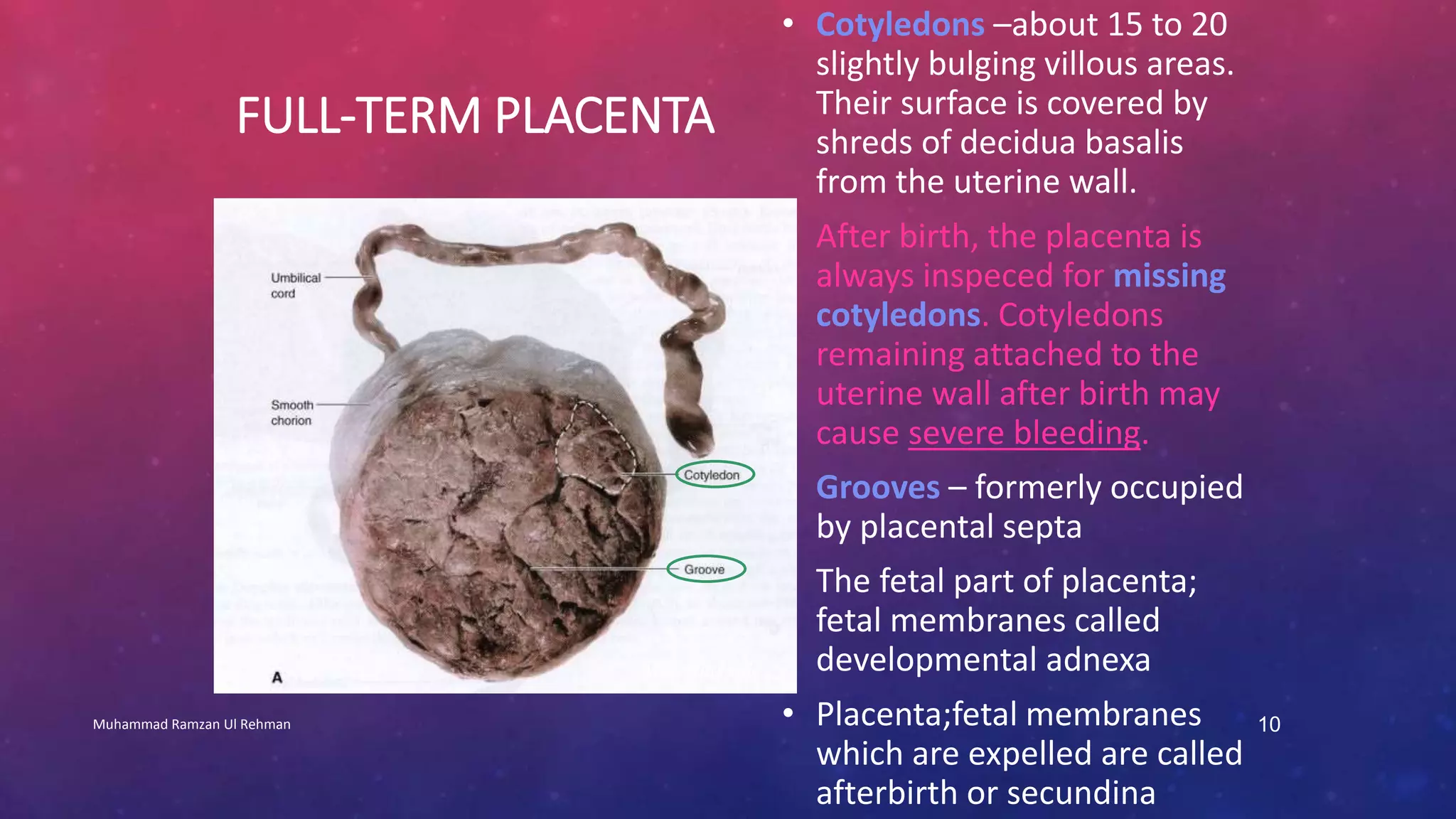
FULL-TERM PLACENTA 
• Cotyledons –about 15 to 20 
slightly bulging villous areas. 
Their surface is covered by 
shreds of decidua basalis 
from the uterine wall. 
• After birth, the placenta is 
always inspeced for missing 
cotyledons. Cotyledons 
remaining attached to the 
uterine wall after birth may 
cause severe bleeding. 
• Grooves – formerly occupied 
by placental septa 
• The fetal part of placenta; 
fetal membranes called 
developmental adnexa 
• Placenta;fetal membranes 
which are expelled are called 
afterbirth or secundina 
Maternal side 
Muhammad Ramzan Ul Rehman 10
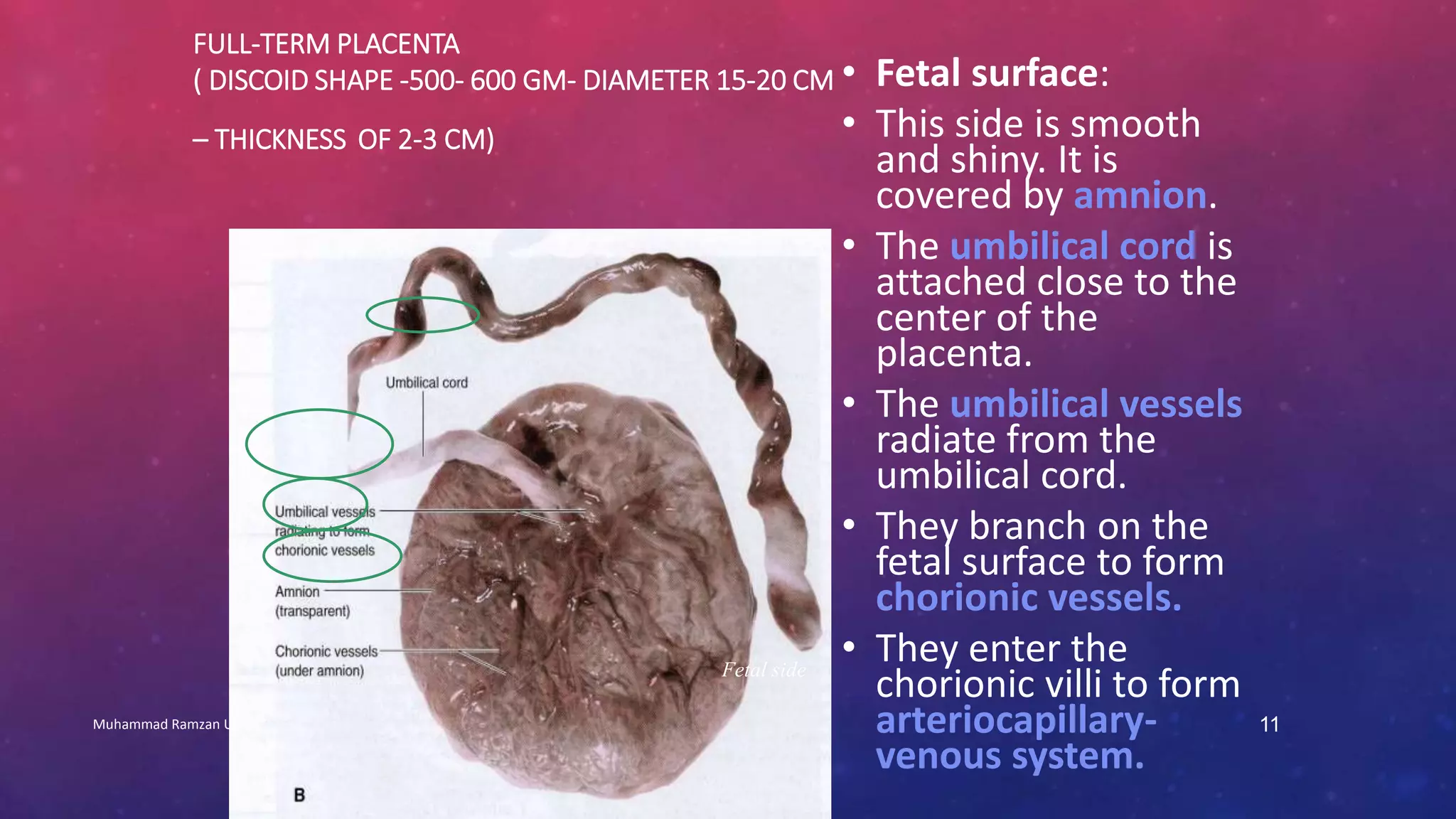
FULL-TERM PLACENTA 
( DISCOID SHAPE -500- 600 GM- DIAMETER 15-20 CM 
– THICKNESS OF 2-3 CM) 
• Fetal surface: 
• This side is smooth 
and shiny. It is 
covered by amnion. 
• The umbilical cord is 
attached close to the 
center of the 
placenta. 
• The umbilical vessels 
radiate from the 
umbilical cord. 
• They branch on the 
fetal surface to form 
chorionic vessels. 
• They enter the 
chorionic villi to form 
arteriocapillary-venous 
Muhammad Ramzan Ul Rehman 11 
system. 
Fetal side
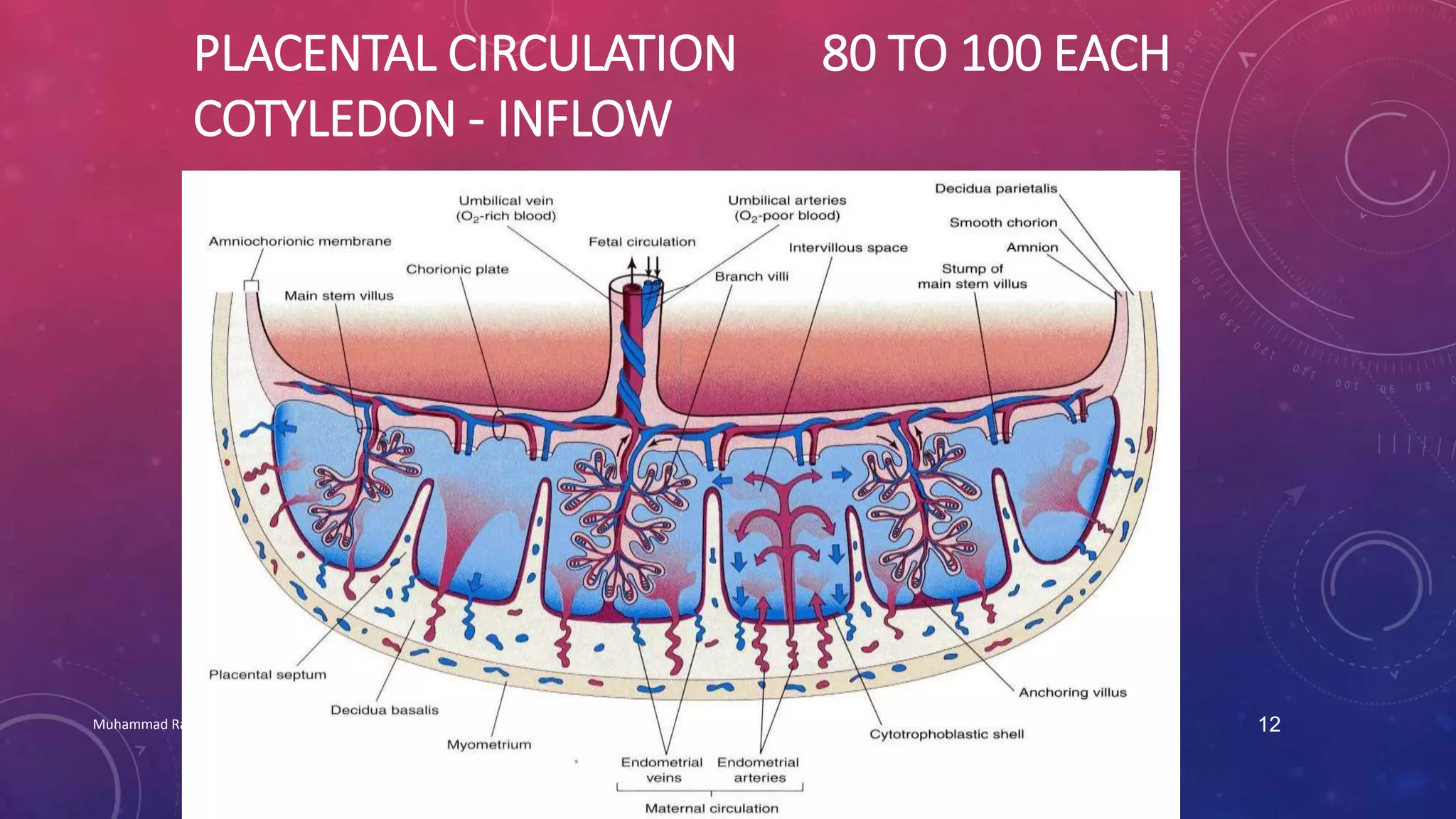
PLACENTAL CIRCULATION 80 TO 100 EACH 
COTYLEDON - INFLOW 
Muhammad Ramzan Ul Rehman 12
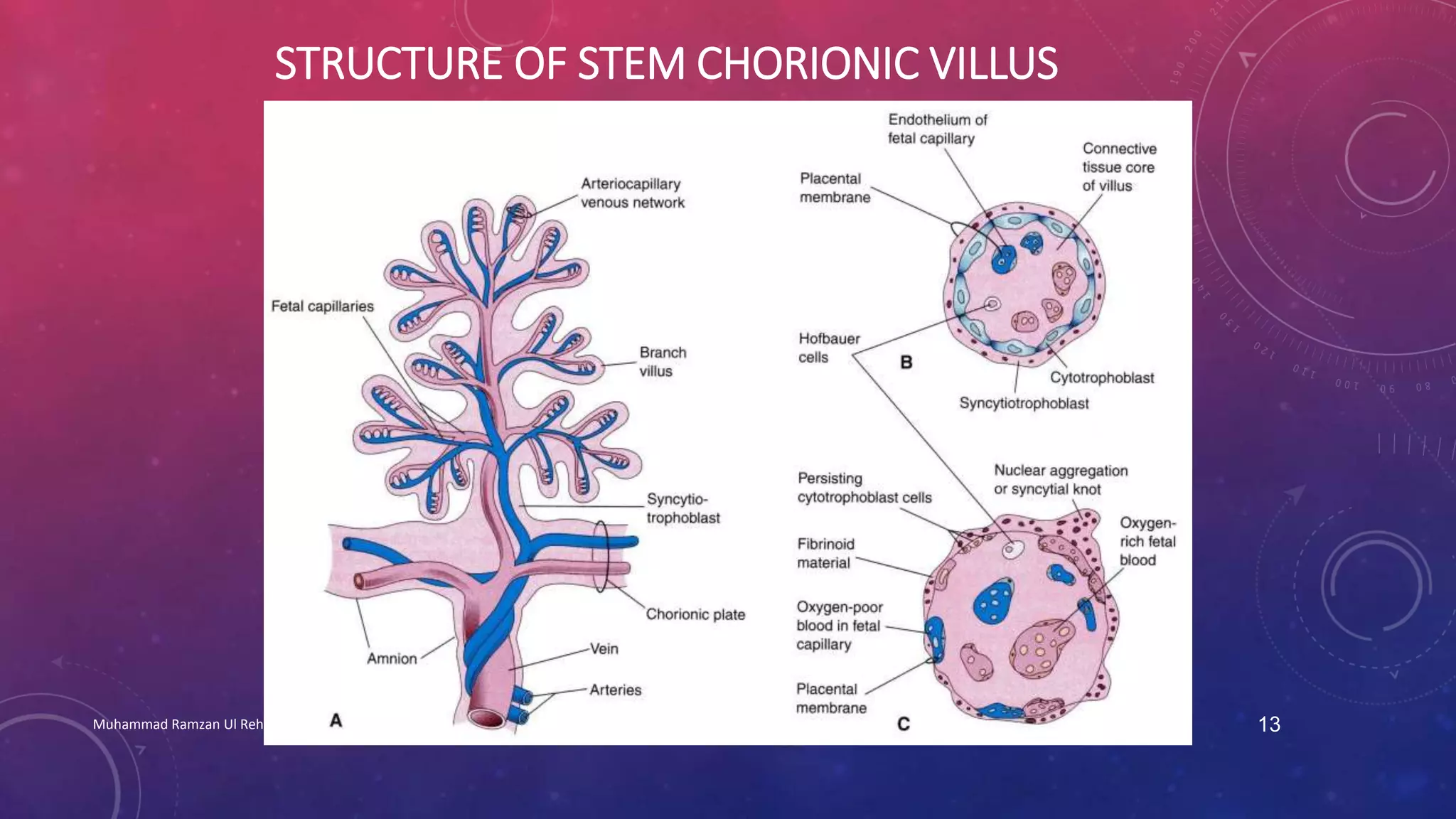
STRUCTURE OF STEM CHORIONIC VILLUS 
Muhammad Ramzan Ul Rehman 13
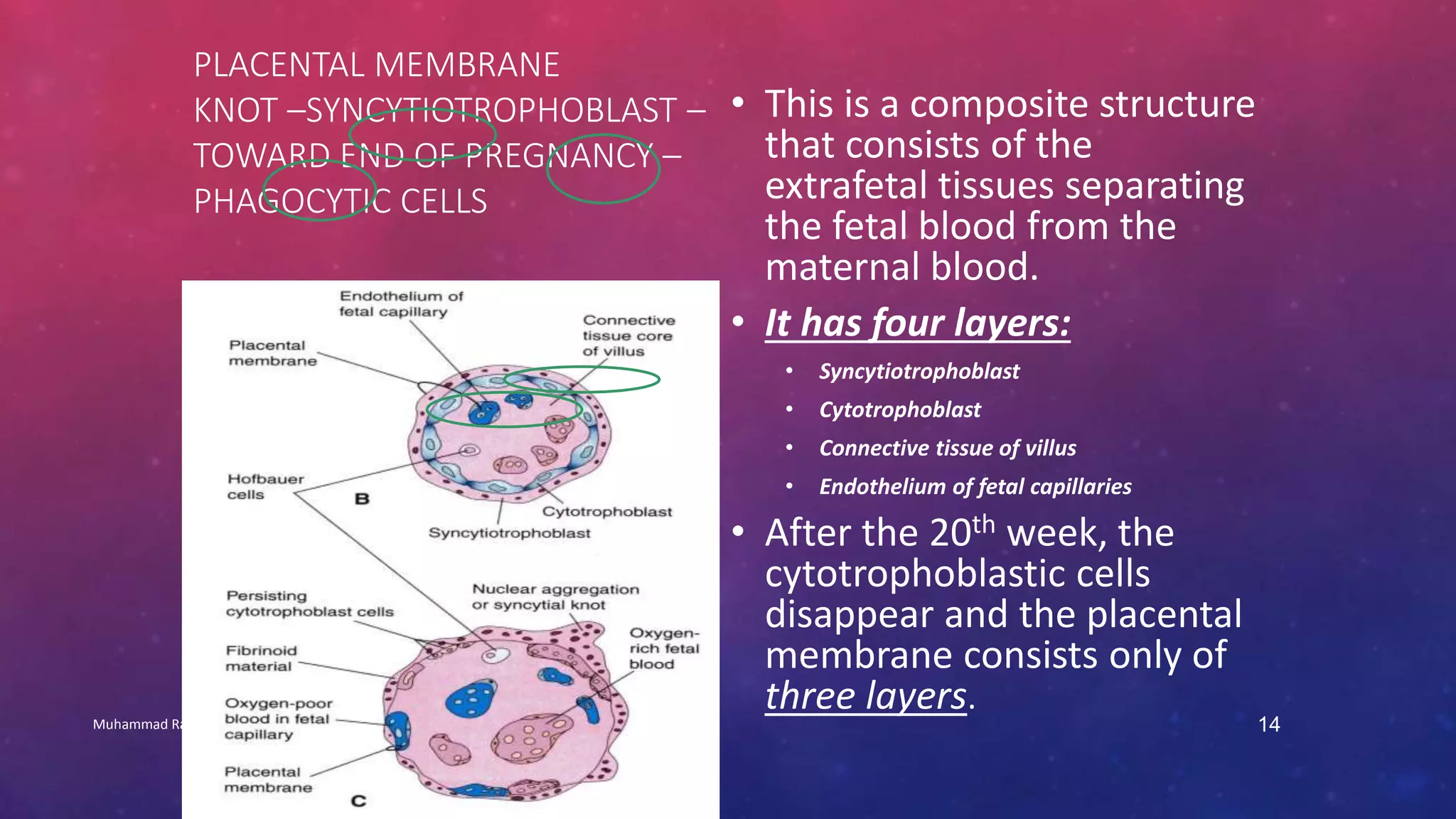
PLACENTAL MEMBRANE 
KNOT –SYNCYTIOTROPHOBLAST – 
TOWARD END OF PREGNANCY – 
PHAGOCYTIC CELLS 
• This is a composite structure 
that consists of the 
extrafetal tissues separating 
the fetal blood from the 
maternal blood. 
• It has four layers: 
• Syncytiotrophoblast 
• Cytotrophoblast 
• Connective tissue of villus 
• Endothelium of fetal capillaries 
• After the 20th week, the 
cytotrophoblastic cells 
disappear and the placental 
membrane consists only of 
three layers. 
Muhammad Ramzan Ul Rehman 14
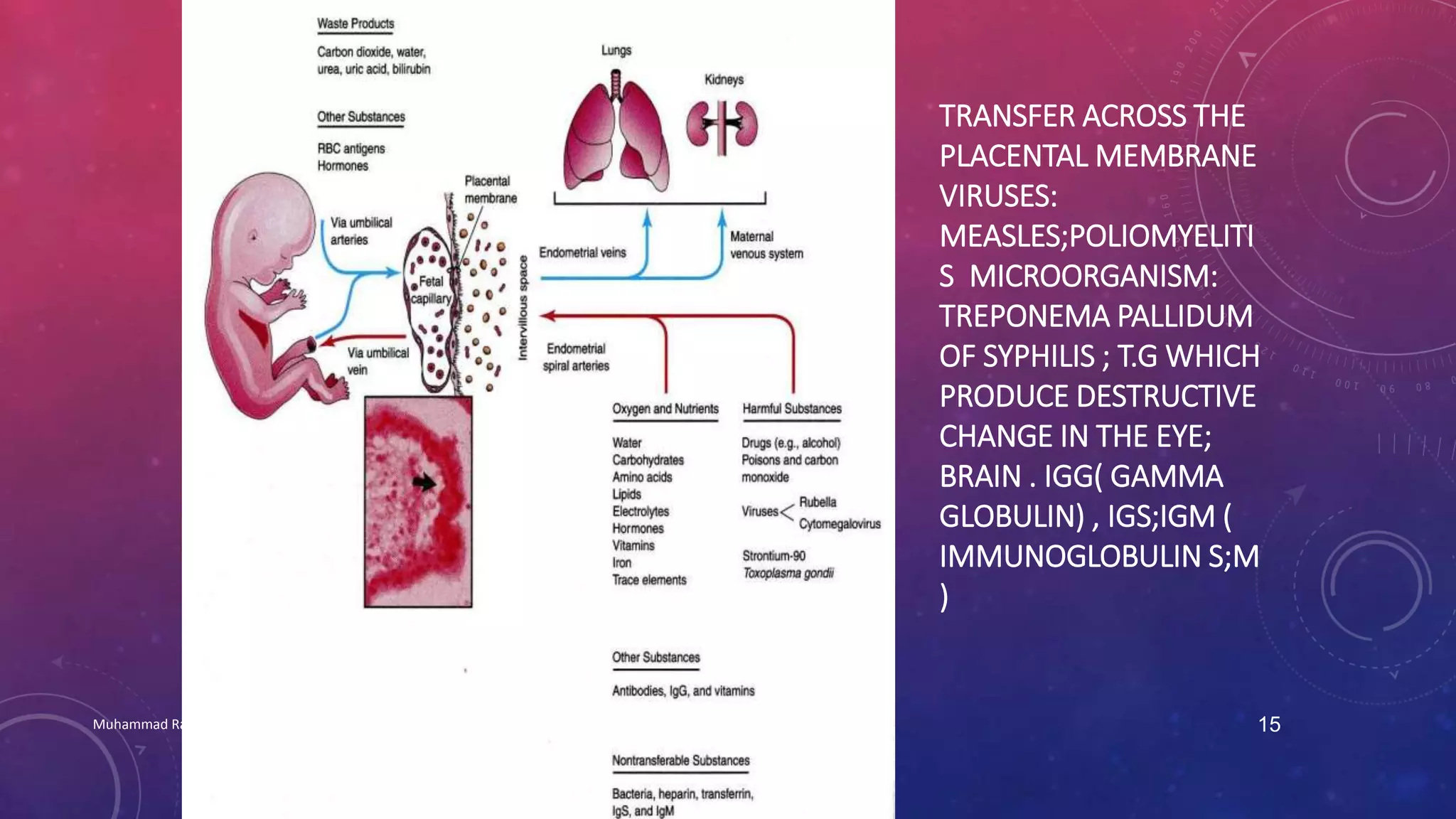
TRANSFER ACROSS THE 
PLACENTAL MEMBRANE 
VIRUSES: 
MEASLES;POLIOMYELITI 
S MICROORGANISM: 
TREPONEMA PALLIDUM 
OF SYPHILIS ; T.G WHICH 
PRODUCE DESTRUCTIVE 
CHANGE IN THE EYE; 
BRAIN . IGG( GAMMA 
GLOBULIN) , IGS;IGM ( 
IMMUNOGLOBULIN S;M 
) 
Muhammad Ramzan Ul Rehman 15
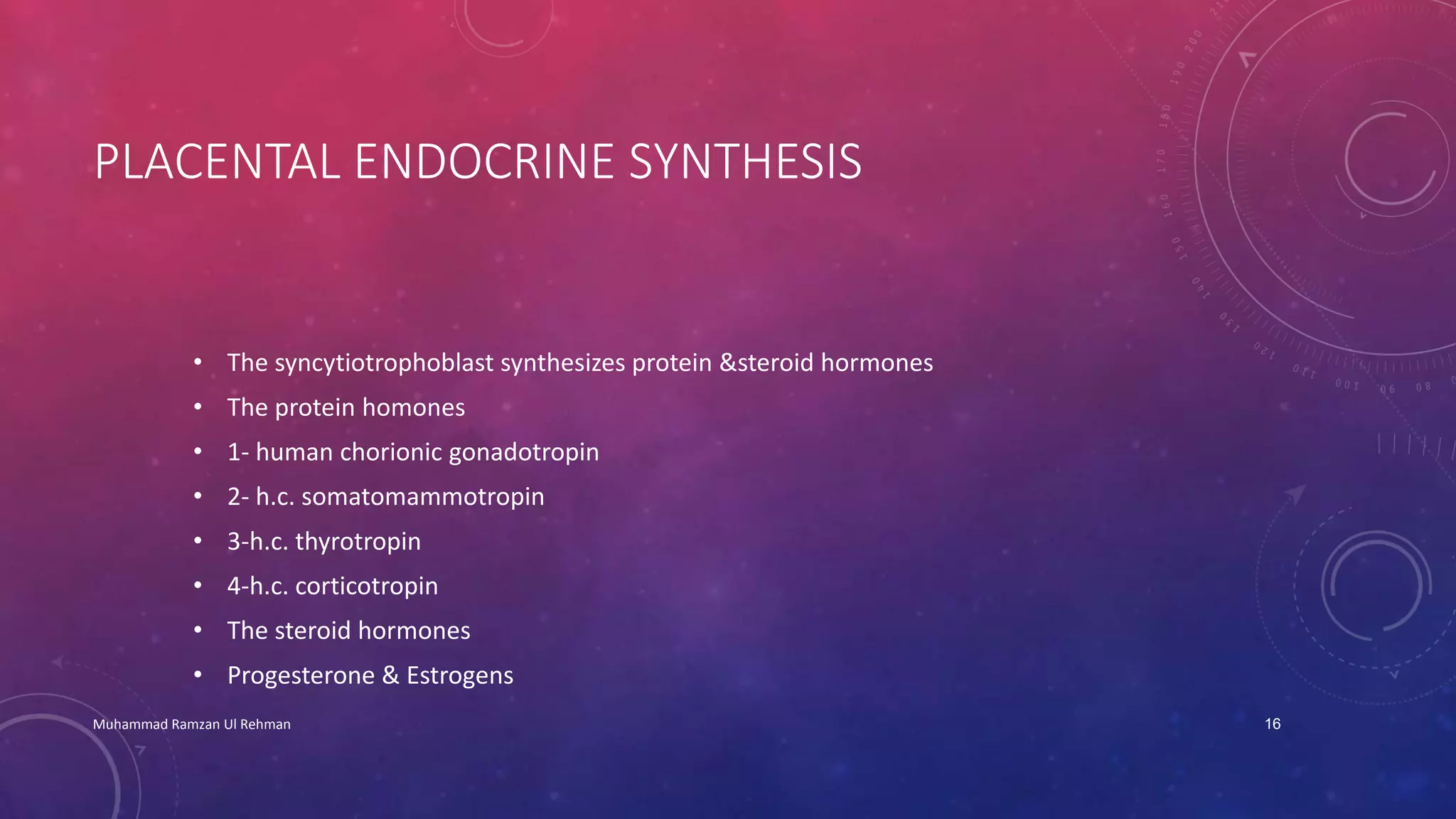
PLACENTAL ENDOCRINE SYNTHESIS 
• The syncytiotrophoblast synthesizes protein &steroid hormones 
• The protein homones 
• 1- human chorionic gonadotropin 
• 2- h.c. somatomammotropin 
• 3-h.c. thyrotropin 
• 4-h.c. corticotropin 
• The steroid hormones 
• Progesterone & Estrogens 
Muhammad Ramzan Ul Rehman 16
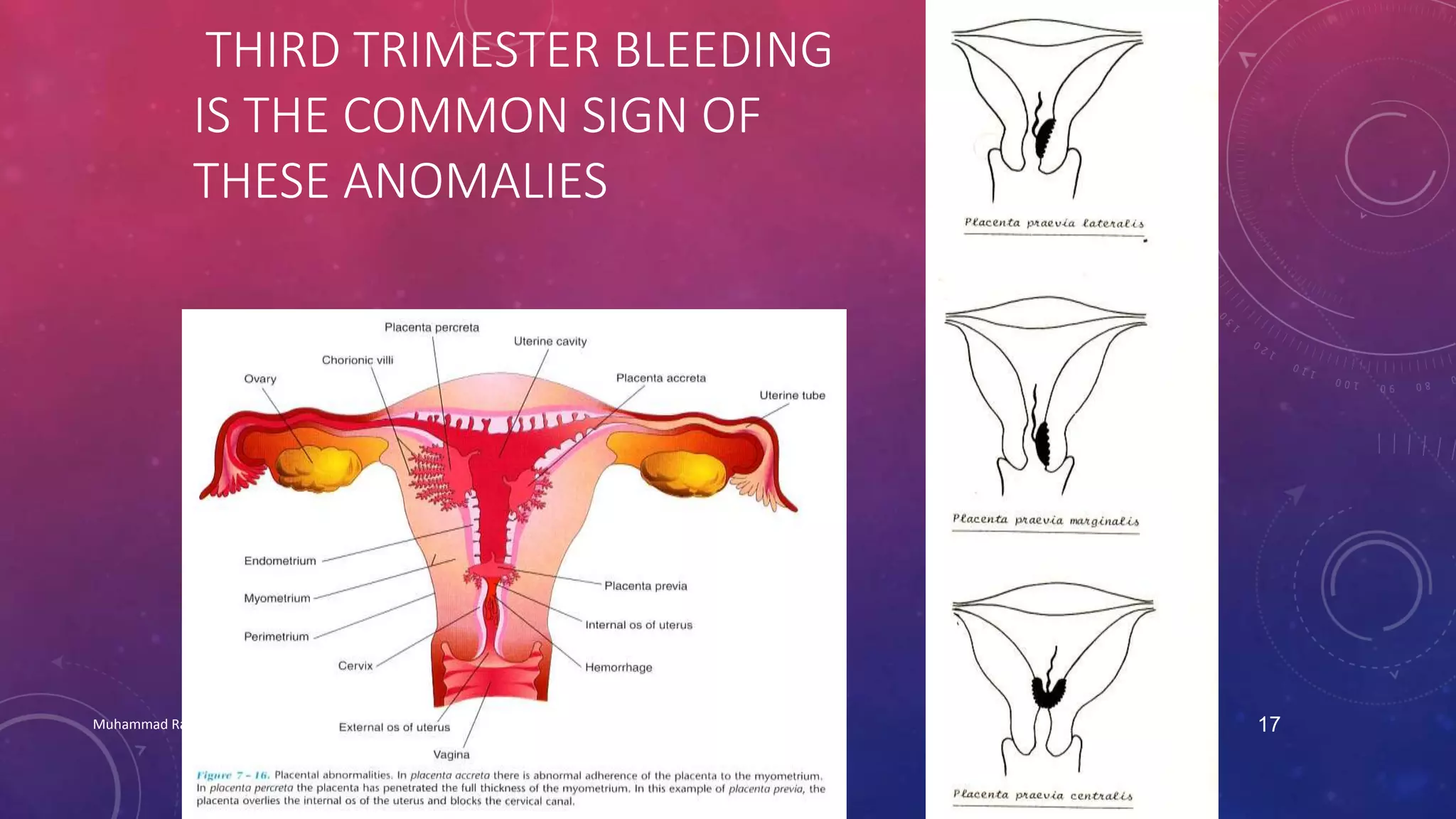
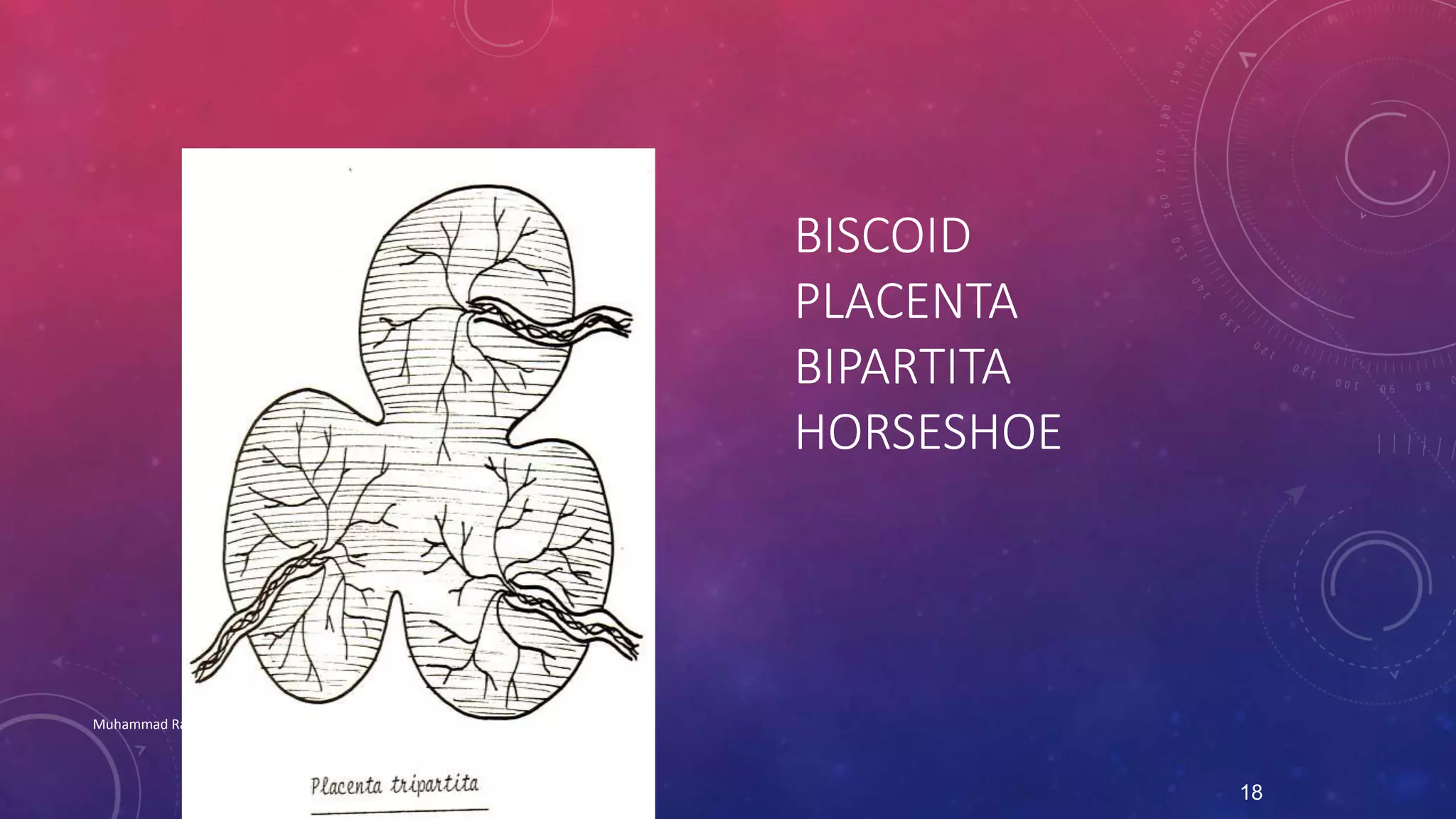
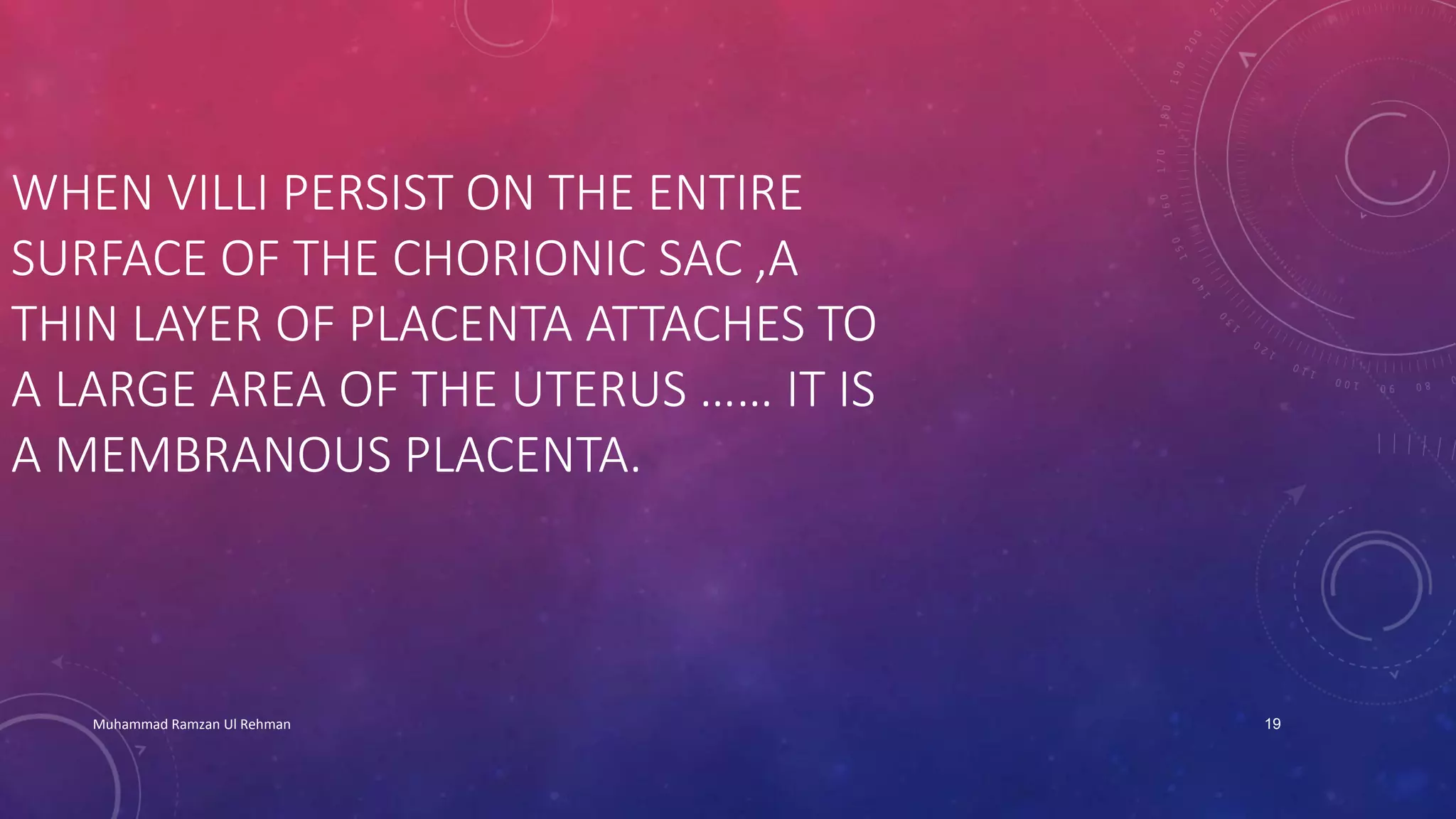
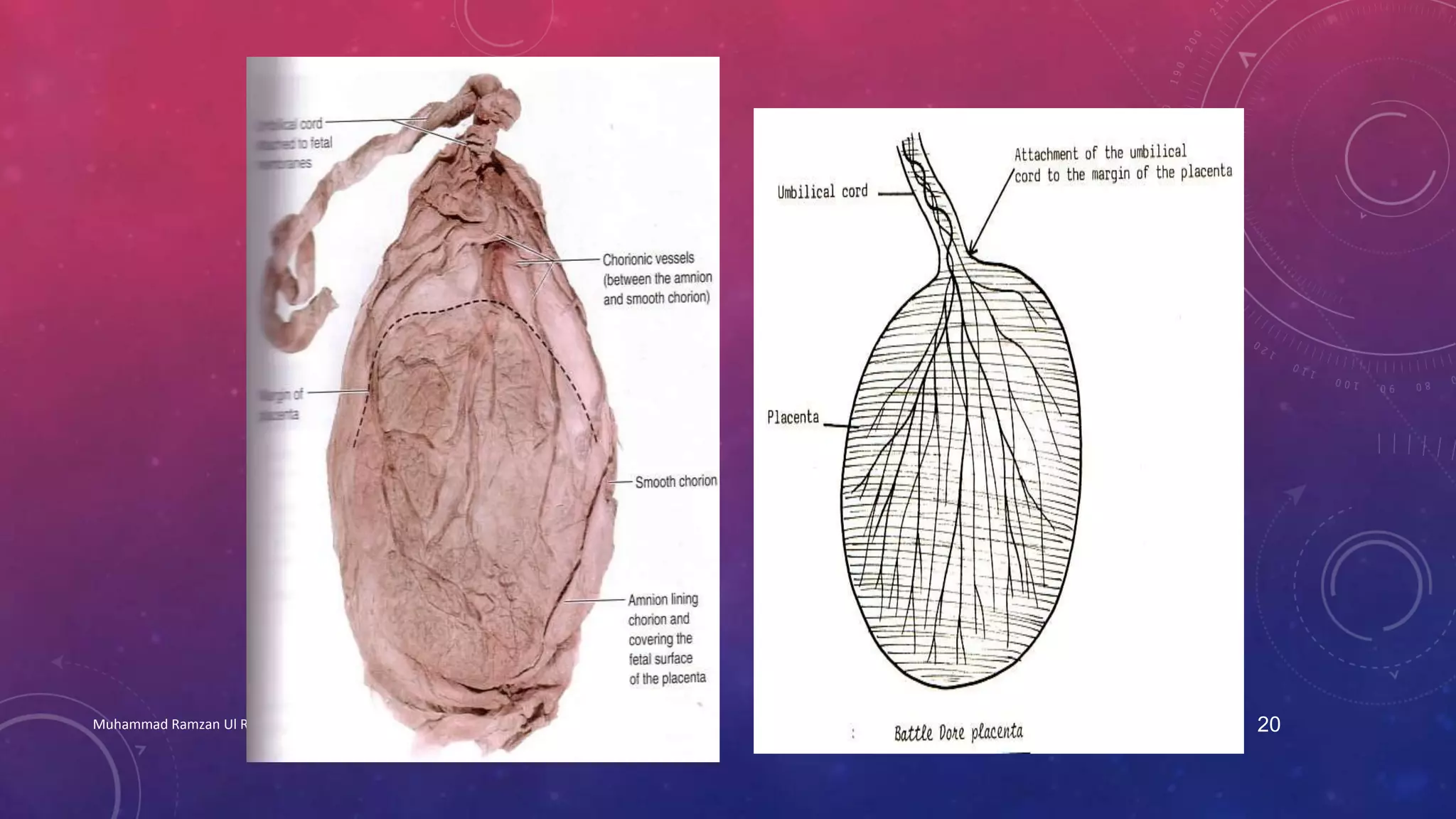
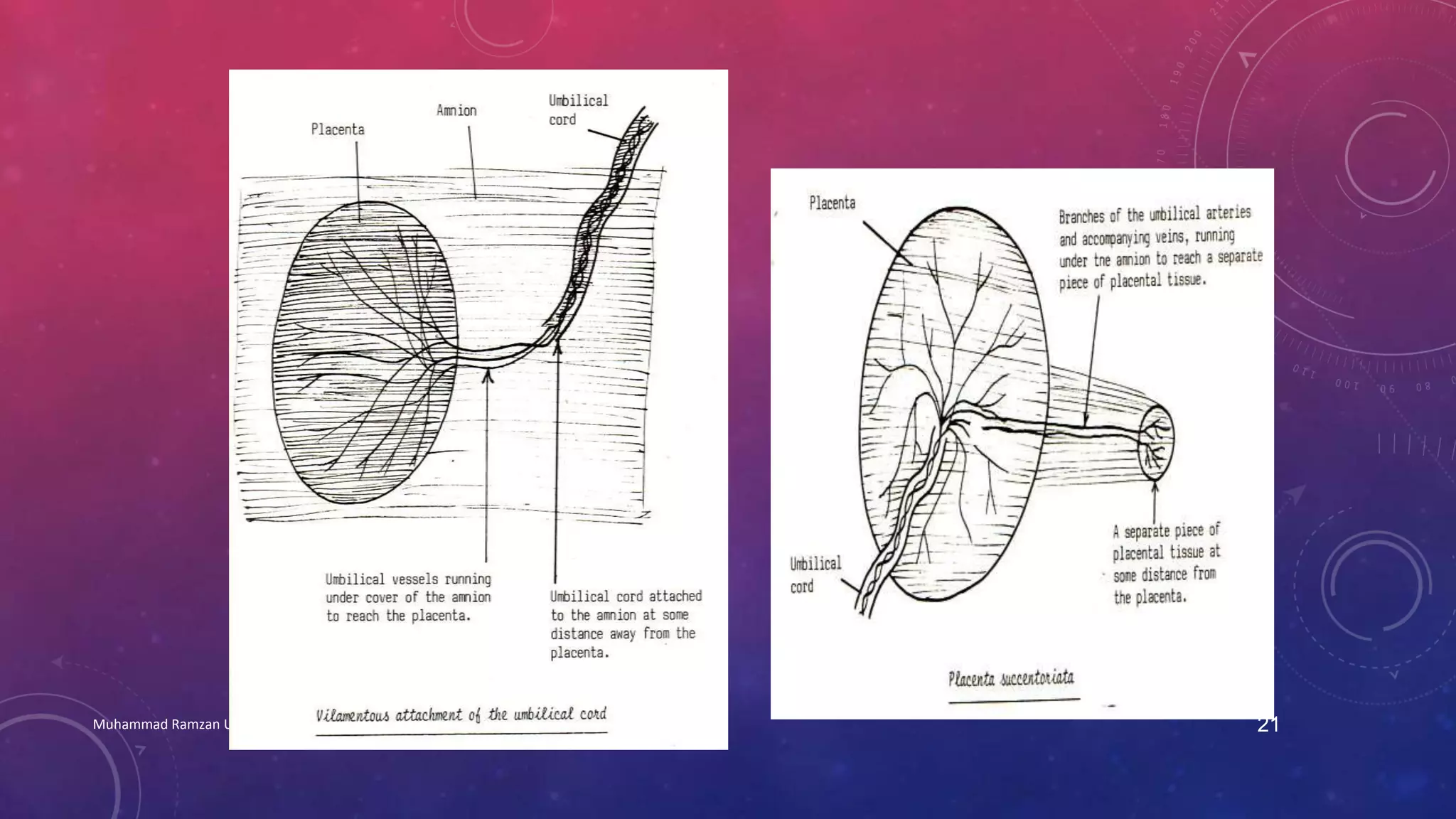
THIRD TRIMESTER BLEEDING 
IS THE COMMON SIGN OF 
THESE ANOMALIES 
Muhammad Ramzan Ul Rehman 17
BISCOID 
PLACENTA 
BIPARTITA 
HORSESHOE 
Muhammad Ramzan Ul Rehman 
18
WHEN VILLI PERSIST ON THE ENTIRE 
SURFACE OF THE CHORIONIC SAC ,A 
THIN LAYER OF PLACENTA ATTACHES TO 
A LARGE AREA OF THE UTERUS …… IT IS 
A MEMBRANOUS PLACENTA. 
Muhammad Ramzan Ul Rehman 19
Muhammad Ramzan Ul Rehman 20
Muhammad Ramzan Ul Rehman 21
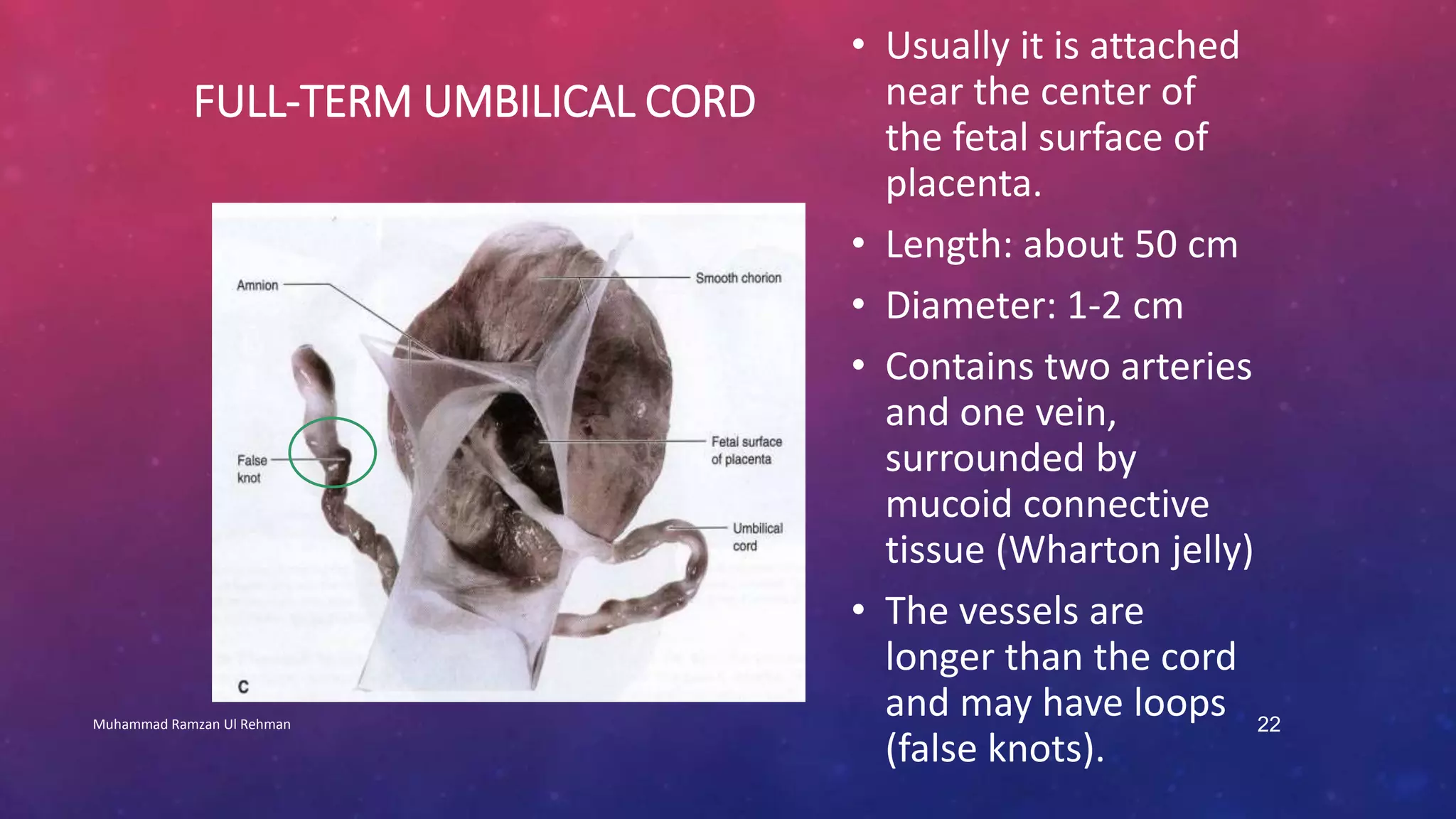
FULL-TERM UMBILICAL CORD 
• Usually it is attached 
near the center of 
the fetal surface of 
placenta. 
• Length: about 50 cm 
• Diameter: 1-2 cm 
• Contains two arteries 
and one vein, 
surrounded by 
mucoid connective 
tissue (Wharton jelly) 
• The vessels are 
longer than the cord 
and may have loops 
(false knots). 
Muhammad Ramzan Ul Rehman 22
JAZZAK ALLAH

Placenta embryology

  • 1.
  • 2.
    PLACENTA BY MUHAMADRAMZAN UL REHMAN
  • 3.
    PLACENTA This isa fetomaternal organ. • It has two components: • Fetal part – develops from the chorionic sac ( chorion frondosum ) • Maternal part – derived from the endometrium ( functional layer – decidua basalis ) • The placenta and the umbilical cord are a transport system for substances between the mother and the fetus.( vessels in umbilical cord ) Function Of The Placenta: 1. Protection 2. Nutrition 3. Respiration 4. Excretion 5. Hormone production Muhammad Ramzan Ul Rehman 3
  • 4.
    Further Development ofChorionic Villi Early in the 3rd week, mesenchyme growth into the primary villi forming a core of mesenchymal tissue. Thus the Secondary Chorionic Villi are formed over the entire surface of the chorionic sac. Some mesenchymal cells in the secondary villi differentiate into capillaries and blood cells forming the Tertiary Chorionic Villi. The capillaries in the villi fuse to Muhammad Ramzan Ul Rehman form arteriocapillary networks. 4
  • 5.
    The previous formedarteriocapillary networks become connected with the embryonic heart through vessels which are formed in the mesenchyme of the chorion and connecting stalk. By the end of the 3rd week, embryonic blood begins to flow through the capillaries in the chorionic villi. Oxygen & nutrients in the maternal blood in the intervillous space diffuse through the walls of the villi and enter the embryo’s blood. Carbon dioxide & waste products diffuse from blood in the fetal capillaries through the wall of the chorionic villi into the maternal blood. Muhammad Ramzan Ul Rehman 5
  • 6.
  • 7.
    DECIDUA • Thisis the endometrium of the gravid (pregnant) uterus. • It has four parts: • Decidua basalis: it forms the maternal part of the placenta • Decidua capsularis: it covers the conceptus • Decidua parietalis: the rest of the endometrium • Decidua reflexa: • Junction between capsularis & parietalis. Muhammad Ramzan Ul Rehman 7
  • 8.
    DEVELOPMENT OF PLACENTA • Until the beginning of the 8th week, the entire chorionic sac is covered with villi. • After that, as the sac grows, only the part that is associated with Decidua basalis retain its villi. • Villi of Decidua capsularis compressed by the developing sac. • Thus, two types of chorion are formed: • Chorion frondosum (villous chorion) • Chorion laeve – bare (smooth) chorion • About 18 weeks old, it covers 15-30% of the decidua and weights about 1 6 of fetus Muhammad Ramzan Ul Rehman 8
  • 9.
    DEVELOPMENT OF PLACENTA • The villous chorion ( increase in number, enlarge and branch ) will form the fetal part of the placenta. • The decidua basalis will form the maternal part of the placenta. • The placenta will grow rapidly. • By the end of the 4th month, the decidua basalis is almost entirely replaced by the fetal part of the placenta. Muhammad Ramzan Ul Rehman 9
  • 10.
    FULL-TERM PLACENTA •Cotyledons –about 15 to 20 slightly bulging villous areas. Their surface is covered by shreds of decidua basalis from the uterine wall. • After birth, the placenta is always inspeced for missing cotyledons. Cotyledons remaining attached to the uterine wall after birth may cause severe bleeding. • Grooves – formerly occupied by placental septa • The fetal part of placenta; fetal membranes called developmental adnexa • Placenta;fetal membranes which are expelled are called afterbirth or secundina Maternal side Muhammad Ramzan Ul Rehman 10
  • 11.
    FULL-TERM PLACENTA (DISCOID SHAPE -500- 600 GM- DIAMETER 15-20 CM – THICKNESS OF 2-3 CM) • Fetal surface: • This side is smooth and shiny. It is covered by amnion. • The umbilical cord is attached close to the center of the placenta. • The umbilical vessels radiate from the umbilical cord. • They branch on the fetal surface to form chorionic vessels. • They enter the chorionic villi to form arteriocapillary-venous Muhammad Ramzan Ul Rehman 11 system. Fetal side
  • 12.
    PLACENTAL CIRCULATION 80TO 100 EACH COTYLEDON - INFLOW Muhammad Ramzan Ul Rehman 12
  • 13.
    STRUCTURE OF STEMCHORIONIC VILLUS Muhammad Ramzan Ul Rehman 13
  • 14.
    PLACENTAL MEMBRANE KNOT–SYNCYTIOTROPHOBLAST – TOWARD END OF PREGNANCY – PHAGOCYTIC CELLS • This is a composite structure that consists of the extrafetal tissues separating the fetal blood from the maternal blood. • It has four layers: • Syncytiotrophoblast • Cytotrophoblast • Connective tissue of villus • Endothelium of fetal capillaries • After the 20th week, the cytotrophoblastic cells disappear and the placental membrane consists only of three layers. Muhammad Ramzan Ul Rehman 14
  • 15.
    TRANSFER ACROSS THE PLACENTAL MEMBRANE VIRUSES: MEASLES;POLIOMYELITI S MICROORGANISM: TREPONEMA PALLIDUM OF SYPHILIS ; T.G WHICH PRODUCE DESTRUCTIVE CHANGE IN THE EYE; BRAIN . IGG( GAMMA GLOBULIN) , IGS;IGM ( IMMUNOGLOBULIN S;M ) Muhammad Ramzan Ul Rehman 15
  • 16.
    PLACENTAL ENDOCRINE SYNTHESIS • The syncytiotrophoblast synthesizes protein &steroid hormones • The protein homones • 1- human chorionic gonadotropin • 2- h.c. somatomammotropin • 3-h.c. thyrotropin • 4-h.c. corticotropin • The steroid hormones • Progesterone & Estrogens Muhammad Ramzan Ul Rehman 16
  • 17.
    THIRD TRIMESTER BLEEDING IS THE COMMON SIGN OF THESE ANOMALIES Muhammad Ramzan Ul Rehman 17
  • 18.
    BISCOID PLACENTA BIPARTITA HORSESHOE Muhammad Ramzan Ul Rehman 18
  • 19.
    WHEN VILLI PERSISTON THE ENTIRE SURFACE OF THE CHORIONIC SAC ,A THIN LAYER OF PLACENTA ATTACHES TO A LARGE AREA OF THE UTERUS …… IT IS A MEMBRANOUS PLACENTA. Muhammad Ramzan Ul Rehman 19
  • 20.
  • 21.
  • 22.
    FULL-TERM UMBILICAL CORD • Usually it is attached near the center of the fetal surface of placenta. • Length: about 50 cm • Diameter: 1-2 cm • Contains two arteries and one vein, surrounded by mucoid connective tissue (Wharton jelly) • The vessels are longer than the cord and may have loops (false knots). Muhammad Ramzan Ul Rehman 22
  • 23.