Cleavage & Migration
Dr.Sherif Fahmy
Dr. Sherif Fahmy
Dr.Sherif Fahmy
Dr. Sherif Fahmy
Dr. Sherif Fahmy
Dr. Sherif Fahmy
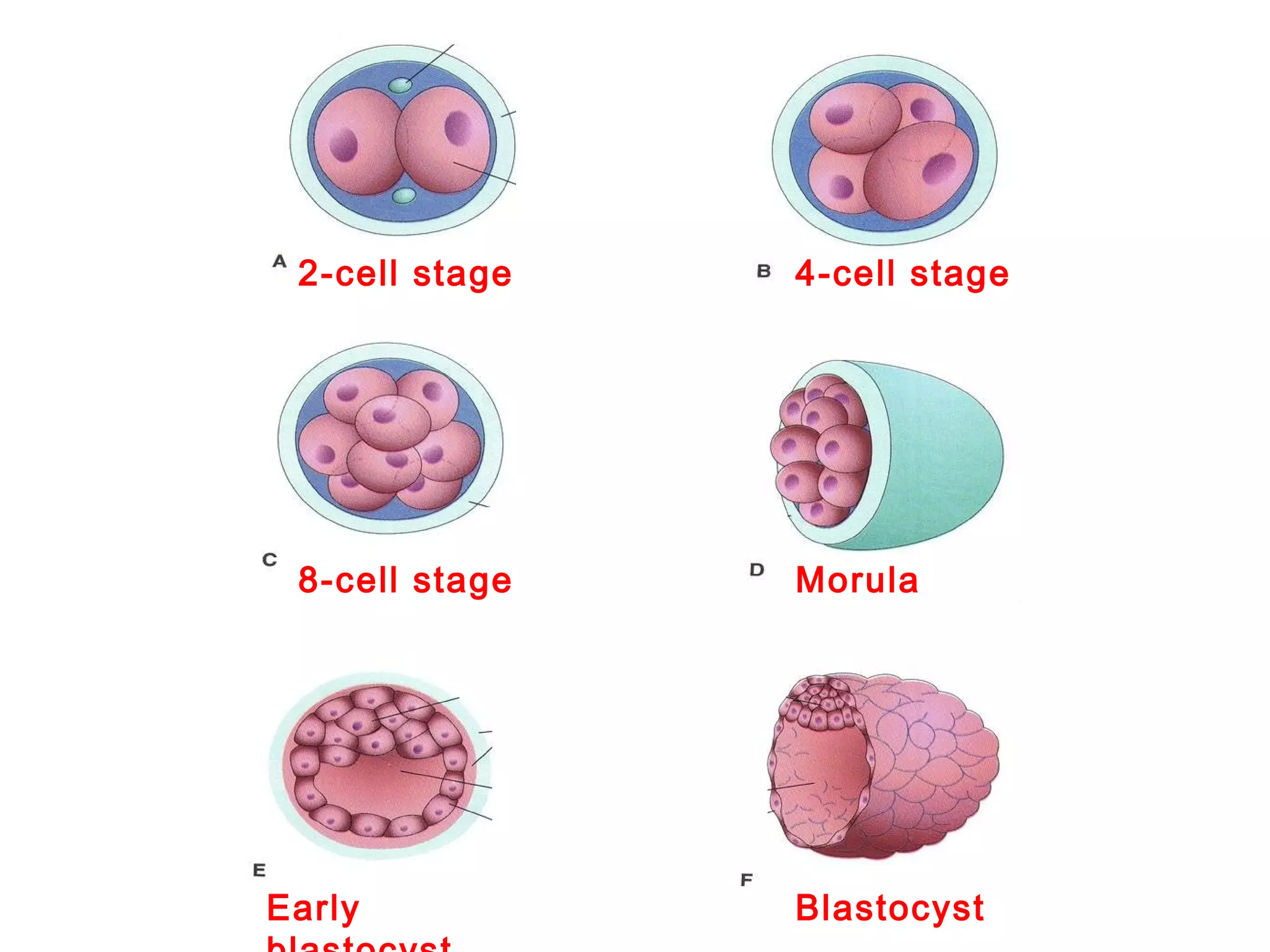
Formation of blastocyst
• By the end of 4th
day, zona pellucida starts
degeneration and disappears by the end of 5th
day.
• The blastomeres that remain after rupture of zona
is called morula.
• Fluid enters between cells and forms a cavity
(blastocele) which separates cells into outer cell
mass (trophoblast) and inner cell mass
(embryoblast). This stage is called blastocyst which
is formed at the 6th
day.
• Embryoblast forms embryo and then fetus while
trophoblast form placenta, amniotic cavity and
Dr. Sherif Fahmy
2-cell stage 4-cell stage
8-cell stage Morula
Early Blastocyst
Blastocele
Inner cell mass
(Embryoblast) Outer cell mass
(Trophoblast)
Embryonic pole
Abembryonic pole Blastocyst
Dr.Sherif Fahmy
Dr. Sherif Fahmy
Dr. Sherif Fahmy
Second Week of
Pregnancy
Implantation
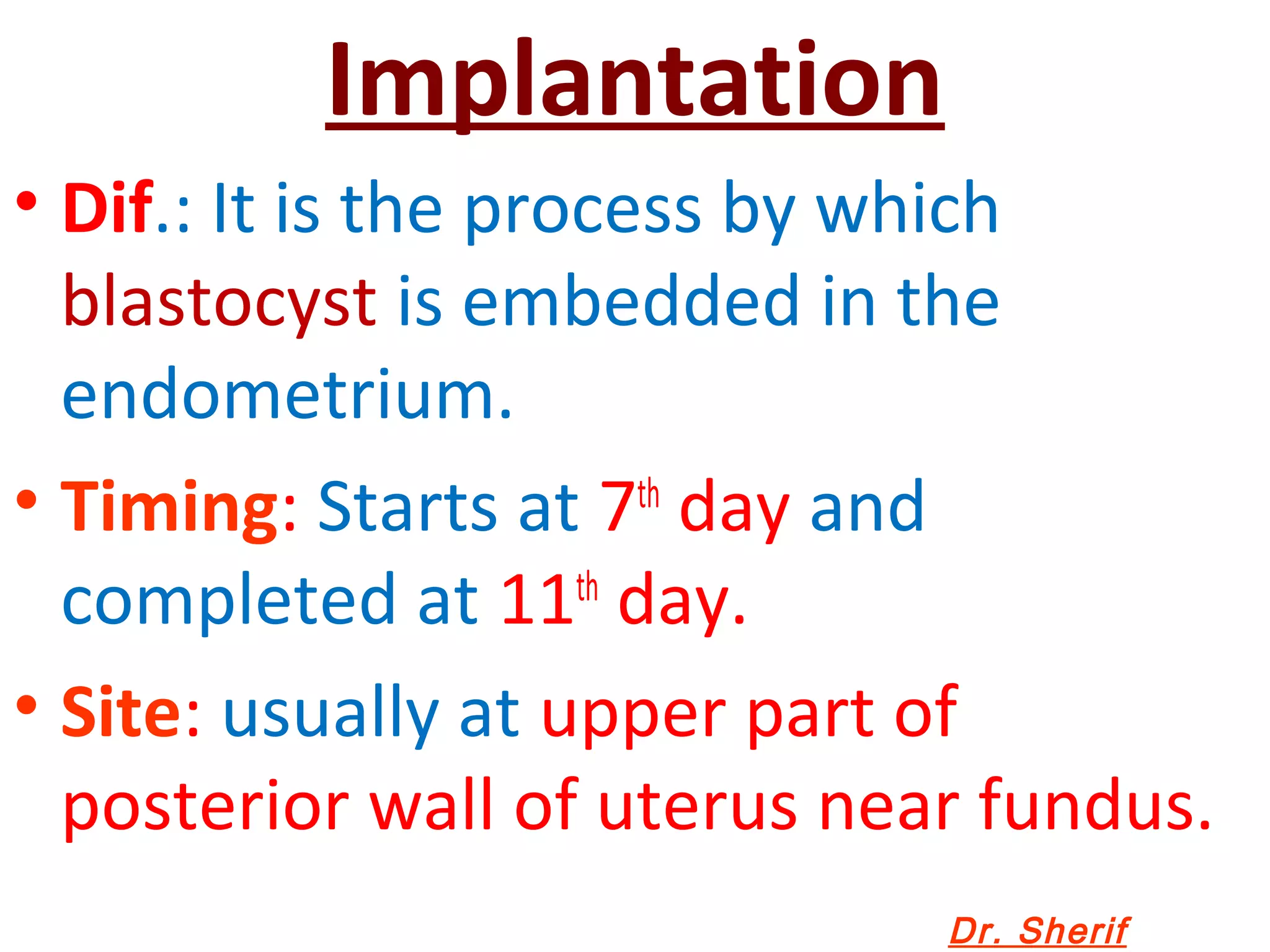
• Dif.: It is the process by which
blastocyst is embedded in the
endometrium.
• Timing: Starts at 7th
day and
completed at 11th
day.
• Site: usually at upper part of
posterior wall of uterus near fundus.
Dr. Sherif
Steps of Implantation
• Blastocyst fixes its embryonic pole
to site of implantation.
• Syncytiotropholast erodes the
compact layer of the
endometrium to form
implantation cavity through which
the blastocyst reaches spongy
layer of endometrium. Dr. Sherif Fahmy
-Endometrium of pregnancy is
called decidua.
-Site of penetration is closed by
fibrin clot (coagulum) at 9th
day.
-Surface epithelium overgrows the
fibrin clot at 11th
day.
Dr.Sherif Fahmy
Dr. Sherif Fahmy
Inner cell mass
(embryoblast)
Outer cell mass
(trophoblast)
Endometrial
arteriol
Endometrial
gland
Blastocyst
Fixation of embryonic
pole to implantation
site
Endometrium
Dr. Sherif Fahmy
Endometrium
Endometrial
arteriol
Syncytiotrophoblast
Embryoblast
Trophoblast
Blastocyst
Cytotrophoblast
Endometrial
gland
Dr. Sherif Fahmy
Gland Arteriol
Syncytiotrophoblast
Cytotrophoblast
Epiblast
Trophoblast
Hypoblast
Amniotic
cavity
Primary
yolk sac
Endometrium
Dr. Sherif Fahmy
Abnormal Sites of Implantation
• 1- Ectopic pregnany: They are tubal,
ovarian or omental (peritoneum).
• 2- Placenta praevia: Parietalis,
marginalis and centralis.
Dr. Sherif Fahmy
Dr. Sherif Fahmy
Ectopic
Pregnancy
Placenta Praevia
Dr. Sherif Fahmy
Placenta
praevia
parietalis
Normal
implantation
site
Placenta
praevia
marginalis
Placenta
praevia
centralis
Decidua
• It is endometrium after implantation
which is sheded after birth of fetus.
• Character of endometrium:
• Increased secretory function of uterine
glands.
• Decidual cells are stromal cells filled with
glycogen.
• Arteries become more spiral with arterio-
venous anastomosis.
Dr. Sherif Fahmy
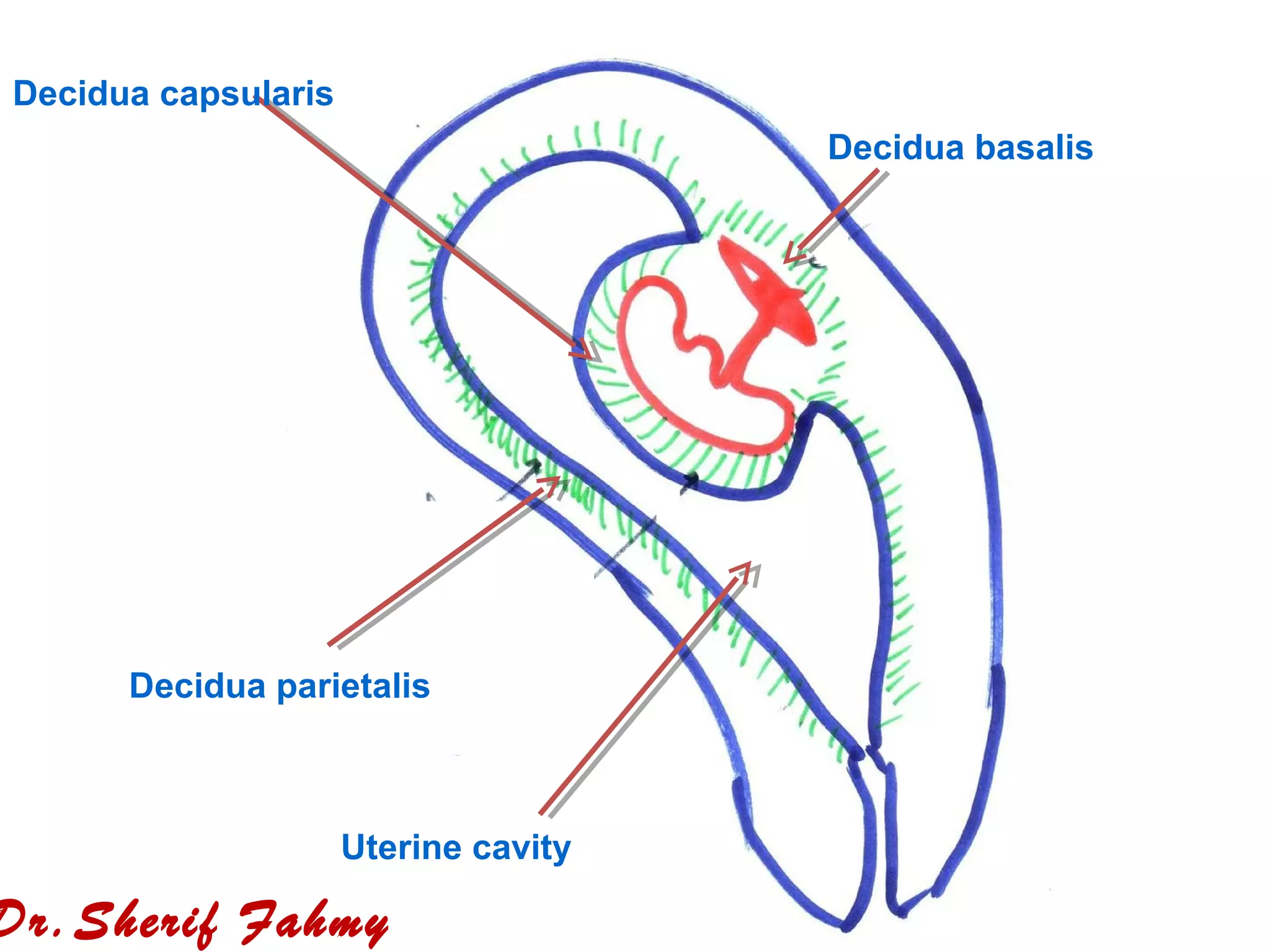
Parts of decidua:
• Decidua basalis: It is the part of decidua
between blastocyst and myometrium. It
forms the fetal part of placenta.
• Decidua capsularis: It covers the blastocyst
except embryonic pole and separates it from
uterine cavity.
• Decidua parietalis: It is the rest of
endometrium that lines the rest of uterine
cavity.
Dr. Sherif Fahmy
Decidua basalis
Decidua capsularis
Decidua parietalis
Uterine cavity
Dr.Sherif Fahmy
Fate of decidua:
• Decidua basalis shares in the
formation of placenta.
• Decidua capsularis and parietalis
fuse together and shedded with
placenta after delivery.
Dr. Sherif Fahmy
Dr. Sherif Fahmy
Decidua basalis
Decidua
parietalis
Decidua
capsularis
Uterine
cavity
Fused decidua
parietalis and
capsularis
Decidua
basalis
Changes of Blastocyst
in the Second Week of
Pregnancy
7th
day:
Dr. Sherif Fahmy
8TH
Day of Pregnancy
Endometrium
Syncytiotrophoblast
Cytotrophoblasts Hypoblasts
Amniotic cavity
Amnioblasts
Epiblast
Dr.Sherif Fahmy
• 8th
day:
• Blastocyt is partially implanted to the endometrium
which is called decidua.
• Trophoblastic cells proliferate rapidly to be
differentiated into 2 layers: cytotrophoblast (inner
cellular layer) and outer syncytiotrophoblast (sheet
of protoplasm).
• Formation of amniotic cavity between epiblast and
amnioblasts.
• Cells of inner cell mass (embryoblast) become
arranged into 2 layers: Hypoblast (primary
endoderm) and epiblast (primary ectoderm), so
forming a bilaminar germ disc.
9th
& 10th
days
Fibrin clot
Primary yolk sac
Heuser’s
membrane
Lacunar spacesSyncytio-
trophoblast
Endometrial
arteriol
Hypoblast
Amniotic
cavity
Epiblast
Amnioblast
Cyto-
trophoblast
9th
day:
• Implantation is completed and the
penetration defect in endometrium is closed
by fibrin clot.
• Formation of primitive yolk sac (exocoelomic
cavity). This occurs by proliferation of cells
from hypoblast which descend to line the
trophoblast at the original blastocele called
Heuser’s membrane.
10th
day:
- Lacunar spaces appear in syncytiotrophoblast.
Dr. Sherif Fahmy
11th
& 12th
days
Blood inside lacunae
Endometrial
sinusoid
Syncytio-trophoblast
Endometrial
epithelium
Extraembryonic
mesoderm
Primary yolk sac
Large
spaces
Amniotic
cavity
Cytotrophoblast
Bilaminar
embryonic disc
11th
& 12th
days
Syncytio-trophoblast
Chorionic Vesicle
Cyto-trophoblast
Somato-
pleuric
(Somatic)
Splanchno-pleuric
(Splanchnic)
11th
& 12th
days:
• Implantation defect is covered by epithelium.
• Blastocyst produces a slight protrusion into uterine
cavity.
• Lacunar spaces become filled with maternal blood
due to deeper penetration of cyncytiotrophoblast
to the endometrium.
• Formation of extraembryonic mesoderm in the
inner aspect of cytotrophoblast. Now trophoblasts
is called chorion and blastocyst is called chorionic
vesicle.
• Large spaces appear in the mesoderm which form
extra-embryonic coelom except at part connected
to caudal end of embryo called connecting stalk.
Dr. Sherif Fahmy
13th
day
Endodermal
cells
Secondary yolk
sac
Exocoelomic cyst
Somatic
mesoderm
Connecting stalk
Somatic
mesoderem
Splanchnic
mesoderm
1ry chorionic villi
Extra-
embryonic
coelom
Chorionic
cavity)
Dr.Sherif Fahmy
Chorionic Vesicle
13th
day:
• Formation of secondary yolk sac which
becomes lined with endodermal cells and
reduced in size due to punching off a part.
• Formation of extra-embryonic coelom and
connecting stalk.
• Formation of primary chorionic villi.
• Development of blood vessels in connecting
stalk.
• Formation of prochordal plate in which the
ectoderm and endoderm are fused together.Dr. Sherif Fahmy
Summary of the Second Week of Pregnancy
• Through this week, the following
structures are formed:
–Two cavities: amniotic and yolk.
–Two layers of embryonic disc: Primary
ectoderm and primary endoderm.
–Two layers of trophoblast: inner
cytotrophoblast and outer
cyncytiotrophoblast.
Dr. Sherif Fahmy

Implantation (General Embryology)

  • 1.
  • 2.
  • 3.
  • 4.
  • 6.
  • 7.
  • 8.
  • 9.
    Formation of blastocyst •By the end of 4th day, zona pellucida starts degeneration and disappears by the end of 5th day. • The blastomeres that remain after rupture of zona is called morula. • Fluid enters between cells and forms a cavity (blastocele) which separates cells into outer cell mass (trophoblast) and inner cell mass (embryoblast). This stage is called blastocyst which is formed at the 6th day. • Embryoblast forms embryo and then fetus while trophoblast form placenta, amniotic cavity and Dr. Sherif Fahmy
  • 10.
    2-cell stage 4-cellstage 8-cell stage Morula Early Blastocyst
  • 11.
    Blastocele Inner cell mass (Embryoblast)Outer cell mass (Trophoblast) Embryonic pole Abembryonic pole Blastocyst Dr.Sherif Fahmy
  • 12.
  • 13.
  • 14.
  • 15.
    Implantation • Dif.: Itis the process by which blastocyst is embedded in the endometrium. • Timing: Starts at 7th day and completed at 11th day. • Site: usually at upper part of posterior wall of uterus near fundus. Dr. Sherif
  • 16.
    Steps of Implantation •Blastocyst fixes its embryonic pole to site of implantation. • Syncytiotropholast erodes the compact layer of the endometrium to form implantation cavity through which the blastocyst reaches spongy layer of endometrium. Dr. Sherif Fahmy
  • 17.
    -Endometrium of pregnancyis called decidua. -Site of penetration is closed by fibrin clot (coagulum) at 9th day. -Surface epithelium overgrows the fibrin clot at 11th day. Dr.Sherif Fahmy
  • 18.
    Dr. Sherif Fahmy Innercell mass (embryoblast) Outer cell mass (trophoblast) Endometrial arteriol Endometrial gland Blastocyst Fixation of embryonic pole to implantation site Endometrium
  • 19.
  • 20.
    Dr. Sherif Fahmy GlandArteriol Syncytiotrophoblast Cytotrophoblast Epiblast Trophoblast Hypoblast Amniotic cavity Primary yolk sac Endometrium
  • 21.
  • 22.
    Abnormal Sites ofImplantation • 1- Ectopic pregnany: They are tubal, ovarian or omental (peritoneum). • 2- Placenta praevia: Parietalis, marginalis and centralis. Dr. Sherif Fahmy
  • 23.
  • 24.
    Placenta Praevia Dr. SherifFahmy Placenta praevia parietalis Normal implantation site Placenta praevia marginalis Placenta praevia centralis
  • 25.
    Decidua • It isendometrium after implantation which is sheded after birth of fetus. • Character of endometrium: • Increased secretory function of uterine glands. • Decidual cells are stromal cells filled with glycogen. • Arteries become more spiral with arterio- venous anastomosis. Dr. Sherif Fahmy
  • 26.
    Parts of decidua: •Decidua basalis: It is the part of decidua between blastocyst and myometrium. It forms the fetal part of placenta. • Decidua capsularis: It covers the blastocyst except embryonic pole and separates it from uterine cavity. • Decidua parietalis: It is the rest of endometrium that lines the rest of uterine cavity. Dr. Sherif Fahmy
  • 27.
    Decidua basalis Decidua capsularis Deciduaparietalis Uterine cavity Dr.Sherif Fahmy
  • 28.
    Fate of decidua: •Decidua basalis shares in the formation of placenta. • Decidua capsularis and parietalis fuse together and shedded with placenta after delivery. Dr. Sherif Fahmy
  • 29.
    Dr. Sherif Fahmy Deciduabasalis Decidua parietalis Decidua capsularis Uterine cavity Fused decidua parietalis and capsularis Decidua basalis
  • 30.
    Changes of Blastocyst inthe Second Week of Pregnancy
  • 31.
  • 32.
    8TH Day of Pregnancy Endometrium Syncytiotrophoblast CytotrophoblastsHypoblasts Amniotic cavity Amnioblasts Epiblast Dr.Sherif Fahmy
  • 33.
    • 8th day: • Blastocytis partially implanted to the endometrium which is called decidua. • Trophoblastic cells proliferate rapidly to be differentiated into 2 layers: cytotrophoblast (inner cellular layer) and outer syncytiotrophoblast (sheet of protoplasm). • Formation of amniotic cavity between epiblast and amnioblasts. • Cells of inner cell mass (embryoblast) become arranged into 2 layers: Hypoblast (primary endoderm) and epiblast (primary ectoderm), so forming a bilaminar germ disc.
  • 34.
    9th & 10th days Fibrin clot Primaryyolk sac Heuser’s membrane Lacunar spacesSyncytio- trophoblast Endometrial arteriol Hypoblast Amniotic cavity Epiblast Amnioblast Cyto- trophoblast
  • 35.
    9th day: • Implantation iscompleted and the penetration defect in endometrium is closed by fibrin clot. • Formation of primitive yolk sac (exocoelomic cavity). This occurs by proliferation of cells from hypoblast which descend to line the trophoblast at the original blastocele called Heuser’s membrane. 10th day: - Lacunar spaces appear in syncytiotrophoblast. Dr. Sherif Fahmy
  • 36.
    11th & 12th days Blood insidelacunae Endometrial sinusoid Syncytio-trophoblast Endometrial epithelium Extraembryonic mesoderm Primary yolk sac Large spaces Amniotic cavity Cytotrophoblast Bilaminar embryonic disc
  • 37.
  • 38.
    11th & 12th days: • Implantationdefect is covered by epithelium. • Blastocyst produces a slight protrusion into uterine cavity. • Lacunar spaces become filled with maternal blood due to deeper penetration of cyncytiotrophoblast to the endometrium. • Formation of extraembryonic mesoderm in the inner aspect of cytotrophoblast. Now trophoblasts is called chorion and blastocyst is called chorionic vesicle. • Large spaces appear in the mesoderm which form extra-embryonic coelom except at part connected to caudal end of embryo called connecting stalk. Dr. Sherif Fahmy
  • 39.
    13th day Endodermal cells Secondary yolk sac Exocoelomic cyst Somatic mesoderm Connectingstalk Somatic mesoderem Splanchnic mesoderm 1ry chorionic villi Extra- embryonic coelom Chorionic cavity) Dr.Sherif Fahmy
  • 40.
  • 41.
    13th day: • Formation ofsecondary yolk sac which becomes lined with endodermal cells and reduced in size due to punching off a part. • Formation of extra-embryonic coelom and connecting stalk. • Formation of primary chorionic villi. • Development of blood vessels in connecting stalk. • Formation of prochordal plate in which the ectoderm and endoderm are fused together.Dr. Sherif Fahmy
  • 42.
    Summary of theSecond Week of Pregnancy • Through this week, the following structures are formed: –Two cavities: amniotic and yolk. –Two layers of embryonic disc: Primary ectoderm and primary endoderm. –Two layers of trophoblast: inner cytotrophoblast and outer cyncytiotrophoblast. Dr. Sherif Fahmy