DR.
VIJAYALAXMI
PATTANSHETT
I
ASST. PROF IN
DEPT. OF
ANATOMY
SIMS & RH
TUMKUR(KAR
NATAKA).
FERTILIZATION
DR. VIJAYALAXMI PATTANSHETTI
Asst. Prof. in dept of Anatomy
SIMS & RH, TUMKURU(Karnataka)
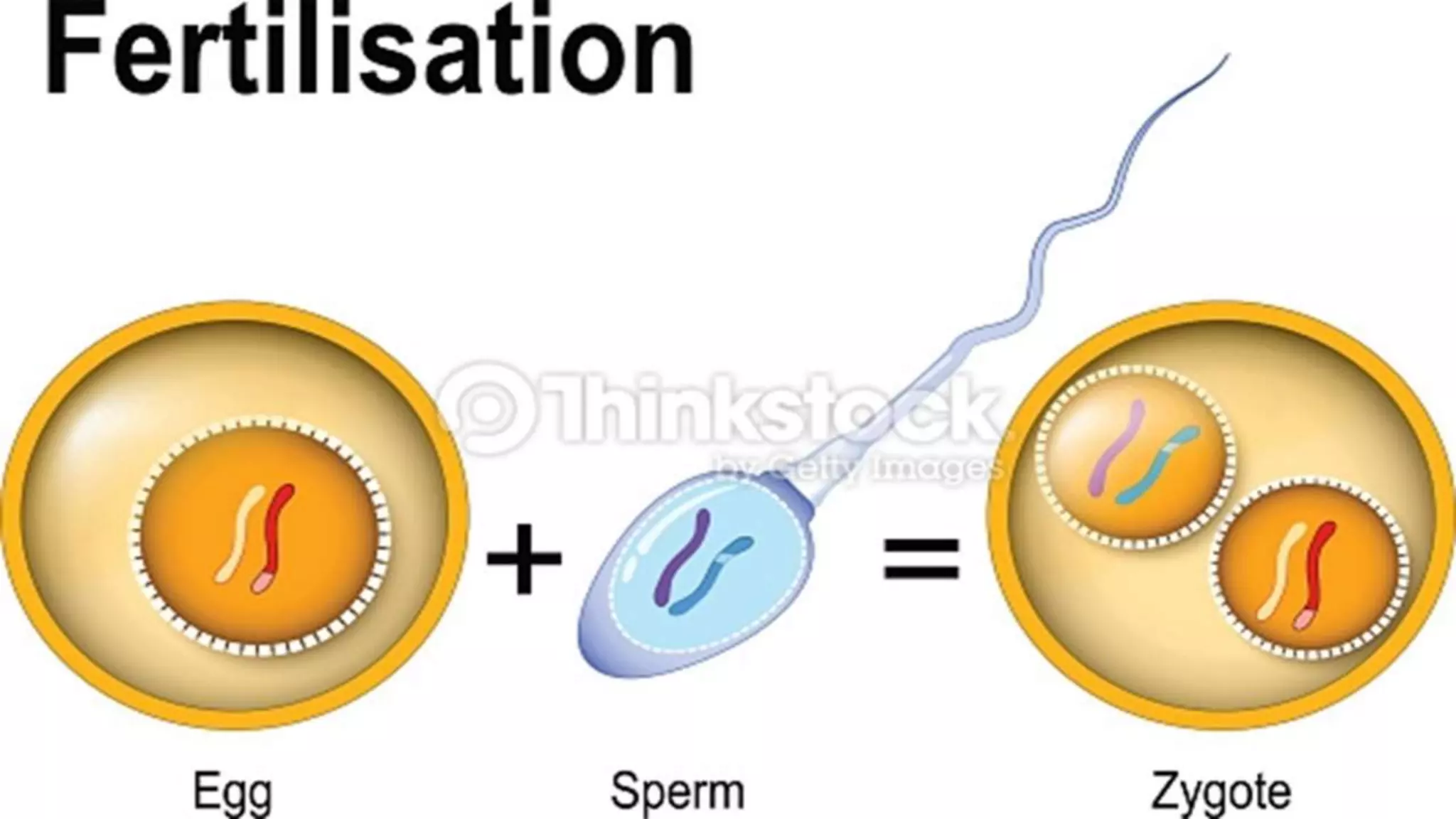
FERTILIZATION: is the process by which male and female gametes (an
ovum and spermatozoon) fuse to form a mono – nucleated single cell the
Zygote.
STEPS OF FERTILIZATION:
Transport of Gametes:
1). Oocyte transport: During ovulation the expelled ovum is taken up by the
ovarian fimbria, and passed to the ampulla by gentle waves of peristalsis.
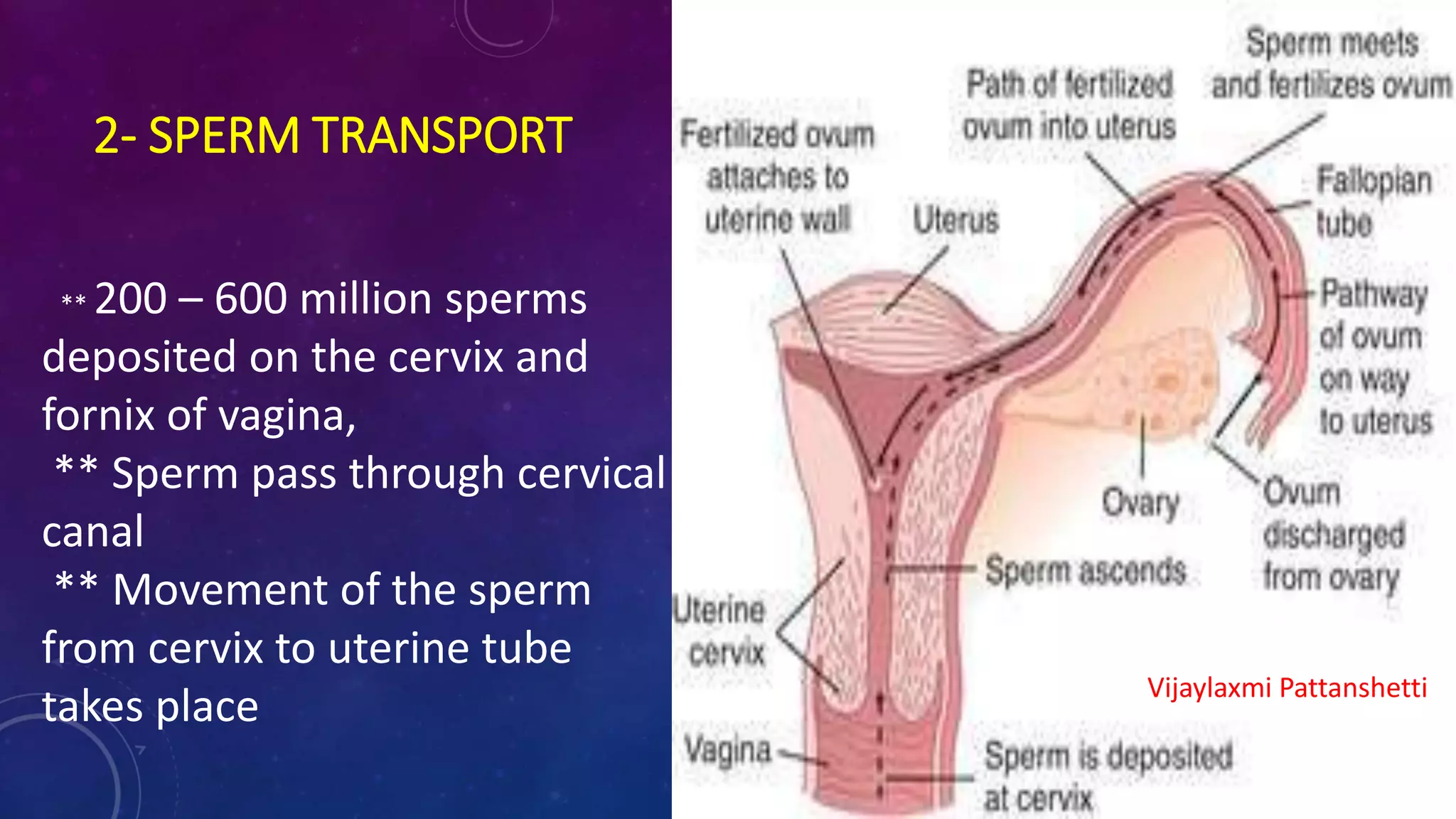
2). Sperm transport: when 200 – 600 million sperms deposited on the cervix
and the fornix of vagina, sperm pass through cervical canal by movement of
their tail.
* Movement of the sperm from cervix to uterine tube occurs by their own
propulsion and assisted by movement of fluids created by cilia.
Vijaylaxmi Pattanshetti
.
FERTILIZATION
* Journey of spermatozoa from cervix to oviduct requires a
minimum of 2 to 7hrs.
* when reaches the isthmus, sperm becomes less motile and
stops their migration
*At ovulation, sperm again becomes motile may be because
of chemo attractants produce by cumulus oophorous cells to
reach ampulla
*Spermatozoa are not able to fertilize the oocyte , when
arrive in the female genital tract but must undergo:
(i) Capacitation and
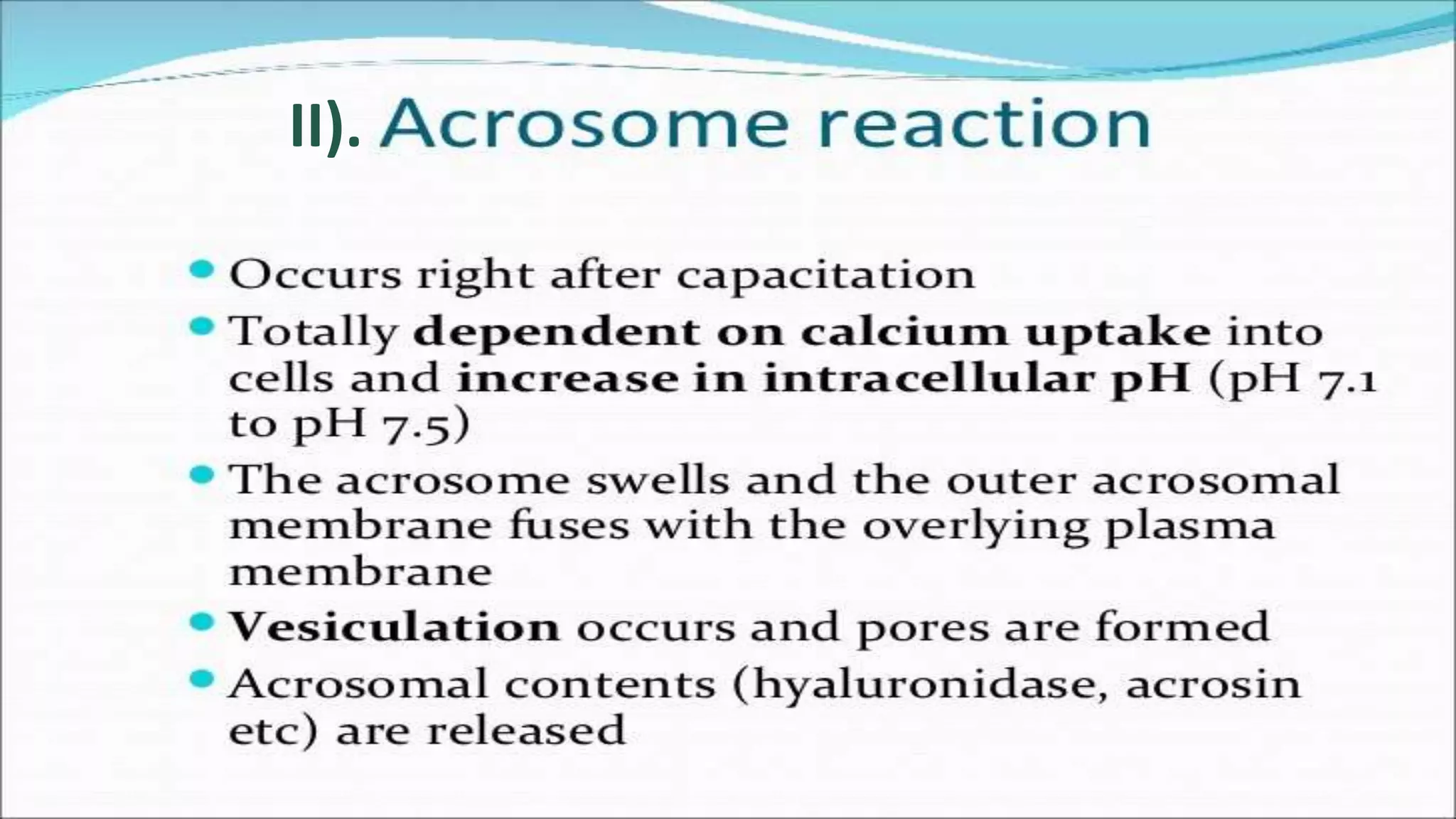
(ii) Acrosome reaction
Vijaylaxmi Pattanshetti
2- SPERM TRANSPORT
** 200 – 600 million sperms
deposited on the cervix and
fornix of vagina,
** Sperm pass through cervical
canal
** Movement of the sperm
from cervix to uterine tube
takes place Vijaylaxmi Pattanshetti
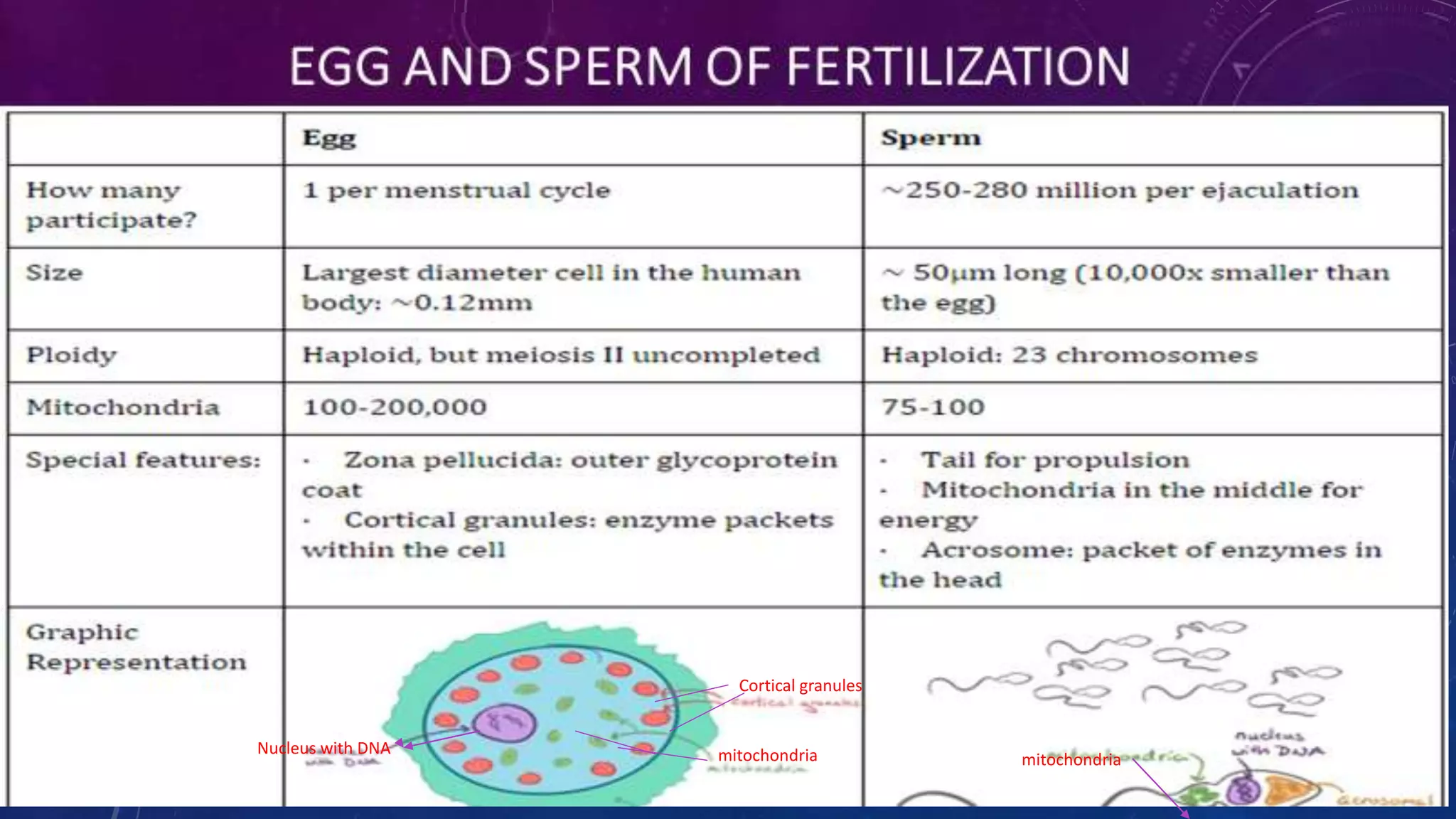
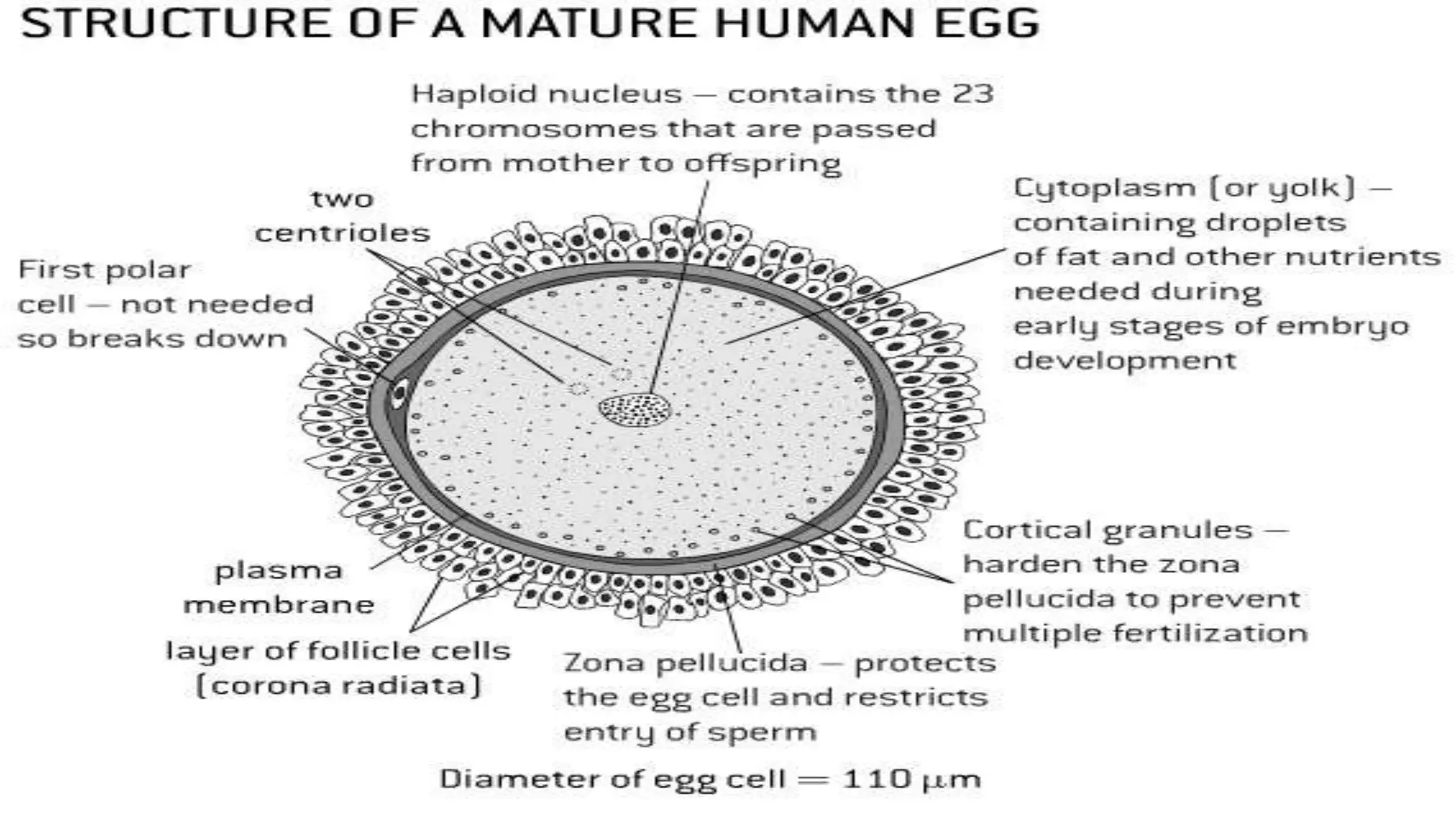
Nucleus with DNA
Cortical granules
mitochondria mitochondria
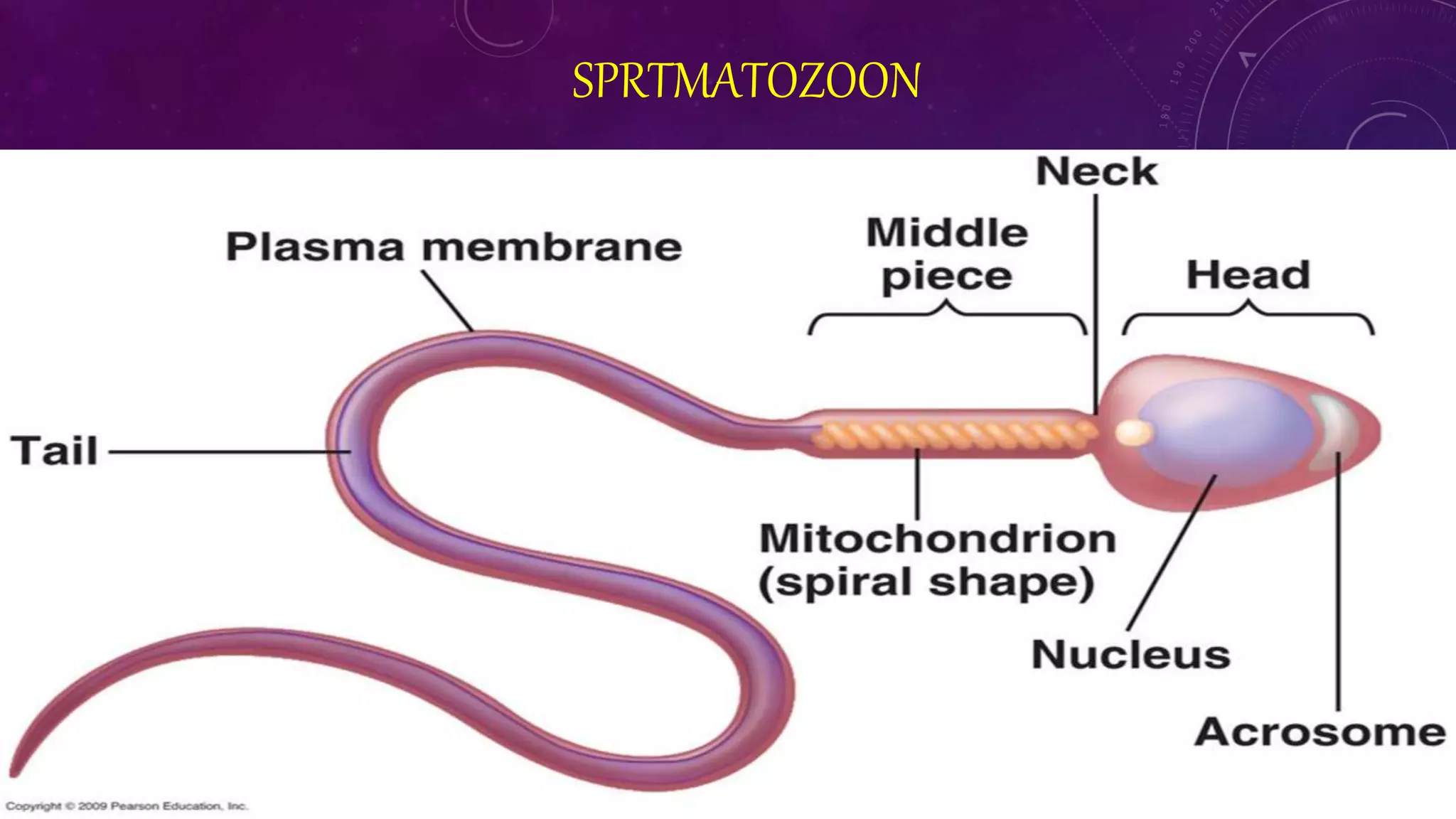
SPRTMATOZOON
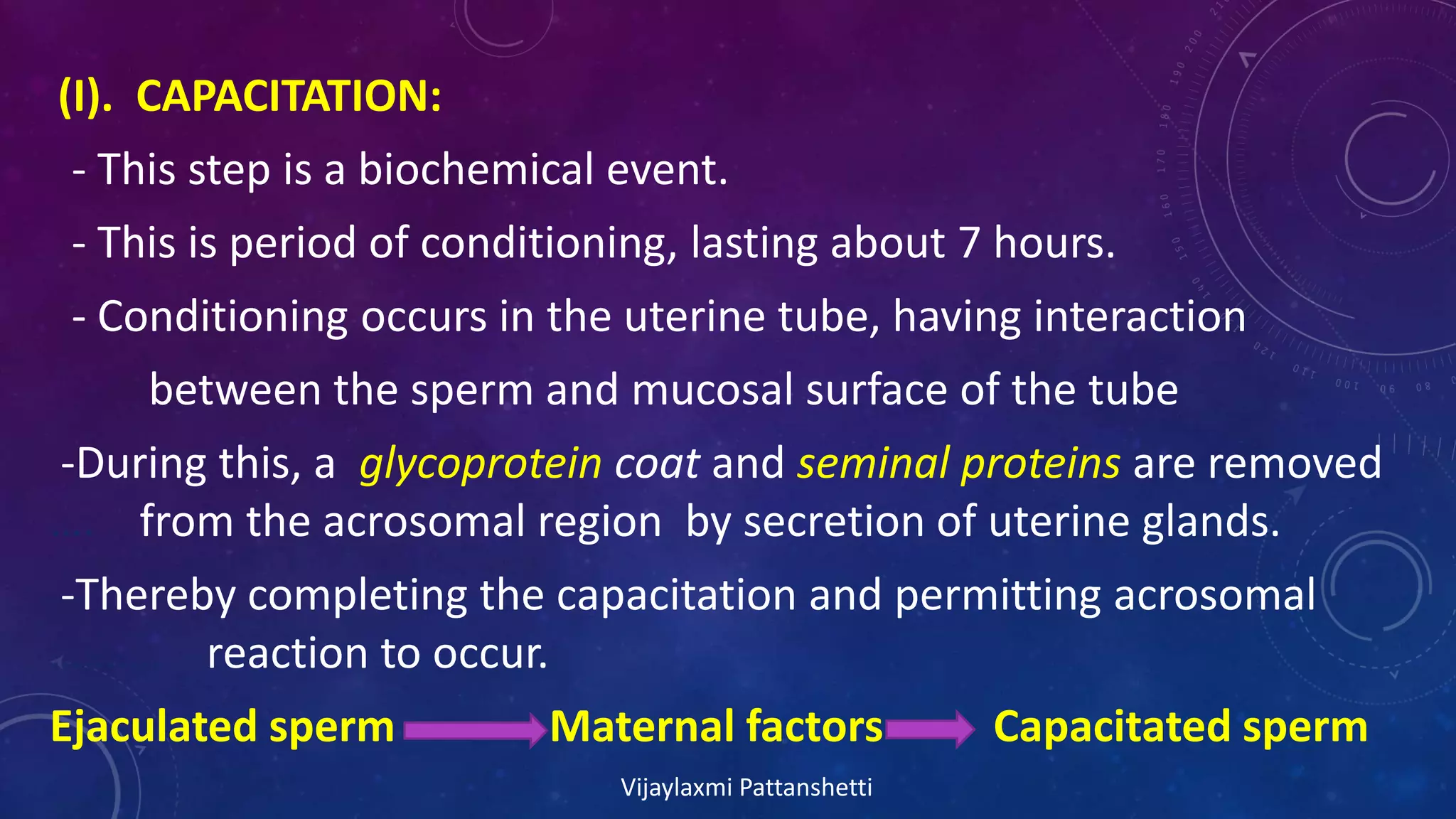
(I). CAPACITATION:
- This step is a biochemical event.
- This is period of conditioning, lasting about 7 hours.
- Conditioning occurs in the uterine tube, having interaction
between the sperm and mucosal surface of the tube
-During this, a glycoprotein coat and seminal proteins are removed
…. from the acrosomal region by secretion of uterine glands.
-Thereby completing the capacitation and permitting acrosomal
………. reaction to occur.
Ejaculated sperm Maternal factors Capacitated sperm
Vijaylaxmi Pattanshetti
II).
BARRIERS PROTECTING
THE FEMALE GAMETE
1. Corona Radiata cells
2. Zona Pellucida covering
3. Vitelline membrane of ..
…. secondary oocyte
Vijaylaxmi Pattanshetti
Vitelline membrane
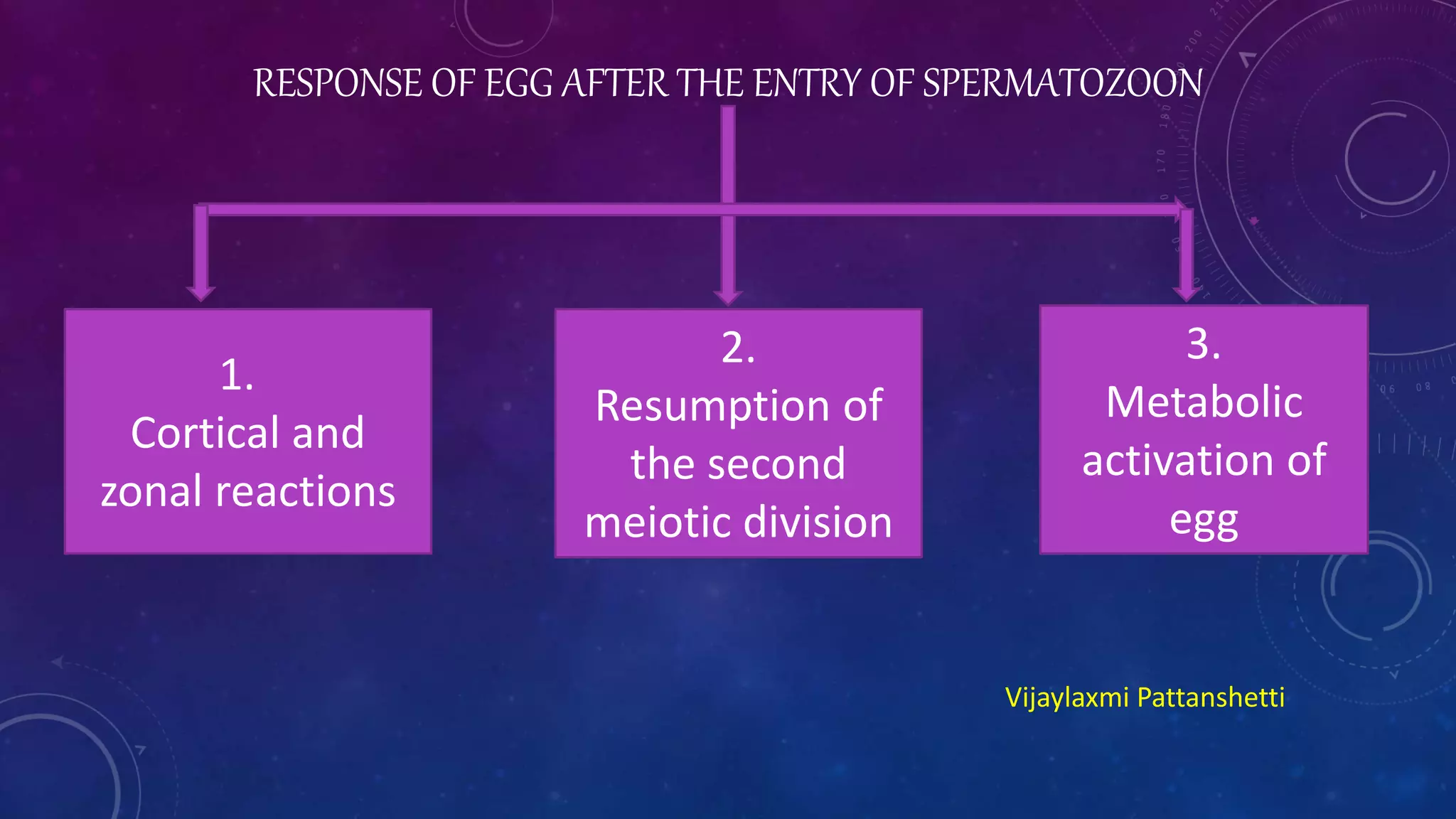
RESPONSE OF EGG AFTER THE ENTRY OF SPERMATOZOON
Vijaylaxmi Pattanshetti
1.
Cortical and
zonal reactions
2.
Resumption of
the second
meiotic division
3.
Metabolic
activation of
egg
THREE RESPONSE OF THE EGG AFTER THE ENTRY OF
THE SPERMATOZOON:
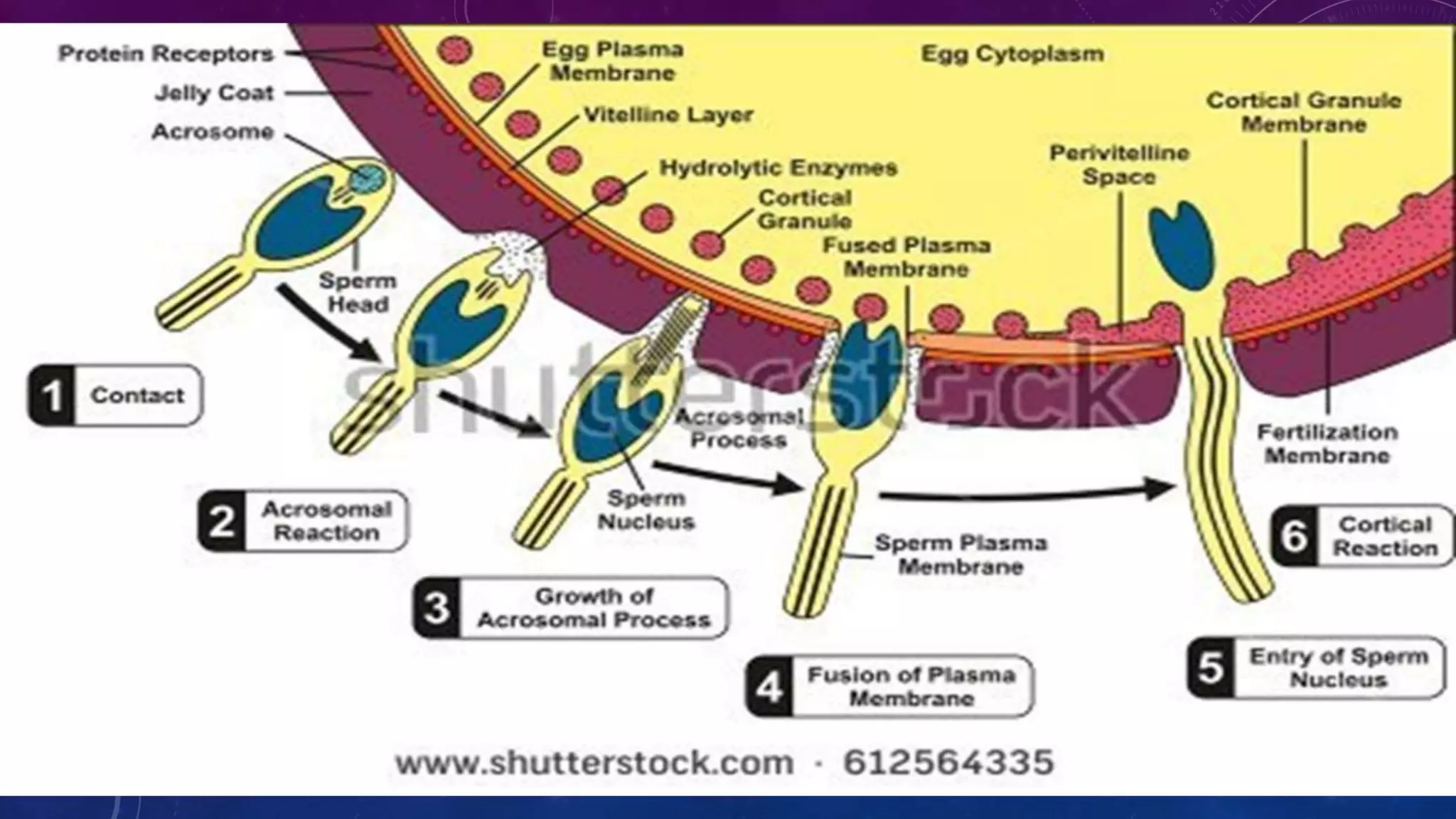
• 1. Cortical and Zona reaction: As a result of release of cortical oocyte
granules which contains lysosomal enzymes
a). the oocyte membrane becomes impermeable to other spermatozoa and
b). the zona pellucida alters its structure and composition to prevent more
than one sperm binding and penetration.
2. Resumption of the second meiotic division:
Oocyte completes its second meiotic division immediately after entry of
the spermatozoon.
One daughter cell known as second polar body and other is definitive oocyte
known as female pronucleus. Vijaylaxmi Pattanshetti
• 3. Metabolic activation of the egg:
The activation factor is probably carried by the spermatozoon.
Spermatozoon moves close to the female pronucleus and forms male
pronucleus, the tail detaches and degenerates
Both male and female pronucleus come in to close contact and loose
their nuclear envelops and form zygote.
What is parthenogenesis?
RESULTS OF FERTILIZATION
fertilization ends
Vijaylaxmi Pattanshetti

Fertilization

  • 1.
    DR. VIJAYALAXMI PATTANSHETT I ASST. PROF IN DEPT.OF ANATOMY SIMS & RH TUMKUR(KAR NATAKA). FERTILIZATION DR. VIJAYALAXMI PATTANSHETTI Asst. Prof. in dept of Anatomy SIMS & RH, TUMKURU(Karnataka)
  • 2.
    FERTILIZATION: is theprocess by which male and female gametes (an ovum and spermatozoon) fuse to form a mono – nucleated single cell the Zygote. STEPS OF FERTILIZATION: Transport of Gametes: 1). Oocyte transport: During ovulation the expelled ovum is taken up by the ovarian fimbria, and passed to the ampulla by gentle waves of peristalsis. 2). Sperm transport: when 200 – 600 million sperms deposited on the cervix and the fornix of vagina, sperm pass through cervical canal by movement of their tail. * Movement of the sperm from cervix to uterine tube occurs by their own propulsion and assisted by movement of fluids created by cilia. Vijaylaxmi Pattanshetti . FERTILIZATION
  • 3.
    * Journey ofspermatozoa from cervix to oviduct requires a minimum of 2 to 7hrs. * when reaches the isthmus, sperm becomes less motile and stops their migration *At ovulation, sperm again becomes motile may be because of chemo attractants produce by cumulus oophorous cells to reach ampulla *Spermatozoa are not able to fertilize the oocyte , when arrive in the female genital tract but must undergo: (i) Capacitation and (ii) Acrosome reaction Vijaylaxmi Pattanshetti
  • 5.
    2- SPERM TRANSPORT **200 – 600 million sperms deposited on the cervix and fornix of vagina, ** Sperm pass through cervical canal ** Movement of the sperm from cervix to uterine tube takes place Vijaylaxmi Pattanshetti
  • 6.
    Nucleus with DNA Corticalgranules mitochondria mitochondria
  • 7.
  • 9.
    (I). CAPACITATION: - Thisstep is a biochemical event. - This is period of conditioning, lasting about 7 hours. - Conditioning occurs in the uterine tube, having interaction between the sperm and mucosal surface of the tube -During this, a glycoprotein coat and seminal proteins are removed …. from the acrosomal region by secretion of uterine glands. -Thereby completing the capacitation and permitting acrosomal ………. reaction to occur. Ejaculated sperm Maternal factors Capacitated sperm Vijaylaxmi Pattanshetti
  • 11.
  • 14.
    BARRIERS PROTECTING THE FEMALEGAMETE 1. Corona Radiata cells 2. Zona Pellucida covering 3. Vitelline membrane of .. …. secondary oocyte Vijaylaxmi Pattanshetti Vitelline membrane
  • 16.
    RESPONSE OF EGGAFTER THE ENTRY OF SPERMATOZOON Vijaylaxmi Pattanshetti 1. Cortical and zonal reactions 2. Resumption of the second meiotic division 3. Metabolic activation of egg
  • 17.
    THREE RESPONSE OFTHE EGG AFTER THE ENTRY OF THE SPERMATOZOON: • 1. Cortical and Zona reaction: As a result of release of cortical oocyte granules which contains lysosomal enzymes a). the oocyte membrane becomes impermeable to other spermatozoa and b). the zona pellucida alters its structure and composition to prevent more than one sperm binding and penetration. 2. Resumption of the second meiotic division: Oocyte completes its second meiotic division immediately after entry of the spermatozoon. One daughter cell known as second polar body and other is definitive oocyte known as female pronucleus. Vijaylaxmi Pattanshetti
  • 18.
    • 3. Metabolicactivation of the egg: The activation factor is probably carried by the spermatozoon. Spermatozoon moves close to the female pronucleus and forms male pronucleus, the tail detaches and degenerates Both male and female pronucleus come in to close contact and loose their nuclear envelops and form zygote. What is parthenogenesis?
  • 20.
  • 21.

Editor's Notes

  • #2 Dr. Vijayalaxmi Pattanshetti Asst. Prof. in dept of Anatomy SIMS & RH TUMKURU(Karnataka)
  • #3 Vijaylaxmi Pattanshetti
  • #4 Vijaylaxmi Pattanshetti
  • #6 Vijaylaxmi Pattanshetti
  • #7 mitochondria
  • #10 Vijaylaxmi Pattanshetti
  • #12 II)
  • #15 Vitelline membrane
  • #17 Vijaylaxmi Pattanshetti
  • #22 Vijaylaxmi Pattanshetti