pKa
By
KAUSHAL KUMAR SAHU
Assistant Professor (Ad Hoc)
Department of Biotechnology
Govt. Digvijay Autonomous P. G. College
Raj-Nandgaon ( C. G. )
SYNOPSIS:-
• INTRODUCTION
• ACID DISSOCIATIION CONSTANT
• DEFINITION
• SELF IONIZATION OF WATER
• BASES
• ISOELECTRIIC POINT
• HANDERSON-HASSELBALCH EQUATION
• MONOPROTIC ACID
• POLYPROTIC ACID
• TITRATION CURVE OF WEAK ACID
• COMPARISON OF TITRATION CURVE OF 3 WEAK ACIDS
• FACTORS THAT AFFECT pKa VALUES
• SIGNIFICANCE ANND USES
• CONCLUSION
• REFRENCES
INTRODUCTION
• The acid dissociation constant for an acid is a direct consequence of
the underlying thermodynamics of the dissociation reaction; the
pKa value is directly proportional to the standard Gibbs energy
change for the reaction. The value of the pKa changes with
temperature and can be understood qualitatively based on Le
Chatelier's principle: when the reaction is endothermic, the
pKa decreases with increasing temperature; the opposite is true
for exothermic reactions.
• The quantitative behaviour of acids and bases in solution can be
understood only if their pKa values are known.
• The pH of a solution can be predicted when the analytical
concentration and pKa values of all acids and bases are known;
conversely, it is possible to calculate the equilibrium concentration of
the acids and bases in solution when the pH is known. These
application in many different areas of chemistry, biology, medicine,
and geology.
ACID DISSOCIATION CONSTANT
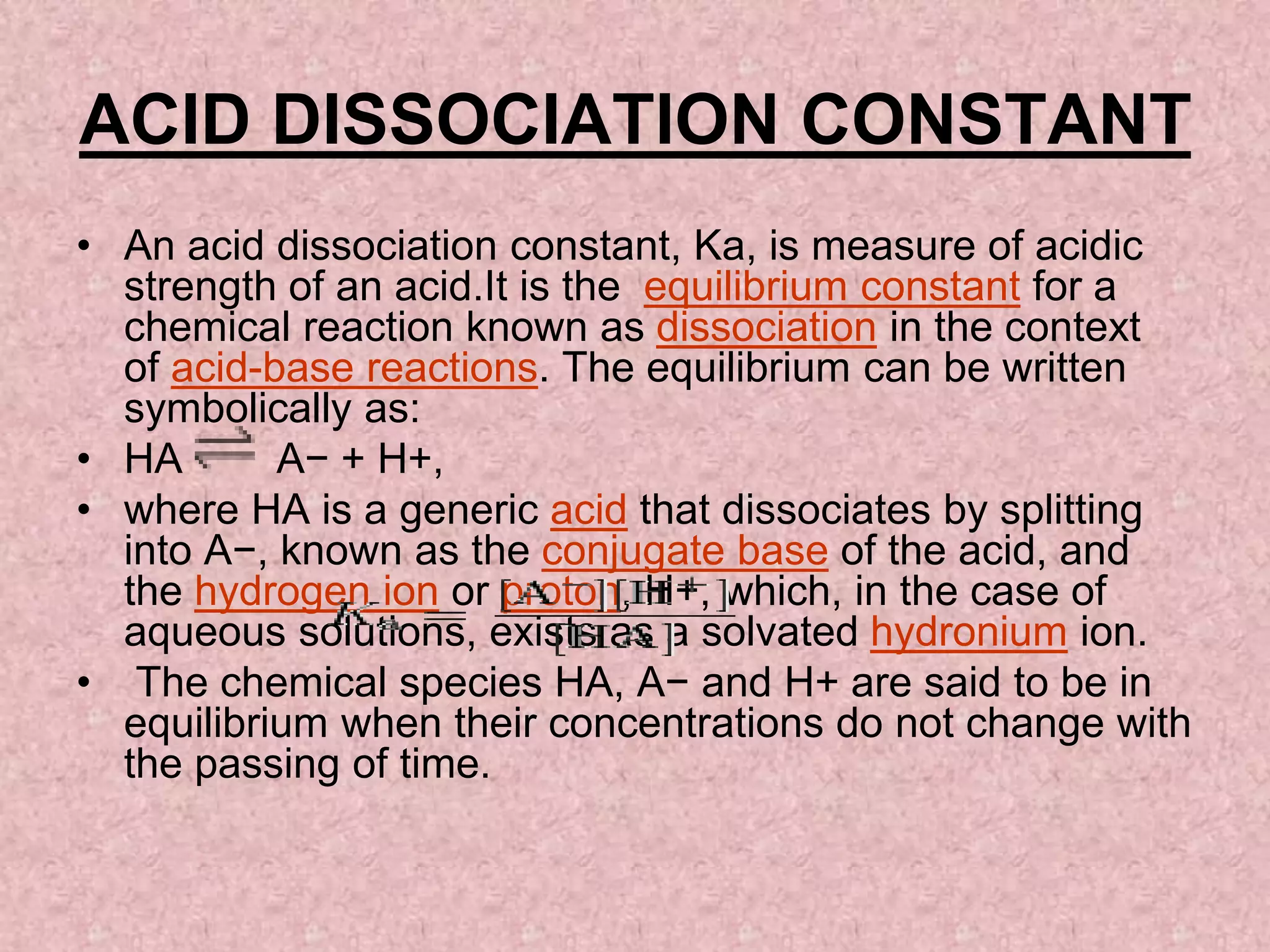
• An acid dissociation constant, Ka, is measure of acidic
strength of an acid.It is the equilibrium constant for a
chemical reaction known as dissociation in the context
of acid-base reactions. The equilibrium can be written
symbolically as:
• HA A− + H+,
• where HA is a generic acid that dissociates by splitting
into A−, known as the conjugate base of the acid, and
the hydrogen ion or proton, H+, which, in the case of
aqueous solutions, exists as a solvated hydronium ion.
• The chemical species HA, A− and H+ are said to be in
equilibrium when their concentrations do not change with
the passing of time.
• The logarithmic constant, pKa, which is
equal to −log10 Ka, is sometimes also (but
incorrectly) referred to as an acid
dissociation constant:
DEFINITION
• According to Arrhenius's original definition, an
acid is a substance that dissociates in aqueous
solution, releasing the hydrogen ion H+ (a
proton):
• HA A− + H+.
• The equilibrium constant for this dissociation
reaction is known as a dissociation constant.
The liberated proton combines with a water
molecule to give a hydronium (or oxonium)
ion H3O+, and so Arrhenius later proposed that
the dissociation should be written as an acid–
base reaction:
HA + H2O A− + H3O+.
• Brønsted and Lowry generalised this further to a
proton exchange reaction:
• acid + base conjugate base + conjugate acid.
• The designation of an acid or base as
"conjugate" depends on the context. The
conjugate acid BH+ of a base B dissociates
according to
• BH+ + OH− B + H2O
• which is the reverse of the equilibrium
• H2O (acid) + B (base) OH− (conjugate base)
+ BH+ (conjugate acid).
SELF IONIZATION OF WATER
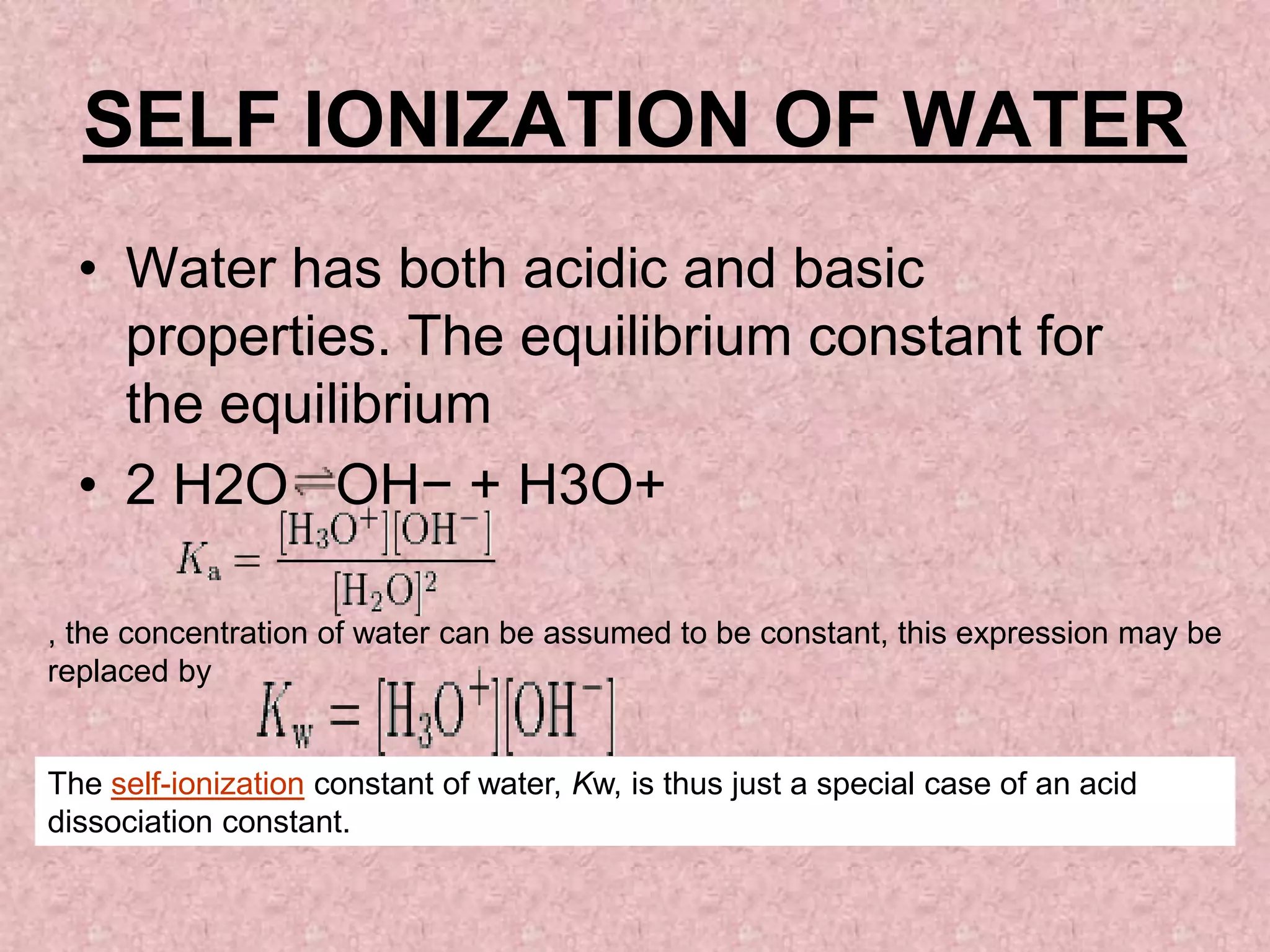
• Water has both acidic and basic
properties. The equilibrium constant for
the equilibrium
• 2 H2O OH− + H3O+
, the concentration of water can be assumed to be constant, this expression may be
replaced by
The self-ionization constant of water, Kw, is thus just a special case of an acid
dissociation constant.
BASES
• Historically, the equilibrium constant Kb for
a base has been defined as
the association constant for protonation of
the base, B, to form the conjugate acid,
HB+.
• B + H2O HB+ + OH−
• Using similar reasoning to that used
before
• Kb is related to Ka for the conjugate acid.
In water, the concentration of
the hydroxide ion, [OH−], is related to the
concentration of the hydrogen ion by Kw =
[H+] [OH−], therefore
• Substitution of the expression for [OH−]
into the expression for Kb gives
ISOELECTRIC POINT
• the isoelectric point (pI) is defined as the
pH at which the sum, weighted by charge
value, of concentrations of positively
charged species is equal to the weighted
sum of concentrations of negatively
charged species. Example:- Glycine
• There are two dissociation equilibria to
consider , taking cologarithms, the pH is
given by
HANDERSON – HASSELBALCH
EQUATION:-
• . For the dissociation of a weak acid HA
into H_ and A_, the Henderson-
Hasselbalch equation can be derived as
follows:-
•
The ratio [A − ] / [HA] is unitless, and as such, other ratios
with other units may be used. For example, the mole ratio of
the components,
MONOPROTIC ACID:-
• They are those acids
that are able to
donate one proton per
molecules during the
process of
dissociation
(sometimes called
ionization)
• Ex. Carboxylic acid,
Ammonium ion
POLYPROTIC ACID:-
• They are able to donate more
than one proton per acid
molecules. Specific types of
polyprotic acids are diprotic
acid( two potential proton to
donate) and triprotic( three
potential proton to donate).
• Diprotic acid:- Ex- Carbonic
acid , Bicarbonate ion
• Triprotic acid:- Ex- Phosphoric
acid , Dihydrogen phosphate
TITRATION CURVE OF WEAK
ACID:-
COMPARISON OF TITRATION
CURVE OF THREE WEAK ACID:-
FACTORS THAT AFFECTS pKa
VALUES:-
1) Alcohols do not normally behave as acids in water, but
the presence of an double bond adjacent to the OH
group can substantially decrease the pKa by the
mechanismof Keto-enol isomerism.
2) organic acids inductive effects and mesomeric
effects affect the pKa values.
3) Effect of replacing the hydrogen atoms in acetic acid by
the more electronegative chlorine atom The electron-
withdrawing effect of the substituent makes ionisation
easier, so successive pKa values decrease in the series
4.7, 2.8, 1.3 and 0.7 when 0,1, 2 or 3 chlorine atoms
are present.
4) Structural effects can also be important. The difference
between fumaricand maleic acid is a classic example.
SIGNIFICANCE AND USES:-
1)A knowledge of pKa values is important for example, the pKa values of
proteins and amino acid side chains are of major importance for the activity
ofenzymes and the stability of proteins.
2)Buffer solutions are used extensively to provide solutions at or near to the
physiological pH for the study of biochemical reactions; the design of these
solutions depends on a knowledge of the pKa values of their components.
3) ionization of any compound will increase the solubility in water, but decrease
the lipophilicity. This is exploited in drug development to increase the
concentration of a compound in the blood by adjusting the pKa of an
ionizablegroup
4) Knowledge of pKa values is important for the understanding of coordination
complexes, which are formed by the interaction of a metal ion, Mm+, acting as
a Lewis acid, with a ligand, L, acting as aLewis base.
CONCLUSION:-
• pKa of a functional group is also profoundly influence by
the surrounding medium. The medium may either raise
or lower the pKa depending on whether the
undissociated acid and conjugate base is the charged
species. The effect of dielectric constant on pKa may be
observed by adding ethanol to water . The pKa of
carboxylic acid increases , whether that of amine
decreases because ethanol decreases the ability of
water to solvate a charged species .
• The pKa values of dissociating groups in the interior of
proteins thus are profoundly affected by their local
environment , including the presence or absence of
water.
• Thus pKa values depends on the properties of medium.
REFRENCES:-
• Lehninger “ Principles of Biochemistry.
• Harper’s Biochemistry
• NET SOURCE:-
• WWW. GOOGLE . CO. In
• WIKIPEDIA

pKa by KK Sahu sir

  • 1.
    pKa By KAUSHAL KUMAR SAHU AssistantProfessor (Ad Hoc) Department of Biotechnology Govt. Digvijay Autonomous P. G. College Raj-Nandgaon ( C. G. )
  • 2.
    SYNOPSIS:- • INTRODUCTION • ACIDDISSOCIATIION CONSTANT • DEFINITION • SELF IONIZATION OF WATER • BASES • ISOELECTRIIC POINT • HANDERSON-HASSELBALCH EQUATION • MONOPROTIC ACID • POLYPROTIC ACID • TITRATION CURVE OF WEAK ACID • COMPARISON OF TITRATION CURVE OF 3 WEAK ACIDS • FACTORS THAT AFFECT pKa VALUES • SIGNIFICANCE ANND USES • CONCLUSION • REFRENCES
  • 3.
    INTRODUCTION • The aciddissociation constant for an acid is a direct consequence of the underlying thermodynamics of the dissociation reaction; the pKa value is directly proportional to the standard Gibbs energy change for the reaction. The value of the pKa changes with temperature and can be understood qualitatively based on Le Chatelier's principle: when the reaction is endothermic, the pKa decreases with increasing temperature; the opposite is true for exothermic reactions. • The quantitative behaviour of acids and bases in solution can be understood only if their pKa values are known. • The pH of a solution can be predicted when the analytical concentration and pKa values of all acids and bases are known; conversely, it is possible to calculate the equilibrium concentration of the acids and bases in solution when the pH is known. These application in many different areas of chemistry, biology, medicine, and geology.
  • 4.
    ACID DISSOCIATION CONSTANT •An acid dissociation constant, Ka, is measure of acidic strength of an acid.It is the equilibrium constant for a chemical reaction known as dissociation in the context of acid-base reactions. The equilibrium can be written symbolically as: • HA A− + H+, • where HA is a generic acid that dissociates by splitting into A−, known as the conjugate base of the acid, and the hydrogen ion or proton, H+, which, in the case of aqueous solutions, exists as a solvated hydronium ion. • The chemical species HA, A− and H+ are said to be in equilibrium when their concentrations do not change with the passing of time.
  • 5.
    • The logarithmicconstant, pKa, which is equal to −log10 Ka, is sometimes also (but incorrectly) referred to as an acid dissociation constant:
  • 6.
    DEFINITION • According toArrhenius's original definition, an acid is a substance that dissociates in aqueous solution, releasing the hydrogen ion H+ (a proton): • HA A− + H+. • The equilibrium constant for this dissociation reaction is known as a dissociation constant. The liberated proton combines with a water molecule to give a hydronium (or oxonium) ion H3O+, and so Arrhenius later proposed that the dissociation should be written as an acid– base reaction:
  • 7.
    HA + H2OA− + H3O+. • Brønsted and Lowry generalised this further to a proton exchange reaction: • acid + base conjugate base + conjugate acid. • The designation of an acid or base as "conjugate" depends on the context. The conjugate acid BH+ of a base B dissociates according to • BH+ + OH− B + H2O • which is the reverse of the equilibrium • H2O (acid) + B (base) OH− (conjugate base) + BH+ (conjugate acid).
  • 8.
    SELF IONIZATION OFWATER • Water has both acidic and basic properties. The equilibrium constant for the equilibrium • 2 H2O OH− + H3O+ , the concentration of water can be assumed to be constant, this expression may be replaced by The self-ionization constant of water, Kw, is thus just a special case of an acid dissociation constant.
  • 9.
    BASES • Historically, theequilibrium constant Kb for a base has been defined as the association constant for protonation of the base, B, to form the conjugate acid, HB+. • B + H2O HB+ + OH− • Using similar reasoning to that used before
  • 10.
    • Kb isrelated to Ka for the conjugate acid. In water, the concentration of the hydroxide ion, [OH−], is related to the concentration of the hydrogen ion by Kw = [H+] [OH−], therefore • Substitution of the expression for [OH−] into the expression for Kb gives
  • 11.
    ISOELECTRIC POINT • theisoelectric point (pI) is defined as the pH at which the sum, weighted by charge value, of concentrations of positively charged species is equal to the weighted sum of concentrations of negatively charged species. Example:- Glycine • There are two dissociation equilibria to consider , taking cologarithms, the pH is given by
  • 12.
    HANDERSON – HASSELBALCH EQUATION:- •. For the dissociation of a weak acid HA into H_ and A_, the Henderson- Hasselbalch equation can be derived as follows:- •
  • 13.
    The ratio [A− ] / [HA] is unitless, and as such, other ratios with other units may be used. For example, the mole ratio of the components,
  • 14.
    MONOPROTIC ACID:- • Theyare those acids that are able to donate one proton per molecules during the process of dissociation (sometimes called ionization) • Ex. Carboxylic acid, Ammonium ion
  • 15.
    POLYPROTIC ACID:- • Theyare able to donate more than one proton per acid molecules. Specific types of polyprotic acids are diprotic acid( two potential proton to donate) and triprotic( three potential proton to donate). • Diprotic acid:- Ex- Carbonic acid , Bicarbonate ion • Triprotic acid:- Ex- Phosphoric acid , Dihydrogen phosphate
  • 16.
    TITRATION CURVE OFWEAK ACID:-
  • 17.
    COMPARISON OF TITRATION CURVEOF THREE WEAK ACID:-
  • 18.
    FACTORS THAT AFFECTSpKa VALUES:- 1) Alcohols do not normally behave as acids in water, but the presence of an double bond adjacent to the OH group can substantially decrease the pKa by the mechanismof Keto-enol isomerism. 2) organic acids inductive effects and mesomeric effects affect the pKa values. 3) Effect of replacing the hydrogen atoms in acetic acid by the more electronegative chlorine atom The electron- withdrawing effect of the substituent makes ionisation easier, so successive pKa values decrease in the series 4.7, 2.8, 1.3 and 0.7 when 0,1, 2 or 3 chlorine atoms are present. 4) Structural effects can also be important. The difference between fumaricand maleic acid is a classic example.
  • 19.
    SIGNIFICANCE AND USES:- 1)Aknowledge of pKa values is important for example, the pKa values of proteins and amino acid side chains are of major importance for the activity ofenzymes and the stability of proteins. 2)Buffer solutions are used extensively to provide solutions at or near to the physiological pH for the study of biochemical reactions; the design of these solutions depends on a knowledge of the pKa values of their components. 3) ionization of any compound will increase the solubility in water, but decrease the lipophilicity. This is exploited in drug development to increase the concentration of a compound in the blood by adjusting the pKa of an ionizablegroup 4) Knowledge of pKa values is important for the understanding of coordination complexes, which are formed by the interaction of a metal ion, Mm+, acting as a Lewis acid, with a ligand, L, acting as aLewis base.
  • 20.
    CONCLUSION:- • pKa ofa functional group is also profoundly influence by the surrounding medium. The medium may either raise or lower the pKa depending on whether the undissociated acid and conjugate base is the charged species. The effect of dielectric constant on pKa may be observed by adding ethanol to water . The pKa of carboxylic acid increases , whether that of amine decreases because ethanol decreases the ability of water to solvate a charged species . • The pKa values of dissociating groups in the interior of proteins thus are profoundly affected by their local environment , including the presence or absence of water. • Thus pKa values depends on the properties of medium.
  • 21.
    REFRENCES:- • Lehninger “Principles of Biochemistry. • Harper’s Biochemistry • NET SOURCE:- • WWW. GOOGLE . CO. In • WIKIPEDIA