Presented by,
R.Venkatesan.
M.Pharm 1st semester
Dept. pharmaceutical analysis
Karnataka college of pharmacy
Bangalore
25-Feb-2023
Presented to,
Dr.C.Sreedhar,
Professor and HOD
Dept. pharmaceutical analysis
Karnataka college of pharmacy
Bangalore
ADVANCED PHARMACEUTICAL ANALYSIS
PKa
Introduction
01
Henderson-Hasselbalch equation
02
Determination
03
Application
04
CONTENT
KARNATAKA COLLEGE OF PHARMACY 2
• Substance dissociate into ions is known as dissociation
constant (Ka).
• It also called acid dissociation constant, acidity constant
and acid ionization constant it denoted as Ka.
• Ionization – atom or molecule acquires a negative or
positive charge by gaining or lossing electron.
Dissociation constant
KARNATAKA COLLEGE OF PHARMACY 3
• Method for detection of dissociation constant is known as
(Pka).
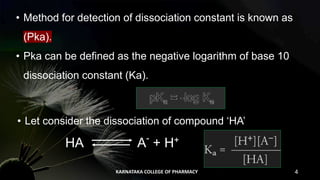
• Pka can be defined as the negative logarithm of base 10
dissociation constant (Ka).
• Let consider the dissociation of compound ‘HA’
HA A-
+ H+
KARNATAKA COLLEGE OF PHARMACY 4
Henderson-Hasselbalch equation
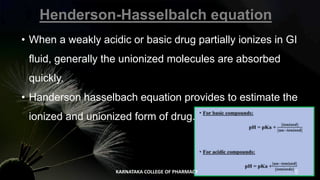
• When a weakly acidic or basic drug partially ionizes in GI
fluid, generally the unionized molecules are absorbed
quickly.
• Handerson hasselbach equation provides to estimate the
ionized and unionized form of drug.
KARNATAKA COLLEGE OF PHARMACY 5
• Depends on PH
• Compound should be unionized before crossing the biological
barrier because as ionized molecule can’t completely cross the
barrier.
1. Ionized - Hydrophilic it decreases absorption
2. Unionized – Lipophilic increses absorption
• The rate of absorption of a drug which depends of the both
ionized and unionized form.
• And this two form is depends on the Pka and PH.
Characteristics dissociation constant
KARNATAKA COLLEGE OF PHARMACY 6
DETERMINATION
OF PKa
1.Conductivity method
2.Solubility method
3.Potentiometric method
4.Spectrophotometric method
KARNATAKA COLLEGE OF PHARMACY 7
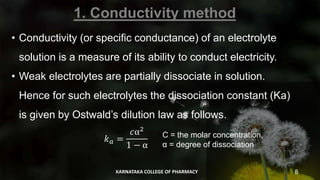
• Conductivity (or specific conductance) of an electrolyte
solution is a measure of its ability to conduct electricity.
• Weak electrolytes are partially dissociate in solution.
Hence for such electrolytes the dissociation constant (Ka)
is given by Ostwald’s dilution law as follows.
1. Conductivity method
𝑘𝑎 =
𝑐α2
1 − α
C = the molar concentration,
α = degree of dissociation
KARNATAKA COLLEGE OF PHARMACY 8
2. Solubility method
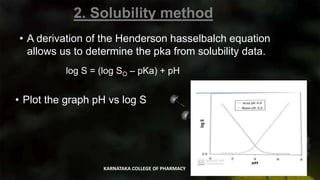
• A derivation of the Henderson hasselbalch equation
allows us to determine the pka from solubility data.
log S = (log SO – pKa) + pH
• Plot the graph pH vs log S
KARNATAKA COLLEGE OF PHARMACY 9
3. Potentiometric method
• In potentiometric titration, a sample is titrated with acid
or base using pH electrode to monitor the course of
titration.
• The pKa value is calculated from the change in shape
of the titration curve compared with that of blank
titration without sample is present.
• Relationship between pH and pKa
pH = pKa + log10 [A
-
]/[H]
KARNATAKA COLLEGE OF PHARMACY 10
4. Spectrophotometric method
• Uv visible spectroscopy is mainly used for the
quantitative estimation of drug.
• Here, uv visible spectroscopy used for determination of
pKa.
• Like we use acidic and basic medium as a solvent for
ionization. After we measure absorbance.
KARNATAKA COLLEGE OF PHARMACY 11
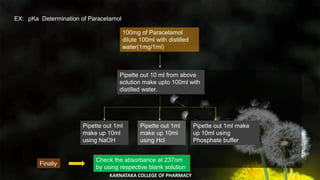
EX: pKa Determination of Paracetamol
100mg of Paracetamol
dilute 100ml with distilled
water(1mg/1ml)
Pipette out 10 ml from above
solution make upto 100ml with
distilled water.
Pipette out 1ml
make up 10ml
using NaOH
Pipette out 1ml
make up 10ml
using Hcl
Pipette out 1ml make
up 10ml using
Phosphate buffer
Finally
Check the absorbance at 237nm
by using respective blank solution
KARNATAKA COLLEGE OF PHARMACY 12
Application
Dissociation constant is incorporated in Henderson
hasselbalch equation to calculate the extent of
ionization ( or dissociation ), i.e percent unionized
and ionized form of drug.
The absorption of drugs in gastrointestinal tracl can
be predicted using dissociation constant of drug and
pH at different sites of GIT.
The concentration of solution can be calculated
KARNATAKA COLLEGE OF PHARMACY 13
THANK
YOU

Pka

  • 1.
    Presented by, R.Venkatesan. M.Pharm 1stsemester Dept. pharmaceutical analysis Karnataka college of pharmacy Bangalore 25-Feb-2023 Presented to, Dr.C.Sreedhar, Professor and HOD Dept. pharmaceutical analysis Karnataka college of pharmacy Bangalore ADVANCED PHARMACEUTICAL ANALYSIS PKa
  • 2.
  • 3.
    • Substance dissociateinto ions is known as dissociation constant (Ka). • It also called acid dissociation constant, acidity constant and acid ionization constant it denoted as Ka. • Ionization – atom or molecule acquires a negative or positive charge by gaining or lossing electron. Dissociation constant KARNATAKA COLLEGE OF PHARMACY 3
  • 4.
    • Method fordetection of dissociation constant is known as (Pka). • Pka can be defined as the negative logarithm of base 10 dissociation constant (Ka). • Let consider the dissociation of compound ‘HA’ HA A- + H+ KARNATAKA COLLEGE OF PHARMACY 4
  • 5.
    Henderson-Hasselbalch equation • Whena weakly acidic or basic drug partially ionizes in GI fluid, generally the unionized molecules are absorbed quickly. • Handerson hasselbach equation provides to estimate the ionized and unionized form of drug. KARNATAKA COLLEGE OF PHARMACY 5
  • 6.
    • Depends onPH • Compound should be unionized before crossing the biological barrier because as ionized molecule can’t completely cross the barrier. 1. Ionized - Hydrophilic it decreases absorption 2. Unionized – Lipophilic increses absorption • The rate of absorption of a drug which depends of the both ionized and unionized form. • And this two form is depends on the Pka and PH. Characteristics dissociation constant KARNATAKA COLLEGE OF PHARMACY 6
  • 7.
    DETERMINATION OF PKa 1.Conductivity method 2.Solubilitymethod 3.Potentiometric method 4.Spectrophotometric method KARNATAKA COLLEGE OF PHARMACY 7
  • 8.
    • Conductivity (orspecific conductance) of an electrolyte solution is a measure of its ability to conduct electricity. • Weak electrolytes are partially dissociate in solution. Hence for such electrolytes the dissociation constant (Ka) is given by Ostwald’s dilution law as follows. 1. Conductivity method 𝑘𝑎 = 𝑐α2 1 − α C = the molar concentration, α = degree of dissociation KARNATAKA COLLEGE OF PHARMACY 8
  • 9.
    2. Solubility method •A derivation of the Henderson hasselbalch equation allows us to determine the pka from solubility data. log S = (log SO – pKa) + pH • Plot the graph pH vs log S KARNATAKA COLLEGE OF PHARMACY 9
  • 10.
    3. Potentiometric method •In potentiometric titration, a sample is titrated with acid or base using pH electrode to monitor the course of titration. • The pKa value is calculated from the change in shape of the titration curve compared with that of blank titration without sample is present. • Relationship between pH and pKa pH = pKa + log10 [A - ]/[H] KARNATAKA COLLEGE OF PHARMACY 10
  • 11.
    4. Spectrophotometric method •Uv visible spectroscopy is mainly used for the quantitative estimation of drug. • Here, uv visible spectroscopy used for determination of pKa. • Like we use acidic and basic medium as a solvent for ionization. After we measure absorbance. KARNATAKA COLLEGE OF PHARMACY 11
  • 12.
    EX: pKa Determinationof Paracetamol 100mg of Paracetamol dilute 100ml with distilled water(1mg/1ml) Pipette out 10 ml from above solution make upto 100ml with distilled water. Pipette out 1ml make up 10ml using NaOH Pipette out 1ml make up 10ml using Hcl Pipette out 1ml make up 10ml using Phosphate buffer Finally Check the absorbance at 237nm by using respective blank solution KARNATAKA COLLEGE OF PHARMACY 12
  • 13.
    Application Dissociation constant isincorporated in Henderson hasselbalch equation to calculate the extent of ionization ( or dissociation ), i.e percent unionized and ionized form of drug. The absorption of drugs in gastrointestinal tracl can be predicted using dissociation constant of drug and pH at different sites of GIT. The concentration of solution can be calculated KARNATAKA COLLEGE OF PHARMACY 13
  • 14.