Copyright 2002 Prentice-Hall, Inc.
Chapter 5
Identifying and Selecting
Systems Development Projects
5.1
Modern Systems Analysis
and Design
Third Edition
Jeffrey A. Hoffer
Joey F. George
Joseph S. Valacich
Learning Objectives
Describe the project identification and
selection process
Describe the corporate strategic
planning and information systems
planning process
Explain the relationship between
corporate strategic planning and
information systems planning
5.2
Learning Objectives
 Describe how information systems planning can be
used to assist in identifying and selecting systems
development projects
 Analyze information systems planning matrices to
determine affinity between information systems and
IS projects and to forecast the impact of IS projects
on business objectives
 Describe the three classes of Internet electronic
commerce applications:
Internet, Intranets and Extranets
5.3
Identifying and Selecting IS
Development Projects
Sources of projects
 Management and business units
 Managers who want to make a system
more efficient or less costly
 Formal planning groups
5.4
Identifying and Selecting IS Development
Projects
Projects are identified by
 Top management
 Steering committee
 User departments
 Development group or senior IS staff
Top-Down Identification
 Senior management or steering committee
 Focus is on global needs of organization
5.5
The Process of Identifying and Selecting
IS Development Projects
Bottom-up Identification
 Business unit or IS group
 Don’t reflect overall goals of the
organization
5.6
Identifying and Selecting IS Development
Projects
Classifying and Ranking IS
Development Projects
 Performed by top management, steering
committee, business units of IS
development group
 Value chain analysis is often used
 Method to analyze an organization’s activities
to determine where value is added and costs
are incurred
5.7
Identifying and Selecting IS Development
Projects
Selecting IS Development Projects
 Process of considering short and long-term
projects
 Projects most likely to achieve business objectives
are selected
 Decision requires consideration of:
 Perceived and real needs
 Potential and ongoing projects
 Current organizational environment
 Existing and available resources
 Evaluation criteria
5.8
Identifying and Selecting IS Development
Projects
Selecting IS Development Projects
 Outcomes
 Project Acceptance
 Project Rejection
 Delay
 Refocus
 End-User Development
 Proof of Concept
5.9
Identifying and Selecting IS Development
Projects
Deliverables and Outcomes
 Primary Deliverable
 Schedule of specific IS development projects
 Outcomes
 Assurance that careful consideration was given
to project selection
 Clear understanding of project’s relation to
organizational objectives
5.10
Identifying and Selecting IS Development
Projects
Knowledge of overall organizational
business strategy
 Improves project selection and
identification process
 Provides sound guidance throughout the
systems development life cycle
5.11
Corporate and Information
Systems Planning
Traditional Project
Identification and
Selection
 Solves isolated problems
 Focuses on business
processes
 Does not easily allow for
organizational change
Planning-Based
Approach to Project
Identification and
Selection
 Focuses on present and
future information needs
 Information needs
change slower than
business processes
5.12
Corporate and Information
Systems Planning
Need for planning
 Improperly planned projects result in
systems that cannot be shared across an
organization
 As business processes change, lack of
integration will hamper strategy and
business process changes
5.13
Corporate and Information
Systems Planning
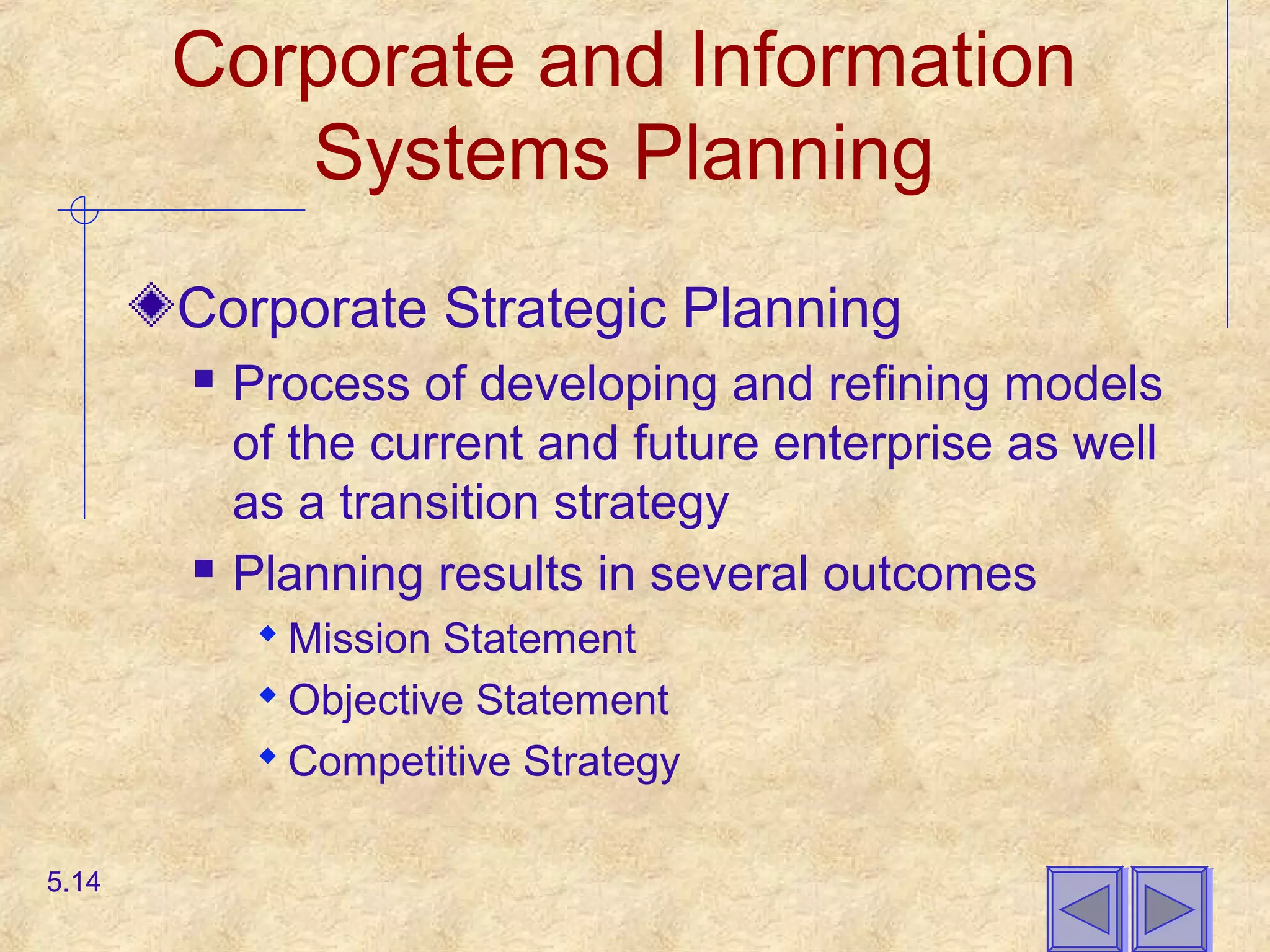
Corporate Strategic Planning
 Process of developing and refining models
of the current and future enterprise as well
as a transition strategy
 Planning results in several outcomes
 Mission Statement
 Objective Statement
 Competitive Strategy
5.14
Corporate and Information
Systems Planning
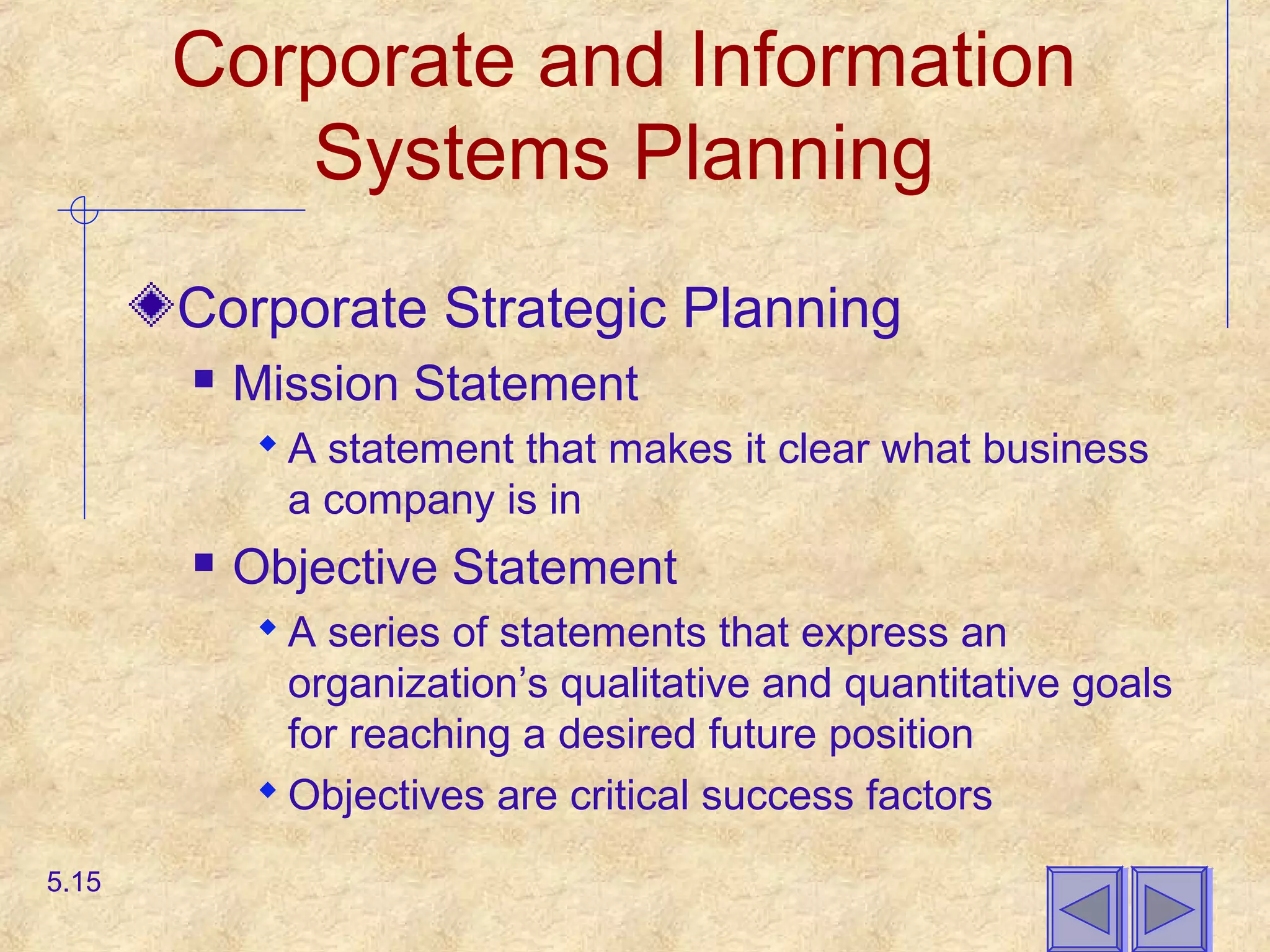
Corporate Strategic Planning
 Mission Statement
 A statement that makes it clear what business
a company is in
 Objective Statement
 A series of statements that express an
organization’s qualitative and quantitative goals
for reaching a desired future position
 Objectives are critical success factors
5.15
Corporate and Information
Systems Planning
Corporate Strategic Planning
 Competitive Strategy
 The method by which an organization attempts
to achieve its mission and objectives
5.16
Corporate and Information
Systems Planning
Information Systems Planning (ISP)
 An orderly means of assessing the information
needs of an organization and defining the
systems, databases and technologies that will
best satisfy those needs
 Three key activities:
 Describe the Current Situation
 Describe the Target (or Future) Situation
 Develop a Transition Plan and Strategy
5.17
Corporate and Information
Systems Planning
Information Systems Planning
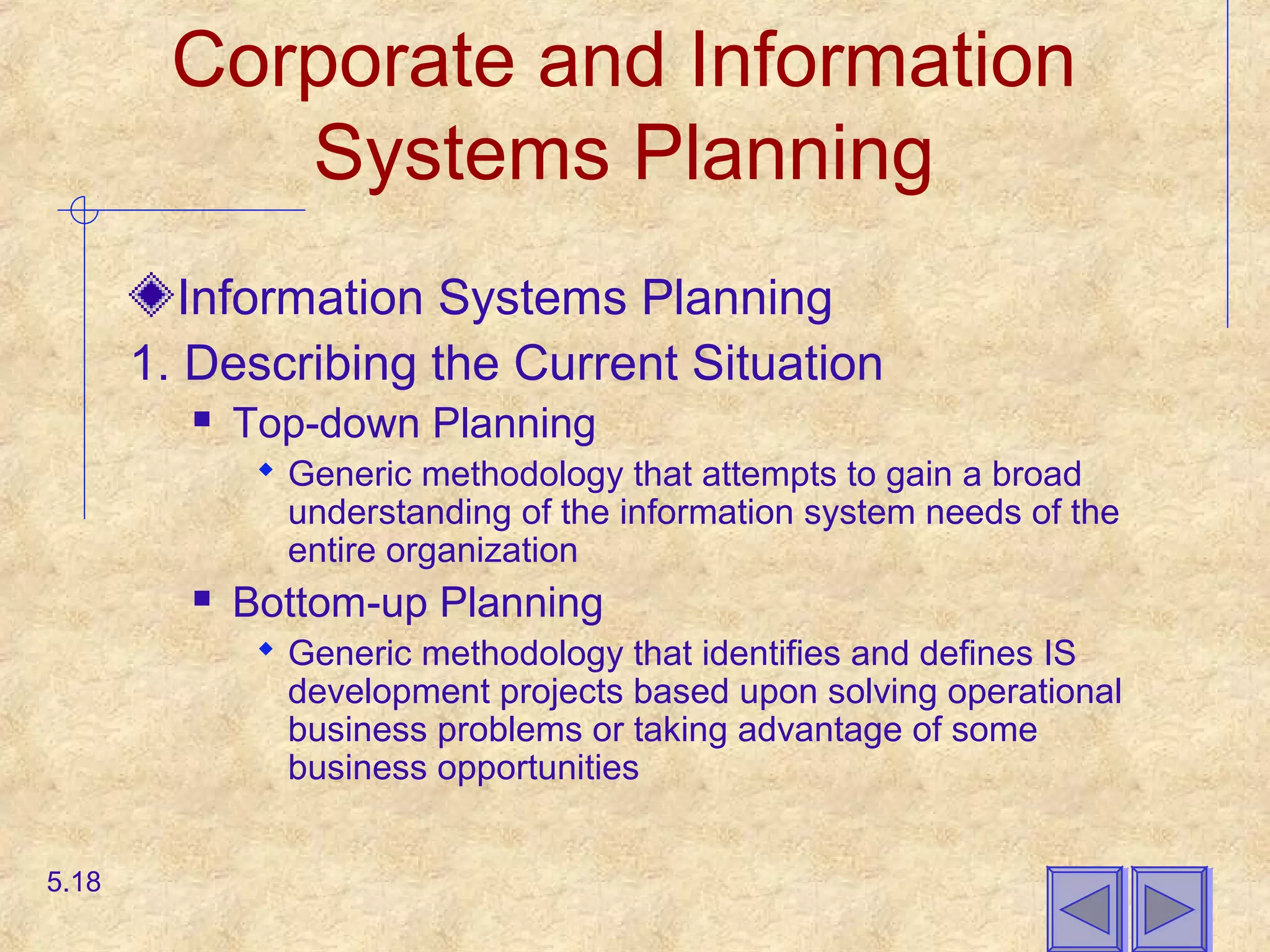
1. Describing the Current Situation
 Top-down Planning
 Generic methodology that attempts to gain a broad
understanding of the information system needs of the
entire organization
 Bottom-up Planning
 Generic methodology that identifies and defines IS
development projects based upon solving operational
business problems or taking advantage of some
business opportunities
5.18
Corporate and Information
Systems Planning
Information Systems Planning
1. Describing the Current Situation
(Continued)
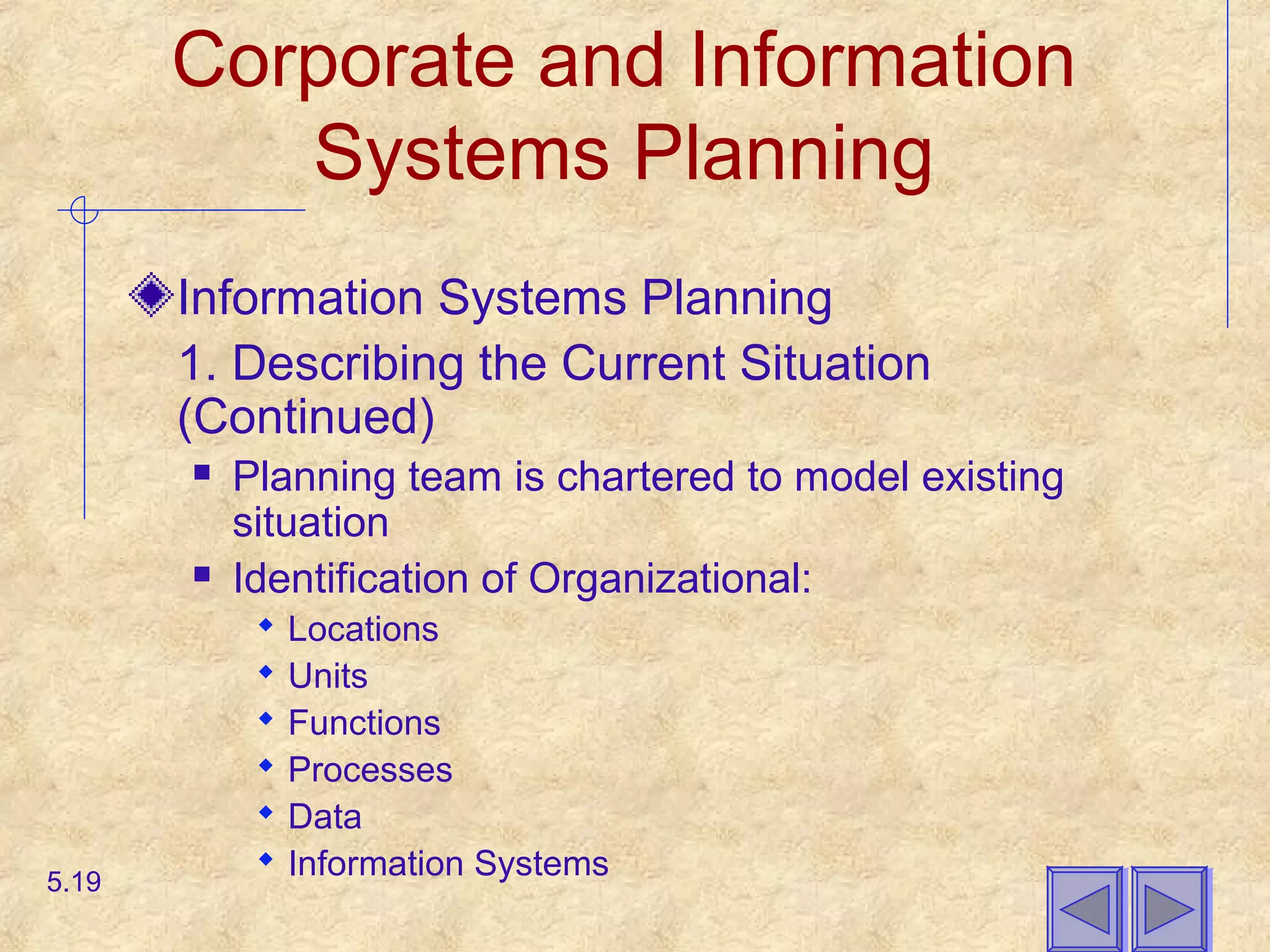
 Planning team is chartered to model existing
situation
 Identification of Organizational:
 Locations
 Units
 Functions
 Processes
 Data
 Information Systems5.19
Corporate and Information
Systems Planning
Information Systems Planning
1. Describing the Current Situation
(Continued)
 Matrices are developed to cross-reference units
 Location-to-Function
 Location-to-Unit
 Unit-to-Function
 Function-to-Objective
 Function-to-Process
 Function-to-Data Entity
 Process-to-Data Entity
 Process-to-Information System
 Data Entity-to-Information System
 Information System-to-Objective
5.20
Corporate and Information
Systems Planning
Information Systems Planning
2. Describing the Target Situation
 Update list of organizational locations,
functions, etc. to reflect desired locations,
functions, etc.
 Matrices are updated to reflect future
states
 Planners focus on differences between
current lists and matrices and future lists
and matrices
5.21
Corporate and Information
Systems Planning
Information Systems Planning
3. Developing a Transition Strategy and
Plans
 Broad, comprehensive document that
looks at both short and long-term
organizational development needs
 Consists of a series of projects
5.22
Electronic Commerce
Applications
Development process for Internet
projects is no different than other
projects
Special issues need to be taken into
account
Electronic Commerce (EC)
 Internet based communication designed to
support business activities
5.23
Internet Development
Internet
 Worldwide network of networks used for electronic
commerce
Intranet
 Internet-based communication to support business
activities within a single organization
Extranet
 Internet-based communication to support
business-to-business activities
5.24
Internet Development
Electronic Data Interchange (EDI)
 The use of telecommunications
technologies to transfer business
documents directly between organizations
Internet vs. Intranet/Extranet Apps
 Intranet/Extranet – Developer knows how
application will be run and used
 Internet – Developer faces various
unknowns
5.25
Summary
Project Identification and Selection
 Identifying Potential Development Projects
 Classifying and Ranking Projects
 Selecting Projects for Development
Top-down and Bottom-up identification
process
Corporate strategic planning
 Process of identifying the mission, objectives and
strategies of an organization
5.26
Summary
Information Systems Planning
 Orderly means for assessing the information
needs of an organization and defining the systems
and databases that will best satisfy those needs
 Top-down process
Electronic Commerce
 Internet
 Intranets
 Extranets
 Electronic Data Interchange
5.27

Chapter 05

  • 1.
    Copyright 2002 Prentice-Hall,Inc. Chapter 5 Identifying and Selecting Systems Development Projects 5.1 Modern Systems Analysis and Design Third Edition Jeffrey A. Hoffer Joey F. George Joseph S. Valacich
  • 2.
    Learning Objectives Describe theproject identification and selection process Describe the corporate strategic planning and information systems planning process Explain the relationship between corporate strategic planning and information systems planning 5.2
  • 3.
    Learning Objectives  Describehow information systems planning can be used to assist in identifying and selecting systems development projects  Analyze information systems planning matrices to determine affinity between information systems and IS projects and to forecast the impact of IS projects on business objectives  Describe the three classes of Internet electronic commerce applications: Internet, Intranets and Extranets 5.3
  • 4.
    Identifying and SelectingIS Development Projects Sources of projects  Management and business units  Managers who want to make a system more efficient or less costly  Formal planning groups 5.4
  • 5.
    Identifying and SelectingIS Development Projects Projects are identified by  Top management  Steering committee  User departments  Development group or senior IS staff Top-Down Identification  Senior management or steering committee  Focus is on global needs of organization 5.5
  • 6.
    The Process ofIdentifying and Selecting IS Development Projects Bottom-up Identification  Business unit or IS group  Don’t reflect overall goals of the organization 5.6
  • 7.
    Identifying and SelectingIS Development Projects Classifying and Ranking IS Development Projects  Performed by top management, steering committee, business units of IS development group  Value chain analysis is often used  Method to analyze an organization’s activities to determine where value is added and costs are incurred 5.7
  • 8.
    Identifying and SelectingIS Development Projects Selecting IS Development Projects  Process of considering short and long-term projects  Projects most likely to achieve business objectives are selected  Decision requires consideration of:  Perceived and real needs  Potential and ongoing projects  Current organizational environment  Existing and available resources  Evaluation criteria 5.8
  • 9.
    Identifying and SelectingIS Development Projects Selecting IS Development Projects  Outcomes  Project Acceptance  Project Rejection  Delay  Refocus  End-User Development  Proof of Concept 5.9
  • 10.
    Identifying and SelectingIS Development Projects Deliverables and Outcomes  Primary Deliverable  Schedule of specific IS development projects  Outcomes  Assurance that careful consideration was given to project selection  Clear understanding of project’s relation to organizational objectives 5.10
  • 11.
    Identifying and SelectingIS Development Projects Knowledge of overall organizational business strategy  Improves project selection and identification process  Provides sound guidance throughout the systems development life cycle 5.11
  • 12.
    Corporate and Information SystemsPlanning Traditional Project Identification and Selection  Solves isolated problems  Focuses on business processes  Does not easily allow for organizational change Planning-Based Approach to Project Identification and Selection  Focuses on present and future information needs  Information needs change slower than business processes 5.12
  • 13.
    Corporate and Information SystemsPlanning Need for planning  Improperly planned projects result in systems that cannot be shared across an organization  As business processes change, lack of integration will hamper strategy and business process changes 5.13
  • 14.
    Corporate and Information SystemsPlanning Corporate Strategic Planning  Process of developing and refining models of the current and future enterprise as well as a transition strategy  Planning results in several outcomes  Mission Statement  Objective Statement  Competitive Strategy 5.14
  • 15.
    Corporate and Information SystemsPlanning Corporate Strategic Planning  Mission Statement  A statement that makes it clear what business a company is in  Objective Statement  A series of statements that express an organization’s qualitative and quantitative goals for reaching a desired future position  Objectives are critical success factors 5.15
  • 16.
    Corporate and Information SystemsPlanning Corporate Strategic Planning  Competitive Strategy  The method by which an organization attempts to achieve its mission and objectives 5.16
  • 17.
    Corporate and Information SystemsPlanning Information Systems Planning (ISP)  An orderly means of assessing the information needs of an organization and defining the systems, databases and technologies that will best satisfy those needs  Three key activities:  Describe the Current Situation  Describe the Target (or Future) Situation  Develop a Transition Plan and Strategy 5.17
  • 18.
    Corporate and Information SystemsPlanning Information Systems Planning 1. Describing the Current Situation  Top-down Planning  Generic methodology that attempts to gain a broad understanding of the information system needs of the entire organization  Bottom-up Planning  Generic methodology that identifies and defines IS development projects based upon solving operational business problems or taking advantage of some business opportunities 5.18
  • 19.
    Corporate and Information SystemsPlanning Information Systems Planning 1. Describing the Current Situation (Continued)  Planning team is chartered to model existing situation  Identification of Organizational:  Locations  Units  Functions  Processes  Data  Information Systems5.19
  • 20.
    Corporate and Information SystemsPlanning Information Systems Planning 1. Describing the Current Situation (Continued)  Matrices are developed to cross-reference units  Location-to-Function  Location-to-Unit  Unit-to-Function  Function-to-Objective  Function-to-Process  Function-to-Data Entity  Process-to-Data Entity  Process-to-Information System  Data Entity-to-Information System  Information System-to-Objective 5.20
  • 21.
    Corporate and Information SystemsPlanning Information Systems Planning 2. Describing the Target Situation  Update list of organizational locations, functions, etc. to reflect desired locations, functions, etc.  Matrices are updated to reflect future states  Planners focus on differences between current lists and matrices and future lists and matrices 5.21
  • 22.
    Corporate and Information SystemsPlanning Information Systems Planning 3. Developing a Transition Strategy and Plans  Broad, comprehensive document that looks at both short and long-term organizational development needs  Consists of a series of projects 5.22
  • 23.
    Electronic Commerce Applications Development processfor Internet projects is no different than other projects Special issues need to be taken into account Electronic Commerce (EC)  Internet based communication designed to support business activities 5.23
  • 24.
    Internet Development Internet  Worldwidenetwork of networks used for electronic commerce Intranet  Internet-based communication to support business activities within a single organization Extranet  Internet-based communication to support business-to-business activities 5.24
  • 25.
    Internet Development Electronic DataInterchange (EDI)  The use of telecommunications technologies to transfer business documents directly between organizations Internet vs. Intranet/Extranet Apps  Intranet/Extranet – Developer knows how application will be run and used  Internet – Developer faces various unknowns 5.25
  • 26.
    Summary Project Identification andSelection  Identifying Potential Development Projects  Classifying and Ranking Projects  Selecting Projects for Development Top-down and Bottom-up identification process Corporate strategic planning  Process of identifying the mission, objectives and strategies of an organization 5.26
  • 27.
    Summary Information Systems Planning Orderly means for assessing the information needs of an organization and defining the systems and databases that will best satisfy those needs  Top-down process Electronic Commerce  Internet  Intranets  Extranets  Electronic Data Interchange 5.27