


Multilevel Queue Scheduling
By- Garishma Bhatia
Multilevel Queue Scheduling
• Having one Queue and scheduling all the process is
very difficult.
• We set the priority of each process with top-
level(system process) higher priority and student
process gets the lowest priority.
• If there is no system process then interactive process
become the highest priority.
Multilevel Queue Scheduling
• It is used where the processes are divided into groups based
on property like process type, CPU time, IO access, memory
size, etc.
• In a multi-level queue scheduling algorithm, there will be ‘n’
number of queues, where ‘n’ is the number of groups the
processes are classified into.
• Each queue will be assigned a priority and will have its own
scheduling algorithm like FCFS, RR, SJF, PRIORITY.
Multilevel Queue Scheduling
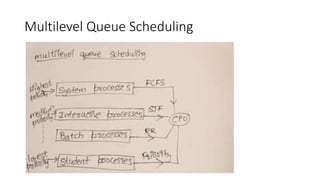
• System process:- The operating system itself has own process to run
called system process.
• Interactive process:-the interactive process is online game or listing
music( there should be the same kind of interaction).
• Batch system:-we submit the job to the processor and take the result
later.
• student process:-the system process will get the highest priority and
the student process gets the lowest priority.
• There are many types of the process we can’t put them in one queue
and get the result, this problem is resolved by the multilevel queue
scheduling.
Disadvantage
• the main disadvantage is the Starvation problem for lowest
level process
Starvation:-
• lower priority process never executes. or wait for the long
amount of time because of lower priority or highest priority
process taking a large amount of time.
Advantage
• we can apply separate scheduling for various kind of process like
system process-FCFS scheduling algorithm
Interactive process- SJF scheduling
Batch process- Round Robin
Student Process- Priority scheduling
Thank you

MULTILEVEL QUEUE SCHEDULING

  • 1.
  • 2.
    Multilevel Queue Scheduling •Having one Queue and scheduling all the process is very difficult. • We set the priority of each process with top- level(system process) higher priority and student process gets the lowest priority. • If there is no system process then interactive process become the highest priority.
  • 3.
    Multilevel Queue Scheduling •It is used where the processes are divided into groups based on property like process type, CPU time, IO access, memory size, etc. • In a multi-level queue scheduling algorithm, there will be ‘n’ number of queues, where ‘n’ is the number of groups the processes are classified into. • Each queue will be assigned a priority and will have its own scheduling algorithm like FCFS, RR, SJF, PRIORITY.
  • 4.
  • 5.
    • System process:-The operating system itself has own process to run called system process. • Interactive process:-the interactive process is online game or listing music( there should be the same kind of interaction). • Batch system:-we submit the job to the processor and take the result later. • student process:-the system process will get the highest priority and the student process gets the lowest priority. • There are many types of the process we can’t put them in one queue and get the result, this problem is resolved by the multilevel queue scheduling.
  • 6.
    Disadvantage • the maindisadvantage is the Starvation problem for lowest level process Starvation:- • lower priority process never executes. or wait for the long amount of time because of lower priority or highest priority process taking a large amount of time.
  • 7.
    Advantage • we canapply separate scheduling for various kind of process like system process-FCFS scheduling algorithm Interactive process- SJF scheduling Batch process- Round Robin Student Process- Priority scheduling
  • 8.