Lecture 5
FEASIBILITY ANALYSIS
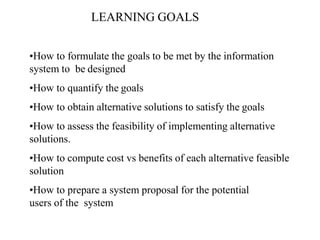
LEARNING GOALS
•How to formulate the goals to be met by the information
system to be designed
•How to quantify the goals
•How to obtain alternative solutions to satisfy the goals
•How to assess the feasibility of implementing alternative
solutions.
•How to compute cost vs benefits of each alternative feasible
solution
•How to prepare a system proposal for the potential
users of the system
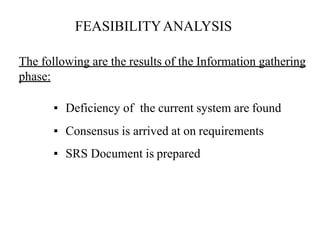
The following are the results of the Information gathering
phase:
▪ Deficiency of the current system are found
▪ Consensus is arrived at on requirements
▪ SRS Document is prepared
FEASIBILITYANALYSIS
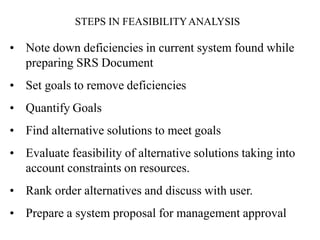
• Note down deficiencies in current system found while
preparing SRS Document
• Set goals to remove deficiencies
• Quantify Goals
• Find alternative solutions to meet goals
• Evaluate feasibility of alternative solutions taking into
account constraints on resources.
• Rank order alternatives and discuss with user.
• Prepare a system proposal for management approval
STEPS IN FEASIBILITYANALYSIS
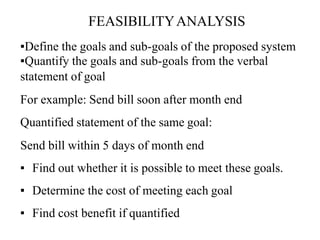
▪Define the goals and sub-goals of the proposed system
▪Quantify the goals and sub-goals from the verbal
statement of goal
For example: Send bill soon after month end
Quantified statement of the same goal:
Send bill within 5 days of month end
▪ Find out whether it is possible to meet these goals.
▪ Determine the cost of meeting each goal
▪ Find cost benefit if quantified
FEASIBILITYANALYSIS
GUIDELINES FOR SEARCHING GOALS
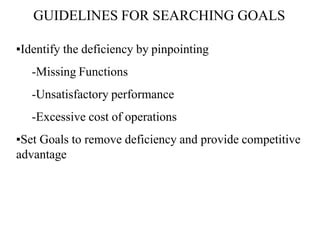
▪Identify the deficiency by pinpointing
-Missing Functions
-Unsatisfactory performance
-Excessive cost of operations
▪Set Goals to remove deficiency and provide competitive
advantage
CHARACTERSTICS OF A GOAL
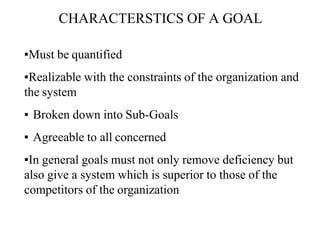
▪Must be quantified
▪Realizable with the constraints of the organization and
the system
▪ Broken down into Sub-Goals
▪ Agreeable to all concerned
▪In general goals must not only remove deficiency but
also give a system which is superior to those of the
competitors of the organization
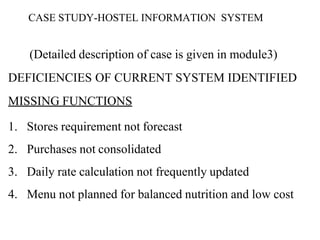
CASE STUDY-HOSTEL INFORMATION SYSTEM
(Detailed description of case is given in module3)
DEFICIENCIES OF CURRENT SYSTEM IDENTIFIED
MISSING FUNCTIONS
1. Stores requirement not forecast
2. Purchases not consolidated
3. Daily rate calculation not frequently updated
4. Menu not planned for balanced nutrition and low cost
CASE STUDY-HOSTEL INFORMATION SYSTEM
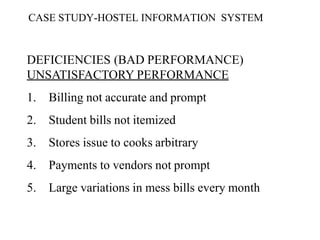
DEFICIENCIES (BAD PERFORMANCE)
UNSATISFACTORY PERFORMANCE
1. Billing not accurate and prompt
2. Student bills not itemized
3. Stores issue to cooks arbitrary
4. Payments to vendors not prompt
5. Large variations in mess bills every month
CASE STUDY-HOSTEL INFORMATION
SYSTEM
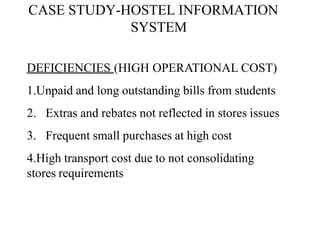
DEFICIENCIES (HIGH OPERATIONAL COST)
1.Unpaid and long outstanding bills from students
2. Extras and rebates not reflected in stores issues
3. Frequent small purchases at high cost
4.High transport cost due to not consolidating
stores requirements
CASE STUDY-HOSTEL INFORMATION
SYSTEM
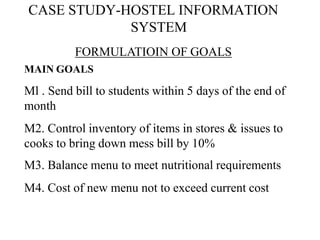
FORMULATIOIN OF GOALS
MAIN GOALS
Ml . Send bill to students within 5 days of the end of
month
M2. Control inventory of items in stores & issues to
cooks to bring down mess bill by 10%
M3. Balance menu to meet nutritional requirements
M4. Cost of new menu not to exceed current cost
CASE STUDY-HOSTEL INFORMATION
SYSTEM
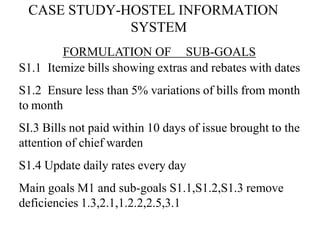
FORMULATION OF SUB-GOALS
S1.1 Itemize bills showing extras and rebates with dates
S1.2 Ensure less than 5% variations of bills from month
to month
SI.3 Bills not paid within 10 days of issue brought to the
attention of chief warden
S1.4 Update daily rates every day
Main goals M1 and sub-goals S1.1,S1.2,S1.3 remove
deficiencies 1.3,2.1,1.2.2,2.5,3.1
CASE STUDY-HOSTEL INFORMATION
SYSTEM
FORMULATIOIN OF SUB-GOALS
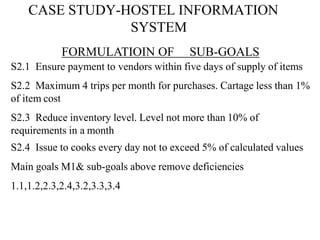
S2.1 Ensure payment to vendors within five days of supply of items
S2.2 Maximum 4 trips per month for purchases. Cartage less than 1%
of item cost
S2.3 Reduce inventory level. Level not more than 10% of
requirements in a month
S2.4 Issue to cooks every day not to exceed 5% of calculated values
Main goals M1& sub-goals above remove deficiencies
1.1,1.2,2.3,2.4,3.2,3.3,3.4
EXAMINING ALTERNATIVE SOLUTIONS
HOSTEL INFORMATION SYSTEM
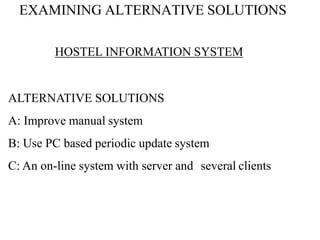
ALTERNATIVE SOLUTIONS
A: Improve manual system
B: Use PC based periodic update system
C: An on-line system with server and several clients
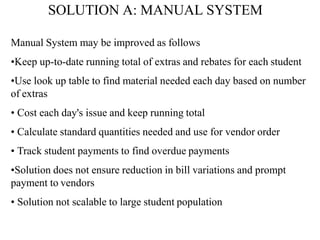
SOLUTION A: MANUAL SYSTEM
Manual System may be improved as follows
•Keep up-to-date running total of extras and rebates for each student
•Use look up table to find material needed each day based on number
of extras
• Cost each day's issue and keep running total
• Calculate standard quantities needed and use for vendor order
• Track student payments to find overdue payments
•Solution does not ensure reduction in bill variations and prompt
payment to vendors
• Solution not scalable to large student population
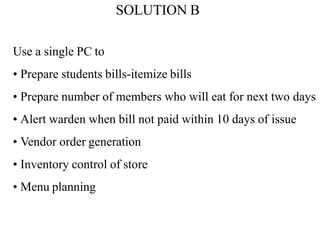
SOLUTION B
Use a single PC to
• Prepare students bills-itemize bills
• Prepare number of members who will eat for next two days
• Alert warden when bill not paid within 10 days of issue
• Vendor order generation
• Inventory control of store
• Menu planning
SOLUTION B
PC configuration needed based on data base sizes
PC with 20 MB disk, 1.2 MB floppy sufficient
However minimum configuration available today(2004) is
PC with 128 MB main memory, 40 GB disk 1.2MB floppy
& CD R/W costs Rs. 25,000.Systems software(Windows
XP+MSOffice+anti-virus) will cost around Rs.25,000.
Total cost=Rs 50,000
Need PC+ printer+uninterrupted power supply cost Rs.
70,000
SOLUTION C
•Use a server which is accessed by 3 clients one each in the
mess, the stores and the accounts sections; perform on-line
transaction processing.
• Advantage: Up to the minute status can be found
•Number of transactions small and does not justify 4
computers
•Solution unnecessarily expensive and rejected
EVALUATING ALTERNATIVE SOLUTIONS
•Determine Technical feasibility of each solution,in other
words is technology mature to implement a solution
•Determine Operational feasibility of each solution.In
other words,for a given organizational structure will the
solution fit in.Will it provide right information at the right
time to users
•Determine Economic feasibility of each solution.In other
words, are finances available to implement system?Will it
be cost effective?Will the money spent be recovered by
savings or by better services to users
TECHNICAL AND OPERATIONAL
FEASIBILITY
•Solution B is selected for further consideration
•It is technically feasible as PC of necessary configuration
is easily available.
•It is also operationally feasible as clerks in hostel office
can be easily trained to use a PC. The necessary problems
will be written by system analyst/ programmer hired for
this purpose.
COST-BENEFIT ANALYSIS
•Needed to find economic feasibility of proposed solution
•Objective to find whether returns by implementing a system
justify the cost
• Found by listing all costs direct and indirect
•Direct cost- Cost of computer, software, space, human resource,
material,travel, training etc.
• Indirect cost- Time spent by persons and data gathering
• Benefit- Tangible- measurable
Intangible- better management
-better user satisfaction
BENEFITS
Direct - Savings due to reduced inventory, early collection
of outstanding payments, reduced wastage,faster
production, increased production
Indirect –Increased work done with same human resource
Intangible - better service to customers
- superior product quality
- accurate,reliable,timely and up-to-date
strategic,tactical and operational information to
management
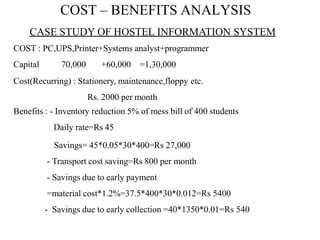
COST – BENEFITS ANALYSIS
CASE STUDY OF HOSTEL INFORMATION SYSTEM
COST : PC,UPS,Printer+Systems analyst+programmer
Capital 70,000 +60,000 =1,30,000
Cost(Recurring) : Stationery, maintenance,floppy etc.
Rs. 2000 per month
Benefits : - Inventory reduction 5% of mess bill of 400 students
Daily rate=Rs 45
Savings= 45*0.05*30*400=Rs 27,000
- Transport cost saving=Rs 800 per month
- Savings due to early payment
=material cost*1.2%=37.5*400*30*0.012=Rs 5400
- Savings due to early collection =40*1350*0.01=Rs 540
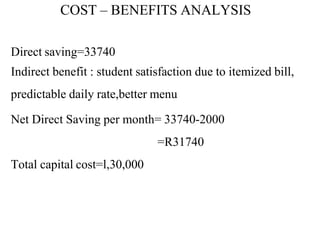
COST – BENEFITS ANALYSIS
Direct saving=33740
Indirect benefit : student satisfaction due to itemized bill,
predictable daily rate,better menu
Net Direct Saving per month= 33740-2000
=R31740
Total capital cost=l,30,000
PAY BACK PERIOD
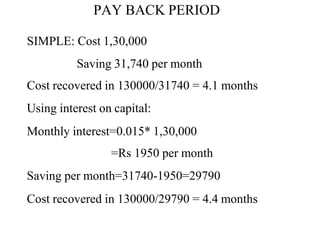
SIMPLE: Cost 1,30,000
Saving 31,740 per month
Cost recovered in 130000/31740 = 4.1 months
Using interest on capital:
Monthly interest=0.015* 1,30,000
=Rs 1950 per month
Saving per month=31740-1950=29790
Cost recovered in 130000/29790 = 4.4 months
PRESENT VALUE METHOD
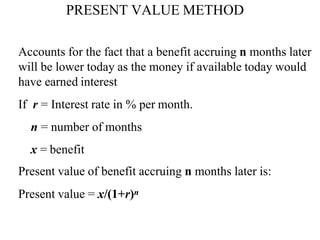
Accounts for the fact that a benefit accruing n months later
will be lower today as the money if available today would
have earned interest
If r = Interest rate in % per month.
n = number of months
x = benefit
Present value of benefit accruing n months later is:
Present value = x/(1+r)n
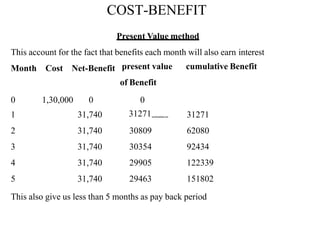
COST-BENEFIT
Present Value method
This account for the fact that benefits each month will also earn interest
Month Cost Net-Benefit present value cumulative Benefit
of Benefit
This also give us less than 5 months as pay back period
0 1,30,000 0 0
1 31,740 31271ace@applabs.net 31271
2 31,740 30809 62080
3 31,740 30354 92434
4 31,740 29905 122339
5 31,740 29463 151802
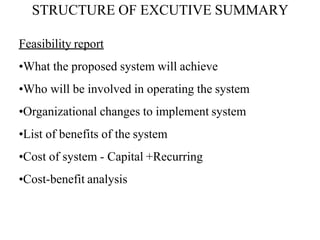
STRUCTURE OF EXCUTIVE SUMMARY
Feasibility report
•What the proposed system will achieve
•Who will be involved in operating the system
•Organizational changes to implement system
•List of benefits of the system
•Cost of system - Capital +Recurring
•Cost-benefit analysis
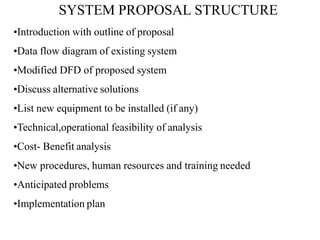
SYSTEM PROPOSAL STRUCTURE
•Introduction with outline of proposal
•Data flow diagram of existing system
•Modified DFD of proposed system
•Discuss alternative solutions
•List new equipment to be installed (if any)
•Technical,operational feasibility of analysis
•Cost- Benefit analysis
•New procedures, human resources and training needed
•Anticipated problems
•Implementation plan

Sad lecture 5

  • 1.
  • 2.
    LEARNING GOALS •How toformulate the goals to be met by the information system to be designed •How to quantify the goals •How to obtain alternative solutions to satisfy the goals •How to assess the feasibility of implementing alternative solutions. •How to compute cost vs benefits of each alternative feasible solution •How to prepare a system proposal for the potential users of the system
  • 3.
    The following arethe results of the Information gathering phase: ▪ Deficiency of the current system are found ▪ Consensus is arrived at on requirements ▪ SRS Document is prepared FEASIBILITYANALYSIS
  • 4.
    • Note downdeficiencies in current system found while preparing SRS Document • Set goals to remove deficiencies • Quantify Goals • Find alternative solutions to meet goals • Evaluate feasibility of alternative solutions taking into account constraints on resources. • Rank order alternatives and discuss with user. • Prepare a system proposal for management approval STEPS IN FEASIBILITYANALYSIS
  • 5.
    ▪Define the goalsand sub-goals of the proposed system ▪Quantify the goals and sub-goals from the verbal statement of goal For example: Send bill soon after month end Quantified statement of the same goal: Send bill within 5 days of month end ▪ Find out whether it is possible to meet these goals. ▪ Determine the cost of meeting each goal ▪ Find cost benefit if quantified FEASIBILITYANALYSIS
  • 6.
    GUIDELINES FOR SEARCHINGGOALS ▪Identify the deficiency by pinpointing -Missing Functions -Unsatisfactory performance -Excessive cost of operations ▪Set Goals to remove deficiency and provide competitive advantage
  • 7.
    CHARACTERSTICS OF AGOAL ▪Must be quantified ▪Realizable with the constraints of the organization and the system ▪ Broken down into Sub-Goals ▪ Agreeable to all concerned ▪In general goals must not only remove deficiency but also give a system which is superior to those of the competitors of the organization
  • 8.
    CASE STUDY-HOSTEL INFORMATIONSYSTEM (Detailed description of case is given in module3) DEFICIENCIES OF CURRENT SYSTEM IDENTIFIED MISSING FUNCTIONS 1. Stores requirement not forecast 2. Purchases not consolidated 3. Daily rate calculation not frequently updated 4. Menu not planned for balanced nutrition and low cost
  • 9.
    CASE STUDY-HOSTEL INFORMATIONSYSTEM DEFICIENCIES (BAD PERFORMANCE) UNSATISFACTORY PERFORMANCE 1. Billing not accurate and prompt 2. Student bills not itemized 3. Stores issue to cooks arbitrary 4. Payments to vendors not prompt 5. Large variations in mess bills every month
  • 10.
    CASE STUDY-HOSTEL INFORMATION SYSTEM DEFICIENCIES(HIGH OPERATIONAL COST) 1.Unpaid and long outstanding bills from students 2. Extras and rebates not reflected in stores issues 3. Frequent small purchases at high cost 4.High transport cost due to not consolidating stores requirements
  • 11.
    CASE STUDY-HOSTEL INFORMATION SYSTEM FORMULATIOINOF GOALS MAIN GOALS Ml . Send bill to students within 5 days of the end of month M2. Control inventory of items in stores & issues to cooks to bring down mess bill by 10% M3. Balance menu to meet nutritional requirements M4. Cost of new menu not to exceed current cost
  • 12.
    CASE STUDY-HOSTEL INFORMATION SYSTEM FORMULATIONOF SUB-GOALS S1.1 Itemize bills showing extras and rebates with dates S1.2 Ensure less than 5% variations of bills from month to month SI.3 Bills not paid within 10 days of issue brought to the attention of chief warden S1.4 Update daily rates every day Main goals M1 and sub-goals S1.1,S1.2,S1.3 remove deficiencies 1.3,2.1,1.2.2,2.5,3.1
  • 13.
    CASE STUDY-HOSTEL INFORMATION SYSTEM FORMULATIOINOF SUB-GOALS S2.1 Ensure payment to vendors within five days of supply of items S2.2 Maximum 4 trips per month for purchases. Cartage less than 1% of item cost S2.3 Reduce inventory level. Level not more than 10% of requirements in a month S2.4 Issue to cooks every day not to exceed 5% of calculated values Main goals M1& sub-goals above remove deficiencies 1.1,1.2,2.3,2.4,3.2,3.3,3.4
  • 14.
    EXAMINING ALTERNATIVE SOLUTIONS HOSTELINFORMATION SYSTEM ALTERNATIVE SOLUTIONS A: Improve manual system B: Use PC based periodic update system C: An on-line system with server and several clients
  • 15.
    SOLUTION A: MANUALSYSTEM Manual System may be improved as follows •Keep up-to-date running total of extras and rebates for each student •Use look up table to find material needed each day based on number of extras • Cost each day's issue and keep running total • Calculate standard quantities needed and use for vendor order • Track student payments to find overdue payments •Solution does not ensure reduction in bill variations and prompt payment to vendors • Solution not scalable to large student population
  • 16.
    SOLUTION B Use asingle PC to • Prepare students bills-itemize bills • Prepare number of members who will eat for next two days • Alert warden when bill not paid within 10 days of issue • Vendor order generation • Inventory control of store • Menu planning
  • 17.
    SOLUTION B PC configurationneeded based on data base sizes PC with 20 MB disk, 1.2 MB floppy sufficient However minimum configuration available today(2004) is PC with 128 MB main memory, 40 GB disk 1.2MB floppy & CD R/W costs Rs. 25,000.Systems software(Windows XP+MSOffice+anti-virus) will cost around Rs.25,000. Total cost=Rs 50,000 Need PC+ printer+uninterrupted power supply cost Rs. 70,000
  • 18.
    SOLUTION C •Use aserver which is accessed by 3 clients one each in the mess, the stores and the accounts sections; perform on-line transaction processing. • Advantage: Up to the minute status can be found •Number of transactions small and does not justify 4 computers •Solution unnecessarily expensive and rejected
  • 19.
    EVALUATING ALTERNATIVE SOLUTIONS •DetermineTechnical feasibility of each solution,in other words is technology mature to implement a solution •Determine Operational feasibility of each solution.In other words,for a given organizational structure will the solution fit in.Will it provide right information at the right time to users •Determine Economic feasibility of each solution.In other words, are finances available to implement system?Will it be cost effective?Will the money spent be recovered by savings or by better services to users
  • 20.
    TECHNICAL AND OPERATIONAL FEASIBILITY •SolutionB is selected for further consideration •It is technically feasible as PC of necessary configuration is easily available. •It is also operationally feasible as clerks in hostel office can be easily trained to use a PC. The necessary problems will be written by system analyst/ programmer hired for this purpose.
  • 21.
    COST-BENEFIT ANALYSIS •Needed tofind economic feasibility of proposed solution •Objective to find whether returns by implementing a system justify the cost • Found by listing all costs direct and indirect •Direct cost- Cost of computer, software, space, human resource, material,travel, training etc. • Indirect cost- Time spent by persons and data gathering • Benefit- Tangible- measurable Intangible- better management -better user satisfaction
  • 22.
    BENEFITS Direct - Savingsdue to reduced inventory, early collection of outstanding payments, reduced wastage,faster production, increased production Indirect –Increased work done with same human resource Intangible - better service to customers - superior product quality - accurate,reliable,timely and up-to-date strategic,tactical and operational information to management
  • 23.
    COST – BENEFITSANALYSIS CASE STUDY OF HOSTEL INFORMATION SYSTEM COST : PC,UPS,Printer+Systems analyst+programmer Capital 70,000 +60,000 =1,30,000 Cost(Recurring) : Stationery, maintenance,floppy etc. Rs. 2000 per month Benefits : - Inventory reduction 5% of mess bill of 400 students Daily rate=Rs 45 Savings= 45*0.05*30*400=Rs 27,000 - Transport cost saving=Rs 800 per month - Savings due to early payment =material cost*1.2%=37.5*400*30*0.012=Rs 5400 - Savings due to early collection =40*1350*0.01=Rs 540
  • 24.
    COST – BENEFITSANALYSIS Direct saving=33740 Indirect benefit : student satisfaction due to itemized bill, predictable daily rate,better menu Net Direct Saving per month= 33740-2000 =R31740 Total capital cost=l,30,000
  • 25.
    PAY BACK PERIOD SIMPLE:Cost 1,30,000 Saving 31,740 per month Cost recovered in 130000/31740 = 4.1 months Using interest on capital: Monthly interest=0.015* 1,30,000 =Rs 1950 per month Saving per month=31740-1950=29790 Cost recovered in 130000/29790 = 4.4 months
  • 26.
    PRESENT VALUE METHOD Accountsfor the fact that a benefit accruing n months later will be lower today as the money if available today would have earned interest If r = Interest rate in % per month. n = number of months x = benefit Present value of benefit accruing n months later is: Present value = x/(1+r)n
  • 27.
    COST-BENEFIT Present Value method Thisaccount for the fact that benefits each month will also earn interest Month Cost Net-Benefit present value cumulative Benefit of Benefit This also give us less than 5 months as pay back period 0 1,30,000 0 0 1 31,740 31271ace@applabs.net 31271 2 31,740 30809 62080 3 31,740 30354 92434 4 31,740 29905 122339 5 31,740 29463 151802
  • 28.
    STRUCTURE OF EXCUTIVESUMMARY Feasibility report •What the proposed system will achieve •Who will be involved in operating the system •Organizational changes to implement system •List of benefits of the system •Cost of system - Capital +Recurring •Cost-benefit analysis
  • 29.
    SYSTEM PROPOSAL STRUCTURE •Introductionwith outline of proposal •Data flow diagram of existing system •Modified DFD of proposed system •Discuss alternative solutions •List new equipment to be installed (if any) •Technical,operational feasibility of analysis •Cost- Benefit analysis •New procedures, human resources and training needed •Anticipated problems •Implementation plan