PIPELINE
PROCESSING
Created by
Suraj Das
INDEX
▪ Introduction
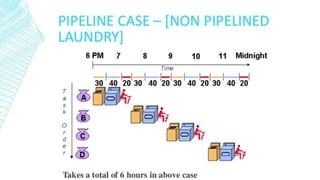
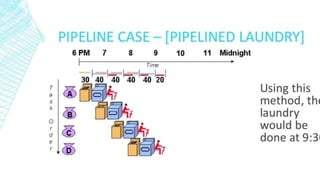
▪ Pipeline Case – Non Pipeline vs. Pipeline
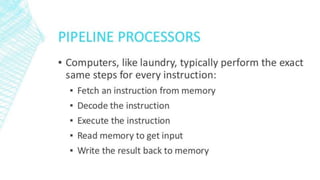
▪ Pipeline Processors
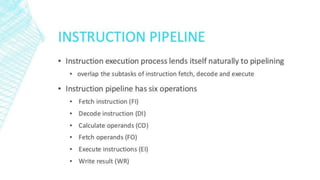
▪ Instruction Pipeline
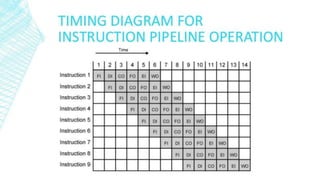
▪ Timing Diagram for Instruction Pipeline Operation
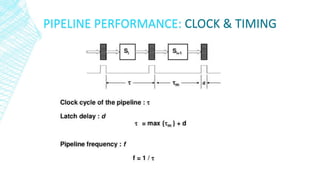
▪ Pipeline Performance: Clock & Timing
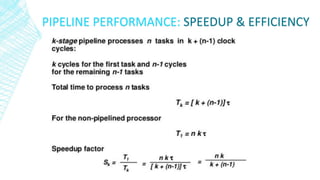
▪ Pipeline Performance: Speedup & Efficiency
▪ Advantages of Pipeline
▪ Disadvantages of Pipeline
INTRODUCTION
 Pipelining is a speed-up technique where multiple instructions are
overlapped in execution on a processor.
 The elements of a pipeline are often executed in parallel or in time-
sliced fashion; in that case, some amount of buffer storage is often
inserted between elements.
 Buffer or data buffer:
• It is a region of physical memory storage used to temporarily
store data while.
• It is moved from one place to another.
 Write result (W R)
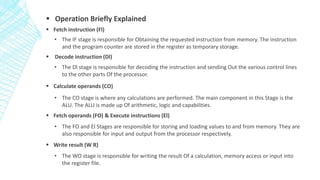
 Operation Briefly Explained
 Fetch instruction (Fl)
 Decode instruction (Dl)
 Calculate operands (CO)
 Fetch operands (FO) & Execute instructions (El)
• The IF stage is responsible for Obtaining the requested instruction from memory. The instruction
and the program counter are stored in the register as temporary storage.
• The Dl stage is responsible for decoding the instruction and sending Out the various control lines
to the other parts Of the processor.
• The CO stage is where any calculations are performed. The main component in this Stage is the
ALU. The ALU is made up Of arithmetic, logic and capabilities.
• The FO and El Stages are responsible for storing and loading values to and from memory. They are
also responsible for input and output from the processor respectively.
• The WO stage is responsible for writing the result Of a calculation, memory access or input into
the register file.
PIPELINE PERFORMANCE: CLOCK & TIMING
PIPELINE PERFORMANCE: SPEEDUP & EFFICIENCY
Advantages of Pipeline
Disadvantages of Pipeline
THE END
Thank You!

Pipeline Processing Architecture

  • 1.
  • 2.
    INDEX ▪ Introduction ▪ PipelineCase – Non Pipeline vs. Pipeline ▪ Pipeline Processors ▪ Instruction Pipeline ▪ Timing Diagram for Instruction Pipeline Operation ▪ Pipeline Performance: Clock & Timing ▪ Pipeline Performance: Speedup & Efficiency ▪ Advantages of Pipeline ▪ Disadvantages of Pipeline
  • 3.
  • 4.
     Pipelining isa speed-up technique where multiple instructions are overlapped in execution on a processor.  The elements of a pipeline are often executed in parallel or in time- sliced fashion; in that case, some amount of buffer storage is often inserted between elements.  Buffer or data buffer: • It is a region of physical memory storage used to temporarily store data while. • It is moved from one place to another.
  • 10.
     Write result(W R)  Operation Briefly Explained  Fetch instruction (Fl)  Decode instruction (Dl)  Calculate operands (CO)  Fetch operands (FO) & Execute instructions (El) • The IF stage is responsible for Obtaining the requested instruction from memory. The instruction and the program counter are stored in the register as temporary storage. • The Dl stage is responsible for decoding the instruction and sending Out the various control lines to the other parts Of the processor. • The CO stage is where any calculations are performed. The main component in this Stage is the ALU. The ALU is made up Of arithmetic, logic and capabilities. • The FO and El Stages are responsible for storing and loading values to and from memory. They are also responsible for input and output from the processor respectively. • The WO stage is responsible for writing the result Of a calculation, memory access or input into the register file.
  • 12.
  • 13.
  • 14.
  • 15.
  • 16.