Potato SNPs


Dan Bolser and David Martin

  Next Gen Bug, Dundee
       01/18/2010


                        1
Aims of the work
1) Learn about handling RNASeq
     
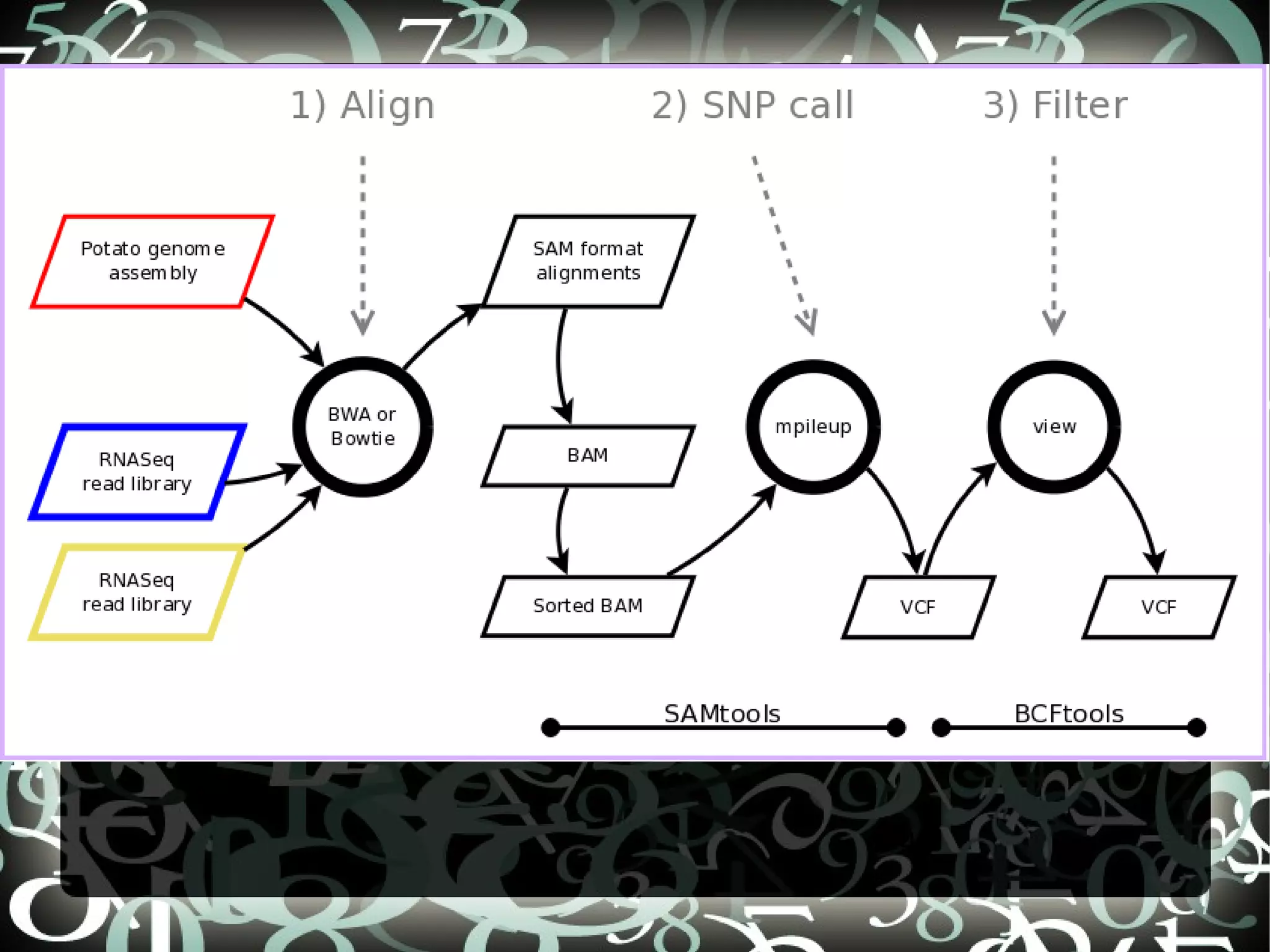
         Create a SNP calling pipeline


2) Select SNPs for genetic mapping
     
         Using Illumina's GoldenGate SNP chip (OPA)


                                         2
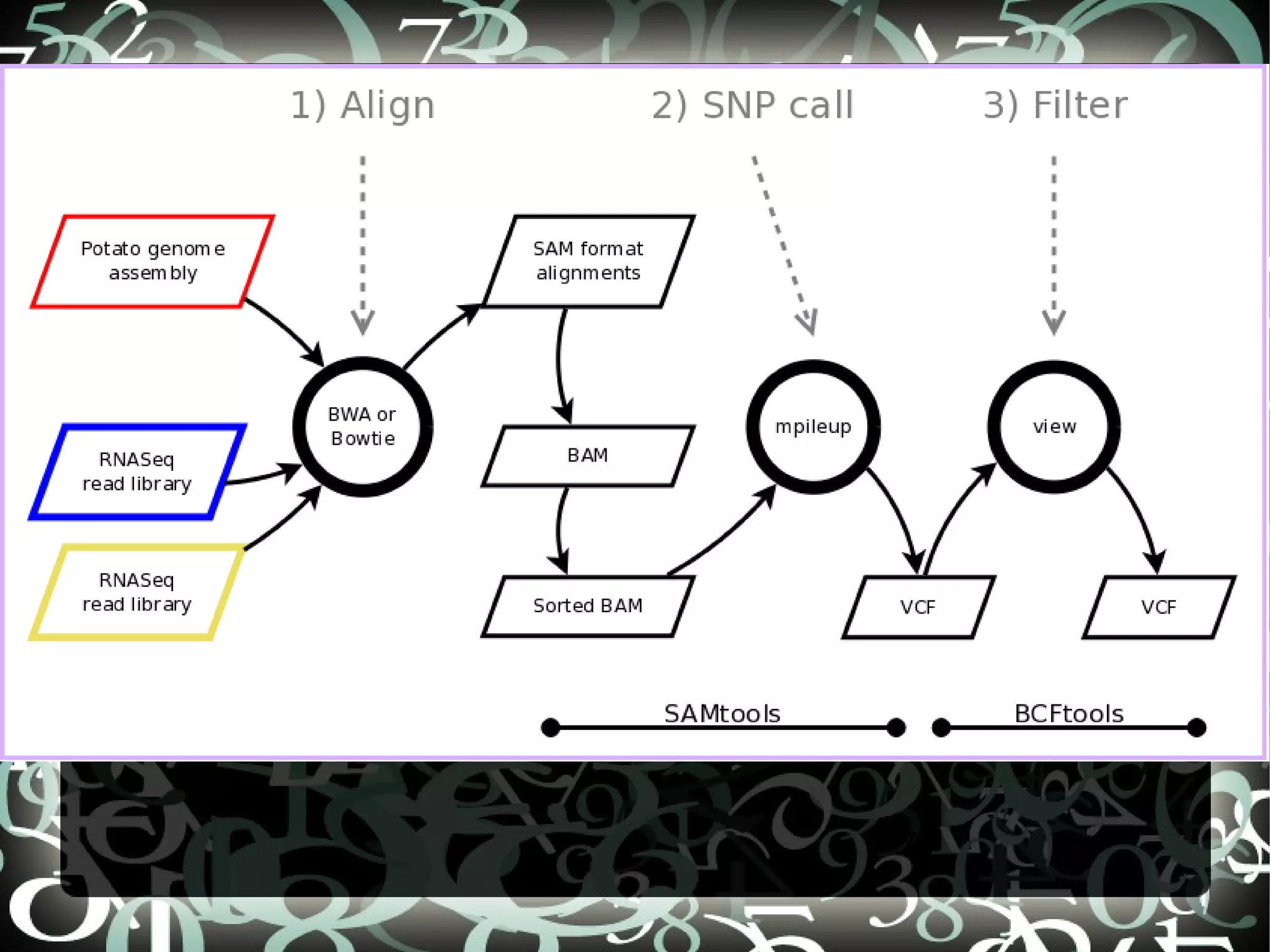
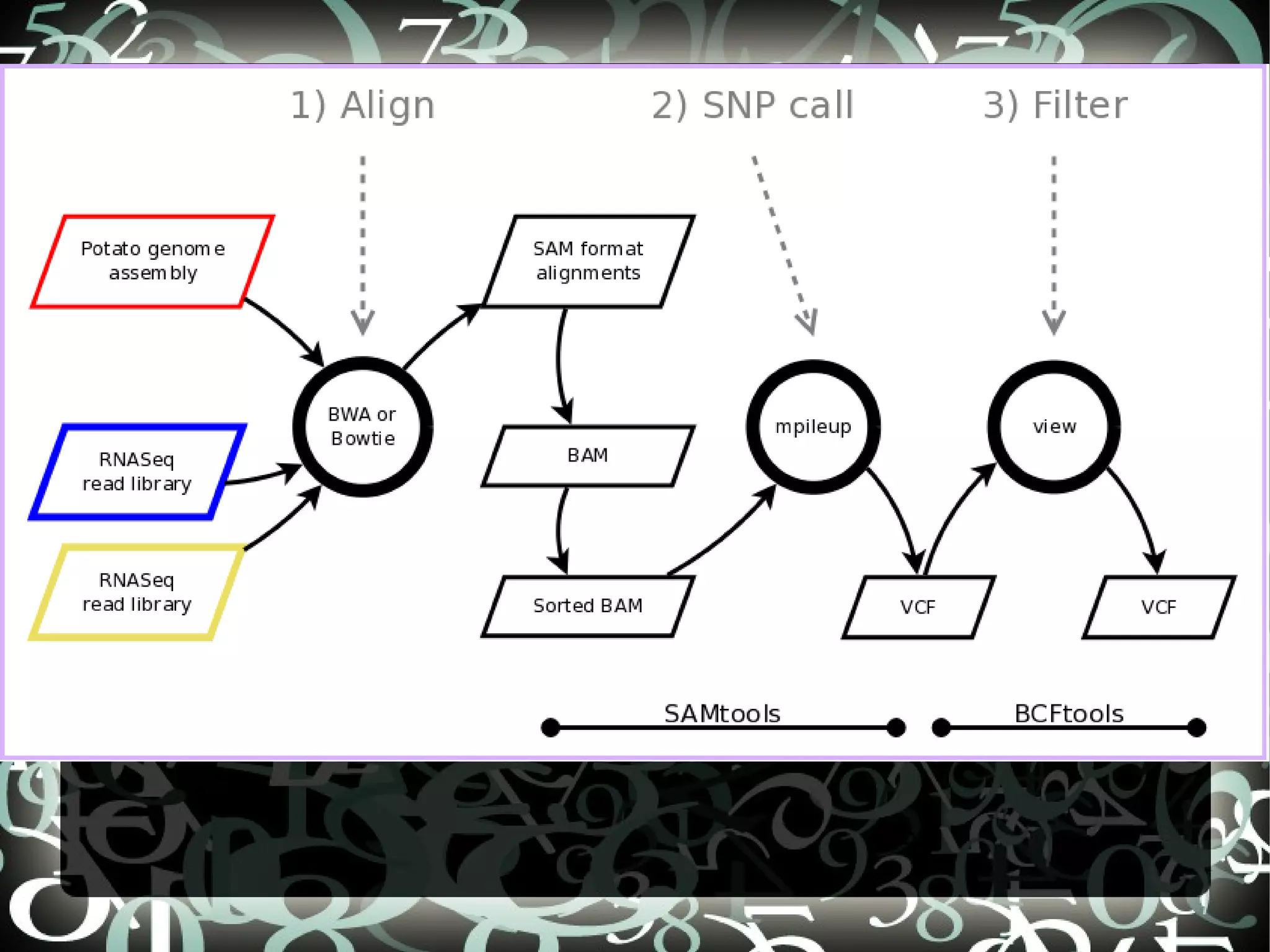
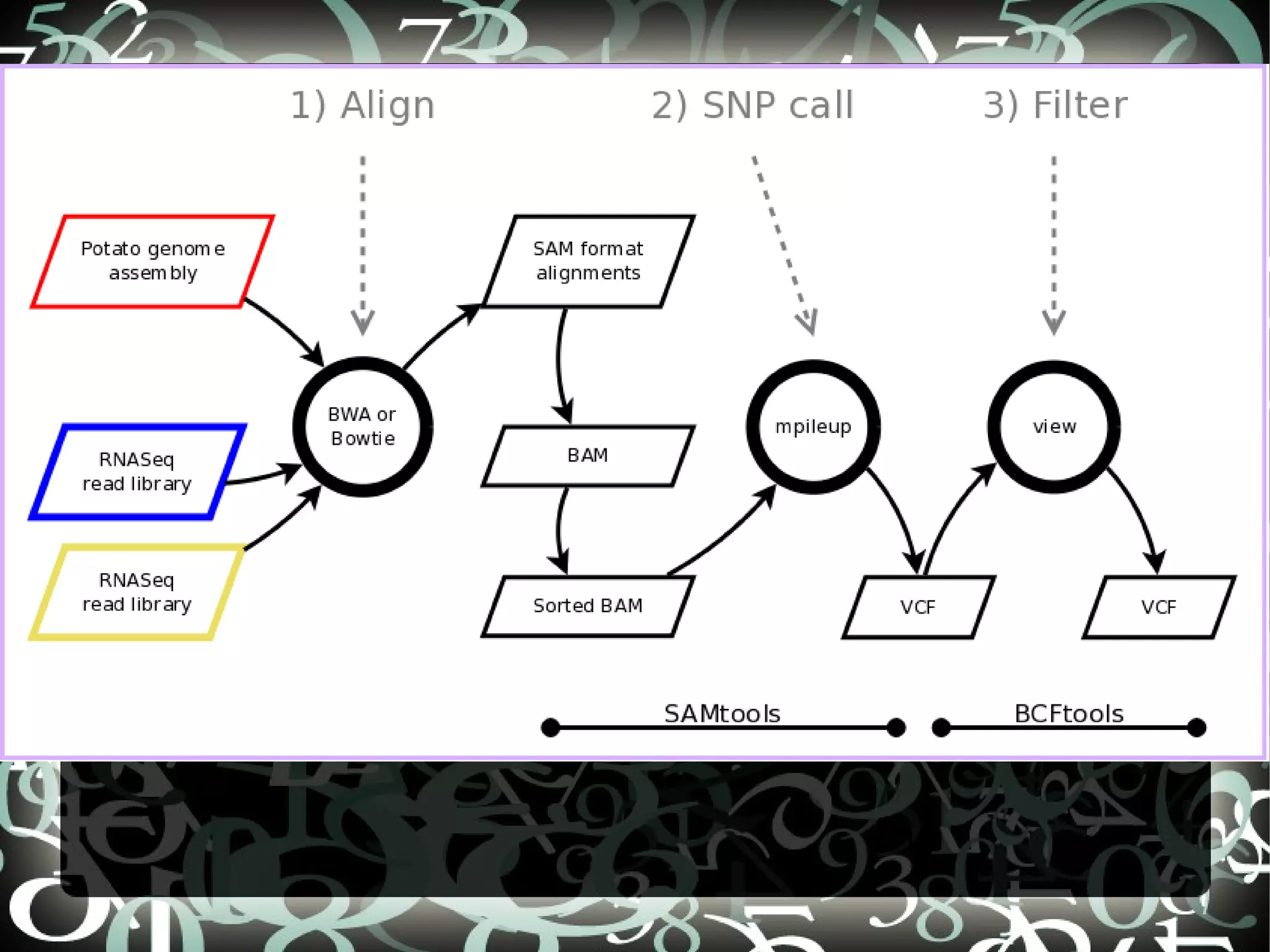
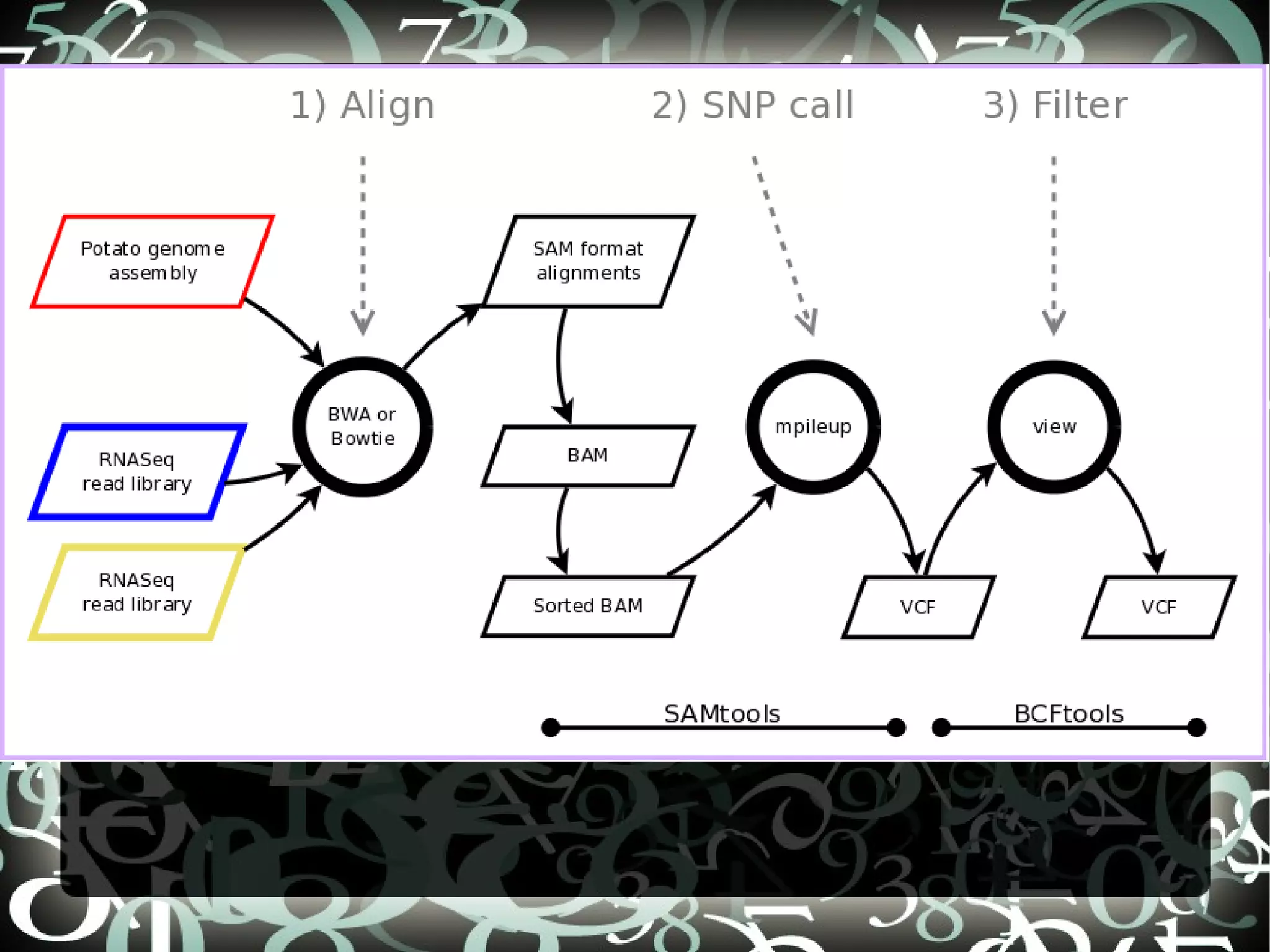
Creating a SNP calling pipeline


                       3
4
Align (using BWA)
1) Index the potato genome assembly
bwa index [-a bwtsw|div|is]             [-c]
 <in.fasta>
2) Perform the alignment
bwa aln [options] <in.fasta>
 <in.fq>
3) Output results in SAM format (single end)
bwa samse <in.fasta> <in.sai>
 <in.fq>                  5
Align (using Bowtie)
1) Index the potato genome assembly
bowtie-build [options] <in.fasta>
  <ebwt>
2) Perform the alignment and output results
bowtie [options] <ebwt> <in.fq>
7
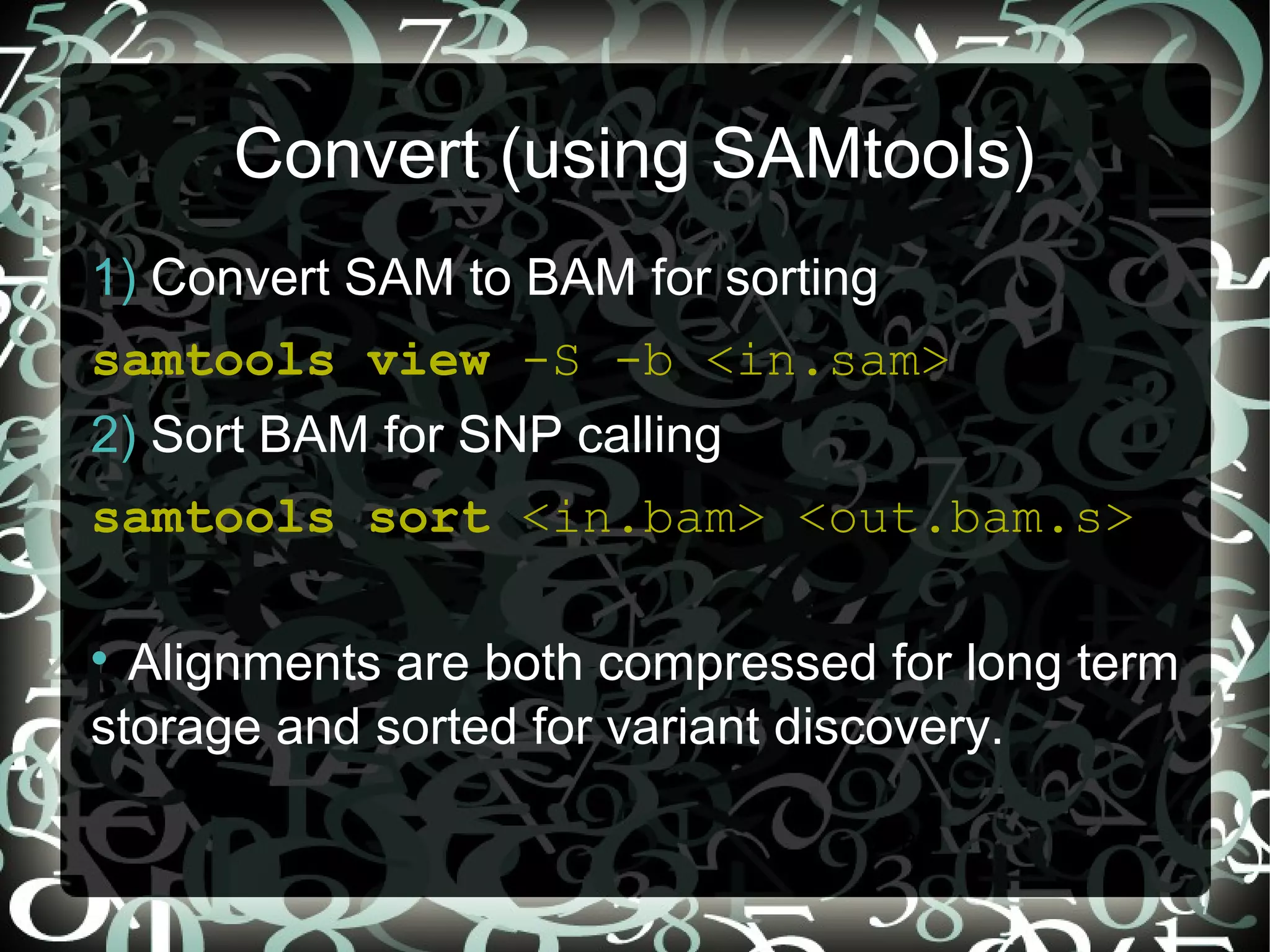
Convert (using SAMtools)
1) Convert SAM to BAM for sorting
samtools view -S -b <in.sam>
2) Sort BAM for SNP calling
samtools sort <in.bam> <out.bam.s>


  Alignments are both compressed for long term
storage and sorted for variant discovery.

                                    8
9
Coverage profiles /
  Depth vectors


                 10
SAMtools...

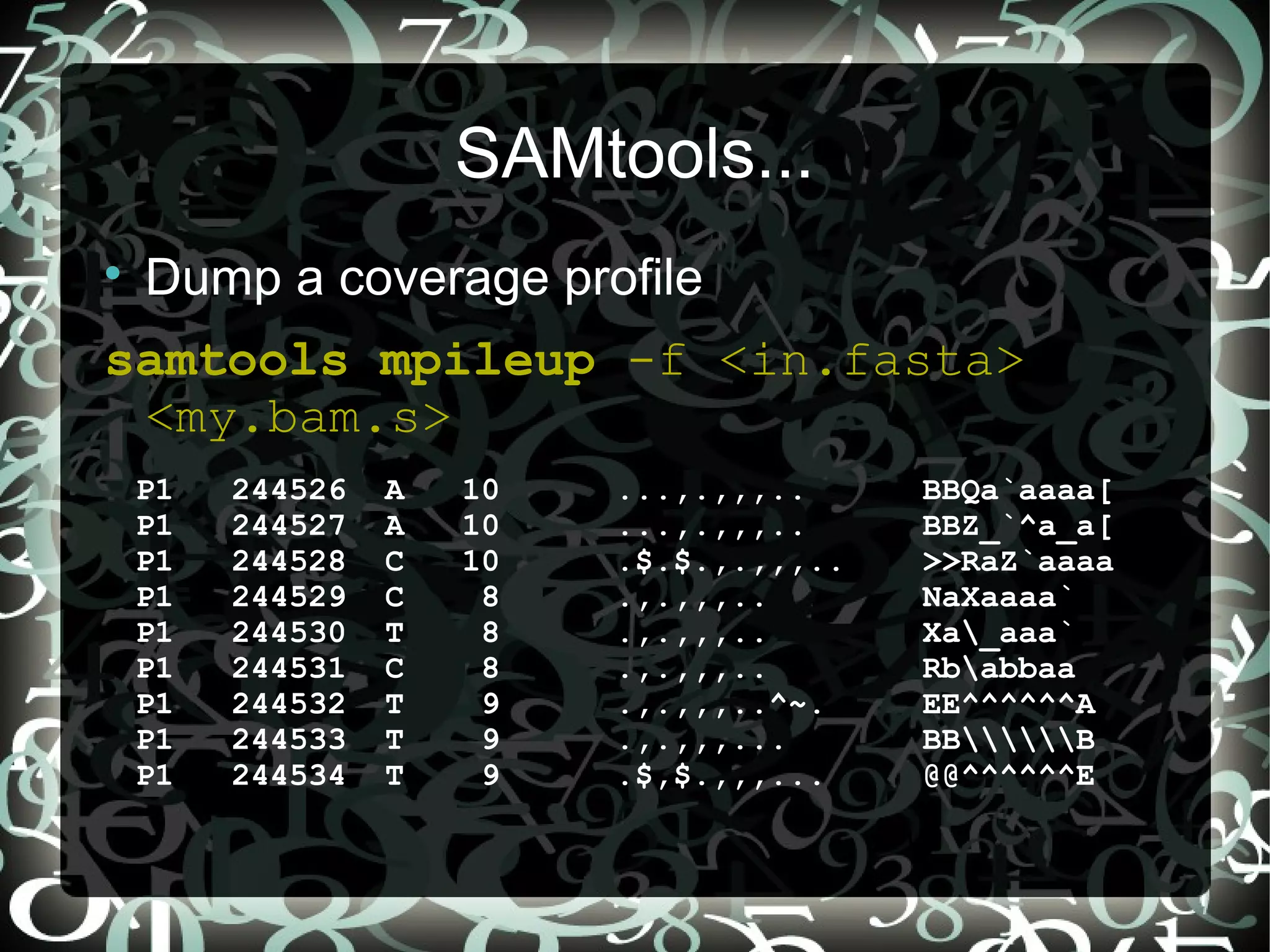
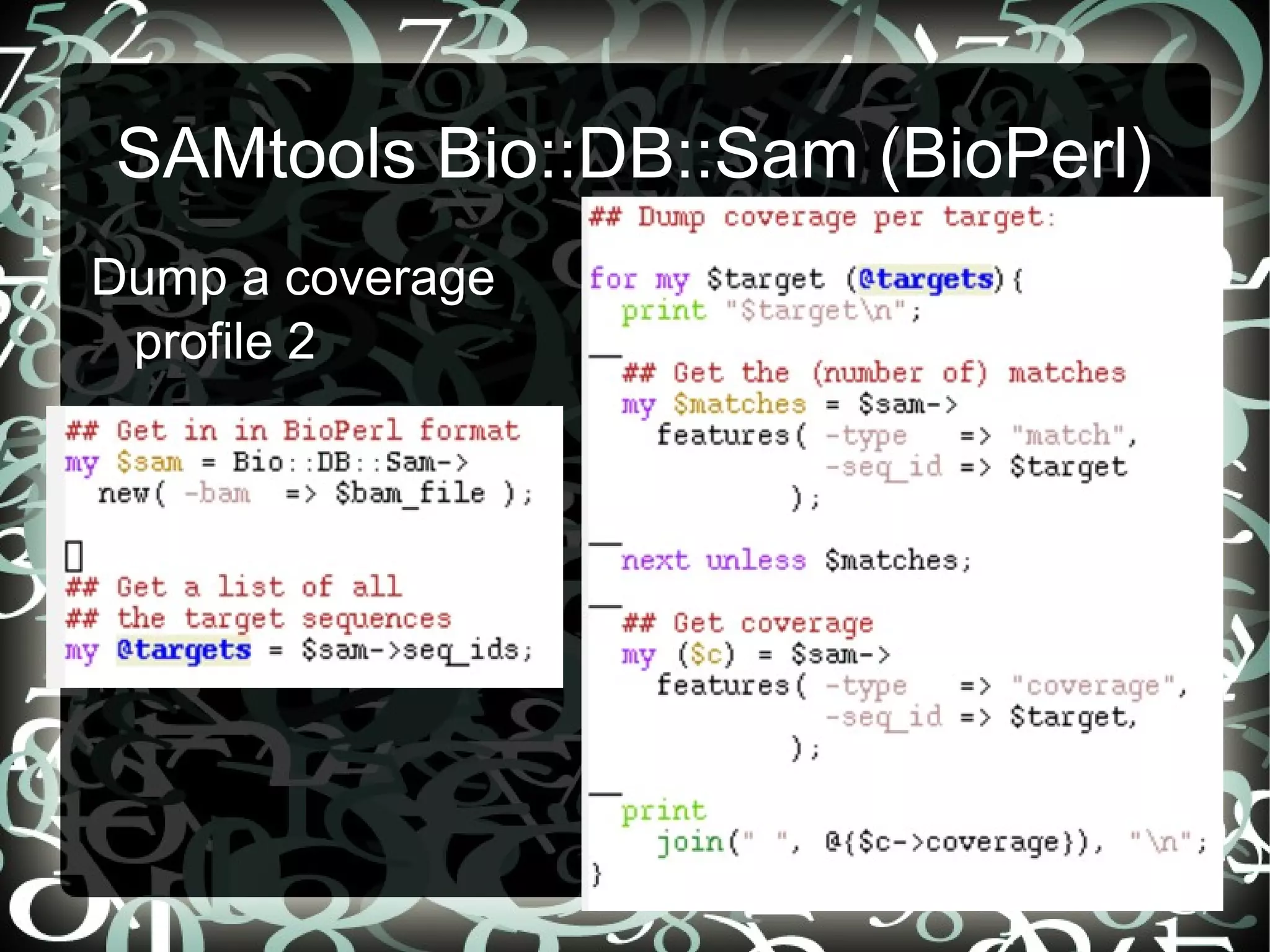
    Dump a coverage profile
samtools mpileup -f <in.fasta>
 <my.bam.s>
    P1   244526   A   10   ...,.,,,..      BBQa`aaaa[
    P1   244527   A   10   ...,.,,,..      BBZ_`^a_a[
    P1   244528   C   10   .$.$.,.,,,..    >>RaZ`aaaa
    P1   244529   C    8   .,.,,,..        NaXaaaa`
    P1   244530   T    8   .,.,,,..        Xa_aaa`
    P1   244531   C    8   .,.,,,..        Rbabbaa
    P1   244532   T    9   .,.,,,..^~.     EE^^^^^^A
    P1   244533   T    9   .,.,,,...       BBB
    P1   244534   T    9   .$,$.,,,...     @@^^^^^^E

                                          11
SAMtools Bio::DB::Sam (BioPerl)
Dump a coverage
 profile 2


                       12
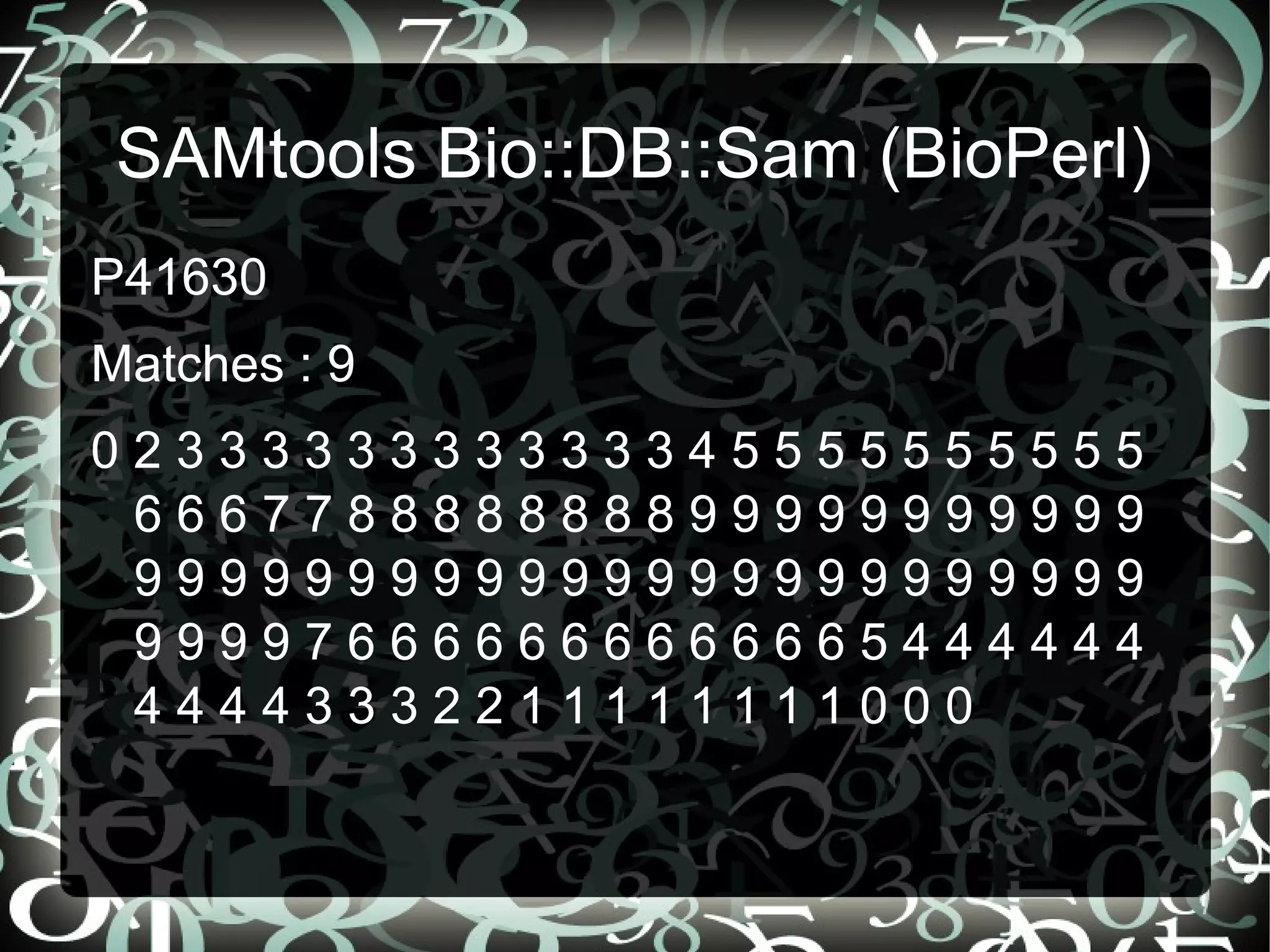
SAMtools Bio::DB::Sam (BioPerl)
P41630
Matches : 9
0233333333333345555555555
 666778888888899999999999
 999999999999999999999999
 999976666666666665444444
 44443332211111111000

                        13
14
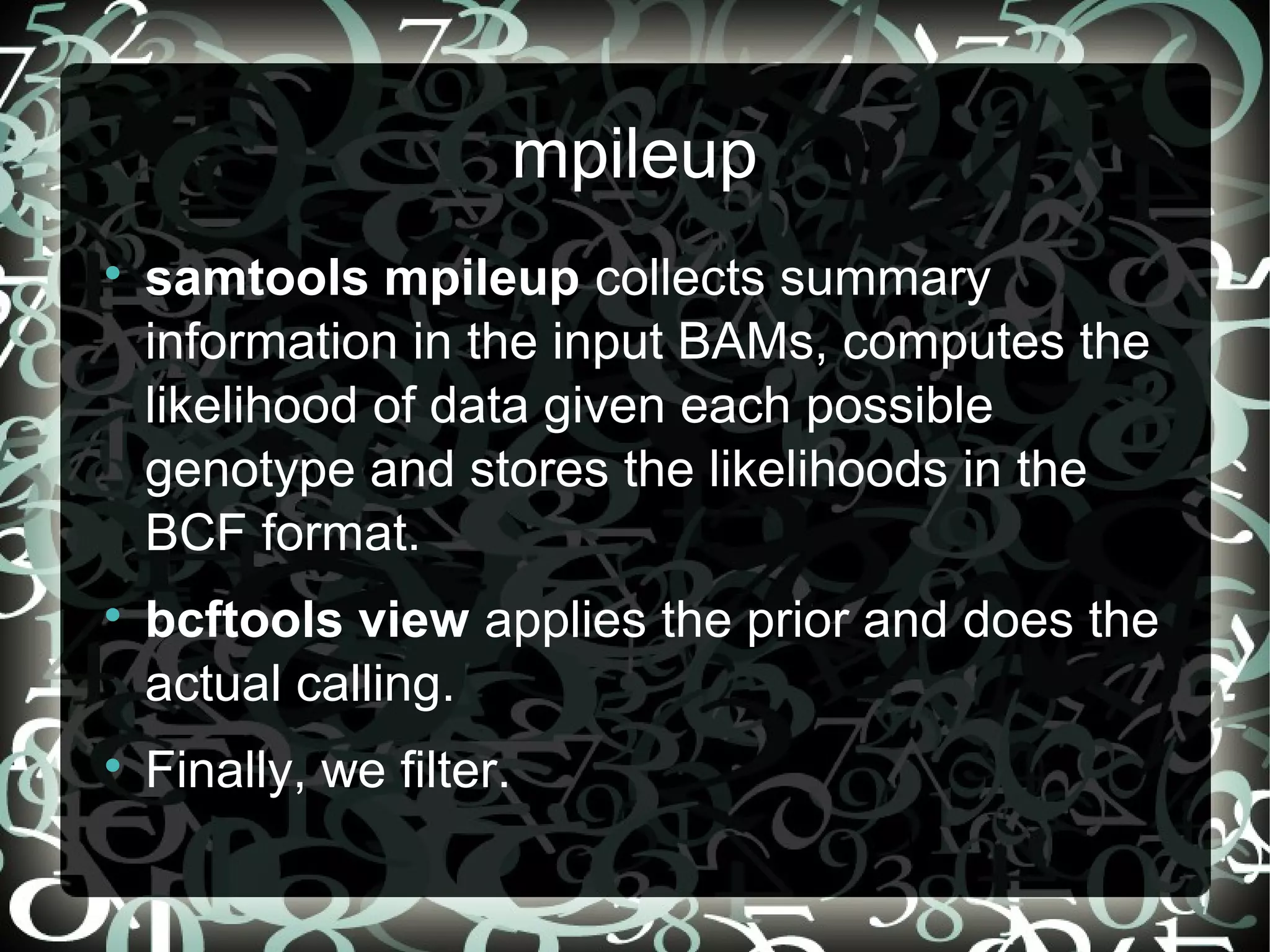
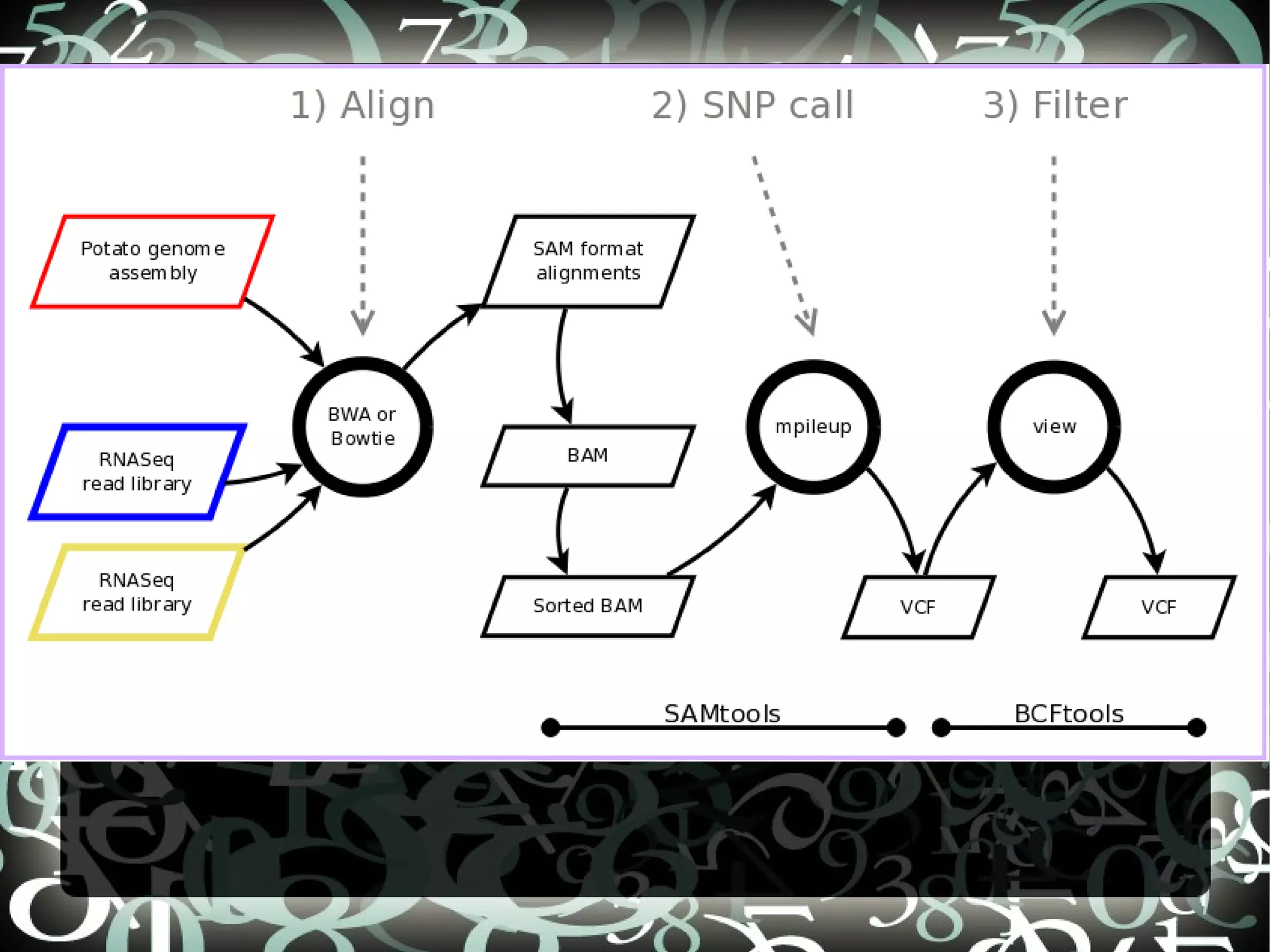
mpileup

    samtools mpileup collects summary
    information in the input BAMs, computes the
    likelihood of data given each possible
    genotype and stores the likelihoods in the
    BCF format.

    bcftools view applies the prior and does the
    actual calling.

    Finally, we filter.
                                    15
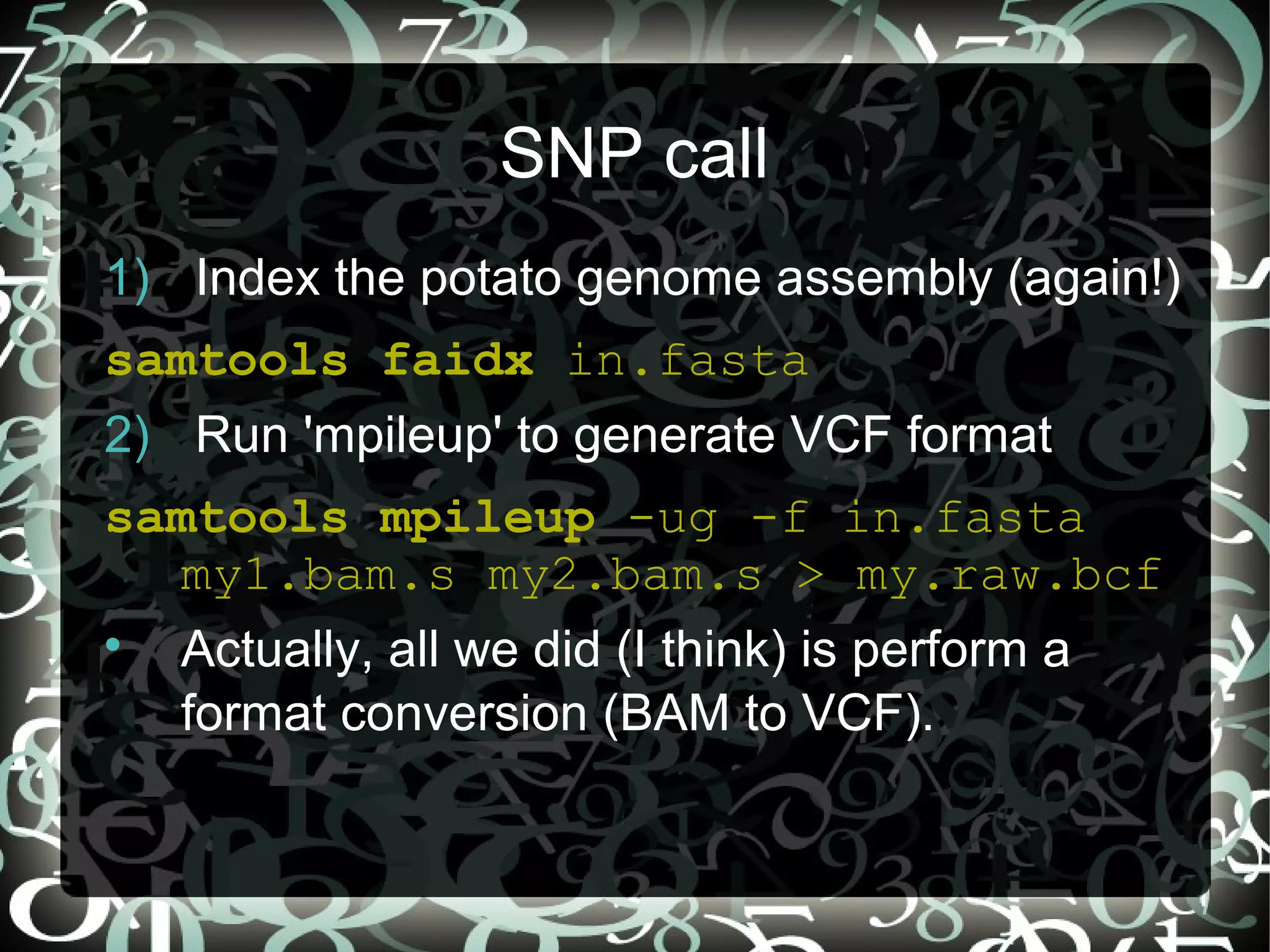
SNP call
1) Index the potato genome assembly (again!)
samtools faidx in.fasta
2) Run 'mpileup' to generate VCF format
samtools mpileup -ug -f in.fasta
  my1.bam.s my2.bam.s > my.raw.bcf

    Actually, all we did (I think) is perform a
    format conversion (BAM to VCF).
VCF format


             17
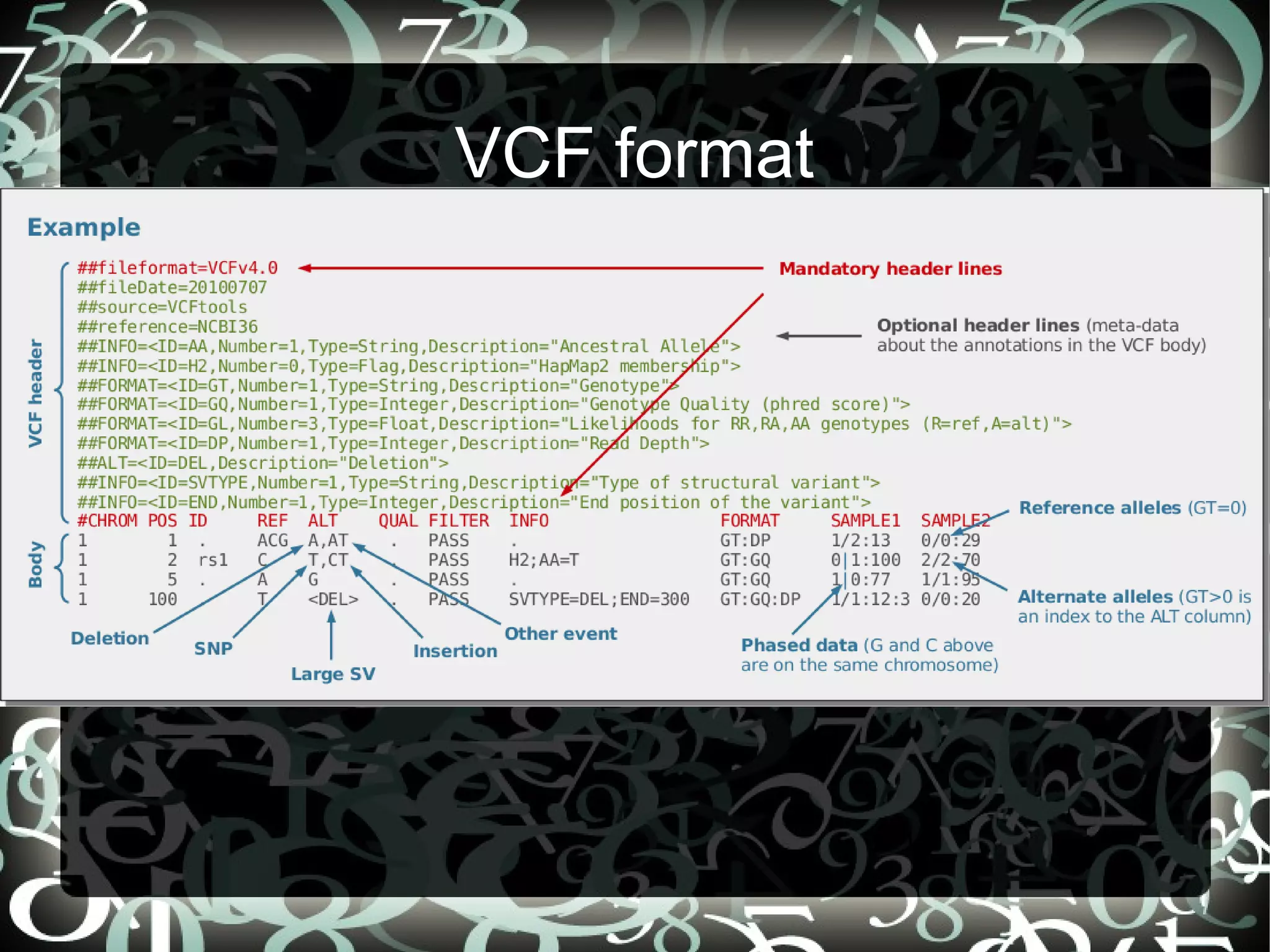
VCF format
A standard format for sequence variation:
  SNPs, indels and structural variants.
Compressed and indexed.
Developed for the 1000 Genomes Project.
VCFtools for VCF like SAMtools for SAM.
Specification and tools available from
 http://vcftools.sourceforge.net
                                    18
19
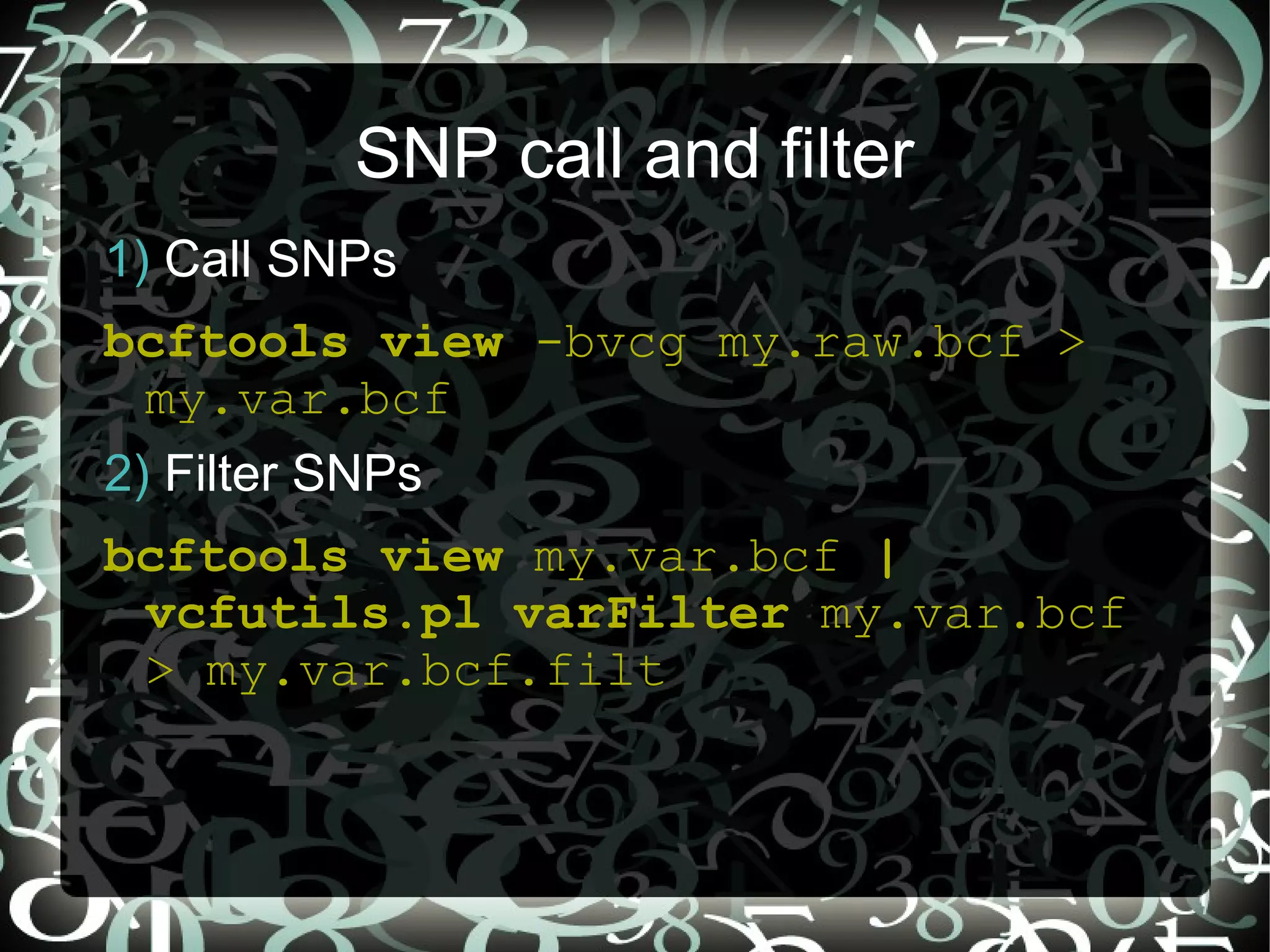
SNP call and filter
1) Call SNPs
bcftools view -bvcg my.raw.bcf >
 my.var.bcf
2) Filter SNPs
bcftools view my.var.bcf |
 vcfutils.pl varFilter my.var.bcf
 > my.var.bcf.filt


                             20
21
Aims of the work
1) Learn about handling RNASeq
     
         Create a SNP calling pipeline


2) Select SNPs for genetic mapping
     
         Using Illumina's GoldenGate SNP chip (OPA)


                                         22
Select SNPs for genetic mapping
 Using Illumina's GoldenGate SNP chip (OPA)


                                23
SNP chip (OPA) construction

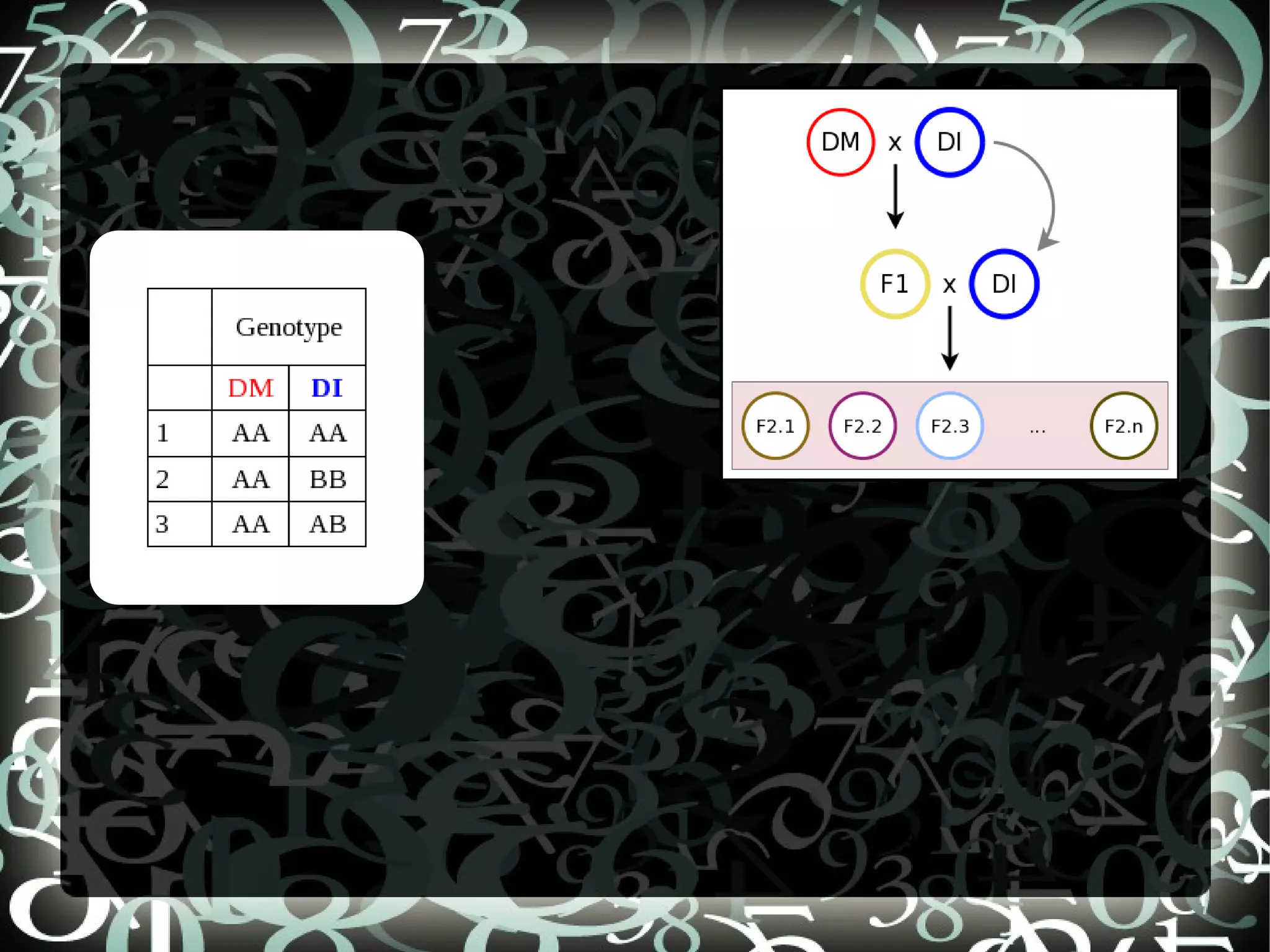
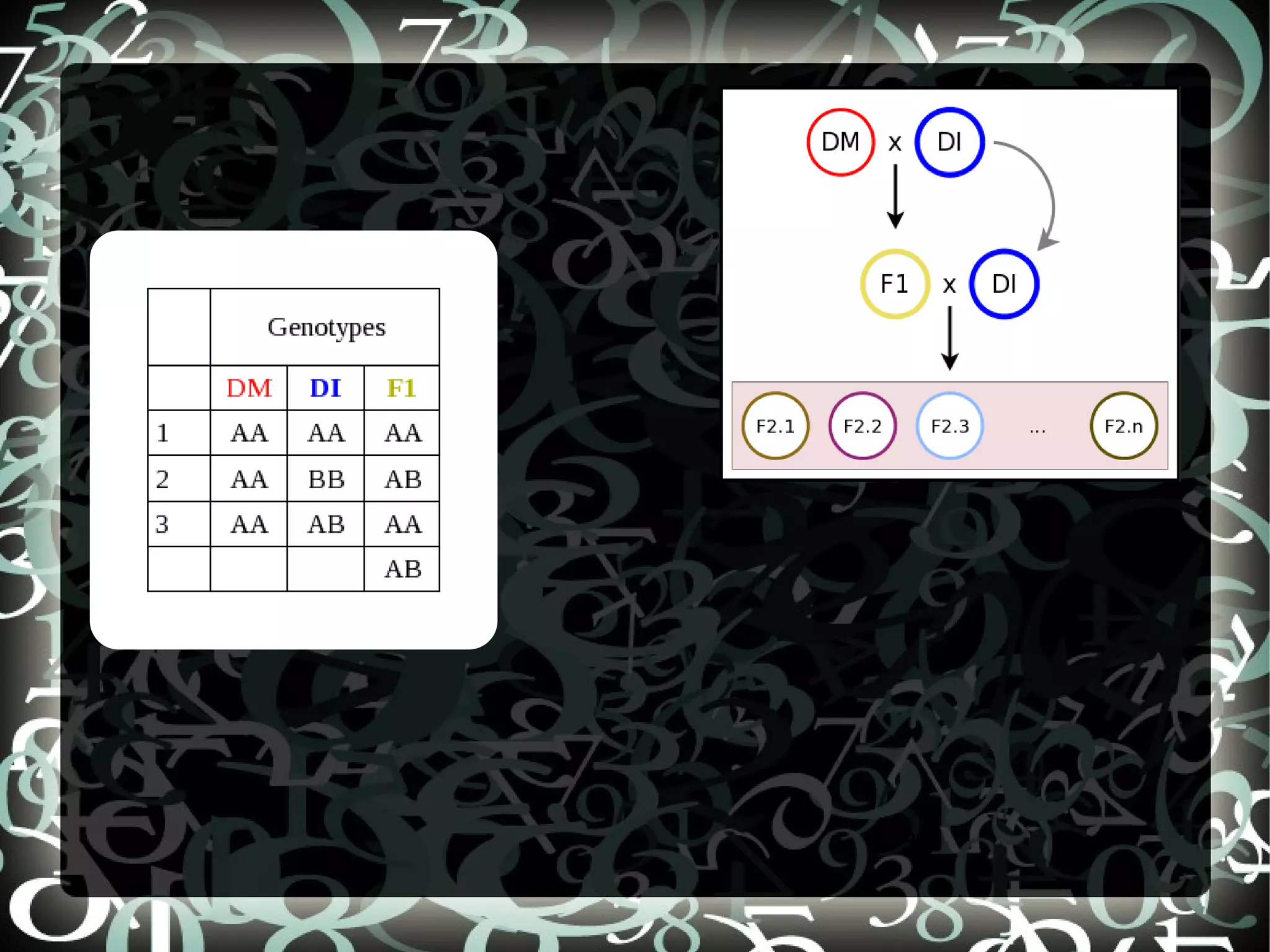
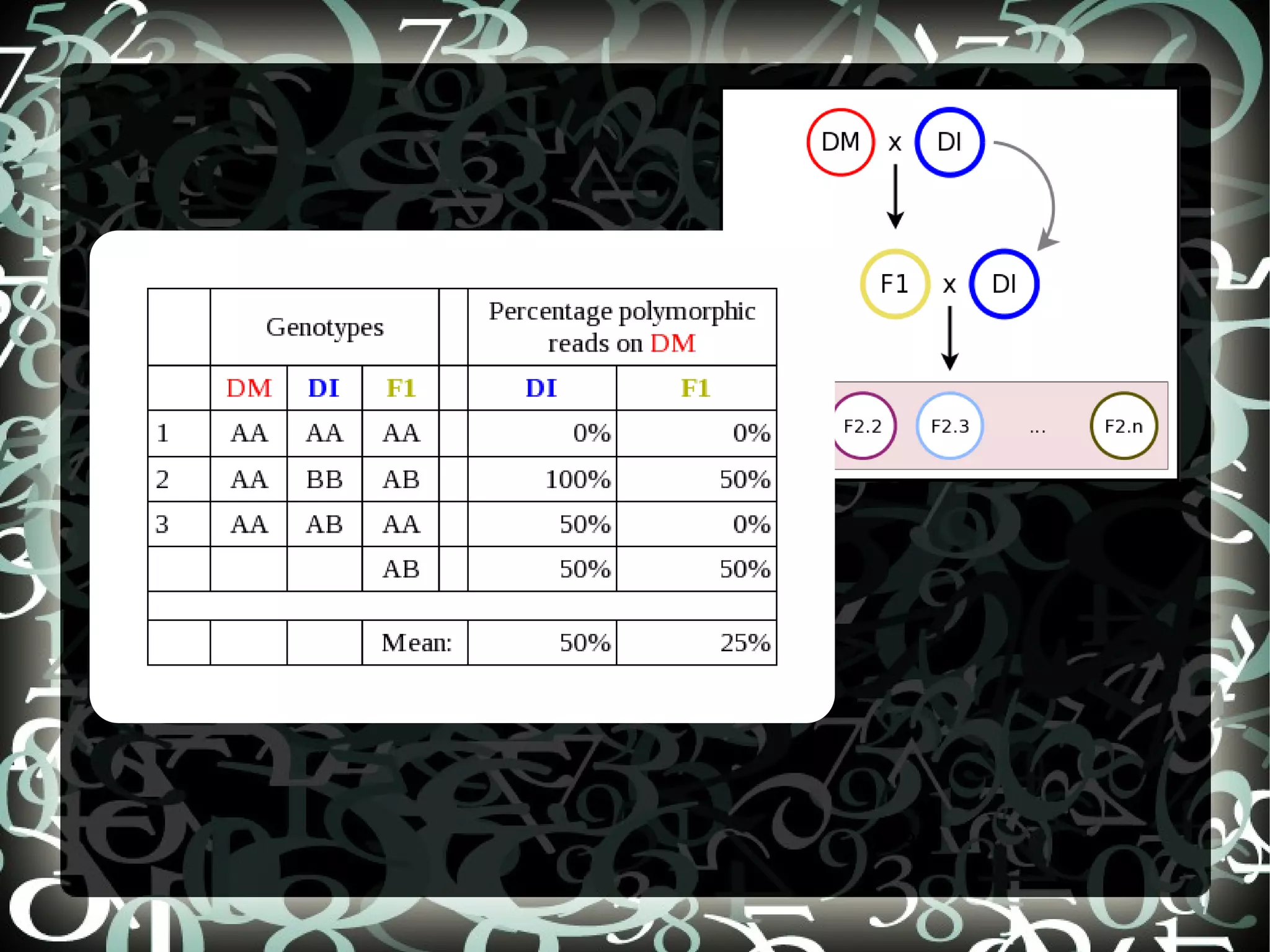
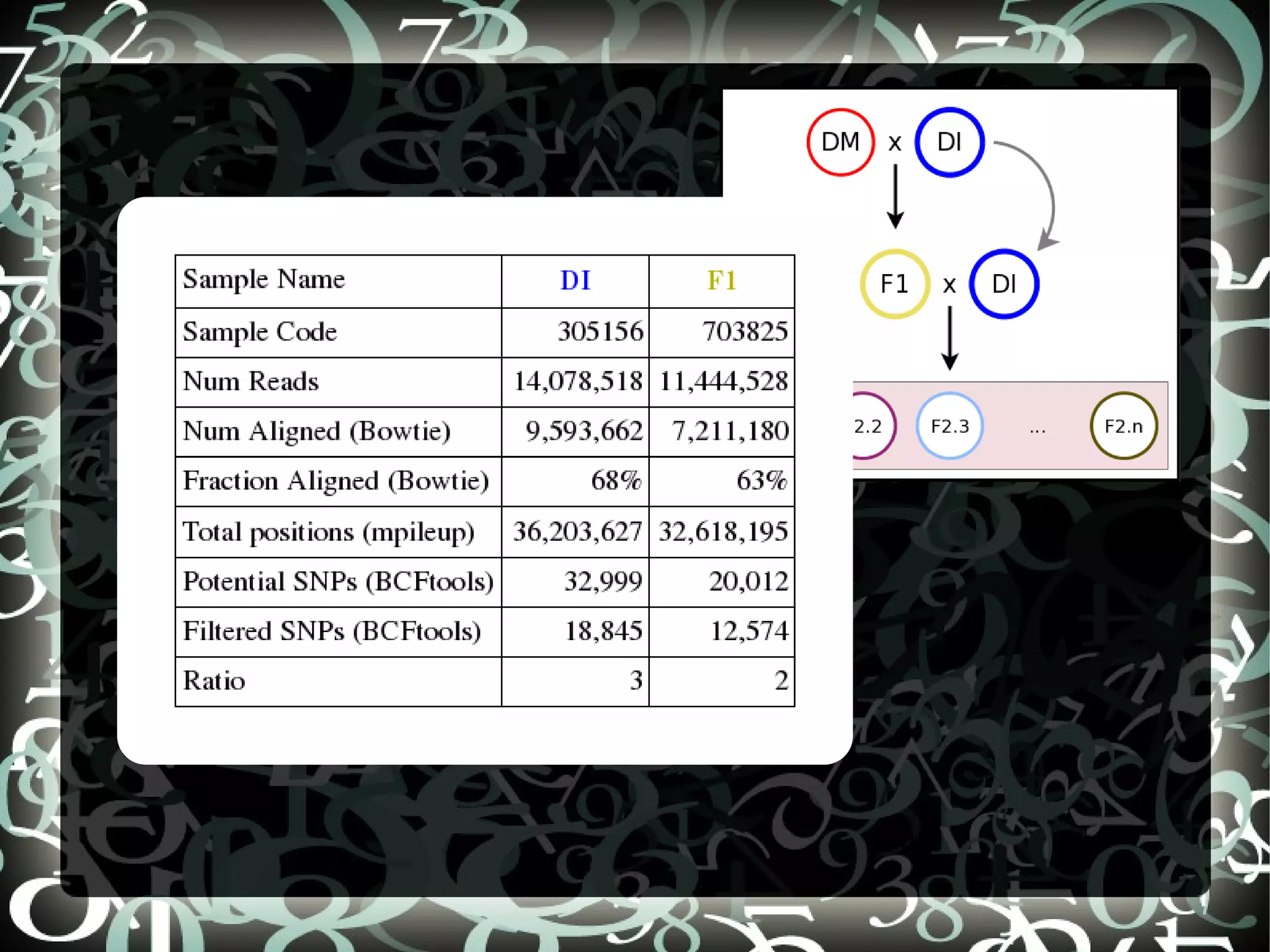
    A set of DM SNP positions was provided by
    the SolCAP project (RNASeq derived).

    A subset was selected for developing OPAs
    (Illumina’s SNP chip technology).

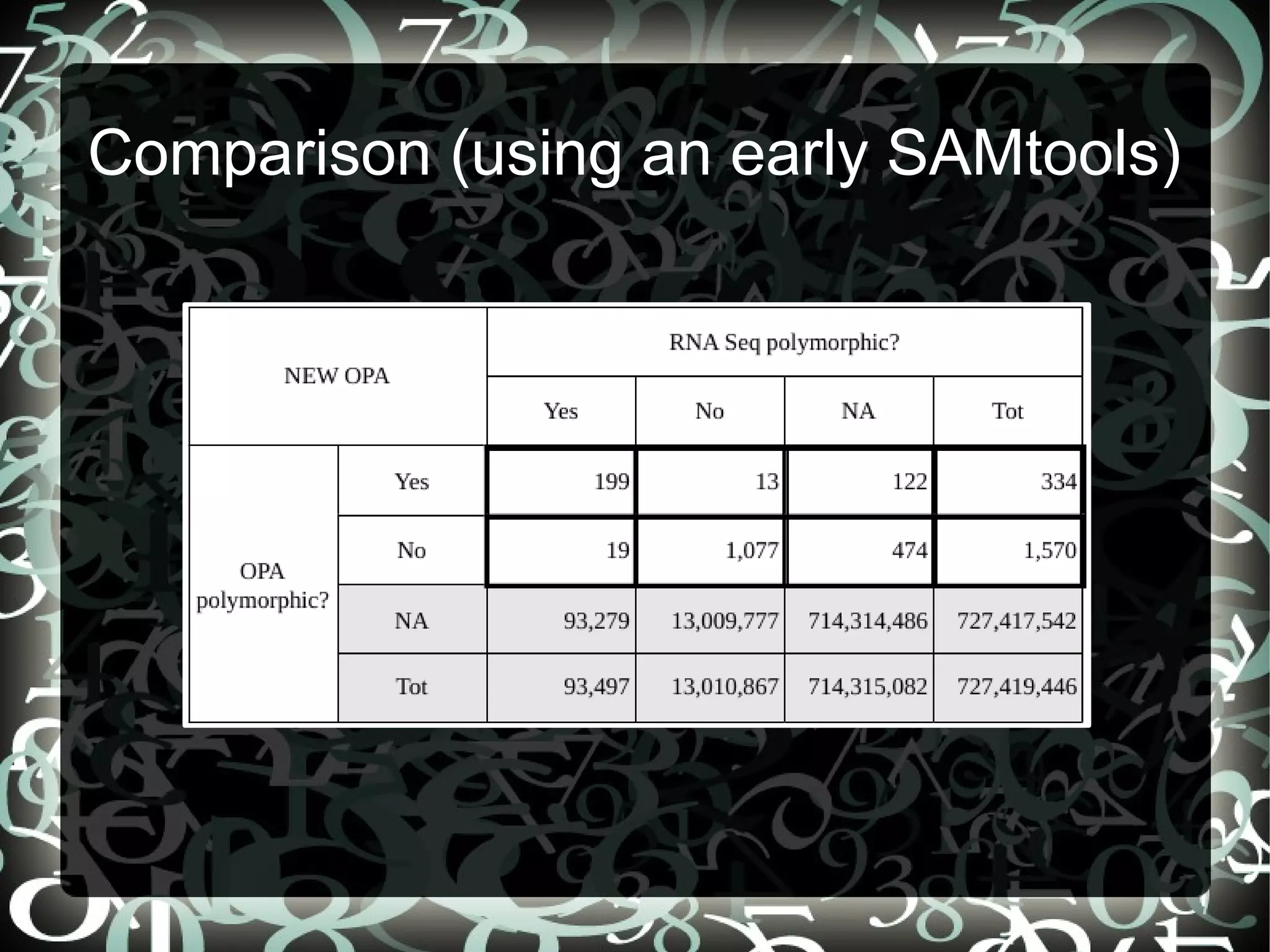
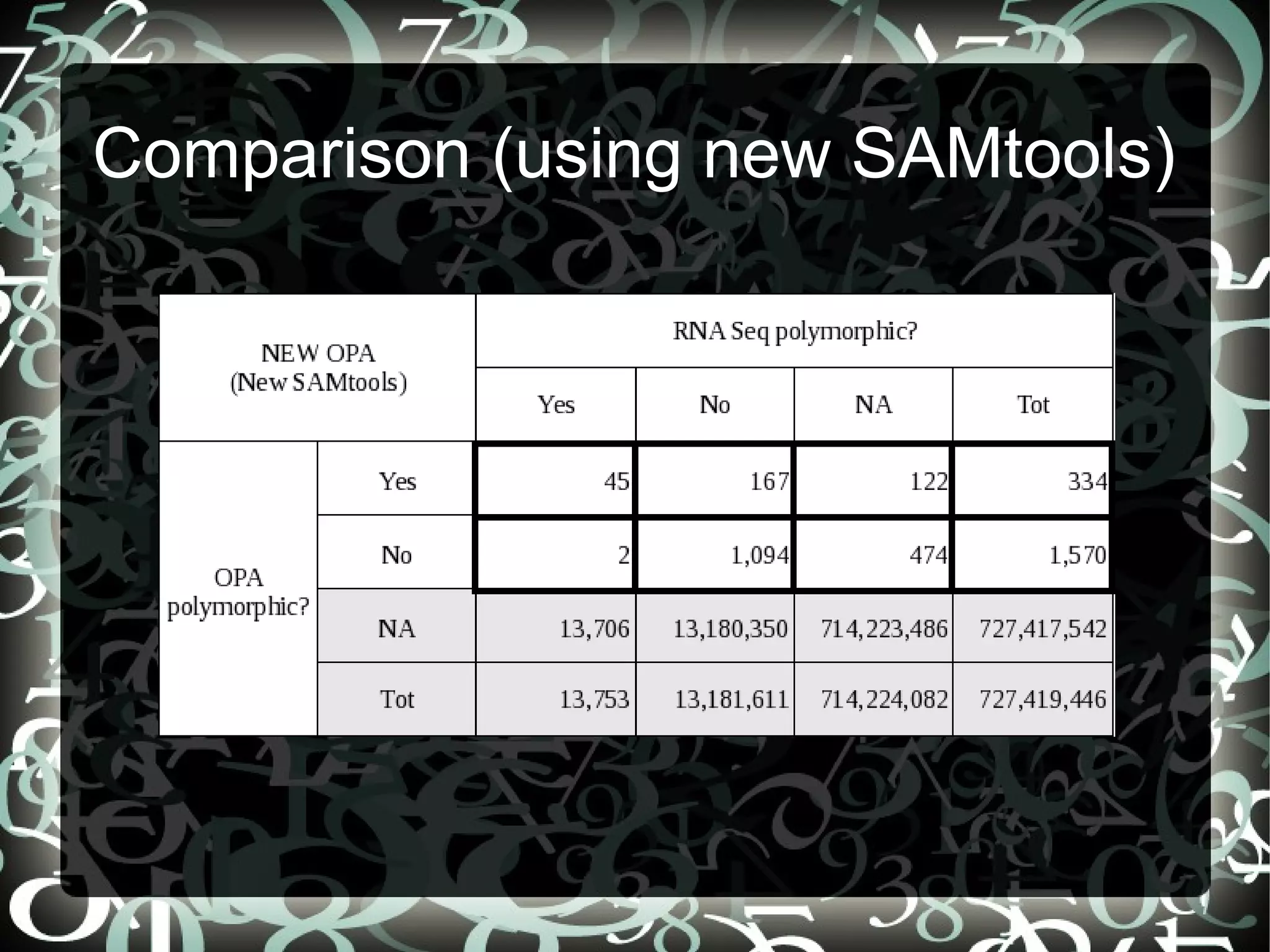
    OPAs were run, and results have now been
    compared to RNASeq.


                                   24
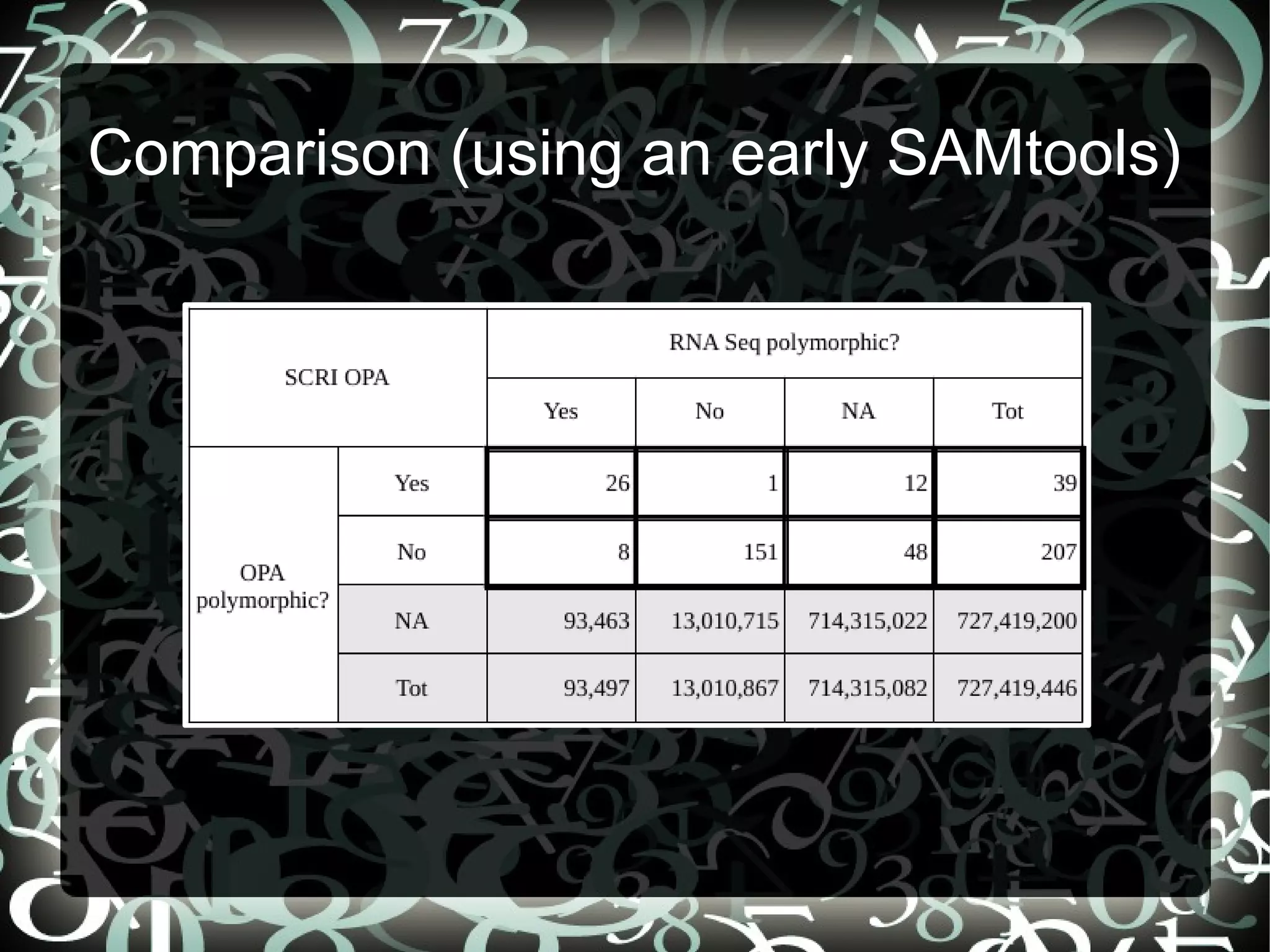
Comparison (using an early SAMtools)
27
Comparison (using an early SAMtools)
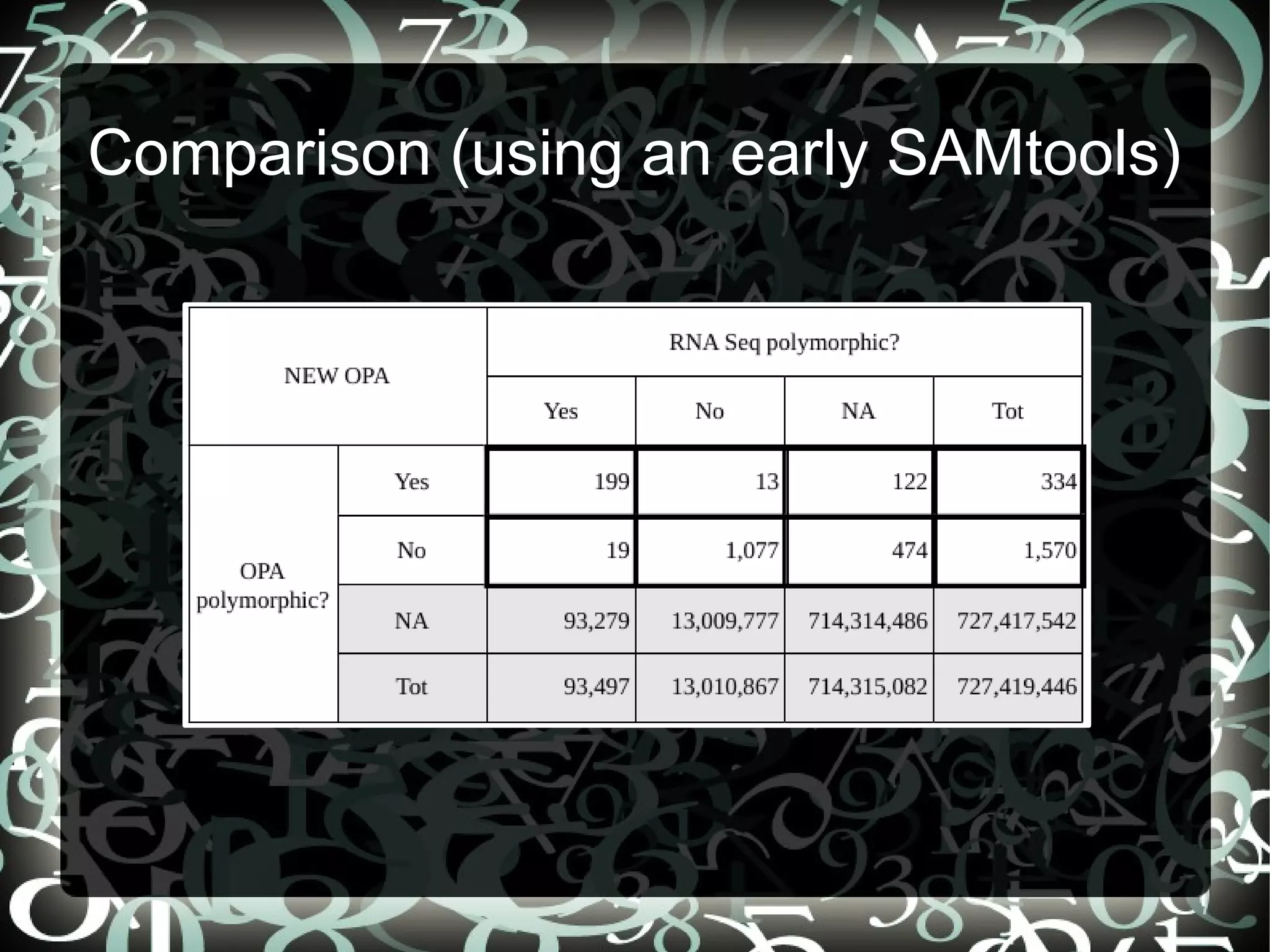
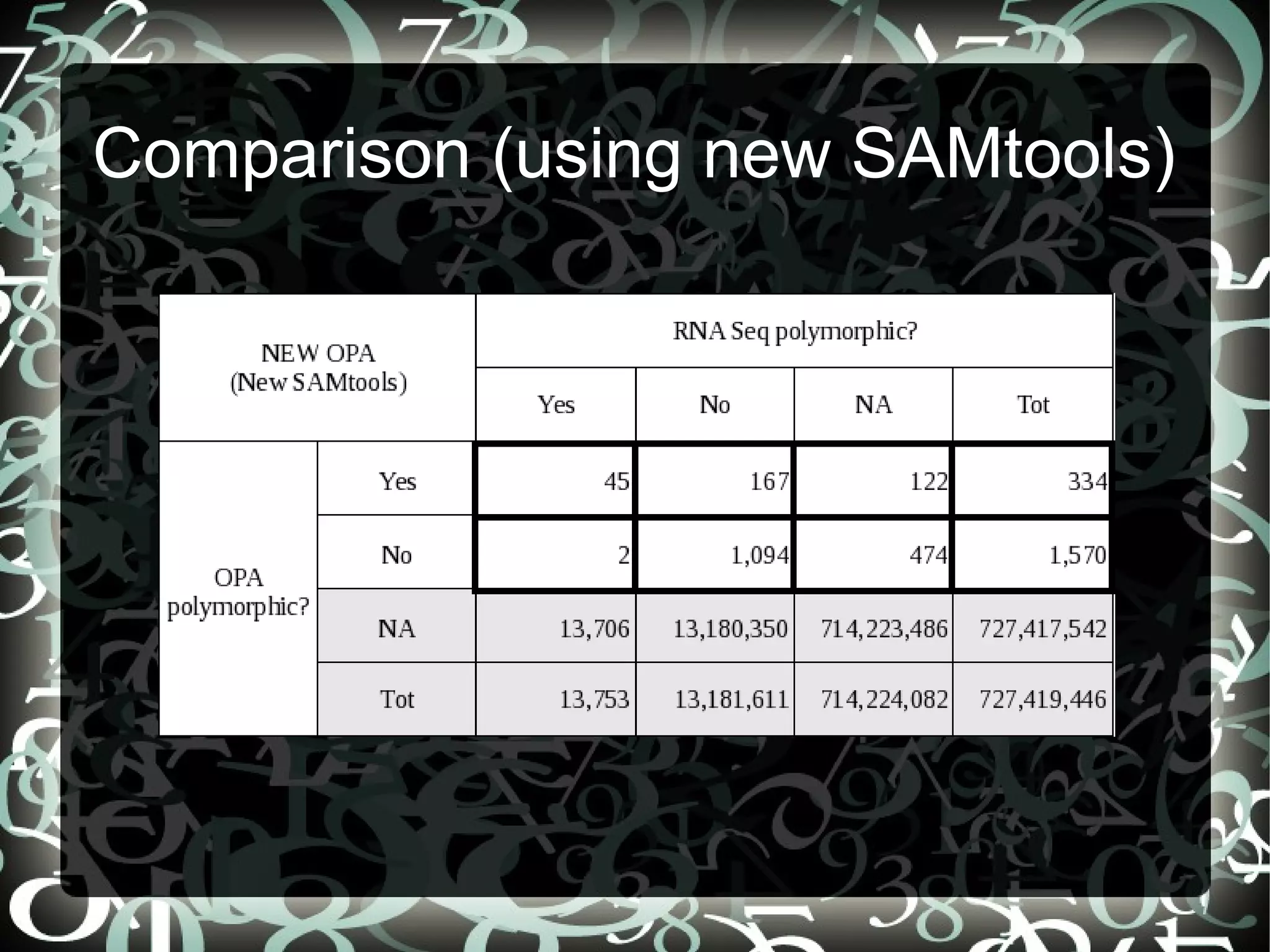
Comparison (using new SAMtools)
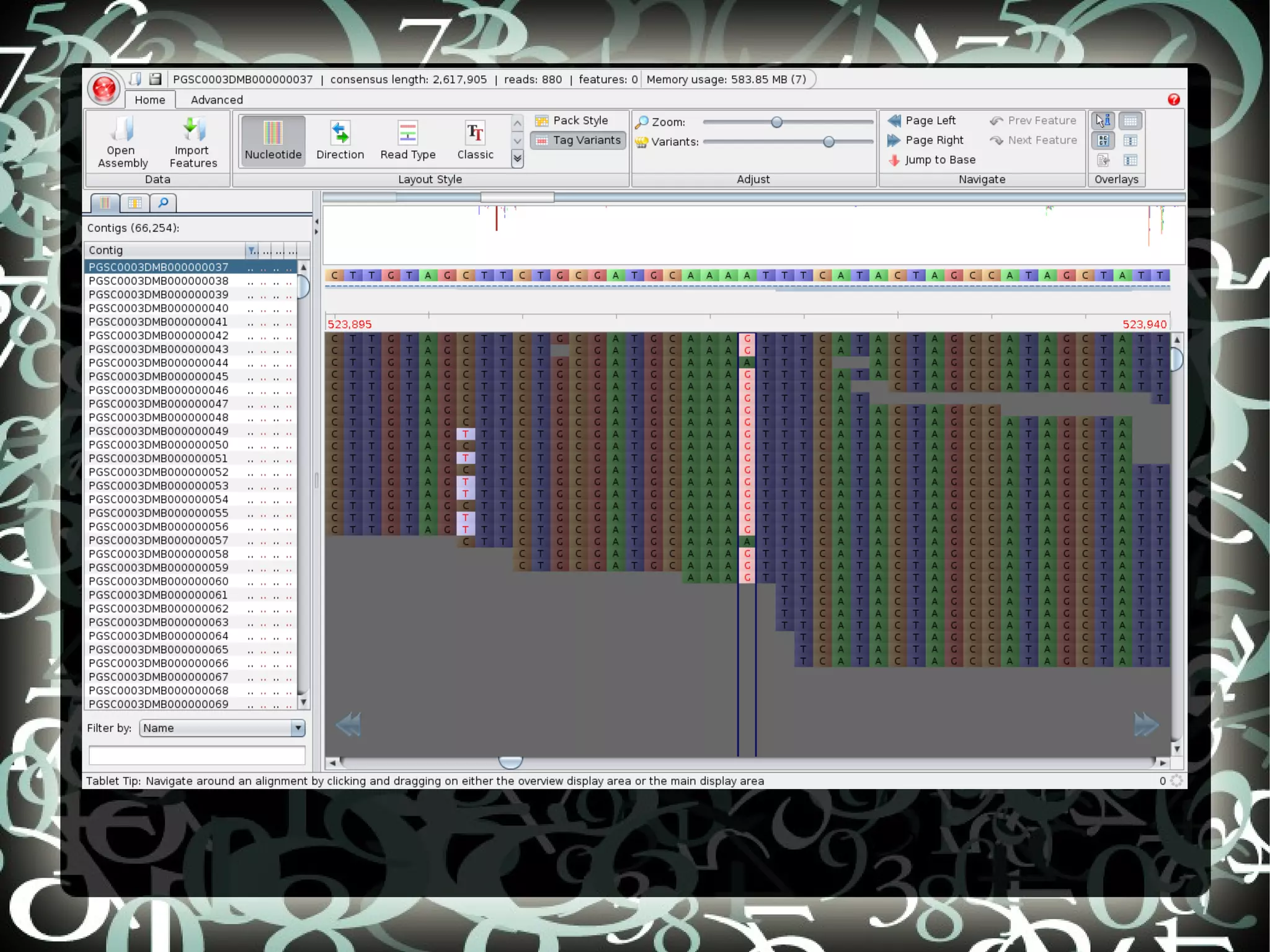
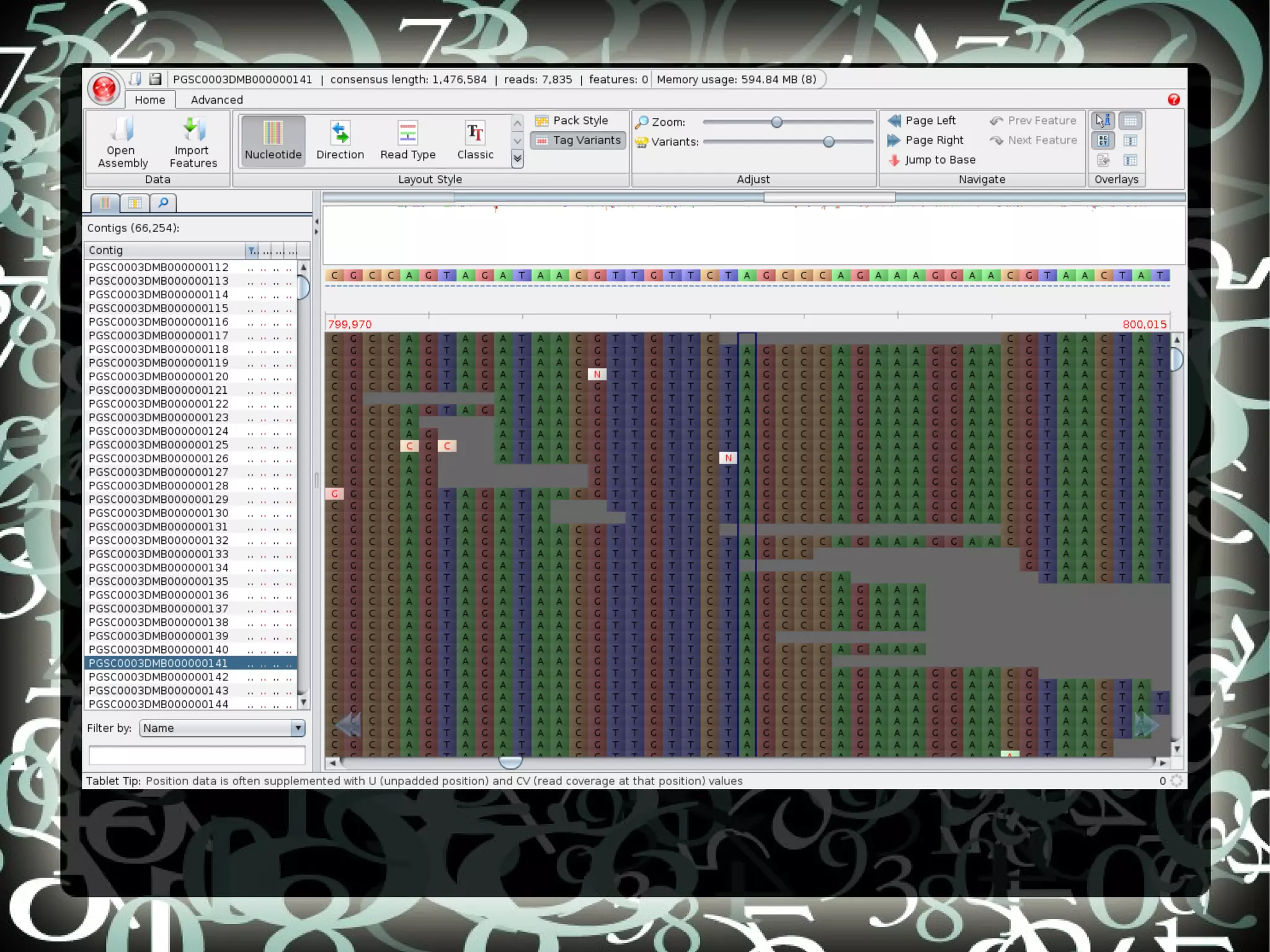
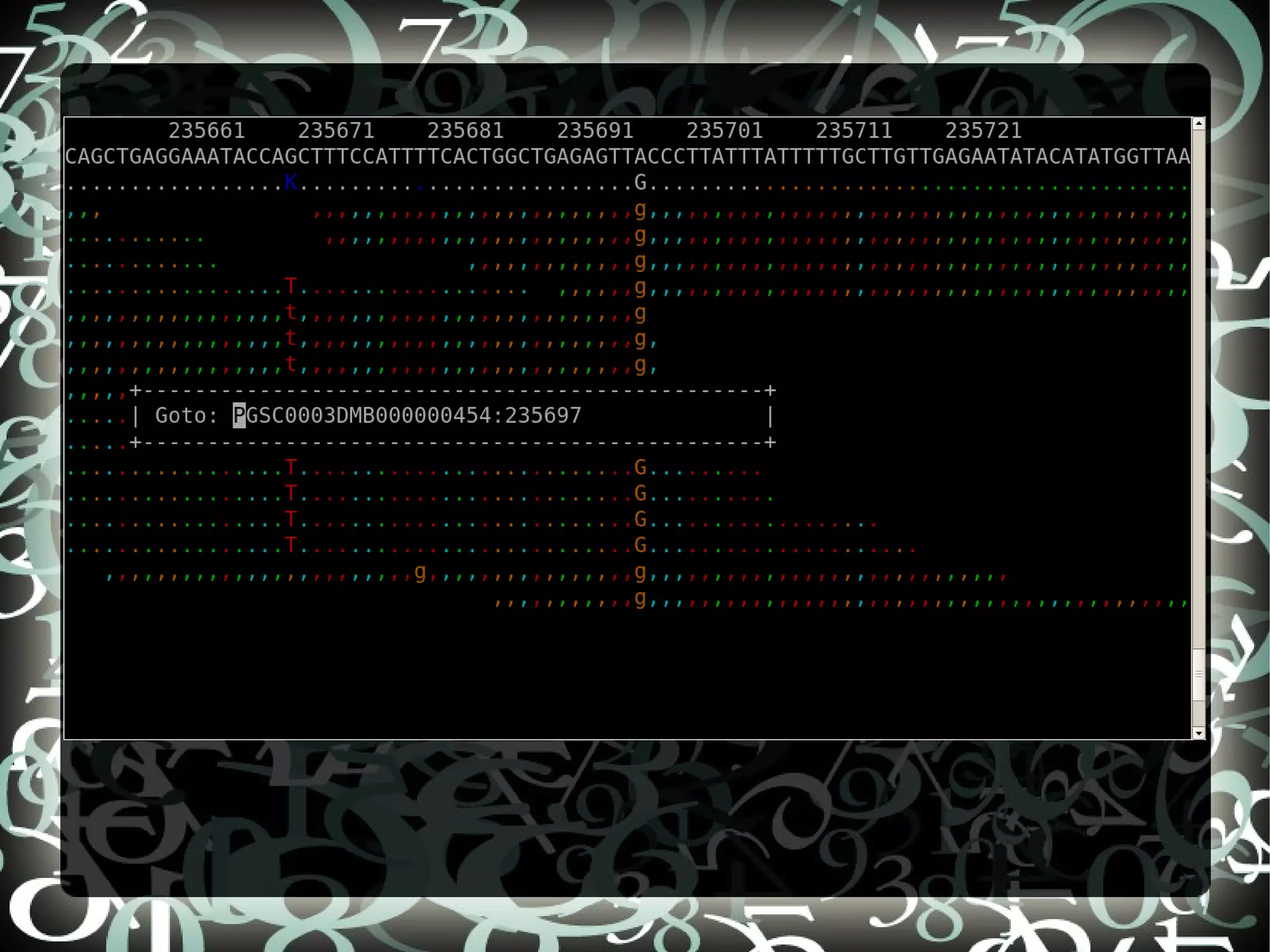
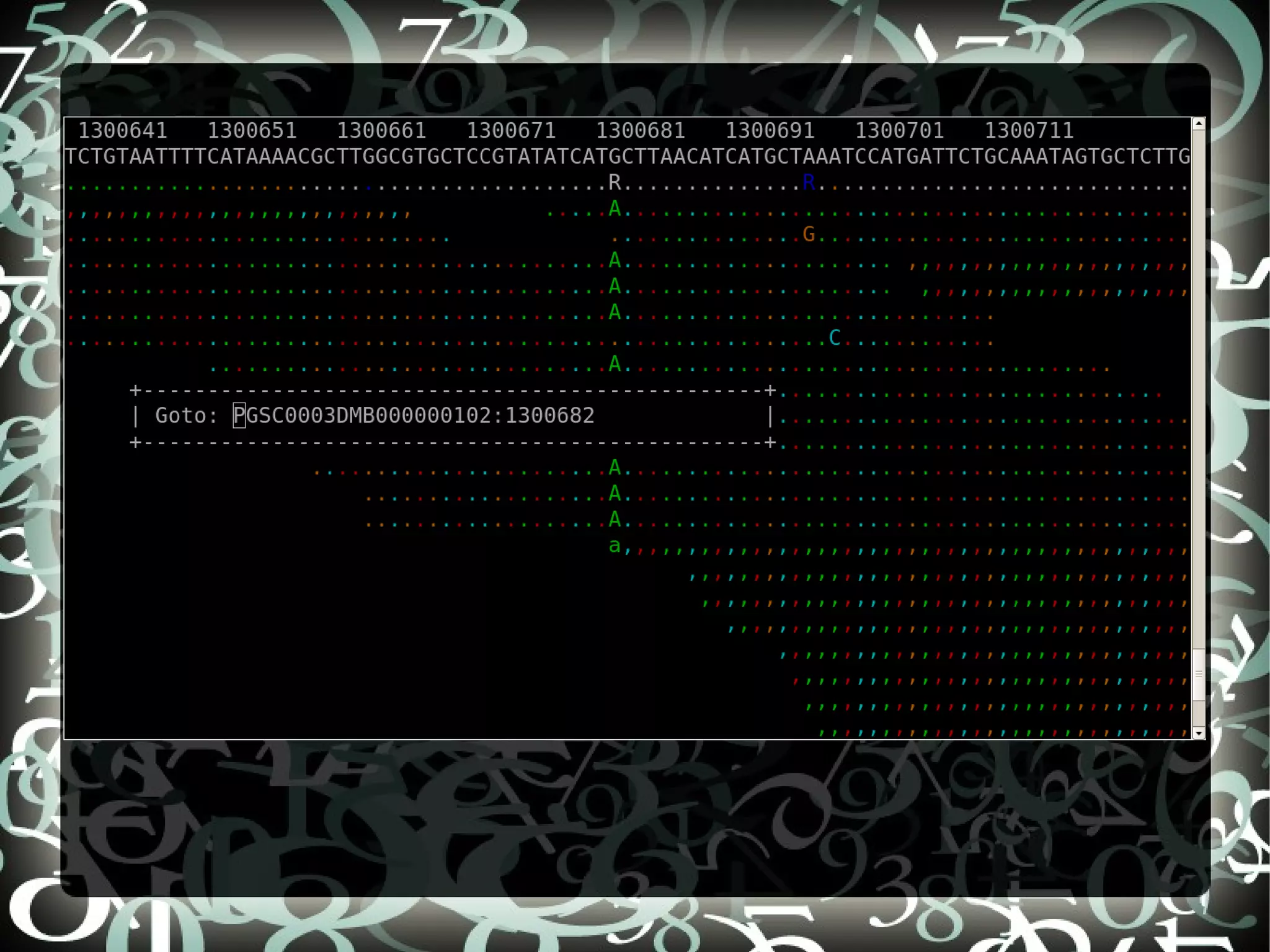
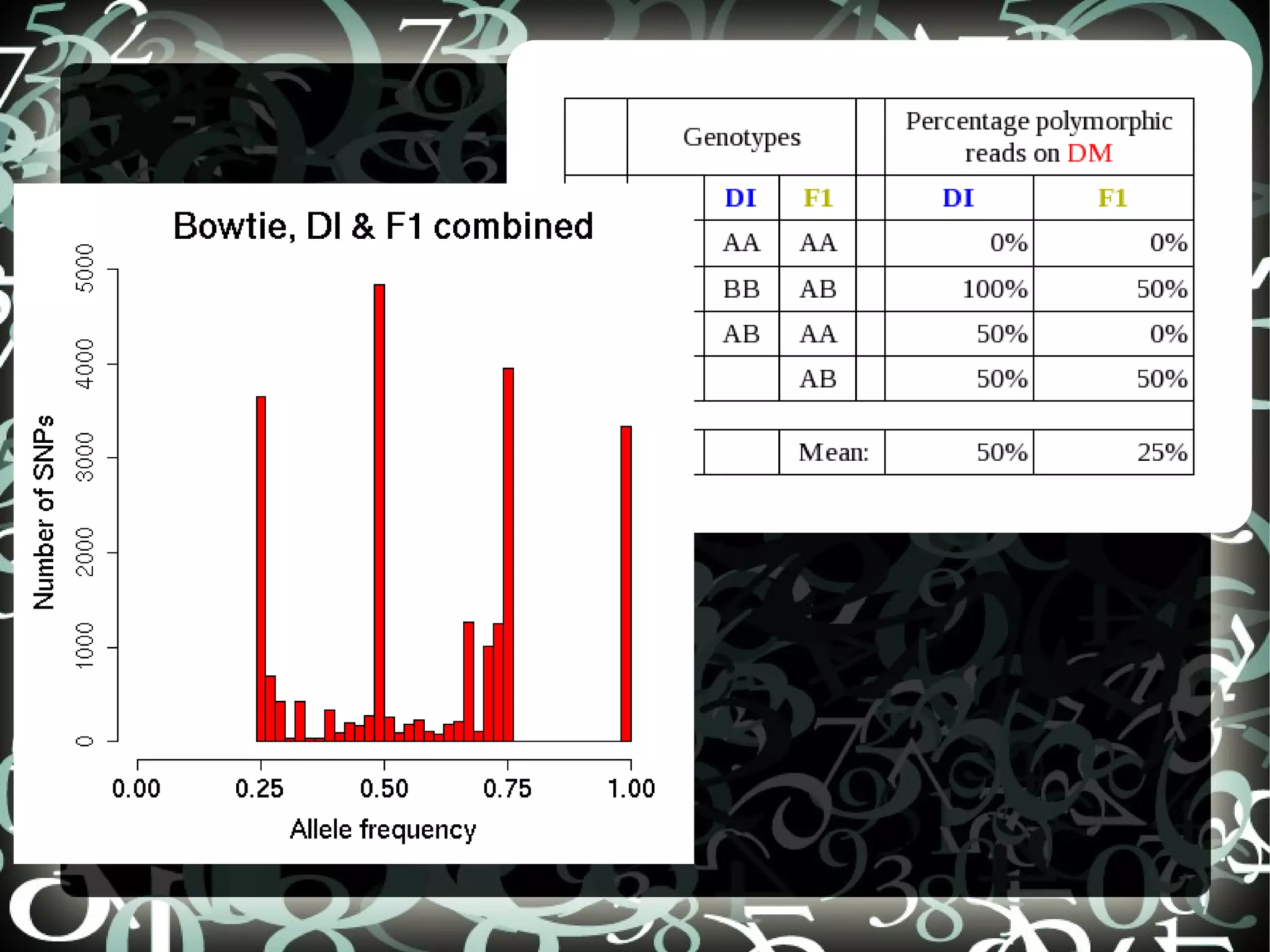
Looking into the RNASeq data…


                      34
35
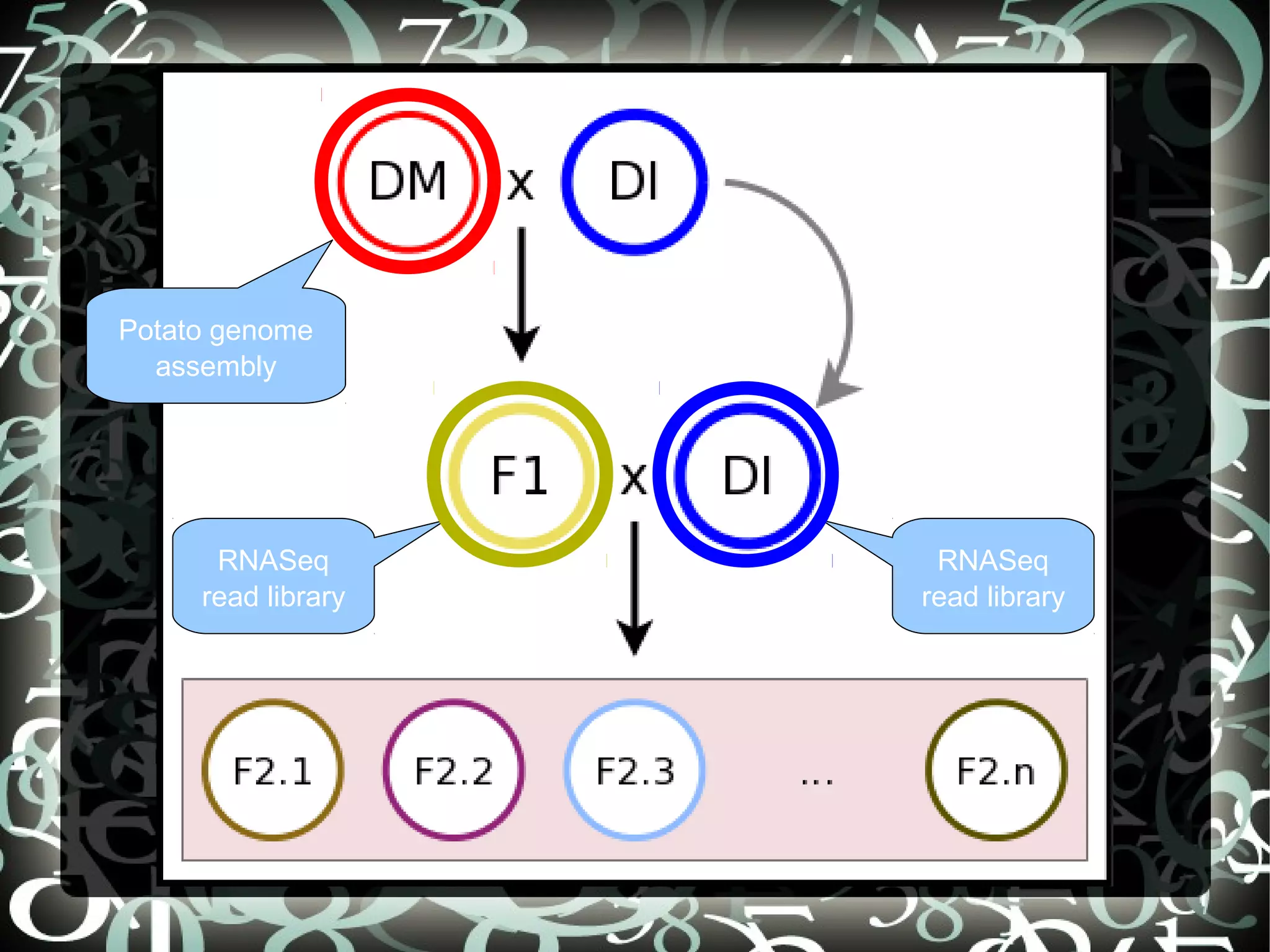
Potato genome
  assembly


      RNASeq          RNASeq
     read library    read library


                    36
37
38
39
40
41
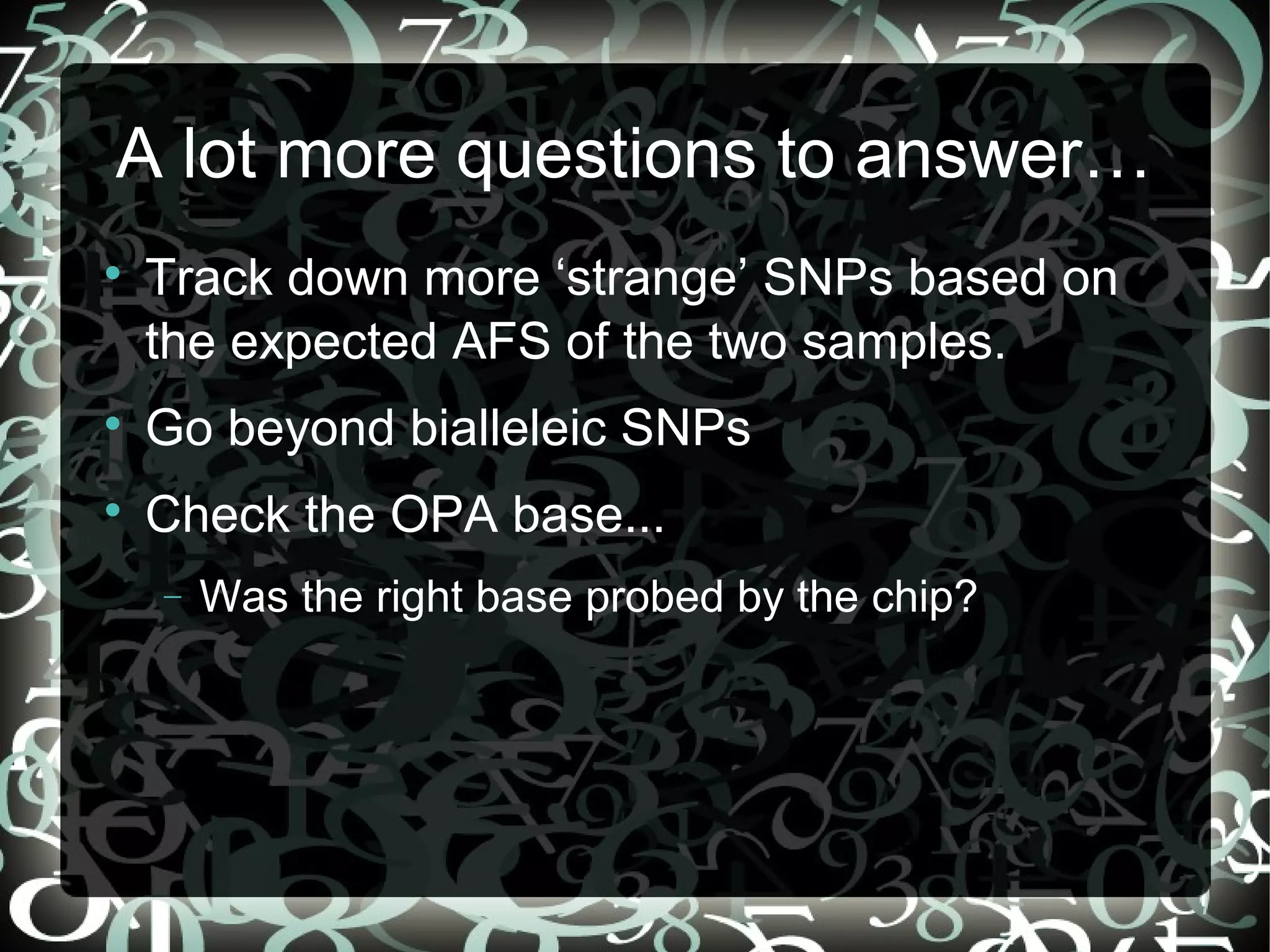
A lot more questions to answer…

    Track down more ‘strange’ SNPs based on
    the expected AFS of the two samples.

    Go beyond bialleleic SNPs

    Check the OPA base...
    −   Was the right base probed by the chip?


                                          42
Thank you for your patience!


                      43
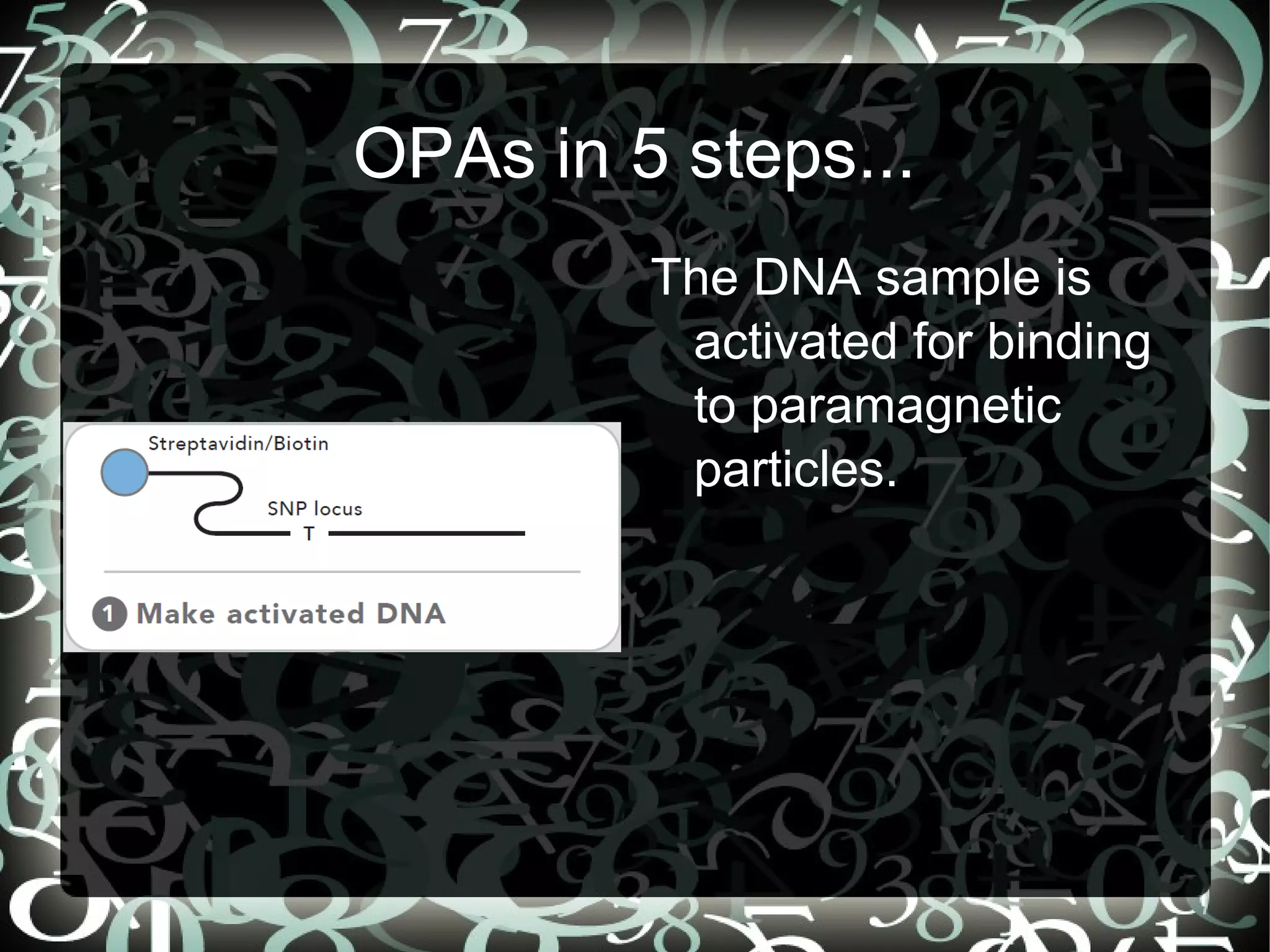
OPAs in 5 steps...
         The DNA sample is
          activated for binding
          to paramagnetic
          particles.
OPAs in 5 steps...
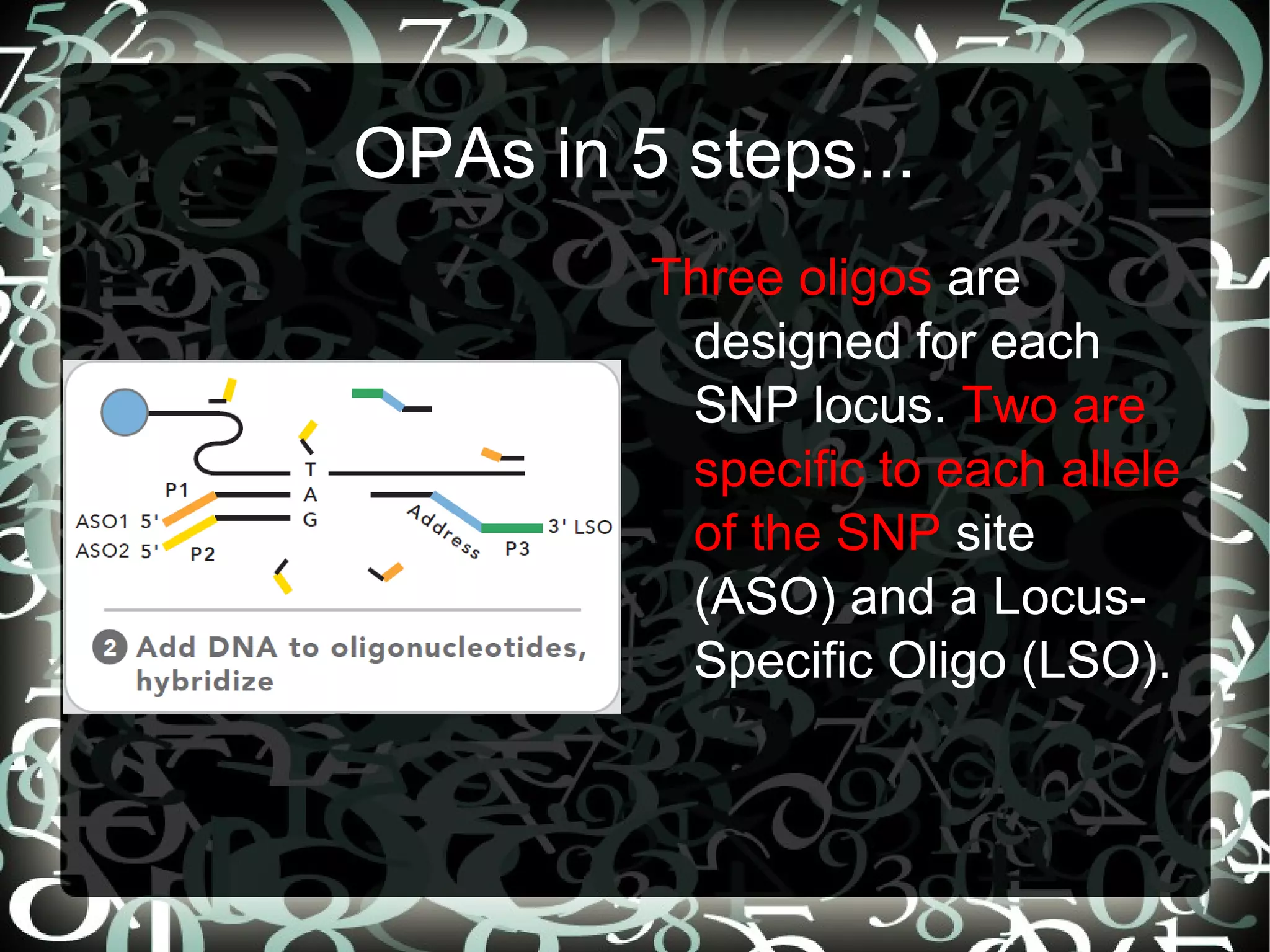
         Three oligos are
          designed for each
          SNP locus. Two are
          specific to each allele
          of the SNP site
          (ASO) and a Locus-
          Specific Oligo (LSO).
OPAs in 5 steps...
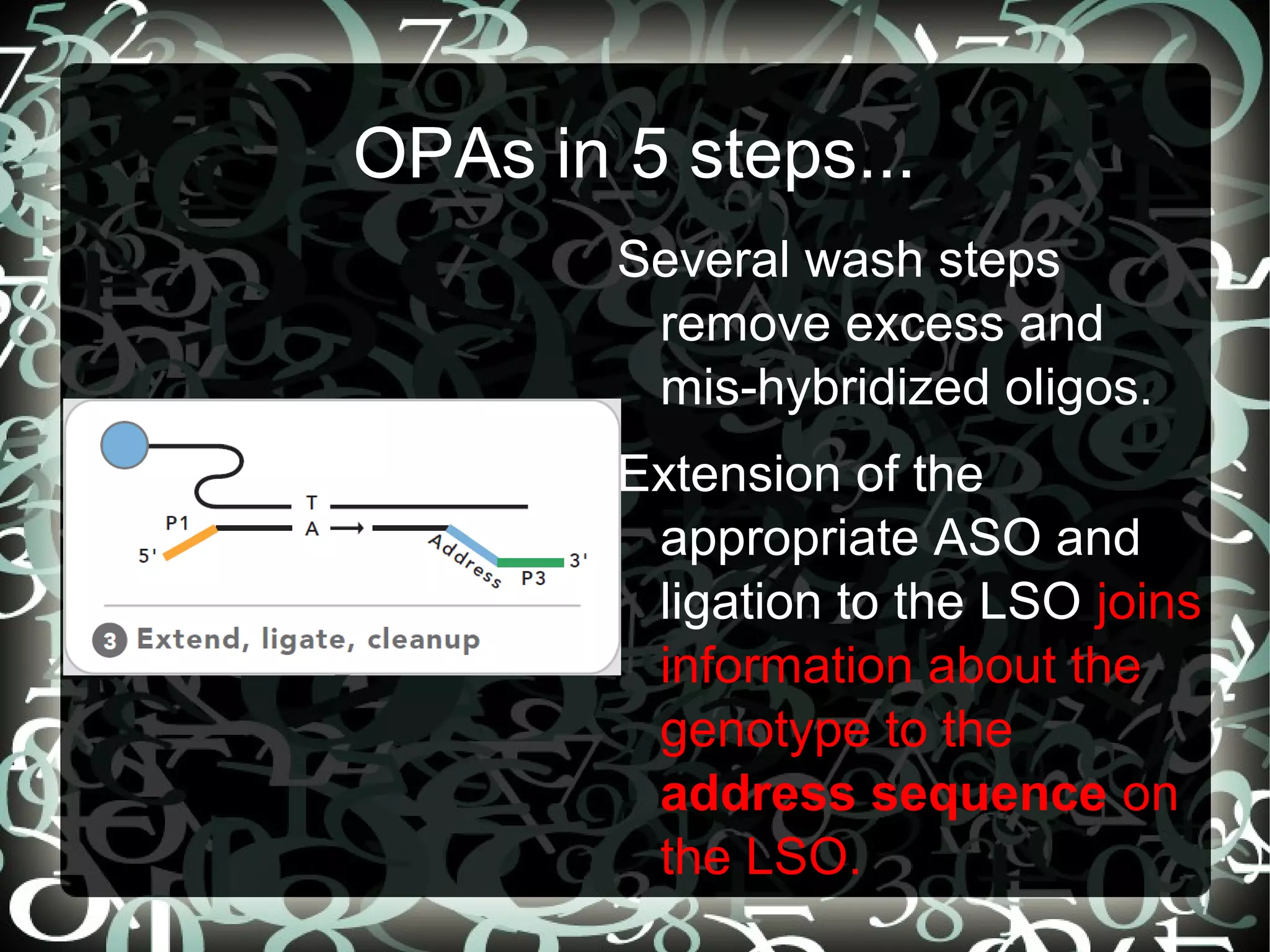
        Several wash steps
         remove excess and
         mis-hybridized oligos.
        Extension of the
         appropriate ASO and
         ligation to the LSO joins
         information about the
         genotype to the
         address sequence on
         the LSO.
OPAs in 5 steps...
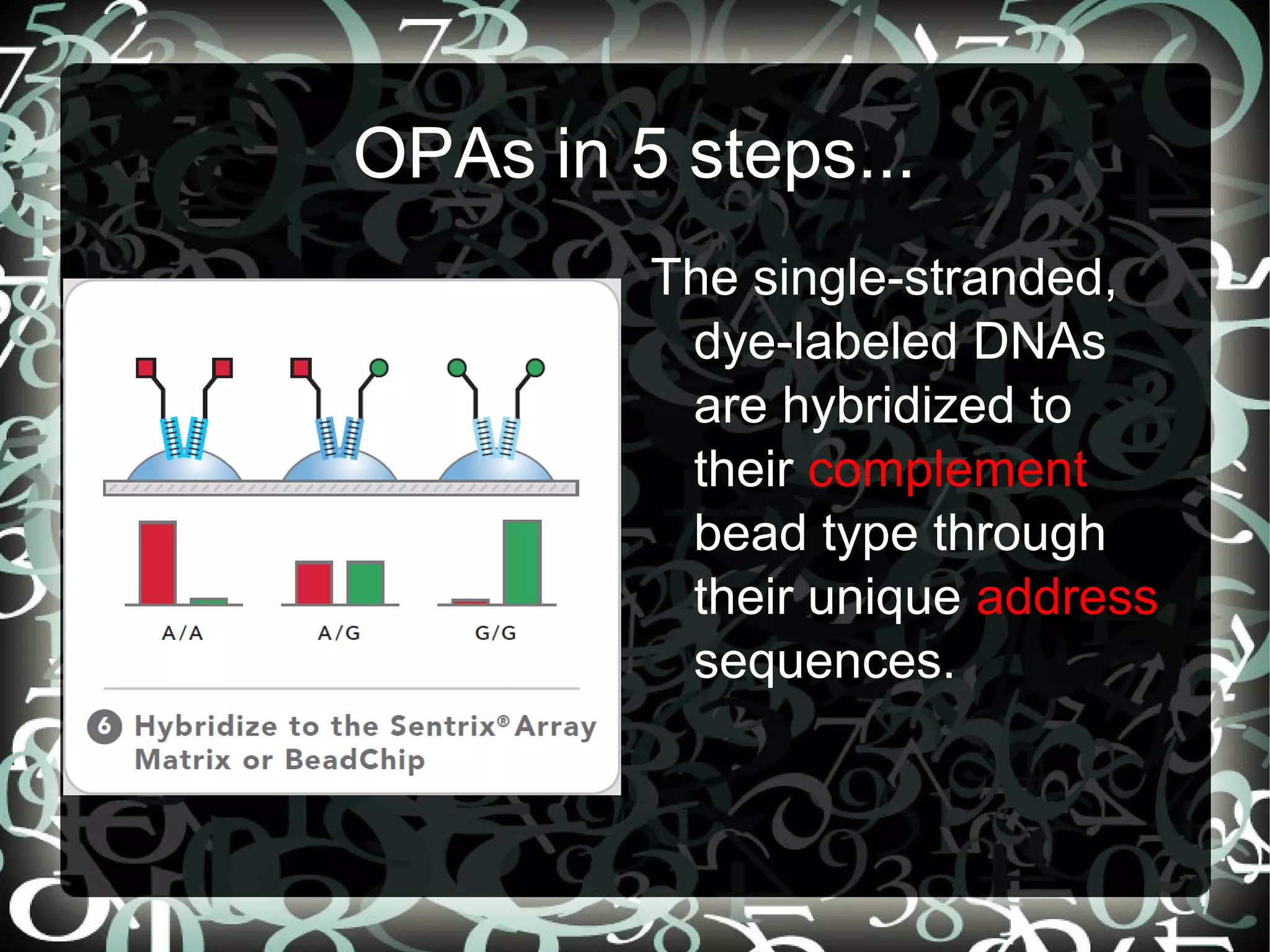
         The single-stranded,
          dye-labeled DNAs
          are hybridized to
          their complement
          bead type through
          their unique address
          sequences.
OPAs in 5 steps...
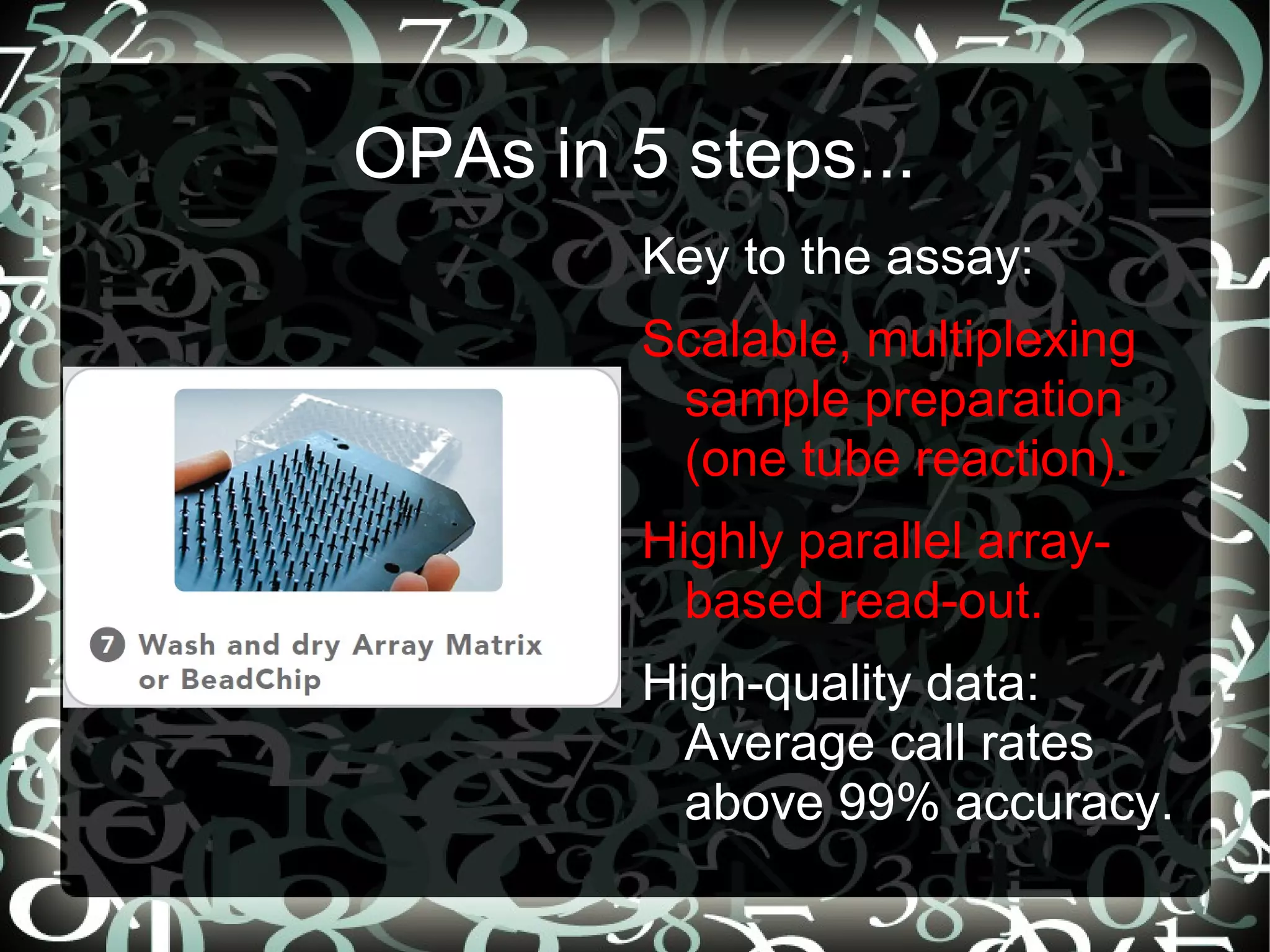
         Key to the assay:
         Scalable, multiplexing
          sample preparation
          (one tube reaction).
         Highly parallel array-
           based read-out.
         High-quality data:
           Average call rates
           above 99% accuracy.

Creating a SNP calling pipeline

  • 1.
    Potato SNPs Dan Bolserand David Martin Next Gen Bug, Dundee 01/18/2010 1
  • 2.
    Aims of thework 1) Learn about handling RNASeq  Create a SNP calling pipeline 2) Select SNPs for genetic mapping  Using Illumina's GoldenGate SNP chip (OPA) 2
  • 3.
    Creating a SNPcalling pipeline 3
  • 4.
  • 5.
    Align (using BWA) 1)Index the potato genome assembly bwa index [-a bwtsw|div|is] [-c] <in.fasta> 2) Perform the alignment bwa aln [options] <in.fasta> <in.fq> 3) Output results in SAM format (single end) bwa samse <in.fasta> <in.sai> <in.fq> 5
  • 6.
    Align (using Bowtie) 1)Index the potato genome assembly bowtie-build [options] <in.fasta> <ebwt> 2) Perform the alignment and output results bowtie [options] <ebwt> <in.fq>
  • 7.
  • 8.
    Convert (using SAMtools) 1)Convert SAM to BAM for sorting samtools view -S -b <in.sam> 2) Sort BAM for SNP calling samtools sort <in.bam> <out.bam.s>  Alignments are both compressed for long term storage and sorted for variant discovery. 8
  • 9.
  • 10.
    Coverage profiles / Depth vectors 10
  • 11.
    SAMtools...  Dump a coverage profile samtools mpileup -f <in.fasta> <my.bam.s> P1 244526 A 10 ...,.,,,.. BBQa`aaaa[ P1 244527 A 10 ...,.,,,.. BBZ_`^a_a[ P1 244528 C 10 .$.$.,.,,,.. >>RaZ`aaaa P1 244529 C 8 .,.,,,.. NaXaaaa` P1 244530 T 8 .,.,,,.. Xa_aaa` P1 244531 C 8 .,.,,,.. Rbabbaa P1 244532 T 9 .,.,,,..^~. EE^^^^^^A P1 244533 T 9 .,.,,,... BBB P1 244534 T 9 .$,$.,,,... @@^^^^^^E 11
  • 12.
    SAMtools Bio::DB::Sam (BioPerl) Dumpa coverage profile 2 12
  • 13.
    SAMtools Bio::DB::Sam (BioPerl) P41630 Matches: 9 0233333333333345555555555 666778888888899999999999 999999999999999999999999 999976666666666665444444 44443332211111111000 13
  • 14.
  • 15.
    mpileup  samtools mpileup collects summary information in the input BAMs, computes the likelihood of data given each possible genotype and stores the likelihoods in the BCF format.  bcftools view applies the prior and does the actual calling.  Finally, we filter. 15
  • 16.
    SNP call 1) Indexthe potato genome assembly (again!) samtools faidx in.fasta 2) Run 'mpileup' to generate VCF format samtools mpileup -ug -f in.fasta my1.bam.s my2.bam.s > my.raw.bcf  Actually, all we did (I think) is perform a format conversion (BAM to VCF).
  • 17.
  • 18.
    VCF format A standardformat for sequence variation: SNPs, indels and structural variants. Compressed and indexed. Developed for the 1000 Genomes Project. VCFtools for VCF like SAMtools for SAM. Specification and tools available from http://vcftools.sourceforge.net 18
  • 19.
  • 20.
    SNP call andfilter 1) Call SNPs bcftools view -bvcg my.raw.bcf > my.var.bcf 2) Filter SNPs bcftools view my.var.bcf | vcfutils.pl varFilter my.var.bcf > my.var.bcf.filt 20
  • 21.
  • 22.
    Aims of thework 1) Learn about handling RNASeq  Create a SNP calling pipeline 2) Select SNPs for genetic mapping  Using Illumina's GoldenGate SNP chip (OPA) 22
  • 23.
    Select SNPs forgenetic mapping Using Illumina's GoldenGate SNP chip (OPA) 23
  • 24.
    SNP chip (OPA)construction  A set of DM SNP positions was provided by the SolCAP project (RNASeq derived).  A subset was selected for developing OPAs (Illumina’s SNP chip technology).  OPAs were run, and results have now been compared to RNASeq. 24
  • 25.
    Comparison (using anearly SAMtools)
  • 26.
    Comparison (using anearly SAMtools)
  • 27.
  • 29.
    Comparison (using anearly SAMtools)
  • 30.
  • 33.
  • 34.
    Looking into theRNASeq data… 34
  • 35.
  • 36.
    Potato genome assembly RNASeq RNASeq read library read library 36
  • 37.
  • 38.
  • 39.
  • 40.
  • 41.
  • 42.
    A lot morequestions to answer…  Track down more ‘strange’ SNPs based on the expected AFS of the two samples.  Go beyond bialleleic SNPs  Check the OPA base... − Was the right base probed by the chip? 42
  • 43.
    Thank you foryour patience! 43
  • 45.
    OPAs in 5steps... The DNA sample is activated for binding to paramagnetic particles.
  • 46.
    OPAs in 5steps... Three oligos are designed for each SNP locus. Two are specific to each allele of the SNP site (ASO) and a Locus- Specific Oligo (LSO).
  • 47.
    OPAs in 5steps... Several wash steps remove excess and mis-hybridized oligos. Extension of the appropriate ASO and ligation to the LSO joins information about the genotype to the address sequence on the LSO.
  • 48.
    OPAs in 5steps... The single-stranded, dye-labeled DNAs are hybridized to their complement bead type through their unique address sequences.
  • 49.
    OPAs in 5steps... Key to the assay: Scalable, multiplexing sample preparation (one tube reaction). Highly parallel array- based read-out. High-quality data: Average call rates above 99% accuracy.

Editor's Notes

  • #47 All three oligo sequences contain regions of genomic complementarity and universal PCR primer sites; the LSO also contains a unique address sequence that targets a particular bead type. Up to 1,536 SNPs may be interrogated simultaneously in this manner. During the primer hybridization process, the assay oligos hybridize to the genomic DNA sample bound to paramagnetic particles. Because hybridization occurs prior to any amplification steps, no amplification bias can be introduced into the assay.
  • #48 Extension of the appropriate ASO and ligation of the extended product to the LSO joins information about the genotype present at the SNP site to the address sequence on the LSO Allele-specific primer extension (ASPE). This step is used to preferentially extend the correctly matched ASO (at the 3&apos; end) up to the 5&apos; end of the LSO primer.
  • #49 One to one mapping between an address sequence on the array and the locus being scored. As a result of this labeling scheme, the PCR product consists of double stranded DNA of which one strand, containing the complement to the Illumicode, is labeled with either Cy3 or Cy5 in an allele specific manner, and a complementary strand labeled with biotin. The biotinylated strand is removed and the single, florescently labeled strand hybridized to the BeadArray.