CHAPTER 1 INTRODUCTION TO BIOPSYCHOLOGY  HOW BIOPSYCHOLOGISTS THINK ABOUT BEHAVIOR COPYRIGHT © 2007 BY ALLYN AND BACON This multimedia product and its contents are protected under copyright law. The following are prohibited by law: any public performance or display, including transmission of any image over a network; preparation of any derivative work, including the extraction, in whole or in part, of any images;  any rental, lease, or lending of the program.
CHAPTER 1 OVERVIEW What is Biopsychology? Human Evolution Fundamental Genetics Thinking about the Biology of Behavior: Mind-Brain and Nature-Nurture Issues COPYRIGHT © 2007 BY ALLYN AND BACON
CONSIDER THIS.. Does the brain have the capacity to understand something as complex as itself? COPYRIGHT © 2007 BY ALLYN AND BACON
FOUR MAJOR THEMES Thinking Clearly about Biopsychology Connecting the text to real life Clinical Implications The Evolutionary Perspective The comparative approach – what can we learn from other species? Cognitive Neuroscience Connecting brain activity and cognition COPYRIGHT © 2007 BY ALLYN AND BACON
WHAT IS BIOPSYCHOLOGY? “ the scientific study of the biology of behavior” Also known as behavioral neuroscience, behavioral biology, psychobiology Psychology: the scientific study of behavior Hebb (1949) proposed that psychological phenomena might be produced by brain activity COPYRIGHT © 2007 BY ALLYN AND BACON
BIOPSYCHOLOGY IS AN INTEGRATIVE DISCIPLINE  Knowledge from other disciplines of neuroscience is applied to the study of behavior Each discipline studies a different aspect of the nervous system that informs our understanding of what produces and controls behavior COPYRIGHT © 2007 BY ALLYN AND BACON
OTHER DISCIPLINES OF NEUROSCIENCE Neuroanatomy Structure of the nervous system Neurochemistry Chemical bases of neural activity Neuroendocrinology Interactions between the nervous system and the endocrine system COPYRIGHT © 2007 BY ALLYN AND BACON
OTHER DISCIPLINES OF NEUROSCIENCE Neuropathology Nervous system disorders Neuropharmacology Effects of drugs on neural activity Neurophysiology Functions and activities of the nervous system COPYRIGHT © 2007 BY ALLYN AND BACON
BEHAVIOR IS THE PRODUCT OF INTERACTIONS AMONG: Genes (“genetic endowment”, nature) Experience (nurture) Perception of the current situation The brain – where these 3 factors interact COPYRIGHT © 2007 BY ALLYN AND BACON
HUMAN EVOLUTION While Darwin was not the 1 st  to propose that species evolve, he was the 1 st  to compile supporting evidence and to suggest how evolution works Darwin presented 3 kinds of evidence The most convincing evidence comes from direct observation of evolution in progress COPYRIGHT © 2007 BY ALLYN AND BACON
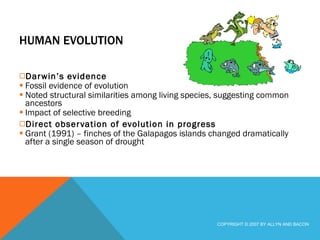
HUMAN EVOLUTION Darwin’s evidence Fossil evidence of evolution Noted structural similarities among living species, suggesting common ancestors Impact of selective breeding Direct observation of evolution in progress Grant (1991) – finches of the Galapagos islands changed dramatically after a single season of drought COPYRIGHT © 2007 BY ALLYN AND BACON
EVOLUTION AND BEHAVIOR Just as physical features can contribute to “fitness”, so do behaviors The ability to find food, avoid predation, etc. Social dominance and courtship displays COPYRIGHT © 2007 BY ALLYN AND BACON
THINKING ABOUT HUMAN EVOLUTION Evolution does not proceed in a single line Humans have only been around for a brief period of time Rapid evolutionary changes do occur < 1% of all known species are still in existence COPYRIGHT © 2007 BY ALLYN AND BACON
THINKING ABOUT HUMAN EVOLUTION Evolution is a tinkerer, not an architect – results are not perfect Not all existing behaviors or structures are adaptive Spandrels  – incidental non-adaptive by-products (such as the human belly button) COPYRIGHT © 2007 BY ALLYN AND BACON
THINKING ABOUT HUMAN EVOLUTION Not all existing adaptive characteristics evolved to perform their current function Exaptions  – evolved to do one thing, but now do something else (such as bird wings) Similarities among species do not necessarily mean that the species have common origins COPYRIGHT © 2007 BY ALLYN AND BACON
THINKING ABOUT HUMAN EVOLUTION Homologous structures – similar structures due to a common evolutionary origin Analogous structures – similar structures without a common origin Convergent evolution – the evolution of similar solutions to the same enivironmental demands by unrelated species COPYRIGHT © 2007 BY ALLYN AND BACON
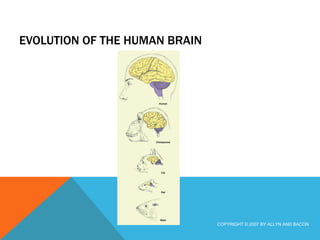
EVOLUTION OF THE HUMAN BRAIN There is no relationship between brain size and intelligence Brain size  is generally correlated with  body size More informative to look at  relative size  of different brain regions COPYRIGHT © 2007 BY ALLYN AND BACON
EVOLUTION OF THE HUMAN BRAIN Brain stem regulates reflex activities that are critical for survival Cerebrum is involved in complex adaptive processes such as learning, perception, and motivation COPYRIGHT © 2007 BY ALLYN AND BACON
EVOLUTION OF THE HUMAN BRAIN The human brain has increased in size during evolution Most of the increase in size has occurred in one region - the cerebrum Increased convolutions in the cerebrum have increased the volume of the cerebral cortex COPYRIGHT © 2007 BY ALLYN AND BACON
EVOLUTION OF THE HUMAN BRAIN COPYRIGHT © 2007 BY ALLYN AND BACON
BIOPSYCHOLOGICAL RESEARCH INVOLVES BOTH HUMAN AND NONHUMAN SUBJECTS Why would we look at rats, mice, and nonhuman primates to further our understanding of the human brain? How different are you and a rat? COPYRIGHT © 2007 BY ALLYN AND BACON
WHY USE NONHUMAN SUBJECTS? While some questions about behavior can only be addressed using human subjects, much can be learned from studying the brains of other species Differences are more quantitative (relating to size) than qualitative (relating to function) COPYRIGHT © 2007 BY ALLYN AND BACON
WHY USE NONHUMAN SUBJECTS? Simpler brains makes it more likely that brain-behavior interactions will be revealed Comparative approach – gain insight by making comparisons with other species Fewer ethical restrictions COPYRIGHT © 2007 BY ALLYN AND BACON
FUNDAMENTAL GENETICS Dichotomous traits – occur in one form or another, not normally in combination True-breeding lines – interbred members always produce offspring with the same traits Mendel studied dichotomous traits in true-breeding lines of pea plants COPYRIGHT © 2007 BY ALLYN AND BACON
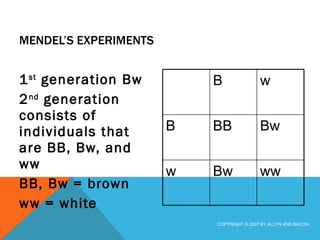
MENDEL’S EXPERIMENTS Crossed a line bred true for brown seeds with one bred true for white First generation offspring all had brown seeds When the first generation were bred, the result was ¾ brown and ¼ white seeds COPYRIGHT © 2007 BY ALLYN AND BACON
MENDEL’S EXPERIMENTS True-breeding lines White (ww) Brown (BB) Brown was the dominant trait, appearing in all of the 1 st  generation offspring (Bw) COPYRIGHT © 2007 BY ALLYN AND BACON
MENDEL’S EXPERIMENTS Phenotype – observable traits Genotype – traits present in the genes If the dominant trait is present in the genotype (Bw), it will be observed in the phenotype (brown seeds) COPYRIGHT © 2007 BY ALLYN AND BACON
MENDEL’S EXPERIMENTS 1 st  generation Bw 2 nd  generation consists of individuals that are BB, Bw, and ww BB, Bw = brown ww = white COPYRIGHT © 2007 BY ALLYN AND BACON ww Bw w Bw BB B w B
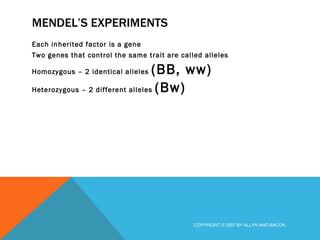
MENDEL’S EXPERIMENTS Each inherited factor is a gene Two genes that control the same trait are called alleles Homozygous – 2 identical alleles  (BB, ww) Heterozygous – 2 different alleles  (Bw)   COPYRIGHT © 2007 BY ALLYN AND BACON
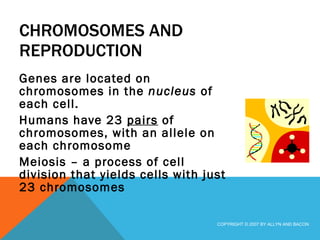
CHROMOSOMES AND REPRODUCTION Genes are located on chromosomes in the  nucleus  of each cell. Humans have 23  pairs  of chromosomes, with an allele on each chromosome  Meiosis – a process of cell division that yields cells with just 23 chromosomes COPYRIGHT © 2007 BY ALLYN AND BACON
CHROMOSOMES AND REPRODUCTION Gametes, eggs and sperm, are produced by meiosis  When egg and sperm combine to form a fertilized egg (zygote), 23 pairs of chromosomes are again present Mitosis – a form of cell division that yields daughter cells that have 23 pairs of chromosomes COPYRIGHT © 2007 BY ALLYN AND BACON
SEX CHROMOSOMES AND SEX-LINKED TRAITS Sex chromosomes, X and Y, look different and carry different genes Female = XX, Male = XY Sex-linked traits - influenced by genes on the sex chromosomes Dominant traits on the X chromosome will be seen more commonly in females, recessive ones in males  COPYRIGHT © 2007 BY ALLYN AND BACON
SEX CHROMOSOMES AND SEX-LINKED TRAITS Color-blindness – a recessive sex-linked trait Who is more likely to be color-blind? Males Why? COPYRIGHT © 2007 BY ALLYN AND BACON
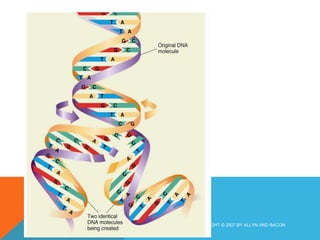
CHROMOSOME STRUCTURE AND REPLICATION Each chromosome is a double-stranded molecule of deoxyribonucleic acid (DNA) Each strand consists of a sequence of nucleotide bases – their sequence constitutes the genetic code  COPYRIGHT © 2007 BY ALLYN AND BACON
CHROMOSOME STRUCTURE AND REPLICATION Replication of each strand must occur prior to mitosis Errors may occur Each strand consists of a sequence of nucleotide bases – their sequence constitutes the genetic code  COPYRIGHT © 2007 BY ALLYN AND BACON
COPYRIGHT © 2007 BY ALLYN AND BACON
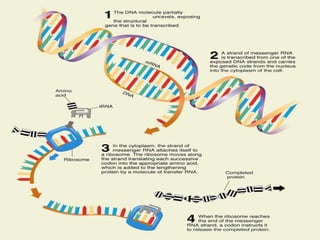
THE GENETIC CODE AND GENE EXPRESSION Structural genes – code for synthesis of proteins Operator genes – control a structural gene or a group of structural genes Operator genes control gene expression  COPYRIGHT © 2007 BY ALLYN AND BACON
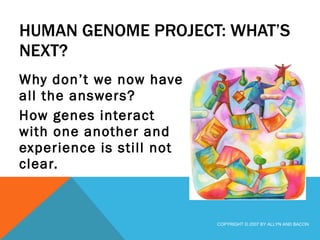
HUMAN GENOME PROJECT: WHAT’S NEXT? Why don’t we now have all the answers? How genes interact with one another and experience is still not clear. COPYRIGHT © 2007 BY ALLYN AND BACON
THINKING ABOUT THE BIOLOGY OF BEHAVIOR: MIND-BRAIN AND NATURE-NURTURE ISSUES The mind-brain issue Are the mind and brain one and the same? The nature-nurture issue What makes you how you are – genes or environment? The genetics of individual differences COPYRIGHT © 2007 BY ALLYN AND BACON
THE MIND-BRAIN ISSUE Dualism – human brain and mind are separate While we generally accept that mind and brain are really one today, there are some who still believe that some components of the mind are not just products of brain activity COPYRIGHT © 2007 BY ALLYN AND BACON
CONSIDER THIS.. What evidence is there that mind and brain are one? COPYRIGHT © 2007 BY ALLYN AND BACON
THE NATURE-NURTURE ISSUE Is it inherited or is it learned? Watson – father of behaviorism – believed that all behavior was the product of learning (nurture) Ethology – the study of animal behavior in the wild – focused on instinctive behaviors, emphasizing nature COPYRIGHT © 2007 BY ALLYN AND BACON
CONSIDER THIS.. Is the “nature-nurture” debate alive today? COPYRIGHT © 2007 BY ALLYN AND BACON
THE NATURE-NURTURE ISSUE Behavior is impacted by factors other than genetics (nature) or learning (nurture) “ Nurture” now encompasses learning and environment While it is generally accepted that behavior is a product of nature and nurture, many still ask  how much  is determined by each But genetic and experiential factors do not merely combine in an additive fashion COPYRIGHT © 2007 BY ALLYN AND BACON
THE HERITABILITY OF INDIVIDUAL DIFFERENCES What conclusions can be made, if any about the heritability of individual differences? What would a biological psychologist say about what makes you who and how you are? COPYRIGHT © 2007 BY ALLYN AND BACON

Pinel basics ch01

  • 1.
    CHAPTER 1 INTRODUCTIONTO BIOPSYCHOLOGY HOW BIOPSYCHOLOGISTS THINK ABOUT BEHAVIOR COPYRIGHT © 2007 BY ALLYN AND BACON This multimedia product and its contents are protected under copyright law. The following are prohibited by law: any public performance or display, including transmission of any image over a network; preparation of any derivative work, including the extraction, in whole or in part, of any images; any rental, lease, or lending of the program.
  • 2.
    CHAPTER 1 OVERVIEWWhat is Biopsychology? Human Evolution Fundamental Genetics Thinking about the Biology of Behavior: Mind-Brain and Nature-Nurture Issues COPYRIGHT © 2007 BY ALLYN AND BACON
  • 3.
    CONSIDER THIS.. Doesthe brain have the capacity to understand something as complex as itself? COPYRIGHT © 2007 BY ALLYN AND BACON
  • 4.
    FOUR MAJOR THEMESThinking Clearly about Biopsychology Connecting the text to real life Clinical Implications The Evolutionary Perspective The comparative approach – what can we learn from other species? Cognitive Neuroscience Connecting brain activity and cognition COPYRIGHT © 2007 BY ALLYN AND BACON
  • 5.
    WHAT IS BIOPSYCHOLOGY?“ the scientific study of the biology of behavior” Also known as behavioral neuroscience, behavioral biology, psychobiology Psychology: the scientific study of behavior Hebb (1949) proposed that psychological phenomena might be produced by brain activity COPYRIGHT © 2007 BY ALLYN AND BACON
  • 6.
    BIOPSYCHOLOGY IS ANINTEGRATIVE DISCIPLINE Knowledge from other disciplines of neuroscience is applied to the study of behavior Each discipline studies a different aspect of the nervous system that informs our understanding of what produces and controls behavior COPYRIGHT © 2007 BY ALLYN AND BACON
  • 7.
    OTHER DISCIPLINES OFNEUROSCIENCE Neuroanatomy Structure of the nervous system Neurochemistry Chemical bases of neural activity Neuroendocrinology Interactions between the nervous system and the endocrine system COPYRIGHT © 2007 BY ALLYN AND BACON
  • 8.
    OTHER DISCIPLINES OFNEUROSCIENCE Neuropathology Nervous system disorders Neuropharmacology Effects of drugs on neural activity Neurophysiology Functions and activities of the nervous system COPYRIGHT © 2007 BY ALLYN AND BACON
  • 9.
    BEHAVIOR IS THEPRODUCT OF INTERACTIONS AMONG: Genes (“genetic endowment”, nature) Experience (nurture) Perception of the current situation The brain – where these 3 factors interact COPYRIGHT © 2007 BY ALLYN AND BACON
  • 10.
    HUMAN EVOLUTION WhileDarwin was not the 1 st to propose that species evolve, he was the 1 st to compile supporting evidence and to suggest how evolution works Darwin presented 3 kinds of evidence The most convincing evidence comes from direct observation of evolution in progress COPYRIGHT © 2007 BY ALLYN AND BACON
  • 11.
    HUMAN EVOLUTION Darwin’sevidence Fossil evidence of evolution Noted structural similarities among living species, suggesting common ancestors Impact of selective breeding Direct observation of evolution in progress Grant (1991) – finches of the Galapagos islands changed dramatically after a single season of drought COPYRIGHT © 2007 BY ALLYN AND BACON
  • 12.
    EVOLUTION AND BEHAVIORJust as physical features can contribute to “fitness”, so do behaviors The ability to find food, avoid predation, etc. Social dominance and courtship displays COPYRIGHT © 2007 BY ALLYN AND BACON
  • 13.
    THINKING ABOUT HUMANEVOLUTION Evolution does not proceed in a single line Humans have only been around for a brief period of time Rapid evolutionary changes do occur < 1% of all known species are still in existence COPYRIGHT © 2007 BY ALLYN AND BACON
  • 14.
    THINKING ABOUT HUMANEVOLUTION Evolution is a tinkerer, not an architect – results are not perfect Not all existing behaviors or structures are adaptive Spandrels – incidental non-adaptive by-products (such as the human belly button) COPYRIGHT © 2007 BY ALLYN AND BACON
  • 15.
    THINKING ABOUT HUMANEVOLUTION Not all existing adaptive characteristics evolved to perform their current function Exaptions – evolved to do one thing, but now do something else (such as bird wings) Similarities among species do not necessarily mean that the species have common origins COPYRIGHT © 2007 BY ALLYN AND BACON
  • 16.
    THINKING ABOUT HUMANEVOLUTION Homologous structures – similar structures due to a common evolutionary origin Analogous structures – similar structures without a common origin Convergent evolution – the evolution of similar solutions to the same enivironmental demands by unrelated species COPYRIGHT © 2007 BY ALLYN AND BACON
  • 17.
    EVOLUTION OF THEHUMAN BRAIN There is no relationship between brain size and intelligence Brain size is generally correlated with body size More informative to look at relative size of different brain regions COPYRIGHT © 2007 BY ALLYN AND BACON
  • 18.
    EVOLUTION OF THEHUMAN BRAIN Brain stem regulates reflex activities that are critical for survival Cerebrum is involved in complex adaptive processes such as learning, perception, and motivation COPYRIGHT © 2007 BY ALLYN AND BACON
  • 19.
    EVOLUTION OF THEHUMAN BRAIN The human brain has increased in size during evolution Most of the increase in size has occurred in one region - the cerebrum Increased convolutions in the cerebrum have increased the volume of the cerebral cortex COPYRIGHT © 2007 BY ALLYN AND BACON
  • 20.
    EVOLUTION OF THEHUMAN BRAIN COPYRIGHT © 2007 BY ALLYN AND BACON
  • 21.
    BIOPSYCHOLOGICAL RESEARCH INVOLVESBOTH HUMAN AND NONHUMAN SUBJECTS Why would we look at rats, mice, and nonhuman primates to further our understanding of the human brain? How different are you and a rat? COPYRIGHT © 2007 BY ALLYN AND BACON
  • 22.
    WHY USE NONHUMANSUBJECTS? While some questions about behavior can only be addressed using human subjects, much can be learned from studying the brains of other species Differences are more quantitative (relating to size) than qualitative (relating to function) COPYRIGHT © 2007 BY ALLYN AND BACON
  • 23.
    WHY USE NONHUMANSUBJECTS? Simpler brains makes it more likely that brain-behavior interactions will be revealed Comparative approach – gain insight by making comparisons with other species Fewer ethical restrictions COPYRIGHT © 2007 BY ALLYN AND BACON
  • 24.
    FUNDAMENTAL GENETICS Dichotomoustraits – occur in one form or another, not normally in combination True-breeding lines – interbred members always produce offspring with the same traits Mendel studied dichotomous traits in true-breeding lines of pea plants COPYRIGHT © 2007 BY ALLYN AND BACON
  • 25.
    MENDEL’S EXPERIMENTS Crosseda line bred true for brown seeds with one bred true for white First generation offspring all had brown seeds When the first generation were bred, the result was ¾ brown and ¼ white seeds COPYRIGHT © 2007 BY ALLYN AND BACON
  • 26.
    MENDEL’S EXPERIMENTS True-breedinglines White (ww) Brown (BB) Brown was the dominant trait, appearing in all of the 1 st generation offspring (Bw) COPYRIGHT © 2007 BY ALLYN AND BACON
  • 27.
    MENDEL’S EXPERIMENTS Phenotype– observable traits Genotype – traits present in the genes If the dominant trait is present in the genotype (Bw), it will be observed in the phenotype (brown seeds) COPYRIGHT © 2007 BY ALLYN AND BACON
  • 28.
    MENDEL’S EXPERIMENTS 1st generation Bw 2 nd generation consists of individuals that are BB, Bw, and ww BB, Bw = brown ww = white COPYRIGHT © 2007 BY ALLYN AND BACON ww Bw w Bw BB B w B
  • 29.
    MENDEL’S EXPERIMENTS Eachinherited factor is a gene Two genes that control the same trait are called alleles Homozygous – 2 identical alleles (BB, ww) Heterozygous – 2 different alleles (Bw) COPYRIGHT © 2007 BY ALLYN AND BACON
  • 30.
    CHROMOSOMES AND REPRODUCTIONGenes are located on chromosomes in the nucleus of each cell. Humans have 23 pairs of chromosomes, with an allele on each chromosome Meiosis – a process of cell division that yields cells with just 23 chromosomes COPYRIGHT © 2007 BY ALLYN AND BACON
  • 31.
    CHROMOSOMES AND REPRODUCTIONGametes, eggs and sperm, are produced by meiosis When egg and sperm combine to form a fertilized egg (zygote), 23 pairs of chromosomes are again present Mitosis – a form of cell division that yields daughter cells that have 23 pairs of chromosomes COPYRIGHT © 2007 BY ALLYN AND BACON
  • 32.
    SEX CHROMOSOMES ANDSEX-LINKED TRAITS Sex chromosomes, X and Y, look different and carry different genes Female = XX, Male = XY Sex-linked traits - influenced by genes on the sex chromosomes Dominant traits on the X chromosome will be seen more commonly in females, recessive ones in males COPYRIGHT © 2007 BY ALLYN AND BACON
  • 33.
    SEX CHROMOSOMES ANDSEX-LINKED TRAITS Color-blindness – a recessive sex-linked trait Who is more likely to be color-blind? Males Why? COPYRIGHT © 2007 BY ALLYN AND BACON
  • 34.
    CHROMOSOME STRUCTURE ANDREPLICATION Each chromosome is a double-stranded molecule of deoxyribonucleic acid (DNA) Each strand consists of a sequence of nucleotide bases – their sequence constitutes the genetic code COPYRIGHT © 2007 BY ALLYN AND BACON
  • 35.
    CHROMOSOME STRUCTURE ANDREPLICATION Replication of each strand must occur prior to mitosis Errors may occur Each strand consists of a sequence of nucleotide bases – their sequence constitutes the genetic code COPYRIGHT © 2007 BY ALLYN AND BACON
  • 36.
    COPYRIGHT © 2007BY ALLYN AND BACON
  • 37.
    COPYRIGHT © 2007BY ALLYN AND BACON
  • 38.
    THE GENETIC CODEAND GENE EXPRESSION Structural genes – code for synthesis of proteins Operator genes – control a structural gene or a group of structural genes Operator genes control gene expression COPYRIGHT © 2007 BY ALLYN AND BACON
  • 39.
    HUMAN GENOME PROJECT:WHAT’S NEXT? Why don’t we now have all the answers? How genes interact with one another and experience is still not clear. COPYRIGHT © 2007 BY ALLYN AND BACON
  • 40.
    THINKING ABOUT THEBIOLOGY OF BEHAVIOR: MIND-BRAIN AND NATURE-NURTURE ISSUES The mind-brain issue Are the mind and brain one and the same? The nature-nurture issue What makes you how you are – genes or environment? The genetics of individual differences COPYRIGHT © 2007 BY ALLYN AND BACON
  • 41.
    THE MIND-BRAIN ISSUEDualism – human brain and mind are separate While we generally accept that mind and brain are really one today, there are some who still believe that some components of the mind are not just products of brain activity COPYRIGHT © 2007 BY ALLYN AND BACON
  • 42.
    CONSIDER THIS.. Whatevidence is there that mind and brain are one? COPYRIGHT © 2007 BY ALLYN AND BACON
  • 43.
    THE NATURE-NURTURE ISSUEIs it inherited or is it learned? Watson – father of behaviorism – believed that all behavior was the product of learning (nurture) Ethology – the study of animal behavior in the wild – focused on instinctive behaviors, emphasizing nature COPYRIGHT © 2007 BY ALLYN AND BACON
  • 44.
    CONSIDER THIS.. Isthe “nature-nurture” debate alive today? COPYRIGHT © 2007 BY ALLYN AND BACON
  • 45.
    THE NATURE-NURTURE ISSUEBehavior is impacted by factors other than genetics (nature) or learning (nurture) “ Nurture” now encompasses learning and environment While it is generally accepted that behavior is a product of nature and nurture, many still ask how much is determined by each But genetic and experiential factors do not merely combine in an additive fashion COPYRIGHT © 2007 BY ALLYN AND BACON
  • 46.
    THE HERITABILITY OFINDIVIDUAL DIFFERENCES What conclusions can be made, if any about the heritability of individual differences? What would a biological psychologist say about what makes you who and how you are? COPYRIGHT © 2007 BY ALLYN AND BACON