Biological
Psychology
- nakko -
Contents
• Neurons ( & Glia cells )
• Neurotransmitters
• How Neurons communicate
• Action potential
• The Nervous System
• Neural Networks
Neurons & Glia Cells
•The central nervous system contains the brain
and spinal cord; the peripheral nervous system
consists of nerves, motor neurons, the autonomic
nervous system, and the enteric nervous system.
•The nervous system coordinates the voluntary
and involuntary actions of the body by transmitting
signals from the brain to the other body parts.
• Nervous systems vary across different animals; some
invertebrates lack a true nervous system or true brain, while
other invertebrates have a brain and a system of nerves.
• Unlike vertebrates, not all invertebrates have both a CNS
and PNS; their nerve cords are located ventrally rather than
dorsally.
• The functions of the nervous system are performed by two
types of cells: neurons, which transmit signals from one part
of the body to another, and glia, which support the function of
neurons.
Neurons
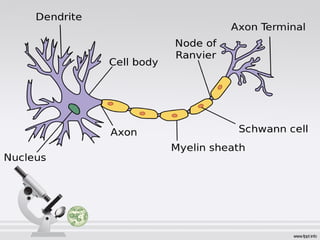
• Neurons are specialized cells that transmit chemical and
electrical signals.
• Dendrites are the tree-like structures in neurons that
extend away from the cell body to receive messages
from other neurons at synapses; not all neurons have
dendrites.
• Synapses enable the dendrites from a single neuron to
interact and receive signals from many other neurons.
• Axons are tube-like structures that send signals to other
neurons, muscles, or organs; not all neurons have
axons.
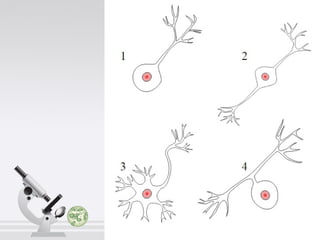
• Neurons are divided into four major types: unipolar,
bipolar, multipolar, and pseudo unipolar.
• Unipolar neurons have only one structure extending from
the soma; bipolar neurons have one axon and one
dendrite extending from the soma.
• Multipolar neurons contain one axon and many
dendrites; pseudo unipolar neurons have a single
structure that extends from the soma, which later
branches into two distinct structures.
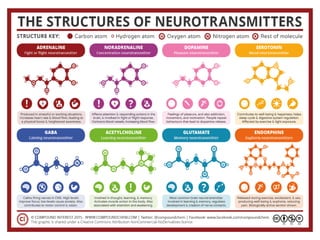
Neurotransmitters
• Neurotransmitters are  chemicals  that  transmit signals 
from a neuron across a synapse to a target cell.
• Neurotransmitters  dictate  communication  between  cells 
by  binding  to  specific receptors and  depolarizing  or 
hyperpolarizing the cell.
• Inhibitory  neurotransmitters  cause  hyperpolarization  of 
the  postsynaptic  cell;  excitatory  neurotransmitters 
cause depolarization of the postsynaptic cell.
• Too little of a neurotransmitter may cause the over
accumulation of proteins, leading to disorders like
Alzheimer's; too much of a neurotransmitter may block
receptors required for proper brain function, leading to
disorders like schizophrenia.
• The three neurotransmitter systems in the brain are
cholinergic, amino acids, and biogenic amines.
• An action potential is necessary for neurotransmitters to 
be  released,  which  means  that  neurons  must  reach  a 
certain  threshold  of  electric  stimulation  in  order  to 
complete the reaction.
How Neurons communícate
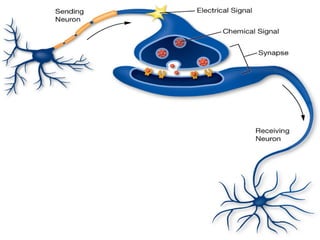
• Neurons Communicate via the Synapse.
• Information  from  one  neuron  flows  to  another  neuron 
across  a  small  gap  called  a  synapse.  At  the  synapse, 
electrical signals are translated into chemical signals in 
order to cross the gap. Once on the other side, the signal 
becomes electrical again.
• One  sending  neuron  can  connect  to  several  receiving 
neurons,  and  one  receiving  neuron  can  connect  to 
several sending neurons.
• When the neuronal membrane is at rest, the resting potential
is negative due to the accumulation of more sodium ions
outside the cell than potassium ions inside the cell.
• Potassium ions diffuse out of the cell at a much faster rate
than sodium ions diffuse into the cell because neurons have
many more potassium leakage channels than sodium leakage
channels.
• Sodium-potassium pumps move two potassium ions inside
the cell as three sodium ions are pumped out to maintain the
negatively-charged membrane inside the cell; this helps
maintain the resting potential.
Nerve Impulse Transmission within a Neuron: Resting
Potential
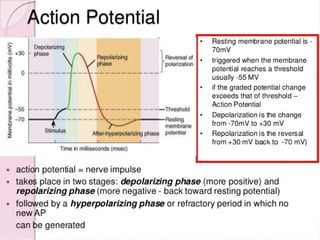
• Action potentials are formed when a stimulus causes
the cell membrane to depolarize past the threshold of
excitation, causing all sodium ion channels to open.
• When the potassium ion channels are opened and
sodium ion channels are closed, the cell membrane
becomes hyperpolarized as potassium ions leave the
cell; the cell cannot fire during this refractory period.
• The action potential travels down the axon as the
membrane of the axon depolarizes and repolarizes.
Nerve Impulse Transmission within a Neuron: Action Potential
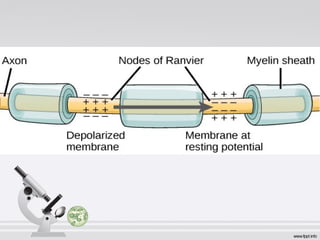
• Myelin insulates the axon to prevent leakage of the
current as it travels down the axon.
• Nodes of Ranvier are gaps in the myelin along the axons;
they contain sodium and potassium ion channels, allowing
the action potential to travel quickly down the axon by
jumping from one node to the next.
Action Potential
• A short-term change in the electrical potential that travels
along a cell, such as a nerve or muscle fiber, and allows
nerves to communicate.
• The neurons (or excitable nerve cells) of the nervous
system conduct electrical impulses, or signals, that serve
as communication between sensory receptors, muscles
and glands, and the brain and spinal cord.
• An action potential occurs when an electrical signal
disrupts the original balance of Na+
and K+
within a cell
membrane, briefly depolarizing the concentrations of
each.
• An electrical impulse travels along the axon via
depolarized voltage-gated ion channels in the
membrane, and can either "jump" along a myelinated
area or travel continuously along an unmyelinated area.
• While an action potential is being generated by a cell, no
other action potential may be generated until the cell's
channels return to their resting state.
• Action potentials generated by neural impulses are "all or
nothing," meaning the signal reaches the threshold for
communication or it doesn't. No signal is stronger or
weaker than another.
• The effect of a neurotransmitter on the postsynaptic
element is entirely dependent on the receptor protein. If
there is no receptor protein in the membrane of the
postsynaptic element, then the neurotransmitter has no
effect.
• Both presynaptic and post-synaptic cell membranes are
depolarized by sodium ions before and after transmission of
the signal across a chemical synapse.
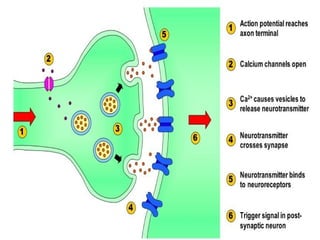
• Calcium ions play a role in signal transmission across
chemical synapses by signaling a cascade that eventually
releases the neurotransmitter that binds to receptors and
opens ion channels on the postsynaptic membrane.
•
Synaptic Transmission
• Neurotransmitters facilitate the signal transmission
across chemical synapses.
• In an electrical synapse, gap junctions, which are formed
by the channel proteins connecting the presynaptic and
postsynaptic membranes of two neurons, allow the
current to pass directly from one neuron to the next.
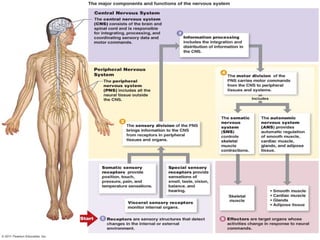
•The central nervous system consists of the brain, which controls complex
body functions, and the spinal cord, which transmits signals from the brain
to the rest of the body.
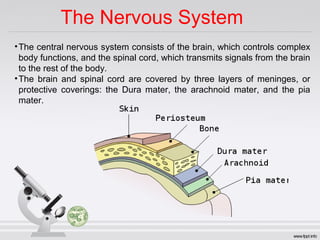
•The brain and spinal cord are covered by three layers of meninges, or
protective coverings: the Dura mater, the arachnoid mater, and the pia
mater.
The Nervous System
• Cerebrospinal fluid surrounds the brain, cushioning it and
providing shock absorption to prevent damage.
• The peripheral nervous system is made up of nerves that
originate within the brain and spinal cord; it serves to
relay information from the central nervous system to all
parts of the body.
• The autonomic system controls involuntary bodily
functions, such as heart rate, breathing, digestion, and
blood vessel dilation.
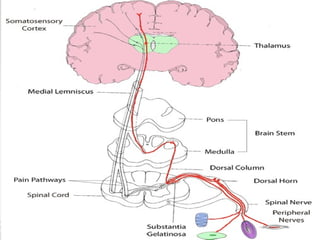
Neural Networks
• A neural network (or neural pathway) is the interface
through which neurons communicate with one
another. These networks consist of a series of
interconnected neurons whose activation sends a signal
or impulse across the body.
• The connections between neurons form a highly
complex network through which signals or impulses are
communicated across the body.
• The basic kinds of connections between neurons are
chemical synapses and electrical gap junctions, through
which either chemical or electrical impulses are
communicated between neurons.
• Neural networks are primarily made up of axons, which
in some cases deliver information as far as two meters.
• Networks formed by interconnected groups of neurons
are capable of a wide variety of functions; in fact the
range of capabilities possible for even small groups of
neurons are beyond our current understanding.
• Modern science views the function of the nervous
system both in terms of stimulus-response chains and in
terms of intrinsically generated activity patterns within
neurons.
• Cell assembly, or Hebbian theory, asserts that "cells that
fire together wire together," meaning neural networks
can be created through associative experience and
learning.
Thank you

Neural Pathway

  • 1.
  • 2.
    Contents • Neurons (& Glia cells ) • Neurotransmitters • How Neurons communicate • Action potential • The Nervous System • Neural Networks
  • 3.
    Neurons & GliaCells •The central nervous system contains the brain and spinal cord; the peripheral nervous system consists of nerves, motor neurons, the autonomic nervous system, and the enteric nervous system. •The nervous system coordinates the voluntary and involuntary actions of the body by transmitting signals from the brain to the other body parts.
  • 4.
    • Nervous systemsvary across different animals; some invertebrates lack a true nervous system or true brain, while other invertebrates have a brain and a system of nerves. • Unlike vertebrates, not all invertebrates have both a CNS and PNS; their nerve cords are located ventrally rather than dorsally. • The functions of the nervous system are performed by two types of cells: neurons, which transmit signals from one part of the body to another, and glia, which support the function of neurons.
  • 5.
    Neurons • Neurons arespecialized cells that transmit chemical and electrical signals. • Dendrites are the tree-like structures in neurons that extend away from the cell body to receive messages from other neurons at synapses; not all neurons have dendrites. • Synapses enable the dendrites from a single neuron to interact and receive signals from many other neurons. • Axons are tube-like structures that send signals to other neurons, muscles, or organs; not all neurons have axons.
  • 6.
    • Neurons aredivided into four major types: unipolar, bipolar, multipolar, and pseudo unipolar. • Unipolar neurons have only one structure extending from the soma; bipolar neurons have one axon and one dendrite extending from the soma. • Multipolar neurons contain one axon and many dendrites; pseudo unipolar neurons have a single structure that extends from the soma, which later branches into two distinct structures.
  • 9.
    Neurotransmitters • Neurotransmitters are  chemicals that  transmit signals  from a neuron across a synapse to a target cell. • Neurotransmitters  dictate  communication  between  cells  by  binding  to  specific receptors and  depolarizing  or  hyperpolarizing the cell. • Inhibitory  neurotransmitters  cause  hyperpolarization  of  the  postsynaptic  cell;  excitatory  neurotransmitters  cause depolarization of the postsynaptic cell.
  • 10.
    • Too littleof a neurotransmitter may cause the over accumulation of proteins, leading to disorders like Alzheimer's; too much of a neurotransmitter may block receptors required for proper brain function, leading to disorders like schizophrenia. • The three neurotransmitter systems in the brain are cholinergic, amino acids, and biogenic amines. • An action potential is necessary for neurotransmitters to  be  released,  which  means  that  neurons  must  reach  a  certain  threshold  of  electric  stimulation  in  order  to  complete the reaction.
  • 12.
    How Neurons communícate • Neurons Communicate via the Synapse. • Information from  one  neuron  flows  to  another  neuron  across  a  small  gap  called  a  synapse.  At  the  synapse,  electrical signals are translated into chemical signals in  order to cross the gap. Once on the other side, the signal  becomes electrical again. • One  sending  neuron  can  connect  to  several  receiving  neurons,  and  one  receiving  neuron  can  connect  to  several sending neurons.
  • 14.
    • When theneuronal membrane is at rest, the resting potential is negative due to the accumulation of more sodium ions outside the cell than potassium ions inside the cell. • Potassium ions diffuse out of the cell at a much faster rate than sodium ions diffuse into the cell because neurons have many more potassium leakage channels than sodium leakage channels. • Sodium-potassium pumps move two potassium ions inside the cell as three sodium ions are pumped out to maintain the negatively-charged membrane inside the cell; this helps maintain the resting potential. Nerve Impulse Transmission within a Neuron: Resting Potential
  • 15.
    • Action potentialsare formed when a stimulus causes the cell membrane to depolarize past the threshold of excitation, causing all sodium ion channels to open. • When the potassium ion channels are opened and sodium ion channels are closed, the cell membrane becomes hyperpolarized as potassium ions leave the cell; the cell cannot fire during this refractory period. • The action potential travels down the axon as the membrane of the axon depolarizes and repolarizes. Nerve Impulse Transmission within a Neuron: Action Potential
  • 16.
    • Myelin insulatesthe axon to prevent leakage of the current as it travels down the axon. • Nodes of Ranvier are gaps in the myelin along the axons; they contain sodium and potassium ion channels, allowing the action potential to travel quickly down the axon by jumping from one node to the next.
  • 17.
    Action Potential • Ashort-term change in the electrical potential that travels along a cell, such as a nerve or muscle fiber, and allows nerves to communicate. • The neurons (or excitable nerve cells) of the nervous system conduct electrical impulses, or signals, that serve as communication between sensory receptors, muscles and glands, and the brain and spinal cord. • An action potential occurs when an electrical signal disrupts the original balance of Na+ and K+ within a cell membrane, briefly depolarizing the concentrations of each.
  • 18.
    • An electricalimpulse travels along the axon via depolarized voltage-gated ion channels in the membrane, and can either "jump" along a myelinated area or travel continuously along an unmyelinated area. • While an action potential is being generated by a cell, no other action potential may be generated until the cell's channels return to their resting state. • Action potentials generated by neural impulses are "all or nothing," meaning the signal reaches the threshold for communication or it doesn't. No signal is stronger or weaker than another.
  • 19.
    • The effectof a neurotransmitter on the postsynaptic element is entirely dependent on the receptor protein. If there is no receptor protein in the membrane of the postsynaptic element, then the neurotransmitter has no effect.
  • 22.
    • Both presynapticand post-synaptic cell membranes are depolarized by sodium ions before and after transmission of the signal across a chemical synapse. • Calcium ions play a role in signal transmission across chemical synapses by signaling a cascade that eventually releases the neurotransmitter that binds to receptors and opens ion channels on the postsynaptic membrane. • Synaptic Transmission
  • 23.
    • Neurotransmitters facilitatethe signal transmission across chemical synapses. • In an electrical synapse, gap junctions, which are formed by the channel proteins connecting the presynaptic and postsynaptic membranes of two neurons, allow the current to pass directly from one neuron to the next.
  • 25.
    •The central nervoussystem consists of the brain, which controls complex body functions, and the spinal cord, which transmits signals from the brain to the rest of the body. •The brain and spinal cord are covered by three layers of meninges, or protective coverings: the Dura mater, the arachnoid mater, and the pia mater. The Nervous System
  • 26.
    • Cerebrospinal fluidsurrounds the brain, cushioning it and providing shock absorption to prevent damage. • The peripheral nervous system is made up of nerves that originate within the brain and spinal cord; it serves to relay information from the central nervous system to all parts of the body. • The autonomic system controls involuntary bodily functions, such as heart rate, breathing, digestion, and blood vessel dilation.
  • 28.
    Neural Networks • Aneural network (or neural pathway) is the interface through which neurons communicate with one another. These networks consist of a series of interconnected neurons whose activation sends a signal or impulse across the body.
  • 30.
    • The connectionsbetween neurons form a highly complex network through which signals or impulses are communicated across the body. • The basic kinds of connections between neurons are chemical synapses and electrical gap junctions, through which either chemical or electrical impulses are communicated between neurons. • Neural networks are primarily made up of axons, which in some cases deliver information as far as two meters.
  • 31.
    • Networks formedby interconnected groups of neurons are capable of a wide variety of functions; in fact the range of capabilities possible for even small groups of neurons are beyond our current understanding. • Modern science views the function of the nervous system both in terms of stimulus-response chains and in terms of intrinsically generated activity patterns within neurons. • Cell assembly, or Hebbian theory, asserts that "cells that fire together wire together," meaning neural networks can be created through associative experience and learning.
  • 32.