CLINICAL
NEUROPSYCHOLOGICAL
               TESTING
• PRESENTED BY: DR.SHILPA PRAJAPATI ( 1ST YR M.P.T)
TESTING OF INTELLIGENCE AND
              PERSONALITY
• Intelligence & personality plays a relatively minor
  role in psychiatric diagnosis its more use in some
  special situation like:

  – To establish the degree of mental retardation

  – Neuropsychological tests help quantify and localize brain
    damage.
TESTING OF INTELLIGENCE AND
                PERSONALITY
• TYPES OF TESTS : introduction
Objective test:
   – Pencil and paper tests based on specific items and question

   – They yield numerical score and profile easily subject to
     mathematical or statistical analysis
Projective test:
   – These tests present stimuli whose meanings are not
     immediately obvious; some ambiguity forces persons to
     project their own needs into the test situations

   – These test presumably no right or wrong answers.
INTELLIGENCE TESTING
  – Defined as the ability to assimilate factual knowledge, to
    recall either recent or remote events, to reason logically, to
    manipulate concept, to translate abstract, to analyze and
    synthesize forms and to deal meaningfully and accurately
    with problems and priorities important in a particular
    setting.

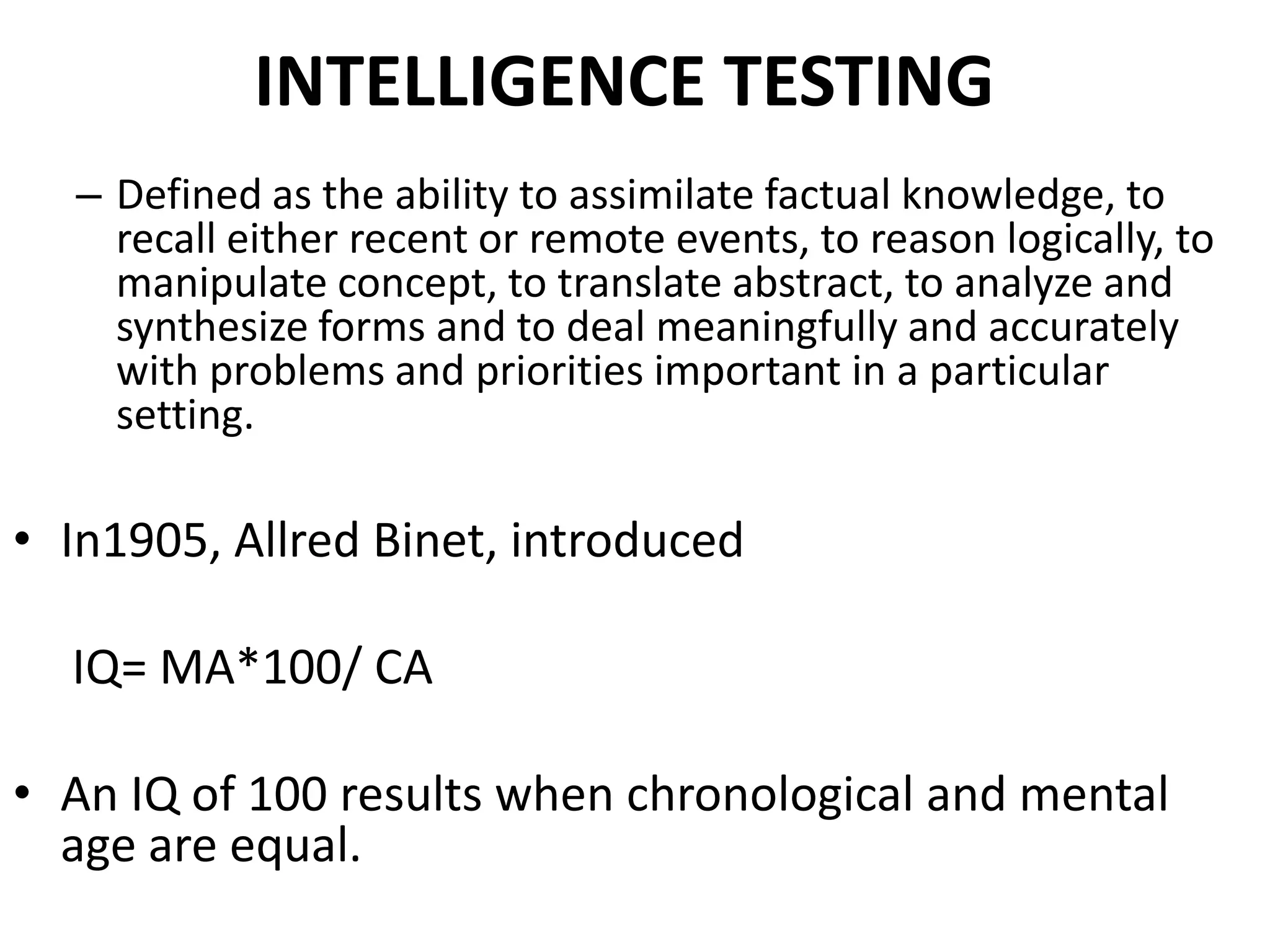
• In1905, Allred Binet, introduced

  IQ= MA*100/ CA

• An IQ of 100 results when chronological and mental
  age are equal.
INTELLIGENCE TESTING
• IQ is a measure of present functioning ability.

• Although, under ordinary circumstances the IQ is a
  stable throughout life.

• The most useful intelligence test must measure a
  variety of skill and abilities, including;
  – Verbal and performance,
  – Early learned and recently learned,
  – time and untimed,
  – culture free and culture bound
INTELLIGENCE TESTING
• WECHSLER ADULT INTELLIGENCE SCALE(WAIS):
  – This is best standardized and most widely used test given
    by David Wechsler at New York university medical center
    and Psychiatric hospital,1939.

  – The latest revision, the WAIS-III, is designed for
     o persons 16 to 89 years of age,
     o children 5 to 15 years,
     o children 4 to 6.5 years
INTELLIGENCE TESTING
Construction of the test
• VERBAL SKILL:
  1. Information:
   – It covers general information and knowledge and is subject to
     cultural variables

   – Person from lower socioeconomic with little schooling do not
     perform as well as those from high socioeconomic with more
     schooling

  2. Comprehension:
   it measures subjects knowledge of social convention and
   common sense and examine quality of persons thinking and
   how persons ought to behave under certain circumstances
INTELLIGENCE TESTING
3. Arithmetic:
– ability to do arithmetic and other simple calculations, which
  is adversely influenced by anxiety and poor attention
  concentration

4. Similarities:
– sensitive indicator of intelligence.
– it covers the ability to abstract by asking subjects to explain
  the similarities btw two things.

5. Digit span:
– immediate retention is measured
– Subjects are ask to learn a series of 2 to 9 digits. Immediately
  recall
INTELLIGENCE TESTING
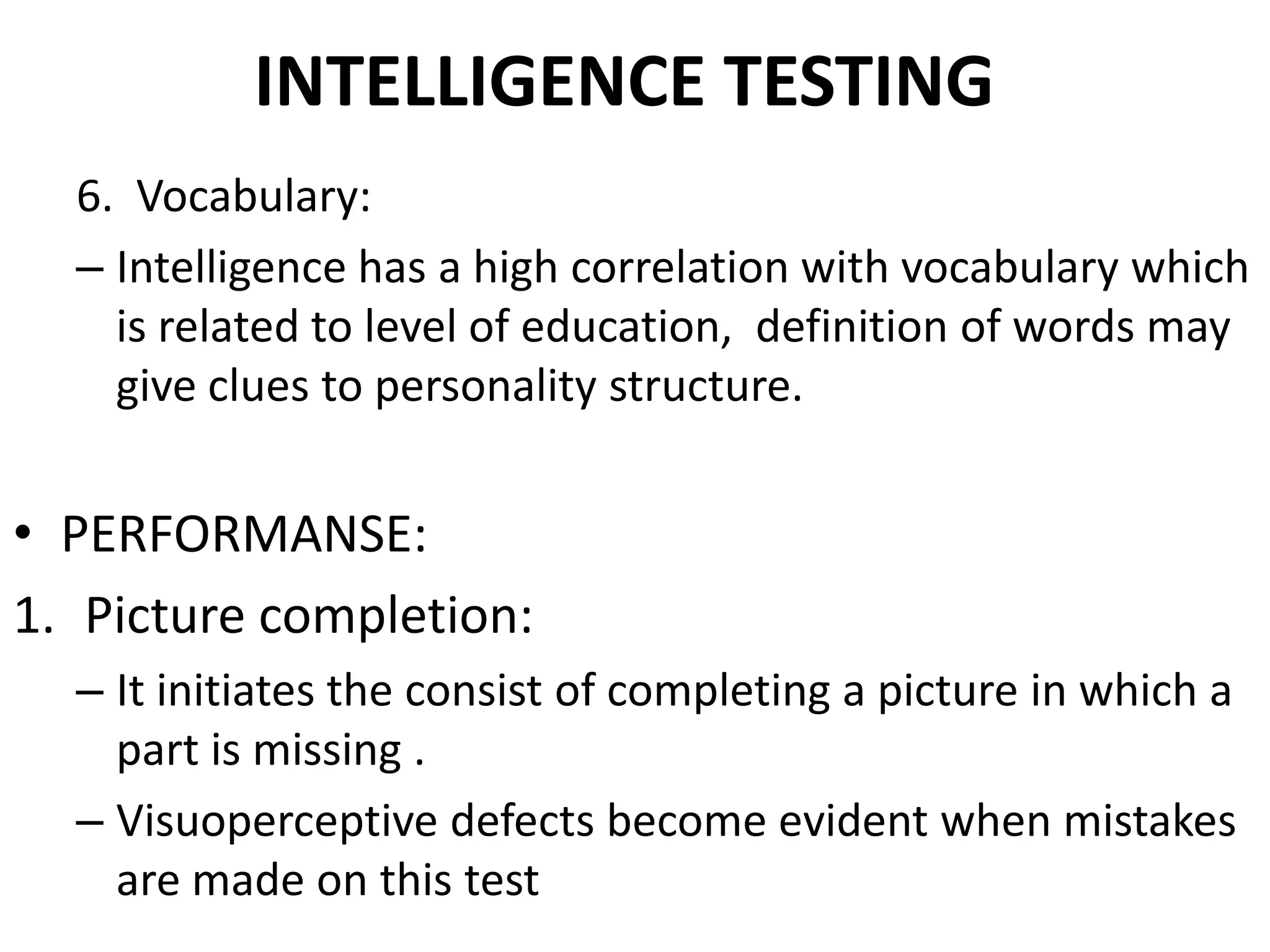
  6. Vocabulary:
  – Intelligence has a high correlation with vocabulary which
    is related to level of education, definition of words may
    give clues to personality structure.


• PERFORMANSE:
1. Picture completion:
  – It initiates the consist of completing a picture in which a
    part is missing .
  – Visuoperceptive defects become evident when mistakes
    are made on this test
INTELLIGENCE TESTING
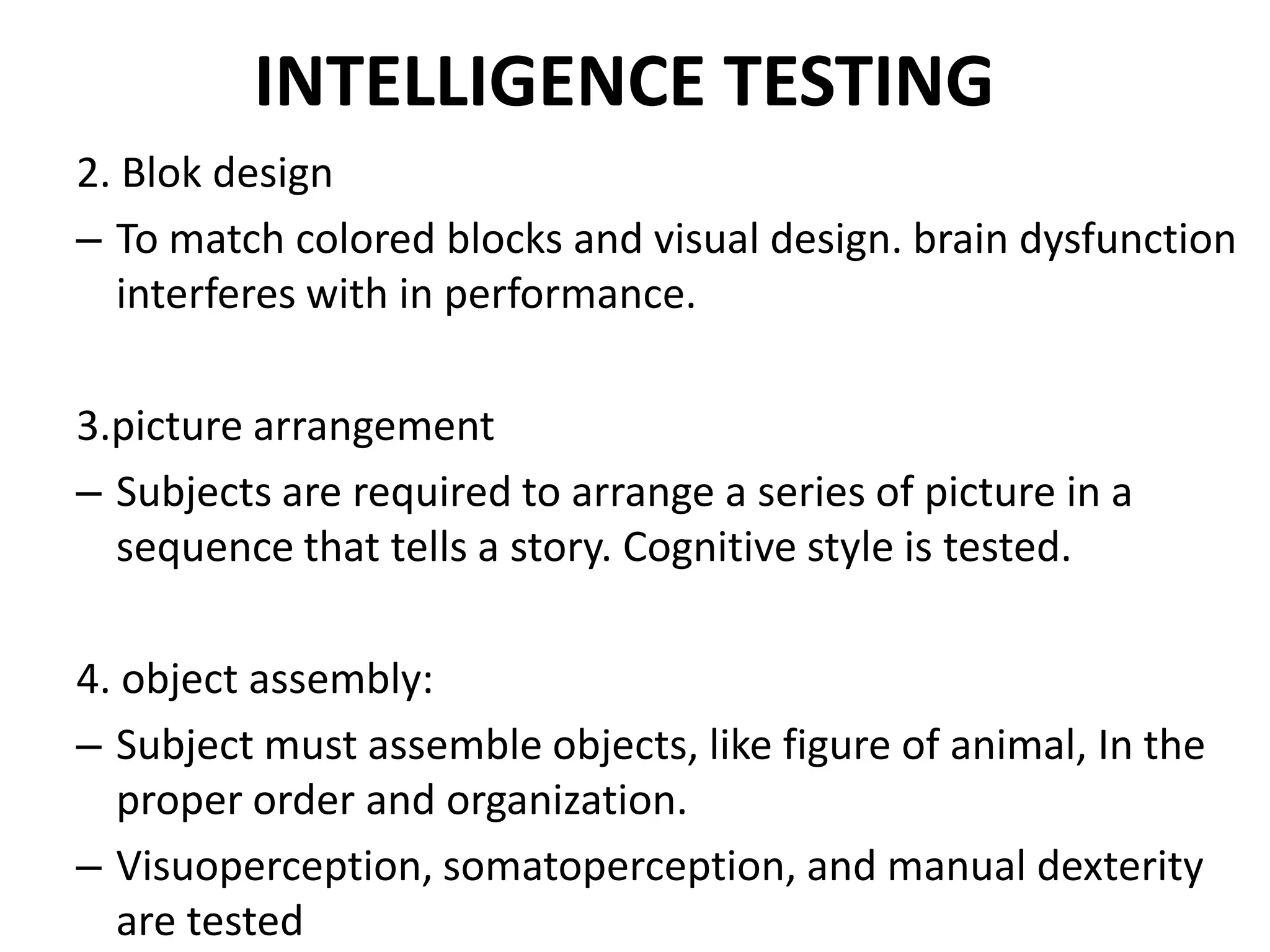
2. Blok design
– To match colored blocks and visual design. brain dysfunction
  interferes with in performance.

3.picture arrangement
– Subjects are required to arrange a series of picture in a
  sequence that tells a story. Cognitive style is tested.

4. object assembly:
– Subject must assemble objects, like figure of animal, In the
  proper order and organization.
– Visuoperception, somatoperception, and manual dexterity
  are tested
INTELLIGENCE TESTING
5.Digit symbol:
– Subject receive a code that pairs symbols with digits.
  Matching a series of digits to their corresponding
  symbols in as little time as possible
INTELLIGENCE TESTING
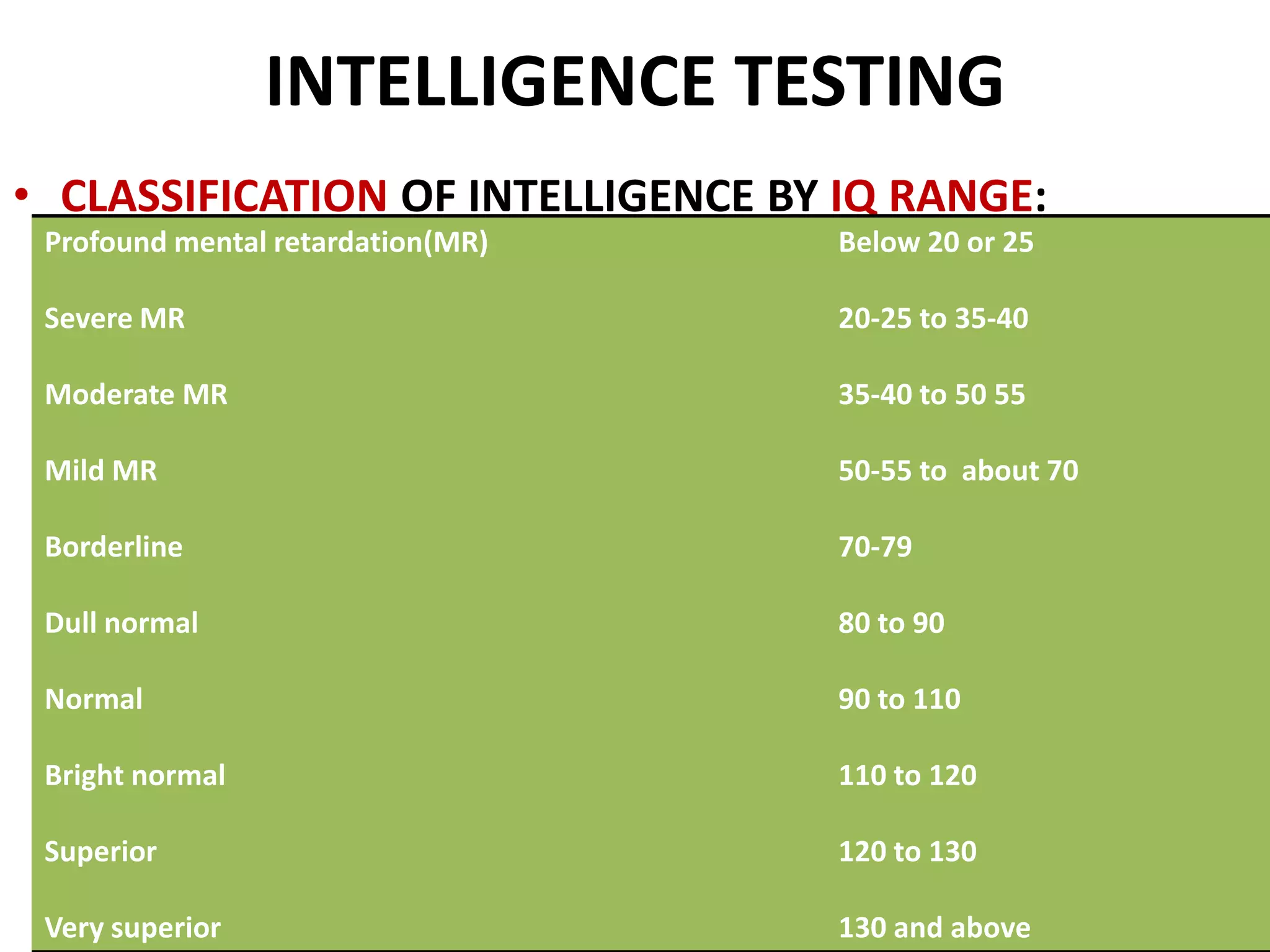
• CLASSIFICATION OF INTELLIGENCE BY IQ RANGE:
 Profound mental retardation(MR)   Below 20 or 25

 Severe MR                         20-25 to 35-40

 Moderate MR                       35-40 to 50 55

 Mild MR                           50-55 to about 70

 Borderline                        70-79

 Dull normal                       80 to 90

 Normal                            90 to 110

 Bright normal                     110 to 120

 Superior                          120 to 130

 Very superior                     130 and above
ADULT PERSONALITY ASSESMENT
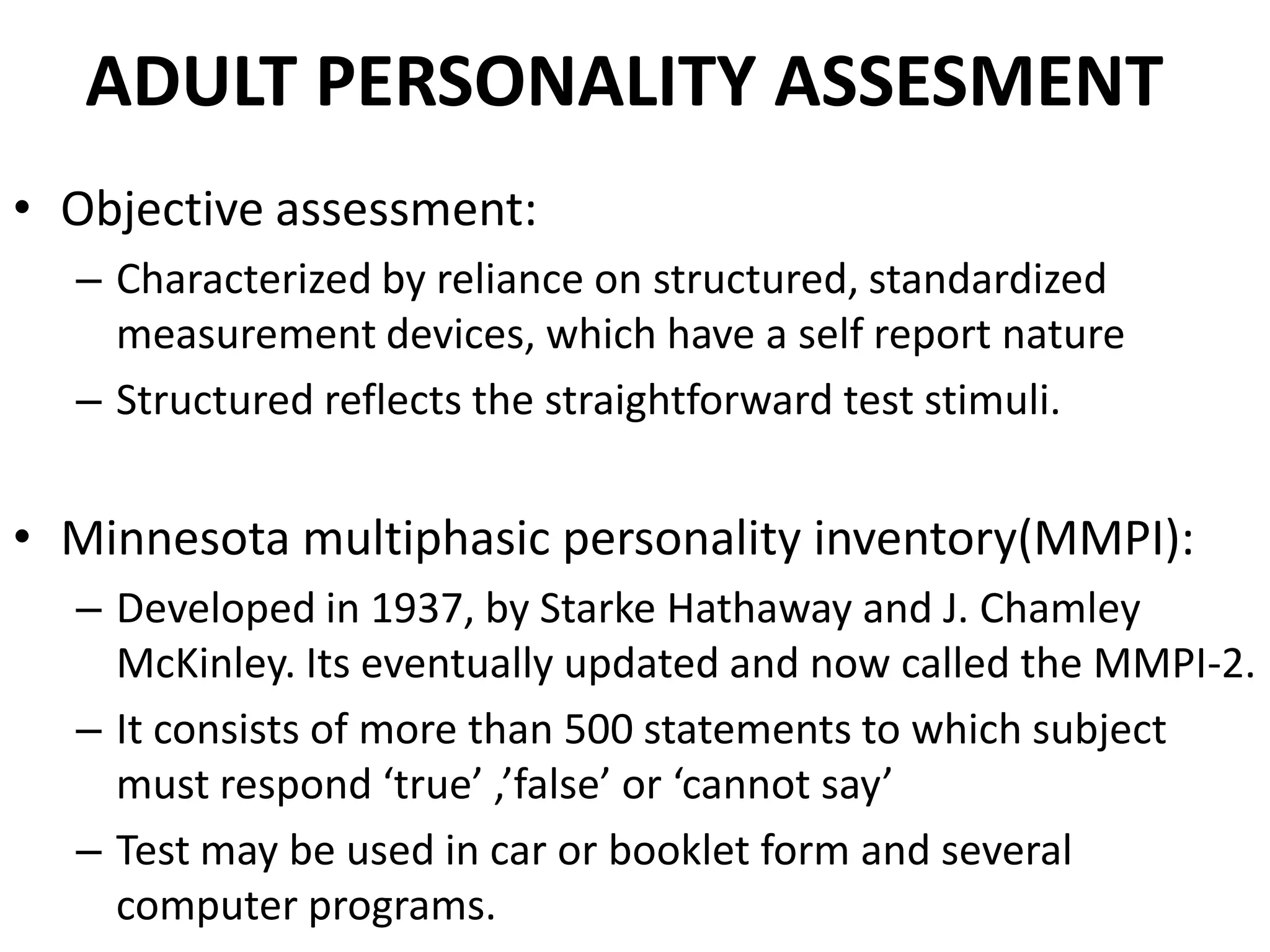
• Objective assessment:
  – Characterized by reliance on structured, standardized
    measurement devices, which have a self report nature
  – Structured reflects the straightforward test stimuli.


• Minnesota multiphasic personality inventory(MMPI):
  – Developed in 1937, by Starke Hathaway and J. Chamley
    McKinley. Its eventually updated and now called the MMPI-2.
  – It consists of more than 500 statements to which subject
    must respond ‘true’ ,’false’ or ‘cannot say’
  – Test may be used in car or booklet form and several
    computer programs.
ADULT PERSONALITY ASSESMENT
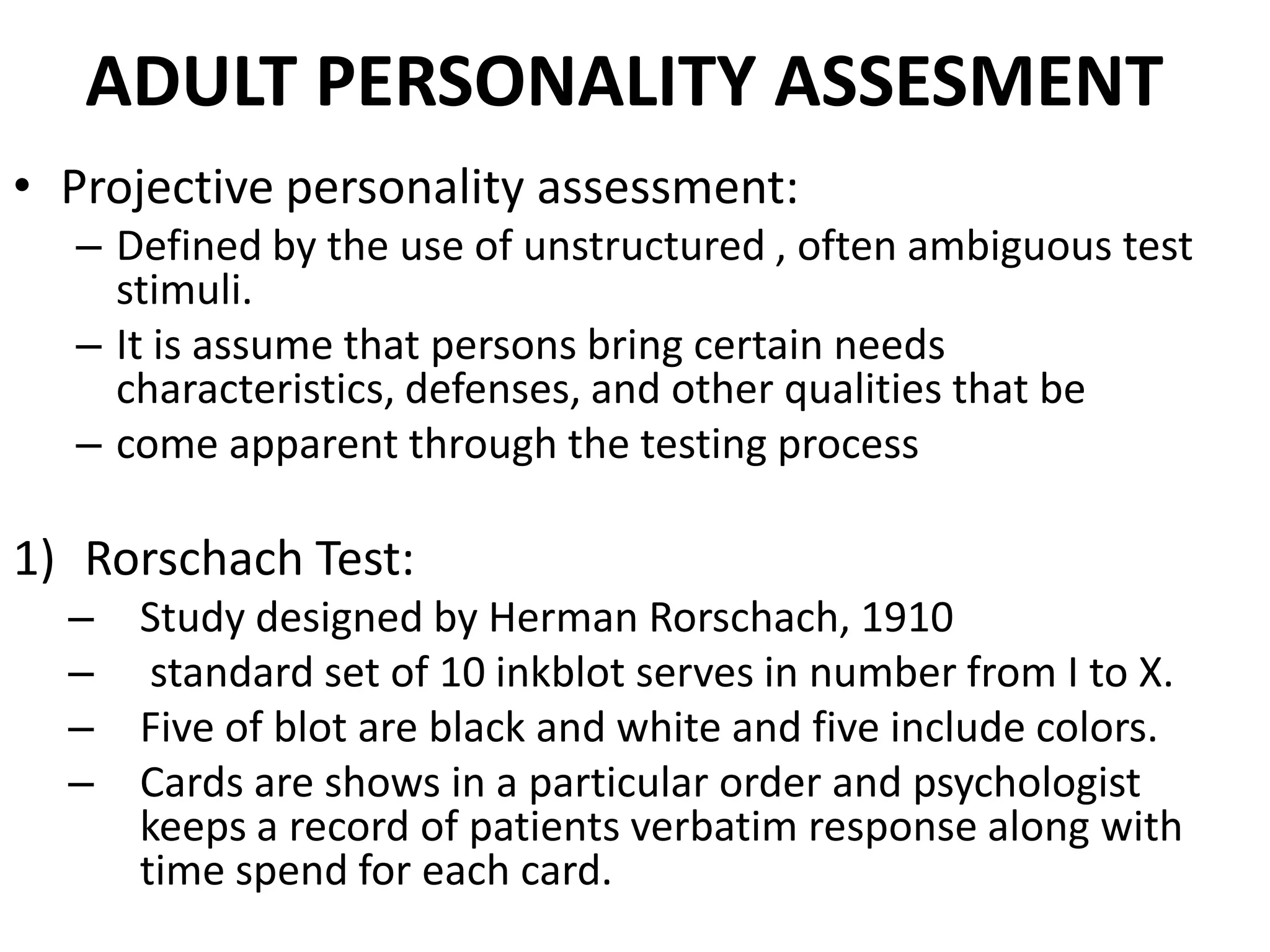
• Projective personality assessment:
  – Defined by the use of unstructured , often ambiguous test
    stimuli.
  – It is assume that persons bring certain needs
    characteristics, defenses, and other qualities that be
  – come apparent through the testing process

1) Rorschach Test:
  – Study designed by Herman Rorschach, 1910
  – standard set of 10 inkblot serves in number from I to X.
  – Five of blot are black and white and five include colors.
  – Cards are shows in a particular order and psychologist
    keeps a record of patients verbatim response along with
    time spend for each card.
ADULT PERSONALITY ASSESMENT
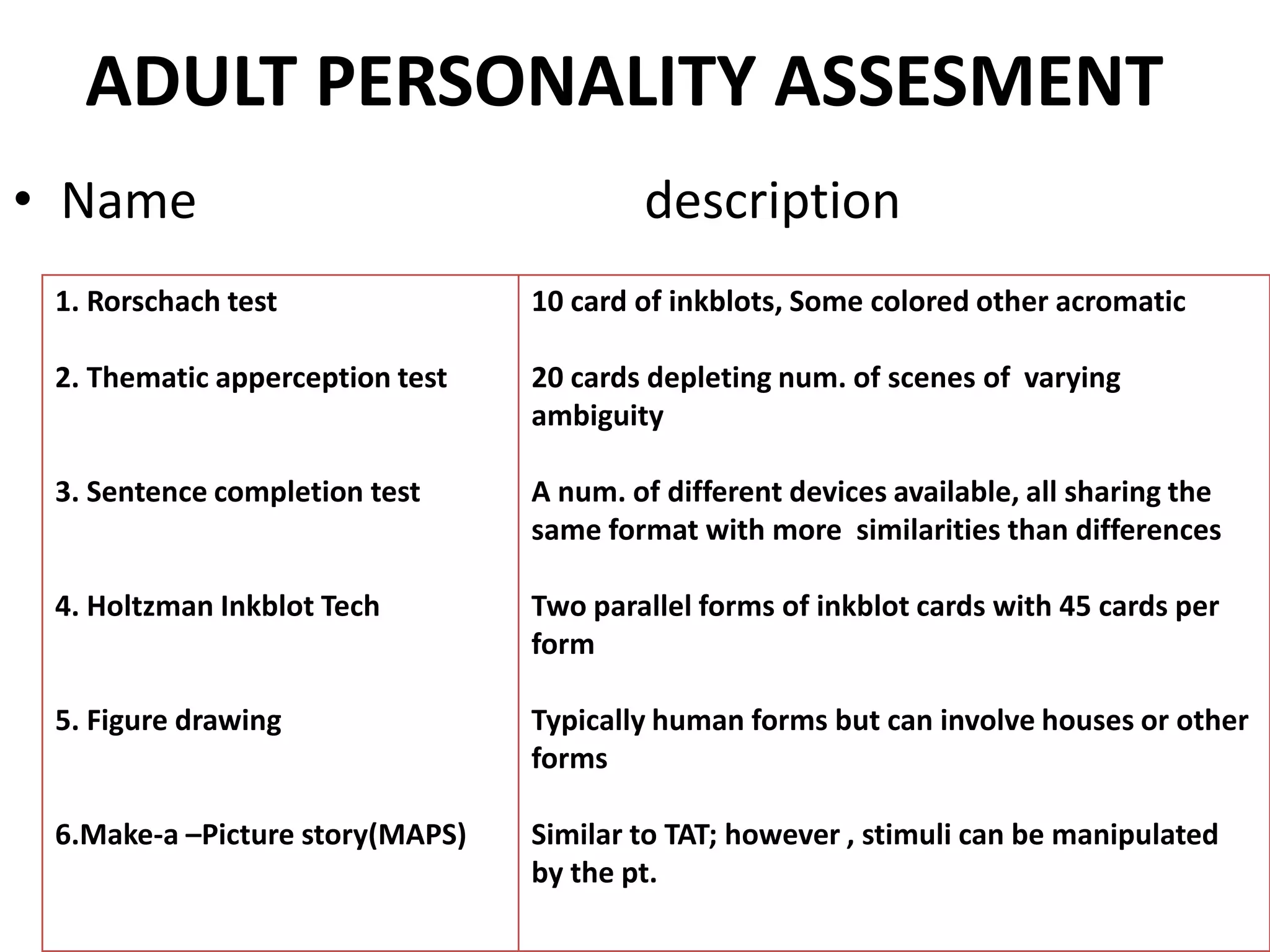
• Name                                   description
 1. Rorschach test               10 card of inkblots, Some colored other acromatic

 2. Thematic apperception test   20 cards depleting num. of scenes of varying
                                 ambiguity

 3. Sentence completion test     A num. of different devices available, all sharing the
                                 same format with more similarities than differences

 4. Holtzman Inkblot Tech        Two parallel forms of inkblot cards with 45 cards per
                                 form

 5. Figure drawing               Typically human forms but can involve houses or other
                                 forms

 6.Make-a –Picture story(MAPS)   Similar to TAT; however , stimuli can be manipulated
                                 by the pt.
ADULT PERSONALITY ASSESMENT
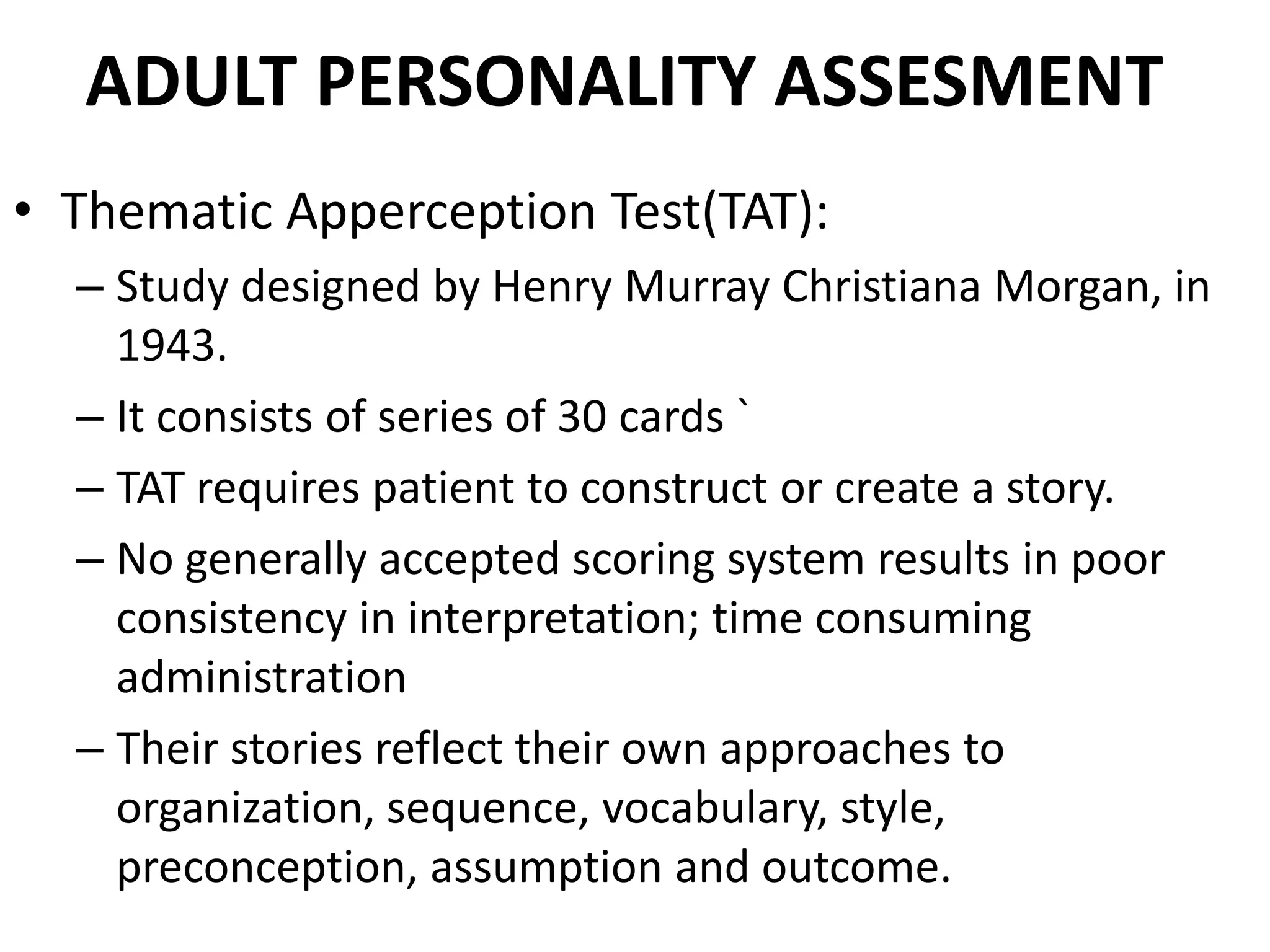
• Thematic Apperception Test(TAT):
  – Study designed by Henry Murray Christiana Morgan, in
    1943.
  – It consists of series of 30 cards `
  – TAT requires patient to construct or create a story.
  – No generally accepted scoring system results in poor
    consistency in interpretation; time consuming
    administration
  – Their stories reflect their own approaches to
    organization, sequence, vocabulary, style,
    preconception, assumption and outcome.
ADULT PERSONALITY ASSESMENT
• Sentence completion test(SCT):
  – To tap patients conscious associations to areas of
    functioning
  – Compose of series of sentences stems usually 75-100 .
  – Such as , I like……., sometime I wish…….., etc
  – That patients are ask to complete in their own word.


• Word association tech.:
  – Carl Gustav Jung presented stimulus word to pt. and had
    them respond with the first word that come to mind
ADULT PERSONALITY ASSESMENT
• Draw a person test:
  – First used as a measure of intelligence in children.
  – Easily administrated with the instruction “I ‘d like you to
    draw the picture of person, draw the best person you
    can.
  – After completion of 1st drawing a patient is asked to
    draw a picture of a person of the sex opposite that of 1st
    drawing
  – Generally, the drawing of person represents the
    expression of the self in environment
  – Primarily it’s a screening technique particularly for the
    detection of the brain damage
ASSESSMENT OF ADULTS
• It is examines the relationship btw behavior and brain
  functioning in the realms of cognitive, motor, sensory
  and emotional functioning

• AIM: To achieve quantifiable and reproducible result

• Assessment is indicated to identify cognitive defects
   –   to differentiate incipient depression from dementia,
   –   to determine the course of an illness,
   –   to assess neurotoxic effects,
   –   to evaluate the effect of treatment
ASSESSMENT OF ADULTS
• The Wisconsin card sorting test(WCST):
  – It assess abstract reasoning and flexibility in problem solving
  – Stimulus card of different color, form and number are
    presented
  – As the pt. sort the cards he is told the response s are correct
    or incorrect, number of trials are 10.
  – When the pt. has mastered the task, examiner change the
    principle of sorting
  – The procedure repeated several times, measures the
    capacity for abstract thinking and flexibility.
  – Person with frontal lobes or to the caudal damage and
    person with schizophrenia give abnormal responses.
ASSESSMENT OF ADULTS
• MEMORY: types

1) Immediate memory: reproduction of perceived material
   within a period up to 30 sec. after presentation.

2) Recent memory: concerns events over the past few hours or
   days, can be tested by asking patients ‘what they had for
   breakfast’ etc.

3) Resent past memory: concern the retention of information
   over the past few months.

4) Remote memory: is the ability to remember the events in
   the distance past.
ASSESSMENT OF ADULTS
•   Memory theories have described 3 more parts:
    – Episodes for specific events eg. Telephone message,
    – semantic for knowledge and facts eg. First president or
      etc, and
    – implicit for automatic skill eg. Speaking grammatically or
      driving car
•   Testing :
    – Wechsler memory scale: the scale yield memory questions
      which is corrected for age and generally approximate the
      WAIS IQ
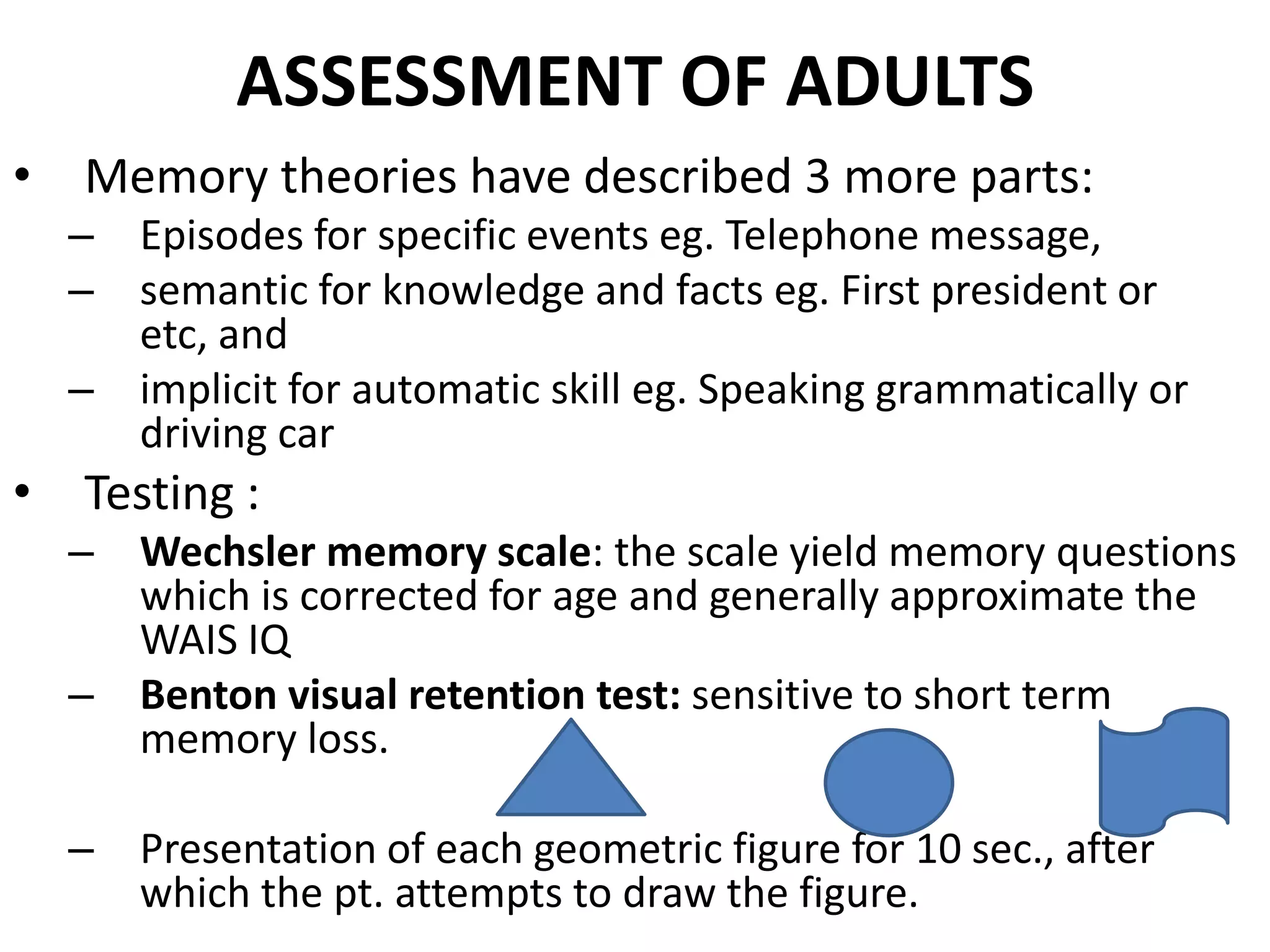
    – Benton visual retention test: sensitive to short term
      memory loss.

    – Presentation of each geometric figure for 10 sec., after
      which the pt. attempts to draw the figure.
ASSESSMENT OF ADULTS
• ORIENTATION:
  – For person or place is rarely disturbed in brain damage
    pt who are not psychotic or severely demented


• Temporal Orientation Schedule
  Administration
  – What is today’s date?
  – What day’s of the is it?
  – What time is it now?
ASSESSMENT OF ADULTS
• PERCEPTUAL &PERCEPTUOMOTOR PERFORMANCE:
  – Many pt. with brain disease shows an impaired ability to
    analyze complex stimulus constellation or an in ability to
    transfer their perception into appropriate motor action

  – Double simultaneous stimulation is tested by lightly
    touching one of the pt.s cheeks with one hand and
    simultaneously touching the back of one of pt.s hand
    with the other

  – A pt. with brain dysfunction is unable to recognize one
    or both of the stimuli
HEMISPARIC DOMINANCE AND
     INTRAHEMISPHARIC LOCALIZATION
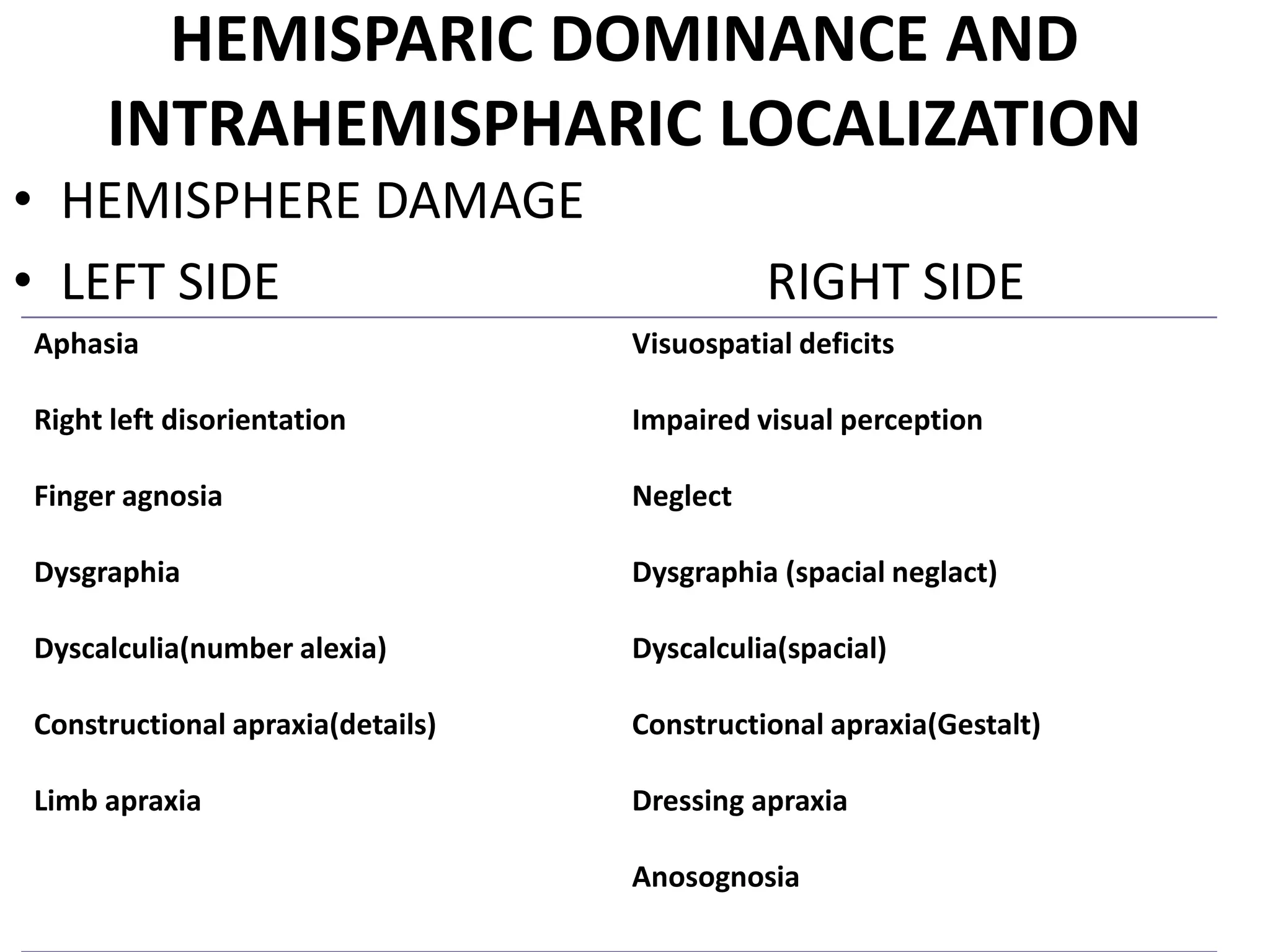
• HEMISPHERE DAMAGE
• LEFT SIDE                                 RIGHT SIDE
Aphasia                           Visuospatial deficits

Right left disorientation         Impaired visual perception

Finger agnosia                    Neglect

Dysgraphia                        Dysgraphia (spacial neglact)

Dyscalculia(number alexia)        Dyscalculia(spacial)

Constructional apraxia(details)   Constructional apraxia(Gestalt)

Limb apraxia                      Dressing apraxia

                                  Anosognosia
HEMISPARIC DOMINANCE AND
    INTRAHEMISPHARIC LOCALIZATION
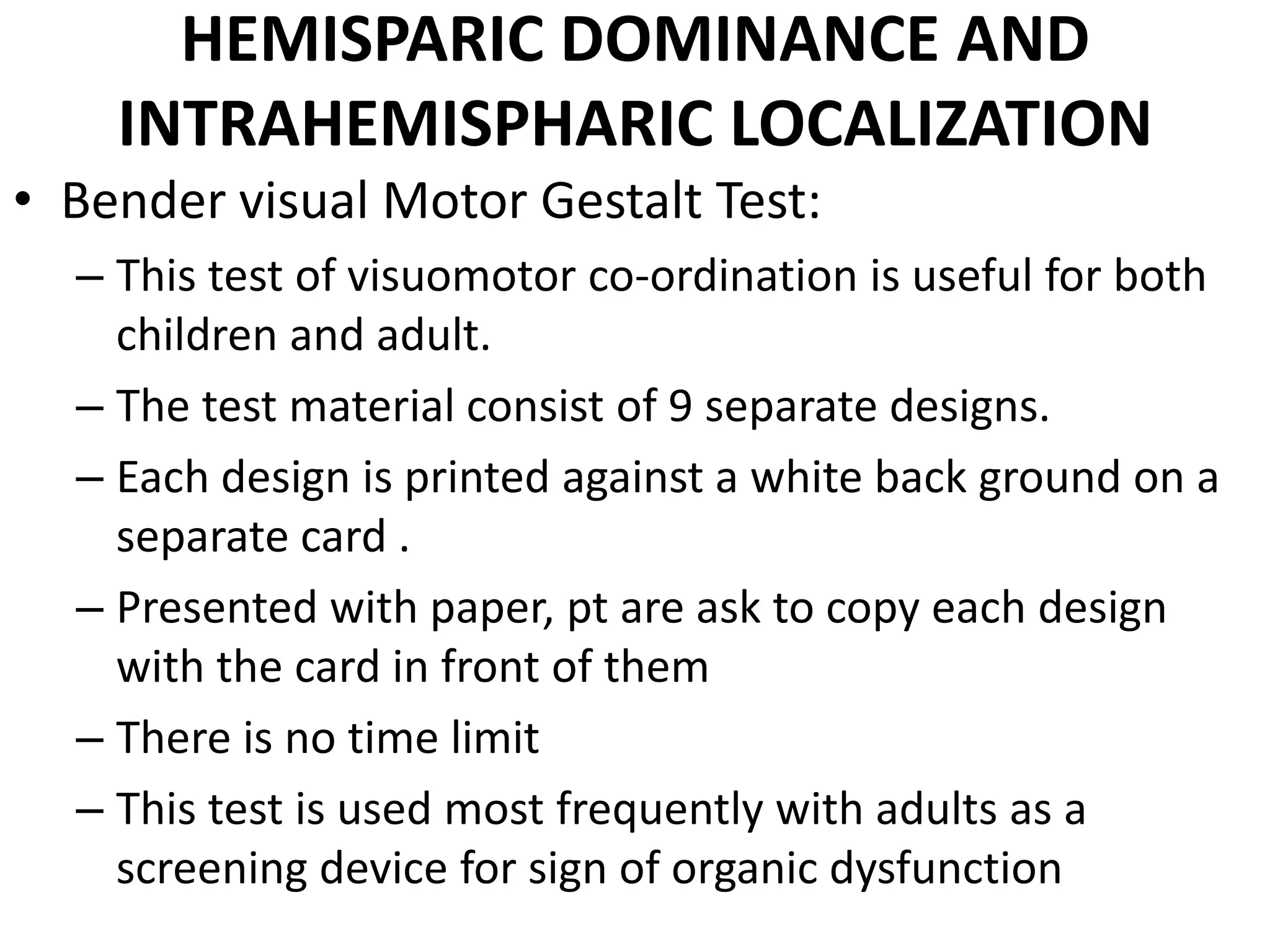
• Bender visual Motor Gestalt Test:
  – This test of visuomotor co-ordination is useful for both
    children and adult.
  – The test material consist of 9 separate designs.
  – Each design is printed against a white back ground on a
    separate card .
  – Presented with paper, pt are ask to copy each design
    with the card in front of them
  – There is no time limit
  – This test is used most frequently with adults as a
    screening device for sign of organic dysfunction
HEMISPARIC DOMINANCE AND
    INTRAHEMISPHARIC LOCALIZATION
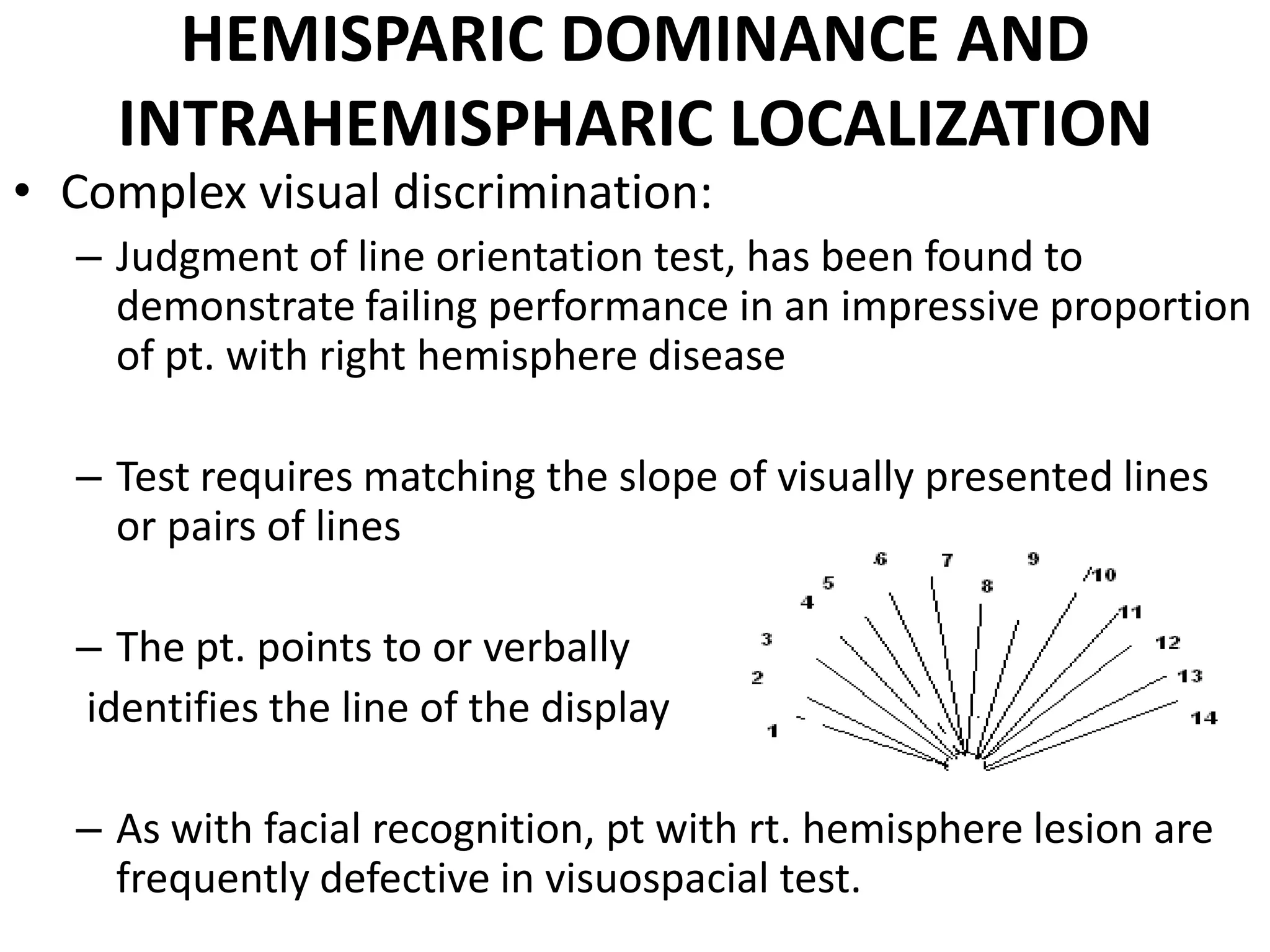
• Complex visual discrimination:
  – Judgment of line orientation test, has been found to
    demonstrate failing performance in an impressive proportion
    of pt. with right hemisphere disease

  – Test requires matching the slope of visually presented lines
    or pairs of lines

  – The pt. points to or verbally
  identifies the line of the display

  – As with facial recognition, pt with rt. hemisphere lesion are
    frequently defective in visuospacial test.
LANGUAGE
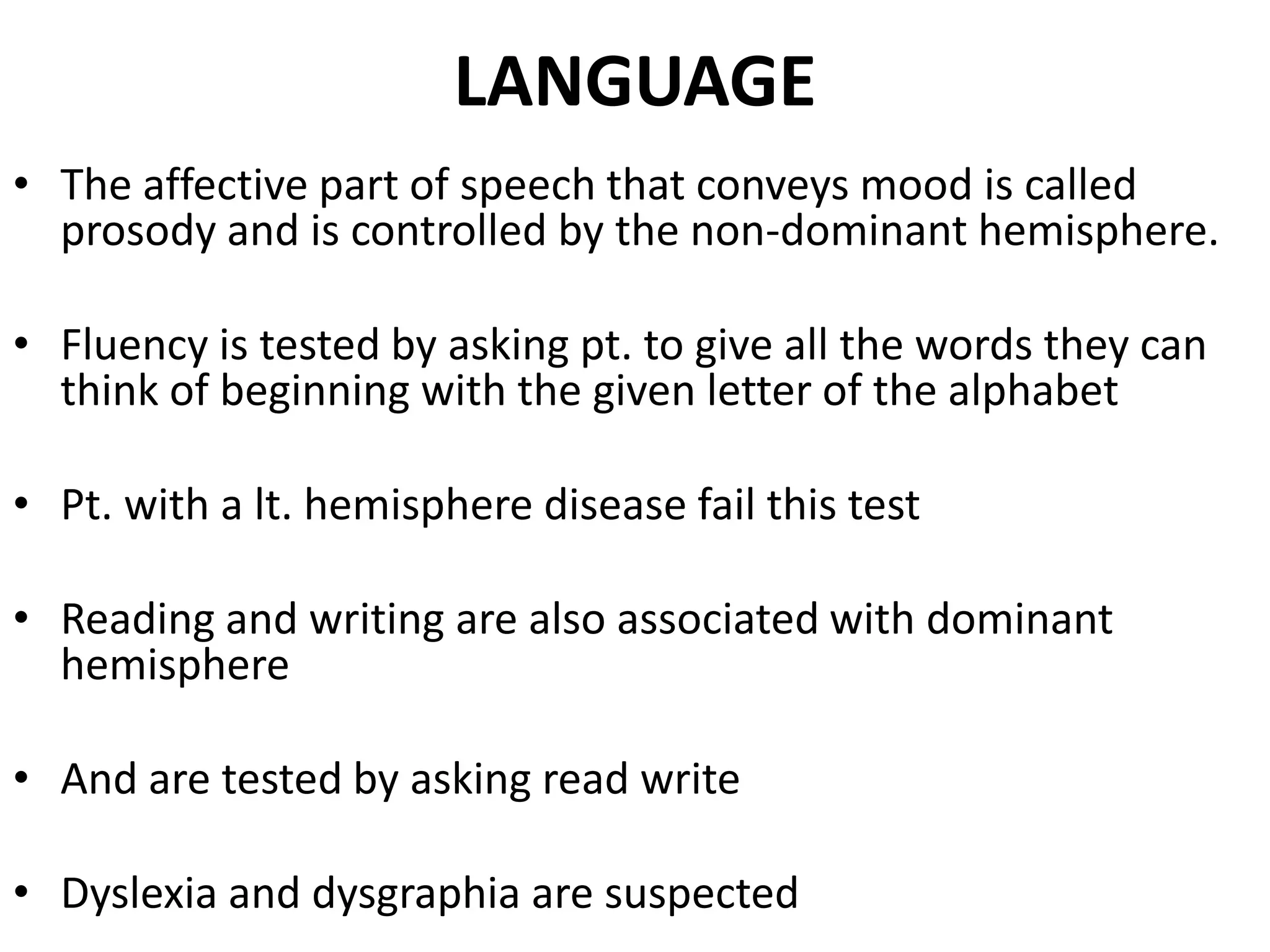
• The affective part of speech that conveys mood is called
  prosody and is controlled by the non-dominant hemisphere.

• Fluency is tested by asking pt. to give all the words they can
  think of beginning with the given letter of the alphabet

• Pt. with a lt. hemisphere disease fail this test

• Reading and writing are also associated with dominant
  hemisphere

• And are tested by asking read write

• Dyslexia and dysgraphia are suspected
ATTENTOIN AND CONCENTRATION
• This impairment is reflected in an oscillation in
  performance level for continuous or repeated activity

• Some evidence indicates that the instability in
  performance is related to an electro-encephalographic
  abnormality

• The reaction time needed to respond to stimulus is
  impaired in 40-45% of brain damage patient

• And is sensitive indicator of cerebral integrity.
COMPREHENSIVE TESTING
• Luria-Nebraska neuropsychological battery:

  – Developed at the uni. Of Nebraska

  – The test assesses a wide range of cognitive function;
    memory; motor function; rhythm; tactile; auditory and
    visual function; receptive and expressive speech; writing:
    spelling; reading; and arithmetic

  – The test is extremely sensitive for identifying specific
    types of problems like dyslexia and dyscalculia
RELIABILITY AND VALIDITY
• The reliability and validity of this test may be
  affected by many factors like; mood states,
  motivation, effort and cooperation

• Results may be confounded by medication
  effects ; anticonvulsants and antipsycotic
THERAPEUTIC DISCUSSION
• A discussion of results of test with the pt. and family, is an
  imp. Component of neuropsychological examination

• This will provide therapeutic opportunity to educate them
  and clarify individual and relationship issues .

• It is useful to review the goals of examination with the pt. and
  family or caregivers.

• This includes information about the pt.’s diagnosis with
  emphasis upon the natural course and prognosis as well as
  compensation and coping strategies.

• It is imp. To relate the impact of the results to the pt.’s current
  living circumstances, future goals and course
•THANK YOU !!
Clinical neuropsychological testing

Clinical neuropsychological testing

  • 1.
    CLINICAL NEUROPSYCHOLOGICAL TESTING • PRESENTED BY: DR.SHILPA PRAJAPATI ( 1ST YR M.P.T)
  • 2.
    TESTING OF INTELLIGENCEAND PERSONALITY • Intelligence & personality plays a relatively minor role in psychiatric diagnosis its more use in some special situation like: – To establish the degree of mental retardation – Neuropsychological tests help quantify and localize brain damage.
  • 3.
    TESTING OF INTELLIGENCEAND PERSONALITY • TYPES OF TESTS : introduction Objective test: – Pencil and paper tests based on specific items and question – They yield numerical score and profile easily subject to mathematical or statistical analysis Projective test: – These tests present stimuli whose meanings are not immediately obvious; some ambiguity forces persons to project their own needs into the test situations – These test presumably no right or wrong answers.
  • 4.
    INTELLIGENCE TESTING – Defined as the ability to assimilate factual knowledge, to recall either recent or remote events, to reason logically, to manipulate concept, to translate abstract, to analyze and synthesize forms and to deal meaningfully and accurately with problems and priorities important in a particular setting. • In1905, Allred Binet, introduced IQ= MA*100/ CA • An IQ of 100 results when chronological and mental age are equal.
  • 5.
    INTELLIGENCE TESTING • IQis a measure of present functioning ability. • Although, under ordinary circumstances the IQ is a stable throughout life. • The most useful intelligence test must measure a variety of skill and abilities, including; – Verbal and performance, – Early learned and recently learned, – time and untimed, – culture free and culture bound
  • 6.
    INTELLIGENCE TESTING • WECHSLERADULT INTELLIGENCE SCALE(WAIS): – This is best standardized and most widely used test given by David Wechsler at New York university medical center and Psychiatric hospital,1939. – The latest revision, the WAIS-III, is designed for o persons 16 to 89 years of age, o children 5 to 15 years, o children 4 to 6.5 years
  • 7.
    INTELLIGENCE TESTING Construction ofthe test • VERBAL SKILL: 1. Information: – It covers general information and knowledge and is subject to cultural variables – Person from lower socioeconomic with little schooling do not perform as well as those from high socioeconomic with more schooling 2. Comprehension: it measures subjects knowledge of social convention and common sense and examine quality of persons thinking and how persons ought to behave under certain circumstances
  • 8.
    INTELLIGENCE TESTING 3. Arithmetic: –ability to do arithmetic and other simple calculations, which is adversely influenced by anxiety and poor attention concentration 4. Similarities: – sensitive indicator of intelligence. – it covers the ability to abstract by asking subjects to explain the similarities btw two things. 5. Digit span: – immediate retention is measured – Subjects are ask to learn a series of 2 to 9 digits. Immediately recall
  • 9.
    INTELLIGENCE TESTING 6. Vocabulary: – Intelligence has a high correlation with vocabulary which is related to level of education, definition of words may give clues to personality structure. • PERFORMANSE: 1. Picture completion: – It initiates the consist of completing a picture in which a part is missing . – Visuoperceptive defects become evident when mistakes are made on this test
  • 10.
    INTELLIGENCE TESTING 2. Blokdesign – To match colored blocks and visual design. brain dysfunction interferes with in performance. 3.picture arrangement – Subjects are required to arrange a series of picture in a sequence that tells a story. Cognitive style is tested. 4. object assembly: – Subject must assemble objects, like figure of animal, In the proper order and organization. – Visuoperception, somatoperception, and manual dexterity are tested
  • 11.
    INTELLIGENCE TESTING 5.Digit symbol: –Subject receive a code that pairs symbols with digits. Matching a series of digits to their corresponding symbols in as little time as possible
  • 12.
    INTELLIGENCE TESTING • CLASSIFICATIONOF INTELLIGENCE BY IQ RANGE: Profound mental retardation(MR) Below 20 or 25 Severe MR 20-25 to 35-40 Moderate MR 35-40 to 50 55 Mild MR 50-55 to about 70 Borderline 70-79 Dull normal 80 to 90 Normal 90 to 110 Bright normal 110 to 120 Superior 120 to 130 Very superior 130 and above
  • 13.
    ADULT PERSONALITY ASSESMENT •Objective assessment: – Characterized by reliance on structured, standardized measurement devices, which have a self report nature – Structured reflects the straightforward test stimuli. • Minnesota multiphasic personality inventory(MMPI): – Developed in 1937, by Starke Hathaway and J. Chamley McKinley. Its eventually updated and now called the MMPI-2. – It consists of more than 500 statements to which subject must respond ‘true’ ,’false’ or ‘cannot say’ – Test may be used in car or booklet form and several computer programs.
  • 14.
    ADULT PERSONALITY ASSESMENT •Projective personality assessment: – Defined by the use of unstructured , often ambiguous test stimuli. – It is assume that persons bring certain needs characteristics, defenses, and other qualities that be – come apparent through the testing process 1) Rorschach Test: – Study designed by Herman Rorschach, 1910 – standard set of 10 inkblot serves in number from I to X. – Five of blot are black and white and five include colors. – Cards are shows in a particular order and psychologist keeps a record of patients verbatim response along with time spend for each card.
  • 15.
    ADULT PERSONALITY ASSESMENT •Name description 1. Rorschach test 10 card of inkblots, Some colored other acromatic 2. Thematic apperception test 20 cards depleting num. of scenes of varying ambiguity 3. Sentence completion test A num. of different devices available, all sharing the same format with more similarities than differences 4. Holtzman Inkblot Tech Two parallel forms of inkblot cards with 45 cards per form 5. Figure drawing Typically human forms but can involve houses or other forms 6.Make-a –Picture story(MAPS) Similar to TAT; however , stimuli can be manipulated by the pt.
  • 16.
    ADULT PERSONALITY ASSESMENT •Thematic Apperception Test(TAT): – Study designed by Henry Murray Christiana Morgan, in 1943. – It consists of series of 30 cards ` – TAT requires patient to construct or create a story. – No generally accepted scoring system results in poor consistency in interpretation; time consuming administration – Their stories reflect their own approaches to organization, sequence, vocabulary, style, preconception, assumption and outcome.
  • 17.
    ADULT PERSONALITY ASSESMENT •Sentence completion test(SCT): – To tap patients conscious associations to areas of functioning – Compose of series of sentences stems usually 75-100 . – Such as , I like……., sometime I wish…….., etc – That patients are ask to complete in their own word. • Word association tech.: – Carl Gustav Jung presented stimulus word to pt. and had them respond with the first word that come to mind
  • 18.
    ADULT PERSONALITY ASSESMENT •Draw a person test: – First used as a measure of intelligence in children. – Easily administrated with the instruction “I ‘d like you to draw the picture of person, draw the best person you can. – After completion of 1st drawing a patient is asked to draw a picture of a person of the sex opposite that of 1st drawing – Generally, the drawing of person represents the expression of the self in environment – Primarily it’s a screening technique particularly for the detection of the brain damage
  • 19.
    ASSESSMENT OF ADULTS •It is examines the relationship btw behavior and brain functioning in the realms of cognitive, motor, sensory and emotional functioning • AIM: To achieve quantifiable and reproducible result • Assessment is indicated to identify cognitive defects – to differentiate incipient depression from dementia, – to determine the course of an illness, – to assess neurotoxic effects, – to evaluate the effect of treatment
  • 20.
    ASSESSMENT OF ADULTS •The Wisconsin card sorting test(WCST): – It assess abstract reasoning and flexibility in problem solving – Stimulus card of different color, form and number are presented – As the pt. sort the cards he is told the response s are correct or incorrect, number of trials are 10. – When the pt. has mastered the task, examiner change the principle of sorting – The procedure repeated several times, measures the capacity for abstract thinking and flexibility. – Person with frontal lobes or to the caudal damage and person with schizophrenia give abnormal responses.
  • 21.
    ASSESSMENT OF ADULTS •MEMORY: types 1) Immediate memory: reproduction of perceived material within a period up to 30 sec. after presentation. 2) Recent memory: concerns events over the past few hours or days, can be tested by asking patients ‘what they had for breakfast’ etc. 3) Resent past memory: concern the retention of information over the past few months. 4) Remote memory: is the ability to remember the events in the distance past.
  • 22.
    ASSESSMENT OF ADULTS • Memory theories have described 3 more parts: – Episodes for specific events eg. Telephone message, – semantic for knowledge and facts eg. First president or etc, and – implicit for automatic skill eg. Speaking grammatically or driving car • Testing : – Wechsler memory scale: the scale yield memory questions which is corrected for age and generally approximate the WAIS IQ – Benton visual retention test: sensitive to short term memory loss. – Presentation of each geometric figure for 10 sec., after which the pt. attempts to draw the figure.
  • 23.
    ASSESSMENT OF ADULTS •ORIENTATION: – For person or place is rarely disturbed in brain damage pt who are not psychotic or severely demented • Temporal Orientation Schedule Administration – What is today’s date? – What day’s of the is it? – What time is it now?
  • 24.
    ASSESSMENT OF ADULTS •PERCEPTUAL &PERCEPTUOMOTOR PERFORMANCE: – Many pt. with brain disease shows an impaired ability to analyze complex stimulus constellation or an in ability to transfer their perception into appropriate motor action – Double simultaneous stimulation is tested by lightly touching one of the pt.s cheeks with one hand and simultaneously touching the back of one of pt.s hand with the other – A pt. with brain dysfunction is unable to recognize one or both of the stimuli
  • 25.
    HEMISPARIC DOMINANCE AND INTRAHEMISPHARIC LOCALIZATION • HEMISPHERE DAMAGE • LEFT SIDE RIGHT SIDE Aphasia Visuospatial deficits Right left disorientation Impaired visual perception Finger agnosia Neglect Dysgraphia Dysgraphia (spacial neglact) Dyscalculia(number alexia) Dyscalculia(spacial) Constructional apraxia(details) Constructional apraxia(Gestalt) Limb apraxia Dressing apraxia Anosognosia
  • 26.
    HEMISPARIC DOMINANCE AND INTRAHEMISPHARIC LOCALIZATION • Bender visual Motor Gestalt Test: – This test of visuomotor co-ordination is useful for both children and adult. – The test material consist of 9 separate designs. – Each design is printed against a white back ground on a separate card . – Presented with paper, pt are ask to copy each design with the card in front of them – There is no time limit – This test is used most frequently with adults as a screening device for sign of organic dysfunction
  • 27.
    HEMISPARIC DOMINANCE AND INTRAHEMISPHARIC LOCALIZATION • Complex visual discrimination: – Judgment of line orientation test, has been found to demonstrate failing performance in an impressive proportion of pt. with right hemisphere disease – Test requires matching the slope of visually presented lines or pairs of lines – The pt. points to or verbally identifies the line of the display – As with facial recognition, pt with rt. hemisphere lesion are frequently defective in visuospacial test.
  • 28.
    LANGUAGE • The affectivepart of speech that conveys mood is called prosody and is controlled by the non-dominant hemisphere. • Fluency is tested by asking pt. to give all the words they can think of beginning with the given letter of the alphabet • Pt. with a lt. hemisphere disease fail this test • Reading and writing are also associated with dominant hemisphere • And are tested by asking read write • Dyslexia and dysgraphia are suspected
  • 29.
    ATTENTOIN AND CONCENTRATION •This impairment is reflected in an oscillation in performance level for continuous or repeated activity • Some evidence indicates that the instability in performance is related to an electro-encephalographic abnormality • The reaction time needed to respond to stimulus is impaired in 40-45% of brain damage patient • And is sensitive indicator of cerebral integrity.
  • 30.
    COMPREHENSIVE TESTING • Luria-Nebraskaneuropsychological battery: – Developed at the uni. Of Nebraska – The test assesses a wide range of cognitive function; memory; motor function; rhythm; tactile; auditory and visual function; receptive and expressive speech; writing: spelling; reading; and arithmetic – The test is extremely sensitive for identifying specific types of problems like dyslexia and dyscalculia
  • 31.
    RELIABILITY AND VALIDITY •The reliability and validity of this test may be affected by many factors like; mood states, motivation, effort and cooperation • Results may be confounded by medication effects ; anticonvulsants and antipsycotic
  • 32.
    THERAPEUTIC DISCUSSION • Adiscussion of results of test with the pt. and family, is an imp. Component of neuropsychological examination • This will provide therapeutic opportunity to educate them and clarify individual and relationship issues . • It is useful to review the goals of examination with the pt. and family or caregivers. • This includes information about the pt.’s diagnosis with emphasis upon the natural course and prognosis as well as compensation and coping strategies. • It is imp. To relate the impact of the results to the pt.’s current living circumstances, future goals and course
  • 33.