Neuropsychological
Assessment of Memory
DR ZAHIRUDDIN OTHMAN
PSYCHIATRY DEPT, USM
23-09-2018
1
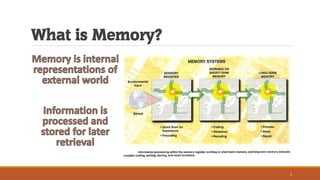
What is Memory?
2
Understanding Memory
1. Length of storage
2. Type of information to be
remembered
3. The stages involved in remembering
4. Recall and recognition
5. Explicit and implicit memory
6. Retrospective and prospective
memory
3
Understanding
Memory
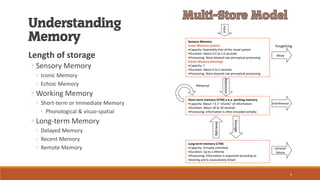
Length of storage
◦ Sensory Memory
◦ Iconic Memory
◦ Echoic Memory
◦ Working Memory
◦ Short-term or Immediate Memory
◦ Phonological & visuo-spatial
◦ Long-term Memory
◦ Delayed Memory
◦ Recent Memory
◦ Remote Memory
Sensory Memory
Iconic Memory (vision)
•Capacity: Essentially that of the visual system
•Duration: About 0.5 to 1.0 seconds
•Processing: None beyond raw perceptual processing
Echoic Memory (hearing}
•Capacity: ?
•Duration: About 4 to 5 seconds
•Processing: None beyond raw perceptual processing
Short-term memory (STM) a.k.a. working memory
•Capacity: About 7 ± 2 "chunks" of information
•Duration: About 18 to 20 seconds
•Processing: information is often encoded verbally
Long-term memory (LTM)
•Capacity: Virtually unlimited
•Duration: Up to a lifetime
•Processing: Information is organized according to
meaning and is associatively linked
InputAttention
Storage
Retrieval
Rehearsal
decay
interference
retrieval
failure
Forgetting
4
Understanding Memory
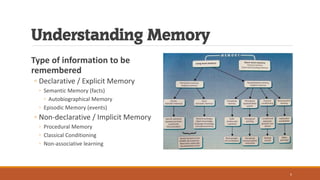
Type of information to be
remembered
◦ Declarative / Explicit Memory
◦ Semantic Memory (facts)
◦ Autobiographical Memory
◦ Episodic Memory (events)
◦ Non-declarative / Implicit Memory
◦ Procedural Memory
◦ Classical Conditioning
◦ Non-associative learning
5
Memory Disturbances
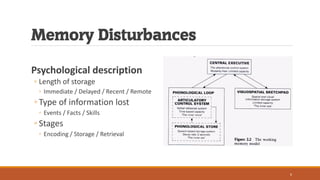
Psychological description
◦ Length of storage
◦ Immediate / Delayed / Recent / Remote
◦ Type of information lost
◦ Events / Facts / Skills
◦ Stages
◦ Encoding / Storage / Retrieval
6
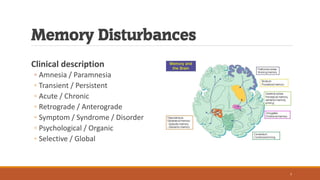
Memory Disturbances
Clinical description
◦ Amnesia / Paramnesia
◦ Transient / Persistent
◦ Acute / Chronic
◦ Retrograde / Anterograde
◦ Symptom / Syndrome / Disorder
◦ Psychological / Organic
◦ Selective / Global
7
Recall Test
Recognition
◦ Identifying that the information has been
seen/heard before
Recall
◦ Reproducing the information from memory
1. Free recall
2. Cued recall
◦ the retrieval of memory with the help of cues,
which can be category, first letter, semantic etc.
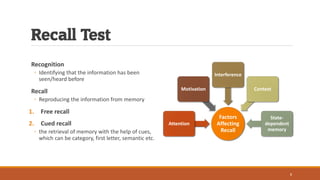
Factors
Affecting
Recall
Attention
Motivation
Interference
Context
State-
dependent
memory
8
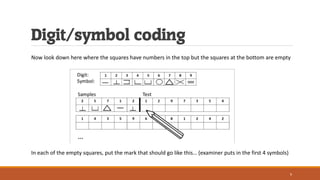
Digit/symbol coding
Now look down here where the squares have numbers in the top but the squares at the bottom are empty
In each of the empty squares, put the mark that should go like this… (examiner puts in the first 4 symbols)
9
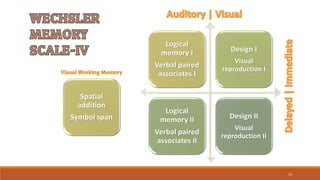
Logical
memory I
Verbal paired
associates I
Design I
Visual
reproduction I
Logical
memory II
Verbal paired
associates II
Design II
Visual
reproduction II
Visual Working Memory
Spatial
addition
Symbol span
10
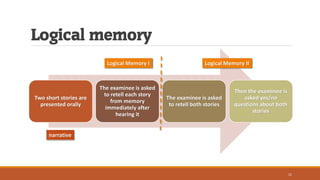
Logical memory
Two short stories are
presented orally
The examinee is asked
to retell each story
from memory
immediately after
hearing it
The examinee is asked
to retell both stories
Then the examinee is
asked yes/no
questions about both
stories
Logical Memory I Logical Memory II
narrative
11
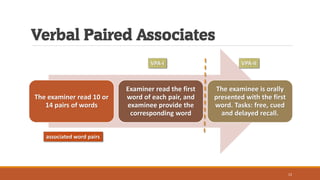
Verbal Paired Associates
The examiner read 10 or
14 pairs of words
Examiner read the first
word of each pair, and
examinee provide the
corresponding word
The examinee is orally
presented with the first
word. Tasks: free, cued
and delayed recall.
VPA-I VPA-II
associated word pairs
12
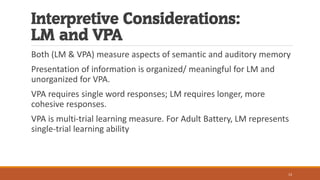
Interpretive Considerations:
LM and VPA
Both (LM & VPA) measure aspects of semantic and auditory memory
Presentation of information is organized/ meaningful for LM and
unorganized for VPA.
VPA requires single word responses; LM requires longer, more
cohesive responses.
VPA is multi-trial learning measure. For Adult Battery, LM represents
single-trial learning ability
13
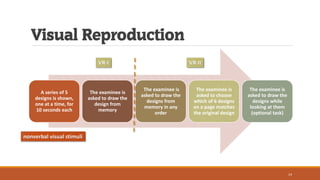
Visual Reproduction
A series of 5
designs is shown,
one at a time, for
10 seconds each
The examinee is
asked to draw the
design from
memory
The examinee is
asked to draw the
designs from
memory in any
order
The examinee is
asked to choose
which of 6 designs
on a page matches
the original design
The examinee is
asked to draw the
designs while
looking at them
(optional task)
VR-I VR-II
nonverbal visual stimuli
14
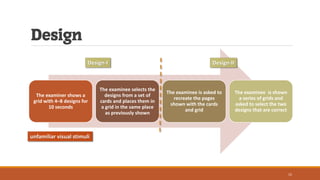
Design
The examiner shows a
grid with 4–8 designs for
10 seconds
The examinee selects the
designs from a set of
cards and places them in
a grid in the same place
as previously shown
The examinee is asked to
recreate the pages
shown with the cards
and grid
The examinee is shown
a series of grids and
asked to select the two
designs that are correct
Design-II
unfamiliar visual stimuli
Design-I
15
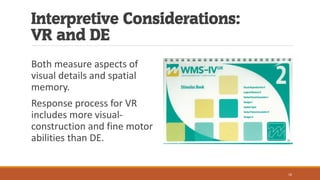
Interpretive Considerations:
VR and DE
Both measure aspects of
visual details and spatial
memory.
Response process for VR
includes more visual-
construction and fine motor
abilities than DE.
16
Spatial Addition
Assesses visual-spatial working
memory using a visual addition task.
Examiner shows the examinee,
sequentially, two grids with blue and
red circles. [5 sec.]
Then, examiner asks examinee to add
or subtract the location of the circles
based on a set of rules.
17
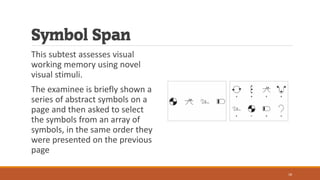
Symbol Span
This subtest assesses visual
working memory using novel
visual stimuli.
The examinee is briefly shown a
series of abstract symbols on a
page and then asked to select
the symbols from an array of
symbols, in the same order they
were presented on the previous
page
18
Interpretive Considerations:
SA and SP
SA taps spatial location memory and the ability to
compare spatial images.
SP is highly focused on recall of visual details and the
sequence of the images must also be maintained in
memory. SA uses a free recall format.
SP uses a recognition memory format
19
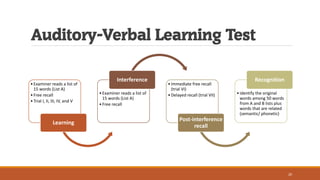
Auditory-Verbal Learning Test
•Examiner reads a list of
15 words (List A)
•Free recall
•Trial I, II, III, IV, and V
Learning
•Examiner reads a list of
15 words (List A)
•Free recall
Interference
•Immediate free recall
(trial VI)
•Delayed recall (trial VII)
Post-interference
recall
•identify the original
words among 50 words
from A and B lists plus
words that are related
(semantic/ phonetic)
Recognition
20
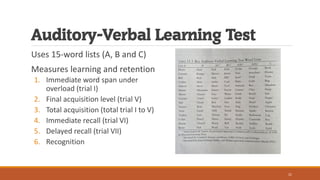
Auditory-Verbal Learning Test
Uses 15-word lists (A, B and C)
Measures learning and retention
1. Immediate word span under
overload (trial I)
2. Final acquisition level (trial V)
3. Total acquisition (total trial I to V)
4. Immediate recall (trial VI)
5. Delayed recall (trial VII)
6. Recognition
21
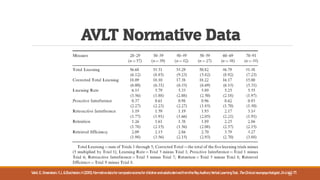
AVLT Normative Data
Vakil,E.,Greenstein, Y.J.,& Blachstein,H.(2010).Normativedataforcompositescoresforchildrenandadultsderived fromtheReyAuditoryVerbal LearningTest. TheClinicalneuropsychologist,244,662-77.22
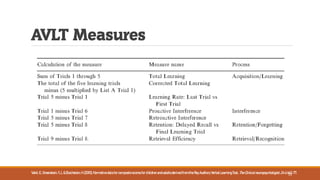
AVLT Measures
Vakil,E.,Greenstein, Y.J.,& Blachstein,H.(2010).Normativedataforcompositescoresforchildrenandadultsderived fromtheReyAuditoryVerbal LearningTest. TheClinicalneuropsychologist,244,662-77.23

Memory assessment

  • 1.
    Neuropsychological Assessment of Memory DRZAHIRUDDIN OTHMAN PSYCHIATRY DEPT, USM 23-09-2018 1
  • 2.
  • 3.
    Understanding Memory 1. Lengthof storage 2. Type of information to be remembered 3. The stages involved in remembering 4. Recall and recognition 5. Explicit and implicit memory 6. Retrospective and prospective memory 3
  • 4.
    Understanding Memory Length of storage ◦Sensory Memory ◦ Iconic Memory ◦ Echoic Memory ◦ Working Memory ◦ Short-term or Immediate Memory ◦ Phonological & visuo-spatial ◦ Long-term Memory ◦ Delayed Memory ◦ Recent Memory ◦ Remote Memory Sensory Memory Iconic Memory (vision) •Capacity: Essentially that of the visual system •Duration: About 0.5 to 1.0 seconds •Processing: None beyond raw perceptual processing Echoic Memory (hearing} •Capacity: ? •Duration: About 4 to 5 seconds •Processing: None beyond raw perceptual processing Short-term memory (STM) a.k.a. working memory •Capacity: About 7 ± 2 "chunks" of information •Duration: About 18 to 20 seconds •Processing: information is often encoded verbally Long-term memory (LTM) •Capacity: Virtually unlimited •Duration: Up to a lifetime •Processing: Information is organized according to meaning and is associatively linked InputAttention Storage Retrieval Rehearsal decay interference retrieval failure Forgetting 4
  • 5.
    Understanding Memory Type ofinformation to be remembered ◦ Declarative / Explicit Memory ◦ Semantic Memory (facts) ◦ Autobiographical Memory ◦ Episodic Memory (events) ◦ Non-declarative / Implicit Memory ◦ Procedural Memory ◦ Classical Conditioning ◦ Non-associative learning 5
  • 6.
    Memory Disturbances Psychological description ◦Length of storage ◦ Immediate / Delayed / Recent / Remote ◦ Type of information lost ◦ Events / Facts / Skills ◦ Stages ◦ Encoding / Storage / Retrieval 6
  • 7.
    Memory Disturbances Clinical description ◦Amnesia / Paramnesia ◦ Transient / Persistent ◦ Acute / Chronic ◦ Retrograde / Anterograde ◦ Symptom / Syndrome / Disorder ◦ Psychological / Organic ◦ Selective / Global 7
  • 8.
    Recall Test Recognition ◦ Identifyingthat the information has been seen/heard before Recall ◦ Reproducing the information from memory 1. Free recall 2. Cued recall ◦ the retrieval of memory with the help of cues, which can be category, first letter, semantic etc. Factors Affecting Recall Attention Motivation Interference Context State- dependent memory 8
  • 9.
    Digit/symbol coding Now lookdown here where the squares have numbers in the top but the squares at the bottom are empty In each of the empty squares, put the mark that should go like this… (examiner puts in the first 4 symbols) 9
  • 10.
    Logical memory I Verbal paired associatesI Design I Visual reproduction I Logical memory II Verbal paired associates II Design II Visual reproduction II Visual Working Memory Spatial addition Symbol span 10
  • 11.
    Logical memory Two shortstories are presented orally The examinee is asked to retell each story from memory immediately after hearing it The examinee is asked to retell both stories Then the examinee is asked yes/no questions about both stories Logical Memory I Logical Memory II narrative 11
  • 12.
    Verbal Paired Associates Theexaminer read 10 or 14 pairs of words Examiner read the first word of each pair, and examinee provide the corresponding word The examinee is orally presented with the first word. Tasks: free, cued and delayed recall. VPA-I VPA-II associated word pairs 12
  • 13.
    Interpretive Considerations: LM andVPA Both (LM & VPA) measure aspects of semantic and auditory memory Presentation of information is organized/ meaningful for LM and unorganized for VPA. VPA requires single word responses; LM requires longer, more cohesive responses. VPA is multi-trial learning measure. For Adult Battery, LM represents single-trial learning ability 13
  • 14.
    Visual Reproduction A seriesof 5 designs is shown, one at a time, for 10 seconds each The examinee is asked to draw the design from memory The examinee is asked to draw the designs from memory in any order The examinee is asked to choose which of 6 designs on a page matches the original design The examinee is asked to draw the designs while looking at them (optional task) VR-I VR-II nonverbal visual stimuli 14
  • 15.
    Design The examiner showsa grid with 4–8 designs for 10 seconds The examinee selects the designs from a set of cards and places them in a grid in the same place as previously shown The examinee is asked to recreate the pages shown with the cards and grid The examinee is shown a series of grids and asked to select the two designs that are correct Design-II unfamiliar visual stimuli Design-I 15
  • 16.
    Interpretive Considerations: VR andDE Both measure aspects of visual details and spatial memory. Response process for VR includes more visual- construction and fine motor abilities than DE. 16
  • 17.
    Spatial Addition Assesses visual-spatialworking memory using a visual addition task. Examiner shows the examinee, sequentially, two grids with blue and red circles. [5 sec.] Then, examiner asks examinee to add or subtract the location of the circles based on a set of rules. 17
  • 18.
    Symbol Span This subtestassesses visual working memory using novel visual stimuli. The examinee is briefly shown a series of abstract symbols on a page and then asked to select the symbols from an array of symbols, in the same order they were presented on the previous page 18
  • 19.
    Interpretive Considerations: SA andSP SA taps spatial location memory and the ability to compare spatial images. SP is highly focused on recall of visual details and the sequence of the images must also be maintained in memory. SA uses a free recall format. SP uses a recognition memory format 19
  • 20.
    Auditory-Verbal Learning Test •Examinerreads a list of 15 words (List A) •Free recall •Trial I, II, III, IV, and V Learning •Examiner reads a list of 15 words (List A) •Free recall Interference •Immediate free recall (trial VI) •Delayed recall (trial VII) Post-interference recall •identify the original words among 50 words from A and B lists plus words that are related (semantic/ phonetic) Recognition 20
  • 21.
    Auditory-Verbal Learning Test Uses15-word lists (A, B and C) Measures learning and retention 1. Immediate word span under overload (trial I) 2. Final acquisition level (trial V) 3. Total acquisition (total trial I to V) 4. Immediate recall (trial VI) 5. Delayed recall (trial VII) 6. Recognition 21
  • 22.
    AVLT Normative Data Vakil,E.,Greenstein,Y.J.,& Blachstein,H.(2010).Normativedataforcompositescoresforchildrenandadultsderived fromtheReyAuditoryVerbal LearningTest. TheClinicalneuropsychologist,244,662-77.22
  • 23.
    AVLT Measures Vakil,E.,Greenstein, Y.J.,&Blachstein,H.(2010).Normativedataforcompositescoresforchildrenandadultsderived fromtheReyAuditoryVerbal LearningTest. TheClinicalneuropsychologist,244,662-77.23