PIEZOSURGERY
CONTENTS
– INTRODUCTION
– HISTORY
– PRINCIPLE OF PIEZOSURGERY
– PIEZOELECTRIC INSTRUMENTS
– CLINICAL USE OF PIEZOSURGERY IN ORAL AND MAXILLOFACIAL SURGERY
– ADVANTAGES
– DISADVANTAGES
INTRODUCTION
– The use of manual instruments such as the chisel,
osteotome or gouge for hard tissue procedures in oral and
maxillofacial surgery has a very long history.
– In recent times, bone surgery - motorized devices that can
run on air pressure or electrical energy.
Eriksson et al. showed that local bone necrosis would
occur in cases where the temperature exceeds 47°C for 1
min due to the contact of rotating tools.
This is of particular importance in the success of dental
implants.
– Motorized devices that make rotary, reciprocal or oscillatory
movements have certain drawbacks that include:
1. Tissue necrosis due to the overheating of bone.
2. A loss of fine-touch sensitivity.
3. Difficulty in the determination of cutting depth.
4. Iatrogenic impairment in undesired areas.
5. The risk of soft tissue injury.
“Piezoelectric bone surgery is a relatively new
alternative for bone-related procedures in oral
and maxillofacial surgery”.
-Tomaso varcellotti
HISTORY
The name Piezo originates from the Greek word
piezein, which means to squeeze or press.
The piezoelectric effect was first proven in 1880
by the brothers Pierre and Jacques Curie.
– Application in surgery by Tomaso Varcellotti
– Patented “piezosurgery”
PRINCIPLE
What is Piezoelectric effect?
– The piezoelectric effect is the creation of electrical tension on some
crystal and ceramic materials such as quarts to which a mechanical
pressure is subsequently applied.
MECHANICAL STRESS
PIEZOELECTRIC MATERIAL
GENERATION OF ELECTRICITY
APPLICATION OF ELECTRICITY
PIEZOELECTRIC MATERIAL
PHYSICAL DEFORMATION
(RESTRAINED)
MECHANICAL FORCE GENERATED
(USEFFUL IN INSTRUMENTS)
– The material in question will expand and then
contract leading to an ultrasonic vibration.
PIEZOSURGERY UNIT
– The piezoelectric unit consists :
1. Piezoelectric handpiece
2. Foot switch
3. Main unit, which supplies power and has
holders for the handpiece and irrigation
fluids.
PIEZOELECTRIC HANDPIECE
MAIN UNIT
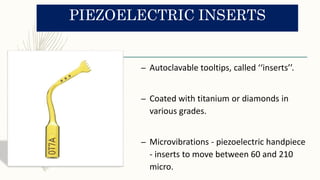
PIEZOELECTRIC INSERTS
– Autoclavable tooltips, called ‘‘inserts’’.
– Coated with titanium or diamonds in
various grades.
– Microvibrations - piezoelectric handpiece
- inserts to move between 60 and 210
micro.
SHARP INSERTS TIPS
– Used in osteotomy- fine and well-defined cut
in the bone structure is required.
– osteoplasty techniques and/or harvesting
bone chips
SMOOTHING INSERTS TIPS
– Used in osteotomy when it is necessary to
prepare difficult and delicate structures.
– E.G. Preparing for a sinus window or
access to a nerve.
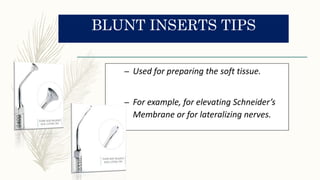
BLUNT INSERTS TIPS
– Used for preparing the soft tissue.
– For example, for elevating Schneider’s
Membrane or for lateralizing nerves.
– GOLD COLOUR- to treat bone.
– STAINLESS STEEL- soft tissue.
Cutting characteristics of piezoelectric devices
Factor affecting cutting characteristics of piezoelectric inserts
1. Bone mineralization (density)
2. Insert design
3. Pressure applied on the handpiece
4. Speed of handpiece movements
CAVITATION EFFECT
– Cavitation is the formation and the
immediate implosion of cavities within a
liquid.
– These bubbles are formed as a
consequence of the forces that are acting
upon a liquid.
Advantage of cavitation effect in piezosurgery
– Good visibility.
– Adequate hemostasis.
– Fragments the cell wall of bacteria.
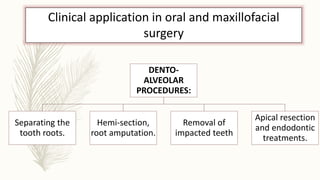
Clinical application in oral and maxillofacial
surgery
DENTO-
ALVEOLAR
PROCEDURES:
Separating the
tooth roots.
Hemi-section,
root amputation.
Removal of
impacted teeth
Apical resection
and endodontic
treatments.
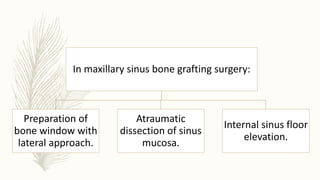
In maxillary sinus bone grafting surgery:
Preparation of
bone window with
lateral approach.
Atraumatic
dissection of sinus
mucosa.
Internal sinus floor
elevation.
In dental
implantology:
Implant socket
preparation.
Alveolar ridge
splitting and
expansion.
Re-contouring
of alveolar crest.
Nerve
reposition.
In maxillofacial
bone surgery:
Harvesting of
autogenous bone
grafts.
Alveolar
decortication and
corticotomy.
Orthognathic
surgery.
Alveolar
distraction.
Removal of cystic
and tumour-like
lesions.
Dental implantology
In dental implantology, piezosurgery is used for:
– Implant site preparation
– Ridge split
– Maxillary sinus lifting
– Six inserts tips available for
implant site preparation.
– Two pilot cylindrical tips.
– Four conical ones, corresponding
to the various implant diameters.
– Allows for the selective enlargement of only one socket wall called
‘differential ultrasonic socket preparation’ by vercellotti.
– Similar primary stability and short-term survival rate of an implant.
– No sign of coagulative necrosis- increase healing.
– Stelzle et al. emphasized that maximum load of 400 g is used during
implant site preparation.
– A total of 3,579 implants were inserted in 1,885 subjects, and the sites were prepared [with
Piezosurgery®] with a 1- to 3-year follow-up.
– No surgical complications related to the UISP protocol were reported for any of the implant
sites [and] an overall implant survival rate of 97.74% (96.99% maxilla, 98.75% mandible).
– Piezosurgery is a predictable method that can be used to perform split-crest
procedures;
1.Risk of bone thermo-necrosis reduced.
2. Reduced risk to the damage of the adjacent soft tissues
Maxillary sinus augmentation
 Used in lateral antrostomy.
 Window preparation- 1. Thin bone- diamond ball smoothing insert
Diamond scalpel
2. Thick bone- osteoplasty insert
Diamond ball smoothing insert
– Initial release of membrane- rounded, dull,
non cutting inserts.
– Saline cavitation- creates small internal
elevation safely.
– The piezoelectric bony window osteotomy easily cuts mineralized tissue without
damaging the soft tissue.
– The piezoelectric sinus membrane elevation separates the schneiderian membrane
without causing perforations resulting in a 95% success rate.
– The average time necessary for the piezoelectric bony window osteotomy was
approximately 3 minutes, while membrane elevation required approximately 5
minutes
– Membrane perforation rate in 100 consecutive cases using the
piezoelectric technique has been reduced from the average reported
rate of 30% with rotary instrumentation to 7%.
– all perforations occurred during the hand instrumentation phase and
not with the piezoelectric inserts
ADVANTAGES
– Selective cutting of bone- pricise and safe window
osteotomy.
– Decreased risk of membrane perforation during
osteotomy and initial release.
– Both open and hinge osteotomy can be done.
ORTHOGNATHIC SURGERY
– Safe & precise osteotomy cut.
– Curvilinear cut possible.
– Loss of bony structure- less as compared conventional rotary
or oscillating instrument.
– Authors recommended as first choice in orthognathic
surgery.
– Higher safety in cutting difficult anatomic zones such as the
lingual aspect of the ascending ramus or the pterygoid fossa.
– Used for sagittal split ramus osteotomies, le fort i osteotomies,
and surgically assisted rapid maxillary expansion and minor
microsurgical procedures
–SARME
Distraction Osteogenesis
Surgical time
– Total surgical time is actually shorter when a piezoelectric
device is used because
1. Less maneuvers to protect the soft tissues.
2. Clearer surgical field.
3. Increased visibility.
Cut quality
– Selective cutting of only mineralized structures
without damaging the elastic soft tissues.
– Reduces damage to the osteocytes.
– Good survival of bone cells.
– No sign of coagulative necrosis.
Nerve injury
– Piezosurgery eliminates trauma to the nerve during the osteotomy.
1. Better surgical control
2. Micro-vibration
3. Rarely requires osteotome for final spilt.
4. Selective cutting of mineralised structure.
– Direct exposure of a peripheral nerve to piezosurgery, even in the worst-case scenarios,
did not dissect the nerve but did induce some structural and functional damage.
– The perineurium of the nerve remained intact even after nerve contact at peak force,
thus enhancing the potential for functional recovery.
– The extent of damage was significantly higher with application of increased force on the
nerve by the device, but not by activation of the ultrasonic vibration.
(1) Minimal risk for soft tissue damaged
(2) Excellent visibility within the surgical
field due to minimal bleeding
(3) Precision and geometric cutting
(4) Low acoustic and vibration impact.
Advantages Disadvantages
(1) Dense bone cutting could take
up to 4 times longer than a
traditional rotary saw
(2) It is necessary to maintain a
stock of tips
(3) Higher cost than mechanical
osteotomes.
 Piezoelectric device allows surgeons to achieve better results compared to a
traditional surgical saw, in terms of
1. Intraoperative blood loss,
2. Postoperative swelling ,
3. Nerve impairment.
 Safer method to perform invasive surgical procedures such as a le fort i osteotomy.
 The use of traditional saw in mandible surgery because it provides more foreseeable
outcomes and well-controlled osteotomy.
– Surgical time reduced as compared to conventional rotary
cutting.
– Low blood loss as compared to conventional.
– Inferior alveolar sensation retained in 97% as compared to
conventional which has 92%, 6 months post-operatively.
BONE HARVESTING
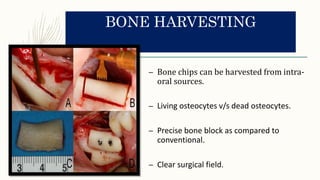
– Bone chips can be harvested from intra-
oral sources.
– Living osteocytes v/s dead osteocytes.
– Precise bone block as compared to
conventional.
– Clear surgical field.
– The Piezosurgery System creates an effective osteotomy with minimal or
no trauma to soft tissue, in contrast to conventional surgical burs or saws.
– In addition, piezoelectric surgery produces less vibration and noise
because it uses microvibration, in contrast to the macrovibration and
extreme noise that occur with a surgical saw or bur.
Sohn et al, Int J Periodontics Restorative Dent 2007; 27(2):127-131
– Precise incision in the bone tissue facilitates the healing process and reduces the
inflammatory reaction while the graft is healing.
– Reduced the surgical time
– Better clinical outcomes in terms of function and tissue esthetics over long-term
observations.
Majewski, int j periodontics restorative dent 2012;32:e210–e217
– In 87.9% of the [Piezosurgery®] specimens, an outgrowth of adherent cells nearby the bone
chips was observed after 6-19 days.
– Confluence of osteoblast reached after 4 weeks.
– The morphometrical analysis revealed a statistically significant more voluminous size of the
particles collected with [Piezosurgery®] than [rotating drills].
Chiriac et al, J Clin Periodontol. 2005; 32(9):994-999
– MONOCORTICAL TOOTH DISLOCATION AND LIGAMENT
DISTRACTION
– Corticotomy - orthodontic movement
– Orthodontic tooth movement time reduced by 60 % in
mandible and 70% in maxilla
RESECTION OF ODONTOGENIC
TUMORS
– The advantage of protection of vital
structures (e.G. Neurovascular bundles)
when surgery is within a close vicinity to
those structures .
ENUCLEATION OF JAW CYST
 Only a small number of applications have
been reported in the literature
 careful removal of the thin bone laminate
that covers the cyst
 meticulous handling of the cyst without
tearing the epithelial wall, reduced
recurrence
Removal Of Impacted Teeth
Used for bone guttering around the impacted tooth.
Frequency-28 to 36 khz.
 Microvibration amplitude between 30 and 60 𝜇m/s.
The mean duration of the operation was longer in the
piezosurgery site than in the control site.
Pain score was significantly lesser in the study site than in the
control site.
Less postoperative swelling.
Better bone healing.
– Pain levels were higher in the control group when compared with the ultrasonic
group.
– Number of analgesics taken in the test group was significantly lower when
compared with the control group.
– Trismus was significantly higher in the control group when compared with the
test group.
– Cheek swelling were higher in the rotary group when compared with the
ultrasound group at the fifth-day visit
ADVANTAGES
Clear vision
Haemostasis
Bone sectioning can be performed with micrometric
sensitivity.
Selective cutting action
Surgical stress: Reduced.
Asepsis: Sterile coolant provides an aseptic
environment (free from contamination.)
Disadvantages
Use in patients with pacemakers is not recommended.
 Purchase of a device may initially be a financial burden.
The duration of the surgical procedure –longer
Learning curve.
conclusion
– piezosurgery is an elegant bone-cutting modality with a
rapidly increasing number of indications in different surgical
fields.
– soft tissue protection, optimal visibility in the surgical field,
decreased blood loss, less vibration and noise, increased
comfort for the patient and protection of tooth structures.
– Many features of piezosurgery need improvement, for
example, the cooling system when preparation is
performed in deep bone structures
– system to indicate the proximity of the instrument tip to
an important anatomical structure, soft tissue or tooth.
REFRENCES

Piezosurgery

  • 2.
  • 3.
    CONTENTS – INTRODUCTION – HISTORY –PRINCIPLE OF PIEZOSURGERY – PIEZOELECTRIC INSTRUMENTS – CLINICAL USE OF PIEZOSURGERY IN ORAL AND MAXILLOFACIAL SURGERY – ADVANTAGES – DISADVANTAGES
  • 4.
    INTRODUCTION – The useof manual instruments such as the chisel, osteotome or gouge for hard tissue procedures in oral and maxillofacial surgery has a very long history. – In recent times, bone surgery - motorized devices that can run on air pressure or electrical energy.
  • 5.
    Eriksson et al.showed that local bone necrosis would occur in cases where the temperature exceeds 47°C for 1 min due to the contact of rotating tools. This is of particular importance in the success of dental implants.
  • 6.
    – Motorized devicesthat make rotary, reciprocal or oscillatory movements have certain drawbacks that include: 1. Tissue necrosis due to the overheating of bone. 2. A loss of fine-touch sensitivity. 3. Difficulty in the determination of cutting depth. 4. Iatrogenic impairment in undesired areas. 5. The risk of soft tissue injury.
  • 7.
    “Piezoelectric bone surgeryis a relatively new alternative for bone-related procedures in oral and maxillofacial surgery”. -Tomaso varcellotti
  • 8.
    HISTORY The name Piezooriginates from the Greek word piezein, which means to squeeze or press. The piezoelectric effect was first proven in 1880 by the brothers Pierre and Jacques Curie.
  • 9.
    – Application insurgery by Tomaso Varcellotti – Patented “piezosurgery”
  • 10.
  • 11.
    What is Piezoelectriceffect? – The piezoelectric effect is the creation of electrical tension on some crystal and ceramic materials such as quarts to which a mechanical pressure is subsequently applied.
  • 12.
  • 13.
    APPLICATION OF ELECTRICITY PIEZOELECTRICMATERIAL PHYSICAL DEFORMATION (RESTRAINED) MECHANICAL FORCE GENERATED (USEFFUL IN INSTRUMENTS)
  • 14.
    – The materialin question will expand and then contract leading to an ultrasonic vibration.
  • 15.
  • 16.
    – The piezoelectricunit consists : 1. Piezoelectric handpiece 2. Foot switch 3. Main unit, which supplies power and has holders for the handpiece and irrigation fluids.
  • 17.
  • 18.
  • 19.
    PIEZOELECTRIC INSERTS – Autoclavabletooltips, called ‘‘inserts’’. – Coated with titanium or diamonds in various grades. – Microvibrations - piezoelectric handpiece - inserts to move between 60 and 210 micro.
  • 21.
    SHARP INSERTS TIPS –Used in osteotomy- fine and well-defined cut in the bone structure is required. – osteoplasty techniques and/or harvesting bone chips
  • 22.
    SMOOTHING INSERTS TIPS –Used in osteotomy when it is necessary to prepare difficult and delicate structures. – E.G. Preparing for a sinus window or access to a nerve.
  • 23.
    BLUNT INSERTS TIPS –Used for preparing the soft tissue. – For example, for elevating Schneider’s Membrane or for lateralizing nerves.
  • 24.
    – GOLD COLOUR-to treat bone. – STAINLESS STEEL- soft tissue.
  • 25.
    Cutting characteristics ofpiezoelectric devices Factor affecting cutting characteristics of piezoelectric inserts 1. Bone mineralization (density) 2. Insert design 3. Pressure applied on the handpiece 4. Speed of handpiece movements
  • 26.
    CAVITATION EFFECT – Cavitationis the formation and the immediate implosion of cavities within a liquid. – These bubbles are formed as a consequence of the forces that are acting upon a liquid.
  • 27.
    Advantage of cavitationeffect in piezosurgery – Good visibility. – Adequate hemostasis. – Fragments the cell wall of bacteria.
  • 28.
    Clinical application inoral and maxillofacial surgery DENTO- ALVEOLAR PROCEDURES: Separating the tooth roots. Hemi-section, root amputation. Removal of impacted teeth Apical resection and endodontic treatments.
  • 29.
    In maxillary sinusbone grafting surgery: Preparation of bone window with lateral approach. Atraumatic dissection of sinus mucosa. Internal sinus floor elevation.
  • 30.
    In dental implantology: Implant socket preparation. Alveolarridge splitting and expansion. Re-contouring of alveolar crest. Nerve reposition.
  • 31.
    In maxillofacial bone surgery: Harvestingof autogenous bone grafts. Alveolar decortication and corticotomy. Orthognathic surgery. Alveolar distraction. Removal of cystic and tumour-like lesions.
  • 32.
    Dental implantology In dentalimplantology, piezosurgery is used for: – Implant site preparation – Ridge split – Maxillary sinus lifting
  • 33.
    – Six insertstips available for implant site preparation. – Two pilot cylindrical tips. – Four conical ones, corresponding to the various implant diameters.
  • 35.
    – Allows forthe selective enlargement of only one socket wall called ‘differential ultrasonic socket preparation’ by vercellotti. – Similar primary stability and short-term survival rate of an implant. – No sign of coagulative necrosis- increase healing. – Stelzle et al. emphasized that maximum load of 400 g is used during implant site preparation.
  • 36.
    – A totalof 3,579 implants were inserted in 1,885 subjects, and the sites were prepared [with Piezosurgery®] with a 1- to 3-year follow-up. – No surgical complications related to the UISP protocol were reported for any of the implant sites [and] an overall implant survival rate of 97.74% (96.99% maxilla, 98.75% mandible).
  • 37.
    – Piezosurgery isa predictable method that can be used to perform split-crest procedures; 1.Risk of bone thermo-necrosis reduced. 2. Reduced risk to the damage of the adjacent soft tissues
  • 39.
    Maxillary sinus augmentation Used in lateral antrostomy.  Window preparation- 1. Thin bone- diamond ball smoothing insert Diamond scalpel 2. Thick bone- osteoplasty insert Diamond ball smoothing insert
  • 43.
    – Initial releaseof membrane- rounded, dull, non cutting inserts. – Saline cavitation- creates small internal elevation safely.
  • 44.
    – The piezoelectricbony window osteotomy easily cuts mineralized tissue without damaging the soft tissue. – The piezoelectric sinus membrane elevation separates the schneiderian membrane without causing perforations resulting in a 95% success rate. – The average time necessary for the piezoelectric bony window osteotomy was approximately 3 minutes, while membrane elevation required approximately 5 minutes
  • 45.
    – Membrane perforationrate in 100 consecutive cases using the piezoelectric technique has been reduced from the average reported rate of 30% with rotary instrumentation to 7%. – all perforations occurred during the hand instrumentation phase and not with the piezoelectric inserts
  • 46.
    ADVANTAGES – Selective cuttingof bone- pricise and safe window osteotomy. – Decreased risk of membrane perforation during osteotomy and initial release. – Both open and hinge osteotomy can be done.
  • 47.
    ORTHOGNATHIC SURGERY – Safe& precise osteotomy cut. – Curvilinear cut possible. – Loss of bony structure- less as compared conventional rotary or oscillating instrument. – Authors recommended as first choice in orthognathic surgery.
  • 48.
    – Higher safetyin cutting difficult anatomic zones such as the lingual aspect of the ascending ramus or the pterygoid fossa. – Used for sagittal split ramus osteotomies, le fort i osteotomies, and surgically assisted rapid maxillary expansion and minor microsurgical procedures
  • 50.
  • 52.
  • 53.
    Surgical time – Totalsurgical time is actually shorter when a piezoelectric device is used because 1. Less maneuvers to protect the soft tissues. 2. Clearer surgical field. 3. Increased visibility.
  • 54.
    Cut quality – Selectivecutting of only mineralized structures without damaging the elastic soft tissues. – Reduces damage to the osteocytes. – Good survival of bone cells. – No sign of coagulative necrosis.
  • 55.
    Nerve injury – Piezosurgeryeliminates trauma to the nerve during the osteotomy. 1. Better surgical control 2. Micro-vibration 3. Rarely requires osteotome for final spilt. 4. Selective cutting of mineralised structure.
  • 56.
    – Direct exposureof a peripheral nerve to piezosurgery, even in the worst-case scenarios, did not dissect the nerve but did induce some structural and functional damage. – The perineurium of the nerve remained intact even after nerve contact at peak force, thus enhancing the potential for functional recovery. – The extent of damage was significantly higher with application of increased force on the nerve by the device, but not by activation of the ultrasonic vibration.
  • 57.
    (1) Minimal riskfor soft tissue damaged (2) Excellent visibility within the surgical field due to minimal bleeding (3) Precision and geometric cutting (4) Low acoustic and vibration impact. Advantages Disadvantages (1) Dense bone cutting could take up to 4 times longer than a traditional rotary saw (2) It is necessary to maintain a stock of tips (3) Higher cost than mechanical osteotomes.
  • 58.
     Piezoelectric deviceallows surgeons to achieve better results compared to a traditional surgical saw, in terms of 1. Intraoperative blood loss, 2. Postoperative swelling , 3. Nerve impairment.  Safer method to perform invasive surgical procedures such as a le fort i osteotomy.  The use of traditional saw in mandible surgery because it provides more foreseeable outcomes and well-controlled osteotomy.
  • 59.
    – Surgical timereduced as compared to conventional rotary cutting. – Low blood loss as compared to conventional. – Inferior alveolar sensation retained in 97% as compared to conventional which has 92%, 6 months post-operatively.
  • 60.
    BONE HARVESTING – Bonechips can be harvested from intra- oral sources. – Living osteocytes v/s dead osteocytes. – Precise bone block as compared to conventional. – Clear surgical field.
  • 62.
    – The PiezosurgerySystem creates an effective osteotomy with minimal or no trauma to soft tissue, in contrast to conventional surgical burs or saws. – In addition, piezoelectric surgery produces less vibration and noise because it uses microvibration, in contrast to the macrovibration and extreme noise that occur with a surgical saw or bur. Sohn et al, Int J Periodontics Restorative Dent 2007; 27(2):127-131
  • 63.
    – Precise incisionin the bone tissue facilitates the healing process and reduces the inflammatory reaction while the graft is healing. – Reduced the surgical time – Better clinical outcomes in terms of function and tissue esthetics over long-term observations. Majewski, int j periodontics restorative dent 2012;32:e210–e217
  • 64.
    – In 87.9%of the [Piezosurgery®] specimens, an outgrowth of adherent cells nearby the bone chips was observed after 6-19 days. – Confluence of osteoblast reached after 4 weeks. – The morphometrical analysis revealed a statistically significant more voluminous size of the particles collected with [Piezosurgery®] than [rotating drills]. Chiriac et al, J Clin Periodontol. 2005; 32(9):994-999
  • 65.
    – MONOCORTICAL TOOTHDISLOCATION AND LIGAMENT DISTRACTION – Corticotomy - orthodontic movement – Orthodontic tooth movement time reduced by 60 % in mandible and 70% in maxilla
  • 69.
    RESECTION OF ODONTOGENIC TUMORS –The advantage of protection of vital structures (e.G. Neurovascular bundles) when surgery is within a close vicinity to those structures .
  • 70.
    ENUCLEATION OF JAWCYST  Only a small number of applications have been reported in the literature  careful removal of the thin bone laminate that covers the cyst  meticulous handling of the cyst without tearing the epithelial wall, reduced recurrence
  • 71.
    Removal Of ImpactedTeeth Used for bone guttering around the impacted tooth. Frequency-28 to 36 khz.  Microvibration amplitude between 30 and 60 𝜇m/s.
  • 73.
    The mean durationof the operation was longer in the piezosurgery site than in the control site. Pain score was significantly lesser in the study site than in the control site. Less postoperative swelling. Better bone healing.
  • 74.
    – Pain levelswere higher in the control group when compared with the ultrasonic group. – Number of analgesics taken in the test group was significantly lower when compared with the control group. – Trismus was significantly higher in the control group when compared with the test group. – Cheek swelling were higher in the rotary group when compared with the ultrasound group at the fifth-day visit
  • 75.
    ADVANTAGES Clear vision Haemostasis Bone sectioningcan be performed with micrometric sensitivity. Selective cutting action
  • 76.
    Surgical stress: Reduced. Asepsis:Sterile coolant provides an aseptic environment (free from contamination.)
  • 77.
    Disadvantages Use in patientswith pacemakers is not recommended.  Purchase of a device may initially be a financial burden. The duration of the surgical procedure –longer Learning curve.
  • 78.
    conclusion – piezosurgery isan elegant bone-cutting modality with a rapidly increasing number of indications in different surgical fields. – soft tissue protection, optimal visibility in the surgical field, decreased blood loss, less vibration and noise, increased comfort for the patient and protection of tooth structures.
  • 79.
    – Many featuresof piezosurgery need improvement, for example, the cooling system when preparation is performed in deep bone structures – system to indicate the proximity of the instrument tip to an important anatomical structure, soft tissue or tooth.
  • 80.

Editor's Notes

  • #7 2. due to the requirement of pressure on the handpiece. 4. due to a failure in the accurate adjustment of the speed of a rotating head or saw 5. to important anatomical structures, such as the inferior alveolar nerve or maxillary sinus.
  • #19 It contains a peristaltic pump for cooling with a jet of solution that discharges from the insert with an adjustable flow of 0—60 ml/min and removes detritus from the cutting area. The settings of power and frequency modulation of the device can be selected on a control panel with a digital display and a keypad according to the planned task. The unit uses a frequency of 25—29 kHz. In ‘‘boosted’’ mode, a digital modulation of this oscillation produces an alternation of high frequency vibrations with pauses at a frequency of up to 30 Hz. This alternation prevents the insert from impacting the bone and avoids overheating while maintaining optimum cutting capacity
  • #26 Low frequency of vibrations may be chosen in low mineralized bone, whereas high frequency of vibrations, up to 30 Hz, may be chosen in highly mineralized bone
  • #54 because are required
  • #55 induces an earlier increase in bone morphogenetic proteins, controls the inflammatory process better, and stimulates remodeling of bone.
  • #61 favouring the use of piezosurgery with regards to the number of living cells, such as osteocytes18, and others that scrutinize the use of piezosurgery owing to the lower percentage of living cells when compared with conventional techniques
  • #76 of the surgical area from the pressurized irrigation and cavitation effect. is ensured through the cavitation effect. sectioning does not damage the adjacent soft tissue.
  • #77 1. The cutting action is less invasive, producing less collateral tissue damage, which results in excellent tissue healing.