Presented By ;
Kamlesh Kumar
Gadri
Final Year
PIEZOELECTRIC
SURGERY
The word piezoelectricity means electricity resulting from
pressure.
The instruments used for ultrasonic cutting of bone
create microvibration that are caused by the
piezoelectric effect first described by the French
physicists Jean and Marie Curie, in 1880.
• Dr. Tomaso Vercellotti (1988): • Invented the
Piezosurgery device using a modulated functional
working frequency of 25- 30 kHz.
 First experiences with a new technique BMC Musculoskeletal
Disorders 2006, performed the first ultrasound osteotomy in hand
surgery.
 The piezosurgery device uses low-frequency piezoelectric
ultrasonic vibrations precisely cutting the bone without cutting
the soft tissue
 Piezosurgery’s patented, controlled three-dimensional
ultrasound vibrations open up a new age for Periodontology,
Implantology, Endodontics and Surgical orthodontics
FEATURES OF PIEZOELECTRIC SURGERY
1. Nerves, vessels, and soft tissue are not injured by the
microvibrations (60 to 200 mm/sec), which are optimally adjusted to
target only mineralized tissue.
2. Bone healing was good and at no point were there
any Neurovascular disturbances.
3. The Piezosurgery System creates an effective osteotomy with
minimal or no trauma to soft tissue, in contrast to conventional
surgical burs or saws.
4. In addition, piezoelectric surgery produces less vibration
and noise because it uses microvibration.
5. Piezosurgery allowed precise, clean, and smooth cutting,
all with excellent visibility and provides a more favorable
osseous repair and remodeling than harvesting with carbide
or diamond burs.
6. The device allows for precise removal of bone, with
minimal risk of injury to underlying root surfaces.
7. Piezoelectric devices are an innovative ultrasonic technique
for safe and effective osteotomy or osteoplasty compared with
traditional hard and soft tissue methods that use rotating
instruments because of the absence of macrovibrations, ease
of use and control, and safer cutting, particularly in complex
anatomical areas.
COMPONENTS OF PIEZOELECTRIC DEVICE
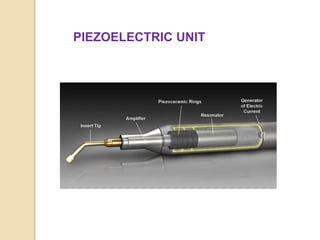
1.The piezosurgery unit is composed of the main body,
activated with a pedal, a handle, and number of inserts with
different shapes depending on the surgical need.
2.Main Body The main body has a display, an electronic
touchpad, a peristaltic pump, one stand for the handle and
another to hold the bag containing irrigation fluid. The
interactive touchpad has four keys that enable to select the
feature mode, the specific program and the flow of the
flowing cooling liquid.
There are two primary operating modes:
a. Root Mode
b. Bone Mode
1 .Root Mode = The vibrations generated by selecting root mode are
characterized by average ultrasonic power without frequency over
modulation Two different programs:
A. ENDO Program: a limited level of power provided by applying
reduced electrical tension to the transducer, which generates insert
oscillation by a few microns. These mechanical microvibrations are
optimal for washing out the apical part of the root canal in
endodontic surgery
B. PERIO Program: an intermediate level of power between the endo
program and the bone program. The ultrasonic wave is transmitted
through the transducer in continuous sinusoidal manner characterized
by a frequency equal to the resonance frequency of the insert used.
2.BONE MODE :-
• The vibrations generated by selecting bone mode are
characterized as follows: extremely high ultrasonic power
compared to root mode. Its performance is monitored by several
sophisticated software and hardware controls.
• Frequency over modulation gives the ultrasonic mechanical
vibrations its unique nature for cutting different kinds of bone.
• The selection recommended is:-
- for cutting the cortical bone or high density spongy bone.
- for cutting low density spongy bone.
SHARP TIP INSERTS
INSERT TIPS
• The sharp edge of the insert tips enables gentle and
effective treatment of the bony structures.
• Sharp insert tips are used in osteotomy whenever a fine
and well- defined cut in the bone structure is required.
• There are also insert tips with sharp edges that are used
for osteoplasty techniques and/or harvesting bone chips.
Gold colour is used for all insert tips used to treat bone.
• The gold color of the insert tips is obtained by applying a coating of
titanium nitride to improve the surface hardness which means a longer
working life.
• Steel is used for all insert tips used to treat soft tissue or delicate
surfaces such as the roots of teeth.
INSER
T TIPS
PIEZOELECTRIC UNIT
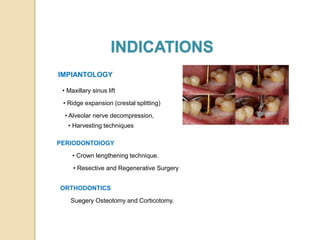
INDICATIONS
IMPIANTOLOGY
• Maxillary sinus lift
• Ridge expansion (crestal splitting)
• Alveolar nerve decompression,
• Harvesting techniques
• Crown lengthening technique.
PERIODONTOIOGY
• Resective and Regenerative Surgery
ORTHODONTICS
Suegery Osteotomy and Corticotomy.
ORAL SURGERY
• Dental extraction
• Third molar extraction
• Osteogenic distraction, RGE
• Cyst removal
• Endodontic surgery,
• Bone harvesting (chips and blocks)
ORTHODONTICS
Suegery Osteotomy and Corticotomy.
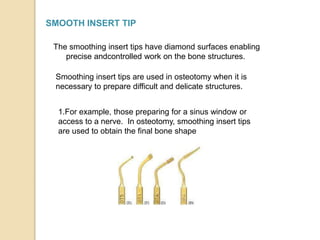
SMOOTH INSERT TIP
The smoothing insert tips have diamond surfaces enabling
precise andcontrolled work on the bone structures.
Smoothing insert tips are used in osteotomy when it is
necessary to prepare difficult and delicate structures.
1.For example, those preparing for a sinus window or
access to a nerve. In osteotomy, smoothing insert tips
are used to obtain the final bone shape
BLUNT INSERT TIP
MECHANISM OF ACTION
1. MICROMETRIC CUTTING ACTION
2. SELECTIVE CUTTING ACTION
3. CAVITATION EFFECT
BIOLOGICAL EFFECTS ON BONE CUT BY A PIEZOELECTRIC DEVICE
1. The effects of mechanical instruments on the structure of bone and the viability of cells is
important in regenerative surgery.
2. Relatively high temperatures, applied even for a short time, are dangerous to cells and
cause necrosis of tissue.
ADVANTAGES
1. Selective cutting action: minimum soft tissue damage - ultrasonic frequency used does
not cut soft tissue
2. Maximum intra-operative visibility (cavitation effect)
3. Minimum surgical stress - Excellent tissue healing .
4. The cutting action is less invasive, producing less collateral tissue damage, which
results in faster healing.
5. Sterile water environment for better asepsis (free from contamination).
6. Can be used in both Local or general anesthesia
7. It can be used even for minor operations
8. Can be used , Exact , Clean , and Smooth due to its geometrices during surgery due to its
precise nature of the instruments .
9 Excellent wound heading post operativeiy with no nerve and soft
tissue injuries have been hardly reported .
Disadvantages/Limitations
• Low effciency/increased operating time: One of the major
drawbacks with ultrasonic/piezo surgery osteotomes is
the increased time required for the procedure.
• Expense: The cost of equipment is sometimes an addi-
tional burden to the provider. Each individual cutting tip
in a piezosurgery equipment setup is generally more
expensive than traditional cutting tools such as burs,
chis-
els, or saw blades
• Learning curve: Use of piezo requires a short learning
curve to attain maximum effcacy, which could be frustrat-
ing to the operator. The digital pressure applied by the sur-
geon while using conventional tools such as saws and
drills is quite different from piezoelectric surgery as it
mandates less pressure and failing to calculate the pressure
according to the speed of the insert prevents microvibra-
tions of the insert.
THANK YOU

PIEZOELECTRIC SURGERY-

  • 1.
    Presented By ; KamleshKumar Gadri Final Year
  • 2.
    PIEZOELECTRIC SURGERY The word piezoelectricitymeans electricity resulting from pressure. The instruments used for ultrasonic cutting of bone create microvibration that are caused by the piezoelectric effect first described by the French physicists Jean and Marie Curie, in 1880. • Dr. Tomaso Vercellotti (1988): • Invented the Piezosurgery device using a modulated functional working frequency of 25- 30 kHz.
  • 3.
     First experienceswith a new technique BMC Musculoskeletal Disorders 2006, performed the first ultrasound osteotomy in hand surgery.  The piezosurgery device uses low-frequency piezoelectric ultrasonic vibrations precisely cutting the bone without cutting the soft tissue  Piezosurgery’s patented, controlled three-dimensional ultrasound vibrations open up a new age for Periodontology, Implantology, Endodontics and Surgical orthodontics
  • 4.
    FEATURES OF PIEZOELECTRICSURGERY 1. Nerves, vessels, and soft tissue are not injured by the microvibrations (60 to 200 mm/sec), which are optimally adjusted to target only mineralized tissue. 2. Bone healing was good and at no point were there any Neurovascular disturbances. 3. The Piezosurgery System creates an effective osteotomy with minimal or no trauma to soft tissue, in contrast to conventional surgical burs or saws.
  • 5.
    4. In addition,piezoelectric surgery produces less vibration and noise because it uses microvibration. 5. Piezosurgery allowed precise, clean, and smooth cutting, all with excellent visibility and provides a more favorable osseous repair and remodeling than harvesting with carbide or diamond burs. 6. The device allows for precise removal of bone, with minimal risk of injury to underlying root surfaces. 7. Piezoelectric devices are an innovative ultrasonic technique for safe and effective osteotomy or osteoplasty compared with traditional hard and soft tissue methods that use rotating instruments because of the absence of macrovibrations, ease of use and control, and safer cutting, particularly in complex anatomical areas.
  • 6.
    COMPONENTS OF PIEZOELECTRICDEVICE 1.The piezosurgery unit is composed of the main body, activated with a pedal, a handle, and number of inserts with different shapes depending on the surgical need. 2.Main Body The main body has a display, an electronic touchpad, a peristaltic pump, one stand for the handle and another to hold the bag containing irrigation fluid. The interactive touchpad has four keys that enable to select the feature mode, the specific program and the flow of the flowing cooling liquid. There are two primary operating modes: a. Root Mode b. Bone Mode
  • 7.
    1 .Root Mode= The vibrations generated by selecting root mode are characterized by average ultrasonic power without frequency over modulation Two different programs: A. ENDO Program: a limited level of power provided by applying reduced electrical tension to the transducer, which generates insert oscillation by a few microns. These mechanical microvibrations are optimal for washing out the apical part of the root canal in endodontic surgery B. PERIO Program: an intermediate level of power between the endo program and the bone program. The ultrasonic wave is transmitted through the transducer in continuous sinusoidal manner characterized by a frequency equal to the resonance frequency of the insert used.
  • 8.
    2.BONE MODE :- •The vibrations generated by selecting bone mode are characterized as follows: extremely high ultrasonic power compared to root mode. Its performance is monitored by several sophisticated software and hardware controls. • Frequency over modulation gives the ultrasonic mechanical vibrations its unique nature for cutting different kinds of bone. • The selection recommended is:- - for cutting the cortical bone or high density spongy bone. - for cutting low density spongy bone.
  • 9.
    SHARP TIP INSERTS INSERTTIPS • The sharp edge of the insert tips enables gentle and effective treatment of the bony structures. • Sharp insert tips are used in osteotomy whenever a fine and well- defined cut in the bone structure is required. • There are also insert tips with sharp edges that are used for osteoplasty techniques and/or harvesting bone chips. Gold colour is used for all insert tips used to treat bone. • The gold color of the insert tips is obtained by applying a coating of titanium nitride to improve the surface hardness which means a longer working life. • Steel is used for all insert tips used to treat soft tissue or delicate surfaces such as the roots of teeth.
  • 10.
  • 11.
  • 13.
    INDICATIONS IMPIANTOLOGY • Maxillary sinuslift • Ridge expansion (crestal splitting) • Alveolar nerve decompression, • Harvesting techniques • Crown lengthening technique. PERIODONTOIOGY • Resective and Regenerative Surgery ORTHODONTICS Suegery Osteotomy and Corticotomy.
  • 14.
    ORAL SURGERY • Dentalextraction • Third molar extraction • Osteogenic distraction, RGE • Cyst removal • Endodontic surgery, • Bone harvesting (chips and blocks) ORTHODONTICS Suegery Osteotomy and Corticotomy.
  • 15.
    SMOOTH INSERT TIP Thesmoothing insert tips have diamond surfaces enabling precise andcontrolled work on the bone structures. Smoothing insert tips are used in osteotomy when it is necessary to prepare difficult and delicate structures. 1.For example, those preparing for a sinus window or access to a nerve. In osteotomy, smoothing insert tips are used to obtain the final bone shape
  • 16.
  • 17.
    MECHANISM OF ACTION 1.MICROMETRIC CUTTING ACTION 2. SELECTIVE CUTTING ACTION 3. CAVITATION EFFECT BIOLOGICAL EFFECTS ON BONE CUT BY A PIEZOELECTRIC DEVICE 1. The effects of mechanical instruments on the structure of bone and the viability of cells is important in regenerative surgery. 2. Relatively high temperatures, applied even for a short time, are dangerous to cells and cause necrosis of tissue.
  • 18.
    ADVANTAGES 1. Selective cuttingaction: minimum soft tissue damage - ultrasonic frequency used does not cut soft tissue 2. Maximum intra-operative visibility (cavitation effect) 3. Minimum surgical stress - Excellent tissue healing . 4. The cutting action is less invasive, producing less collateral tissue damage, which results in faster healing. 5. Sterile water environment for better asepsis (free from contamination). 6. Can be used in both Local or general anesthesia 7. It can be used even for minor operations 8. Can be used , Exact , Clean , and Smooth due to its geometrices during surgery due to its precise nature of the instruments . 9 Excellent wound heading post operativeiy with no nerve and soft tissue injuries have been hardly reported .
  • 19.
    Disadvantages/Limitations • Low effciency/increasedoperating time: One of the major drawbacks with ultrasonic/piezo surgery osteotomes is the increased time required for the procedure. • Expense: The cost of equipment is sometimes an addi- tional burden to the provider. Each individual cutting tip in a piezosurgery equipment setup is generally more expensive than traditional cutting tools such as burs, chis- els, or saw blades • Learning curve: Use of piezo requires a short learning curve to attain maximum effcacy, which could be frustrat- ing to the operator. The digital pressure applied by the sur- geon while using conventional tools such as saws and drills is quite different from piezoelectric surgery as it mandates less pressure and failing to calculate the pressure according to the speed of the insert prevents microvibra- tions of the insert.
  • 20.