Presented By :
Sahal Abu
IV th year
BDS Part A
LASERSANDIT’ZUSESIN DENTISTRY
• Introduction
• History
• Fundamentals Of Laser Operation
• Classification Of Lasers
• Current Uses
• Technique For Use Of Laser In OMFS
• Laser Safety
• Conclusion
Introduction
• Advances in technology are increasing and changing the
ways that patient experience dental treatment. Technology
helps to reduce treatment time and treatment more
comfortable.
• One of the milestones in technological advancements in
dentistry is the use of LASERS.
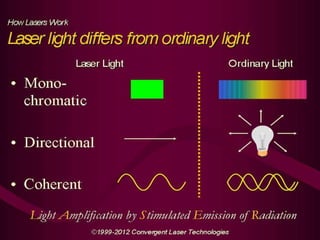
• The term Laser is the acronym for “Light Amplification by
Stimulated Emission of Radiation”.
• They provide more efficient , more comfortable and more
predictable outcomes for the patient.
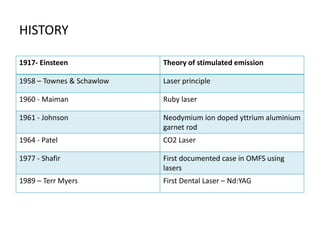
HISTORY
1917- Einsteen Theory of stimulated emission
1958 – Townes & Schawlow Laser principle
1960 - Maiman Ruby laser
1961 - Johnson Neodymium ion doped yttrium aluminium
garnet rod
1964 - Patel CO2 Laser
1977 - Shafir First documented case in OMFS using
lasers
1989 – Terr Myers First Dental Laser – Nd:YAG
Fundamentals Of Laser Operation
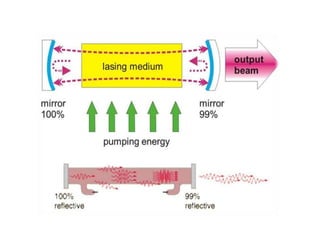
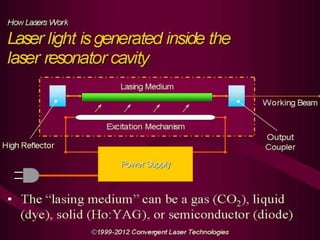
• Components -
Active medium [ Lasing Medium ]
Pumping mechanism
Optical Resonators
Laser Delivery System
Cooling system
Control Panel
Properties Of LASER
Monochromaticity
Directionality
Coherence
Brightness
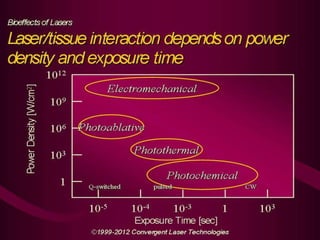
Photobiology Of Lasers
• Photochemical
Biostimulation - Stimulatory effects of laser
on biochemical and molecular processes that
normally occur in tissues such as healing and
repair.
Photodynamic Therapy – induce reactions in
tissues for the treatment of pathologic condition.
Tissue fluorescence - used as a diagnostic
method to detect light reactive substance in
tissue.
• Photo thermal interactions-
Photo ablation – removal of tissue by
vaporization and super heating of tissue fluids
, coagulation, and hemostasis.
Photopyrolysis
• Photomechanical
Photo disruption - breaking apart of
structures by laser light.
Photoaccoustic interaction- involve
removal of tissue with shock wave generation.
• Photoelectrical Interaction- include
photoplasmolysis which describes how tissue
is removed through the formation of
electrically charged ions and particles that
exist in a semi gaseous high energy state.
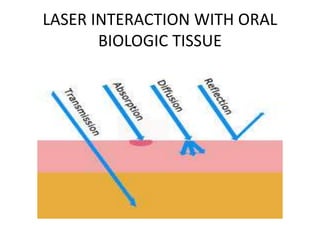
LASER INTERACTION WITH ORAL
BIOLOGIC TISSUE
• Photocoagulation : Laser heats the tissues to 60
deg C for a limited time leading to coagulation of the
tissues with minimal alteration in the appearance of
tissue structure. As a result of these proteins
enzymes cytokines and other bio active molecules
get denatured.
Classification Of Lasers
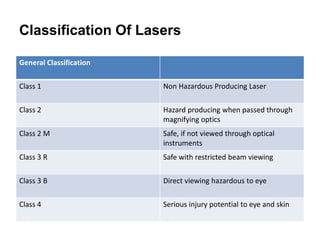
General Classification
Class 1 Non Hazardous Producing Laser
Class 2 Hazard producing when passed through
magnifying optics
Class 2 M Safe, if not viewed through optical
instruments
Class 3 R Safe with restricted beam viewing
Class 3 B Direct viewing hazardous to eye
Class 4 Serious injury potential to eye and skin
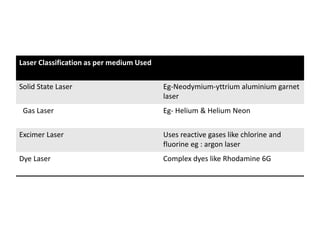
Laser Classification as per medium Used
Solid State Laser Eg-Neodymium-yttrium aluminium garnet
laser
Gas Laser Eg- Helium & Helium Neon
Excimer Laser Uses reactive gases like chlorine and
fluorine eg : argon laser
Dye Laser Complex dyes like Rhodamine 6G
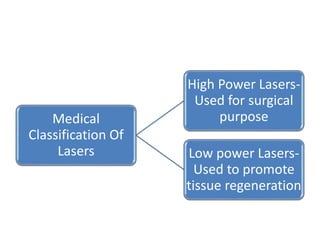
Medical
Classification Of
Lasers
High Power Lasers-
Used for surgical
purpose
Low power Lasers-
Used to promote
tissue regeneration
General Medical Uses Of Laser
• Angioplasty
• Cancer diagnosis
• Cancer treatment
• Laser hair removal , tattoo removal
• Dermatology
• Medical imaging
• Microscopy
• Ophthalmology
• Optical coherence tomography
• Prostatectomy
• Surgery
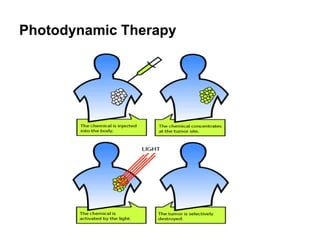
Photodynamic Therapy
Uses In Dentistry
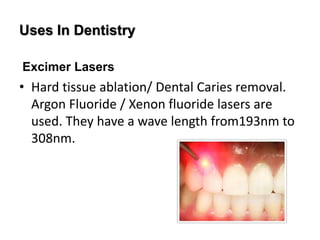
Excimer Lasers
• Hard tissue ablation/ Dental Caries removal.
Argon Fluoride / Xenon fluoride lasers are
used. They have a wave length from193nm to
308nm.
Gas Laser
• Carbon dioxide lasers are used for intra oral and
implant soft tissue surgery , aphthous ulcer ,
melanin pigmentation. Has a wavelength of
10600nm. Color- Infrared
• Helium Neon Lasers has a wavelength of 637nm
and is used for dentin hypersensitivity , analgesia
etc. Color-Red
• Argon lasers having a wavelength of 488nm & are
used for tooth whitening , curing of composites ,
curettage etc Color-Blue
Diode Lasers
• Indium Gallium Arsenide Phosphorous are
used for caries and calculus detection and has
wavelength of 655nm. The color of the laser is
Red.
• Gallium Aluminum Laser – Intra oral Surgery ,
Implant soft tissue surgery , sulcular
debridement , Pulpotomy , root canal
disinfection removal of enamel caries etc,
Wavelength- 840nm Color-Infrared
Solid state Laser
• Neodymium:YAG Laser – Intra oral soft tissue
surgery , sulcular debridement , analgesia ,
Pulpotomy , root canal treatment, removal of
gingival melanin pigmentation . Has a wave
length of 1064nm and is infrared.
Erbium Group
• Erbium:YAG is used for modification of enamel and
dentin surface , implant soft tissue surgery , sulcular
debridement , osseous surgery , treatment of dentin
hypersensitivity , apthous ulcer treatment etc
Techniques For Incisional Biopsy
• Provide local or general anesthesia.
• Outline the intended superficial incision line without deep
penetration.
• Connect the outline marks.
• Excise the specimen.
• Obtain Homeostasis.
• Consider the need for suturing.
• Consider tagging the biopsy margins.
Lesions treated
• Fibroma
• Mucocele
• Papilloma
• Gingival lesion
• Salivary stones
• Malignancy removal
• Vestibuloplasty
• Incisional and excisional biopsy
• Tongue lesion treatment
Technique for ablation and vaporization
• Laser vaporization is an effective , non-morbid ,
inexpensive , quick , and relatively painless method of
managing pre malignant lesions.
• A spot size of 1.5 to 3mm is typical for most intra oral
vaporization procedures. The beam is transverse in
vertical strokes.
• A constant speed must be maintained to create a
uniform depth. Increasing depth can be accomplished by
increasing power.
• Allows for removal of a surface lesion in layers.
Uses Of Laser Ablation
• Solar chelitis
• Leukoplakia
• Dysplasia
• Lichen Planus
• Oral melanosis
• Nicotine stomatitis
• Tissue hyperplasia
• Lasers are also used in arthroscopic
surgery of TMJ
• Scar revision is also made possible
these days with the help of pulsed dye
lasers[PDL]. PDL have hb as their
chromophores and penetrate the
epidermis without de-epithelisation.
They reduce scar tissue erythema and
induce collagen remodeling to flatten
and soften scars. Indicated in cases
Low level Laser therapy
• Also known as therapeutic laser treatment.
• Promotes tissue healing , reduces edema ,
inflammation and pain.
• Used in cases of – dermatological conditions , neural
ailments , mucoskeletal ailments etc
• Easy and safe to handle
• Improved surgical versality- ability to vaporize coagulate
and incise tissue.
• Reduces / Eliminate bleeding.
• Spot coagulation and vaporization gives excellent
hemostasis.
• Reduces Operating Time.
• Anesthesia free soft and hard tissue cutting
• No need for suturing
• Instant sterilization of surgical site
• No sensory disturbances
• No functional /mobility disorder
Demerits
• Cannot be used in teeth with restoration and
prosthesis.
• Hazard to patient , operating and assisting team.
• Maintenance requirements
• Electrical hazards of laser equipments
• Expense of laser equipments
• Specialized arrangements
• Fire hazards
Laser Hazards
• Primary Hazards: Caused directly by laser beam.
Endangers mainly two organs- Eyes and Skin
In case of eyes it damages retina , cornea , & the lens and
slight carelessness can destroy vision permanently.
• Secondary Hazards : Its related to operation of the laser and
are independent of radiation characteristics.
Operating Room Safety
• Use of non inflammable materials
• Use of eye shields for the patient
• Use of laser resistant shielding materials for
surgical field and for protecting anesthesia
equipments
• Certain anesthesia techniques may also
decrease potential hazard
Patient Safety
Personnel Safety
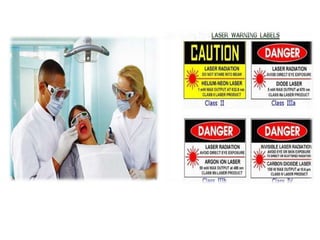
• Post signs that lasers are being used
• Eye shields to be worn by all personnel in
operating room
• Safety shields must be used
• A laser safety officer should be stationed at the
laser unit
• Use only wet cloth in operative field
• Use only non-combustible anesthetic agent
• Avoid alcohol based topical anesthetic and gauze
• Protect tissues adjacent to surgical site
Sterilization And Infection Control Of
Laser Unit
• Steam sterilization is the standard of care
• Protective housing around the laser and
articulating arm should receive spray
disinfectant
Conclusion
• The past decade has seen a variable explosion
of research into clinical application of lasers in
dental practice. Laser treatment not only is
helpful in treating general problems of the
teeth but also helps to reduce the fear and
anxiety of the patient towards the treatment.
Lasers and Its Use In Dentistry

Lasers and Its Use In Dentistry

  • 1.
    Presented By : SahalAbu IV th year BDS Part A
  • 2.
  • 3.
    • Introduction • History •Fundamentals Of Laser Operation • Classification Of Lasers • Current Uses • Technique For Use Of Laser In OMFS • Laser Safety • Conclusion
  • 4.
    Introduction • Advances intechnology are increasing and changing the ways that patient experience dental treatment. Technology helps to reduce treatment time and treatment more comfortable. • One of the milestones in technological advancements in dentistry is the use of LASERS. • The term Laser is the acronym for “Light Amplification by Stimulated Emission of Radiation”. • They provide more efficient , more comfortable and more predictable outcomes for the patient.
  • 5.
    HISTORY 1917- Einsteen Theoryof stimulated emission 1958 – Townes & Schawlow Laser principle 1960 - Maiman Ruby laser 1961 - Johnson Neodymium ion doped yttrium aluminium garnet rod 1964 - Patel CO2 Laser 1977 - Shafir First documented case in OMFS using lasers 1989 – Terr Myers First Dental Laser – Nd:YAG
  • 6.
    Fundamentals Of LaserOperation • Components - Active medium [ Lasing Medium ] Pumping mechanism Optical Resonators Laser Delivery System Cooling system Control Panel
  • 9.
  • 11.
    Photobiology Of Lasers •Photochemical Biostimulation - Stimulatory effects of laser on biochemical and molecular processes that normally occur in tissues such as healing and repair. Photodynamic Therapy – induce reactions in tissues for the treatment of pathologic condition. Tissue fluorescence - used as a diagnostic method to detect light reactive substance in tissue.
  • 12.
    • Photo thermalinteractions- Photo ablation – removal of tissue by vaporization and super heating of tissue fluids , coagulation, and hemostasis. Photopyrolysis
  • 13.
    • Photomechanical Photo disruption- breaking apart of structures by laser light. Photoaccoustic interaction- involve removal of tissue with shock wave generation.
  • 14.
    • Photoelectrical Interaction-include photoplasmolysis which describes how tissue is removed through the formation of electrically charged ions and particles that exist in a semi gaseous high energy state.
  • 16.
    LASER INTERACTION WITHORAL BIOLOGIC TISSUE
  • 17.
    • Photocoagulation :Laser heats the tissues to 60 deg C for a limited time leading to coagulation of the tissues with minimal alteration in the appearance of tissue structure. As a result of these proteins enzymes cytokines and other bio active molecules get denatured.
  • 18.
    Classification Of Lasers GeneralClassification Class 1 Non Hazardous Producing Laser Class 2 Hazard producing when passed through magnifying optics Class 2 M Safe, if not viewed through optical instruments Class 3 R Safe with restricted beam viewing Class 3 B Direct viewing hazardous to eye Class 4 Serious injury potential to eye and skin
  • 19.
    Laser Classification asper medium Used Solid State Laser Eg-Neodymium-yttrium aluminium garnet laser Gas Laser Eg- Helium & Helium Neon Excimer Laser Uses reactive gases like chlorine and fluorine eg : argon laser Dye Laser Complex dyes like Rhodamine 6G
  • 20.
    Medical Classification Of Lasers High PowerLasers- Used for surgical purpose Low power Lasers- Used to promote tissue regeneration
  • 21.
    General Medical UsesOf Laser • Angioplasty • Cancer diagnosis • Cancer treatment • Laser hair removal , tattoo removal • Dermatology • Medical imaging • Microscopy • Ophthalmology • Optical coherence tomography • Prostatectomy • Surgery
  • 22.
  • 23.
    Uses In Dentistry ExcimerLasers • Hard tissue ablation/ Dental Caries removal. Argon Fluoride / Xenon fluoride lasers are used. They have a wave length from193nm to 308nm.
  • 24.
    Gas Laser • Carbondioxide lasers are used for intra oral and implant soft tissue surgery , aphthous ulcer , melanin pigmentation. Has a wavelength of 10600nm. Color- Infrared • Helium Neon Lasers has a wavelength of 637nm and is used for dentin hypersensitivity , analgesia etc. Color-Red • Argon lasers having a wavelength of 488nm & are used for tooth whitening , curing of composites , curettage etc Color-Blue
  • 25.
    Diode Lasers • IndiumGallium Arsenide Phosphorous are used for caries and calculus detection and has wavelength of 655nm. The color of the laser is Red. • Gallium Aluminum Laser – Intra oral Surgery , Implant soft tissue surgery , sulcular debridement , Pulpotomy , root canal disinfection removal of enamel caries etc, Wavelength- 840nm Color-Infrared
  • 26.
    Solid state Laser •Neodymium:YAG Laser – Intra oral soft tissue surgery , sulcular debridement , analgesia , Pulpotomy , root canal treatment, removal of gingival melanin pigmentation . Has a wave length of 1064nm and is infrared.
  • 27.
    Erbium Group • Erbium:YAGis used for modification of enamel and dentin surface , implant soft tissue surgery , sulcular debridement , osseous surgery , treatment of dentin hypersensitivity , apthous ulcer treatment etc
  • 29.
    Techniques For IncisionalBiopsy • Provide local or general anesthesia. • Outline the intended superficial incision line without deep penetration. • Connect the outline marks. • Excise the specimen. • Obtain Homeostasis. • Consider the need for suturing. • Consider tagging the biopsy margins.
  • 30.
    Lesions treated • Fibroma •Mucocele • Papilloma • Gingival lesion • Salivary stones • Malignancy removal • Vestibuloplasty • Incisional and excisional biopsy • Tongue lesion treatment
  • 31.
    Technique for ablationand vaporization • Laser vaporization is an effective , non-morbid , inexpensive , quick , and relatively painless method of managing pre malignant lesions. • A spot size of 1.5 to 3mm is typical for most intra oral vaporization procedures. The beam is transverse in vertical strokes. • A constant speed must be maintained to create a uniform depth. Increasing depth can be accomplished by increasing power. • Allows for removal of a surface lesion in layers.
  • 32.
    Uses Of LaserAblation • Solar chelitis • Leukoplakia • Dysplasia • Lichen Planus • Oral melanosis • Nicotine stomatitis • Tissue hyperplasia
  • 33.
    • Lasers arealso used in arthroscopic surgery of TMJ • Scar revision is also made possible these days with the help of pulsed dye lasers[PDL]. PDL have hb as their chromophores and penetrate the epidermis without de-epithelisation. They reduce scar tissue erythema and induce collagen remodeling to flatten and soften scars. Indicated in cases
  • 34.
    Low level Lasertherapy • Also known as therapeutic laser treatment. • Promotes tissue healing , reduces edema , inflammation and pain. • Used in cases of – dermatological conditions , neural ailments , mucoskeletal ailments etc
  • 35.
    • Easy andsafe to handle • Improved surgical versality- ability to vaporize coagulate and incise tissue. • Reduces / Eliminate bleeding. • Spot coagulation and vaporization gives excellent hemostasis. • Reduces Operating Time. • Anesthesia free soft and hard tissue cutting • No need for suturing • Instant sterilization of surgical site • No sensory disturbances • No functional /mobility disorder
  • 36.
    Demerits • Cannot beused in teeth with restoration and prosthesis. • Hazard to patient , operating and assisting team. • Maintenance requirements • Electrical hazards of laser equipments • Expense of laser equipments • Specialized arrangements • Fire hazards
  • 37.
    Laser Hazards • PrimaryHazards: Caused directly by laser beam. Endangers mainly two organs- Eyes and Skin In case of eyes it damages retina , cornea , & the lens and slight carelessness can destroy vision permanently. • Secondary Hazards : Its related to operation of the laser and are independent of radiation characteristics.
  • 38.
    Operating Room Safety •Use of non inflammable materials • Use of eye shields for the patient • Use of laser resistant shielding materials for surgical field and for protecting anesthesia equipments • Certain anesthesia techniques may also decrease potential hazard Patient Safety
  • 39.
    Personnel Safety • Postsigns that lasers are being used • Eye shields to be worn by all personnel in operating room • Safety shields must be used • A laser safety officer should be stationed at the laser unit • Use only wet cloth in operative field • Use only non-combustible anesthetic agent • Avoid alcohol based topical anesthetic and gauze • Protect tissues adjacent to surgical site
  • 41.
    Sterilization And InfectionControl Of Laser Unit • Steam sterilization is the standard of care • Protective housing around the laser and articulating arm should receive spray disinfectant
  • 42.
    Conclusion • The pastdecade has seen a variable explosion of research into clinical application of lasers in dental practice. Laser treatment not only is helpful in treating general problems of the teeth but also helps to reduce the fear and anxiety of the patient towards the treatment.