OSTEOMYELITIS
&
OSTEORADIONECROSIS OF JAWS
Presented by-Dr Shibani Sarangi
MDS 11nd year
INTRODUCTION
• The word “osteomyelitis” originates from the ancient Greek words
osteon (bone) and muelinos (marrow)
• Inflammation process of the entire bone including the cortex and the
periosteum , recognizing that the pathological process is rarely
confined to the endosteum.
DEFINATION
•Osteomyelitis is considered as an inflammatory condition of bone
that usually begins as an infection of the medullary cavity, rapidly
involves the haversian systems and quickly extends to periosteum of
that area.
PREDISPOSING FACTORS
• Fractures due to trauma and road traffic accidents
• Gun shot wounds
• Radiation damage
• Paget`s disease
• Osteoporosis
• Systemic disease :
Malnutrition,
Acute Leukemia,
Uncontrolled diabetes,
Sickle cell anemia,
Chronic alcoholism
 Osteomyelitis is initiated by a -
 Contiguous focus of infection (jaw)
 Hematogenous spread (children)
Osteomyelitis of mandible > maxilla
PATHOGENESIS
Acute inflammation following infection
⇃
Hyperemia
⇃
Capillary permeability ↑and infiltration of granulocytes
⇃
Tissue necrosis
⇃
Destruction of bacteria, vascular thrombosis & Pus forms
⇃
Intramedullary pressure ↑ as pus accumulates -> anesthesia
compression
⇃
Vascular collapse, venous stasis and ischemia
⇃
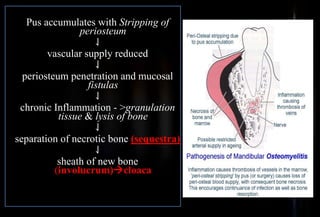
Pus accumulates with Stripping of
periosteum
⇃
vascular supply reduced
⇃
periosteum penetration and mucosal
fistulas
⇃
chronic Inflammation - >granulation
tissue & lysis of bone
⇃
separation of necrotic bone (sequestra)
⇃
sheath of new bone
(involucrum)cloaca
MICROBIOLOGY OF OSTEOMYELITIS
Osteomyeiltis of jaws now is recognised as a disease caused primarily
by-
-alpha hemolytic streptococci
-Peptostreptococcus
-Porphyromanas
-Fusobacterium
-Prevotella sp.
IMAGING TECHNIQUES
TYPES OF IMAGING-
• Conventional Radiographs
• Radionuclide imaging(Scintigraphy)
• Computed tomography
• Magnetic resonance imaging
Conventional Radiographs(H.M.Worth-1969)
 Moth-eaten appearance
 Enlargement of medullary spaces
 Destruction and replacement
with granulation tissue.

 Islands
 Sequestra, with evidence of a
trabecular pattern and
marrow spaces.
 A sheath of new bone
(involucrum) often is found,
separated from the sequestra
by a zone of radiolucency.
Computed tomography
Scintigraphy
imaging of jaws
•
CONVENTIONAL RADIOGRAPHY
TECHNETIUM BONE SCANS
67Ga or IIIIn WBC scan
MRI or CT in selected cases (drainable abcess,
do MRI , sequestrum ,use CT
Positive Negative
Osteomyelitis (osteomyelitis highly suspected)
Positive Negative
Osteomyelitis (osteomyelitis highly suspected)
Positive Negative
(osteomyelitis Osteomyelitis
Highly suspected)
Positive negative
Osteomyelitis (Stop)
Aliabadi P Nikpoor J:Imaging osteomyelitis ,Arthritis Rheum 37:617,1994
ACUTE SUPPURATIVE OSTEOMYELITIS
• Acute intramedullary osteomyelitis
• Characterized by:
(1) deep, intense pain,
(2) high intermittent fever,
(3) paresthesia of the lower lip, and
(4) a clearly identifiable cause
(5)minimal swelling
(6)fistulas are not present.
 Imaging
 Conventional radiographs – not of much use
 Radionuclide scan – positive
 Lab investigations –
 Generally negative
 Slight leukocytosis.
 Treatment
 Immediate antibiotic therapy
 Identification and correction of immunocompromising conditions.
SUB ACUTE SUPPURATIVE OSTEOMYELITIES
 10 to 14 days after onset of Acute Suppurative osteomyelitis.
 Clinical features –
Deep pain , malaise, fever and anorexia
 Teeth begin to loosen (sensitive to percussion)
 Pus exudes around the gingival sulcus and through mucosal
 Fetid odor
 Firm cellulitis of the cheek,
 Expansion of the bone from increased periosteal activity,
 Abscess formation.
 Trismus is not always present
 Regional lymphadenopathy
 The patient's temperature may reach 1010 to 1020 F and the patient
often is dehydrated.
CHRONIC OSTEOMYELITIS
SUBTYPES
PRIMARY SECONDARY
In secondary chronic osteomyelitis,
the type observed in incompletely
treated acute osteomyelitis, the clinical
findings usually are limited to fistulas,
induration of soft tissues, and a
thickened or “wooden” character to
the affected area with pain and
tenderness on palpation..
• Conventional radiographs –
– Bone changes – 4 to 14 days
– Full extent of bone dissolution - 3 weeks
– 30-60% bone destruction is necessary
Moth-eaten appearance Island pattern
SCINTIGRAPHY IMAGING
- 99Tc , 67Ga
COMPUTED TOMOGRAPHY MAGNETIC RESONANCE IMAGING
TREATMENT MODALITIES
PRINCIPLES OF TREATMENT :
(1) Evaluation and correction of host defenses,
(2) Gram staining and culture and sensitivity testing,
(3) Imaging to rule out bone tumors,
(4) Empirical administration of Gram stain-guided antibiotics,
(5) Removal of loose teeth and sequestra.
(6) Prescription of culture-guided antibiotic therapy, repeated cultures
(7) Possible placement of irrigation drains/ PMMC antibiotic beads
(8) Sequestrectomy, debridement, decortication, resection, or reconstruction
MANAGEMENT
Conservative management
(Medical management)
Surgical management
[A] Conservative management
1. Complete bed rest
2. Supportive therapy (nutritional
support)
3. Rehydration
4. Blood transfusion (If RBC, Hb% are
low)
5. Control of Pain
Antibiotic therapy
-Systemic antibiotics
-Local antibiotic
Closed wound irrigation – suction
Antibiotic impregnated beads
Hyperbaric oxygen therapy
[B] Surgical management
1. Extraction of offending teeth
2. Incision and drainage
3. Sequestrectomy
4. Saucerisation
5. Decortication
6. Resection and Reconstruction
7. Post operative care
CONSERVATIVE MANAGEMENT
-Antibiotic Treatment-
Regime 1: hospitalized/medically compromised patient IV is
- Aqueous penicillin 2million U IV + metronidazole 500mg 6hrly
when improved for 48-72 hrs switch to
-Penicillin V 500mg 4hrly + metro 500mg 6hrly orally, for additional
4-6 weeks
OR
-Clindamycin 600-900mg 6hrly IV then
-Clindamycin 300-450mg 6hrly orally
OR
-Cefoxitin(Mefoxin) 1g 8hrly IV Or 2g 4hrly IM Or IV until no
symptoms then switch to
-Cephalexin (keflex) 500mg 6hrly orally, for 2-4 weeks
FOR PENICILLIN ALLERGIC PATIENTS:
• Clindamycin
• Cefoxitin
OR
• Ampicillin /sulbactam 1.5-3g IV 6hrly
when improved for 48-72 hrs switch to
• Amoxacillin/clavulanic acid (Augmentin) 875/125 mg Orally bid for
additional 4-6 weeks
Regime 2: For out patient treatment
Penicillin V 2g + metronidazole 0.5g 8hrly orally for 2-4 weeks after
last sequestrum removed & patients without symptoms
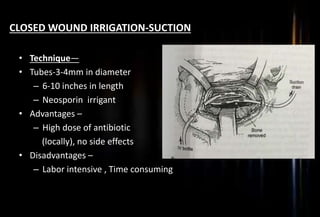
CLOSED WOUND IRRIGATION-SUCTION
• Technique—
• Tubes-3-4mm in diameter
– 6-10 inches in length
– Neosporin irrigant
• Advantages –
– High dose of antibiotic
(locally), no side effects
• Disadvantages –
– Labor intensive , Time consuming
Antibiotic Impregnated Beads
• TECHNIQUE
• Tobramycin or gentamicin in PMMA.
• Indications –
– chronically infected bone associated
with fractures
– refractory to systemic antibiotics.
• Advantages –
– deliver high concentrations of antibiotics
– low systemic concentrations thus low
toxicity
Hyperbaric oxygen therapy
• Involves intermittent , usually daily inhalation of 100% humidified
oxygen under pressure greater than 1 absolute ATP
• Each session , or dive is 90 minutes in length.
• Treatment given :-
• 5 days per week twice daily for 30.
• 60 or more dives at 2.4 ATA for 90 minutes while breathing.
SEQUESTRECTOMY
 Removal of sequestrum (dead nerotic bone).
 Fate of sequestra-
 It may get infected and form a chronic infective
focus
 May remain dormant with no changes in it.
 May get revascularized and healing takes place
 May get resorbed completely.
 Antibiotics will not be able to penetrate into it
(avascular)
SAUCERIZATION
Removal of bony hollow cavity/ dead space
After removal of Sequestrum
A hollow cavity/dead space occurs
A large clot form in the cavity
The clot will most likely to get infected
So the margins of the bone which lodge the sequestra are
trimmed down
This create a saucer shaped defect instead of a deep
hollow cavity.
This saucer shaped defect can’t accumulate a large clot
DECORTICATION
• Removal of chronically infected cortex of bone. The lateral and
inferior border cortex is removed 1-2 cm beyond the affected area,
providing access to medullary cavity
• Cancellous bone is removed till the uninvolved area. (bleeding
points)
• .
RESECTION AND RECONSTRUCTION
• All the above procedures are not effective completely eliminating
the infective process.
• Once the part of the jaw is resected, it may be reconstructed using
autologous bone graft or reconstruction plates.
IINFANTILE OSTEOMYELITIS
- Seen a few weeks after birth and usually involves maxilla
• Occur via hematogenous route or from perinatal trauma of the oral
mucosa from the obstetrician’s finger or the mucosa suction bulb used
to clear the airway immediately after birth.
• Infections involving the maxillary sinus and infected human have also
been implicated as sources of infant infection.
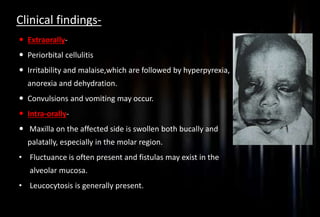
Clinical findings-
 Extraorally-
 Periorbital cellulitis
 Irritability and malaise,which are followed by hyperpyrexia,
anorexia and dehydration.
 Convulsions and vomiting may occur.
 Intra-orally-
 Maxilla on the affected side is swollen both bucally and
palatally, especially in the molar region.
• Fluctuance is often present and fistulas may exist in the
alveolar mucosa.
• Leucocytosis is generally present.
Treatment-
– Intravenous antibiotics
– drainage of all abscesses.
– Sequestrectomy – conservative approach (danger of
damage to tooth buds)
– Antibiotics should be continued orally for 2 to 4 weeks
after all signs of infection have subsided.
– Supportive
NON SUPPURATIVE OSTEOMYELITIS
CHRONIC SCLEROSING OSTEOMYELITIS-
Focal Diffuse
• Other names- Sclerosing osteitis
Multiple enostosis
Local bone sclerosis
Ossifying osteomyelitis
Sclerosing cementoma
Giantiform cementoma
Sclerotic cemental masses of jaws.
•
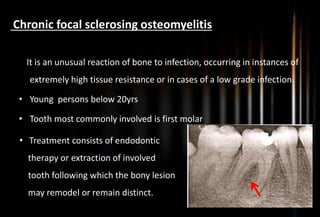
Chronic focal sclerosing osteomyelitis
It It is an unusual reaction of bone to infection, occurring in instances of
extremely high tissue resistance or in cases of a low grade infection.
• Young persons below 20yrs
• Tooth most commonly involved is first molar
• Treatment consists of endodontic
therapy or extraction of involved
tooth following which the bony lesion
may remodel or remain distinct.
Chronic diffuse sclerosing
osteomyelitis
 Shows a proliferative reaction of bone to low grade infection.
 Here the portal of entry of infection is mainly through the
periodontium.
 More common in females.
• Is of insidious in nature,
• On occasion results in mild suppuration and formation of fistulas to
establish drainage.
• In such cases patient might complain of vague pain and a bad taste .
• Treatment –
– Removal of the source of infection,
– Repeated culture and sensitivity testing,
– High doses of antibiotics for prolonged periods,
– Wound irrigation, antibiotic impregnated beads, and
debridement.
– Decortication or resection, and reconstrucrion
– HBO therapy
GARRE’S OSTEOMYELITIS / PERIOSTEITIS OSSIFICANS
• First described by Carl Garre in 1893 as a focal gross thickening of the
periosteum of long bones, with peripheral reactive bone formation
resulting from mild irritation or infection.
• A localized, hard, non-tender swelling over the mandible.
seen primarily in children and young adults.
• It is commonly associated with a carious molar, usually the first molar
and a history .of past toothache.
OSTEOMYELITIS DUE TO NON PYOGENIC ORGANISMS
ACTINOMYCOTIC OSTEOMYELITIS:
- It is a chronic infection manifests both with granulomatous and
suppurative features involving soft tissues and bone of cervicofacial
region.
- It is caused by Actinomycosis israelii.
- Actinomycosis is of endogenous origin.
Pathogenesis : Organisms gain entry into soft tissue
When established, infection spreads and typically appears on
cutaneous rather than mucosal surface.
Actinomycotic osteomyelitis of jaws are rare but may present as :-
• A periosteitis as a result of the involvement of the adjacent soft
tissues.
• An Actinomycotic osteomyelitis in which the mandible is thickened,
‘Woody hard’ swelling .
• Eventually sequestration of the bone occurs.
• A chronic infection of a fracture of the jaw bone and produce a
chronic fistula.
• Diagnosis is by microscopic examination of the pus.
Sulphur granules are present.
TUBERCULOUS OSTEOMYELITIS
• Mycobacterium tuberculosis is usually brought about
by hematogenous spread.
• Etiopathogensis :- “ Mycobacterium tuberculosis”
• Three possible methods of inoculation of bacteria into bone-
1)Direct inoculation of bacilli into oral mucosa through an ulcer or break
in the continuity of the mucosa
2) Spread to bone via an extraction of socket or an infected fracture line.
3) Hematogenous or lymphatic spread from primary focus elsewhere in
body
Surgical treatment:-
• Positive for AFB : Patient started Antikochs regimen. After
6 to 8 weeks the lesion is reviewed both clinically and
radioghphically to evaluate the need for surgical
debridement.
• Negative for AFB : -- Complete excisional biopsy and
debridement of tissue is done. Then tissue is sent for
histopatholical studies.
• Long term follow up
OSTEORADIONECROSIS
INTRODUCTION
• It is a chronic, nonhealing wound caused by hypoxia,
hypocellularity, and hypovascularity of irradiated tissue.
DEFINATIONS
• Marx –
”An area greater than 1cm of exposed area of bone in a field of
irradiation that has failed to show any evidence of healing for atleast
6 months.”
• Hutchinson-
• “An area of exposed bone (mandible) present for longer than 2
months in a previously irradiated field,in the absence of recurrent
tumour.
INCIDENCE
• Incidence of involvement of mandible ranges from 2-3%.
• Extraction of tooth causes ORN- 60-89% of cases
• Time period b/w RT and development of ORN has been
reported as a mean of 7.5 – 20 yrs.
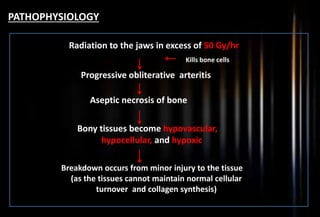
Radiation to the jaws in excess of 50 Gy/hr
Progressive obliterative arteritis
Aseptic necrosis of bone
Bony tissues become hypovascular,
hypocellular, and hypoxic
Breakdown occurs from minor injury to the tissue
(as the tissues cannot maintain normal cellular
turnover and collagen synthesis)
Kills bone cells
PATHOPHYSIOLOGY
Small high radiation particles TUMOUR CELLS/NORMAL CELLS
Cellular water
undergo radiolysis
H2O H+ +OH-
INTERACTS
DISRUPTS DNA
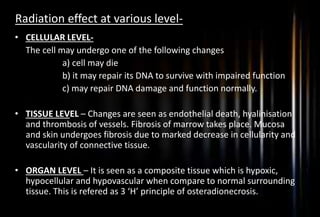
Radiation effect at various level-
• CELLULAR LEVEL-
The cell may undergo one of the following changes
a) cell may die
b) it may repair its DNA to survive with impaired function
c) may repair DNA damage and function normally.
• TISSUE LEVEL – Changes are seen as endothelial death, hyalinisation
and thrombosis of vessels. Fibrosis of marrow takes place. Mucosa
and skin undergoes fibrosis due to marked decrease in cellularity and
vascularity of connective tissue.
• ORGAN LEVEL – It is seen as a composite tissue which is hypoxic,
hypocellular and hypovascular when compare to normal surrounding
tissue. This is refered as 3 ‘H’ principle of osteradionecrosis.
Types of ORN
1. Type I: Develops shortly after radiation; is due to synergistic
effects of surgical trauma and radiation closely coupled in time.
2. Type II: Develops years after radiation and follows a traumatic
event; rarely occurs before 2 years after treatment; most
commonly occurs after 6 years; due to progressive endarteritis
and vascular occlusion of the nutrient vessels in the bone. .
3. Type III: (Spontaneous ORN) Occurs spontaneously without a
preceding traumatic event; usually occurs between 6 months and
3 years after radiation. ; due to immediate cellular damage and
death due to radiation treatment. This occurs when the radiation
dose exceeds 7000 Rads or the fraction doses are greater than
200 Rads per day.
CLINICAL FEATURES
• Early ORN may be asymptomatic even though the its main features
of exposed devitalised bone through ulcerated mucosa or skin can
be seen clearly.
• Pain is a common symptom and some patients have presented with
intractable pain.
• Other associated symptoms include dysaesthesia, halitosis,
dysgeusia, and food impaction in the area of exposed sequestra.
• In severe cases, patients can present with fistulation from the oral
mucosa or skin, complete devitalisation of bone, and pathological
fractures
MANAGEMENT
• Initial treatment is directed at controlling frank infection.
– Administration of parenteral antibiotics and fluids.
– Gentle irrigation of the soft tissue margins is useful in removing
debris and reducing inflammation
– Culture for sensitivity testing (fistulas present)
– Supportive treatment– good diet
• Conservative treatment -
– Indicated initially
– Irrigation of the exposed bone, mechanical debridement,
medicated pack
– Repeated until sequestration occurs or bone is penetrated by
granulation tissue.
• Ultrasound Therapy -- Neovascularity and Neocellularity
• Bone resection
– not candidates for extensive treatment
• HBO therapy
– l00%
– 2.4 absolute atmospheres pressure
– 90minute sessions (dives)
– 5 days a week totaling 30 or more sessions
Marx-University of Miami Protocol
 Stage I
 30 HBO sessions.
 If softening of the exposed bone results the wound is debrided
and 10 more HBO sessions are provided.
 Stage II
 Noncontinuity resection of exposed bone (bleeding margins)
followed by 10 HBO sessions.
 If the tissue heals completely with no exposed bone the patient is
considered a stage II responder.
 Stage III
 Continuity resection and 10 postoperative sessions of HBO
 reconstruction after 3 months.
Hyperbaric oxygen is effective in treatment of osteomyelitis because:
• Hyperbaric oxygen enhances lysosomal degradation.
• The oxygen free radicals are formed which are toxic to anaerobic
pathogens.
• The elevated partial pressure of oxygen created, inactivate the
exotoxins released by the pathogens.
• The tissue oxygen level is elevated which enhances the healing.
• It helps in neoangiogenesis by encouraging endothelial proliferation.
Bisphosphonate-Related Osteradionecrosis of
jaws(BRONJ)
• What is BRONJ?
Bisphosphonate Related Osteonecrosis of the Jaw (BRONJ) can be
described as an area of bone in the jaw that has died and been
exposed in the mouth for more than 8 weeks in a person taking any
bisphosphonate
Stages
EXPOSED BONE
SHOWS NO
INFLAMMATION
PAINFUL
EXPOSED AREAS
OF BONE
ADVANCED
STAGE,
# OF BONEII
ACCORDING TO AAOMS
STAGING
CLASSIFICATION
CLINICAL MANIFESTATIONS TREATMENT
STAGE 1 Exposed bone, small oral ulcerations
without acute symptoms.
Rinse with 0.12%
Chlorhexidine and checkup
STAGE 2A Exposed bone necrosis or small oral
fistula without bone necrosis.
Symptoms controlled with medical
treatment
Rinse with 0.12%
Chlorhexidine,Antibiotics and
analgesics to be started
STAGE 2B Exposed bone necrosis or small oral
fistula without bone necrosis,but with
symptoms not controlled with medical
treatment
Rinse with 0.12%
Chlorhexidine,Antibiotics and
analgesics and surgery
STAGE 3 Jaw fractures ,skin fistula,osteolysis
extending till inferior border
Rinse with 0.12%
Chlorhexidine,Antibiotics and
analgesics and extensive
surgery with resection of bone
New protocols for prevention and treatment of
osteoradionecrosis
• Pentoxifylline is a methylxanthine derivative that exerts
an anti-TNF effect.
• increases erythrocyte flexibility,
• dilates blood vessels,
• inhibits inflammatory reactions in vivo,
• inhibits proliferation of human dermal fibroblasts and the
production of extracellular matrix, and
• increases collagenase activity in vitro.
REFERENCESr
• Oral and Maxillofacial infections,Topazian
• Peterson’s Oral and Maxillofacial surgery
• Shafers Textbook of oral pathology
THANK YOU

Osteomyelitis and osteoradionecrosis of jaws

  • 1.
    OSTEOMYELITIS & OSTEORADIONECROSIS OF JAWS Presentedby-Dr Shibani Sarangi MDS 11nd year
  • 2.
    INTRODUCTION • The word“osteomyelitis” originates from the ancient Greek words osteon (bone) and muelinos (marrow) • Inflammation process of the entire bone including the cortex and the periosteum , recognizing that the pathological process is rarely confined to the endosteum.
  • 3.
    DEFINATION •Osteomyelitis is consideredas an inflammatory condition of bone that usually begins as an infection of the medullary cavity, rapidly involves the haversian systems and quickly extends to periosteum of that area.
  • 4.
    PREDISPOSING FACTORS • Fracturesdue to trauma and road traffic accidents • Gun shot wounds • Radiation damage • Paget`s disease • Osteoporosis • Systemic disease : Malnutrition, Acute Leukemia, Uncontrolled diabetes, Sickle cell anemia, Chronic alcoholism
  • 5.
     Osteomyelitis isinitiated by a -  Contiguous focus of infection (jaw)  Hematogenous spread (children) Osteomyelitis of mandible > maxilla
  • 6.
    PATHOGENESIS Acute inflammation followinginfection ⇃ Hyperemia ⇃ Capillary permeability ↑and infiltration of granulocytes ⇃ Tissue necrosis ⇃ Destruction of bacteria, vascular thrombosis & Pus forms ⇃ Intramedullary pressure ↑ as pus accumulates -> anesthesia compression ⇃ Vascular collapse, venous stasis and ischemia ⇃
  • 7.
    Pus accumulates withStripping of periosteum ⇃ vascular supply reduced ⇃ periosteum penetration and mucosal fistulas ⇃ chronic Inflammation - >granulation tissue & lysis of bone ⇃ separation of necrotic bone (sequestra) ⇃ sheath of new bone (involucrum)cloaca
  • 8.
    MICROBIOLOGY OF OSTEOMYELITIS Osteomyeiltisof jaws now is recognised as a disease caused primarily by- -alpha hemolytic streptococci -Peptostreptococcus -Porphyromanas -Fusobacterium -Prevotella sp.
  • 11.
    IMAGING TECHNIQUES TYPES OFIMAGING- • Conventional Radiographs • Radionuclide imaging(Scintigraphy) • Computed tomography • Magnetic resonance imaging
  • 12.
    Conventional Radiographs(H.M.Worth-1969)  Moth-eatenappearance  Enlargement of medullary spaces  Destruction and replacement with granulation tissue.   Islands  Sequestra, with evidence of a trabecular pattern and marrow spaces.  A sheath of new bone (involucrum) often is found, separated from the sequestra by a zone of radiolucency.
  • 13.
  • 14.
    • CONVENTIONAL RADIOGRAPHY TECHNETIUM BONESCANS 67Ga or IIIIn WBC scan MRI or CT in selected cases (drainable abcess, do MRI , sequestrum ,use CT Positive Negative Osteomyelitis (osteomyelitis highly suspected) Positive Negative Osteomyelitis (osteomyelitis highly suspected) Positive Negative (osteomyelitis Osteomyelitis Highly suspected) Positive negative Osteomyelitis (Stop) Aliabadi P Nikpoor J:Imaging osteomyelitis ,Arthritis Rheum 37:617,1994
  • 15.
    ACUTE SUPPURATIVE OSTEOMYELITIS •Acute intramedullary osteomyelitis • Characterized by: (1) deep, intense pain, (2) high intermittent fever, (3) paresthesia of the lower lip, and (4) a clearly identifiable cause (5)minimal swelling (6)fistulas are not present.
  • 16.
     Imaging  Conventionalradiographs – not of much use  Radionuclide scan – positive  Lab investigations –  Generally negative  Slight leukocytosis.  Treatment  Immediate antibiotic therapy  Identification and correction of immunocompromising conditions.
  • 17.
    SUB ACUTE SUPPURATIVEOSTEOMYELITIES  10 to 14 days after onset of Acute Suppurative osteomyelitis.  Clinical features – Deep pain , malaise, fever and anorexia  Teeth begin to loosen (sensitive to percussion)  Pus exudes around the gingival sulcus and through mucosal  Fetid odor  Firm cellulitis of the cheek,  Expansion of the bone from increased periosteal activity,  Abscess formation.  Trismus is not always present  Regional lymphadenopathy  The patient's temperature may reach 1010 to 1020 F and the patient often is dehydrated.
  • 18.
    CHRONIC OSTEOMYELITIS SUBTYPES PRIMARY SECONDARY Insecondary chronic osteomyelitis, the type observed in incompletely treated acute osteomyelitis, the clinical findings usually are limited to fistulas, induration of soft tissues, and a thickened or “wooden” character to the affected area with pain and tenderness on palpation..
  • 19.
    • Conventional radiographs– – Bone changes – 4 to 14 days – Full extent of bone dissolution - 3 weeks – 30-60% bone destruction is necessary Moth-eaten appearance Island pattern
  • 20.
    SCINTIGRAPHY IMAGING - 99Tc, 67Ga COMPUTED TOMOGRAPHY MAGNETIC RESONANCE IMAGING
  • 21.
    TREATMENT MODALITIES PRINCIPLES OFTREATMENT : (1) Evaluation and correction of host defenses, (2) Gram staining and culture and sensitivity testing, (3) Imaging to rule out bone tumors, (4) Empirical administration of Gram stain-guided antibiotics, (5) Removal of loose teeth and sequestra. (6) Prescription of culture-guided antibiotic therapy, repeated cultures (7) Possible placement of irrigation drains/ PMMC antibiotic beads (8) Sequestrectomy, debridement, decortication, resection, or reconstruction
  • 22.
    MANAGEMENT Conservative management (Medical management) Surgicalmanagement [A] Conservative management 1. Complete bed rest 2. Supportive therapy (nutritional support) 3. Rehydration 4. Blood transfusion (If RBC, Hb% are low) 5. Control of Pain Antibiotic therapy -Systemic antibiotics -Local antibiotic Closed wound irrigation – suction Antibiotic impregnated beads Hyperbaric oxygen therapy
  • 23.
    [B] Surgical management 1.Extraction of offending teeth 2. Incision and drainage 3. Sequestrectomy 4. Saucerisation 5. Decortication 6. Resection and Reconstruction 7. Post operative care
  • 24.
    CONSERVATIVE MANAGEMENT -Antibiotic Treatment- Regime1: hospitalized/medically compromised patient IV is - Aqueous penicillin 2million U IV + metronidazole 500mg 6hrly when improved for 48-72 hrs switch to -Penicillin V 500mg 4hrly + metro 500mg 6hrly orally, for additional 4-6 weeks OR -Clindamycin 600-900mg 6hrly IV then -Clindamycin 300-450mg 6hrly orally OR -Cefoxitin(Mefoxin) 1g 8hrly IV Or 2g 4hrly IM Or IV until no symptoms then switch to -Cephalexin (keflex) 500mg 6hrly orally, for 2-4 weeks
  • 25.
    FOR PENICILLIN ALLERGICPATIENTS: • Clindamycin • Cefoxitin OR • Ampicillin /sulbactam 1.5-3g IV 6hrly when improved for 48-72 hrs switch to • Amoxacillin/clavulanic acid (Augmentin) 875/125 mg Orally bid for additional 4-6 weeks Regime 2: For out patient treatment Penicillin V 2g + metronidazole 0.5g 8hrly orally for 2-4 weeks after last sequestrum removed & patients without symptoms
  • 26.
    CLOSED WOUND IRRIGATION-SUCTION •Technique— • Tubes-3-4mm in diameter – 6-10 inches in length – Neosporin irrigant • Advantages – – High dose of antibiotic (locally), no side effects • Disadvantages – – Labor intensive , Time consuming
  • 27.
    Antibiotic Impregnated Beads •TECHNIQUE • Tobramycin or gentamicin in PMMA. • Indications – – chronically infected bone associated with fractures – refractory to systemic antibiotics. • Advantages – – deliver high concentrations of antibiotics – low systemic concentrations thus low toxicity
  • 28.
    Hyperbaric oxygen therapy •Involves intermittent , usually daily inhalation of 100% humidified oxygen under pressure greater than 1 absolute ATP • Each session , or dive is 90 minutes in length. • Treatment given :- • 5 days per week twice daily for 30. • 60 or more dives at 2.4 ATA for 90 minutes while breathing.
  • 29.
    SEQUESTRECTOMY  Removal ofsequestrum (dead nerotic bone).  Fate of sequestra-  It may get infected and form a chronic infective focus  May remain dormant with no changes in it.  May get revascularized and healing takes place  May get resorbed completely.  Antibiotics will not be able to penetrate into it (avascular)
  • 30.
    SAUCERIZATION Removal of bonyhollow cavity/ dead space After removal of Sequestrum A hollow cavity/dead space occurs A large clot form in the cavity The clot will most likely to get infected So the margins of the bone which lodge the sequestra are trimmed down This create a saucer shaped defect instead of a deep hollow cavity. This saucer shaped defect can’t accumulate a large clot
  • 31.
    DECORTICATION • Removal ofchronically infected cortex of bone. The lateral and inferior border cortex is removed 1-2 cm beyond the affected area, providing access to medullary cavity • Cancellous bone is removed till the uninvolved area. (bleeding points) • .
  • 32.
    RESECTION AND RECONSTRUCTION •All the above procedures are not effective completely eliminating the infective process. • Once the part of the jaw is resected, it may be reconstructed using autologous bone graft or reconstruction plates.
  • 33.
    IINFANTILE OSTEOMYELITIS - Seena few weeks after birth and usually involves maxilla • Occur via hematogenous route or from perinatal trauma of the oral mucosa from the obstetrician’s finger or the mucosa suction bulb used to clear the airway immediately after birth. • Infections involving the maxillary sinus and infected human have also been implicated as sources of infant infection.
  • 34.
    Clinical findings-  Extraorally- Periorbital cellulitis  Irritability and malaise,which are followed by hyperpyrexia, anorexia and dehydration.  Convulsions and vomiting may occur.  Intra-orally-  Maxilla on the affected side is swollen both bucally and palatally, especially in the molar region. • Fluctuance is often present and fistulas may exist in the alveolar mucosa. • Leucocytosis is generally present.
  • 35.
    Treatment- – Intravenous antibiotics –drainage of all abscesses. – Sequestrectomy – conservative approach (danger of damage to tooth buds) – Antibiotics should be continued orally for 2 to 4 weeks after all signs of infection have subsided. – Supportive
  • 36.
    NON SUPPURATIVE OSTEOMYELITIS CHRONICSCLEROSING OSTEOMYELITIS- Focal Diffuse • Other names- Sclerosing osteitis Multiple enostosis Local bone sclerosis Ossifying osteomyelitis Sclerosing cementoma Giantiform cementoma Sclerotic cemental masses of jaws. •
  • 37.
    Chronic focal sclerosingosteomyelitis It It is an unusual reaction of bone to infection, occurring in instances of extremely high tissue resistance or in cases of a low grade infection. • Young persons below 20yrs • Tooth most commonly involved is first molar • Treatment consists of endodontic therapy or extraction of involved tooth following which the bony lesion may remodel or remain distinct.
  • 38.
    Chronic diffuse sclerosing osteomyelitis Shows a proliferative reaction of bone to low grade infection.  Here the portal of entry of infection is mainly through the periodontium.  More common in females. • Is of insidious in nature, • On occasion results in mild suppuration and formation of fistulas to establish drainage. • In such cases patient might complain of vague pain and a bad taste .
  • 39.
    • Treatment – –Removal of the source of infection, – Repeated culture and sensitivity testing, – High doses of antibiotics for prolonged periods, – Wound irrigation, antibiotic impregnated beads, and debridement. – Decortication or resection, and reconstrucrion – HBO therapy
  • 40.
    GARRE’S OSTEOMYELITIS /PERIOSTEITIS OSSIFICANS • First described by Carl Garre in 1893 as a focal gross thickening of the periosteum of long bones, with peripheral reactive bone formation resulting from mild irritation or infection. • A localized, hard, non-tender swelling over the mandible. seen primarily in children and young adults. • It is commonly associated with a carious molar, usually the first molar and a history .of past toothache.
  • 41.
    OSTEOMYELITIS DUE TONON PYOGENIC ORGANISMS ACTINOMYCOTIC OSTEOMYELITIS: - It is a chronic infection manifests both with granulomatous and suppurative features involving soft tissues and bone of cervicofacial region. - It is caused by Actinomycosis israelii. - Actinomycosis is of endogenous origin. Pathogenesis : Organisms gain entry into soft tissue When established, infection spreads and typically appears on cutaneous rather than mucosal surface.
  • 42.
    Actinomycotic osteomyelitis ofjaws are rare but may present as :- • A periosteitis as a result of the involvement of the adjacent soft tissues. • An Actinomycotic osteomyelitis in which the mandible is thickened, ‘Woody hard’ swelling . • Eventually sequestration of the bone occurs. • A chronic infection of a fracture of the jaw bone and produce a chronic fistula. • Diagnosis is by microscopic examination of the pus. Sulphur granules are present.
  • 43.
    TUBERCULOUS OSTEOMYELITIS • Mycobacteriumtuberculosis is usually brought about by hematogenous spread. • Etiopathogensis :- “ Mycobacterium tuberculosis” • Three possible methods of inoculation of bacteria into bone- 1)Direct inoculation of bacilli into oral mucosa through an ulcer or break in the continuity of the mucosa 2) Spread to bone via an extraction of socket or an infected fracture line. 3) Hematogenous or lymphatic spread from primary focus elsewhere in body
  • 44.
    Surgical treatment:- • Positivefor AFB : Patient started Antikochs regimen. After 6 to 8 weeks the lesion is reviewed both clinically and radioghphically to evaluate the need for surgical debridement. • Negative for AFB : -- Complete excisional biopsy and debridement of tissue is done. Then tissue is sent for histopatholical studies. • Long term follow up
  • 45.
  • 46.
    INTRODUCTION • It isa chronic, nonhealing wound caused by hypoxia, hypocellularity, and hypovascularity of irradiated tissue.
  • 47.
    DEFINATIONS • Marx – ”Anarea greater than 1cm of exposed area of bone in a field of irradiation that has failed to show any evidence of healing for atleast 6 months.” • Hutchinson- • “An area of exposed bone (mandible) present for longer than 2 months in a previously irradiated field,in the absence of recurrent tumour.
  • 48.
    INCIDENCE • Incidence ofinvolvement of mandible ranges from 2-3%. • Extraction of tooth causes ORN- 60-89% of cases • Time period b/w RT and development of ORN has been reported as a mean of 7.5 – 20 yrs.
  • 50.
    Radiation to thejaws in excess of 50 Gy/hr Progressive obliterative arteritis Aseptic necrosis of bone Bony tissues become hypovascular, hypocellular, and hypoxic Breakdown occurs from minor injury to the tissue (as the tissues cannot maintain normal cellular turnover and collagen synthesis) Kills bone cells PATHOPHYSIOLOGY
  • 51.
    Small high radiationparticles TUMOUR CELLS/NORMAL CELLS Cellular water undergo radiolysis H2O H+ +OH- INTERACTS DISRUPTS DNA
  • 52.
    Radiation effect atvarious level- • CELLULAR LEVEL- The cell may undergo one of the following changes a) cell may die b) it may repair its DNA to survive with impaired function c) may repair DNA damage and function normally. • TISSUE LEVEL – Changes are seen as endothelial death, hyalinisation and thrombosis of vessels. Fibrosis of marrow takes place. Mucosa and skin undergoes fibrosis due to marked decrease in cellularity and vascularity of connective tissue. • ORGAN LEVEL – It is seen as a composite tissue which is hypoxic, hypocellular and hypovascular when compare to normal surrounding tissue. This is refered as 3 ‘H’ principle of osteradionecrosis.
  • 53.
    Types of ORN 1.Type I: Develops shortly after radiation; is due to synergistic effects of surgical trauma and radiation closely coupled in time. 2. Type II: Develops years after radiation and follows a traumatic event; rarely occurs before 2 years after treatment; most commonly occurs after 6 years; due to progressive endarteritis and vascular occlusion of the nutrient vessels in the bone. . 3. Type III: (Spontaneous ORN) Occurs spontaneously without a preceding traumatic event; usually occurs between 6 months and 3 years after radiation. ; due to immediate cellular damage and death due to radiation treatment. This occurs when the radiation dose exceeds 7000 Rads or the fraction doses are greater than 200 Rads per day.
  • 54.
    CLINICAL FEATURES • EarlyORN may be asymptomatic even though the its main features of exposed devitalised bone through ulcerated mucosa or skin can be seen clearly. • Pain is a common symptom and some patients have presented with intractable pain. • Other associated symptoms include dysaesthesia, halitosis, dysgeusia, and food impaction in the area of exposed sequestra. • In severe cases, patients can present with fistulation from the oral mucosa or skin, complete devitalisation of bone, and pathological fractures
  • 55.
    MANAGEMENT • Initial treatmentis directed at controlling frank infection. – Administration of parenteral antibiotics and fluids. – Gentle irrigation of the soft tissue margins is useful in removing debris and reducing inflammation – Culture for sensitivity testing (fistulas present) – Supportive treatment– good diet • Conservative treatment - – Indicated initially – Irrigation of the exposed bone, mechanical debridement, medicated pack – Repeated until sequestration occurs or bone is penetrated by granulation tissue.
  • 56.
    • Ultrasound Therapy-- Neovascularity and Neocellularity • Bone resection – not candidates for extensive treatment • HBO therapy – l00% – 2.4 absolute atmospheres pressure – 90minute sessions (dives) – 5 days a week totaling 30 or more sessions
  • 57.
    Marx-University of MiamiProtocol  Stage I  30 HBO sessions.  If softening of the exposed bone results the wound is debrided and 10 more HBO sessions are provided.  Stage II  Noncontinuity resection of exposed bone (bleeding margins) followed by 10 HBO sessions.  If the tissue heals completely with no exposed bone the patient is considered a stage II responder.  Stage III  Continuity resection and 10 postoperative sessions of HBO  reconstruction after 3 months.
  • 58.
    Hyperbaric oxygen iseffective in treatment of osteomyelitis because: • Hyperbaric oxygen enhances lysosomal degradation. • The oxygen free radicals are formed which are toxic to anaerobic pathogens. • The elevated partial pressure of oxygen created, inactivate the exotoxins released by the pathogens. • The tissue oxygen level is elevated which enhances the healing. • It helps in neoangiogenesis by encouraging endothelial proliferation.
  • 59.
    Bisphosphonate-Related Osteradionecrosis of jaws(BRONJ) •What is BRONJ? Bisphosphonate Related Osteonecrosis of the Jaw (BRONJ) can be described as an area of bone in the jaw that has died and been exposed in the mouth for more than 8 weeks in a person taking any bisphosphonate
  • 60.
    Stages EXPOSED BONE SHOWS NO INFLAMMATION PAINFUL EXPOSEDAREAS OF BONE ADVANCED STAGE, # OF BONEII
  • 61.
    ACCORDING TO AAOMS STAGING CLASSIFICATION CLINICALMANIFESTATIONS TREATMENT STAGE 1 Exposed bone, small oral ulcerations without acute symptoms. Rinse with 0.12% Chlorhexidine and checkup STAGE 2A Exposed bone necrosis or small oral fistula without bone necrosis. Symptoms controlled with medical treatment Rinse with 0.12% Chlorhexidine,Antibiotics and analgesics to be started STAGE 2B Exposed bone necrosis or small oral fistula without bone necrosis,but with symptoms not controlled with medical treatment Rinse with 0.12% Chlorhexidine,Antibiotics and analgesics and surgery STAGE 3 Jaw fractures ,skin fistula,osteolysis extending till inferior border Rinse with 0.12% Chlorhexidine,Antibiotics and analgesics and extensive surgery with resection of bone
  • 62.
    New protocols forprevention and treatment of osteoradionecrosis • Pentoxifylline is a methylxanthine derivative that exerts an anti-TNF effect. • increases erythrocyte flexibility, • dilates blood vessels, • inhibits inflammatory reactions in vivo, • inhibits proliferation of human dermal fibroblasts and the production of extracellular matrix, and • increases collagenase activity in vitro.
  • 63.
    REFERENCESr • Oral andMaxillofacial infections,Topazian • Peterson’s Oral and Maxillofacial surgery • Shafers Textbook of oral pathology
  • 64.

Editor's Notes

  • #13 H.M worth
  • #52 THAT MANIFESTS AT VARIOUS LEVELS