Evaluating Piecewise and
Step Functions
Step Functions
Evaluating Piecewise Functions
• Piecewise functions are functions defined
by at least two equations, each of which
applies to a different part of the domain
• A piecewise function looks like this:
Equations
Domain restrictions
Evaluating Piecewise Functions
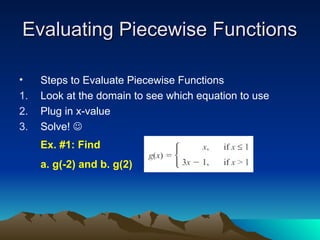
• Steps to Evaluate Piecewise Functions
1. Look at the domain to see which equation to use
2. Plug in x-value
3. Solve! 
Ex. #1: Find
a. g(-2) and b. g(2)
Evaluating Piecewise Functions
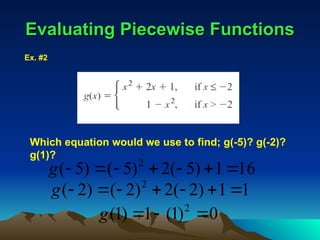
Ex. #2
Which equation would we use to find; g(-5)? g(-2)?
g(1)?
16
1
)
5
(
2
)
5
(
)
5
( 2







g
1
1
)
2
(
2
)
2
(
)
2
( 2







g
0
)
1
(
1
)
1
( 2



g
Step Functions
Step Functions
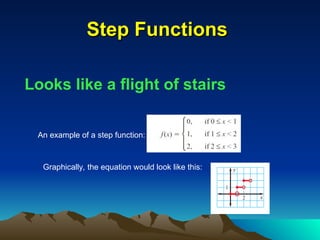
Looks like a flight of stairs
An example of a step function:
Graphically, the equation would look like this:
Classwork/Homework
Classwork/Homework
• Evaluating WS
Domain and Range of Piecewise
Functions
Functions
• Domain (x): the set of all input numbers -
will not include points where the
function(s) do not exist. The domain also
controls which part of the piecewise
function will be used over certain values of
x.
• Range (y): the set of all outputs.
Points of Dis
Points of Discontinu
continuity
ity
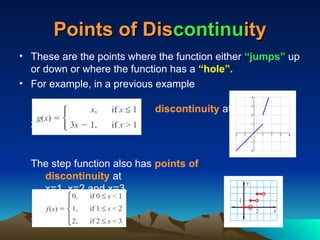
• These are the points where the function either “jumps” up
or down or where the function has a “hole”.
• For example, in a previous example
Has a point of discontinuity at
x=1
The step function also has points of
discontinuity at
x=1, x=2 and x=3.
Axis of Symmetry
Axis of Symmetry
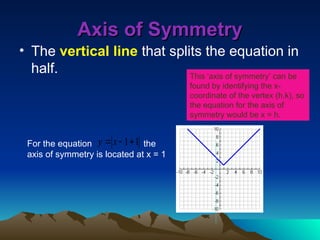
• The vertical line that splits the equation in
half.
For the equation the
axis of symmetry is located at x = 1
1
1

x
y
This ‘axis of symmetry’ can be
found by identifying the x-
coordinate of the vertex (h,k), so
the equation for the axis of
symmetry would be x = h.
Max
Maxima and
ima and Min
Minima
ima
(aka extrema)
(aka extrema)
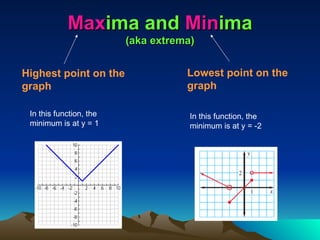
In this function, the
minimum is at y = 1
In this function, the
minimum is at y = -2
Highest point on the
graph
Lowest point on the
graph
Intervals of Increase and
Decrease
Decrease
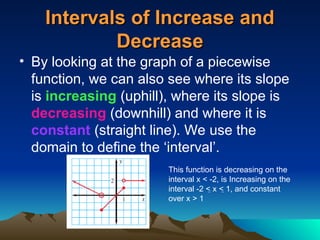
• By looking at the graph of a piecewise
function, we can also see where its slope
is increasing (uphill), where its slope is
decreasing (downhill) and where it is
constant (straight line). We use the
domain to define the ‘interval’.
This function is decreasing on the
interval x < -2, is Increasing on the
interval -2 < x < 1, and constant
over x > 1
Classwork/Homework
Classwork/Homework
• Characteristics WS

Evaluating Piecewise Functions General Mathematics.ppt

  • 1.
    Evaluating Piecewise and EvaluatingPiecewise and Step Functions Step Functions
  • 2.
    Evaluating Piecewise Functions EvaluatingPiecewise Functions • Piecewise functions are functions defined by at least two equations, each of which applies to a different part of the domain • A piecewise function looks like this: Equations Domain restrictions
  • 3.
    Evaluating Piecewise Functions EvaluatingPiecewise Functions • Steps to Evaluate Piecewise Functions 1. Look at the domain to see which equation to use 2. Plug in x-value 3. Solve!  Ex. #1: Find a. g(-2) and b. g(2)
  • 4.
    Evaluating Piecewise Functions EvaluatingPiecewise Functions Ex. #2 Which equation would we use to find; g(-5)? g(-2)? g(1)? 16 1 ) 5 ( 2 ) 5 ( ) 5 ( 2        g 1 1 ) 2 ( 2 ) 2 ( ) 2 ( 2        g 0 ) 1 ( 1 ) 1 ( 2    g
  • 5.
    Step Functions Step Functions Lookslike a flight of stairs An example of a step function: Graphically, the equation would look like this:
  • 6.
  • 8.
    Domain and Rangeof Piecewise Domain and Range of Piecewise Functions Functions • Domain (x): the set of all input numbers - will not include points where the function(s) do not exist. The domain also controls which part of the piecewise function will be used over certain values of x. • Range (y): the set of all outputs.
  • 9.
    Points of Dis Pointsof Discontinu continuity ity • These are the points where the function either “jumps” up or down or where the function has a “hole”. • For example, in a previous example Has a point of discontinuity at x=1 The step function also has points of discontinuity at x=1, x=2 and x=3.
  • 10.
    Axis of Symmetry Axisof Symmetry • The vertical line that splits the equation in half. For the equation the axis of symmetry is located at x = 1 1 1  x y This ‘axis of symmetry’ can be found by identifying the x- coordinate of the vertex (h,k), so the equation for the axis of symmetry would be x = h.
  • 11.
    Max Maxima and ima andMin Minima ima (aka extrema) (aka extrema) In this function, the minimum is at y = 1 In this function, the minimum is at y = -2 Highest point on the graph Lowest point on the graph
  • 12.
    Intervals of Increaseand Intervals of Increase and Decrease Decrease • By looking at the graph of a piecewise function, we can also see where its slope is increasing (uphill), where its slope is decreasing (downhill) and where it is constant (straight line). We use the domain to define the ‘interval’. This function is decreasing on the interval x < -2, is Increasing on the interval -2 < x < 1, and constant over x > 1
  • 13.