Download to read offline







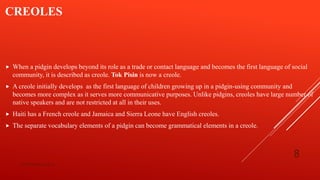
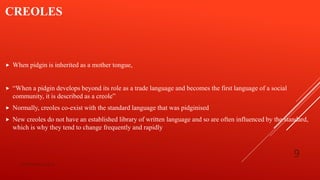



The document discusses sociolinguistics and related topics. It begins by defining language planning, which involves governments deciding official languages. Next, it describes pidgins as contact languages between groups without a shared language used for practical purposes. When a pidgin becomes a community's native language, it evolves into a creole. Creoles have native speakers and are no longer restricted in use. The document concludes by explaining the post-creole continuum, where a creole evolves varieties ranging from basilects with more creole features to acrolects closer to the standard language.


