ENGLISH PRONUNCIATION COMPETENCE OF THE SECOND 
SEMESTER STUDENTS CIVIL ENGINEERING DEPARTMENT OF 
SAMARINDA STATE POLYTECHNIC 
Sektalonir Oscarini Wati Bhakti, S.Pd., M.Pd 
(Staf Pengajar MKDU Jurusan Teknik Sipil Polnes) 
Fariyanti, S.E., M.Si 
(staf Pengajar Jurusan Akuntansi) 
Abstract 
This research investigated the second semester students’ pronunciation competence 
who are studying in Civil Engineering Department. This research belongs to 
quantitative research which the data taken from the test. The students were asked to 
pronounce 100 words that consisted of 1-syllable, 2-syllable, 3-syllable, and 4 and 
more-syllable words. The result of the test showed that the average score was 75 so 
that it was classified into “Fair”. It also showed that no students got score under 50. 
It means that no students had problem in pronouncing the words of test. There were 
11 students got fair score, between 60 – 69, and two students got poor score, between 
50 -59. Although, it was said that no students got no problem in pronouncing the 
words, but it needed considering that those students still need to have some exercises 
to pronounce the words correctly. 
INTRODUCTION 
Pronunciation is one of essential aspect in learning English. The deficiency in 
pronunciation ability can affect the ability of speech production. Carruthers (2007), 
states that good pronunciation is one of the foundations of effective spoken 
communication. If speakers pronounce the words clearly and correctly, their 
audience interlocutor would be able to understand what they are trying to express 
easily. However, misunderstanding, in many cases, occurs when words are 
1
inaccurately pronounced. Besides the ability to communicate, Nation and Newton 
(2009) informs that the lack of stable pronunciation can seriously affect students’ 
memory. The amount of stable pronunciation knowledge can help the learners 
enhance long-term memory capacity. 
Pronunciation must be acquired by the students since it is a fundamental skill 
that affect comprehensions. There are two keys problems with pronunciation 
teaching. First, it is likely to be neglected, second, if it is not neglected, it tends to be 
reactive to a particular problem that has arisen in the classroom rather than being 
strategically planned (Kelly: 2000). 
Besides those problems above, some factors also reveal in teaching 
pronunciation as the results of some researches of pronunciations. Some of them are 
the limitation of time in pronunciation practice in traditional classroom instruction, 
the less attention in speaking and listening skills of the teachers in the classroom, the 
students attitudes that tends to give less attention to the speaking and listening skills, 
and the teachers’ insufficient skill in teaching pronunciation. 
THE PURPOSE AND THE SIGNIFICANT 
The purpose of the research was to find out the English Pronunciation 
Competence of the second semester students Civil Engineering Department of 
Samarinda State Polytechnic. The significant that gained from the research were the 
researcher would expect to be able to share good inputs about the students’ English 
pronunciation competence, to contribute valuable information to English lecturers 
and Management of Samarinda State Polytechnic, and to give some additional 
information to anyone who is interested in investigating the same area of research. 
REVIEW OF LITERATURES 
The Definition of Pronunciation 
There are some definitions of pronunciation that delivers by some researchers. 
Macháčková (2012:9) defines pronunciation as a way how sounds are articulated by 
speakers marking their social class, education and so forth. According to 
www.nceltr.edu.au/pdamep , pronunciation refers to the production of sounds that we 
2
use to make meaning. It includes attention to the particular sounds of a language 
(segments), aspects of speech beyond the level of the individual sound, such as 
intonation, phrasing, stress, timing, rhythm (suprasegmental aspects), how the voice 
is projected (voice quality) and, in its broadest definition, attention to gestures and 
expressions that are closely related to the way we speak a language (2002:1). 
Department of Education Training and Youth Affairs (DETYA) also states 
pronunciations includes all those aspects of speech which make for an easily 
intelligible flow of speech, including segmental articulation, rhythm, intonation and 
phrasing, and more peripherally even gesture, body language and eye contact. 
Pronunciation is an essential ingredient of oral communication, which also includes 
grammar, vocabulary choice, and cultural considerations and so on (2001:6). 
It could be concluded that pronunciation is an essential aspect in 
communicating. A person who has a good pronunciation even not in other aspects, 
such as grammar, will be understood by his partner in speaking. Even pronunciation 
has connection to grammar, especially in English. The speaker who pronounces 
correctly the endings of the words, for example, can give grammatical information. 
The Factors Contributing to Students’ Pronunciation 
Kenworthy, Collier and Brown in Yangklang (2006) propose six other factors 
that affect student’s pronunciation, i.e., native language, age, exposure, innate 
phonetic ability, identity and language ego and motivation and concern for good 
pronunciation ability. 
The native language will be the most influential factor affecting a students’ 
pronunciation. If the students are familiar with the sound system of their native 
language, they will be able to diagnose their own difficulties. Many L1-L2 carryovers 
can be overcome through a focused awareness and effort onthe learners’ part. 
Age is not the crucial and only factor that affects learning or improving 
pronunciation abilities. Adults were probably able to learn second language 
phonology as well as children did, in a direct way, using a traditional listen and-repeat 
exercise, minimal pairs in the context of the sentences, conversation and role 
3
playing. Moreover, the older students were faster and more efficient than younger 
students in the early states of language learning. Older students and adolescents 
developed their second language skills continuously, but adults would diminish after 
the first year. However, there was no evidence for a simple and straightforward link 
between age and ability in pronunciation of a new language. Both younger learners 
and adults can improve their pronunciation ability. 
Various studies compared the pronunciation accuracy of people living in 
English-speaking countries and those who did not. It seemed that the amount of 
exposure is a contributing factor but not a necessary factor for the development of 
pronunciation skill. 
This skill is sometimes called ‘phonetic coding ability’. It is a common view 
that some people have a ‘better ear’ for a foreign language than others. Although 
students may have had exposure to a foreign language as children and attuned to 
phonetic discrimination, some studies have suggested that some elements of learning 
are a matter of awareness of the different sounds. Pronunciation can improve with 
effort and concentration on those sounds. 
Another influence was one’s attitude toward speakers of the target language and 
the extent to which the language ego identified with those speakers. Students with a 
positive attitude toward the people who spoke the language were likely to learn 
pronunciation more successfully. They were not afraid of the second identity that may 
have been emerging within them. 
The learners’ motivation can be the strongest factor. If the learners’ motivation 
is high, then they will be willing to improve their abilities by themselves. On the 
other hand, if they do not see the value or care about pronunciation, they may not be 
motivated to do well. 
4
RESEARCH METHODOLOGY 
Research Design 
This research applied quantitative design that is about explaining phenomena 
by collecting quantitative data that are analyzed using mathematically based methods 
(Muijs, 2004:11). 
The Research Context 
This research was designed to describe English reading problem of Civil 
Engineering of Samarinda State Polytechnic, East Kalimantan. This research will use 
quantitative method. All the participants were second semester students Civil 
Engineering Department of Samarinda State Polytechnic. 
Population 
In this research, the researcher took all second semester Civil Engineering 
Department students of Samarinda State Polytechnic as the population. The 
researcher found out that it was possible to give the test to all second semester Civil 
Engineering Department students of Samarinda State Polytechnic as long as they 
were still in the same campus. 
Data Collection Techniques 
The instrument used in this study was a test that aimed to investigate the 
participants’ pronunciation competence. Since one of the objectives of the current 
study focuses on English pronunciation and as far as the syllable numbers are 
concerned, these 100 words were divided into four groups: one syllable (e.g. read, 
street), two-syllable words (e.g., process, data), three-syllable words (e.g., engineer, 
energy), four and more -syllable words (e.g., automatic, construction) with 25 words 
each. All of these words selected were arranged in the ascending order based on their 
number of syllables. That was, the test begins with a group of one-syllable words and 
ends with four and more-syllable words. The words were taken from Civil 
Engineering handbook. 
5
Data Collection Procedures 
The researcher found out how many participants would be her population of 
the research. The data of the participants were gotten from the Academic Department 
of Samarinda State Polytechnic that concerns about the students’ data. After figuring 
out the number of the population, then the researcher constructed the the test. 
Data Analysis 
Percentage of students passing the test would be used to determine the 
participants’ pronunciation competence. They were classified that below 50 will be 
problem area. 
FINDINGS AND DISCUSSIONS 
Before conducting the test, the researcher conducted pilot test to ten the 
second students of Diploma Four of Civil Engineering Department to find out the 
validity and the reliability of test. The validity of the 1-syllable word was 0.7246, the 
validity of the 2-syllable words was 0.7521, the validity of the 3-syllable word was 
0.7246, and the validity of the 4 and more-syllable word was 0.7456. The reliability 
of the 1-syllable words was 0.9646, the reliability of 2-syllable words was 0.9646, the 
reliability of 3-syllable word was 0.9895, and the reliability of 4 and more syllable 
words was 0.9831. And there were 20 invalid number, so that there were 100 valid 
number. 
The pronunciation test was consisted of four parts. They were one-syllable 
words, two-syllable words, three-syllable words, and four and more-syllable words. 
After conducting the test to the second semester students of civil Engineering of 
Samarinda State Polytechnic, the researcher scored the test. Then, the researcher 
tabulated the data to find out the mean score and the number of the students who got 
the problem in pronunciation or not. 
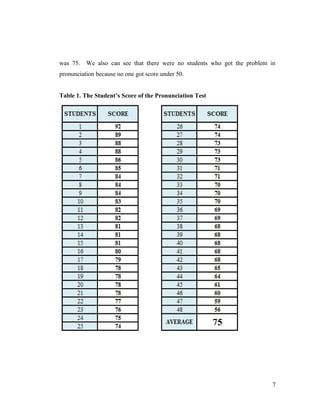
From table 1., we can see that there were 48 students who conducted the test. 
And the highest score was 92 and the lowest score was 56. And the average score 
6
was 75. We also can see that there were no students who got the problem in 
pronunciation because no one got score under 50. 
Table 1. The Student’s Score of the Pronunciation Test 
7
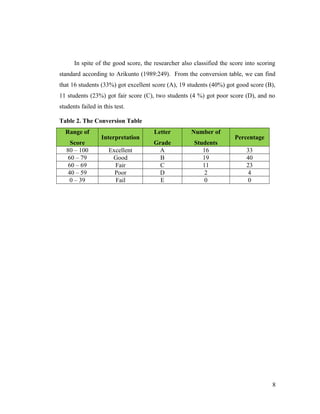
In spite of the good score, the researcher also classified the score into scoring 
standard according to Arikunto (1989:249). From the conversion table, we can find 
that 16 students (33%) got excellent score (A), 19 students (40%) got good score (B), 
11 students (23%) got fair score (C), two students (4 %) got poor score (D), and no 
students failed in this test. 
Table 2. The Conversion Table 
Range of 
Score 
Interpretation 
Letter 
Grade 
Number of 
Students 
Percentage 
80 – 100 Excellent A 16 33 
60 – 79 Good B 19 40 
60 – 69 Fair C 11 23 
40 – 59 Poor D 2 4 
0 – 39 Fail E 0 0 
8
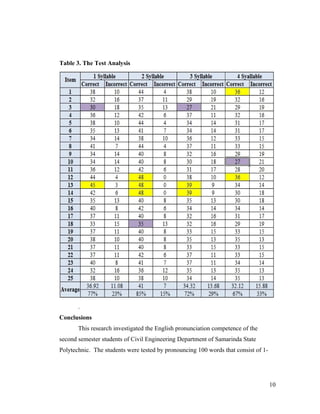
The researcher also tried to find out which syllable was the most difficult and 
easiest for the students to pronounce. From the table we can see that 2-syllable word 
was the easiest syllable to be pronounced and 4 and more-syllable word was the most 
difficult one. 
For 1-syllable word, the easiest word was number 13 because 45 students were 
correct to pronounce it and the most difficult word was number 3. For 2-syllable 
word, the easiest words were number 12, 13, and 14 because all the students could 
pronounce it correctly but there were only 35 students could pronounce number 18 
correctly. For 3-syllable words, there were 27 students could pronounce number 3 
correctly so that it was considered as the most difficult word while the easiest words 
were number 13 and 14. The easiest word for 4 and more-syllable word were number 
1 and 12 because there were 36 students could pronounce them correctly. And the 
most difficult word for 4 and more syllable was number 10. 
9
Table 3. The Test Analysis 
. 
Conclusions 
This research investigated the English pronunciation competence of the 
second semester students of Civil Engineering Department of Samarinda State 
Polytechnic. The students were tested by pronouncing 100 words that consist of 1- 
10
syllables words, 2-syllable words, 3-syllable words, and 4-more syllable words. Each 
syllable was consisted of 25 words. 
The research revealed that no students had problem in pronouncing the words 
that always appear in their reading about civil engineering. Nevertheless, the average 
score was 75 or categorized in “fair”. There were 16 students got excellent scores 
(33%), 19 students got good scores (40%), 11 students got fair scores (23%0, two 
students got poor scores (4%), and no students got fail score. The most difficult 
syllable to be pronounced was 2-syllable word and the easiest was 1-syllable words 
Suggestions 
According on the findings of the research, the researchers would like to give 
some suggestion that could give contribution to the management of Samarinda State 
Polytechnic. Because most of the participants no students got problem in 
pronouncing the words, but the average score was only 75 (fair). It means that there 
are still ways to increase the students competence in pronouncing the words. 
First, the management needs to appeal to the English lecturers to give some 
reading exercises to their students, not only silent reading but also loud reading, so 
that the students are able to find out to pronounce the words correctly. And then, the 
English lectures need to conduct the pronunciation test so that the teacher will find 
out their competence in English pronunciation. 
References 
AMEP Research Centre. www.nceltr.edu.au/pdamep (retrived April 20,2013) 
Arikunto, Suharsimi, 2003, Dasar-dasar Evaluasi Pendiikan, Jakarta: PT. Bina 
Aksara 
Carruthers, S. 2007. Articulatory Training on Facial Movements Using the Webcam 
Pronunciation Mirror: A Pilot Study. HPU TESL Working paper Series, 5(1), 
3-17. 
11
Department of Education Training and Youth Affair (DETYA). 2001. Teaching 
Pronunciation: A Handbook for Teachers and Trainers. Three Frameworks for 
an Integrated Approach. New South Wales Department of Education and 
Training 
Eva, Farida. 2001. A Study of the Repetition Drill Towards the English 
Pronunciation of the Fourth Grade Elementary School Students of SDN 018 
Samarinda in 1999/2000 Academic Year. English Department Faculty of 
Teacher Trainning and Education Mulawarman University. Samarinda. 2001 
Gilbert, Judy B. 2008. Teaching Pronunciation Using the Prosody Pyramid. 
Cambridge University Press 
Imamesup, Ampawan. 2011. The Study of the Effectiveness of Audioarticulation 
Model in Improving Thai Learners’ Pronunciation of Fricative Sounds. Master 
of Arts Degree in Teaching as a Foreign Language at Srinakharinwirot 
University 
Khamkhien, Attapol. 2010. Thai Learners’ English Pronunciation Competence: 
Lesson Learned From Word Stress Assignment. Journal off Language 
Teaching and Research, Vol.1, No. 6, pp. 757-764, November 2010. 
Kelly, G. 2000. How to Teach Pronunciation (1st Ed). London: Longman/Pearson 
Education Limited 
Machackova, Eva. 2012. Teaching English Pronunciation to Secondary School 
Students with Focus on “th” Consonants. Masaryk University Brno Faculty of 
Education Department of English Language and Literature 
Tomcikova, Nad’a. 2006. Developing Pronunciation With Young Learners. 
University of Pardubice Faculty of Arts and Philosophy Department of English 
and American Studies 
Varasarin. Patchara. 2007. An Action Research Study of Pronunciation Training, 
Language Learning Strategies and Speaking Confidence. School of Education 
Faculty of Arts, Education and Human Development Victoria University 
Yangklang, W. 2006. Improving English Final /-l/ Pronunciation of Thai Students 
Through Computer-Assisted Instruction Program. Suranaree University of 
Technology. Master of English Language Studies 
12

proununciation

  • 1.
    ENGLISH PRONUNCIATION COMPETENCEOF THE SECOND SEMESTER STUDENTS CIVIL ENGINEERING DEPARTMENT OF SAMARINDA STATE POLYTECHNIC Sektalonir Oscarini Wati Bhakti, S.Pd., M.Pd (Staf Pengajar MKDU Jurusan Teknik Sipil Polnes) Fariyanti, S.E., M.Si (staf Pengajar Jurusan Akuntansi) Abstract This research investigated the second semester students’ pronunciation competence who are studying in Civil Engineering Department. This research belongs to quantitative research which the data taken from the test. The students were asked to pronounce 100 words that consisted of 1-syllable, 2-syllable, 3-syllable, and 4 and more-syllable words. The result of the test showed that the average score was 75 so that it was classified into “Fair”. It also showed that no students got score under 50. It means that no students had problem in pronouncing the words of test. There were 11 students got fair score, between 60 – 69, and two students got poor score, between 50 -59. Although, it was said that no students got no problem in pronouncing the words, but it needed considering that those students still need to have some exercises to pronounce the words correctly. INTRODUCTION Pronunciation is one of essential aspect in learning English. The deficiency in pronunciation ability can affect the ability of speech production. Carruthers (2007), states that good pronunciation is one of the foundations of effective spoken communication. If speakers pronounce the words clearly and correctly, their audience interlocutor would be able to understand what they are trying to express easily. However, misunderstanding, in many cases, occurs when words are 1
  • 2.
    inaccurately pronounced. Besidesthe ability to communicate, Nation and Newton (2009) informs that the lack of stable pronunciation can seriously affect students’ memory. The amount of stable pronunciation knowledge can help the learners enhance long-term memory capacity. Pronunciation must be acquired by the students since it is a fundamental skill that affect comprehensions. There are two keys problems with pronunciation teaching. First, it is likely to be neglected, second, if it is not neglected, it tends to be reactive to a particular problem that has arisen in the classroom rather than being strategically planned (Kelly: 2000). Besides those problems above, some factors also reveal in teaching pronunciation as the results of some researches of pronunciations. Some of them are the limitation of time in pronunciation practice in traditional classroom instruction, the less attention in speaking and listening skills of the teachers in the classroom, the students attitudes that tends to give less attention to the speaking and listening skills, and the teachers’ insufficient skill in teaching pronunciation. THE PURPOSE AND THE SIGNIFICANT The purpose of the research was to find out the English Pronunciation Competence of the second semester students Civil Engineering Department of Samarinda State Polytechnic. The significant that gained from the research were the researcher would expect to be able to share good inputs about the students’ English pronunciation competence, to contribute valuable information to English lecturers and Management of Samarinda State Polytechnic, and to give some additional information to anyone who is interested in investigating the same area of research. REVIEW OF LITERATURES The Definition of Pronunciation There are some definitions of pronunciation that delivers by some researchers. Macháčková (2012:9) defines pronunciation as a way how sounds are articulated by speakers marking their social class, education and so forth. According to www.nceltr.edu.au/pdamep , pronunciation refers to the production of sounds that we 2
  • 3.
    use to makemeaning. It includes attention to the particular sounds of a language (segments), aspects of speech beyond the level of the individual sound, such as intonation, phrasing, stress, timing, rhythm (suprasegmental aspects), how the voice is projected (voice quality) and, in its broadest definition, attention to gestures and expressions that are closely related to the way we speak a language (2002:1). Department of Education Training and Youth Affairs (DETYA) also states pronunciations includes all those aspects of speech which make for an easily intelligible flow of speech, including segmental articulation, rhythm, intonation and phrasing, and more peripherally even gesture, body language and eye contact. Pronunciation is an essential ingredient of oral communication, which also includes grammar, vocabulary choice, and cultural considerations and so on (2001:6). It could be concluded that pronunciation is an essential aspect in communicating. A person who has a good pronunciation even not in other aspects, such as grammar, will be understood by his partner in speaking. Even pronunciation has connection to grammar, especially in English. The speaker who pronounces correctly the endings of the words, for example, can give grammatical information. The Factors Contributing to Students’ Pronunciation Kenworthy, Collier and Brown in Yangklang (2006) propose six other factors that affect student’s pronunciation, i.e., native language, age, exposure, innate phonetic ability, identity and language ego and motivation and concern for good pronunciation ability. The native language will be the most influential factor affecting a students’ pronunciation. If the students are familiar with the sound system of their native language, they will be able to diagnose their own difficulties. Many L1-L2 carryovers can be overcome through a focused awareness and effort onthe learners’ part. Age is not the crucial and only factor that affects learning or improving pronunciation abilities. Adults were probably able to learn second language phonology as well as children did, in a direct way, using a traditional listen and-repeat exercise, minimal pairs in the context of the sentences, conversation and role 3
  • 4.
    playing. Moreover, theolder students were faster and more efficient than younger students in the early states of language learning. Older students and adolescents developed their second language skills continuously, but adults would diminish after the first year. However, there was no evidence for a simple and straightforward link between age and ability in pronunciation of a new language. Both younger learners and adults can improve their pronunciation ability. Various studies compared the pronunciation accuracy of people living in English-speaking countries and those who did not. It seemed that the amount of exposure is a contributing factor but not a necessary factor for the development of pronunciation skill. This skill is sometimes called ‘phonetic coding ability’. It is a common view that some people have a ‘better ear’ for a foreign language than others. Although students may have had exposure to a foreign language as children and attuned to phonetic discrimination, some studies have suggested that some elements of learning are a matter of awareness of the different sounds. Pronunciation can improve with effort and concentration on those sounds. Another influence was one’s attitude toward speakers of the target language and the extent to which the language ego identified with those speakers. Students with a positive attitude toward the people who spoke the language were likely to learn pronunciation more successfully. They were not afraid of the second identity that may have been emerging within them. The learners’ motivation can be the strongest factor. If the learners’ motivation is high, then they will be willing to improve their abilities by themselves. On the other hand, if they do not see the value or care about pronunciation, they may not be motivated to do well. 4
  • 5.
    RESEARCH METHODOLOGY ResearchDesign This research applied quantitative design that is about explaining phenomena by collecting quantitative data that are analyzed using mathematically based methods (Muijs, 2004:11). The Research Context This research was designed to describe English reading problem of Civil Engineering of Samarinda State Polytechnic, East Kalimantan. This research will use quantitative method. All the participants were second semester students Civil Engineering Department of Samarinda State Polytechnic. Population In this research, the researcher took all second semester Civil Engineering Department students of Samarinda State Polytechnic as the population. The researcher found out that it was possible to give the test to all second semester Civil Engineering Department students of Samarinda State Polytechnic as long as they were still in the same campus. Data Collection Techniques The instrument used in this study was a test that aimed to investigate the participants’ pronunciation competence. Since one of the objectives of the current study focuses on English pronunciation and as far as the syllable numbers are concerned, these 100 words were divided into four groups: one syllable (e.g. read, street), two-syllable words (e.g., process, data), three-syllable words (e.g., engineer, energy), four and more -syllable words (e.g., automatic, construction) with 25 words each. All of these words selected were arranged in the ascending order based on their number of syllables. That was, the test begins with a group of one-syllable words and ends with four and more-syllable words. The words were taken from Civil Engineering handbook. 5
  • 6.
    Data Collection Procedures The researcher found out how many participants would be her population of the research. The data of the participants were gotten from the Academic Department of Samarinda State Polytechnic that concerns about the students’ data. After figuring out the number of the population, then the researcher constructed the the test. Data Analysis Percentage of students passing the test would be used to determine the participants’ pronunciation competence. They were classified that below 50 will be problem area. FINDINGS AND DISCUSSIONS Before conducting the test, the researcher conducted pilot test to ten the second students of Diploma Four of Civil Engineering Department to find out the validity and the reliability of test. The validity of the 1-syllable word was 0.7246, the validity of the 2-syllable words was 0.7521, the validity of the 3-syllable word was 0.7246, and the validity of the 4 and more-syllable word was 0.7456. The reliability of the 1-syllable words was 0.9646, the reliability of 2-syllable words was 0.9646, the reliability of 3-syllable word was 0.9895, and the reliability of 4 and more syllable words was 0.9831. And there were 20 invalid number, so that there were 100 valid number. The pronunciation test was consisted of four parts. They were one-syllable words, two-syllable words, three-syllable words, and four and more-syllable words. After conducting the test to the second semester students of civil Engineering of Samarinda State Polytechnic, the researcher scored the test. Then, the researcher tabulated the data to find out the mean score and the number of the students who got the problem in pronunciation or not. From table 1., we can see that there were 48 students who conducted the test. And the highest score was 92 and the lowest score was 56. And the average score 6
  • 7.
    was 75. Wealso can see that there were no students who got the problem in pronunciation because no one got score under 50. Table 1. The Student’s Score of the Pronunciation Test 7
  • 8.
    In spite ofthe good score, the researcher also classified the score into scoring standard according to Arikunto (1989:249). From the conversion table, we can find that 16 students (33%) got excellent score (A), 19 students (40%) got good score (B), 11 students (23%) got fair score (C), two students (4 %) got poor score (D), and no students failed in this test. Table 2. The Conversion Table Range of Score Interpretation Letter Grade Number of Students Percentage 80 – 100 Excellent A 16 33 60 – 79 Good B 19 40 60 – 69 Fair C 11 23 40 – 59 Poor D 2 4 0 – 39 Fail E 0 0 8
  • 9.
    The researcher alsotried to find out which syllable was the most difficult and easiest for the students to pronounce. From the table we can see that 2-syllable word was the easiest syllable to be pronounced and 4 and more-syllable word was the most difficult one. For 1-syllable word, the easiest word was number 13 because 45 students were correct to pronounce it and the most difficult word was number 3. For 2-syllable word, the easiest words were number 12, 13, and 14 because all the students could pronounce it correctly but there were only 35 students could pronounce number 18 correctly. For 3-syllable words, there were 27 students could pronounce number 3 correctly so that it was considered as the most difficult word while the easiest words were number 13 and 14. The easiest word for 4 and more-syllable word were number 1 and 12 because there were 36 students could pronounce them correctly. And the most difficult word for 4 and more syllable was number 10. 9
  • 10.
    Table 3. TheTest Analysis . Conclusions This research investigated the English pronunciation competence of the second semester students of Civil Engineering Department of Samarinda State Polytechnic. The students were tested by pronouncing 100 words that consist of 1- 10
  • 11.
    syllables words, 2-syllablewords, 3-syllable words, and 4-more syllable words. Each syllable was consisted of 25 words. The research revealed that no students had problem in pronouncing the words that always appear in their reading about civil engineering. Nevertheless, the average score was 75 or categorized in “fair”. There were 16 students got excellent scores (33%), 19 students got good scores (40%), 11 students got fair scores (23%0, two students got poor scores (4%), and no students got fail score. The most difficult syllable to be pronounced was 2-syllable word and the easiest was 1-syllable words Suggestions According on the findings of the research, the researchers would like to give some suggestion that could give contribution to the management of Samarinda State Polytechnic. Because most of the participants no students got problem in pronouncing the words, but the average score was only 75 (fair). It means that there are still ways to increase the students competence in pronouncing the words. First, the management needs to appeal to the English lecturers to give some reading exercises to their students, not only silent reading but also loud reading, so that the students are able to find out to pronounce the words correctly. And then, the English lectures need to conduct the pronunciation test so that the teacher will find out their competence in English pronunciation. References AMEP Research Centre. www.nceltr.edu.au/pdamep (retrived April 20,2013) Arikunto, Suharsimi, 2003, Dasar-dasar Evaluasi Pendiikan, Jakarta: PT. Bina Aksara Carruthers, S. 2007. Articulatory Training on Facial Movements Using the Webcam Pronunciation Mirror: A Pilot Study. HPU TESL Working paper Series, 5(1), 3-17. 11
  • 12.
    Department of EducationTraining and Youth Affair (DETYA). 2001. Teaching Pronunciation: A Handbook for Teachers and Trainers. Three Frameworks for an Integrated Approach. New South Wales Department of Education and Training Eva, Farida. 2001. A Study of the Repetition Drill Towards the English Pronunciation of the Fourth Grade Elementary School Students of SDN 018 Samarinda in 1999/2000 Academic Year. English Department Faculty of Teacher Trainning and Education Mulawarman University. Samarinda. 2001 Gilbert, Judy B. 2008. Teaching Pronunciation Using the Prosody Pyramid. Cambridge University Press Imamesup, Ampawan. 2011. The Study of the Effectiveness of Audioarticulation Model in Improving Thai Learners’ Pronunciation of Fricative Sounds. Master of Arts Degree in Teaching as a Foreign Language at Srinakharinwirot University Khamkhien, Attapol. 2010. Thai Learners’ English Pronunciation Competence: Lesson Learned From Word Stress Assignment. Journal off Language Teaching and Research, Vol.1, No. 6, pp. 757-764, November 2010. Kelly, G. 2000. How to Teach Pronunciation (1st Ed). London: Longman/Pearson Education Limited Machackova, Eva. 2012. Teaching English Pronunciation to Secondary School Students with Focus on “th” Consonants. Masaryk University Brno Faculty of Education Department of English Language and Literature Tomcikova, Nad’a. 2006. Developing Pronunciation With Young Learners. University of Pardubice Faculty of Arts and Philosophy Department of English and American Studies Varasarin. Patchara. 2007. An Action Research Study of Pronunciation Training, Language Learning Strategies and Speaking Confidence. School of Education Faculty of Arts, Education and Human Development Victoria University Yangklang, W. 2006. Improving English Final /-l/ Pronunciation of Thai Students Through Computer-Assisted Instruction Program. Suranaree University of Technology. Master of English Language Studies 12