Fitango Education
          Health Topics

                                    PID


http://www.fitango.com/categories.php?id=177
Overview
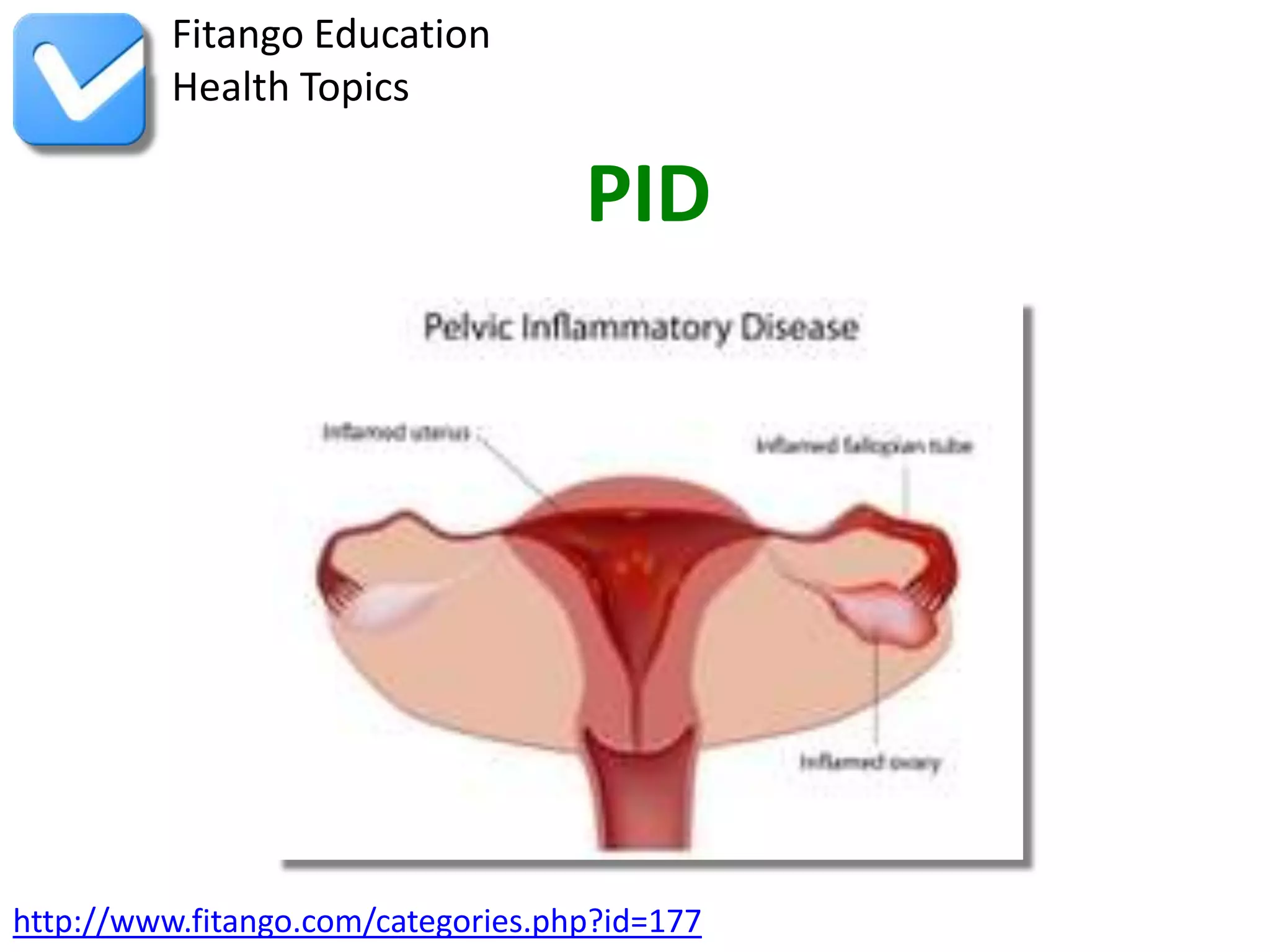
   Pelvic inflammatory disease (PID) is an infection
   and inflammation of the female reproductive
   organs. It can scar the tubes that carry eggs from
   the ovary to the uterus which can lead to infertility,
   ectopic pregnancy, pelvic pain and other problems.
   PID is the most common preventable cause of
   infertility in the United States. Gonorrhea and
   chlamydia are the most common causes, but other
   bacteria can also cause PID.


http://www.fitango.com/categories.php?id=177                1
Symptoms
   Some women have no symptoms. Others have pain
   in the lower abdomen, fever, smelly vaginal
   discharge, irregular bleeding or pain during
   intercourse. Antibiotics can cure PID. Early
   treatment is important - waiting too long increases
   the risk of infertility.


http://www.fitango.com/categories.php?id=177             2
Diagnosis
   If you think that you may have PID, see a doctor
   right away. If you have pain in your lower abdomen
   (stomach area), your doctor will perform a physical
   exam. This will include a pelvic (internal) exam.
   Your doctor will check for:
   -- Abnormal discharge from your vagina or cervix


http://www.fitango.com/categories.php?id=177             3
Diagnosis
   -- Lumps called abscesses near your ovaries and
   tubes
   -- Tenderness or pain in your pelvic organs
   Your doctor will also test you for STIs, including HIV
   and syphilis (SI-fuh-luhs), urinary tract infection,
   and if needed, pregnancy. If needed, your doctor
   may do other tests:


http://www.fitango.com/categories.php?id=177                4
Diagnosis
   -- Ultrasound (sonogram) — a test that uses sound
   waves to take pictures of the pelvic area.
   -- Endometrial (en-duh-MEE-tree-uhl) (uterine)
   biopsy — the doctor removes and tests a small
   piece of the endometrium (the inside lining of the
   womb).


http://www.fitango.com/categories.php?id=177            5
Diagnosis
   -- Laparoscopy (lap-uh-RAHS-kuh-pee) — the
   doctor inserts a small, lighted tube through your
   abdomen (stomach area) to look at your pelvic
   organs.
   These tests will help your doctor find out if you
   have PID, or if you have a different problem that
   looks like PID.


http://www.fitango.com/categories.php?id=177           6
Treatment
   PID can be cured with antibiotics (drugs that kill
   bacteria). Most of the time, at least two antibiotics
   are used that work against a wide range of
   bacteria. Your doctor will work with you to find the
   best treatment for you. You must take all your
   medicine, even if your symptoms go away. This
   helps to make sure your infection is fully cured.
   You should see your doctor again 2 to 3 days after
   starting treatment to make sure the antibiotics are
   working.
http://www.fitango.com/categories.php?id=177               7
Treatment
   Without treatment, PID can lead to severe
   problems like infertility, ectopic pregnancy, and
   chronic pelvic pain.
   Any damage done to your pelvic organs before you
   start treatment likely cannot be undone. Still, don't
   put off getting treatment. If you do, you may not
   be able to have children. If you think you may have
   PID, see a doctor right away.


http://www.fitango.com/categories.php?id=177               8
Treatment
   Your doctor may suggest going into the hospital to
   treat your PID if you:
   -- Are very sick
   -- Are pregnant
   -- Don’t respond to or cannot swallow pills. If this is
   the case, you will need intravenous (in the vein or
   IV) antibiotics.


http://www.fitango.com/categories.php?id=177                 9
Treatment
   -- Have an abscess (sore) in a tube or ovary
   If you still have symptoms or if the abscess doesn't
   go away after treatment, you may need surgery.
   Problems caused by PID, such as constant pelvic
   pain and scarring, are often hard to treat. But,
   sometimes they get better after surgery.


http://www.fitango.com/categories.php?id=177              10
Causes
   A woman can get PID if bacteria (germs) move up
   from her vagina and infect her pelvic organs. Many
   different types of bacteria can cause PID. But, most
   cases of PID are caused by bacteria that cause 2
   common sexually transmitted infections (STIs) —
   gonorrhea (gah-nuh-REE-uh) and chlamydia (kluh-
   MI-dee-uh). It can take from a few days to a few
   months for an infection to travel up from the
   vagina to the pelvic organs.


http://www.fitango.com/categories.php?id=177              11
Causes
   You can get PID without having an STI. Normal
   bacteria found in the vagina and on the cervix can
   sometimes cause PID. No one is sure why this
   happens.


http://www.fitango.com/categories.php?id=177            12
Risks
   You are at risk if you
   • Are sexually active and younger than 25
   • Have more than one sex partner
   • Douche


http://www.fitango.com/categories.php?id=177   13
Prevention
   PID is most often caused by an STI that hasn't been
   treated. You can keep from getting PID by not
   getting an STI.
   The best way to prevent an STI is:
   -- Don't have sex of any kind.


http://www.fitango.com/categories.php?id=177             14
Prevention
   -- Have sex with one partner who doesn't have any
   STIs.
   -- Use condoms every time you have vaginal, anal,
   or oral sex. Read and follow the directions on the
   package. Condoms, when used the right way, can
   lower your chances of getting an STI.


http://www.fitango.com/categories.php?id=177            15
Prevention
   -- Don't douche. Douching removes some of the
   normal bacteria in the vagina that protect you
   from infection. This makes it easier for you to get
   an STI.
   -- If you're having sex, ask your doctor to test you
   for STIs. STIs are easier to treat if they are found
   early.


http://www.fitango.com/categories.php?id=177              16
Prevention
   Learn the common symptoms of STIs. If you think
   you might have an STI, see your doctor right away.


http://www.fitango.com/categories.php?id=177            17
PID

PID

  • 1.
    Fitango Education Health Topics PID http://www.fitango.com/categories.php?id=177
  • 2.
    Overview Pelvic inflammatory disease (PID) is an infection and inflammation of the female reproductive organs. It can scar the tubes that carry eggs from the ovary to the uterus which can lead to infertility, ectopic pregnancy, pelvic pain and other problems. PID is the most common preventable cause of infertility in the United States. Gonorrhea and chlamydia are the most common causes, but other bacteria can also cause PID. http://www.fitango.com/categories.php?id=177 1
  • 3.
    Symptoms Some women have no symptoms. Others have pain in the lower abdomen, fever, smelly vaginal discharge, irregular bleeding or pain during intercourse. Antibiotics can cure PID. Early treatment is important - waiting too long increases the risk of infertility. http://www.fitango.com/categories.php?id=177 2
  • 4.
    Diagnosis If you think that you may have PID, see a doctor right away. If you have pain in your lower abdomen (stomach area), your doctor will perform a physical exam. This will include a pelvic (internal) exam. Your doctor will check for: -- Abnormal discharge from your vagina or cervix http://www.fitango.com/categories.php?id=177 3
  • 5.
    Diagnosis -- Lumps called abscesses near your ovaries and tubes -- Tenderness or pain in your pelvic organs Your doctor will also test you for STIs, including HIV and syphilis (SI-fuh-luhs), urinary tract infection, and if needed, pregnancy. If needed, your doctor may do other tests: http://www.fitango.com/categories.php?id=177 4
  • 6.
    Diagnosis -- Ultrasound (sonogram) — a test that uses sound waves to take pictures of the pelvic area. -- Endometrial (en-duh-MEE-tree-uhl) (uterine) biopsy — the doctor removes and tests a small piece of the endometrium (the inside lining of the womb). http://www.fitango.com/categories.php?id=177 5
  • 7.
    Diagnosis -- Laparoscopy (lap-uh-RAHS-kuh-pee) — the doctor inserts a small, lighted tube through your abdomen (stomach area) to look at your pelvic organs. These tests will help your doctor find out if you have PID, or if you have a different problem that looks like PID. http://www.fitango.com/categories.php?id=177 6
  • 8.
    Treatment PID can be cured with antibiotics (drugs that kill bacteria). Most of the time, at least two antibiotics are used that work against a wide range of bacteria. Your doctor will work with you to find the best treatment for you. You must take all your medicine, even if your symptoms go away. This helps to make sure your infection is fully cured. You should see your doctor again 2 to 3 days after starting treatment to make sure the antibiotics are working. http://www.fitango.com/categories.php?id=177 7
  • 9.
    Treatment Without treatment, PID can lead to severe problems like infertility, ectopic pregnancy, and chronic pelvic pain. Any damage done to your pelvic organs before you start treatment likely cannot be undone. Still, don't put off getting treatment. If you do, you may not be able to have children. If you think you may have PID, see a doctor right away. http://www.fitango.com/categories.php?id=177 8
  • 10.
    Treatment Your doctor may suggest going into the hospital to treat your PID if you: -- Are very sick -- Are pregnant -- Don’t respond to or cannot swallow pills. If this is the case, you will need intravenous (in the vein or IV) antibiotics. http://www.fitango.com/categories.php?id=177 9
  • 11.
    Treatment -- Have an abscess (sore) in a tube or ovary If you still have symptoms or if the abscess doesn't go away after treatment, you may need surgery. Problems caused by PID, such as constant pelvic pain and scarring, are often hard to treat. But, sometimes they get better after surgery. http://www.fitango.com/categories.php?id=177 10
  • 12.
    Causes A woman can get PID if bacteria (germs) move up from her vagina and infect her pelvic organs. Many different types of bacteria can cause PID. But, most cases of PID are caused by bacteria that cause 2 common sexually transmitted infections (STIs) — gonorrhea (gah-nuh-REE-uh) and chlamydia (kluh- MI-dee-uh). It can take from a few days to a few months for an infection to travel up from the vagina to the pelvic organs. http://www.fitango.com/categories.php?id=177 11
  • 13.
    Causes You can get PID without having an STI. Normal bacteria found in the vagina and on the cervix can sometimes cause PID. No one is sure why this happens. http://www.fitango.com/categories.php?id=177 12
  • 14.
    Risks You are at risk if you • Are sexually active and younger than 25 • Have more than one sex partner • Douche http://www.fitango.com/categories.php?id=177 13
  • 15.
    Prevention PID is most often caused by an STI that hasn't been treated. You can keep from getting PID by not getting an STI. The best way to prevent an STI is: -- Don't have sex of any kind. http://www.fitango.com/categories.php?id=177 14
  • 16.
    Prevention -- Have sex with one partner who doesn't have any STIs. -- Use condoms every time you have vaginal, anal, or oral sex. Read and follow the directions on the package. Condoms, when used the right way, can lower your chances of getting an STI. http://www.fitango.com/categories.php?id=177 15
  • 17.
    Prevention -- Don't douche. Douching removes some of the normal bacteria in the vagina that protect you from infection. This makes it easier for you to get an STI. -- If you're having sex, ask your doctor to test you for STIs. STIs are easier to treat if they are found early. http://www.fitango.com/categories.php?id=177 16
  • 18.
    Prevention Learn the common symptoms of STIs. If you think you might have an STI, see your doctor right away. http://www.fitango.com/categories.php?id=177 17