http://www.fitango.com/categories.php?id=650
Fitango Education
Health Topics
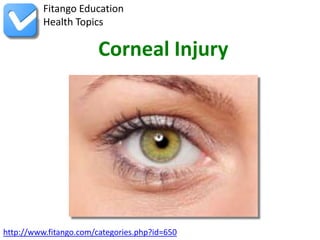
Corneal Injury
1
Overview
Corneal injury describes an injury to the
cornea. The cornea is the crystal clear
(transparent) tissue covering the front
of the eye. It works with the lens of the eye to
focus images on the retina.
2
Symptoms
-- Being very sensitive to
light
-- Blurred vision
-- Decrease in vision
-- Eye pain
3
Symptoms
or stinging and burning in the eye
-- Feeling like something is in your eye, called a
foreign-body
sensation
-- Redness of
the eye, "bloodshot" eyes
4
Symptoms
-- Swollen eyelids
-- Watery eyes or increased tearing
5
Diagnoses
A complete eye exam must be done. The health
care provider may use a special stain called
fluorescein, placed on the surface
of the eye.
Tests that are used to examine the eye for
6
Diagnoses
damage to the cornea include:
Standard
ophthalmic exam
Slit lamp
examination
of the eye
7
Treatment
See: Eye emergencies
for information on immediate first aid.
Anyone with severe eye pain needs to be
evaluated in an emergency care center or by an
ophthalmologist immediately.
8
Treatment
Treatment for corneal injuries may involve:
Removing
any foreign material from the eye
Wearing an
eye patch or temporary bandage contact lens
9
Treatment
Using eye
drops or ointments prescribed by the doctor
Not wearing
contact lenses until the eye has healed
Taking pain
medicines
10
Treatment
An abrasion or foreign object that is large
enough to damage the cornea may not be visible
without proper magnification or
special eye drops that stain the cornea. Abrasions
will often feel like foreign
bodies in the eye.
11
Causes
Injuries to the cornea are common.
Injuries to the outer surface of the cornea,
called corneal abrasions, may be caused by:
Chemical
12
Causes
irritation - from almost any fluid that gets into the
eye
Overuse of
contact lenses or lenses that don't fit correctly
Reaction or
sensitivity to contact lens solutions and cosmetics
13
Causes
Scratches
or scrapes on the surface of the cornea (called an
abrasion)
Something
getting into the eye (such as sand or dust)
Sunlight,
14
Causes
sun lamps, snow or water reflections, or arc-
welding
Infections
may also damage the cornea.
High-speed particles, such as chips from
15
Causes
hammering metal on metal, may become
embedded in the surface of the cornea.
Rarely, they may pass through the cornea and go
deeper into the eye.
Injuries that affect only the surface of the
cornea normally heal very rapidly with treatment.
The eye should be back to
16
Causes
normal within 2 days.
Penetrating corneal injuries are much more
serious. The outcome depends on the specific
injury. Severe corneal injury may require extensive
surgery or a cornea transplant.
17
Risks
You are more likely to develop a corneal
injury if you:
Are exposed
to sunlight or artificial ultraviolet light for long
periods of time
18
Risks
Have
ill-fitting contact lenses or overuse your contact
lenses
Have very dry eyes
Work in a
dusty environment
19
Prevention
-- Wear safety goggles at all times when using hand
or power
tools or chemicals, during high impact sports, or in
other situations where
there is a potential for eye injury.
20
Prevention
-- Wear sunglasses designed to screen ultraviolet
light when
you are exposed to sunlight, even during the
winter.
-- Be careful when using household cleaners. Many
household
products contain strong acids, alkalis, or other
chemicals. Drain and oven
21
Prevention
cleaners are particularly dangerous. They can lead
to blindness if not used
correctly.
Corneal Injury

Corneal Injury

  • 1.
  • 2.
    1 Overview Corneal injury describesan injury to the cornea. The cornea is the crystal clear (transparent) tissue covering the front of the eye. It works with the lens of the eye to focus images on the retina.
  • 3.
    2 Symptoms -- Being verysensitive to light -- Blurred vision -- Decrease in vision -- Eye pain
  • 4.
    3 Symptoms or stinging andburning in the eye -- Feeling like something is in your eye, called a foreign-body sensation -- Redness of the eye, "bloodshot" eyes
  • 5.
    4 Symptoms -- Swollen eyelids --Watery eyes or increased tearing
  • 6.
    5 Diagnoses A complete eyeexam must be done. The health care provider may use a special stain called fluorescein, placed on the surface of the eye. Tests that are used to examine the eye for
  • 7.
    6 Diagnoses damage to thecornea include: Standard ophthalmic exam Slit lamp examination of the eye
  • 8.
    7 Treatment See: Eye emergencies forinformation on immediate first aid. Anyone with severe eye pain needs to be evaluated in an emergency care center or by an ophthalmologist immediately.
  • 9.
    8 Treatment Treatment for cornealinjuries may involve: Removing any foreign material from the eye Wearing an eye patch or temporary bandage contact lens
  • 10.
    9 Treatment Using eye drops orointments prescribed by the doctor Not wearing contact lenses until the eye has healed Taking pain medicines
  • 11.
    10 Treatment An abrasion orforeign object that is large enough to damage the cornea may not be visible without proper magnification or special eye drops that stain the cornea. Abrasions will often feel like foreign bodies in the eye.
  • 12.
    11 Causes Injuries to thecornea are common. Injuries to the outer surface of the cornea, called corneal abrasions, may be caused by: Chemical
  • 13.
    12 Causes irritation - fromalmost any fluid that gets into the eye Overuse of contact lenses or lenses that don't fit correctly Reaction or sensitivity to contact lens solutions and cosmetics
  • 14.
    13 Causes Scratches or scrapes onthe surface of the cornea (called an abrasion) Something getting into the eye (such as sand or dust) Sunlight,
  • 15.
    14 Causes sun lamps, snowor water reflections, or arc- welding Infections may also damage the cornea. High-speed particles, such as chips from
  • 16.
    15 Causes hammering metal onmetal, may become embedded in the surface of the cornea. Rarely, they may pass through the cornea and go deeper into the eye. Injuries that affect only the surface of the cornea normally heal very rapidly with treatment. The eye should be back to
  • 17.
    16 Causes normal within 2days. Penetrating corneal injuries are much more serious. The outcome depends on the specific injury. Severe corneal injury may require extensive surgery or a cornea transplant.
  • 18.
    17 Risks You are morelikely to develop a corneal injury if you: Are exposed to sunlight or artificial ultraviolet light for long periods of time
  • 19.
    18 Risks Have ill-fitting contact lensesor overuse your contact lenses Have very dry eyes Work in a dusty environment
  • 20.
    19 Prevention -- Wear safetygoggles at all times when using hand or power tools or chemicals, during high impact sports, or in other situations where there is a potential for eye injury.
  • 21.
    20 Prevention -- Wear sunglassesdesigned to screen ultraviolet light when you are exposed to sunlight, even during the winter. -- Be careful when using household cleaners. Many household products contain strong acids, alkalis, or other chemicals. Drain and oven
  • 22.
    21 Prevention cleaners are particularlydangerous. They can lead to blindness if not used correctly.