MISCARRIAGE
Outlines
 INTRODUCTION TO MISCARRIAGE
 EPIDIMOLOGY
 RISK FACTORS
 ETIOLCLINICAL PRESINTING FEATURES
 OGY
 Physical examination
 Clinical investigations
 Types of miscarriage
 In all forms of miscarriage
 Complications of miscarriage
INTRODUCTION TOMISCARRIAGE
• Miscarriage is pregnancy that ends
spontaneously before 24th week of gestation
(before getting viability )
• Vs Abortion which is the deliberate termination
of a human pregnancy
EPIDIMOLOGY
•Approximately 20% of pregnancies end in miscarriage
and these miscarriages can cause considerable
distress.
(Sotiriadis et al, 2004).
•In the UK, it is estimated that around a quarter of a
million pregnancies each year end in a miscarriage
(The Miscarriage Association,
2011).
•This loss is associated with a significant amount of
physical and psychological morbidity.
RISKFACTORS
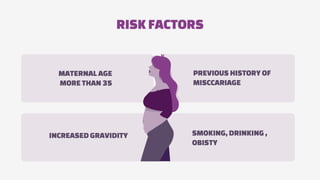
MATERNAL AGE
MORE THAN 35
INCREASED GRAVIDITY
PREVIOUS HISTORY OF
MISCCARIAGE
SMOKING, DRINKING,
OBISTY
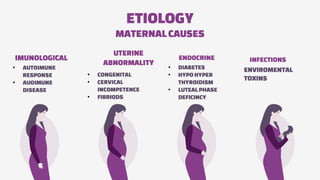
ETIOLOGY
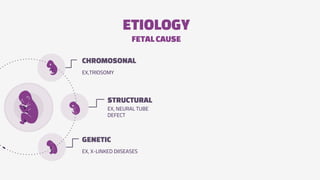
FETALCAUSE
GENETIC
EX, X-LINKED DIISEASES
STRUCTURAL
EX, NEURAL TUBE
DEFECT
CHROMOSONAL
EX,TRIOSOMY
ETIOLOGY
MATERNAL CAUSES
• AUTOIMUNE
RESPONSE
• AUOIMUNE
DISEASE
IMUNOLOGICAL
• CONGENITAL
• CERVICAL
INCOMPETENCE
• FIBRIODS
UTERINE
ABNORMALITY
• DIABETES
• HYPOHYPER
THYROIDISM
• LUTEALPHASE
DEFICINCY
ENDOCRINE
ENVIROMENTAL
TOXINS
INFECTIONS
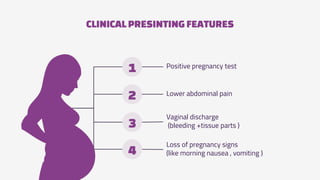
CLINICALPRESINTING FEATURES
Lower abdominal pain
Vaginal discharge
(bleeding +tissue parts )
Loss of pregnancy signs
(like morning nausea , vomiting )
Positive pregnancy test
1
2
3
4
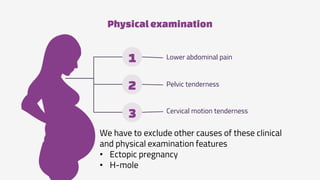
Physicalexamination
Pelvic tenderness
Cervical motion tenderness
Lower abdominal pain
1
2
3
We have to exclude other causes of these clinical
and physical examination features
• Ectopic pregnancy
• H-mole
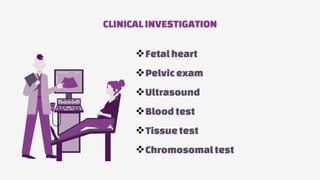
CLINICALINVESTIGATION
Fetalheart
Pelvicexam
Ultrasound
Blood test
Tissuetest
Chromosomaltest
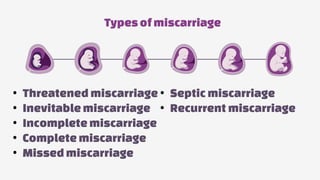
Types ofmiscarriage
• Threatened miscarriage
• Inevitable miscarriage
• Incomplete miscarriage
• Complete miscarriage
• Missedmiscarriage
• Septic miscarriage
• Recurrent miscarriage
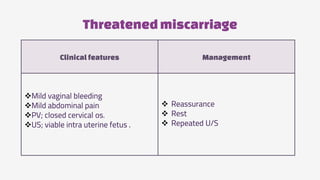
Threatenedmiscarriage
Clinicalfeatures Management
Mild vaginal bleeding
Mild abdominal pain
PV; closed cervical os.
US; viable intra uterine fetus .
 Reassurance
 Rest
 Repeated U/S
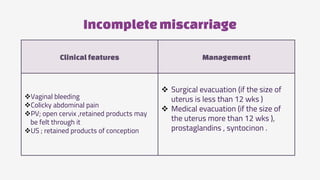
Incompletemiscarriage
Clinicalfeatures Management
Vaginal bleeding
Colicky abdominal pain
PV; open cervix ,retained products may
be felt through it
US ; retained products of conception
 Surgical evacuation (if the size of
uterus is less than 12 wks )
 Medical evacuation (if the size of
the uterus more than 12 wks ),
prostaglandins , syntocinon .
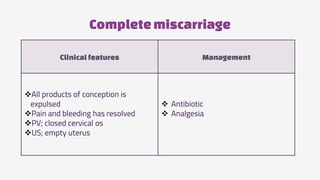
Completemiscarriage
Clinicalfeatures Management
All products of conception is
expulsed
Pain and bleeding has resolved
PV; closed cervical os
US; empty uterus
 Antibiotic
 Analgesia
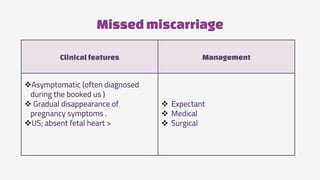
Missedmiscarriage
Clinicalfeatures Management
Asymptomatic (often diagnosed
during the booked us )
 Gradual disappearance of
pregnancy symptoms .
US; absent fetal heart >
 Expectant
 Medical
 Surgical
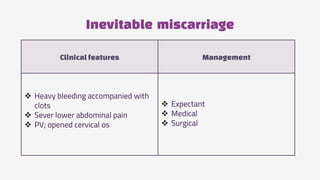
Inevitable miscarriage
Clinicalfeatures Management
 Heavy bleeding accompanied with
clots
 Sever lower abdominal pain
 PV; opened cervical os
 Expectant
 Medical
 Surgical
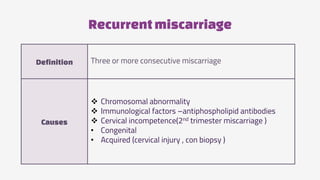
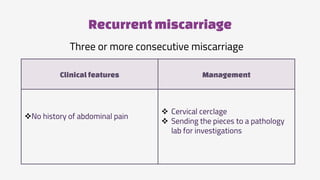
Recurrentmiscarriage
Definition Three or more consecutive miscarriage
Causes
 Chromosomal abnormality
 Immunological factors –antiphospholipid antibodies
 Cervical incompetence(2nd trimester miscarriage )
• Congenital
• Acquired (cervical injury , con biopsy )
Recurrentmiscarriage
Clinicalfeatures Management
No history of abdominal pain
 Cervical cerclage
 Sending the pieces to a pathology
lab for investigations
Three or more consecutive miscarriage
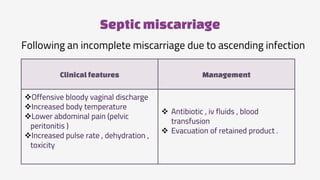
Septicmiscarriage
Clinicalfeatures Management
Offensive bloody vaginal discharge
Increased body temperature
Lower abdominal pain (pelvic
peritonitis )
Increased pulse rate , dehydration ,
toxicity
 Antibiotic , iv fluids , blood
transfusion
 Evacuation of retained product .
Following an incomplete miscarriage due to ascending infection
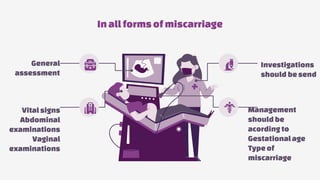
Inallformsof miscarriage
Investigations
should be send
Management
should be
acording to
Gestationalage
Type of
miscarriage
General
assessment
Vitalsigns
Abdominal
examinations
Vaginal
examinations
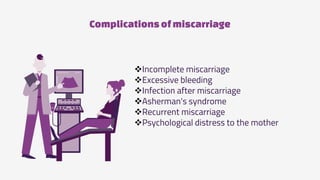
Complicationsofmiscarriage
Incomplete miscarriage
Excessive bleeding
Infection after miscarriage
Asherman's syndrome
Recurrent miscarriage
Psychological distress to the mother
Sources
• Ten teachers
• Myoclinic website
• University lectures
• Slideshare.com
THANKYOU

miscarriage

Editor's Notes

  • #4 causes ; maternal fetal -mode of termination ; medical surgical
  • #6 Maternal cigarette smoking and caffeine consumption have been associated with an increased risk of spontaneous miscarriage in a dose-dependent manner. However, current evidence is insufficient to confirm this association. Heavy alcohol consumption is toxic to the embryo and the fetus. Even moderate consumption of five or more units per week may increase the risk of sporadic miscarriage.  Recent retrospective studies have reported that obesity increases the risk of both sporadic and recurrent miscarriage. Advanced paternal age has also been identified as a risk factor for miscarriage. The risk of miscarriage is highest among couples where the woman is ≥35 years of age and the man ≥40 years of age. Previous reproductive history is an independent predictor of future pregnancy outcome. The risk of a further miscarriage increases after each successive pregnancy loss, reaching approximately 40% after three consecutive pregnancy losses, and the prognosis worsens with increasing maternal age. A previous live birth does not preclude a woman developing recurrent miscarriage.
  • #7 Some extra notes
  • #8 SLIDE SHARE Antiphospholipid syndrome Allo immune response is when the mothers immune system can not accept the baby and considers it as a forign object NOTES Antiphospholipid antibodies are present in 15% of women with recurrent miscarriage. Uterine congenital anomaly like Uterine arcuate >where it is concave towards the funds Septate uterine >look it up Cervical weakness is a recognised cause of second-trimester miscarriage, but the true incidence is unknown, since the diagnosis is essentially a clinical one. Fibroids which can cause it by disruption of implanation and development of blood supply And taking up space in the uterus during the development of fetus Anti thyroid antibodys Luteal phase deficiency >progesterone deficiency >poor inviroment for implantation The presence of bacterial vaginosis in the first trimester of pregnancy has been reported as a risk factor for second-trimester miscarriage and preterm delivery Enviromental suchj as drugs and alchhole and so on Antiphospholipid syndrome refers to the association between antiphospholipid antibodies – lupus anticoagulant,        anticardiolipin antibodies , anti-B2 glycoprotein antibodies  and adverse pregnancy outcome or vascular thrombosis. Adverse pregnancy outcomes include:  Three or more consecutive miscarriages before 10 weeks of gestation  One or more morphologically normal fetal losses after the 10th week of gestation  One or more preterm births before the 34th week of gestation owing to placental disease.    To diagnose antiphospholipid syndrome it is mandatory that the woman has two positive tests at least 12 weeks apart for either lupus anticoagulant or anticardiolipin antibodies of immunoglobulin G and/or immunoglobulin M class present in a medium or high titre over 40 g/l or ml/l, or above the 99th percentile
  • #9 Positive pregnancy test
  • #11 Pelvic test to check if cervical ios is closed Ultrasound to confirm that there is miscarriage Crown rump length of 5mm and no fetal herat Empty gestational sac 16mm in diameter and no fetal heart Blood test to see if bhcg is decrease Tissue test to check if these clotes are inded fetal parts Chromosomal test done in recurrent miscarriage
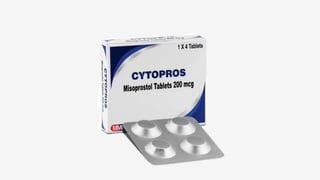
  • #14 Do not offer mifepristone as a treatment for missed or incomplete miscarriage.  Offer vaginal misoprostol for the medical treatment of missed or incomplete miscarriage. Oral administration is an acceptable alternative if this is the woman’s preference. For women with a missed miscarriage, use a single dose of 800 micrograms of misoprostol.  Advise the woman that if bleeding has not started 24 hours after treatment, she should contact her healthcare professional to determine ongoing individualised care.  For women with an incomplete miscarriage, use a single dose of 600 micrograms of misoprostol. (800 micrograms can be used as an alternative to allow alignment of treatment protocols for both missed and incomplete miscarriage.)
  • #15 Supporative treatment
  • #16 Brownish vaginal discharge Pregnancy test negative Maybe positive for 3 to 4 weeks after death of fetus Do not offer mifepristone as a treatment for missed or incomplete miscarriage.  Offer vaginal misoprostol for the medical treatment of missed or incomplete miscarriage. Oral administration is an acceptable alternative if this is the woman’s preference. For women with a missed miscarriage, use a single dose of 800 micrograms of misoprostol.  Advise the woman that if bleeding has not started 24 hours after treatment, she should contact her healthcare professional to determine ongoing individualised care.  For women with an incomplete miscarriage, use a single dose of 600 micrograms of misoprostol. (800 micrograms can be used as an alternative to allow alignment of treatment protocols for both missed and incomplete miscarriage.) Where clinically appropriate, offer women undergoing a  miscarriage a choice of: • manual vacuum aspiration under local anaesthetic in an outpatient or clinic setting or • surgical management in a theatre under general anaesthetic.  Provide oral and written information to all women undergoing surgical management of miscarriage about the treatment  options available and what to expect during and after the  procedure
  • #18 Iv fluids Blood if needed Digital evacuation if possible Ergometrine and syntocinon Evacuation of the uterus Medical and surgical
  • #20 Read it in the ten teacher book
  • #21 Read it in the ten teacher book Send blood for investigation and culter and sensitivity test
  • #22 Read about it