http://www.fitango.com/categories.php?id=597
Fitango Education
Health Topics
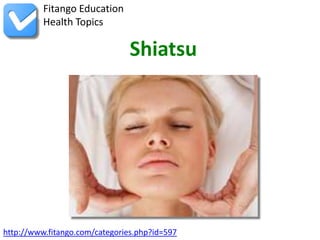
Shiatsu
1
Overview
Shiatsu is a physical therapy that supports
and strengthens the body’s natural ability to heal
and balance itself. It works
on the whole person - not just a physical body, but
also a psychological,
2
Overview
emotional and spiritual being.
Shiatsu originated in Japan from traditional
Chinese medicine, with influences from more
recent Western therapies. Although
shiatsu means ‘finger pressure’ in Japanese, in
practise a practitioner uses
3
Overview
touch, comfortable pressure and manipulative
techniques to adjust the body’s
physical structure and balance its energy flow. It is
a deeply relaxing
experience and regular treatments can alleviate
stress and illness and maintain
health and well-being.
4
History of Shiatsu
Massage, along with acupuncture and
herbalism, was for centuries an integral part of
traditional Chinese medicine,
which was introduced to Japan by a Buddhist monk
in the 6th century. The
5
History of Shiatsu
Japanese developed and refined many of its
methods to suit their own
physiology, temperament and cli-mate. In
particular, they developed the manual
healing and diagnostic arts, evolving special
techniques of abdominal
6
History of Shiatsu
diagnosis, treatment and massage, which are used
in shiatsu today.
However, the practice of massage known by
the old name of anma (anmo or tuina in China)
became
gradually divorced from medicine and more
associated with relaxation and
7
History of Shiatsu
pleasure. Certain practitioners were concerned to
preserve massage and related
techniques as an accepted healing art.
In the early part of the 20th century,
one such practitioner, Tamai Tempaku,
incorporated the newer Western sciences
8
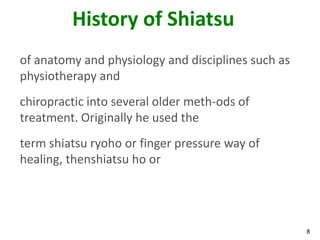
History of Shiatsu
of anatomy and physiology and disciplines such as
physiotherapy and
chiropractic into several older meth-ods of
treatment. Originally he used the
term shiatsu ryoho or finger pressure way of
healing, thenshiatsu ho or
9
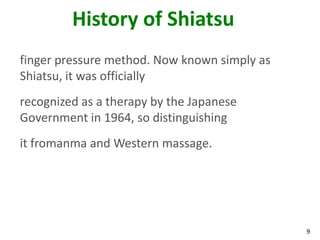
History of Shiatsu
finger pressure method. Now known simply as
Shiatsu, it was officially
recognized as a therapy by the Japanese
Government in 1964, so distinguishing
it fromanma and Western massage.
10
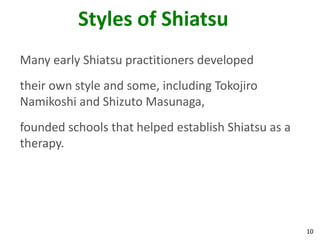
Styles of Shiatsu
Many early Shiatsu practitioners developed
their own style and some, including Tokojiro
Namikoshi and Shizuto Masunaga,
founded schools that helped establish Shiatsu as a
therapy.
11
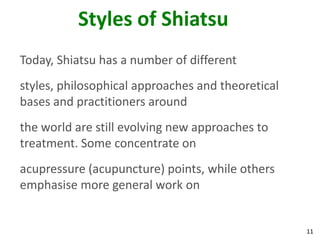
Styles of Shiatsu
Today, Shiatsu has a number of different
styles, philosophical approaches and theoretical
bases and practitioners around
the world are still evolving new approaches to
treatment. Some concentrate on
acupressure (acupuncture) points, while others
emphasise more general work on
12
Styles of Shiatsu
the body or along the pathways of energy to
influence the Ki that flows in
them. Other styles high-light diagnostic systems,
such as the Five Element system
or the macrobiotic approach. However all are
based on traditional Chinese
medicine.
13
Styles of Shiatsu
The approaches most commonly found in
Britain are Zen Shiatsu, Macrobiotic Shiatsu,
Healing Shiatsu, Namikoshi
Shiatsu, Movement Shiatsu and Hara Shiatsu.
Shiatsu

Shiatsu

  • 1.
  • 2.
    1 Overview Shiatsu is aphysical therapy that supports and strengthens the body’s natural ability to heal and balance itself. It works on the whole person - not just a physical body, but also a psychological,
  • 3.
    2 Overview emotional and spiritualbeing. Shiatsu originated in Japan from traditional Chinese medicine, with influences from more recent Western therapies. Although shiatsu means ‘finger pressure’ in Japanese, in practise a practitioner uses
  • 4.
    3 Overview touch, comfortable pressureand manipulative techniques to adjust the body’s physical structure and balance its energy flow. It is a deeply relaxing experience and regular treatments can alleviate stress and illness and maintain health and well-being.
  • 5.
    4 History of Shiatsu Massage,along with acupuncture and herbalism, was for centuries an integral part of traditional Chinese medicine, which was introduced to Japan by a Buddhist monk in the 6th century. The
  • 6.
    5 History of Shiatsu Japanesedeveloped and refined many of its methods to suit their own physiology, temperament and cli-mate. In particular, they developed the manual healing and diagnostic arts, evolving special techniques of abdominal
  • 7.
    6 History of Shiatsu diagnosis,treatment and massage, which are used in shiatsu today. However, the practice of massage known by the old name of anma (anmo or tuina in China) became gradually divorced from medicine and more associated with relaxation and
  • 8.
    7 History of Shiatsu pleasure.Certain practitioners were concerned to preserve massage and related techniques as an accepted healing art. In the early part of the 20th century, one such practitioner, Tamai Tempaku, incorporated the newer Western sciences
  • 9.
    8 History of Shiatsu ofanatomy and physiology and disciplines such as physiotherapy and chiropractic into several older meth-ods of treatment. Originally he used the term shiatsu ryoho or finger pressure way of healing, thenshiatsu ho or
  • 10.
    9 History of Shiatsu fingerpressure method. Now known simply as Shiatsu, it was officially recognized as a therapy by the Japanese Government in 1964, so distinguishing it fromanma and Western massage.
  • 11.
    10 Styles of Shiatsu Manyearly Shiatsu practitioners developed their own style and some, including Tokojiro Namikoshi and Shizuto Masunaga, founded schools that helped establish Shiatsu as a therapy.
  • 12.
    11 Styles of Shiatsu Today,Shiatsu has a number of different styles, philosophical approaches and theoretical bases and practitioners around the world are still evolving new approaches to treatment. Some concentrate on acupressure (acupuncture) points, while others emphasise more general work on
  • 13.
    12 Styles of Shiatsu thebody or along the pathways of energy to influence the Ki that flows in them. Other styles high-light diagnostic systems, such as the Five Element system or the macrobiotic approach. However all are based on traditional Chinese medicine.
  • 14.
    13 Styles of Shiatsu Theapproaches most commonly found in Britain are Zen Shiatsu, Macrobiotic Shiatsu, Healing Shiatsu, Namikoshi Shiatsu, Movement Shiatsu and Hara Shiatsu.