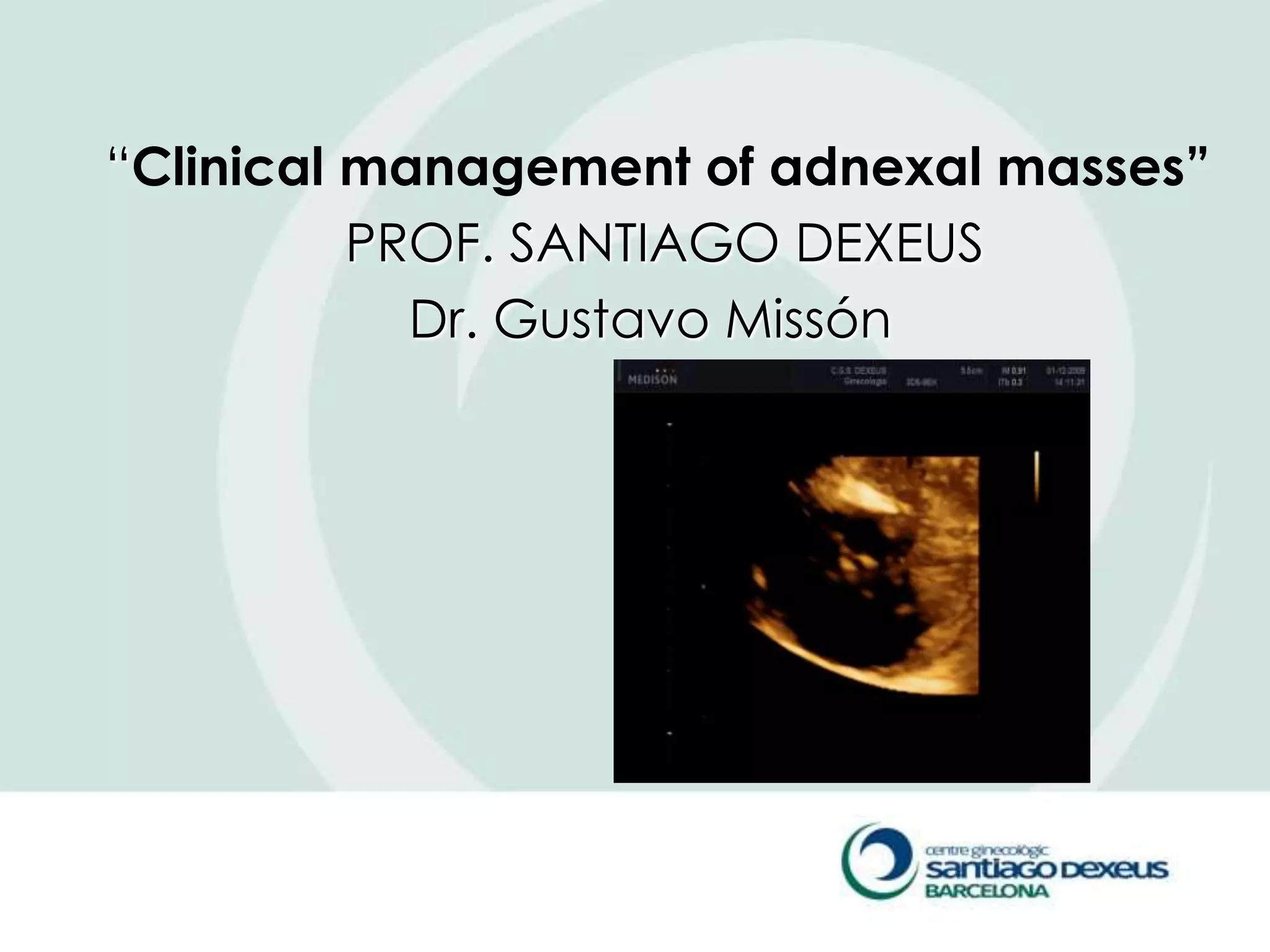
―Clinical management of adnexal masses”
          PROF. SANTIAGO DEXEUS
            Dr. Gustavo Missón
Introduction

   Adnexal masses are the fourth most

    common gynecological cause for

    hospitalization and 90% have benign

    characteristics.
Adnexal Mases USA
ANNUAL HOSPITALIZATION: 289000 PATIENTS

RISK OF
MALIGNANCY

13% in pre menopause
45% in post menopause
L Van Lie (2000)
48 Meeting of the ACOG
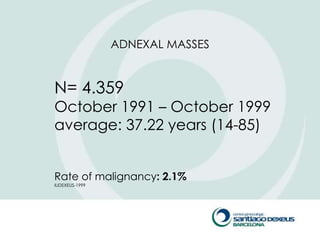
ADNEXAL MASSES


N= 4.359
October 1991 – October 1999
average: 37.22 years (14-85)


Rate of malignancy: 2.1%
IUDEXEUS-1999
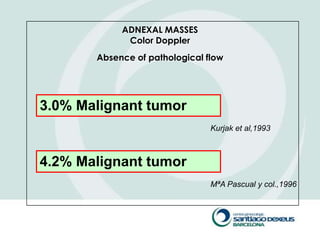
ADNEXAL MASSES
             Color Doppler
       Absence of pathological flow


3.0% Malignant tumor
                                Kurjak et al,1993


4.2% Malignant tumor
                                MªA Pascual y col.,1996
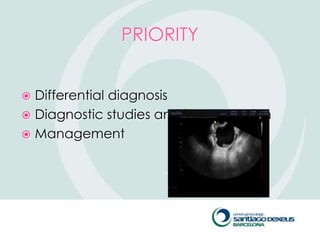
PRIORITY


 Differential diagnosis
 Diagnostic studies and interpretation
 Management
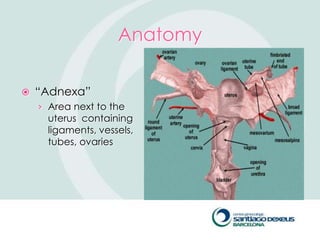
Anatomy

   ―Adnexa‖
    › Area next to the
      uterus containing
      ligaments, vessels,
      tubes, ovaries
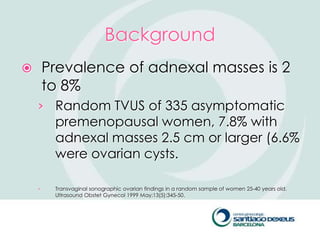
Background
       Prevalence of adnexal masses is 2
        to 8%
    › Random TVUS of 335 asymptomatic
         premenopausal women, 7.8% with
         adnexal masses 2.5 cm or larger (6.6%
         were ovarian cysts.

    ›    Transvaginal sonographic ovarian findings in a random sample of women 25-40 years old.
         Ultrasound Obstet Gynecol 1999 May;13(5):345-50.
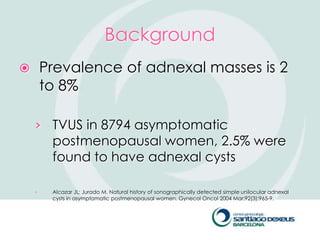
Background
       Prevalence of adnexal masses is 2
        to 8%

    › TVUS in 8794 asymptomatic
         postmenopausal women, 2.5% were
         found to have adnexal cysts

    ›    Alcazar JL; Jurado M. Natural history of sonographically detected simple unilocular adnexal
         cysts in asymptomatic postmenopausal women. Gynecol Oncol 2004 Mar;92(3):965-9.
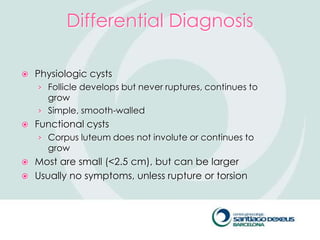
Differential Diagnosis

   Physiologic cysts
    › Follicle develops but never ruptures, continues to
      grow
    › Simple, smooth-walled
   Functional cysts
    › Corpus luteum does not involute or continues to
      grow
 Most are small (<2.5 cm), but can be larger
 Usually no symptoms, unless rupture or torsion
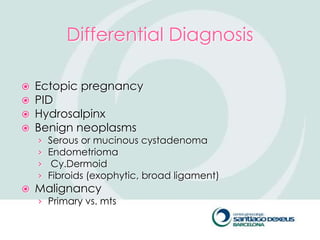
Differential Diagnosis

   Ectopic pregnancy
   PID
   Hydrosalpinx
   Benign neoplasms
    ›   Serous or mucinous cystadenoma
    ›   Endometrioma
    ›    Cy.Dermoid
    ›   Fibroids (exophytic, broad ligament)
   Malignancy
    › Primary vs. mts
Non-Gyn Etiology
   Abdominal
    › Appendicitis
    › Diverticulitis
    › Inflammatory bowel
      disease
   Inclusion cysts
    › Peritoneal or omental
   Retroperitoneal
    masses
    › Pelvic kidney
Diagnosis: History
   History
    › Pain
       Midcycle physiologic or functional cyst
       Dysmenorrhea/dyspareunia endometriosis
       Sudden onset, severetorsion, rupture, hemorrhage
       Chronic aching, bloatingneoplasm
    › Nonspecific GI symptoms
       May suggest ovarian cancer in postmenopausal female
       May suggest appendicitis or GI etiology in younger
        women
    › FH
       Breast, colon, or ovarian cancer
Diagnosis: Physical Exam

   Physical exam—should include bimanual
    and rectovaginal exam

    › Fever PID, appy, diverticulitis
    › Shouldn’t be able to palpate a
      postmenopausal ovary
    › Cul de sac nodularity, tender ligaments
      endometriosis
    › Cervical motion tendernessPID
    › Fixed, irregular, solid may suggest neoplasia
Diagnosis: Physical Exam

       Will probably need more than an H&P
        to make a diagnosis
    ›    84 women underwent pelvic examination
         prior to surgery, blinded to surgical
         indication
    ›    Attending, resident, student examined
         patient
    ›    Padilla L, Radosevich D, Milad M. Limitations of the pelvic examination for evaluation of the
         female pelvic organs . Int J of Gyn 2005; 88 (1): 84 – 88.
Diagnosis: Physical Exam


› Exam is a ―limited screening tool‖ for
 detection of adnexal masses


› Sensitivity at detecting adnexal masses: p
 >0.04
Diagnosis: Labs

   Labs
    › β-HCG to exclude ectopic
    › RPC if infection suspected
    › Tumor makers
       CA-125 (more to come)
       Others useful in adolescents/premenopaual
        women with adnexal masses and high
        suspicion
         LDHDysgerminoma
         HCGchoriocarcinoma
         AFPEndodermal sinus tumor
Malignancy
   Postmenopausal
    › Roughly 50 per 100,000 women, relative risk of ~3.5
    › 80% of ovarian cancers occur in women over 50
   Family history
   Symptoms
    › Vague, chronic aching, bloating, +/- GI symptoms
   Physical examination
    › Remember. . . Not really useful
   Ultrasound findings
   CA-125
Family History

       Lifetime risk of ovarian cancer in
        general population 1.5%
    ›     In BRCA 1 carrier 45-55%
    ›     In BRCA 2 carrier 15-25%
       Not all mutations have been identified
    ›     Two to three relatives with ovarian cancer
          increases lifetime risk to 5% (15% if first
          degree relatives)
    ›     Carlson KJ; Skates SJ; Singer DE. Screening for ovarian cancer. Ann Intern Med 1994 Jul 15;121(2):124-32.
CA-125
   Not specific to ovarian cancer, also elevated
    in:
       Other cancers (endometrial, fallopian tube, germ
        cell, cervical, pancreatic, breast, colon)
       Benign conditions
        (endometriosis, fibroids, PID, adenomyosis, functional
        ovarian cysts, pregnancy)
       Other diseases (renal, heart, liver, and many others)
       Also abnormal in 1% of normal females

         Bast R; Klug T; St John E; Jenison E; Niloff J; Lazarus H; Berkowitz R; Leavitt T; Griffiths C; Parker L;
          Zurawski V; Knapp R. A radioimmunoassay using a monoclonal antibody to monitor th
         course of epithelial ovarian cancer. N Engl J Med 1983 Oct 13;309(15):883
CA-125
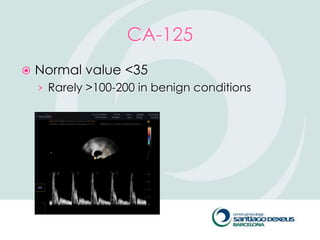
   Normal value <35
    › Rarely >100-200 in benign conditions
CA-125
   Utility as screening tool for ovarian cancer
    ›   CA-125 increased in roughly 80% of ovarian cancers
    ›   About 50% sensitivity for Stage I, 90% for Stage II

   Study of 5550 healthy Swedish women
    ›   Followed women with elevated and normal CA-125
        levels
    ›   Serial pelvic exams, U/S, serial CA-125 levels
    ›   Of 175 women with elevated CA-125, 6 with ovarian
        cancer
    ›   Of the remaining women with normal CA-125
        levels, 3 had ovarian cancer
    ›   Einhorn N; Sjovall K; Knapp RC; Hall P; Scully RE; Bast RC Jr; Zurawski VR Jr. Prospective evaluation of serum CA 125
        levels for early detection of ovarian cancer. Obstet Gynecol 1992 Jul;80(1):14-8.
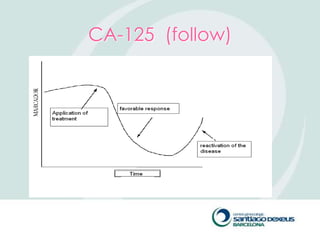
CA-125 (follow)
BIOMARKERS
› Ca 125
› Ca 19.9
› Ca 15.3
› BCGH
› Alpfa-phetoprotein


› HE-4
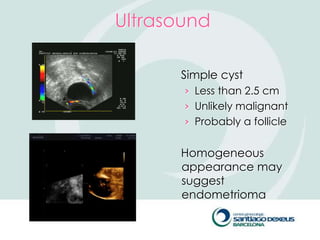
Ultrasound

                         Simple cyst
                          › Less than 2.5 cm
                          › Unlikely malignant
                          › Probably a follicle


                         Homogeneous
                         appearance may
                         suggest
                         endometrioma


www.uptodate.com
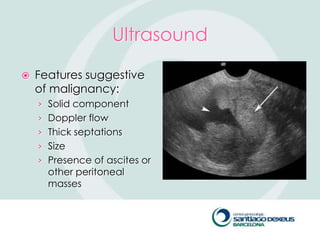
Ultrasound

   Features suggestive
    of malignancy:
    › Solid component
    › Doppler flow
    › Thick septations
    › Size
    › Presence of ascites or
      other peritoneal
      masses
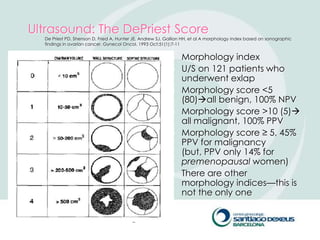
Ultrasound: The DePriest Score
  De Priest PD, Shenson D, Fried A, Hunter JE, Andrew SJ, Gallion HH, et al A morphology index based on sonographic
  findings in ovarian cancer. Gynecol Oncol. 1993 Oct;51(1):7-11


                                                               Morphology index
                                                               U/S on 121 patients who
                                                                underwent exlap
                                                               Morphology score <5
                                                                (80)all benign, 100% NPV
                                                               Morphology score >10 (5)
                                                                all malignant, 100% PPV
                                                               Morphology score ≥ 5, 45%
                                                                PPV for malignancy
                                                                (but, PPV only 14% for
                                                                premenopausal women)
                                                               There are other
                                                                morphology indices—this is
                                                                not the only one
So now what?
                 Management
   Premenopausal females
    › If size <10 cm, mobile, cystic,
      unilateralfollow, place patient on
      monophasic OC, repeat U/S in 2-3 months
       70% of these will resolve8
    › If size >10 cm, fixed, solid, or other
      concerning featurestake it out
    › If mass persists or enlarges at repeat
      scantake it out
What about the Postmenopausal
 Female?
   Modesitt study9
    ›   15,106 asymptomatic women over 50 who underwent TVUS
    ›   If no abnormalitiesannual screening
    ›   If abnormalrepeat U/S in 4-6 weeks with Doppler and CA-125
    ›   18% with unilocular ovarian cysts <10 cm in diameter
           69.4% resolved
           5.8% developed solid component
           16.5% developed septum
           6.8% persisted as unilocular
    › 10 patients with unilocular lesion who developed ovarian cancer, all
        of whom either:
         developed a septum or solid component on U/S,
         underwent complete resolution of the cyst,
         or developed cancer in the contralateral ovary
    › Thus. . . The risk of developing ovarian cancer in a woman with a
        unilocular, small cyst is VERY low (0.1%)
Management
   Postmenopausal
     › If asymptomatic, normal exam, simple cyst on U/S, normal
       CA-125,unilateral, ≤ 5 cm
        follow with serial U/S and CA-125 q 3-6 months until 12 months,
         then annually thereafter
    › If above except complex appearance and ≤ 5 cm
        Repeat U/S and CA-125 in 4 weeks
          Resolution
          Persistence or decreasing complexityfollow q 3-6 months with U/S
           and CA-125
          Increasing CA-125 or increasing complexitysurgery
    › If complex, ≤ 5 cm, and elevated CA-125
        Take it out
    › If symptomatic, ≥ 5 cm, clinically apparent, non-simple in
      appearance, or elevated CA-125take it out.
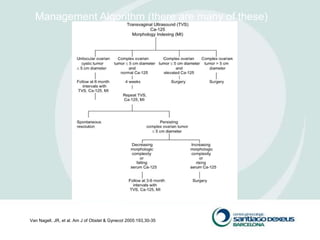
Management Algorithm (there are many of these)


Van Nagell, JR, et al. Am J of Obstet & Gynecol 2005:193,30-35
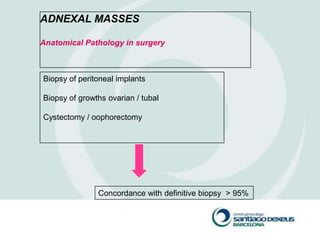
ADNEXAL MASSES

Anatomical Pathology in surgery


Biopsy of peritoneal implants

Biopsy of growths ovarian / tubal

Cystectomy / oophorectomy


               Concordance with definitive biopsy > 95%
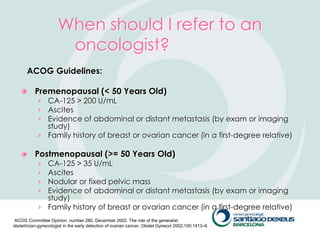
When should I refer to an
                       oncologist?
       ACOG Guidelines:

          Premenopausal (< 50 Years Old)
            › CA-125 > 200 U/mL
            › Ascites
            › Evidence of abdominal or distant metastasis (by exam or imaging
              study)
            › Family history of breast or ovarian cancer (in a first-degree relative)

          Postmenopausal (>= 50 Years Old)
            › CA-125 > 35 U/mL
            › Ascites
            › Nodular or fixed pelvic mass
            › Evidence of abdominal or distant metastasis (by exam or imaging
              study)
            › Family history of breast or ovarian cancer (in a first-degree relative)
 ACOG Committee Opinion: number 280, December 2002. The role of the generalist
obstetrician-gynecologist in the early detection of ovarian cancer. Obstet Gynecol 2002;100:1413–6
Thank you by you attention
 www.santiagodexeus.com

Adnexal Masses

  • 1.
    ―Clinical management ofadnexal masses” PROF. SANTIAGO DEXEUS Dr. Gustavo Missón
  • 2.
    Introduction  Adnexal masses are the fourth most common gynecological cause for hospitalization and 90% have benign characteristics.
  • 3.
    Adnexal Mases USA ANNUALHOSPITALIZATION: 289000 PATIENTS RISK OF MALIGNANCY 13% in pre menopause 45% in post menopause L Van Lie (2000) 48 Meeting of the ACOG
  • 4.
    ADNEXAL MASSES N= 4.359 October1991 – October 1999 average: 37.22 years (14-85) Rate of malignancy: 2.1% IUDEXEUS-1999
  • 5.
    ADNEXAL MASSES Color Doppler Absence of pathological flow 3.0% Malignant tumor Kurjak et al,1993 4.2% Malignant tumor MªA Pascual y col.,1996
  • 6.
    PRIORITY  Differential diagnosis Diagnostic studies and interpretation  Management
  • 7.
    Anatomy  ―Adnexa‖ › Area next to the uterus containing ligaments, vessels, tubes, ovaries
  • 8.
    Background  Prevalence of adnexal masses is 2 to 8% › Random TVUS of 335 asymptomatic premenopausal women, 7.8% with adnexal masses 2.5 cm or larger (6.6% were ovarian cysts. › Transvaginal sonographic ovarian findings in a random sample of women 25-40 years old. Ultrasound Obstet Gynecol 1999 May;13(5):345-50.
  • 9.
    Background  Prevalence of adnexal masses is 2 to 8% › TVUS in 8794 asymptomatic postmenopausal women, 2.5% were found to have adnexal cysts › Alcazar JL; Jurado M. Natural history of sonographically detected simple unilocular adnexal cysts in asymptomatic postmenopausal women. Gynecol Oncol 2004 Mar;92(3):965-9.
  • 10.
    Differential Diagnosis  Physiologic cysts › Follicle develops but never ruptures, continues to grow › Simple, smooth-walled  Functional cysts › Corpus luteum does not involute or continues to grow  Most are small (<2.5 cm), but can be larger  Usually no symptoms, unless rupture or torsion
  • 11.
    Differential Diagnosis  Ectopic pregnancy  PID  Hydrosalpinx  Benign neoplasms › Serous or mucinous cystadenoma › Endometrioma › Cy.Dermoid › Fibroids (exophytic, broad ligament)  Malignancy › Primary vs. mts
  • 12.
    Non-Gyn Etiology  Abdominal › Appendicitis › Diverticulitis › Inflammatory bowel disease  Inclusion cysts › Peritoneal or omental  Retroperitoneal masses › Pelvic kidney
  • 13.
    Diagnosis: History  History › Pain  Midcycle physiologic or functional cyst  Dysmenorrhea/dyspareunia endometriosis  Sudden onset, severetorsion, rupture, hemorrhage  Chronic aching, bloatingneoplasm › Nonspecific GI symptoms  May suggest ovarian cancer in postmenopausal female  May suggest appendicitis or GI etiology in younger women › FH  Breast, colon, or ovarian cancer
  • 14.
    Diagnosis: Physical Exam  Physical exam—should include bimanual and rectovaginal exam › Fever PID, appy, diverticulitis › Shouldn’t be able to palpate a postmenopausal ovary › Cul de sac nodularity, tender ligaments endometriosis › Cervical motion tendernessPID › Fixed, irregular, solid may suggest neoplasia
  • 15.
    Diagnosis: Physical Exam  Will probably need more than an H&P to make a diagnosis › 84 women underwent pelvic examination prior to surgery, blinded to surgical indication › Attending, resident, student examined patient › Padilla L, Radosevich D, Milad M. Limitations of the pelvic examination for evaluation of the female pelvic organs . Int J of Gyn 2005; 88 (1): 84 – 88.
  • 16.
    Diagnosis: Physical Exam ›Exam is a ―limited screening tool‖ for detection of adnexal masses › Sensitivity at detecting adnexal masses: p >0.04
  • 17.
    Diagnosis: Labs  Labs › β-HCG to exclude ectopic › RPC if infection suspected › Tumor makers  CA-125 (more to come)  Others useful in adolescents/premenopaual women with adnexal masses and high suspicion  LDHDysgerminoma  HCGchoriocarcinoma  AFPEndodermal sinus tumor
  • 18.
    Malignancy  Postmenopausal › Roughly 50 per 100,000 women, relative risk of ~3.5 › 80% of ovarian cancers occur in women over 50  Family history  Symptoms › Vague, chronic aching, bloating, +/- GI symptoms  Physical examination › Remember. . . Not really useful  Ultrasound findings  CA-125
  • 19.
    Family History  Lifetime risk of ovarian cancer in general population 1.5% › In BRCA 1 carrier 45-55% › In BRCA 2 carrier 15-25%  Not all mutations have been identified › Two to three relatives with ovarian cancer increases lifetime risk to 5% (15% if first degree relatives) › Carlson KJ; Skates SJ; Singer DE. Screening for ovarian cancer. Ann Intern Med 1994 Jul 15;121(2):124-32.
  • 20.
    CA-125  Not specific to ovarian cancer, also elevated in:  Other cancers (endometrial, fallopian tube, germ cell, cervical, pancreatic, breast, colon)  Benign conditions (endometriosis, fibroids, PID, adenomyosis, functional ovarian cysts, pregnancy)  Other diseases (renal, heart, liver, and many others)  Also abnormal in 1% of normal females  Bast R; Klug T; St John E; Jenison E; Niloff J; Lazarus H; Berkowitz R; Leavitt T; Griffiths C; Parker L; Zurawski V; Knapp R. A radioimmunoassay using a monoclonal antibody to monitor th  course of epithelial ovarian cancer. N Engl J Med 1983 Oct 13;309(15):883
  • 21.
    CA-125  Normal value <35 › Rarely >100-200 in benign conditions
  • 22.
    CA-125  Utility as screening tool for ovarian cancer › CA-125 increased in roughly 80% of ovarian cancers › About 50% sensitivity for Stage I, 90% for Stage II  Study of 5550 healthy Swedish women › Followed women with elevated and normal CA-125 levels › Serial pelvic exams, U/S, serial CA-125 levels › Of 175 women with elevated CA-125, 6 with ovarian cancer › Of the remaining women with normal CA-125 levels, 3 had ovarian cancer › Einhorn N; Sjovall K; Knapp RC; Hall P; Scully RE; Bast RC Jr; Zurawski VR Jr. Prospective evaluation of serum CA 125 levels for early detection of ovarian cancer. Obstet Gynecol 1992 Jul;80(1):14-8.
  • 23.
  • 24.
    BIOMARKERS › Ca 125 ›Ca 19.9 › Ca 15.3 › BCGH › Alpfa-phetoprotein › HE-4
  • 25.
    Ultrasound Simple cyst › Less than 2.5 cm › Unlikely malignant › Probably a follicle Homogeneous appearance may suggest endometrioma www.uptodate.com
  • 26.
    Ultrasound  Features suggestive of malignancy: › Solid component › Doppler flow › Thick septations › Size › Presence of ascites or other peritoneal masses
  • 27.
    Ultrasound: The DePriestScore De Priest PD, Shenson D, Fried A, Hunter JE, Andrew SJ, Gallion HH, et al A morphology index based on sonographic findings in ovarian cancer. Gynecol Oncol. 1993 Oct;51(1):7-11  Morphology index  U/S on 121 patients who underwent exlap  Morphology score <5 (80)all benign, 100% NPV  Morphology score >10 (5) all malignant, 100% PPV  Morphology score ≥ 5, 45% PPV for malignancy (but, PPV only 14% for premenopausal women)  There are other morphology indices—this is not the only one
  • 28.
    So now what? Management  Premenopausal females › If size <10 cm, mobile, cystic, unilateralfollow, place patient on monophasic OC, repeat U/S in 2-3 months  70% of these will resolve8 › If size >10 cm, fixed, solid, or other concerning featurestake it out › If mass persists or enlarges at repeat scantake it out
  • 29.
    What about thePostmenopausal Female?  Modesitt study9 › 15,106 asymptomatic women over 50 who underwent TVUS › If no abnormalitiesannual screening › If abnormalrepeat U/S in 4-6 weeks with Doppler and CA-125 › 18% with unilocular ovarian cysts <10 cm in diameter  69.4% resolved  5.8% developed solid component  16.5% developed septum  6.8% persisted as unilocular › 10 patients with unilocular lesion who developed ovarian cancer, all of whom either:  developed a septum or solid component on U/S,  underwent complete resolution of the cyst,  or developed cancer in the contralateral ovary › Thus. . . The risk of developing ovarian cancer in a woman with a unilocular, small cyst is VERY low (0.1%)
  • 30.
    Management  Postmenopausal › If asymptomatic, normal exam, simple cyst on U/S, normal CA-125,unilateral, ≤ 5 cm  follow with serial U/S and CA-125 q 3-6 months until 12 months, then annually thereafter › If above except complex appearance and ≤ 5 cm  Repeat U/S and CA-125 in 4 weeks  Resolution  Persistence or decreasing complexityfollow q 3-6 months with U/S and CA-125  Increasing CA-125 or increasing complexitysurgery › If complex, ≤ 5 cm, and elevated CA-125  Take it out › If symptomatic, ≥ 5 cm, clinically apparent, non-simple in appearance, or elevated CA-125take it out.
  • 31.
    Management Algorithm (thereare many of these) Van Nagell, JR, et al. Am J of Obstet & Gynecol 2005:193,30-35
  • 32.
    ADNEXAL MASSES Anatomical Pathologyin surgery Biopsy of peritoneal implants Biopsy of growths ovarian / tubal Cystectomy / oophorectomy Concordance with definitive biopsy > 95%
  • 33.
    When should Irefer to an oncologist? ACOG Guidelines:  Premenopausal (< 50 Years Old) › CA-125 > 200 U/mL › Ascites › Evidence of abdominal or distant metastasis (by exam or imaging study) › Family history of breast or ovarian cancer (in a first-degree relative)  Postmenopausal (>= 50 Years Old) › CA-125 > 35 U/mL › Ascites › Nodular or fixed pelvic mass › Evidence of abdominal or distant metastasis (by exam or imaging study) › Family history of breast or ovarian cancer (in a first-degree relative) ACOG Committee Opinion: number 280, December 2002. The role of the generalist obstetrician-gynecologist in the early detection of ovarian cancer. Obstet Gynecol 2002;100:1413–6
  • 35.
    Thank you byyou attention www.santiagodexeus.com