PERSPECTIVE DRAWING
- Prof. Rohan Dasgupta
• Drawing is the language Civil Engineers express their ideas in.
• Drawings give us detailed idea about the structure, as it will
appear.
• According to the need or purpose, drawings can be classified as:
i) Oblique Drawing
ii) Isometric Drawing
iii) Perspective Drawing
BDD-II_Mod2_PrDr_AIKTC_RD
OBLIQUE DRAWING
• The top and side view of the object is shown by projecting
oblique lines from a frontal orthographic view i.e. elevation in an
oblique drawing.
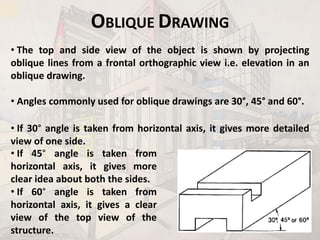
• Angles commonly used for oblique drawings are 30°, 45° and 60°.
• If 30° angle is taken from horizontal axis, it gives more detailed
view of one side.
• If 45° angle is taken from
horizontal axis, it gives more
clear idea about both the sides.
• If 60° angle is taken from
horizontal axis, it gives a clear
view of the top view of the
structure.BDD-II_Mod2_PrDr_AIKTC_RD
ISOMETRIC DRAWING
• The prefix “iso” is derived from the Latin word “isos” meaning
“equal”.
• To draw an isometric view, the object or structure is turned to
make the 3 sides visible in such a way that they should lie on 3
equally divided axes about a centre.
• A pleasing view is obtained by
keeping one axis vertical and
other two axes at 30° angle with
the horizontal.
BDD-II_Mod2_PrDr_AIKTC_RD
PERSPECTVE DRAWING
• The word “perspective” means the proper relative position of
objects as seen.
• Perspective drawing is the only drawing which represents
contemplated building as it would appear to a spectator.
• It is the representation of an
object on a plane surface as it
would appear to the eye when
viewed from a fixed point.
BDD-II_Mod2_PrDr_AIKTC_RD
OBLIQUE
DRAWING
ISOMETRIC
DRAWING
PERSPECTIVE DRAWING
BDD-II_Mod2_PrDr_AIKTC_RD
Now let’s consider this box...
BDD-II_Mod2_PrDr_AIKTC_RD
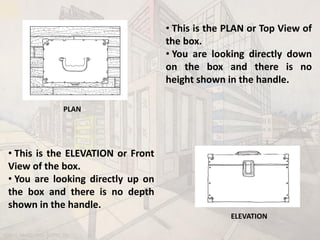
PLAN
ELEVATION
• This is the PLAN or Top View of
the box.
• You are looking directly down
on the box and there is no
height shown in the handle.
• This is the ELEVATION or Front
View of the box.
• You are looking directly up on
the box and there is no depth
shown in the handle.
BDD-II_Mod2_PrDr_AIKTC_RD
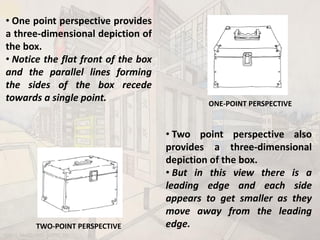
• One point perspective provides
a three-dimensional depiction of
the box.
• Notice the flat front of the box
and the parallel lines forming
the sides of the box recede
towards a single point.
• Two point perspective also
provides a three-dimensional
depiction of the box.
• But in this view there is a
leading edge and each side
appears to get smaller as they
move away from the leading
edge.
ONE-POINT PERSPECTIVE
TWO-POINT PERSPECTIVE
BDD-II_Mod2_PrDr_AIKTC_RD
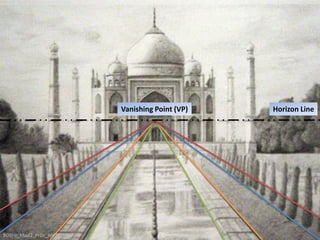
Vanishing Point (VP) Horizon Line
BDD-II_Mod2_PrDr_AIKTC_RD
Ground Level
Central
Visual
Plane
Height of Observer
Eye Level Plane
BDD-II_Mod2_PrDr_AIKTC_RD
Picture
Plane
BDD-II_Mod2_PrDr_AIKTC_RD
DEFINITIONS:
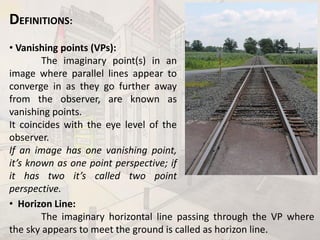
• Vanishing points (VPs):
The imaginary point(s) in an
image where parallel lines appear to
converge in as they go further away
from the observer, are known as
vanishing points.
It coincides with the eye level of the
observer.
If an image has one vanishing point,
it’s known as one point perspective; if
it has two it’s called two point
perspective.
• Horizon Line:
The imaginary horizontal line passing through the VP where
the sky appears to meet the ground is called as horizon line.BDD-II_Mod2_PrDr_AIKTC_RD
DEFINITIONS:
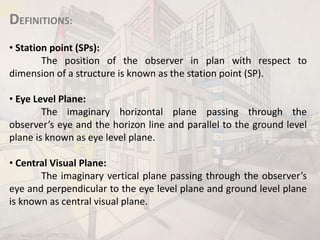
• Station point (SPs):
The position of the observer in plan with respect to
dimension of a structure is known as the station point (SP).
• Eye Level Plane:
The imaginary horizontal plane passing through the
observer’s eye and the horizon line and parallel to the ground level
plane is known as eye level plane.
• Central Visual Plane:
The imaginary vertical plane passing through the observer’s
eye and perpendicular to the eye level plane and ground level plane
is known as central visual plane.
BDD-II_Mod2_PrDr_AIKTC_RD
DEFINITIONS:
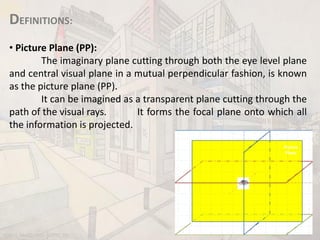
• Picture Plane (PP):
The imaginary plane cutting through both the eye level plane
and central visual plane in a mutual perpendicular fashion, is known
as the picture plane (PP).
It can be imagined as a transparent plane cutting through the
path of the visual rays. It forms the focal plane onto which all
the information is projected.
BDD-II_Mod2_PrDr_AIKTC_RD
• How to draw a one-point perspective drawing:
✓ Given data:
i) Plan of the structure
ii) Elevation of the structure
iii) Position of station point
iv) Height of the observer
BDD-II_Mod2_PrDr_AIKTC_RD
• How to draw a one-point perspective drawing:
✓ Steps:
i) Draw the given plan on the extreme top of the drawing sheet.
Note: If the station point is to the left of the plan, draw the plan
on the extreme top right and vice versa.
ii) Mark the picture plane (PP) and the station point (SP) on the plan
with the help of the given data.
iii) Draw the given elevation at the bottom of the drawing sheet.
Note: If the station point is to the left of the plan, draw the
elevation on the bottom left and vice versa.
Leave adequate distance between the station point and the
elevation for a neat drawing.
BDD-II_Mod2_PrDr_AIKTC_RD
• How to draw a one-point perspective drawing:
✓ Steps:
iv) Draw the ground level (GL) and mark the vanishing point (VP) on
the elevation with the help of the given data.
v) Draw the true shape of the face lying on the PP with the help of
projections from the plan and elevation.
Note: Straight faces only will maintain their true shapes in the
perspective; inclined faces will not maintain their true shapes in the
perspective.
vi) In the plan, join points of details (wall edges, windows, doors etc)
of the face NOT lying on the PP to the SP.
vii) In the elevation, join the points of details of the same face to the
VP.BDD-II_Mod2_PrDr_AIKTC_RD
• How to draw a one-point perspective drawing:
✓ Steps:
Note: No projections from the true shape face can be directly joined
to the VP. Projections must be first transferred to the edge of the
tapering face and then joined to the VP.
Similarly, inclined edges on the true faces are also to be first projected
on to the edge of the tapering end and then joined to the VP.
viii) To get the details of the tapering end in perspective, draw
projections of the same from the lines joining the SP at the point
where they’re cutting the PP.
ix) Join the details on the tapering face to complete the one point
perspective drawing.
BDD-II_Mod2_PrDr_AIKTC_RD
• How to draw a two-point perspective drawing:
BDD-II_Mod2_PrDr_AIKTC_RD
• How to draw a two-point perspective drawing:
✓ Steps:
i) Draw the inclined given plan at the top centre of the drawing
sheet with an edge leading.
Note: If angle of inclination is not given, take 30 degrees for
longer side and 60 degrees for shorter side.
ii) Draw the picture plane (PP) and the station point (SP) on the plan
with the help of the given data.
iii) Mark the ground level (GL) at a suitable place at the bottom of
the sheet and draw the horizon line (HL) at a length equal to the
height of the observer.
BDD-II_Mod2_PrDr_AIKTC_RD
iv) In order to draw the vanishing points (VP1 and VP2), from the
SP draw lines parallel to the sides of the plan to meet the PP.
From these points on the PP, project lines downwards to the
HP. These are the VPs.
v) Draw the elevation on either side of either VP according to your
own convenience.
vi) Only the leading edge will maintain its true length in the
perspective view. Join the extreme ends of this edge with the
VPs on both side.
vii) In the plan, join all details to the SP and from the points where
they’re intersecting the PP, bring down the projections.
viii) Take projections of the same details from the elevation on to
the true edge and project them back to their respective VPs.
BDD-II_Mod2_PrDr_AIKTC_RD
ix) Join the details on the tapering face to complete the one point
perspective drawing.
BDD-II_Mod2_PrDr_AIKTC_RD
Thank you!

Perspective Drawing

  • 1.
  • 3.
    • Drawing isthe language Civil Engineers express their ideas in. • Drawings give us detailed idea about the structure, as it will appear. • According to the need or purpose, drawings can be classified as: i) Oblique Drawing ii) Isometric Drawing iii) Perspective Drawing BDD-II_Mod2_PrDr_AIKTC_RD
  • 4.
    OBLIQUE DRAWING • Thetop and side view of the object is shown by projecting oblique lines from a frontal orthographic view i.e. elevation in an oblique drawing. • Angles commonly used for oblique drawings are 30°, 45° and 60°. • If 30° angle is taken from horizontal axis, it gives more detailed view of one side. • If 45° angle is taken from horizontal axis, it gives more clear idea about both the sides. • If 60° angle is taken from horizontal axis, it gives a clear view of the top view of the structure.BDD-II_Mod2_PrDr_AIKTC_RD
  • 5.
    ISOMETRIC DRAWING • Theprefix “iso” is derived from the Latin word “isos” meaning “equal”. • To draw an isometric view, the object or structure is turned to make the 3 sides visible in such a way that they should lie on 3 equally divided axes about a centre. • A pleasing view is obtained by keeping one axis vertical and other two axes at 30° angle with the horizontal. BDD-II_Mod2_PrDr_AIKTC_RD
  • 6.
    PERSPECTVE DRAWING • Theword “perspective” means the proper relative position of objects as seen. • Perspective drawing is the only drawing which represents contemplated building as it would appear to a spectator. • It is the representation of an object on a plane surface as it would appear to the eye when viewed from a fixed point. BDD-II_Mod2_PrDr_AIKTC_RD
  • 7.
  • 8.
    Now let’s considerthis box... BDD-II_Mod2_PrDr_AIKTC_RD
  • 9.
    PLAN ELEVATION • This isthe PLAN or Top View of the box. • You are looking directly down on the box and there is no height shown in the handle. • This is the ELEVATION or Front View of the box. • You are looking directly up on the box and there is no depth shown in the handle. BDD-II_Mod2_PrDr_AIKTC_RD
  • 10.
    • One pointperspective provides a three-dimensional depiction of the box. • Notice the flat front of the box and the parallel lines forming the sides of the box recede towards a single point. • Two point perspective also provides a three-dimensional depiction of the box. • But in this view there is a leading edge and each side appears to get smaller as they move away from the leading edge. ONE-POINT PERSPECTIVE TWO-POINT PERSPECTIVE BDD-II_Mod2_PrDr_AIKTC_RD
  • 11.
    Vanishing Point (VP)Horizon Line BDD-II_Mod2_PrDr_AIKTC_RD
  • 12.
    Ground Level Central Visual Plane Height ofObserver Eye Level Plane BDD-II_Mod2_PrDr_AIKTC_RD
  • 13.
  • 14.
    DEFINITIONS: • Vanishing points(VPs): The imaginary point(s) in an image where parallel lines appear to converge in as they go further away from the observer, are known as vanishing points. It coincides with the eye level of the observer. If an image has one vanishing point, it’s known as one point perspective; if it has two it’s called two point perspective. • Horizon Line: The imaginary horizontal line passing through the VP where the sky appears to meet the ground is called as horizon line.BDD-II_Mod2_PrDr_AIKTC_RD
  • 15.
    DEFINITIONS: • Station point(SPs): The position of the observer in plan with respect to dimension of a structure is known as the station point (SP). • Eye Level Plane: The imaginary horizontal plane passing through the observer’s eye and the horizon line and parallel to the ground level plane is known as eye level plane. • Central Visual Plane: The imaginary vertical plane passing through the observer’s eye and perpendicular to the eye level plane and ground level plane is known as central visual plane. BDD-II_Mod2_PrDr_AIKTC_RD
  • 16.
    DEFINITIONS: • Picture Plane(PP): The imaginary plane cutting through both the eye level plane and central visual plane in a mutual perpendicular fashion, is known as the picture plane (PP). It can be imagined as a transparent plane cutting through the path of the visual rays. It forms the focal plane onto which all the information is projected. BDD-II_Mod2_PrDr_AIKTC_RD
  • 17.
    • How todraw a one-point perspective drawing: ✓ Given data: i) Plan of the structure ii) Elevation of the structure iii) Position of station point iv) Height of the observer BDD-II_Mod2_PrDr_AIKTC_RD
  • 18.
    • How todraw a one-point perspective drawing: ✓ Steps: i) Draw the given plan on the extreme top of the drawing sheet. Note: If the station point is to the left of the plan, draw the plan on the extreme top right and vice versa. ii) Mark the picture plane (PP) and the station point (SP) on the plan with the help of the given data. iii) Draw the given elevation at the bottom of the drawing sheet. Note: If the station point is to the left of the plan, draw the elevation on the bottom left and vice versa. Leave adequate distance between the station point and the elevation for a neat drawing. BDD-II_Mod2_PrDr_AIKTC_RD
  • 19.
    • How todraw a one-point perspective drawing: ✓ Steps: iv) Draw the ground level (GL) and mark the vanishing point (VP) on the elevation with the help of the given data. v) Draw the true shape of the face lying on the PP with the help of projections from the plan and elevation. Note: Straight faces only will maintain their true shapes in the perspective; inclined faces will not maintain their true shapes in the perspective. vi) In the plan, join points of details (wall edges, windows, doors etc) of the face NOT lying on the PP to the SP. vii) In the elevation, join the points of details of the same face to the VP.BDD-II_Mod2_PrDr_AIKTC_RD
  • 20.
    • How todraw a one-point perspective drawing: ✓ Steps: Note: No projections from the true shape face can be directly joined to the VP. Projections must be first transferred to the edge of the tapering face and then joined to the VP. Similarly, inclined edges on the true faces are also to be first projected on to the edge of the tapering end and then joined to the VP. viii) To get the details of the tapering end in perspective, draw projections of the same from the lines joining the SP at the point where they’re cutting the PP. ix) Join the details on the tapering face to complete the one point perspective drawing. BDD-II_Mod2_PrDr_AIKTC_RD
  • 21.
    • How todraw a two-point perspective drawing: BDD-II_Mod2_PrDr_AIKTC_RD
  • 22.
    • How todraw a two-point perspective drawing: ✓ Steps: i) Draw the inclined given plan at the top centre of the drawing sheet with an edge leading. Note: If angle of inclination is not given, take 30 degrees for longer side and 60 degrees for shorter side. ii) Draw the picture plane (PP) and the station point (SP) on the plan with the help of the given data. iii) Mark the ground level (GL) at a suitable place at the bottom of the sheet and draw the horizon line (HL) at a length equal to the height of the observer. BDD-II_Mod2_PrDr_AIKTC_RD
  • 23.
    iv) In orderto draw the vanishing points (VP1 and VP2), from the SP draw lines parallel to the sides of the plan to meet the PP. From these points on the PP, project lines downwards to the HP. These are the VPs. v) Draw the elevation on either side of either VP according to your own convenience. vi) Only the leading edge will maintain its true length in the perspective view. Join the extreme ends of this edge with the VPs on both side. vii) In the plan, join all details to the SP and from the points where they’re intersecting the PP, bring down the projections. viii) Take projections of the same details from the elevation on to the true edge and project them back to their respective VPs. BDD-II_Mod2_PrDr_AIKTC_RD
  • 24.
    ix) Join thedetails on the tapering face to complete the one point perspective drawing. BDD-II_Mod2_PrDr_AIKTC_RD
  • 30.